Jaipur International Airport (JAI) — Airport Guide 2026
Terminal 1 reopened on 27 October 2024 after a multi-year renovation — doubled in floor area, clad in jharokha-style screens and local stone — and promptly absorbed most of the international routes, which means roughly half the airport information circulating online now points you to the wrong building.
Quick Reference
JAI / VIJP
Jaipur International Airport (Sanganer)
Adani Airport Holdings (Jaipur International Airport Ltd)
~13 km / 25–45 min by road
T1 (international); T2 (domestic); Air India Express and SpiceJet use both — confirm with airline
~1.5 km, no airside link
08/26, 3,407 m, CAT III-B
~6.06 million (+10.8% year-on-year)
India e-Visa via indianvisaonline.gov.in — no general visa-on-arrival
US$10 (Apr–Jun) / US$25 (Jul–Mar) + 3% bank charge
Indian rupee (₹, INR) — ~₹95 = US$1, ~₹111 = €1 (May 2026)
Uber and Ola, airport pickup zone designated
Adani Lounge only — Terminal 2, domestic departures; Priority Pass accepted. No lounge on the T1 international side
None — nearest station Mansarovar (~6–7 km), Pink Line
IndiGo and Air India Express
No — Air Suvidha scrapped 2022
🏢 Terminals and the 2024 Reshuffle
Jaipur has run two terminals since 2009. Terminal 2 came first — opened 1 July 2009, ~23,000 m², 14 check-in counters, four security lanes — and for years carried the full domestic-and-international load. Terminal 1, the older heritage building, closed for renovation and came back as a different animal on 27 October 2024: floor area expanded from ~10,000 to ~18,000 m², redesigned in Rajasthani vernacular with jharokha lattice screens and local stone. On reopening, the international traffic moved into T1: the operator’s own airline table lists Air Arabia, SalamAir, Etihad Airways, and Thai AirAsia at Terminal 1 as international, while the domestic carriers — IndiGo, Air India, Star Air, Alliance Air — sit at Terminal 2. Air India Express and SpiceJet are listed at both terminals, so those two are the ones to check flight by flight.
The two terminals sit about 1.5 km apart with no airside connection. Getting dropped at the wrong one costs you twenty minutes you may not have.
⚠️ Confirm your terminal before you leave for the airport
The allocation has been in flux since October 2024. Check your airline’s confirmation email or the Adani OneApp flight-status page. The old online advice — “T2 is international” — is often wrong now.
The practical consolation: both terminals are single-level airside for most purposes, and the airport’s lounge capacity runs around 500 runs around 500 passengers per hour, so even on a bad day you won’t be fighting for floor space. The CAT III-B instrument landing system on the 3,407 m runway (08/26) matters in winter: north India’s December–January fog grounds a lot of Delhi flights, and this is the practical reason Jaipur keeps operating when visibility drops.
The airport was granted international status on 29 December 2005, which is when the Gulf routes started building. A third terminal (T3) has been discussed since 2018 under a multi-thousand-crore development plan; as of mid-2025 there was no visible construction, so don’t factor it in.
✈️ 2026 Schedule
The summer schedule (29 March–24 October 2026) brings Jaipur to roughly 750 weekly domestic flights and 74 weekly international movements — about 118 aircraft movements a day. The headline new international route is Thai AirAsia’s Jaipur–Bangkok (Don Mueang) service launching May 2026. SalamAir runs a seasonal Muscat link May through October.
International services in 2026: Etihad Airways (Abu Dhabi), Air India Express and SpiceJet (Dubai), Air Arabia (Sharjah/Dubai), SalamAir (Muscat, seasonal), Thai AirAsia (Bangkok Don Mueang, from May 2026). Domestically, IndiGo and Air India Express treat Jaipur as a focus city; Air India, SpiceJet, Star Air, and Alliance Air cover the major-city routes.
🛂 Visa, Entry, and Currency
India does not offer general visa-on-arrival. For the overwhelming majority of foreign tourists, the route in is the e-Tourist Visa, applied for online before you fly at indianvisaonline.gov.in — the official government portal, not the lookalike third-party sites that charge a US$50–100 markup to submit the same form.
e-Tourist Visa options:
- 30-day, multiple-entry: US$10 during April–June; US$25 during July–March — the 30-day tier is the only one with a seasonal price.
- 1-year, multiple-entry: US$40
- 5-year, multiple-entry: US$200 on the standard tier; US$160 on a United States passport, US$484 on a United Kingdom passport
A 3% bank transaction charge is added on top. The portal requires you to apply at least four days before travel or the application won’t process in time. Fees are set on a reciprocal-nationality basis, so the figures above are the standard tier — check the country-wise table for your passport.
Nepal and Bhutan nationals enter India visa-free. Everyone else either uses the e-Visa or applies through an Indian mission for a category the e-Visa doesn’t cover.
📋 No health form needed
The Air Suvidha self-declaration was discontinued in 2022 and has not returned. There is no Covid-era paperwork for arrivals at Jaipur in 2026.
₹ Currency
The unit is the Indian rupee (₹). Notes run ₹10, ₹20, ₹50, ₹100, ₹200, ₹500; coins to ₹20. The ₹2,000 note was withdrawn by the Reserve Bank of India in 2023 — you won’t be handed one. The old ₹1,000 note was demonetised in 2016 and never reissued.
The rupee is a managed-float closed currency: you can’t buy meaningful quantities outside India, and you can’t legally take large amounts out. Airport money-changers give a rate a few percent below the interbank rate, so change a small amount at the airport for your taxi and draw the rest from a bank ATM in town. India is heavily UPI-digital, but UPI apps generally require an Indian bank account — as a visitor you live on cash and card. Keep small notes (₹10–₹100) because change for a ₹500 is a perennial problem at small vendors and in autos.
🚆 Getting Into the Pink City
There is no rail or metro link to the airport. The Pink Line’s nearest stop, Mansarovar, is roughly 6–7 km short of the terminal — metro-plus-auto is only worth considering if you are specifically heading to a Pink Line stop and want to avoid surge pricing. For almost everyone, the choice comes down to ride-hailing, a prepaid taxi, or (theoretically) the bus.
App Cabs — Uber and Ola
Both operate with a designated airport pickup zone. To the Pink City / Hawa Mahal area, expect roughly ₹350–500 in normal conditions. To nearer suburbs like Mansarovar or Malviya Nagar an Uber Go or Ola Mini can drop to ₹250–300 off-peak. This is the cheapest reliable door-to-door option most of the time.
The catch is surge pricing during Diwali, Holi, and the Jaipur Literature Festival (15–19 January 2026, Hotel Clarks Amer). On those nights, app fares can double or triple, and the prepaid counter becomes the better deal.
🚕 App vs prepaid — the honest calculation
On a normal Tuesday, the app is cheaper (₹350–500 vs ~₹700) and equally quick. At 2 a.m. on a festival night, the prepaid counter’s fixed fare may undercut a surging app. Check the live app quote before committing; if it’s above ₹700, use the counter.
Prepaid Taxi
The airport prepaid counter quotes a fixed fare before you get in — no haggling, no surge. Fares start around ₹500 and typically land near ₹700 to the city centre depending on vehicle and destination. You pay more than a non-surging app fare for the certainty, which is a reasonable trade on arrival when you’re jet-lagged and don’t want a negotiation. Use the official counter inside the terminal; ignore touts approaching you in the hall.
Bus
RSRTC runs public buses past the airport to points across the city for around ₹20. The stop is roughly a 30-minute walk from the terminal, there’s no luggage provision worth mentioning, and the routing is designed for commuters. It exists; it is not what you want after a flight unless you are travelling unencumbered and already know Jaipur’s bus network.
Auto-Rickshaws
Autos cluster outside arrivals but rarely run metered for an airport trip. Agree the fare before you get in — expect somewhere in the ₹250–400 range to the old town. For two people with luggage, an app cab is generally the same money in air-conditioned comfort. Autos make more sense once you’re in town and moving between sights.
Hired Car with Driver
Self-drive is uncommon for foreign visitors in India. A car and driver booked through your hotel or a recognised operator costs more than any of the above but is the standard mechanism for Golden Triangle touring — you keep the vehicle for Amber Fort, the Agra run, and the long road days. Sort this before you land rather than improvising at the rank.
🛋️ Lounges
Jaipur has exactly one lounge, and your boarding pass decides whether you can use it — there is no airside link between the terminals, so an international boarding pass for T1 cannot reach it.
Adani Lounge — Terminal 2, domestic departures. The airport’s only lounge, past security on the first floor of T2. Priority Pass accepted, and the operator quotes two hours of access before your scheduled departure. Hours roughly 4 a.m.–11 p.m., tracking the domestic schedule. Hot Indian and continental buffet, bar, wifi, washrooms.
There is no lounge on the international side. The airport operator and Priority Pass each list one lounge for the whole airport, and it is the Adani Lounge in T2 on the domestic side. The international departures leave from T1 with no airside link between the buildings, so an Etihad, Air Arabia, SalamAir, or Thai AirAsia boarding pass gets you no lounge at all — plan on gate seating.
What’s absent: no Plaza Premium, no airline flagship lounge of the Emirates or Qatar Al Mourjan variety, nothing resembling a first-class product. Even in business class on Etihad or Air India Express you get no lounge at all on the T1 international side. For a 6-million-passenger airport that’s normal — adjust expectations accordingly.
🍽️ Food Before You Fly
Airport food in Jaipur is overpriced relative to the city, as it is everywhere in India. A thali that costs ₹120–200 at a working town restaurant runs ₹350–600 airside; a bottle of water is ₹50–60 past security versus ₹20 in a shop. The airside concourse carries the standard India-airport mix — a domestic coffee chain, a quick-service Indian counter, packaged snacks — and the specific tenants rotate. It’s fuel, not a meal worth planning around.
Eat in town if you have the time.
The Rajasthani Canon
Rajasthani cooking is heavier and spicier than most north-Indian-restaurant defaults abroad. The logic is climatic: desert cuisine was engineered around dried spices, ghee, and gram flour because the region historically had little fresh produce and scarce water, so dishes keep.
- Dal baati churma — the regional signature. Baked wheat dough balls (baati) cracked open and drowned in ghee, with spiced lentils (dal) and a sweet crumbled wheat dessert (churma). Order this.
- Laal maas — Rajasthani mutton curry, fierce with Mathania red chillies. The benchmark for heat in the region. Order it if you eat meat and can take it; kitchens will dial it down on request, but the default is hot.
- Gatte ki sabzi — gram-flour dumplings in a yoghurt-spiced gravy. The vegetarian backbone of a proper thali.
- Ker sangri — a desert bean-and-dried-berry dish, unusual and distinctive.
- Pyaaz kachori — flaky pastry stuffed with spiced onion. The Jaipur street staple.
- Mirchi vada — battered, fried green chilli.
- Ghevar — a disc-shaped honeycomb sweet soaked in syrup, strongly associated with the monsoon Teej festival.
Rajasthan is one of India’s most vegetarian regions, and a pure-veg thali at a good restaurant is the easier, cheaper, and arguably more representative meal than the meat dishes.
Worth the Detour in Town
🥐 Rawat Mishthan Bhandar, Station Road (Sindhi Camp)
The long-standing Jaipur address for pyaaz kachori — around ₹35 a piece. Open roughly 7:30 a.m.–10:30 p.m. Don’t expect an airport outlet.
🍛 Laxmi Mishthan Bhandar (LMB), Johari Bazaar Road
Old institution, Rajasthani thali and ghee jalebi (~₹40 a piece). Open roughly 8 a.m.–10 p.m. — verify current hours. Also town-only; no airport presence.
Both are firmly city addresses. If your connection timing permits a detour before heading to departures, either is worth it.
Duty-Free and What to Actually Take Home
Both international-side terminals carry the standard liquor-tobacco-confectionery range; the savings are unremarkable. The better buys are in the city — block-printed textiles, blue pottery from the Sanganer/Jaipur tradition (Sanganer is the suburb the airport sits in and the historic home of hand-block printing), and packaged sweets and tea that travel fine and are cheaper bought in a city shop than at the gate.
On gemstones: Jaipur is a major coloured-stone cutting centre, which also makes it a prime location to pay three times what something is worth. Buy from a shop your hotel will vouch for, not from a tout or from anyone who approaches you unsolicited.
💡 Layover Planning — The Honest Maths
The airport is ~13 km from the walled old town. Allow 25–45 minutes each way by cab depending on traffic, plus a return-to-airport buffer: 2 hours before a domestic departure, 3 hours before international. That is your planning envelope.
| Layover duration | What’s viable |
|---|---|
| Under 3 hours | Stay airside |
| 4 hours | Old-town cluster (City Palace, Jantar Mantar, Hawa Mahal) — tight |
| 6 hours+ | Old-town cluster comfortably, or Amber Fort on a tight run |
| Full day | Amber Fort, old town, Albert Hall; feasible day-trips begin |
🏰 The Old-Town Cluster (~13 km / 30–40 min from airport)
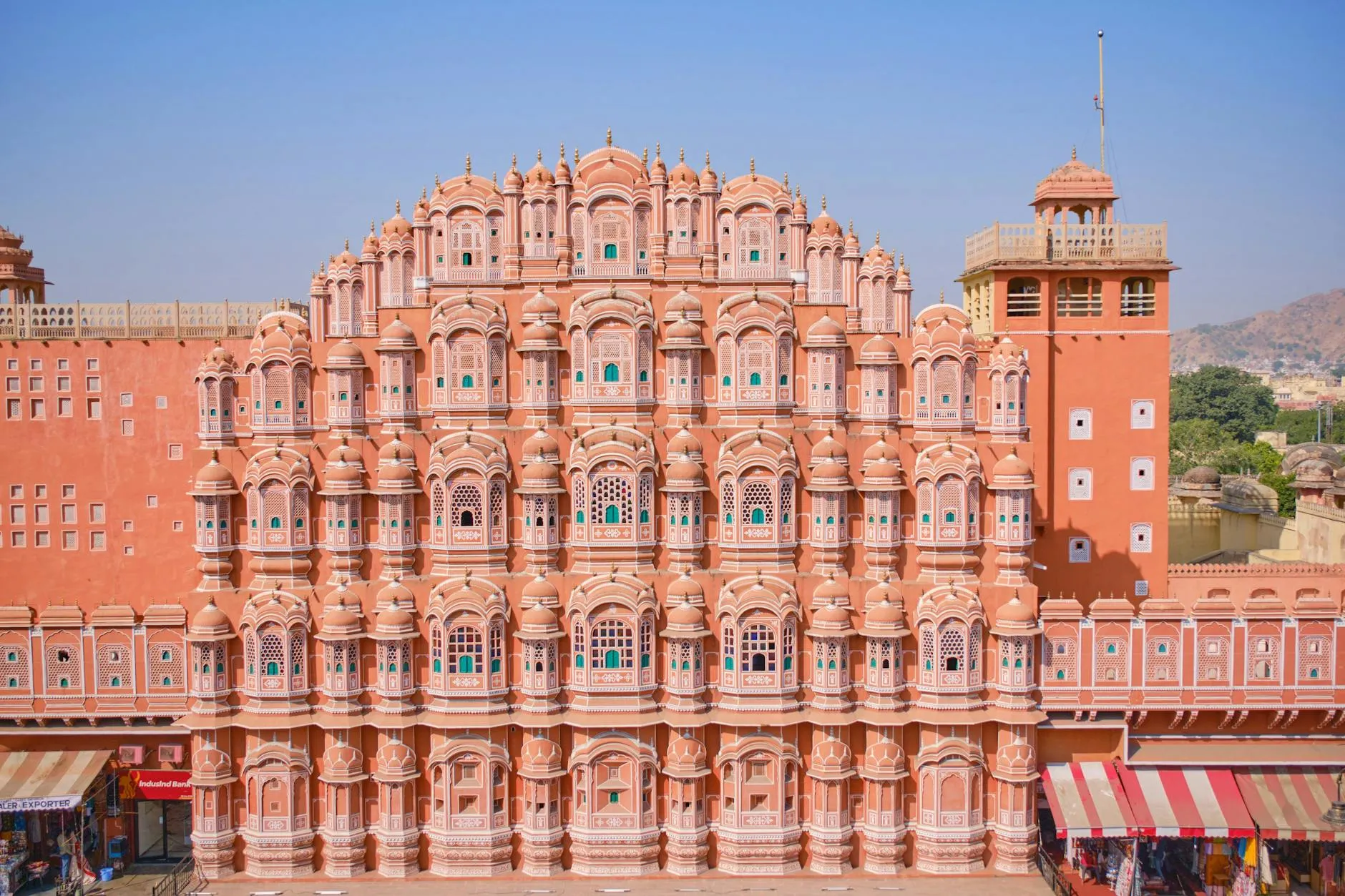
City Palace, Jantar Mantar, and Hawa Mahal sit within walking distance of each other in the walled city. Entry fees: City Palace roughly ₹100–300 depending on the ticket (premium royal-apartment tickets cost considerably more); Jantar Mantar is a UNESCO World Heritage Site — an 18th-century stone astronomical instrument park, and it rewards a guide or audioguide because the giant masonry instruments mean nothing without context; Hawa Mahal charges ~₹50 for foreign visitors and its interest is the five-storey honeycomb facade, best photographed from the cafe terraces across the street in the morning. It’s a photo stop, not a walkthrough.
Albert Hall Museum in Ram Niwas Garden, ~12 km from the airport — Rajasthan’s oldest museum, foreign entry ~₹300. The building is floodlit at night (₹100 night ticket).
Jal Mahal, the water palace half-submerged in Man Sagar Lake, is free to view from the shore about 5 km from the old-town centre. You cannot enter the palace — it’s closed to visitors. Boat rides on the lake run ₹50–200 when operating, which varies with water level and season; don’t plan your day around them.
🦁 Amber Fort (~26 km / 40–50 min from airport)
The sight worth the effort if you have it. Foreign entry ~₹200 (a combined ticket also covers Jaigarh Fort above). Elephant rides up to the gate run in the morning only and stop by mid-morning; the fort opens around 8 a.m., so an early start gives you the cooler, emptier hour and better light. The round-trip from the airport plus an hour inside is the better part of three hours — feasible on a 6-hour-plus layover, not on a tight one.
Nahargarh Fort on the ridge above the city is the opposite play: go late, because its draw is the sunset view over Jaipur and the Padao cafe that trades on it.
Composite ticket: ~₹1,000 for foreign visitors, valid two days, covering Amber Fort, Hawa Mahal, Jantar Mantar, Albert Hall, Nahargarh, and a couple of gardens. It pays for itself once you’re seeing three or more of these, but it’s a city-stay tool, not a layover one.
🗓️ Beyond Layover Range
- Pushkar — ~150 km / ~3 hours southwest via Ajmer. Lakeside pilgrimage town, ghats, the rare Brahma temple, and the November camel fair. Doable as a long day from Jaipur, better as an overnight.
- Ranthambore — ~175 km / 3.5–4 hours by road; train to Sawai Madhopur (the park railhead) is ~2–2.5 hours on the faster services. Tiger sightings are a lottery. Safari slots and park-entry permits fill up in season — book well ahead.
- Agra and the Taj Mahal — ~240 km / 4–5 hours via the expressway. Fatehpur Sikri, the abandoned Mughal capital, sits roughly halfway and is worth a stop.
- Delhi — ~270 km / 4.5–5 hours north. The classic Golden Triangle circuit runs Delhi–Agra–Jaipur–Delhi; Jaipur is the third corner, and JAI is where many travellers start or finish the loop.
🔧 Practical Notes
Wifi and SIM. Both terminals offer free airport wifi using an OTP-to-mobile login — awkward if your foreign number doesn’t receive the SMS. For a local SIM, buy from an official Airtel or Jio counter with your passport, visa copy, and a photo; airport stands exist, but city activation tends to go more smoothly. An eSIM from a travel provider set up before you land sidesteps the OTP problem entirely.
Heat. May–June routinely tops 40°C. If you are doing the layover-sightseeing run, early morning and late afternoon are the only sensible windows. Carry water. The airside terminals are air-conditioned; the city is not.
Scams. Jaipur is not dangerous in any serious sense, but it is one of India’s most heavily touristed cities, and the commercial frictions are real.
⚠️ The standard arrival traps
— Driver insists your hotel is “closed / full / moved” and steers you elsewhere: ignore it, go to your booked hotel.
— “Government emporium” detour on the way in from the airport: commission shop, not government anything.
— Gem-carrying proposition in the bazaars (you “carry” stones for a fictitious profit): never engage.
— Inflated entry fees or unsolicited guide services at the monuments: Amber Fort photographers are persistent. Agree every price — auto fare, guide fee, purchase — before the service.
Tipping. Restaurant service charge often appears on the bill; if not, 5–10% is generous. Round up for auto and cab drivers. ₹50–100 for a hotel porter is standard. Dress modestly at temples (shoulders and knees covered, shoes off at thresholds).
Water. Don’t drink tap water. Bottled (check the seal) or filtered throughout. That extends to ice and raw salads at lower-end places.
❓ Frequently Asked Questions
📊 At a Glance — JAI 2026
| Attribute | Detail |
|---|---|
| Airport | Jaipur International (JAI / VIJP), Sanganer |
| Operator | Adani Airport Holdings |
| Distance to Pink City | ~13 km / 25–45 min by road |
| Terminals | T1 (international, reopened Oct 2024); T2 (domestic); Air India Express and SpiceJet at both |
| Terminal separation | ~1.5 km, no airside link |
| Runway | 08/26, 3,407 m, CAT III-B |
| Passengers FY 2024–25 | ~6.06 million (+10.8%) |
| Summer 2026 schedule | ~750 weekly domestic / 74 weekly international (~118 movements/day) |
| New 2026 route | Thai AirAsia Jaipur–Bangkok (Don Mueang), from May 2026 |
| Visa | India e-Visa (indianvisaonline.gov.in) — no general visa-on-arrival |
| 30-day e-Visa fee | US$10 (Apr–Jun) / US$25 (Jul–Mar) + 3% bank charge |
| 1-year / 5-year e-Visa | US$40 / US$200 standard (US$160 United States passport, US$484 United Kingdom passport) |
| Visa-free | Nepal and Bhutan nationals only |
| Health form | None — Air Suvidha scrapped 2022 |
| Currency | Indian rupee (₹) — ~₹95/US$, ~₹111/€ (May 2026) |
| Ride-hailing to old town | Uber / Ola ~₹350–500 off-peak |
| Prepaid taxi to centre | From ~₹500, typically ~₹700 |
| Public bus | RSRTC ~₹20 (stop ~30-min walk from terminal, no luggage provision) |
| Metro | None to airport — nearest Mansarovar (~6–7 km), Pink Line |
| Lounges | Adani Lounge only (Terminal 2, domestic departures) |
| Priority Pass | Accepted at the Adani Lounge (T2, domestic); no lounge on the T1 international side |
| Premium lounges absent | No Plaza Premium, no airline flagship |
| Amber Fort entry (foreigner) | ~₹200 (combined with Jaigarh) |
| Hawa Mahal entry (foreigner) | ~₹50 |
| Albert Hall Museum (foreigner) | ~₹300 (₹100 night ticket) |
| Composite ticket (foreigner) | ~₹1,000, valid 2 days, multi-monument |
| Day-trips | Pushkar ~150 km; Ranthambore ~175 km; Agra ~240 km; Delhi ~270 km |