La Tontouta International Airport (NOU) — Airport Guide 2026
The airport is 50 km from Nouméa by road — a fact that dictates every arrival decision, from whether the 500 XPF public bus is viable (usually not, for international arrivals) to whether the city is worth attempting on a layover (barely, with a five-hour-plus gap and direct taxis each way).
Quick Reference
NOU / NWWW
La Tontouta International Airport (Aéroport de Nouméa–La Tontouta)
~50 km by road; ~45 min taxi / 60–75 min shared shuttle
CFP franc (XPF), fixed at 1 EUR = 119.3317 XPF
Visa-free 90 days for most Western nationals; French territory, NOT Schengen
One passenger terminal; Air Calédonie domestic flights moved here from Magenta on 2 March 2026
Arc en Ciel shuttle 2,700 XPF, book ahead; taxi ~6,500–10,000+ XPF; TEX bus 500 XPF (domestic-aligned)
Aircalin Salon Hibiscus (business / partner business only; no Priority Pass)
Aircalin, Qantas / QantasLink, Air New Zealand, Air Calédonie
360,066 (+0.2% on 2024’s 359,419, itself down 27% after the airport closed during the May 2024 unrest and reopened 21 May 2024)
Safe to drink in Nouméa
Not customary
Stabilised; increased-caution level; security presence remains
None — airport charges bundled into ticket
🏢 Terminal Layout & the 2026 Domestic Move
La Tontouta handles roughly 360,000 passengers a year from a single terminal on the west-coast coastal plain near the village of Tontouta. US Navy Seabees built the original airfield during the Pacific War, when New Caledonia was a major Allied staging base, and the two-runway layout they left behind eventually consolidated to runway 11/29: asphalt, 3,250 m long, 16 m above sea level — enough for the Aircalin widebodies flying to Singapore, Bangkok and Paris. The military inheritance gave the airport a strip longer than its passenger count would otherwise justify.
The terminal in use in 2026 is largely the product of a 2012 expansion: a new arrivals hall, additional check-in positions, two jet bridges and stands for five commercial jets. At this volume it works without congestion. Immigration, baggage reclaim and the exit are a short walk apart; no concourses, no inter-terminal trains. The scale is an advantage when you’re tired.
The genuine structural change in 2026 is the domestic network arriving. Air Calédonie — the inter-island carrier that historically flew from Magenta, the small airport inside Nouméa itself — transferred all of its operations to La Tontouta on 2 March 2026. Magenta now handles freight and parcels only, with a daily road service out to La Tontouta. Phase 2, which will fully separate domestic and international passenger flows, is scheduled for around mid-2026, with construction having started in late July 2025; the layout you meet until then is transitional. The practical upshot: if you’re connecting from a long-haul arrival onto an island-hopper to Île des Pins, Lifou, Maré or Ouvéa, you make that connection at the same airport rather than transferring across town. Check-in on the island flights closes 45 minutes before departure.
The terminal has the basics: a few cafés, duty-free, car rental desks, ATMs and currency exchange. There is no airside hotel; the nearest accommodation is a handful of guesthouses near Tontouta village, not a walkable airport complex. Arrive, clear the formalities, move.
🛂 Border, Entry & Currency
New Caledonia runs its own immigration system. It is a French overseas territory — collectivité sui generis — with substantial autonomy, part of the French Republic but outside the Schengen Area. A flight from Paris to Nouméa crosses a passport control, not a domestic gate.
Visa rules. Holders of passports from roughly 90-plus nationalities — British, Australian, New Zealand, Canadian, Japanese and EU states among them — enter visa-free for tourism for up to 90 days within any 180-day period, granted on arrival with no online pre-authorisation required. Nationals outside the exempt list need a short-stay visa arranged in advance through the French system; anyone working, studying or staying beyond 90 days needs the appropriate long-stay visa regardless of nationality. The exempt list can differ from mainland France’s — check your specific nationality before booking.
Passport requirements. Issued within the last 10 years, valid at least three months beyond your planned departure from New Caledonia, with at least two blank pages. Immigration may ask visa-exempt arrivals to show means of support (card or cash), a return or onward ticket, and accommodation details — carry these accessible rather than buried.
⚠️ NOT Schengen — verify your visa separately
New Caledonia’s entry rules can differ from mainland France’s. A French Schengen visa does not cover entry here. Check your nationality against New Caledonia’s current exempt list before buying your ticket.
Currency. The CFP franc (XPF) is shared with French Polynesia and Wallis and Futuna, pegged to the euro at a fixed 1 EUR = 119.3317 XPF — a rate held since 1999 that does not fluctuate. Working conversion: 1,000 XPF is about €8.40, or roughly US$9 (the dollar figure moves with EUR/USD; the euro figure does not). Notes come in 500, 1,000, 5,000 and 10,000 XPF; coins run from 1 to 100. Prices read high on first contact — a 600 XPF coffee is roughly €5 — because the unit is small, not because New Caledonia is cheap. It genuinely isn’t.
Departure tax. No separate cash levy collected at the airport — all airport and security charges are folded into the ticket price.
Health. No routine vaccinations are required for entry from most countries. Proof of yellow fever vaccination is mandatory if you’re arriving from a country with active transmission risk — relevant if you’ve routed through parts of Africa or South America, not from Sydney or Auckland. Dengue circulates seasonally; pack repellent. Medical care in Nouméa is good by Pacific standards; outside the capital it thins out fast.
🚆 Getting to Nouméa — the 50-km Problem
The road from the terminal to central Nouméa is roughly 50 km. That’s 45 minutes in a private vehicle running direct, 60–75 minutes on a shared shuttle working a hotel-drop loop. There is no train, no metro. Your four options:
🚌 Arc en Ciel Shared Shuttle — the default
Arc en Ciel Service runs on reservation, not walk-up: book through its website or by phone (+687 27 19 80) before you fly. Its agents meet every arrival, but what they do is point you to the shuttle you have already booked. The shared fare is a flat 2,700 XPF per person per trip (roughly €23); cancelling costs 500 XPF. It is a door-to-door service rather than a terminus run — pickup and drop-off at your address across Nouméa and Grand Nouméa within its published perimeter, with private transfers for addresses outside it — which is why the journey takes longer than a direct taxi. For a solo traveller or a couple without a hotel transfer pre-arranged, this is the sensible call on price and convenience. Several other private operators — AKWABA, Allo Transports among those listed by the airport — also run on reservation only. Nothing on the ground here is walk-up priced except the TEX bus, so arrange the transfer before you land.
🚌 Arc en Ciel Shuttle — 2,700 XPF, booking required
Reserve before you fly, through the Arc en Ciel website or on +687 27 19 80. Agents meet each arrival to point you to your booked shuttle. Door-to-door across Nouméa and Grand Nouméa — 60–75 minutes total.
🚕 Taxi — faster, not cheap
The meter runs roughly 555 XPF base plus about 123 XPF per kilometre, putting the 50-km run theoretically around 6,500–7,000 XPF. Real quotes to specific Nouméa addresses commonly run 10,000 XPF or more at night or with surcharges. A taxi delivers you in roughly 45 minutes, door to door, no other drops. For a group of three or four splitting the cost, or a late-night arrival where speed matters, it earns the premium. Confirm the fare or check that the meter is running before the car moves.
🚕 Taxi to Nouméa — budget 7,000–10,000+ XPF
The mathematical meter fare underpredicts real quotes. Budget 10,000 XPF at night. Direct at ~45 minutes, no hotel loop.
🚍 TEX Public Bus — 500 XPF, with conditions
The Tontouta Express (TEX) launched 2 March 2026 at a flat 500 XPF (roughly €4) per trip, with stops at the airport terminal, Nouméa (Old CHT / Patch Station), Dumbéa (Koutio, opposite the McDonald’s) and Païta (Arènes du Sud). At 500 XPF it is by far the cheapest option. The constraint: the official service is timetabled around Air Calédonie domestic flight times, not around the long-haul international schedule. A 02:00 arrival from Paris or a late Singapore service will not find a TEX waiting outside. Treat it as a genuine budget option for daytime arrivals that happen to line up with the domestic timetable, and verify departure times against your specific flight before relying on it.
⚠️ TEX Bus — 500 XPF but verify the timetable
The TEX is aligned with domestic Air Calédonie departures, not international long-haul arrivals. Don’t assume it’s running for your flight. Check the schedule before you depend on it.
🚗 Rental Car — for the road, not just the airport run
The major rental desks operate in the terminal. A car makes sense if you’re planning to drive Grande Terre’s coasts or reach beaches and tribal areas the shuttles don’t serve. For a stay confined to Nouméa — a compact, walkable seafront city — you’ll pay to park a car you don’t use. Drive on the right; roads outside Nouméa are quiet but largely unlit at night.
Rideshare apps (Uber, Bolt equivalents) are not a viable option at La Tontouta. The local market runs on taxis and shuttles.
🛋️ Lounges — One Room, No Networks
⚠️ No Priority Pass, LoungeKey or DragonPass at NOU
If your lounge access strategy relies on a premium credit card membership or third-party network, it does nothing here. There is one lounge open to travellers at this airport, and it is not affiliated with any of those schemes.
The one lounge open to travellers is the Aircalin Salon Hibiscus — airside, second floor of the departures area, facing the runway with a view toward the mountains. The lift is located near the duty-free collection point and the bar. It functions as the shared business lounge for the full-service carriers at the airport: Aircalin Business (Hibiscus Class) fare passengers, eligible Aircalin frequent flyers, and the business-class passengers of partner carriers including Qantas and Air New Zealand. Economy passengers without status are not admitted on their ticket alone.
Hours are flight-driven, not fixed. The Hibiscus opens 2 hours 30 minutes before departures to Paris, Bangkok, Singapore and Papeete, and 2 hours before flights to Sydney, Brisbane, Auckland, Wallis, Nadi and Port Vila. In practice it opens in waves around the international banks — an airport running a handful of departures a day doesn’t keep a lounge open continuously.
Paid access is published and sold in advance. Aircalin charges 6,000 XPF for the Hibiscus on a Nouméa departure, or 12,000 XPF for the Hibiscus plus the Miracle Business Lounge in Bangkok on the Paris routing. Buy it up to 24 hours before departure — at booking, through My Booking, at an Aircalin sales office or through a travel agency. There is no counter sale at the airport and no last-hour purchase, and the pass is sold only to passengers travelling on Aircalin-operated SB flights. It is non-refundable and non-transferable, and children aged 2 and over pay the adult fare.
For economy passengers: there is no alternative airside refuge. Factor a café sit-down into your departure plan.
🍽️ Food Before You Fly
The terminal cafés price as captive-audience airport food does everywhere. A coffee that runs 500–600 XPF in town drifts higher once you’re airside. The honest play is to eat before you reach the airport.
Bougna is the dish to know from Kanak cooking: fish or chicken with taro, yam, sweet potato and poingo banana, wrapped in banana leaves with coconut milk and cooked in an earth oven over hot stones. It is communal and ceremonial food — a tribal welcome or a festival, not a restaurant menu item. You will encounter it most authentically on the islands or in the interior, not at the airport or on the tourist strip. It is a stay discovery, not a day-one airport dish.
Nouméa’s restaurant strip runs along Anse Vata and Baie des Citrons: seafront tables, French bistro fare, wood-fired pizza, seafood. It is pitched at visitors and priced accordingly — New Caledonia is a costly destination, and a sit-down dinner with a drink is not a budget exercise.
The Marché de Nouméa at Port Moselle, open Tuesday to Sunday mornings under its blue-roofed hexagonal halls, is a different proposition: fresh seafood from the boats, tropical produce, flowers, handicrafts and strong Melanesian coffee at the café tables. It is the best-value eating in the city. Go early, before the cruise-day crowds arrive and the best produce is gone. If you want a New Caledonian food experience rather than a duty-free bottle, start here — Kanak carving and weaving are also sold at the market by their makers.
🍽️ Port Moselle Market — eat here before the airport
Marché de Nouméa, Port Moselle. Tuesday–Sunday mornings. The most local eating in the city at the fairest prices. Go early.
Duty-free covers the standard French-territory range: perfume, spirits, French wine, cosmetics. Because this is a French territory, the wine and cognac selection is better than you’d expect at a small Pacific airport. Competitive on French spirits and perfumes relative to most home markets; less compelling on everything else.
💡 Day-Trips, Layovers & What’s Worth Your Time
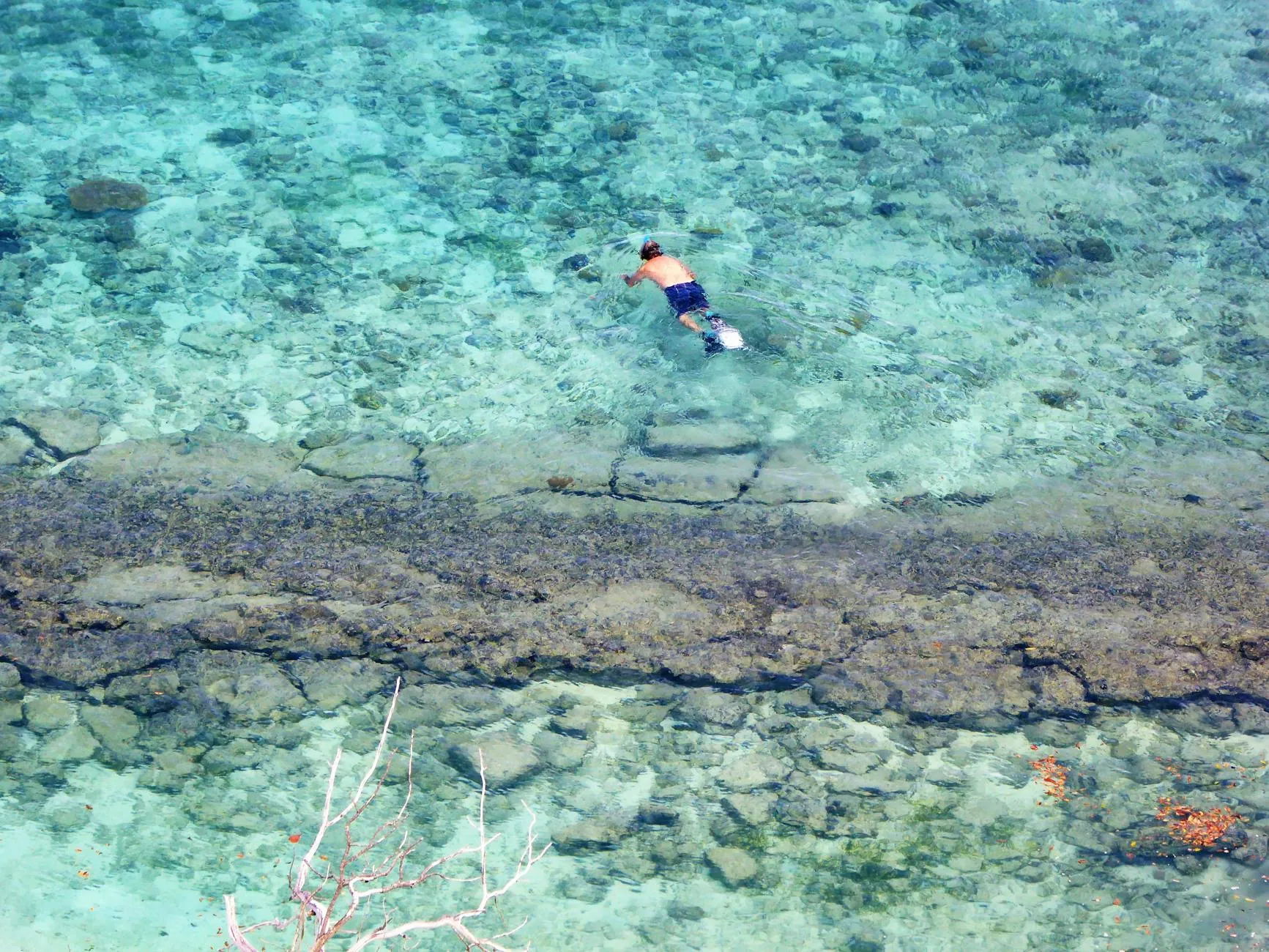
The reason to come is the water. New Caledonia’s barrier reef and lagoon are a UNESCO World Heritage site and one of the largest reef systems on earth — by coral and fish diversity it rivals or exceeds the far bigger Great Barrier Reef. Almost everything worth doing fans out from Nouméa’s southern bays.
What to see
Île aux Canards (Îlot Canard / Duck Island): a 5-to-10-minute water-taxi from Anse Vata to a small islet with a marine reserve and a marked underwater snorkelling trail. A half-day at most, and the lowest-effort entry to the famous water.
Amédée Lighthouse (Phare Amédée): a 56-metre iron lighthouse inaugurated on 15 November 1865, the last surviving metal lighthouse of its kind in France, sitting on a motu about 40 minutes by boat south-southeast of Nouméa. Access is via organised full-day excursion — boat each way, snorkelling, glass-bottom boat, buffet lunch, and 247 steps to the top if you want the view. Full day is the operative phrase and it is not negotiable.
🏛️ Tjibaou Cultural Centre — the strongest reason to come to Nouméa
Renzo Piano’s 1998 complex of soaring timber cases on the Tina Peninsula, about 8 km (roughly 15 minutes’ drive) northeast of the city centre. Open Tuesday–Sunday 9am–5pm, last entry 4:30pm. Admission roughly 1,000 XPF, half for children and seniors. Budget 60–90 minutes. It is devoted to Kanak culture and there is nothing else like it in the Pacific.
Tjibaou Cultural Centre: Renzo Piano’s 1998 complex on the Tina Peninsula, about 8 km northeast of the city centre — roughly a 15-minute drive. Open Tuesday–Sunday 9am–5pm, last entry 4:30pm; admission roughly 1,000 XPF, half price for children and seniors (verify current hours and fee before visiting). Budget 60–90 minutes.
Aquarium des Lagons at Anse Vata: the marine life that earned the UNESCO listing, in tanks. Open Monday–Friday 1pm–5pm, weekends, public holidays and school holidays 9am–5pm (last entry 4:30pm); admission roughly 1,600 XPF, reduced for students, seniors and children. About 90 minutes is enough.
Layover math — be honest
The 50 km from the airport is the constraint that kills most layover plans. The round-trip drive alone runs about 2.5 hours: roughly 45–50 minutes each way by taxi, plus a 60–90-minute return-side check-in and security buffer before an international departure.
- Tjibaou Cultural Centre, Port Moselle market or Aquarium des Lagons: need roughly a 5-hour-plus connection, with a private taxi both ways, to be feasible. Even then it will be close.
- Île aux Canards: the water-taxi from Anse Vata is quick, but reaching Anse Vata is the full 50-km city run. It is a stay activity, not a layover one.
- Amédée Lighthouse: not layover-viable, full stop. Boat schedules and the full-day format require an overnight in Nouméa.
La Tontouta runs once-or-twice-daily international departures on most routes. Miss one and the consequences are measured in days, not hours. Under five hours, stay at the airport.
🔧 Practical Notes
📱 SIM Cards and Connectivity
The local network is Mobilis, operated by OPT-NC. There is no OPT store inside the La Tontouta terminal, so you cannot buy a physical SIM on arrival at the airport. OPT’s Helia (Liberté) prepaid plans run roughly 3,000 XPF for 15 GB or 5,000 XPF for 30 GB, sold at OPT shops in town. OPT now also offers Liberté plans as eSIM, and international travel-eSIM providers cover New Caledonia from around US$24 for a 15–20 GB, 30-day package. Buy before you fly and you walk out of the terminal already connected, sidestepping the no-airport-SIM problem entirely.
Terminal Wi-Fi exists, as it does across Nouméa hotels and cafés, but it is patchy enough that you shouldn’t plan around it as a primary connection.
📱 No airport SIM — buy an eSIM before you fly
OPT has no store at La Tontouta. Local Mobilis SIMs (~3,000–5,000 XPF) are sold at OPT town branches. International travel eSIMs cover New Caledonia from ~US$24 for 15–20 GB. Buy before departure.
🔐 Safety and the 2024 Context
New Caledonia saw serious civil unrest in May 2024, tied to a French electoral-reform dispute. The airport closed and only reopened on 21 May 2024; tourism fell 27% that year. The reform that triggered the violence was subsequently withdrawn. By 2026 the situation had stabilised: no travel restrictions remain, and major Western government advisories had been eased to an increased-caution level rather than a reconsider-travel warning.
The 2026 picture in practice: Nouméa and the tourist areas operate normally; an increased police and military presence remains visible; petty crime is a real concern; and political demonstrations can flare at short notice and disrupt transport. Check your government’s current advisory close to your departure date, keep an eye on local news for any demonstration days, and note that emergency assistance thins out sharply outside the capital and on the islands.
💱 Currency in Practice
Cards (Visa, Mastercard) work across Nouméa. The islands, markets and smaller shuttle operators run on cash, so pull XPF from a terminal or town ATM on arrival. The EUR peg is fixed at 1 EUR = 119.3317 XPF — convert mentally off the euro and ignore daily rate-watching. Keep small notes for the 500 XPF bus and market stalls.
💬 Tipping, Water and Language
Tipping is not customary. Rounding up a restaurant bill or taxi fare is welcome but not expected, and there is no service-charge culture to navigate. Tap water in Nouméa is treated and safe; ask any restaurant for a carafe d’eau rather than paying for bottled water. On the islands and in tribal areas, be more cautious with untreated water.
French is the working language everywhere, alongside Kanak languages. English is variable among tourism staff and patchy outside the resort strip. A few words of French carry real weight at the market, the shuttle counter and anywhere off the main tourist circuit.
❓ Frequently Asked Questions
📊 At a Glance — NOU 2026
| Feature | Detail |
|---|---|
| IATA / ICAO | NOU / NWWW |
| Full name | La Tontouta International Airport (Aéroport de Nouméa–La Tontouta) |
| Location | Tontouta, Grande Terre, west coast of New Caledonia |
| Distance to Nouméa | ~50 km by road (Wikipedia’s 37 km is the straight-line figure) |
| Transfer time | ~45 min taxi / 60–75 min shared shuttle; no rail link |
| Terminals | One passenger terminal; Air Calédonie domestic flights moved here from Magenta on 2 March 2026 (Phase 2 ~mid-2026) |
| Runway | 11/29, asphalt, 3,250 m; elevation 16 m (52 ft) |
| 2025 passengers | 360,066 (+0.2% on 2024’s 359,419, itself down 27% after the airport closed during the May 2024 unrest and reopened 21 May 2024) |
| Currency | CFP franc (XPF), fixed 1 EUR = 119.3317 XPF (≈ US$9 per 1,000 XPF) |
| Entry | Visa-free 90 days for most Western nationals; French territory, NOT Schengen; passport valid 3+ months, 2 blank pages |
| Departure tax | None — bundled into ticket price |
| Shared shuttle | Arc en Ciel 2,700 XPF flat per person per trip; reservation required, door-to-door across Nouméa and Grand Nouméa |
| Taxi | ~555 XPF base + ~123 XPF/km; real fares ~6,500–10,000+ XPF to Nouméa |
| Public bus | TEX (Tontouta Express) 500 XPF flat, launched 2 March 2026 — aligned with domestic flights; verify for international arrivals |
| Lounge | Aircalin Salon Hibiscus (business / partner business only; flight-driven hours) |
| Priority Pass / LoungeKey / DragonPass | None at NOU |
| Main carriers | Aircalin (base), Qantas / QantasLink, Air New Zealand, Air Calédonie (domestic) |
| SIM / eSIM | No airport OPT store; Mobilis SIM ~3,000–5,000 XPF in town; travel eSIM from ~US$24 — buy before arrival |
| Tap water / tipping | Water safe in Nouméa; tipping not customary |
| Advisory (2026) | Stabilised post-2024 unrest; increased-caution level; security presence remains; watch for demonstrations |
| Top sights | UNESCO lagoon and barrier reef, Tjibaou Cultural Centre (~8 km from city, ~1,000 XPF), Aquarium des Lagons at Anse Vata (~1,600 XPF), Amédée Lighthouse (full-day excursion, inaugurated 15 Nov 1865), Île aux Canards (half-day water-taxi from Anse Vata) |