Kefalonia Airport (EFL) — Airport Guide 2026
Quick Reference
Kefalonia “Anna Pollatou” National Airport
EFL / LGKF
Argostoli, Kefalonia, Ionian Islands, Greece
About 9 km south of Argostoli; ~3 km from the Lassi resort strip
One terminal (new build, opened 2019 under Fraport Greece)
About 886,000 in the first ten months (+2.3%) — heading for ~900,000, a summer-led airport
Greece — Schengen, euro; EES live since April 2026, ETIAS expected, date not announced
Euro (€)
Taxi ~€20 (~15 min) — there is no public bus from the airport
None — no lounge or Priority Pass access
Jet2, easyJet, TUI, Ryanair (seasonal); Sky Express (Athens)
🛫 1. What Kefalonia Airport is
Kefalonia’s airport is a seasonal leisure field for the largest of the Ionian islands, rebuilt from scratch in 2019 under Fraport Greece’s regional-airport programme. The new terminal — more check-in desks, more security lanes, a bigger airside, room for the car-hire firms — is why a small airport copes with the summer crush better than its size suggests; it handled about 886,000 passengers in the first ten months of 2025, up a couple of per cent, and is on track for roughly 900,000 over the year.
There’s no dramatic recent change to flag beyond that terminal, now a few years bedded in. The thing that actually shapes a trip here isn’t the building — it’s the island. Kefalonia is big and mountainous, its sights are far apart, and the airport has one operational quirk that catches people out: getting away from it.
🛬 2. The terminal and the lounge
One terminal, modern since the 2019 rebuild and easy to cross. It’s a genuine improvement on what came before, but it’s still a single-runway seasonal airport, and the security line is the pinch point when charter flights stack up on a summer morning — give yourself two hours for a peak departure. Walks are short and there’s nothing to connect to.
On lounges, the answer is short: there isn’t one. Kefalonia airport has no walk-in or pay-per-use lounge and no Priority Pass access, so plan on the café rather than a quiet wait. For a seasonal island terminal that’s normal — just don’t arrive expecting somewhere to escape the crowd.
✈️ 3. Carriers, and the seasonal reality
This is a UK-dominated summer airport. Jet2 is the heavyweight, flying from a long list of British cities — Birmingham, Bristol, East Midlands, Edinburgh, Glasgow and Leeds among them — with easyJet (Gatwick, Manchester, plus Milan and Nice), British Airways, TUI and a Ryanair route or two filling out the European map. Year-round, the airport leans on the domestic link to Athens, flown by Sky Express and the Aegean group.
The pattern is the usual island one. In summer you can fly direct from much of the UK and parts of Europe; in winter the international schedule all but disappears and you connect through Athens. There’s no long-haul and nothing to change onto — every trip is point-to-point or a hop via the mainland. Because the market is so British and so seasonal, fares spike hard for the school holidays, and the cheaper, calmer weeks sit in the shoulders of May, June and September.
Worth knowing for budgeting: a large share of that UK traffic is Jet2holidays packages rather than flight-only, the flight bundled with a hotel and transfers under ATOL protection. On an island where you’ll want a base and probably a car anyway, the bundle is sometimes the cheaper and simpler buy — but not always, so put the package total up against a flight plus a villa booked separately before you commit.
🛂 4. The border: Greece, Schengen, the euro
Greece is in the Schengen Area and uses the euro. EU/EEA and Swiss nationals pass straight through; UK, US, Canadian, Australian and many other passport-holders enter visa-free for up to 90 days in any 180-day period.
A 2026 note: Greece’s EES biometric registration has been live since April 2026, and it applies to arrivals from outside Schengen — which here means the UK, by far the airport’s biggest market. At a seasonal terminal taking back-to-back charter flights, that new check can mean a slow passport queue on a summer afternoon. Intra-Schengen and domestic arrivals skip it entirely.
ETIAS, the pre-travel authorisation for visa-exempt visitors, is expected to follow, with no launch date announced, ahead of becoming mandatory on a date the EU has not announced — worth checking before you book on a non-EU passport. Prices are in euros, there’s an ATM in the terminal, and cards work nearly everywhere, but keep some cash for taxis and small village tavernas.
🚗 5. Getting off the airport — there’s no bus, so plan ahead
This is the part people get wrong. Kefalonia airport sits about 9 km south of Argostoli, the island capital, and 3 km from the Lassi resort strip — but the way out is not as obvious as the short distance suggests.
Sort your transfer before you fly. There is no public bus from Kefalonia airport — the island’s KTEL network skips it — so your options off the apron are a taxi (about €20 to Argostoli, 15 minutes; €7–10 to nearby Lassi), a pre-booked private transfer, or a hire car. Don’t land expecting a cheap bus into town; there isn’t one.
The taxi rank sits outside arrivals and the fares to the closest spots are reasonable, but they climb fast for the villages further out, and in a busy arrivals bank the queue can outlast the wait you saved by not pre-booking. For anything beyond Argostoli or Lassi, a pre-booked transfer or a hire car is the saner choice.
On a big, mountainous island, a car earns its cost. Kefalonia’s draws — Myrtos beach, the Melissani cave, Fiskardo in the far north — are spread far apart over slow mountain roads, and the inter-town buses are thin where they run at all. Unless you’re planting yourself at one resort for the week, hiring a car (the desks are in the terminal) is the difference between seeing the island and seeing one beach.
Nobody connects through Kefalonia, so there’s no transit maths — just the transfer at each end. The one piece of return advice that matters: leave enough time to drive back across the island to this single small airport, because the roads are slow and there’s no quick alternative.
🏝️ 6. The reason you’re here: a big island, and the 1953 question
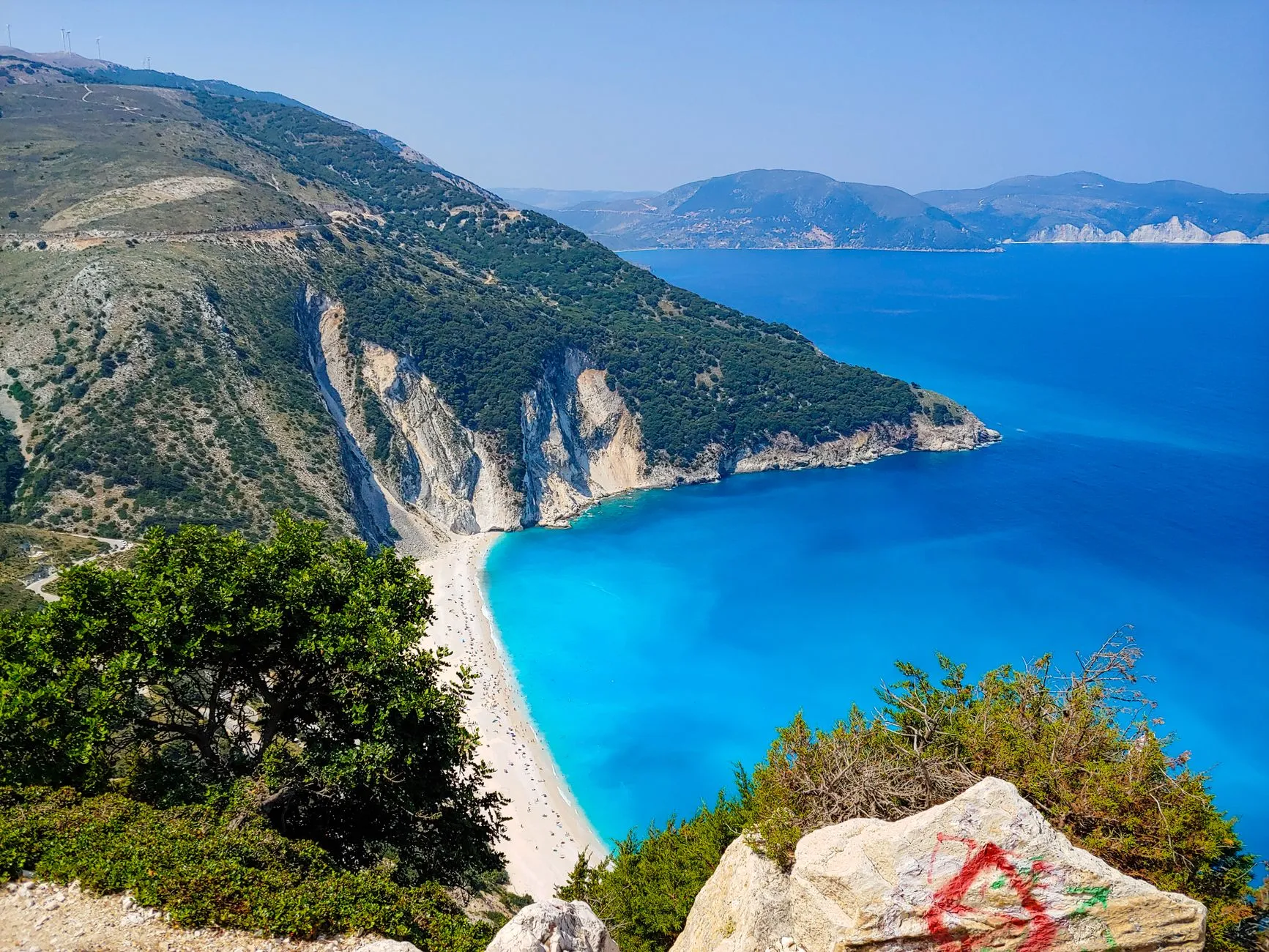
Kefalonia trades on a handful of genuine set-pieces: Myrtos, the white-pebble cove framed by cliffs that fronts half the island’s postcards; the Melissani cave, where a midday boat drifts under a collapsed roof and the light turns the underground lake electric blue; and Fiskardo, the chic harbour village in the north. The novel and film Captain Corelli’s Mandolin were set here, which still draws a certain visitor. There’s no aifly guide to the island yet, so take this as orientation rather than a tour — and a frank note: Myrtos is stunning from the viewpoint but a steep, shadeless pebble beach up close, and the harbour-front tavernas in Fiskardo are priced for the yachts moored in front of them.
If Kefalonia looks newer than other Greek islands, here’s why. The Great Ionian earthquake of August 1953 levelled almost every village on the island and lifted the whole landmass by about 60 cm. Most of what you see was rebuilt afterwards in low, plain concrete — which is exactly why Fiskardo, the one northern harbour that came through intact, is the village everyone drives two hours to see.
The location quietly enables one more thing: Kefalonia is a hub for the southern Ionian, so from its ports you can ferry on to neighbouring islands rather than only fly in and out. Ithaca — Odysseus’s island — is a short crossing away, and there are links south to Zakynthos and east to the mainland at Kyllini. If you’re island-hopping, flying into Kefalonia and leaving by boat is a real itinerary, not just a fallback.
If you want something to carry home, the island’s own wine is the genuine article: Robola, a crisp dry white from a grape grown on Kefalonia’s limestone slopes, sold at the cooperative winery near Argostoli for less than the airport shelf charges.
❓ 7. FAQ
📋 8. At a glance
| Item | Detail |
|---|---|
| Airport | Kefalonia (EFL / LGKF), ~9 km from Argostoli |
| Terminal | New since 2019; single security line — arrive 2h in summer peak |
| Bus | None — the airport has no public bus service |
| Taxi | ~€20 to Argostoli (~15 min); ~€7–10 to Lassi (~6 min) |
| Hire car | Recommended for a big, spread-out island; desks in the terminal |
| Border | Greece; Schengen; euro; EES live since April 2026; ETIAS expected, date not announced |
| Currency | Euro (€); cash useful for taxis and villages |
| Lounge | None (no lounge or Priority Pass) |
| Carriers | Jet2, easyJet, BA, TUI, Ryanair (summer); Sky Express to Athens (year-round) |
| Carry home | Robola, the island’s dry white — better from the cooperative winery than the airport |
🔗 9. Explore More
- Zakynthos Island Guide — the neighbouring Ionian island, a short ferry hop and a natural pairing
- Athens Airport (ATH) guide — the mainland gateway you’ll connect through off-season