Graz Airport (GRZ) — Airport Guide 2026
Graz Airport handles around a million passengers a year, almost entirely as a hub-feed operation: Austrian runs an hourly-ish shuttle to Vienna, and from there — or via Frankfurt, Munich, and Zürich on Lufthansa, SWISS, and Air Dolomiti — you connect to everywhere else. The airport’s one genuine advantage over driving to Vienna is the S-Bahn: twelve minutes to the city centre, €3.
Quick Reference
Flughafen Graz (Graz-Thalerhof)
GRZ / LOWG
~10 km south of Graz, Styria
S-Bahn S5, Flughafen Graz-Feldkirchen → Graz Hauptbahnhof, ~12 min, ~€3.00 (Tarifzone 101)
~€25–30, ~15–20 min
Euro (€)
Member; EES live since 10 April 2026; ETIAS pending
Graz Airport VIP Lounge (Priority Pass, DragonPass, Diners Club; €30 walk-in; ~05:30–20:00)
Austrian, Eurowings, Lufthansa, SWISS, Air Dolomiti
1
🏢 Terminal & Network
One compact terminal, one airside zone, the lounge on the first floor. It does not feel like a major airport because it is not one — roughly nine airlines serve around 19 destinations, the bulk of them hub connections or short-haul European routes. Eurowings adds point-to-point European flying and some leisure routes, with Corendon, Pegasus, and SunExpress covering the Antalya end of the market. The airport doesn’t get overwhelmed; security queues are short; and the signage is clear enough that you won’t need twenty minutes to work out where you’re going.
This is not a low-cost-charter field. If you want Ryanair frequencies, you’re at the wrong airport for that — Vienna Schwechat or Bratislava are the budget options for the region.
✈️ Hub-feed character
Austrian’s Vienna connection is the spine of the schedule. For long-haul travel, Graz works as a feeder to VIE, FRA, MUC, or ZRH — not as a long-haul origin. If your itinerary requires a non-stop beyond Europe, factor in an extra hop.
🛂 Border & Entry in 2026
Austria is in Schengen, so flights arriving from within the zone — the large majority at GRZ, given the hub-feed structure — clear with no passport control.
For non-EU arrivals, the Entry/Exit System (EES) became fully operational at the Schengen external border on 10 April 2026, after a phased rollout from October 2025. It replaces the old passport stamp with biometric records — facial image and fingerprints — used to enforce the 90-in-180-day short-stay rule. First entry of a cycle takes a little longer while the system creates your record. In practice, most Graz arrivals will have already cleared EES at Vienna, Frankfurt, or Munich.
ETIAS — the separate pre-travel authorisation for visa-exempt non-EU visitors — is not yet live. It has no announced launch date. Until then, a valid passport is the only requirement for UK, US, Canadian, Australian, Japanese, South Korean, and Singaporean nationals.
| Passport | Visa for short stay? | EES applies? | ETIAS (once live)? |
|---|---|---|---|
| EU / EEA / Swiss | No | No | No |
| UK | No (≤90/180 days) | Yes | Yes |
| USA / Canada / Australia / NZ | No (≤90/180 days) | Yes | Yes |
| Japan / South Korea / Singapore | No (≤90/180 days) | Yes | Yes |
| India / China / South Africa | Yes — Schengen visa required | Yes (recorded at entry) | N/A while visa required |
🛂 EES is live — first entry takes longer
If Graz is your first Schengen entry of a 180-day cycle, allow extra time at border control for biometric registration. Subsequent entries within the same cycle are faster.
⚠️ ETIAS warning — not yet active
ETIAS has no announced launch date but has slipped repeatedly. Don’t pay for any third-party “ETIAS application service” — when it launches, the official application will be online only, via the EU’s own system.
🚆 Getting Into Graz
By Train (S-Bahn S5)
The S5 from Flughafen Graz-Feldkirchen station is a few minutes’ walk from the terminal. It runs to Graz Hauptbahnhof in about twelve minutes for around €3.00 (Tarifzone 101). From the Hauptbahnhof, the city’s tram network connects to the old town (Hauptplatz) in a few minutes. This is the obvious choice — faster than a taxi in traffic, cheaper by a factor of ten.
🚆 S-Bahn S5 — ~€3, ~12 minutes
Buy a Zone 101 ticket before boarding. The Flughafen Graz-Feldkirchen station is signed from the terminal — allow 5 minutes’ walk with luggage. Trams onward from Hauptbahnhof are on the same zone ticket.
By Bus (Line 630)
Line 630 takes around 20 minutes but doesn’t run all the way into the centre — you change near the Zentralfriedhof. There is no scenario where this beats the S5 for a city-centre destination.
By Taxi
The rank is at the terminal exit; expect €25–30 and 15–20 minutes to the centre. Useful if you’re arriving late, heavily loaded, or going somewhere the S-Bahn doesn’t reach directly. Use the official rank rather than approaching drivers inside.
🛋️ Lounge
The Graz Airport VIP Lounge (Aspire network) sits on the first floor airside. It accepts Priority Pass, DragonPass, and Diners Club, with a €30 walk-in at the desk. Hours run roughly 05:30 to 20:00.
⚠️ Collect your lounge QR landside — before security
This is the single most useful operational fact about the Graz lounge: you must collect an entry QR or invitation at the landside Information Desk near Check-in Counter 1 before going through security. You cannot sort it airside. Don’t skip this step.
The offer is decent for a regional airport — a rest area, complimentary hot meals and snacks, soft and alcoholic drinks — and the lounge rarely gets packed the way a major leisure-airport lounge does. Worth using if you have access; worth the €30 walk-in on a longer wait.
🍽️ Styrian Food Before You Fly
Styria is one of Austria’s more serious food regions, and its signature product is Steirisches Kürbiskernöl — a dark-green, nutty pumpkin-seed oil with a protected designation of origin, poured over salads and, less obviously, over vanilla ice cream. The classic local salad is Käferbohnensalat, made from scarlet runner beans dressed with that oil. For something more substantial, Backhendl is the regional version of fried chicken — Styrian rather than Viennese Schnitzel.
On the wine side: the crisp Sauvignon Blanc and Welschriesling of South Styria, and the Schilcher — a tart, distinctively pink wine made from the Blauer Wildbacher grape, grown almost nowhere else. The cured Vulcano ham is another regional name worth knowing.
If you’re buying to take home, a bottle of pumpkin-seed oil or a South-Styrian wine is the practical souvenir. Both clear EU customs without issue.
🫙 Kürbiskernöl — the one thing to buy
Steirisches Kürbiskernöl has a protected designation; the real thing is labelled with the green “g.g.A.” mark. It’s available in airport shops and in the city. A 250ml bottle travels easily and is significantly cheaper than the specialty-food-shop price you’d pay back home.
💡 The City: Schlossberg, Kunsthaus, Layover Math
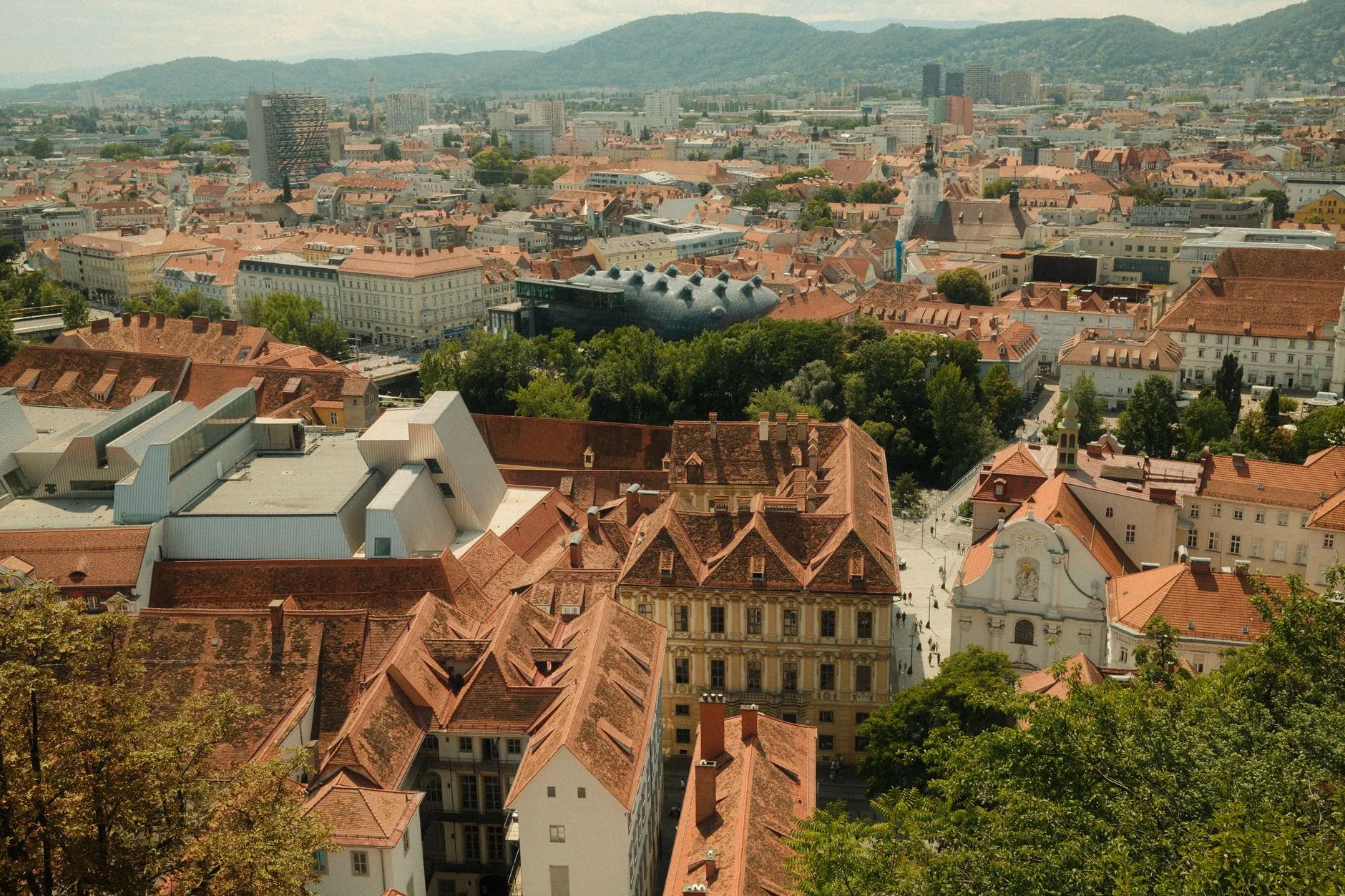
Graz’s Altstadt is a UNESCO World Heritage site — one of the best-preserved Renaissance and Baroque town centres in Central Europe. The Schlossberg hill rises over the centre, topped by the Uhrturm, the 16th-century clock tower that is the city’s visual anchor. You reach it by funicular, by a glass lift cut into the rock, or on foot up the steps. The view over the red-roofed old town is the reason to go.
Down by the River Mur, two relics of Graz’s 2003 year as European Capital of Culture: the Kunsthaus Graz, a bulbous blue contemporary-art museum that the city has always called the “Friendly Alien,” and the Murinsel, a floating steel platform-and-café moored in the river. Eggenberg Palace, on the western edge of the city, is part of the same UNESCO listing as the Altstadt.
Layover Math
The S5 is twelve minutes to the Hauptbahnhof, plus a short tram to Hauptplatz. Return security buffer at a small regional airport: 90 minutes is safe, 60 is tight.
- 4+ hours: Altstadt, Schlossberg and Uhrturm (by lift or funicular), exterior of the Kunsthaus, and the Murinsel — all comfortably covered.
- 3 hours: A quick look at the old town and the clock tower. Doable, not relaxed.
- Under 3 hours: Stay airside. The maths doesn’t work.
Graz is compact and the transit is fast, so even a borderline layover is less stressful here than at a city with a 40-minute airport transfer. But “the transit is only 12 minutes” is not an invitation to cut the buffer — security at small airports can still produce queues.
💡 Funicular vs. lift vs. steps — the honest take
The glass lift (Schlossberglift) is the fastest way up and costs a small fee. The funicular is more atmospheric and roughly the same price. The steps are free and take about 15 minutes. For a layover, the lift is the right call — you want the view, not the workout.
🧭 Before You Go
- Take the S5, not a taxi, unless you’re going somewhere off the tram network or arriving after the last service.
- Lounge QR landside first. The entry invitation comes from the Information Desk near Check-in 1, before security. This is not optional and is not obvious from the signage.
- Cash. Austria is fairly cash-friendly. Draw euros from a bank ATM; the airport bureau de change will give you a worse rate. Cards are widely accepted in the city, but having €20–30 on hand avoids friction with smaller places.
- Reduced-mobility assistance is free under EU rules but must be booked through your airline at least 48 hours before departure. The meeting point is signed in the terminal.
❓ Frequently Asked Questions
📊 At a Glance — GRZ 2026
| Feature | Detail |
|---|---|
| Official name | Flughafen Graz (Graz-Thalerhof) |
| IATA / ICAO | GRZ / LOWG |
| Location | ~10 km south of Graz, Styria |
| Annual passengers | ~1 million (hub-feed / business) |
| Terminals | 1 |
| Train to centre | S-Bahn S5, Flughafen Graz-Feldkirchen → Graz Hauptbahnhof, ~12 min, ~€3.00 (Zone 101) |
| Taxi to centre | ~€25–30, ~15–20 min |
| Currency | Euro (€) |
| Schengen | Member; EES live 10 April 2026; ETIAS pending |
| Lounge | Graz Airport VIP Lounge — Priority Pass / DragonPass / Diners Club; €30 walk-in; QR collected landside; ~05:30–20:00 |
| Dominant carriers | Austrian, Eurowings, Lufthansa, SWISS, Air Dolomiti |
| Best layover option | S5 to Hauptbahnhof + tram to Altstadt / Schlossberg (requires 4 hr+ layover) |