Sarajevo International Airport (SJJ) — Airport Guide 2026
Quick Reference
Sarajevo International Airport (Aerodrom Sarajevo)
SJJ / LQSA
Sarajevo, Bosnia and Herzegovina
Butmir, about 12 km southwest of central Sarajevo
One passenger complex (Terminals A and B)
About 2.2 million passengers, up roughly 20% year-on-year
Bosnia and Herzegovina — not EU, not Schengen; own visa regime; no EES or ETIAS
Convertible mark (KM / BAM), pegged to the euro at 1 EUR ≈ 1.96 KM
Airport Bus 5 KM (about 30 min) or taxi around 20 KM
One airside business lounge (Priority Pass / DragonPass / Diners Club)
Wizz Air, Ryanair, Turkish Airlines — no national flag carrier
🛫 1. Why Sarajevo got cheap to fly to
Sarajevo airport is in the busiest stretch of its history, and the reason matters if you are the one buying the ticket. It cleared about 2.2 million passengers in 2025, up more than 20% in a year, and the engine is low-cost. Wizz Air restored Sarajevo flying in late 2025, Ryanair has been growing fast and is openly being courted as a based carrier, and the Sarajevo Canton put up a €1.5 million incentive to attract new routes for summer 2026. The airport is building out dedicated low-cost terminal facilities and aiming for roughly 41 destinations by summer 2026.
For a traveller that cuts two ways. Fares into SJJ from European cities are the lowest they have been in years. The flip side is that a terminal built for a quieter airport now handles peak-summer LCC banks, so the security line and the small landside hall can back up on busy mornings. Treat it as a cheap-to-reach destination airport that is growing faster than its concrete.
For fare-hunters: this low-cost surge is exactly why Sarajevo got cheap to reach. The catch is that the nonstop bargains come from a limited set of European cities — check whether your origin has a direct Wizz Air, Ryanair or Pegasus route before assuming the low headline fare applies to you.
🛬 2. The terminal
One passenger complex, split into the older Terminal A and a renovated Terminal B that added landside and airside cafés and restaurants. It is small and walkable end to end. There is a single security screening point, and that is the choke: in a summer morning bank of LCC departures it backs up, so allow two hours for a low-cost flight in peak season and about ninety minutes off-peak. Airside is compact — a few cafés, a duty-free, the lounge, and the gates a short walk away. Nothing here rewards arriving early beyond the queue insurance.
✈️ 3. Carriers, and what that means for your booking
Bosnia has had no flag carrier since B&H Airlines ceased flying in 2015, and the route map reflects that. Three kinds of airline now use Sarajevo:
- Low-cost, point-to-point: Wizz Air, Ryanair and Pegasus run cheap nonstops to a rotating set of European cities. New leisure entrants for 2026 include Transavia France (Paris-Orly) and Eurowings (Berlin).
- Legacy one-stop feed: Austrian Airlines (Vienna), Lufthansa (Munich, Frankfurt), Turkish Airlines (Istanbul), Croatia Airlines (Zagreb) and Air Serbia (Belgrade) connect Sarajevo to the rest of the world through their hubs.
- A single Gulf link: flydubai (Dubai).
The practical read: if your city has a direct LCC, the fare is cheap and the flight is nonstop. If it doesn’t, you connect once — through Vienna, Istanbul, Munich, Zagreb or Belgrade. There is no long-haul service, so anything intercontinental is a one-stop itinerary. Check whether a fare routes you through Belgrade or Zagreb if onward visa or transit rules matter to you.
🛂 4. The border: Bosnia’s own system
Bosnia and Herzegovina is not in the EU and not in Schengen, and it runs its own entry regime. Citizens of the EU/EEA, the UK, the US, Canada, Australia and many other countries enter visa-free for up to 90 days in any 180-day period. Passport control is manual and stamped by hand.
EES and ETIAS are EU border systems with no bearing here — Bosnia sits outside both the EU and Schengen. A Schengen visa alone won’t admit you, and ETIAS, the Schengen pre-authorisation has no confirmed launch date, is for entering Schengen countries rather than Bosnia.
One local quirk worth knowing: foreigners are technically required to register their address with the police within a few days of arrival. Any hotel does this for you automatically. If you stay in private accommodation, confirm your host registers you.
On money, the convertible mark (KM, currency code BAM) is the only legal tender, fixed to the euro at roughly 1 EUR to 1.96 KM. Carry KM. ATMs in the terminal dispense it, and while a few places near the airport will take euros, the rate you get doing that is poor. Card acceptance is normal in the city; some smaller spots and the Tunnel Museum are cash-only.
🚌 5. Getting to the city, and the honest math
The airport is 12 km from the centre. Two sensible options:
- Airport Bus — 5 KM one-way, 8 KM return, roughly 30 minutes to the centre and the main bus station. It runs to a timetable built around flight banks rather than a frequent clock-face service, so check the schedule on sarajevo-airport.ba before relying on it. If your flight lands between buses, you wait.
- Taxi — the city tourism board quotes around 20 KM to the centre. Use the official rank outside arrivals and expect roughly 15–25 KM (about €8–13) for 20–30 minutes.
Avoid the arrivals taxi overcharge: the official rank runs about 15–25 KM to the centre. A driver quoting 50 KM or more, or refusing to run the meter, is working the classic airport scam — walk to the next car.
There is no train and no tram to the terminal. The nearest tram terminus, Ilidža on line 3, is a few kilometres away and not worth dragging luggage to.
The layover question barely applies, because almost nobody transits Sarajevo — you arrive here, you don’t connect here. It is a single terminal, so a self-transfer between two separate bookings is mechanically simple, but the route map gives you little reason to. If you booked a cheap LCC into SJJ to continue overland into the region — Mostar, Belgrade, Dubrovnik — budget the 20–30 minute hop to the main bus station plus your onward coach, and don’t cut it fine against an evening departure.
🛋️ 6. Lounge
There is one airside business lounge, marketed under a couple of names, on the second floor. It accepts Priority Pass, DragonPass and Diners Club, runs roughly 05:00 to 22:00 with a three-hour stay cap, and offers wifi, drinks and a quiet area. Verify hours and your card’s current acceptance before you count on it, as small-airport lounge contracts change. Outside it, your options are the Terminal B cafés.
🍽️ 7. Food, and what’s worth carrying home
Inside the airport the food is limited and marked up — cafés and a couple of restaurants in Terminal B, fine for a coffee and a bureka, not a reason to linger. The real eating is in town. A plate of ćevapi — grilled minced-meat fingers served in somun flatbread with raw onion — runs under 10 KM at the Baščaršija grills, and Bosnian coffee arrives in a small copper džezva with a cube of sugar and rahat lokum on the side.
To carry home, skip the airport shelf and buy in the old town: ground Bosnian coffee and a hand-beaten copper džezva from the Kazandžiluk coppersmiths’ lane, and a box of rahat lokum. The airport duty-free will sell you a worse version of all of it at a worse price.
🏛️ 8. The reason this airport is worth a detour
You landed on top of the city’s wartime lifeline. During the 1992–95 siege, an 800-metre tunnel ran beneath this runway, linking encircled Sarajevo to free territory at Butmir — the airport’s own neighbourhood.
The tunnel carried supplies and fighters into the city and the wounded out for the length of the siege, and it is the single reason Sarajevo held. The Bosnian army dug it by hand in 1993, under the UN-controlled runway that split the besieged city from its one corridor to free ground.
The Tunnel of Hope museum (Tunel spasa) sits at the Butmir end, a short taxi from the terminal in the same neighbourhood. It preserves about 25 metres of the original tunnel alongside siege exhibits. Entry is 20 KM, cash only; hours are 08:30–17:30 in summer and 09:00–16:00 in winter (verify before travel). If you have a few hours before a flight, it is the rare airport-adjacent sight genuinely worth the trip — and you landed on top of it. Book a metered taxi out-and-back rather than one of the marked-up “private war tour” packages that bundle the same 20 KM ticket into a much larger bill.
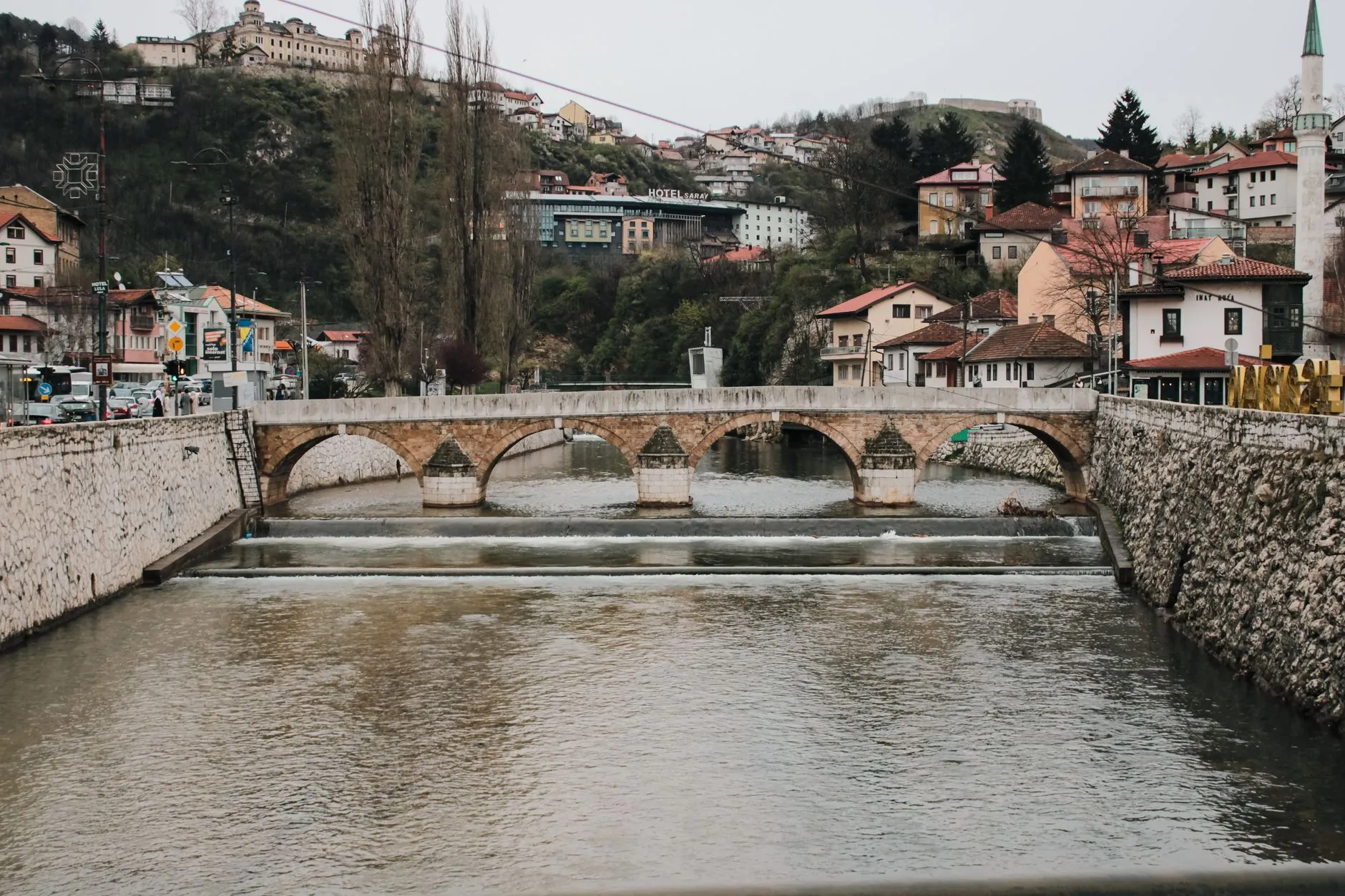
If you are actually staying, the city is compact: the Ottoman bazaar at Baščaršija, the Latin Bridge where the 1914 assassination of Archduke Franz Ferdinand triggered the First World War, and the siege-era sites all sit within a 20-minute walk of one another.
❓ 9. FAQ
📋 10. At a glance
| Item | Detail |
|---|---|
| Airport | Sarajevo International (SJJ / LQSA), Butmir |
| Distance to centre | 12 km |
| Airport Bus | 5 KM one-way, 8 KM return, about 30 min; flight-based timetable |
| Taxi | About 15–25 KM (€8–13), 20–30 min; use the official rank |
| Rail/tram | None to the terminal |
| Border | Bosnia and Herzegovina; not EU/Schengen; 90/180 visa-free for most; no EES/ETIAS |
| Currency | Convertible mark (KM/BAM), pegged ~1.96 to the euro; carry cash |
| Lounge | One airside business lounge; Priority Pass / DragonPass / Diners Club; ~05:00–22:00 |
| Terminal | Single complex (A and B); one security line — arrive 2h in summer peak |
| Carriers | Wizz Air, Ryanair, Pegasus, Turkish, Austrian, Lufthansa, Croatia, Air Serbia, flydubai |
| Airport-adjacent sight | Tunnel of Hope museum, Butmir — 20 KM cash, summer 08:30–17:30 |
🔗 11. Explore More
- Zagreb Airport (ZAG) guide — the Croatia Airlines connecting point for Sarajevo
- Vienna Airport (VIE) guide — the main Austrian/Star Alliance one-stop hub for Sarajevo