Skopje International Airport (SKP) — Airport Guide 2026
Skopje is a small capital-city airport having a big moment: a record 3.2 million passengers in 2025, up nearly 9%, almost all of it riding on Wizz Air. That growth isn’t an accident — the North Macedonian government pays the airline to fly here, which is why a country of two million suddenly has 36 Wizz routes across Europe. For the traveller that means cheap fares and a lot of European connections, but also a near-monoculture you should plan around. The other thing worth knowing up front: North Macedonia is not in the EU or Schengen, so the border, the currency and the rules are its own. This guide sticks to the operational side.
Quick Reference
Skopje International Airport
SKP / LWSK
Skopje, North Macedonia
3,211,419 — a record (up 8.7%)
TAV Airports (Groupe ADP)
About 20 km east (≈30–40 min)
None
Vardar Express shuttle (MKD 199, ~€3.20) or taxi
Primeclass Business Lounge (Priority Pass; 24/7)
Wizz Air (the base; ~36 routes)
Macedonian denar (MKD)
NOT EU/Schengen; visa-free 90 days for EU/UK/US/CA; no EES/ETIAS
🛫 1. What’s happening: subsidised Wizz growth and a record year
Skopje’s numbers are climbing fast, and the engine is explicit. Wizz Air bases aircraft here and now connects the airport to around 36 destinations, helped by a North Macedonian government subsidy — roughly €9 per arriving passenger on newly launched routes, running 2025 to 2027. That money is why the route map keeps adding cities (Palermo, Alghero, Stockholm, Bari, Madrid, Prague, Cologne and more announced for 2026), and why 2025 set a passenger record.
✈️ What the Wizz monoculture means for you
The upside is real: lots of cheap European connections, especially to the Macedonian diaspora hubs in Germany, Switzerland, Italy and the Nordics. The catch is concentration — when one ultra-low-cost carrier dominates an airport, you’re playing by its rules on bags and fees, and there’s little fallback if a route is cut or a flight goes wrong.
Two practical consequences. First, price the Wizz bag and seat add-ons into your fare, because the headline number is rarely what you’ll pay. Second, treat subsidised routes as potentially short-lived — a city that appeared this year on the back of the subsidy can vanish when the economics change, so don’t assume a niche route will still be there next season.
Alongside Wizz you’ll find Pegasus and Turkish carriers feeding Istanbul, and a scattering of others, but the airport’s character is overwhelmingly low-cost and point-to-point. Almost no one connects here; you’re arriving in or leaving Skopje.
In practice that makes SKP a diaspora-and-budget airport more than a tourism one — a large share of the traffic is North Macedonians travelling to and from jobs and family across Western Europe. The peaks follow that rhythm rather than a beach calendar: heavy in summer and around the holidays, with the early-morning and late-night Wizz departures the busiest windows to avoid if you can.
🛂 2. The border: North Macedonia, not the EU
This is the part people get wrong by assuming the Balkans means Schengen. North Macedonia is outside the EU and Schengen, uses its own currency, and runs its own entry rules.
A useful quirk for long-trip travellers: because North Macedonia sits outside Schengen, your 90 days here don’t count against your Schengen allowance. It’s a legitimate place to spend time while your Schengen clock resets — a genuine reason some long-stay travellers route through Skopje.
Entry itself is quick — a passport check and through, with no biometric registration and no tourist card to complete. Pick up some denar on arrival for the shuttle or a taxi, but the exchange rates in town beat the airport’s, so change only what you need at the terminal rather than converting a large sum there.
🚌 3. Getting into Skopje
The airport is about 20 km east of the city, near Petrovec, a 30–40 minute trip. There’s no rail link, so it’s the shuttle or a taxi.
Don’t take an unmarked “taxi” tout in the arrivals hall. The licensed firms are cheap and metered, and the worst overcharging at SKP comes from the freelancers who approach you before you reach the rank. Use the marked taxis or the Vardar Express, and the trip is a non-issue.
The Vardar Express runs to the flight schedule rather than a fixed clock, so check it lines up with your arrival; if you land in a gap between services, a licensed taxi is the sane fallback rather than a long wait at the stand. Heading back out, leave a buffer for Skopje’s traffic, which can be heavy on the airport road at peak hours.
There is no train to or from the airport, and city buses don’t serve it usefully for a visitor with luggage, so plan on the shuttle or a taxi rather than the public network.
🛋️ 4. Lounges
For a small airport, Skopje is well covered by one good lounge. The Primeclass Business Lounge sits after passport control in the international terminal and is open 24 hours, which suits the early-morning and late-night low-cost schedule. Access comes via Priority Pass, DragonPass or TAV Passport, or a paid day pass (around €42). It’s a comfortable spot with Wi-Fi, refreshments and proper seating — genuinely useful if you’ve a long wait on either end of an awkwardly-timed low-cost flight.
Without lounge access, the terminal itself is small and plain — a handful of cafés and shops airside — so a long layover is best handled either by the lounge or by timing your arrival so you’re not stuck for hours in a compact departures hall. It’s a functional airport, not a place to linger.
🍽️ 5. Food and what to carry home
Don’t plan a meal airside — it’s the usual limited terminal fare. Eat in Skopje instead, where the strength is grilled meat (the kebapi of the Old Bazaar) and the Balkan staples. The honest things to carry home are Macedonian: a bottle of the country’s well-regarded red wine (Vranec is the local grape), ajvar (the red-pepper relish) and, if you drink it, a bottle of rakija. Buy any liquids airside after security if you’re flying cabin-only on Wizz.
🏙️ 6. Skopje, briefly
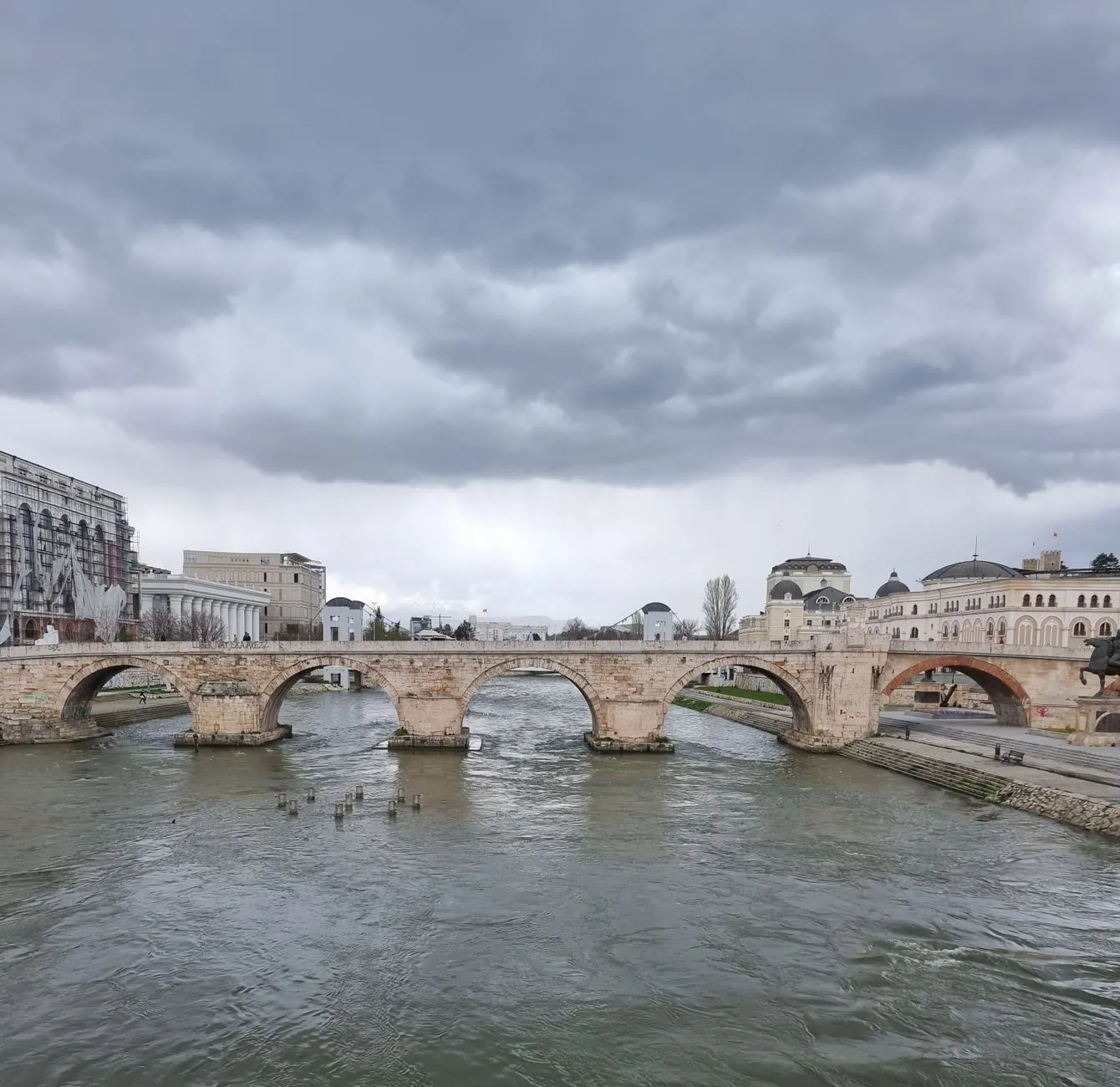
Skopje is an odd, interesting city, and worth a stop rather than a rush to the airport. The Old Bazaar (Čaršija) on the east bank of the Vardar is one of the largest in the Balkans, a maze of craft shops, mosques and old caravanserais running up from the Ottoman Stone Bridge to the Kale fortress above. Mother Teresa was born here, with a memorial house in the centre. The honest talking point is the “Skopje 2014” makeover — a government project that filled the centre with neoclassical façades and hundreds of statues, including a giant warrior-on-a-horse; you’ll either find it striking or baffling, and plenty of locals are in the second camp.
The standout day trip is Matka Canyon, about 30 minutes west — a gorge with medieval monasteries, a reservoir lake and boat trips to a cave, and the best half-day in easy reach of the city. It’s the one excursion worth building in if your schedule allows.
❓ Frequently asked questions
📊 Skopje Airport (SKP) at a glance — 2026
| Item | Detail |
|---|---|
| Codes | SKP / LWSK |
| 2025 passengers | 3,211,419 (record, +8.7%) |
| Operator | TAV Airports (Groupe ADP) |
| Distance to centre | ~20 km east (≈30–40 min) |
| Vardar Express shuttle | MKD 199 (~€3.20), 30–40 min |
| Taxi | MKD 800–1,200 (€13–20); use reputable firms |
| Rail | None |
| Lounge | Primeclass Business Lounge (Priority Pass/DragonPass; 24/7) |
| Dominant carrier | Wizz Air (base; ~36 routes, subsidised) |
| Currency | Macedonian denar (MKD) |
| Visa | Visa-free 90 days for EU/UK/US/CA |
| EES/ETIAS | Do not apply (outside the EU/Schengen) |
Explore more
- Cheap flights to Skopje: current tracked fares into SKP across Europe.
- Balkan airport guides: operational guides to nearby gateways including Thessaloniki and Zagreb.