Pointe-à-Pitre Pôle Caraïbes Airport (PTP) — The Complete Master Guide 2026
The only Caribbean airport where you pay in euros, drink Châteauneuf-du-Pape with grilled lambi, and clear French immigration alongside passengers continuing to Paris — Guadeloupe’s gateway to two-island Grande-Terre and Basse-Terre, plus the Saintes archipelago.
Quick Reference
Pôle Caraïbes is one of two French Caribbean airports in the same league (Martinique’s FDF is the other) and shares its route map almost entirely with Paris — Air France runs a daily widebody from CDG, Air Caraïbes does the same from Orly, Corsair adds a third option also from Orly, and the rest is regional turboprop traffic to Saint Martin, Martinique, and the Saintes. Outside the Paris-Pointe-à-Pitre corridor, the airport is quiet: think 10-minute security at 13:00, plenty of duty-free time, and a single arrivals-baggage hall.
Table of Contents
🏢 1. Terminals & Pôle Caraïbes Architecture
Pôle Caraïbes is a single passenger terminal opened in 1996 and substantially renovated 2014–2018 after Hurricane Maria’s damage was rectified. It runs on a clean two-level scheme: arrivals on the ground floor, departures upstairs, with one airside concourse running the length of the building. Twelve jet bridges plus four hardstand positions handle a peak of around 25 movements per hour during the December–April high season.
Departures level — check-in, security, the airside curve
Sixty-eight check-in counters split into Air France/SkyTeam (counters 1–24), Air Caraïbes (25–38), Corsair (39–52), and regional LIAT 2020 (53–68). Two security lanes — standard and family/reduced-mobility — both ICAO 100ml liquid rules. Passport control for non-EU departures runs four lanes; EU passports use the e-gate (PARAFE) with biometric scanning since 2019.
Arrivals — the post-flight reality
Three baggage carousels handle widebody arrivals (typically 350 bags off a 787 Air France); two smaller carousels for narrowbody and regional. Customs runs the green/red split. Anyone arriving from outside the EU customs area faces a 200-euro duty-free allowance — significantly tighter than US arrivals. After customs you exit directly into the landside hall with taxi rank, rental cars, and a small Carrefour Express for SIM cards.
Connecting flights — the regional turboprop split
Pôle Caraïbes is the regional turboprop hub for the post-2020 LIAT relaunch (LIAT 2020, ATR service to Antigua and Montego Bay), with Air Caraïbes covering the inter-island routes to Martinique (FDF), Saint Martin (SXM) and Saint-Barthélemy (SBH). These flights board from a remote stand reached via a 4-minute apron bus from the main concourse. International-to-regional connections need 90 minutes minimum because you collect bags landside and re-check at the regional counter.
Family services, accessibility, lost-luggage office
Three baby-change rooms (one airside near gate 11, two landside). One quiet/sensory room added in 2023 near departures-level mezzanine. Wheelchair assistance via Air France Service Plus or directly with airline 48 hours pre-flight. Lost-luggage office (BD-Air) on arrivals level near baggage claim 2; English-language service 06:00–22:00 daily.
Editor’s note — Pôle Caraïbes does not feel French in the way a Schiphol or a CDG do — it is markedly more Caribbean: pastel walls, ceiling fans even when air conditioning runs, locally-made signage, occasional Creole over the PA. But the procedures are unambiguously French: the queues are orderly, the security is correct, the immigration is unhurried but never delayed. Plan 90 minutes door-to-gate for an Air France or Air Caraïbes departure and you’ll have time for a coffee and a pain au chocolat at the post-security café.
🛂 2. Visa, Currency & Sargassum — The OMR Reality
Visa-free entry — same rules as mainland France
USA, Canada, UK, EU/EEA, Switzerland, Japan, Singapore, South Korea, Australia, New Zealand, Israel, and most of Latin America enter visa-free for 90 days. Required: passport valid 3 months past departure (the EU rule, stricter than the Caribbean 6-month norm), proof of funds (~50 EUR/day evidence), return ticket.
Currency — Euro, ATMs, card culture
Currency is the Euro. ATMs are everywhere; Visa/Mastercard accepted at all hotels, restaurants, supermarkets; AMEX accepted at most upscale spots. Cash useful for: small bakeries, market stalls (Marché Saint-Antoine in Pointe-à-Pitre), and rural beach restaurants. Tipping: 10% standard at restaurants but service is included by law (“service compris”) — it’s a thank-you, not an obligation. ATM fees: typically 2–3 EUR per withdrawal from non-French banks.
Sargassum — the April-to-August reality
Brown sargassum seaweed has been arriving on Caribbean beaches in increasing volumes since 2011, peaking April-August. Guadeloupe’s southeast coast (Le Moule, Saint-Anne south, Saint-François northeast) gets the worst; the western Basse-Terre coast and the Pigeon Island reserve are largely spared. The local prefecture publishes a daily forecast at guadeloupe.developpement-durable.gouv.fr. Resorts have varying clear-up policies; some clean daily, some don’t.
🚚 3. Transport — From PTP to Le Gosier, Basse-Terre & the Saintes
Pôle Caraïbes is unusually close to its city: 3 km from Pointe-à-Pitre proper, 6 km from the resort coast at Le Gosier, 35 km from Sainte-Anne, 80 km from the southern tip of Basse-Terre. The two main islands (Grande-Terre and Basse-Terre) are connected by a 1-km bridge over the Rivière Salée. Add ferry connections to the Saintes (35 minutes from Trois-Rivières) and Marie-Galante (45 minutes from Pointe-à-Pitre), and you have an unusually well-connected island chain.
Taxi — metered, regulated, surprisingly affordable
Government-regulated rates: 18–22 EUR airport to Pointe-à-Pitre centre; 25–30 EUR to Le Gosier; 45–55 EUR to Sainte-Anne; 90–120 EUR to Saint-François or Trois-Rivières. Surcharges of 25% nights/Sundays/holidays. Fixed flat-rate boards posted at the rank. Drivers all accept cash; most accept card via Pulse/Sumup wireless terminals.
Rental car — near-essential for multi-area trips
All major chains landside (Hertz, Avis, Europcar, Sixt, Budget, Enterprise) plus local Jumbocar (cheapest, often the best deal). Economy from 28 EUR/day, mid-size SUV 40–55 EUR. Driving on the right (French), all signage in French, fuel ~1.65 EUR/litre. Insurance: bring credit-card CDW or buy at counter (10–15 EUR/day extra). Free toll system — no tolls in Guadeloupe. Roads are good but mountainous in Basse-Terre.
Public bus (TC) — affordable but limited reach
Karib’Bus (formerly TC, the local transport authority) runs lines connecting the airport to Pointe-à-Pitre central station (1.50 EUR, 25 minutes, every 20 minutes 06:00–19:00) and to Le Gosier (2.00 EUR, 35 minutes, every 30 minutes). From Pointe-à-Pitre, transfers reach Sainte-Anne, Saint-François, and Basse-Terre town — but service can be sparse (1 every 60 minutes off-peak) and Sundays are skeletal.
Ferries — the Saintes, Marie-Galante, La Désirade
Ferries to outer islands depart from Pointe-à-Pitre’s Bergevin pier or from Trois-Rivières (south coast Basse-Terre). Saintes from Trois-Rivières: 35 minutes, 25–32 EUR return. Marie-Galante from Pointe-à-Pitre Bergevin: 45 minutes, 35–45 EUR return. La Désirade from Saint-François pier (east coast Grande-Terre): 45 minutes, 30 EUR return. All operate roughly 4–6 round-trips daily; reduced Sundays.
Practical — A 7-day Guadeloupe trip pretty much requires a rental car if you want to see both Grande-Terre beaches and Basse-Terre rainforest/volcano. Taxi-only works if you’re Le-Gosier-resort-based and don’t plan to leave the resort area. The ferry to the Saintes is the single best day-trip in Guadeloupe and is worth the early start — first ferry Trois-Rivières 06:30, last return 17:30.
🛍️ 4. Lounges — Air France, Salon Caraïbes & Pay-Per-Use
Pôle Caraïbes runs three lounges plus a small premium-class bar — modest by mainland-French airport standards but plenty for the route map. Two are airline-operated (Air France Salon, Air Caraïbes Salon Caraïbes) and one is independent (the Bessie Coleman VIP Lounge, the Priority Pass / pay-per-use option).
Air France Salon — SkyTeam Elite Plus and business
Located post-security on the airside concourse, near gate 6. Open during Air France schedule windows (typically 09:00–13:00 for the daily 11:00 CDG departure). Access: Air France business class, Flying Blue Platinum and Gold (when traveling SkyTeam), SkyTeam Elite Plus on same-day SkyTeam departure. Capacity ~50. Continental breakfast, full bar, free Wi-Fi 50 Mbps, two showers, separate quiet zone.
Salon Caraïbes (Air Caraïbes) — smaller but well-kept
Located post-security near gate 9. Open 12:00–15:00 for the daily 14:30 Orly departure (sometimes also 06:00–09:00 for the 08:00 outbound). Access: Air Caraïbes business and Madras Plus elite, Madras Voyageur Frequent Flyer Gold, paid access for premium-economy with 30 EUR upgrade. ~30 capacity, hot Caribbean dishes (colombo, accras), local rum (Damoiseau, Bologne) on tap, espresso machine.
Bessie Coleman VIP Lounge — Priority Pass and walk-in
Independent lounge on the second floor of Terminal 1, by gate 6, for international departures only. Open Monday to Thursday, Saturday and Sunday, roughly 13:30–20:30; closed Fridays. Priority Pass and Diners Club accepted; a walk-in fee is usually available. Showers, snacks, drinks and free Wi-Fi.
Showers, prayer rooms, smoking
The Bessie Coleman VIP Lounge has showers for lounge users. One single-stall multi-faith prayer room landside near departures check-in. No formal Christian chapel. Strict no-smoking inside the terminal (French law); designated outdoor smoking areas outside arrivals doors and outside check-in entrance. Vaping rules same as cigarettes — outside only.
Lounge math — Air Caraïbes Madras Plus elite tier remains the most-overlooked frequent-flyer status for Guadeloupe-bound travelers because it grants Salon Caraïbes access plus priority boarding and free hold-bag — achievable at three round-trips Paris-Pointe-à-Pitre per year. Priority Pass via credit card (Chase Sapphire Reserve, Amex Platinum) is the easiest no-airline route; one airport visit pays for half a year of Priority Pass annual fee.
🥩 5. Food, Duty-Free & the Ti-Punch Question
Airport food at Pôle Caraïbes punches above its weight because Guadeloupe takes food seriously — the airport has two full-service restaurants serving Creole plates, two cafés running French pastry-and-coffee culture, and a duty-free zone that rotates Damoiseau rum, Bologne rum, and a respectable selection of French wines and cheeses bound for export to mainland France.
L’Atelier Créole — the airside Creole kitchen
Located airside near gate 8. Full sit-down Creole plates: colombo de cabri (goat curry, 18 EUR), accras (cod fritters, 9 EUR), boudin créole (Creole blood sausage, 12 EUR), bokit (Creole sandwich with chicken or fish, 12 EUR), poulet boucané (smoked chicken, 14 EUR). Service efficient, plates substantial, kitchen open 06:00–22:00. The bokit alone is worth a 30-minute pre-flight detour.
Café Excelsior — the French croissant standard
Located landside near departures level. Standard French airport café: pain au chocolat (1.80 EUR), croissant (1.50 EUR), espresso (1.40 EUR), café crème (2.20 EUR), tartines, baguettes with ham/Brie. Service is brisk; plates are honest. The pain au chocolat is laminated in Guadeloupe (not flown in from mainland) and tastes the same as a CDG one.
Local plates worth flying for — if you know what to ask for
Colombo: French Caribbean curry, originated from Tamil indentured laborers, made with fresh masala and slow-cooked goat or chicken — the signature Guadeloupean dish. Accras: salt-cod fritters, served as appetizer everywhere. Boudin: blood sausage with Caribbean spices. Christophine gratin: chayote-squash gratin, vegetarian classic. Tarte coco: coconut tart for dessert. All available at L’Atelier or, with 90 minutes, at Marché Saint-Antoine in central Pointe-à-Pitre (5km, 12 EUR taxi).
Duty-free — rum is the answer
The serious duty-free buy is Guadeloupean agricultural rum (rhum agricole). Damoiseau VSOP, Bologne Vieux, Père Labat from Marie-Galante — all distilled from fresh sugarcane juice (not molasses), aged in oak. 18–45 EUR per 700ml bottle. Cheaper than most equivalents in mainland France because of OMR tax structure. The blue Damoiseau bottle is the most-recognized export.
Eat-and-fly — Don’t leave PTP without one bokit and one Damoiseau. The bokit is your last Creole hot meal before Paris-airport food; the Damoiseau is the most generous-priced French Caribbean rum you’ll find. If your timetable allows, taxi to Marché Saint-Antoine and back in 90 minutes for the real plate — otherwise L’Atelier Créole is a fair substitute.
💡 6. Insider Tips — Beyond Le Gosier Resort
Most first-time travelers stay in Le Gosier (eastern Grande-Terre, 6 km from the airport) because that’s where the resort cluster is. That’s the safe play but it’s only one Guadeloupe. The other Guadeloupe is the Basse-Terre rainforest, the Soufrière volcano, the Saintes ferry, and the Marie-Galante windmills — and almost none of that requires longer than 60 minutes from the airport. Here’s what locals plan around.
Hurricane risk — Maria 2017 and the planning calendar
Guadeloupe is squarely in the hurricane belt. Hurricane Maria (September 2017) caused 30M+ EUR damage to PTP terminal infrastructure; recovery work continued through 2018. Recent significant events: Lee 2023 (graze, no damage), Beryl 2024 (passed south of Guadeloupe but caused Marie-Galante and Saintes ferry suspensions). Peak risk September-October. Trip insurance for hurricane-season Guadeloupe travel runs 6–9% of trip cost — budget for it.
Spirit Airlines collapsed — route reality
Spirit’s shutdown in May 2026 removed Fort Lauderdale-Pointe-à-Pitre (FLL-PTP) from the schedule — the only US-direct option from Florida. JetBlue has not yet announced a replacement; American does not currently fly Miami-PTP. US travelers in 2026 effectively reach Guadeloupe via CDG (Air France) or Orly (Air Caraïbes/Corsair) connections from JFK, BOS, MIA, ATL. Air Caraïbes and LIAT 2020 provide regional Caribbean-only routing between Guadeloupe, Martinique (FDF), Saint Martin (SXM) and Antigua (ANU).
Two-island geography — Grande-Terre vs Basse-Terre
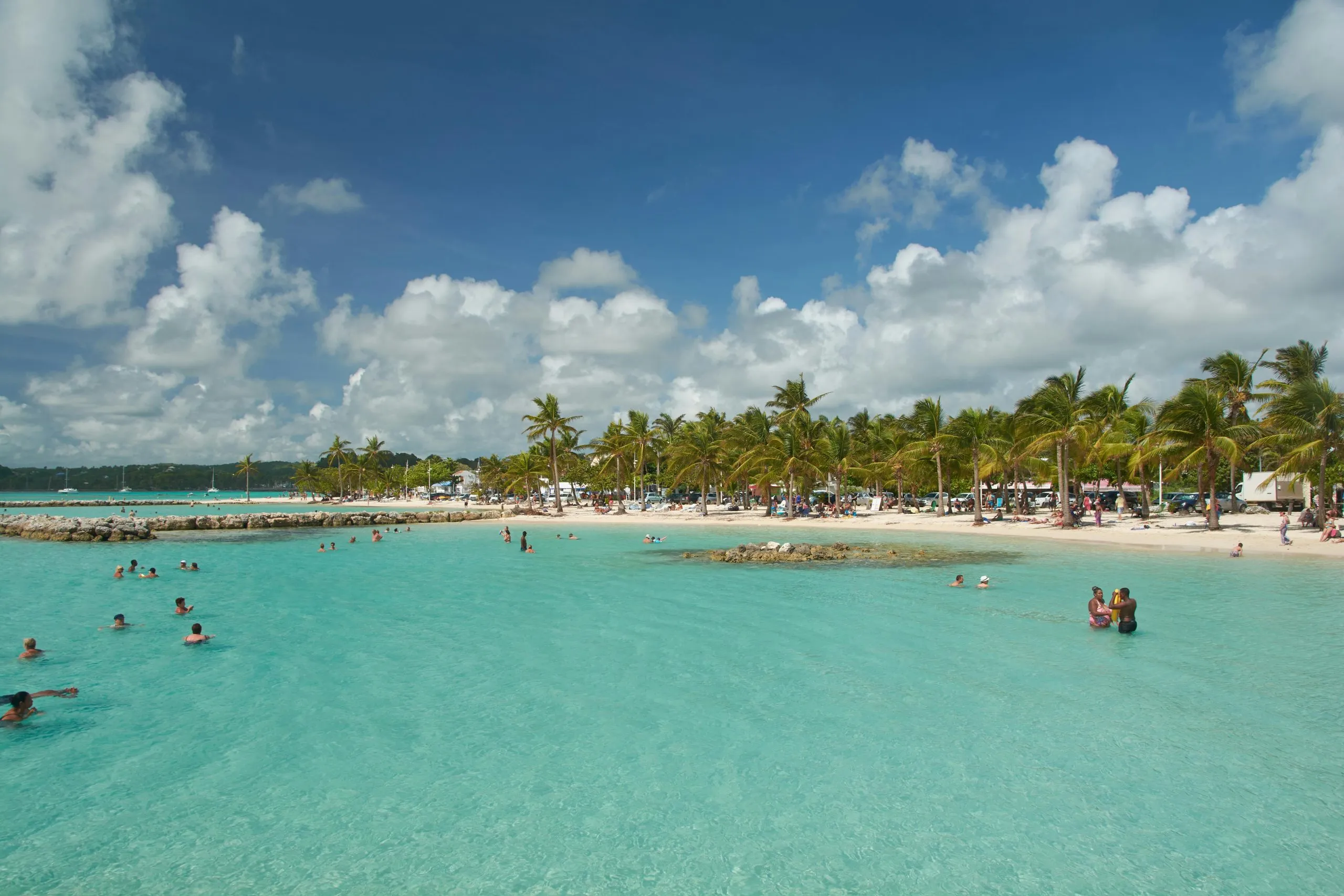
Grande-Terre (eastern, flat, calcareous) holds the resorts (Le Gosier, Sainte-Anne, Saint-François), the airport, and the white-sand beaches. Basse-Terre (western, mountainous, volcanic) holds the Soufrière volcano, the rainforest national park, the famous Carbet waterfalls, and most of the dive sites including Pigeon Island Cousteau Reserve. The two islands are connected by a 1-km bridge over the Rivière Salée — technically two islands, practically one drive-around chain.
Saintes archipelago — the ferry that defines a holiday
The Saintes (Iles des Saintes) are eight small islands south of Basse-Terre, a 35-minute ferry from Trois-Rivières. The main island, Terre-de-Haut, has one village (Bourg des Saintes) and the most photographed beach in the French Caribbean (Pain de Sucre). No big resorts — small guesthouses (15 in total), three rental-bike shops, six restaurants. Day-trippable but worth one overnight.
The honest comparison — Guadeloupe versus Martinique is the eternal French-Caribbean question. Guadeloupe is bigger (~1,500 sq km vs ~1,100), more island-chain (Saintes/Marie-Galante/Désirade), more Creole-rural in feel. Martinique is smaller, more concentrated, more ‘Riviera-Caribbean’ in atmosphere with Fort-de-France as a real city. If you want diversity of experience — rainforest, volcano, multiple beach types, multiple ferry day-trips — Guadeloupe wins. If you want concentrated luxury and fewer driving hours, Martinique is the answer.
FAQ — Frequently Asked Questions
Eight questions French Caribbean first-timers ask most often, with current 2026 information.
Do I need a visa to visit Guadeloupe?
If you hold a US, Canadian, UK, EU/EEA, Swiss, Japanese, Singaporean, South Korean, Australian, New Zealand, Israeli, or major Latin American passport, you enter visa-free for 90 days. Required: passport valid 3 months past departure (the EU rule), proof of funds (~50 EUR/day), return ticket. Travelers from outside the visa-free list need a French Caribbean tourist visa from a French consulate — 4–8 week processing.
What currency does Guadeloupe use?
The Euro. Guadeloupe is an Outermost Region (OMR) of the European Union and uses the same currency as mainland France. ATMs are everywhere; cards accepted at all hotels, restaurants, supermarkets, and most beach establishments. AMEX accepted at most upscale spots. Cash useful for small markets and rural beach restaurants. Service is included by law (‘service compris’); 10% tip is appreciated but never expected.
Is Guadeloupe safe in hurricane season (June-November)?
Hurricanes are a real risk, especially September-October. The most recent significant event was Maria 2017 (Category 5, major damage), with Beryl in 2024 causing ferry suspensions but no direct hit. Trip insurance for June-November Guadeloupe travel runs 6–9% of trip cost — budget for it. Most resorts have free-rebooking policies for confirmed hurricane events. December-May is the safe window.
How do I get from PTP airport to Le Gosier?
Three options: (1) Taxi — 25–30 EUR fixed rate, 12 minutes; (2) Karib’Bus public bus — 2 EUR, 35 minutes, every 30 minutes 06:00–19:00; (3) Rental car — recommended for stays of 3+ days, all major chains on-site, economy from 28 EUR/day. Uber and Bolt do not operate in Guadeloupe; the regulated taxi system is the only on-demand option. Resort hotels in Le Gosier (Marriott La Toubana, Karibea Beach) offer pre-booked transfers for 35–45 EUR.
Are Uber, Lyft, and Bolt available in Guadeloupe?
No. Rideshare apps do not operate in Guadeloupe. Use the regulated taxi system (rate sheets posted at the rank), pre-booked private transfers via WhatsApp, or rent a car. Several resorts include airport transfers in package bookings — verify before paying separately for a taxi. The local equivalent for inter-island travel is the Karib’Bus public network plus the inter-island ferry system.
Is sargassum bad in Guadeloupe?
Yes, in season. Brown sargassum seaweed arrives in increasing volumes April-August, peaking in June-July. The southeast coast (Le Moule, Saint-Anne south, Saint-François northeast) is hit hardest; the western Basse-Terre coast (Pigeon, Bouillante, Deshaies) and the Saintes archipelago are largely spared. The local prefecture publishes a daily forecast at guadeloupe.developpement-durable.gouv.fr. If you visit April-August and want clean beaches, stay on the western coast or in the Saintes.
Can I fly from the US directly to Guadeloupe in 2026?
Not currently. Spirit Airlines’ collapse in May 2026 removed Fort Lauderdale-Pointe-à-Pitre (FLL-PTP), the only US-direct option from Florida. JetBlue has not announced a replacement; American does not fly Miami-PTP. US travelers in 2026 reach Guadeloupe via CDG (Air France from JFK, MIA, ATL, BOS) or Orly (Air Caraïbes from JFK, MIA) connections, or via Caribbean routing through Barbados (BGI) on Caribbean Airlines or LIAT 2020.
2026 Summary Data Table
The full 2026 reference table for Pointe-à-Pitre Pôle Caraïbes Airport at a glance.
| Feature | Detail |
|---|---|
| IATA / ICAO | PTP / TFFR |
| Country / status | Guadeloupe — French overseas department, EU Outermost Region (OMR) |
| Capital city | Basse-Terre (administrative); Pointe-à-Pitre is the largest city |
| Airport location | Les Abymes, ~3 km from Pointe-à-Pitre centre |
| Annual passengers (2024) | ~2.4 million |
| Single runway | 12/30 — 3,125 m (10,253 ft) |
| Major airlines (2026) | Air France, Air Caraïbes, Corsair, LIAT 2020 |
| Currency | Euro — full EU currency |
| Languages | French (official), Antillean Creole, limited English |
| Visa-free entry | USA, Canada, EU/UK, most Latin America — 90 days |
| Tourism tax | Included in airline ticket; ~3 EUR equivalent |
| US preclearance | No |
| Hurricane risk | Significant — Maria 2017 Cat 5; trip insurance 6–9% of cost |
| Sargassum season | April-August — eastern Grande-Terre worst, Basse-Terre/Saintes spared |
| Priority Pass / pay-per-use lounge | Bessie Coleman VIP Lounge — Priority Pass and Diners Club accepted |
| Rideshare apps | Not available — regulated taxi or pre-booked transfer |
This guide is current as of May 2026 and reflects the post-Spirit-collapse North American route map (no current US-direct, all routings via Paris CDG/Orly or Caribbean connections via BGI Barbados). For weekly route updates and Pointe-à-Pitre flight deals, follow our aifly.one main feed.