Harbin Taiping International Airport (HRB) — Airport Guide 2026
Harbin Taiping handled about 24.7 million passengers in 2025 — China’s 22nd-busiest airport — and the large majority of its international arrivals are headed to a park built from ice that exists for roughly ten weeks a year.
Quick Reference
HRB / ZYHB
~37 km southwest of Harbin city centre, Heilongjiang Province
T1 (international, rebuilt zone opened July 2024) and T2 (domestic, 2018) merged into one integrated terminal
China Southern; China Eastern + Sichuan Airlines also significant
No airport metro — shuttle bus ¥20 flat, taxi ~¥100–130, DiDi
240-hour transit (designated port) · unilateral visa-free · standard Chinese visa
Harbin municipal administrative area only
China Southern Gold/Silver/Elite Plus Lounge
Additional lounges — check the app for current list and terminal
Alipay / WeChat Pay dominant; link an overseas card before arrival
CNY (¥); ≈ ¥6.71/US$1, ≈ ¥7.82/€1 (September 2026)
~24.7 million (China’s 22nd busiest)
✈️ Terminals, Layout & Airlines
T1 and T2 at Harbin Taiping are now one integrated terminal. International flights moved into T1 on 12 July 2024, when the last departure left the old T0 building and T1’s rebuilt 47,000 m² international zone entered service; T2, which opened on 30 April 2018, carries domestic flights. International-to-domestic and domestic-to-international transfers are completed inside the same building. If you are self-transferring from an international arrival to a domestic departure — the most common pattern here, given how Russia, Korea and Southeast Asia feed into onward China connections — you will still clear the border, collect your bag and re-check it, but you no longer cross between separate buildings.
ℹ️ T1 and T2 have been one building since July 2024
The old separate international terminal, T0, stopped handling those flights on 12 July 2024. International and domestic transfers now run inside the integrated terminal. A self-transfer still means clearing immigration, collecting your bag and re-checking it, so budget for the border process itself rather than for a cross-airport move.
China Southern Airlines is the hub carrier. China Eastern and Sichuan Airlines also run substantial schedules. The domestic network is dense; flights south and west are frequent and competitively priced. International service follows the airport’s geography: Russia (Vladivostok, Yekaterinburg, and seasonal links), Northeast Asia (Seoul, Japanese cities), and seasonal lifts that expand considerably during the December–February ice-tourism window. Many of these tickets — particularly the Russian and budget Asian routes — are sold as point-to-point without through-checked baggage, which means a self-transfer through Harbin will usually involve clearing immigration and re-checking luggage rather than walking gate to gate.
A second runway, 05R/23L, opened on 23 January 2025, doubling Taiping’s runway capacity. The timing was deliberate: the Harbin 2025 Asian Winter Games and a broader investment in winter tourism drove the upgrade.
🛂 Border & Visa
Three different systems can admit a foreign traveller at Harbin. They have different conditions, and confusing them at the immigration desk is not a recoverable situation.
🟢 240-Hour Visa-Free Transit
China extended its transit allowance to 240 hours (10 days) in December 2024 and named Harbin Taiping as a designated port on 17 December 2024. A further expansion on 5 November 2025 took the port list to 65, and the scheme now covers citizens of 57 countries; Harbin is one of the ports. Check your own nationality against a current official source — the country list has changed multiple times and will likely change again.
The third-country condition is the rule that catches people. You must arrive from one country and depart to a different country or region. Country A → China → Country B qualifies; Country A → China → Country A does not, regardless of how long you wait in between. You need a confirmed onward ticket to the third country departing within 240 hours, and you should have it accessible at check-in and at immigration.
⚠️ Return trips do not qualify for 240-hour transit
Arriving from and departing to the same country is not a transit itinerary under Chinese rules. If your ticket returns you to your origin country, you need either a Chinese visa or unilateral visa-free entry — transit status will not cover you.
Entering Harbin on transit status confines you to Harbin’s municipal administrative area. This is narrower than at some other designated ports, several of which now open an entire province. For the headline reason most international visitors come, it is sufficient — the Ice and Snow World, Central Street, Stalin Park, and Sun Island all sit inside the municipal boundary. The northern border regions and the Greater Khingan forests do not. Leaving the permitted area on transit status risks removal and a future entry ban; treat the municipal boundary as a hard line, not a suggestion.
🛂 Transit zone: Harbin municipal area only — not the wider province
Several Chinese transit ports allow province-wide movement. Harbin does not. The permitted zone covers the city and its administered districts: the Ice and Snow World, Central Street, Sun Island, the Songhua River frontage. The rest of Heilongjiang is outside it.
🟢 Unilateral Visa-Free Entry
Separately from the transit scheme, China has extended unilateral visa-free entry for ordinary-passport holders of a growing list of countries — commonly up to 30 days — without any visa, without the third-country condition, and without the Harbin-area cap. The list includes many European nationals and expanded repeatedly through 2024 and 2025. Confirm your passport’s current status against an official source before booking, as this list also changes. Where it applies, unilateral visa-free is the cleaner option: no onward-ticket rule, no geographic restriction to one city.
🔴 When You Need a Visa
Round trips, stays over 10 days, and travel outside Harbin’s municipal area (where unilateral visa-free does not apply) require a Chinese tourist visa (L) arranged at a Chinese embassy or visa centre before travel. There is no general visa-on-arrival at Harbin for tourism.
📱 Digital Arrival Card
China’s arrival card can now be completed online before landing. Foreign arrivals can fill in the China Arrival Card electronically on the official platform and present the resulting QR code at immigration instead of a paper form. During the winter season, when the international hall at Taiping is genuinely busy, doing it in advance saves time. Paper cards remain available if you skip it.
🚌 Getting Into the City
The 37 km from Taiping to central Harbin takes 45 minutes to an hour by road in normal conditions — longer in winter weather. There is no airport metro. Every option involves a vehicle on the same highway.
🚌 Shuttle Buses — ¥20 Flat
The airport runs several numbered shuttle-bus lines into the city. The fare is a flat ¥20 (about US$3 / €2.50) on all of them.
- Line 1 runs to the Harbin Railway Station area and continues toward the centre. It operates around the clock, making it the only realistic public option for late or pre-dawn arrivals.
- Line 2 serves a downtown commercial corridor on the airport’s side of the city.
- Other lines reach further points around Harbin.
Buses leave when reasonably full or on a roughly half-hourly cadence during the day. Check the current board at the ground-transport desk on arrival rather than relying on an old timetable — routes and stops change, and the winter schedule differs from the summer one.
🚌 Line 1 — ¥20, 24-hour service
Flat fare regardless of stop. For arrivals at any hour, Line 1 to the railway station area is the dependable cheap option. Journey time 45–60 minutes, longer in winter conditions.
🚕 Taxi — Official Rank Only
Metered taxis queue at the official airport rank. The fare to downtown runs roughly ¥100–130, varying with destination, time of day, night rates, and a winter surcharge during the cold months. Use the official rank and insist on the meter. The people approaching you inside the terminal to offer a private ride are not a competitive alternative — at any large Chinese airport during a tourist season, the unsolicited-driver approach produces overcharges, and Harbin’s ice season is specifically when this happens most.
📱 DiDi
DiDi works in English, accepts an overseas card or a linked Alipay/WeChat account, and runs door-to-door in the same price range as a metered taxi. For overnight arrivals when you want door-to-door without navigating the rank, DiDi or the 24-hour Line 1 bus are the two dependable choices.
🛋️ Lounges
Harbin has lounges, but the Priority Pass / DragonPass split matters more here than at many airports — a significant number of Chinese lounges sit on DragonPass rather than Priority Pass, and the two cards do not cover the same spaces.
Priority Pass is accepted at the China Southern Gold/Silver/Elite Plus Lounge. That is the lounge Priority Pass lists for Harbin. Check the app for where it sits: the building was reorganised when international flights moved into T1 in July 2024.
DragonPass covers additional lounges at the airport. Check the DragonPass app for the current Harbin list and where each lounge sits before you rely on it.
If you are flying business or first on a hub carrier, your boarding pass gets you into the matching carrier lounge regardless of card. Pay-per-use entry is sold at several lounge desks; confirm the current price on the day.
🛋️ Priority Pass: one lounge — check where it sits on the day
Priority Pass lists a single Harbin lounge, the China Southern Gold/Silver/Elite Plus Lounge. T1 and T2 became one integrated terminal when international flights moved into T1 in July 2024, so check the app for its current position against your own gate rather than assuming it is out of reach.
🍽️ Food Before You Fly
Northeastern Chinese food is hearty, built for the cold, and Harbin has a culinary identity distinct from the rest of the country — partly because of Russian influence and partly because of the climate.
Guo bao rou (锅包肉) is the dish most associated with the city: pork in a sweet-and-sour glaze, deep-fried to a crisp exterior. It is a Northeast China staple and it originated specifically in Harbin.
Harbin red sausage (红肠, hóng cháng) is the local cured sausage, smoky and garlicky, a direct inheritance from the Russian railway-era population that shaped the city in the late nineteenth and early twentieth centuries. It is sold all over town and also vacuum-packed in the departure hall.
Di san xian (地三鲜) is the everyday vegetable plate: potato, aubergine, and green pepper stir-fried together. Cheap, filling, and on nearly every menu.
Lieba (列巴) is Harbin’s European-style large round dark loaf — a Russian inheritance with no real equivalent elsewhere in China. Bakeries on and around Central Street are the places to buy it; the airport stocks a version at a premium.
Prices airside are inflated in the standard airport way. The real eating is in the city, and landside before security is cheaper and better than the departure-hall options. If you want to bring back Harbin red sausage or Russian-style chocolates as a gift and did not buy them in town, both are available at the airport — just at a markup over city prices.
🥩 Harbin red sausage (红肠) — buy in the city if you can
The vacuum-packed sausage in the departure hall is the same product sold cheaper on Central Street or near the railway station. The airport version is fine if you forgot; it is not a better or different product.
💡 Layover Reality: Ice, City & the Clock
The layover question at Harbin has a harder seasonal edge than at most airports, because the main attraction only exists for roughly ten weeks.
❄️ Winter (mid-December to late February) — Ice and Snow World
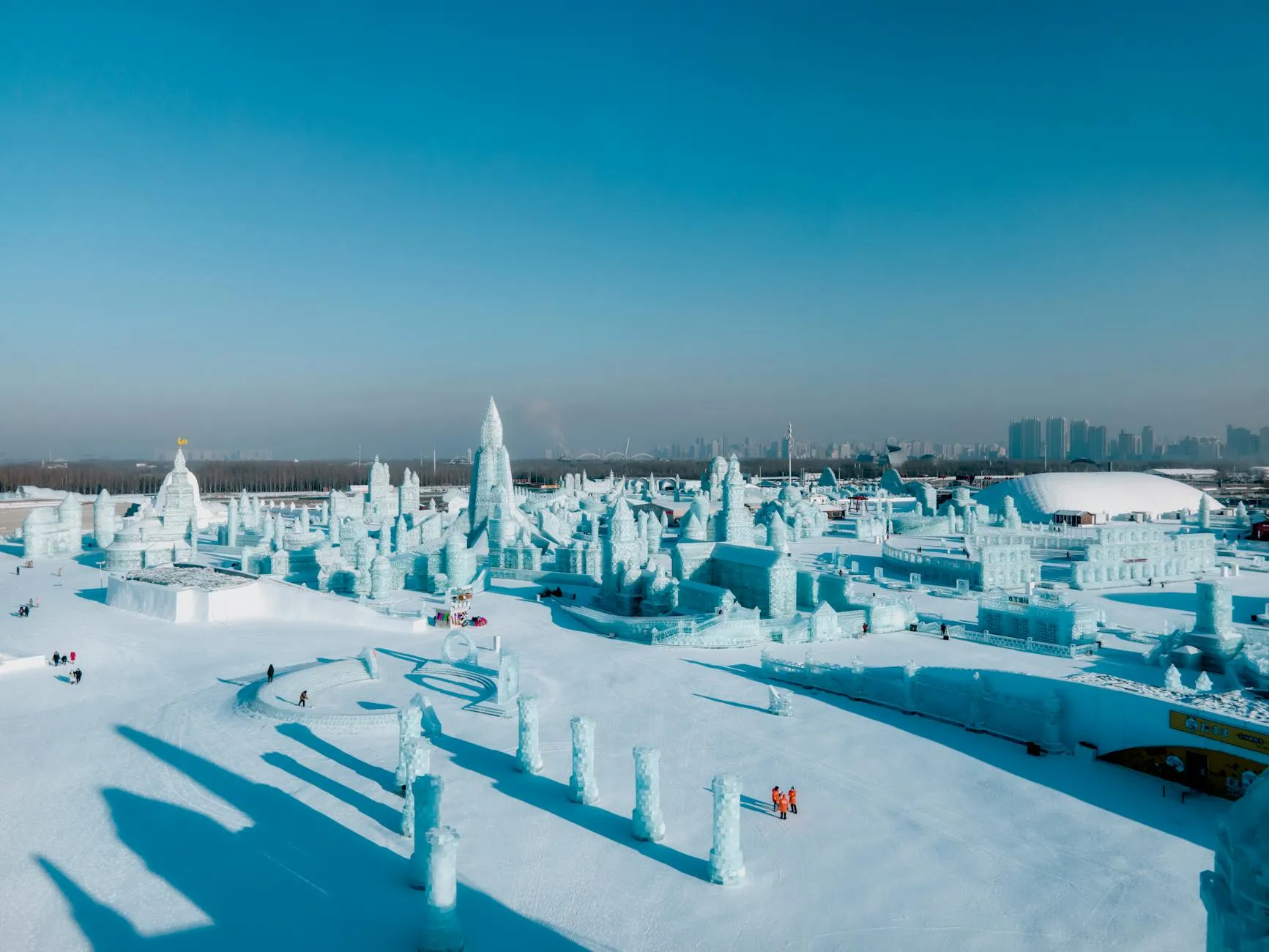
The Harbin Ice and Snow World is the headline draw. It sits about 40 km from the airport — roughly 45 minutes by car each way. The 2025–26 edition ran from 17 December 2025 until 21 February 2026, when an unseasonal warm spell melted the sculptures ahead of schedule and the park closed early. The park runs long evening hours in season and is designed to be seen lit up after dark.
A round trip from the airport to the park and back is over 80 km of driving plus the visit itself, plus international check-in and security on top. For that to work without gambling your departure, you need a layover of approximately eight hours or more from when you clear immigration. Outside the operating window — exact dates shift each year and can end early, as the 2026 season showed — the park is closed and the trip is impossible regardless of how much time you have.
⚠️ Ice and Snow World: ~8 hours minimum, in-season only
The park operates roughly mid-December to late February, but confirm the season’s exact dates before planning around it — in 2025–26 it closed on 21 February due to warm weather. The 80 km-plus round trip plus visit plus border and security buffer does not fit a short layover at any time of year, and outside the operating window there is nothing to see.
🏙️ Year-Round — Central Street & Sun Island
Central Street (Zhongyang Dajie) is the pedestrianised European-architecture strip in the city centre; Stalin Park and the Songhua River frontage are a short walk from its northern end, and a river crossing takes you to Sun Island park. All of this falls inside Harbin’s municipal administrative area, which means it is accessible on 240-hour transit status.
From the airport it is roughly 45 minutes to an hour each way by car. On a layover of six hours or more — cleared immigration, with a confident buffer for the return journey and re-entry through security — this is a workable half-day. In winter, the smaller free ice and snow sculptures along Central Street and in the riverside parks give a genuine impression of the season without the full logistics of the Ice and Snow World trip.
The Maths, Plainly
- Under ~4 hours: stay in the terminal. The 37 km each-way journey plus any border process leaves no time for the city.
- International → domestic connection: there is no inter-terminal move any more, but you still clear immigration, collect the bag and re-check it. Budget for the border, not for a change of building.
- 6 hours or more: Central Street and Sun Island are viable, with buffer.
- 8 hours or more, in season: the Ice and Snow World becomes an option rather than a gamble.
🔧 Practical Notes
Payment. Alipay and WeChat Pay are the practical payment systems across most of Harbin — taxis, restaurants, ticket machines, small shops. Both now allow foreign visitors to link an overseas Visa or Mastercard; set one up before you land, because the setup requires a working connection and takes some time. Cash (¥) works as a fallback. Foreign credit cards are accepted at major hotels and large stores but not reliably elsewhere.
Connectivity. China’s national firewall blocks Google, WhatsApp, Instagram, and most Western services. Arrange a roaming plan or travel eSIM that handles this before arrival. You cannot easily install a workaround once you are inside the country without already having access.
Currency. The yuan trades at approximately ¥6.71 to the US dollar and ¥7.82 to the euro (September 2026). Airport exchange counters apply a poor rate. Change only what you immediately need at the airport; use Alipay/WeChat Pay or a city ATM for the rest.
Winter conditions. Harbin in January and February sees temperatures regularly below −20°C. Taxi fares carry a winter surcharge, shuttle-bus journey times lengthen, and the 37 km road is less predictable in extreme cold or snow. Add time to every ground-transport estimate between November and March.
📱 Set up Alipay or WeChat Pay before you land
Without one of them linked to an overseas card, you will struggle at small vendors, ticket machines, and some taxis. The setup takes 10–15 minutes and requires a working internet connection — do it before you arrive, not at the ¥20 bus kiosk.
❓ FAQ
📊 At a Glance — HRB 2026
| Item | Detail |
|---|---|
| IATA / ICAO | HRB / ZYHB |
| Distance to centre | ~37 km southwest |
| Terminals | T1 (international, rebuilt zone opened 12 July 2024) and T2 (domestic, 2018) merged into one integrated terminal |
| Airport metro | None — bus, taxi, or DiDi only |
| Shuttle bus | Numbered lines, flat ¥20; Line 1 runs 24h to railway station / centre |
| Taxi / DiDi | Official rank or DiDi app; ~¥100–130, 45–60 min depending on traffic and season |
| Currency | CNY (¥); ≈ ¥6.71/US$1, ≈ ¥7.82/€1 (September 2026) |
| Payment | Alipay / WeChat Pay dominant; link an overseas card before arrival |
| Border options | 240-hour transit (designated port, Harbin municipal area only) · unilateral visa-free · standard visa |
| Transit zone limit | Harbin municipal administrative area only — rest of Heilongjiang excluded |
| Priority Pass lounge | China Southern Gold/Silver/Elite Plus Lounge |
| DragonPass lounges | Additional lounges — check the DragonPass app for current list and terminal |
| Hub carrier | China Southern; China Eastern + Sichuan Airlines also significant |
| 2025 passengers | ~24.7 million (China’s 22nd busiest) |
| New in 2025 | Second runway 05R/23L opened 23 January 2025 |
| Transit designation | 240-hour visa-free transit port from 17 December 2024; 57 countries, 65 ports since 5 November 2025 |
| Layover verdict | Stay airside under ~4 hrs · Central Street viable at 6 hrs+ · Ice and Snow World needs ~8 hrs+ and only mid-Dec–late Feb |