Aso Kumamoto Airport (KMJ) — Airport Guide 2026
Mt Aso’s Nakadake crater has been closed to visitors since January 2026 — a helicopter crashed on the volcano’s southeast flank and the wreck remains unrecovered — which removes the airport’s most-marketed attraction from any itinerary this year and leaves Kumamoto Castle as the only realistic reason to leave the terminal on a layover.
Quick Reference
KMJ / RJFT
Mashiki, ~20 km east of central Kumamoto, Kyushu
Single integrated building (domestic + international), opened 23 March 2023
JPY (¥) — ≈ ¥159/US$1, ≈ ¥185/€1 (late May 2026)
Airport limousine bus to Kumamoto Station — ¥1,200, ~65 min
Airport Liner (free shared taxi) to Higo-Ozu Station, ~15 min, then JR train
Official rank — ~¥6,100, ~45 min to Kumamoto Station
None; airport rail link targeted for the 2030s
Visa-free up to 90 days (~70 nationalities); visa/eVisa otherwise
Not in force in 2026; expected around FY2028
Lounge ASO, 3rd floor airside, 06:30–last departure; Priority Pass listed (verify)
ANA, JAL, Solaseed Air, Jetstar Japan, Fuji Dream Airlines, Amakusa Airlines
China Airlines, Starlux, Tigerair Taiwan; Korean Air, Eastar Jet
Closed in 2026 (January helicopter crash); no confirmed reopening
🏢 Terminal & Carriers
The current terminal opened on 23 March 2023. The previous building was wrecked in the 2016 Kumamoto earthquakes and the replacement was designed to handle both domestic and international flights under one roof, with seismic reinforcement against future major quakes. One building means domestic-to-international connections happen in the same terminal — simpler than at the bigger Japanese hubs — but it also means a self-connecting passenger who needs to clear immigration will collect their bag and re-check in the same space.
Traffic is heavily domestic. ANA and Japan Airlines serve the trunk routes to Tokyo–Haneda and Osaka–Itami; Solaseed Air adds Haneda capacity; Jetstar Japan covers the budget runs to Tokyo–Narita and Osaka–Kansai; Fuji Dream Airlines connects Nagoya–Komaki; Amakusa Airlines — the small prefectural carrier — links Amakusa and Osaka–Itami. ANA Wings, J-Air, and Ibex fill regional frequencies. Kumamoto is a spoke.
International service is thin and entirely East Asian. Taiwan is covered by China Airlines (Taipei and Kaohsiung), Starlux (Taichung and Taipei), and Tigerair Taiwan (Kaohsiung and Tainan). South Korea by Korean Air from Seoul–Incheon and Eastar Jet from Busan. These schedules shift seasonally; confirm the day’s international departures rather than assuming a fixed pattern.
⚠️ Self-connection — baggage reclaim required
Low-cost international tickets are often sold point-to-point with no through-checked baggage. On a self-connection you will clear immigration, collect your bag, and re-check it — which is why entry rules in the next section matter even if you only meant to transit.
🛂 Border & Entry
Japan runs a single national entry regime. There is no regional scheme layered on top.
✅ Visa-free entry
Ordinary-passport holders of around 70 countries — including the United States, Canada, Australia, New Zealand, the UK, Ireland, and EU member states — enter Japan visa-free for short stays of up to 90 days. The officer issues a landing-permission stamp; there is no fee and no advance form. A handful of nationalities hold older bilateral arrangements allowing longer stays (Mexican passport holders, for instance, can stay up to six months), but the standard landing stamp is 90 days. Extending beyond that requires an application at a Regional Immigration Bureau inside Japan before the first 90 days run out. The duration varies by nationality — check your own passport against an official source.
📄 When a visa is required
If your nationality is not on the visa-exemption list, or your purpose is work, study, or a stay beyond what exemption covers, you need a Japanese visa arranged in advance through a Japanese embassy, consulate, or the eVisa system where available for your country. There is no general visa-on-arrival for tourism at Kumamoto.
❌ JESTA — not yet
JESTA (Japan Electronic System for Travel Authorization) is a planned electronic pre-approval for visa-exempt visitors. It is not operating in 2026 and is not expected until around Japan’s fiscal year 2028 (April 2028 onward). Nothing exists to apply for; any third-party site selling a “Japan JESTA” today is selling fabricated paperwork. For a 2026 trip the rule is visa-free stamp or a visa.
📋 Visit Japan Web — optional, genuinely useful
Pre-register immigration and customs details before landing through Japan’s official Visit Japan Web service and present QR codes on arrival instead of filling paper forms. Paper cards remain available on the aircraft and in the arrivals hall. Pre-filling saves time at busy international halls.
🚌 Getting Into the City
No railway serves the airport. A long-discussed rail link from Higo-Ozu Station has been targeted for the 2030s — not relevant to a 2026 trip. Every option below shares the same road east of the city.
⭐ Airport Limousine Bus — the default
The airport limousine bus runs from outside the terminal to Kumamoto Station and the city centre for ¥1,200 (roughly US$7.50), taking about 65 minutes. The operator changed at the end of 2025 — Sanko Bus took over the limousine and related services from 1 November 2025, with revised timetables. Several services sharing the city-bound platform (Takamori-go, Yamabiko-go, and Takachiho-go among them) continue east to towns beyond the airport. Discounted tickets are available from vending machines in the terminal.
🚌 Limousine Bus — ¥1,200, ~65 min
New operator (Sanko Bus) as of November 2025 means old schedules may be wrong. Check the departure board on the day rather than a cached timetable.
🚕 Free Airport Liner + JR Train
The Airport Liner is a free shared taxi running from the terminal to Higo-Ozu Station (also listed as Ozu Station), a 15-minute ride. From there you board the JR Hohi Main Line toward Kumamoto. It is a shared-shuttle service, not a turn-up-and-go bus — confirm the booking method at the airport information desk on arrival. The combined journey is slower and involves a transfer, but it costs nothing on the Liner leg, which makes it worth knowing if your destination is along the JR Hohi line anyway.
🚖 Metered Taxi
An official-rank taxi to Kumamoto Station runs roughly ¥6,100 (about US$38) and takes around 45 minutes. Use the official rank outside the terminal. A taxi makes sense for a group splitting the fare or a late arrival; for a solo traveller the limousine bus is a fraction of the cost.
⚠️ Unofficial rides — standard airport trap
Anyone approaching you inside arrivals with a ride offer is not the metered taxi. Use the official rank outside. The overcharge is the same mechanism at every airport in the world.
🛋️ The Lounge
Kumamoto has one lounge. Lounge ASO sits on the 3rd floor of the airside boarding area, open from 06:30 until the last departure, for departing passengers only. It serves drinks, newspapers, and magazines; outside food and drink are not permitted.
Access is primarily through Japanese-issuer premium cards: JCB, Diners Club, American Express Japan, Saison, Rakuten, and others admit the cardholder free — that is how the majority of domestic passengers get in. Priority Pass carries a directory listing for Lounge ASO, so a Priority Pass membership should also work here. Because the airport’s own English page lists only Japanese card networks and does not explicitly confirm Priority Pass, verify at the lounge desk rather than assuming acceptance.
🛋️ Lounge ASO — one room, one entrance
Third floor, airside. Priority Pass is listed but not explicitly confirmed on the airport’s English pages — ask at the desk. There is no separate international-side lounge.
🍜 Food Before You Fly
Kumamoto’s food is distinct from the Fukuoka or Oita defaults, and the terminal’s landside shops and food court carry workable versions of the local staples. The city’s restaurants serve the same things cheaper and better; eat in town if the schedule allows. If the terminal is all you have, the landside food court on the arrivals-side is the place to do it — airside prices carry the usual markup.
Basashi — raw horse meat, sliced thin and eaten with ginger, garlic, and soy. This is a Kumamoto speciality with no close equivalent elsewhere in Kyushu.
Karashi renkon — lotus root stuffed with mustard-miso paste, battered and deep-fried. The heat reads like horseradish. It is tied to the city’s feudal history and is common in local shops.
Taipien — a clear soup of glass noodles, seafood, vegetables, and a fried egg. The everyday lunch of the prefecture, on menus across Kumamoto.
Kumamoto ramen — tonkotsu pork-bone broth finished with fried garlic oil (mayu) and garlic chips. Darker and more pungent than the Fukuoka version up the coast; the garlic finish is the marker.
🛍️ Souvenirs: buy in town
Airside and duty-free carry Kumamon merchandise (the prefecture’s black-bear mascot), karashi renkon, dried higo sweets, and Kyushu shochu. Kumamoto Station’s souvenir shops and the city’s department stores sell the same goods at better prices. The airport is the last resort, not the first stop.
💡 Layover Reality: Castle vs. Crater
The 2026 answer is shaped by one closure.
Mt Aso crater — off the table. The Nakadake crater has been closed to visitors since a January 2026 helicopter crash left wreckage on the southeast flank. No reopening date has been given. Even when it is accessible, the crater is routinely restricted whenever volcanic alert levels rise or gas concentrations exceed safe limits, and people with asthma or heart conditions are barred regardless. The caldera is about an hour by car from the airport — even if you drove out, there is nothing to see at the top this year.
⚠️ Mt Aso Nakadake — closed in 2026
A January 2026 helicopter crash sealed the crater rim. The wreck remains on the southeast flank with no confirmed recovery or reopening timeline. The drive from the airport is roughly an hour each way. Do not build a connection around this.
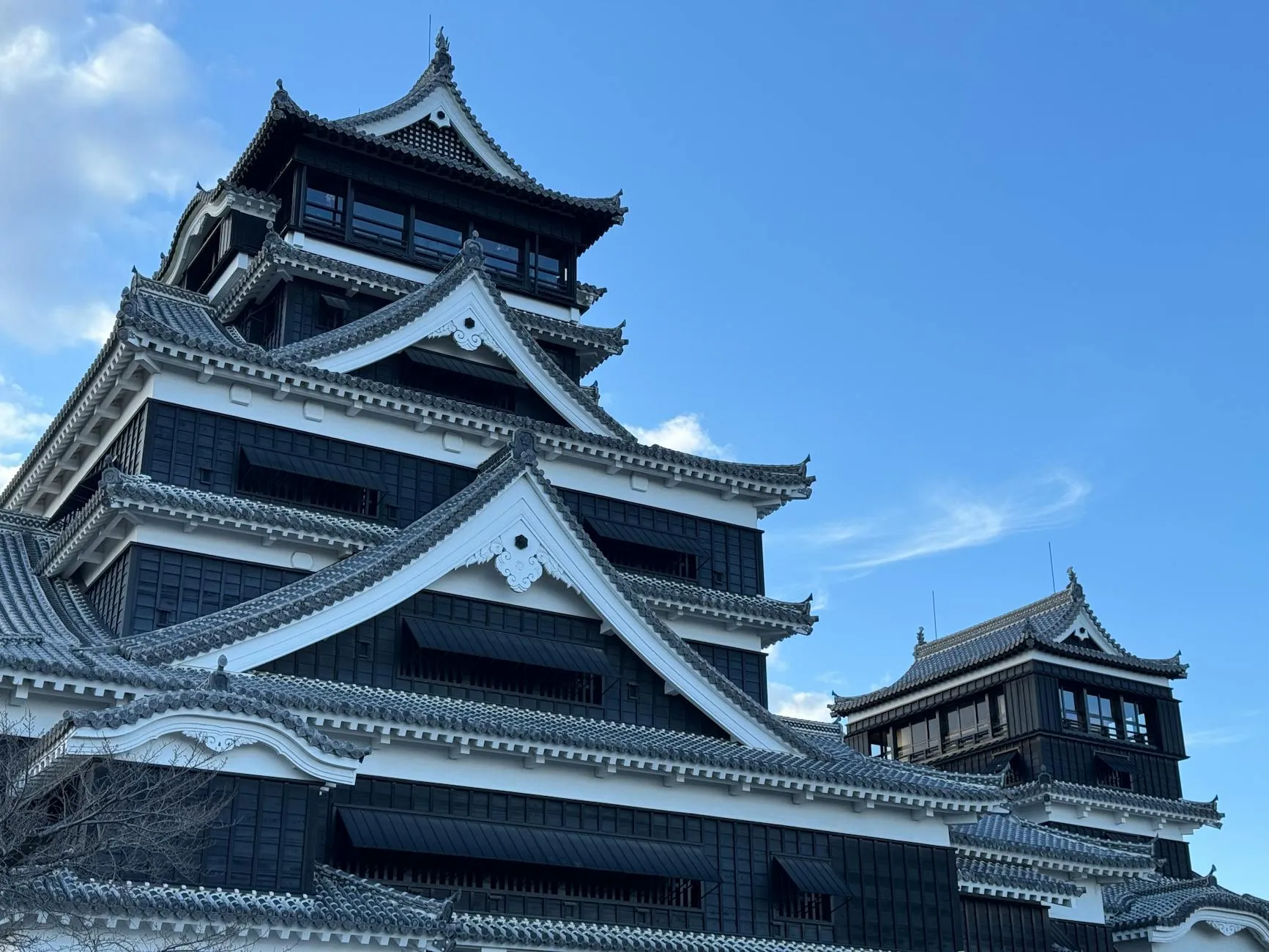
Kumamoto Castle — the viable option. The castle was badly damaged in the 2016 earthquakes and has been progressively restored since; in 2026 it is back as the main city attraction. Reaching it means the 65-minute limousine bus (¥1,200 each way), the visit itself, and a return leg with enough buffer for international check-in and security.
The arithmetic is direct: 65 minutes out, 65 minutes back, plus a minimum 90-minute international check-in and security buffer — that is 220 minutes, or about three hours and forty minutes, before you have spent any time at the castle itself. On a layover of five to six hours or more, cleared through immigration with bags in hand, the castle is a realistic half-day. Under about four hours, the numbers do not support leaving the terminal.
💡 Layover threshold: five hours is the floor
Under four hours, the 65-minute bus each way plus the return security buffer eats the window entirely. Five to six hours gives you time at the castle before you need to be back through security. There is no airside attraction to chase; this is a binary choice.
🔧 Practical Notes
Payment. A transit IC card (Suica, ICOCA, or a regional equivalent) and a contactless credit card handle most of the day in Kumamoto. Carry some cash (¥) for small shops, rural buses, and shrine donations, which can still be cash-only. Foreign cards work at the airport, hotels, and larger stores.
Connectivity. Japan does not block Western apps or services. Airport and station Wi-Fi is widely available. A travel eSIM or pocket Wi-Fi gives data coverage from the gate; worth arranging before you land if you want it immediately on arrival.
Currency exchange. At roughly ¥159 to the US dollar and ¥185 to the euro as of late May 2026, airport exchange counters offer poor rates against a markup. Change only what you immediately need and use an ATM in the city — Japan Post and 7-Eleven ATMs reliably accept foreign cards.
Border reminder. The single most common mistake at this airport in 2026 is believing “JESTA” must be arranged in advance. It does not exist yet. Match your nationality to the visa-free 90-day route or arrange a visa; pre-fill Visit Japan Web if you want the immigration hall to move faster.
❓ FAQ
📊 At a Glance — KMJ 2026
| Item | Detail |
|---|---|
| IATA / ICAO | KMJ / RJFT |
| Location | Mashiki, ~20 km east of central Kumamoto, Kyushu |
| Terminal | Single integrated building (domestic + international), opened 23 March 2023 |
| Limousine bus | Kumamoto Station — ¥1,200, ~65 min; operator Sanko Bus from November 2025 |
| Free Airport Liner | Shared taxi to Higo-Ozu Station, ~15 min, then JR Hohi Main Line |
| Taxi | Official rank — ~¥6,100, ~45 min to Kumamoto Station |
| Railway | None; rail link targeted for the 2030s |
| Currency | JPY (¥) — ≈ ¥159/US$1, ≈ ¥185/€1 (late May 2026) |
| Payment | Contactless + IC cards widely accepted; carry cash for small shops |
| Border | Visa-free up to 90 days (~70 nationalities); visa/eVisa otherwise |
| JESTA | Not in force in 2026; expected ~FY2028 — nothing to apply for |
| Lounge | Lounge ASO, 3rd floor airside; 06:30–last departure; Priority Pass listed (verify at desk) |
| Domestic carriers | ANA, JAL, Solaseed Air, Jetstar Japan, Fuji Dream Airlines, Amakusa Airlines |
| International carriers | China Airlines, Starlux, Tigerair Taiwan (Taiwan); Korean Air, Eastar Jet (South Korea) |
| Mt Aso crater | Closed in 2026 (January helicopter crash); no confirmed reopening date |
| Layover verdict | Stay airside under ~4 hrs; Kumamoto Castle viable at ~5–6 hrs+; Mt Aso closed in 2026 |