Tancredo Neves International Airport, Belo Horizonte/Confins (CNF) — Airport Guide 2026
Confins is 40 km north of the city — that distance is the single fact that governs every decision you make here, from which bus to take to whether any day-trip is actually feasible on your layover.
Quick Reference
CNF / SBCF
Tancredo Neves International Airport (Belo Horizonte/Confins)
BH Airport S.A. — CCR 75% + Flughafen Zürich AG 25%
~40 km north of downtown Belo Horizonte
T1 + T2 (one connected building); T3 is executive/general aviation, not public
~12.36 million / ~13.32 million
Azul (2nd-largest connecting hub, ~55 domestic destinations)
GOL, LATAM (domestic); TAP (Lisbon), Copa (Panama)
Brazilian real (BRL) — ~R$5.04/US$1, ~R$5.77/€1 (late May 2026 — verify)
Visa-free, 90 days
e-Visa required (in force since 10 Apr 2025), US$80.90, apply at brazil.vfsevisa.com
Not required at entry; CDC/WHO recommend vaccine for Minas Gerais
Conexão Aeroporto: convencional ~R$20.90 / semi-exec ~R$24.90 / executivo ~R$49.50
~R$95 (~US$19), ~46 min
None
Ambaar, Advantage VIP — Priority Pass / LoungeKey / Diners; no alliance flagship
Ouro Preto (~2 h drive from airport), Inhotim/Brumadinho (~1 h from city)
🏢 Terminals, Layout & the Ghost Airport History
Confins opened in 1984 and spent its first two decades nearly empty. Airlines kept using Pampulha — 8 km from the centre, convenient, beloved — while the new airport sat idle 40 km out. Locals called it the aeroporto fantasma, the ghost airport. That ended in 2005, when a government directive moved all international flights and major domestic jet service from Pampulha to Confins. The traffic followed, and the ghost got a pulse.
The airport was named in 1986 after Tancredo Neves (1910–1985), the Minas Gerais politician elected Brazil’s president in 1985 who died before he could take office. The naming has a certain irony for an airport that spent its first two decades as a monument to things that didn’t quite launch.
The layout is simple. T1 and T2 are not separate buildings — T2 was constructed as an extension of T1, opening in December 2016 to push annual capacity toward 22 million passengers. You walk between them airside; there is no shuttle, no extra security run. International operations sit in the T2 wing, moved there from the old Terminal 3 in January 2017. The thing now labelled “Terminal 3” is general and executive aviation — you will never check in there.
The operator is BH Airport S.A., a concession awarded in 2014 to a consortium of Brazil’s CCR and Switzerland’s Flughafen Zürich AG. The Swiss involvement explains why this airport feels better maintained than its ghost-airport reputation suggests: signage is bilingual, the terminals are clean, and the connection flows are laid out with some logic. It is not Guarulhos in scale or retail, but it is a well-run mid-size hub.
⚠️ Pampulha is the wrong airport
PLU is 8 km from downtown — it sounds ideal, but it now handles only regional turboprops and executive aviation. All international flights and the GOL/LATAM/Azul mainline network use Confins (CNF), 40 km out. Anyone saying “the airport is near the city centre” is stuck in a mental model from before 2005.
Azul treats Confins as its second-largest connecting hub, behind Viracopos (Campinas), and runs roughly 55 domestic destinations through it. For a connecting passenger that concentration is useful: most Azul domestic-to-domestic transfers stay inside the same building without re-clearing security.
On arrival: international passengers clear Polícia Federal (immigration) then proceed to customs, which uses a random-selection light system. Green: walk through. Red: your bags get screened. It is not a judgement. Immigration queues here are shorter than at São Paulo Guarulhos — Confins is a low-tens-of-millions hub, not the 40-million-plus monsters of the southeast, and the lines reflect that.
One practical note on international-to-domestic connections in Brazil: most itineraries do not through-check baggage. You collect your bag after customs, re-check it at the domestic counter. Azul does offer some through-check options on its own connecting itineraries — verify on booking.
🛂 Border, Visa & the E-Visa Reality
The visa rules depend entirely on your passport, and the distinction matters because getting it wrong means being denied boarding at origin.
Most Western European, UK and Irish ordinary passports enter Brazil visa-free for 90 days. No advance application, no paperwork — just a passport valid for your stay and, if asked, evidence of onward travel.
US, Canadian and Australian ordinary-passport holders are in a different position. Brazil reintroduced an electronic visa requirement for these three nationalities, in force since 10 April 2025 after several rounds of postponement. There is no visa on arrival. You apply before travel at the official portal brazil.vfsevisa.com (run by VFS Global), pay US$80.90 online, and receive approval typically within a few business days — though the official window extends to around ten in peak periods. The e-Visa is multiple-entry, valid for 10 years (US citizens), 5 years (Canadians and Australians), with each stay capped at 90 days and a 180-day total per 12-month period.
⚠️ e-Visa is wired into airline check-in systems
From early 2026, departure-control systems check e-Visa status before issuing a boarding pass. No valid e-Visa on file means no boarding pass — at your origin airport, not Confins. Apply well ahead, print the confirmation, carry it.
One caveat: the requirement has been politically contested. The Brazilian Senate voted against the policy in March 2025 and the House had not issued a final ruling as of this writing. Treat the e-Visa as required today, and re-check the official portal before booking — this is exactly the kind of rule that can change quietly.
💉 Yellow Fever
Brazil does not require a yellow fever certificate at entry for most travellers arriving from non-endemic countries. But the CDC and WHO recommend the vaccine for Minas Gerais — which includes Belo Horizonte, Ouro Preto and Brumadinho/Inhotim — for travellers aged 9 months and older. The vaccine takes about 10 days to take effect, making it a pre-trip decision.
A separate consideration: if you continue onward from Brazil to certain countries (particularly in Africa or Asia), they may demand proof of the Brazilian-leg vaccination. Check your onward destination’s entry requirements, not just Brazil’s.
🦟 Mosquito Season
Belo Horizonte sits at roughly 850 m — comfortable year-round climate, no altitude adjustment needed. The real seasonal hazard is dengue (and lesser instances of zika and chikungunya), which peaks during the warm, wet months roughly November through April. Repellent and long sleeves at dawn and dusk are sensible precautions, particularly on the Inhotim day-trip where you walk forested gardens for several hours. Tap water is treated; most visitors drink bottled (água mineral, R$3–6 everywhere).
🚆 Getting Into the City
The 40 km to downtown shapes every transport calculation. Budget 45–60 minutes in normal traffic; add 20–30 minutes for rush hour.
🚌 Conexão Aeroporto — the default for solo travellers
Three tiers, departing from outside arrivals. Convencional ~R$20.90 (~US$4.15); semi-executivo ~R$24.90; executivo (air-conditioned, fewer stops) ~R$49.50 (~US$9.80). Journey time roughly 50 min to 1 h 40 depending on line and drop point. Buy at the counter, self-service kiosks, or onboard. For one person with time to spare, the executivo is the sensible pick — comfortable, predictable, a fraction of an Uber. Verify current fares and your specific line at the counter.
🚗 Uber / 99 / inDrive — best value for two or more
Average ~R$95 (~US$19), ~46 min to the centre. 99 (DiDi-owned) and inDrive often undercut Uber slightly. Pick up from the designated rideshare zone — follow signs from arrivals. Do not accept an approach in the arrivals hall; the “taxi?” offer from someone walking toward you is the standard overcharge setup at every Brazilian airport. Confirm the licence plate before you get in. Download and configure the app before landing; data helps.
The official airport taxi rank runs metered fares that land roughly double an Uber for the same trip. If you use it, use the rank — not a tout.
There is no train or metro connection. The single BH metro line serves the city, not the airport. Anyone suggesting you “take the metro from Confins” is wrong.
🚗 Rental Car
Localiza (founded in Belo Horizonte in 1973, now the largest rental company in Latin America), Movida, Unidas and the international brands all have counters in arrivals. A car makes sense for the day-trips: Ouro Preto and Inhotim are both far more manageable self-driven than by patchwork bus, and the MG-010 / BR-040 out of the airport are decent roads.
Brazilian rentals quote a daily rate that often excludes mandatory insurance (proteção) — confirm the all-in price. An International Driving Permit alongside your home licence is the safe combination. Fuel is sold by the litre; gasolina runs around R$6 per litre (verify locally — Brazilian pump prices move). Many Brazilian cars are flex-fuel running on either petrol or ethanol (álcool), which is cheaper but less efficient per litre.
🧭 Which Option, Briefly
Solo, budget, time available: executivo bus. Two or more people going to one address: Uber. Day-trips to Ouro Preto or Inhotim, or a multi-stop Minas itinerary: rent a car. Short connection staying near the airport: neither — the terminal area has an on-site hotel.
🛋️ Lounges
Confins has contract lounges rather than airline flagship rooms, and your access card matters more than the brand name. The two operators are Ambaar Lounge and Advantage VIP Lounge, with units split across domestic and international departures.
Ambaar Lounge runs multiple units — domestic and an international-departures unit in T2. Access via Priority Pass, LoungeKey, Diners Club, and a range of Brazilian premium cards (Bradesco Visa Aeternum, Bradesco Elo Diners/Nanquim, Amex Centurion and Platinum). One domestic Ambaar unit also takes Visa Airport Companion. Expect: hot and cold buffet, Brazilian coffee done properly, soft drinks, beer, basic spirits, Wi-Fi, showers in some units.
Advantage VIP Lounge (Terminal 1) is also on Priority Pass, and offers a Fast Track security lane for Priority Pass members. Mastercard premium cards access via LoungeKey (Mastercard Airport Experiences). Some units include a Bluma wellness corner — short massage, foot spa, manicure — included for certain Priority Pass/LoungeKey black-tier holders, paid otherwise.
🛋️ Walk-in day passes are available
Most units sell access at the door, commonly R$120–200. Confirm at the desk — it varies by unit and time. For a long international connection, with thin general seating airside, it is usually worth it.
There is no Star Alliance, oneworld or SkyTeam flagship lounge here, and no LATAM or GOL premium room of the kind you would find at São Paulo Guarulhos. If you are flying TAP to Lisbon or Copa to Panama in business class, your lounge access will most likely be one of the Ambaar units via an airline contract — not a dedicated carrier space.
🍽️ Food Before You Fly
Minas Gerais food — comida mineira — is the reason Brazilians from other states actually plan trips here. The airport versions are convenient; the town versions are cheaper and better. Calibrate by how much time you have left.
🧀 Pão de queijo — eat it here
Chewy cheese bread made from polvilho (cassava starch) and Minas cheese, baked into a ball — it originated in this state, and the local version is the reference standard. An airport café charges roughly R$8–14 for a couple; a city padaria does the same for R$3–6. It travels badly once hot, reheats acceptably. It is also the most honest thing to carry onto a flight out of Belo Horizonte.
Feijão tropeiro is the dish to sit down for if you have a city meal ahead of you — beans cooked down with cassava flour (farofa), sausage, egg and seasonings, named for the 19th-century tropeiros (mule-train traders) who moved goods across Minas. A plate runs around R$25–45 at a city restaurante por quilo (pay-by-weight buffet, the standard Brazilian lunch format). Other staples worth finding: frango com quiabo (chicken with okra), tutu de feijão (bean-and-farofa purée), doce de leite for dessert. Coffee is taken seriously — Minas Gerais is one of the world’s largest coffee-growing regions, so a cafezinho here is from the source.
The default Brazilian midday meal is the por quilo — a buffet billed per kilogram at the till, honest, fast, the cheapest way to eat a full mineiro spread. In the city these places are everywhere around Savassi and the centre. At the airport you get à la carte and counter service, marked up; use the food court in the departures pier for a reasonable café or buffet counter, and the pão-de-queijo stands for a grab-and-go.
🥃 Cachaça — the duty-free buy worth making
Minas Gerais produces some of Brazil’s best artisanal cachaça, the sugarcane spirit at the base of a caipirinha. A good alambique (pot-still) bottle — aged, wood-rested, nothing like the harsh industrial stuff — is a better souvenir than generic duty-free spirits. If you have checked luggage, the Mercado Central sells them for a fraction of airside pricing. If you are carry-on only, the duty-free shop in international departures carries respectable bottles. The name to know: Salinas, a town in northern Minas, is the most recognised cachaça-producing region.
Duty-free is a standard Dufry-style shop in international departures — spirits, perfume, chocolate, cigarettes. Worth it for cachaça; skippable for everything else.
💡 Day-Trips, the City & Honest Layover Math
Confins is one of the more rewarding Brazilian airports to actually leave — but whether you can do that on a layover requires arithmetic before optimism.
⏱️ The Layover Calculation
The terminal is ~40 km from the city; the day-trip sights extend well beyond that. Ouro Preto is roughly 2 hours each way from the airport — 4 hours of driving, minimum. Inhotim is about an hour from the city, further from CNF. Add the return-security buffer: be back airside 2–3 hours before an international departure, 1.5 hours domestic. The honest minimum for either day-trip is an 8-hour-plus layover, and Ouro Preto is still tight at that. Under 6 hours, stay near the airport or at most grab a city meal. These are trips for an overnight stay in Minas Gerais, not a connection.
⚠️ Layover day-trips are rarely viable here
The 40 km to the city plus 2 hours each way to Ouro Preto means the arithmetic rarely works. Run the numbers before you commit: transit out + time at destination + transit back + security buffer. If it does not reach 8 hours comfortably, it does not work.
🏛️ Ouro Preto
A UNESCO World Heritage Site since 1980. The 18th-century baroque churches, steep cobbled streets and gold-rush-era architecture of Brazil’s mining past — and the work of Aleijadinho (the sculptor Antônio Francisco Lisboa), who is to Brazilian baroque what Gaudí is to Catalan Art Nouveau. It is roughly 100 km and 2 hours’ drive from Confins, or reachable by intercity bus from the Belo Horizonte rodoviária. This is an overnight-worthy destination in its own right. Self-drive or a booked transfer is far easier than the multi-leg bus from the airport.
🎨 Inhotim
At Brumadinho, about 60 km and 1 hour’s drive from Belo Horizonte (further from the airport). One of the largest open-air contemporary-art institutions in the world: site-specific pavilions and large-scale works set across botanical gardens you walk through for hours. Open Wednesday–Sunday and holidays (closed Monday and Tuesday — a common trap). Hours roughly 9:30 to 16:30/17:30. Day ticket ~R$65, half-price ~R$32.50. Admission is free on Wednesdays and the last Sunday of each month.
🎨 Inhotim — plan a full day, not a half-day
People consistently underestimate the walking. The site is vast; you will cover several kilometres on foot through gardens and between pavilions. It is the single best reason to build a Belo Horizonte stop rather than just connecting through.
🏙️ Pampulha — the Short Option
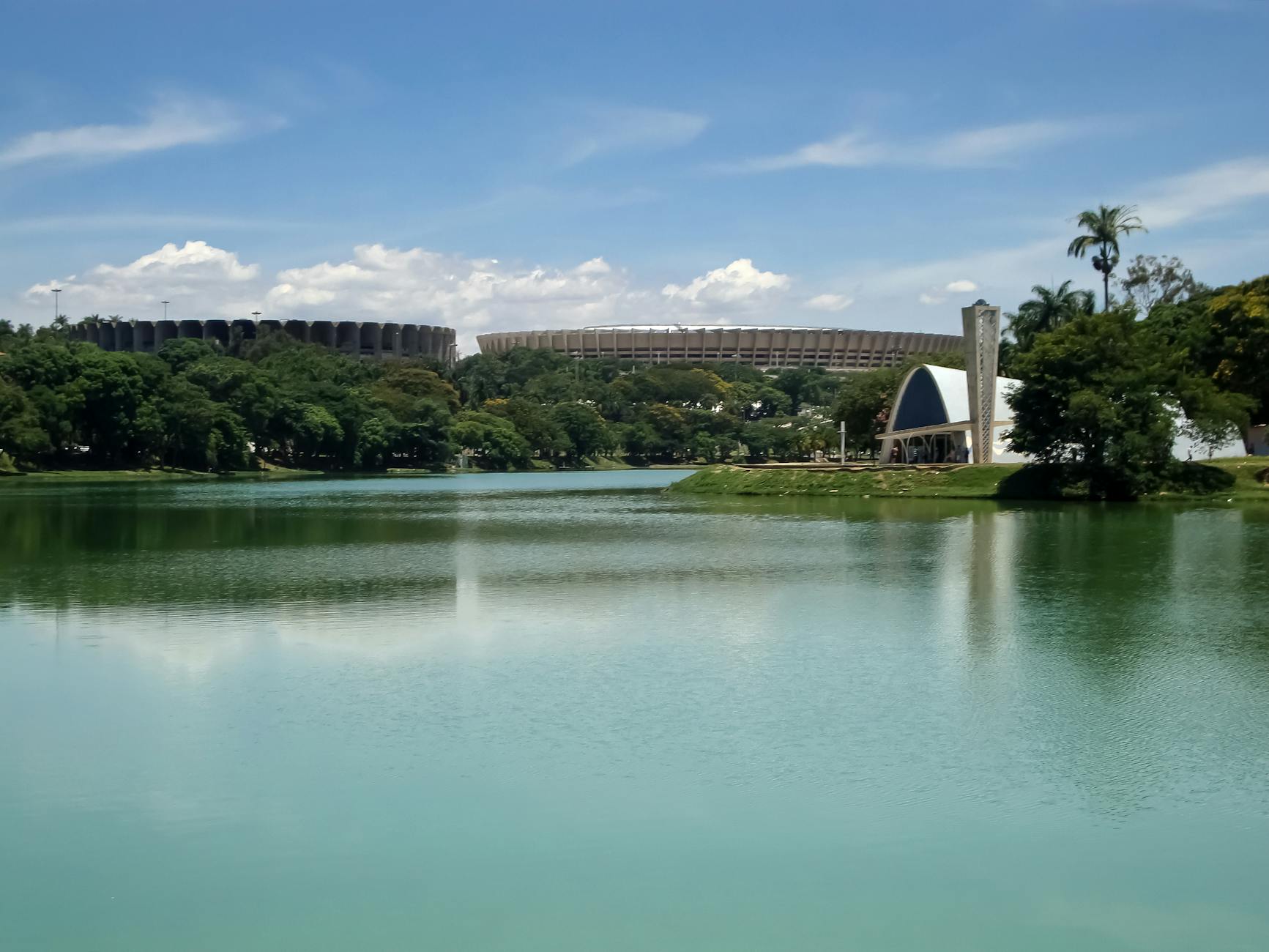
For anyone with most of a day in Belo Horizonte but not enough for a day-trip: the Pampulha lakefront. Oscar Niemeyer’s 1940s church of São Francisco de Assis (the Igrejinha da Pampulha), with Cândido Portinari azulejo tilework, plus the surrounding modernist complex commissioned by then-mayor Juscelino Kubitschek. The Pampulha Modern Ensemble was inscribed as a UNESCO World Heritage Site in 2016. It is in the city — a short Uber from downtown — and a half-day at most. That is the realistic short-layover cultural option.
🏙️ The City Itself
Belo Horizonte was Brazil’s first planned modern city, laid out on a grid in the 1890s and inaugurated in 1897 as the replacement state capital after Ouro Preto. Today it anchors the country’s third-largest metropolitan area — roughly 2.3 million in the city, ~6 million across the metro. The state economy is mining, farming, coffee and cachaça, which shapes the airport: a steady business-and-domestic flow rather than a beach-holiday rush.
The Mercado Central — open since 1929, operating daily roughly 7:00 to 18:00 (shorter on Sundays, verify) — is the one stop worth the Uber if you have an hour to spare: a covered market of hundreds of stalls selling Minas cheese, cachaça, produce, herbs, and a boteco beer at a standing counter.
The Savassi district is the dining and nightlife centre, dense with bars and restaurants. Belo Horizonte calls itself the capital nacional dos botecos — the bar capital of Brazil — and that claim has numbers behind it: more bars per capita than anywhere else in the country. If you have a few hours in the city without time for the day-trips: Mercado Central for an hour, Pampulha lakefront for the Niemeyer church, a por-quilo lunch in Savassi. That is a genuine picture of the city.
🔧 Practical Notes
📶 Connectivity
Free Wi-Fi covers the terminals via a quick email/name captive-portal sign-in. For mobile data, the main Brazilian carriers are Vivo, Claro and TIM; Claro and Vivo have the broadest coverage in Minas Gerais. A prepaid SIM typically requires a passport and a Brazilian tax ID (CPF), which is a real obstacle for tourists. An eSIM bought before arrival is the cleaner route and activates on landing — you want data live before you try to order the Uber.
💸 Currency
The real (R$, BRL). Banknotes: R$2, 5, 10, 20, 50, 100, 200; coins: 5, 10, 25, 50 centavos and R$1. The real floats freely and moves — in late May 2026 it traded around R$5.04 to the US dollar and R$5.77 to the euro, but it had swung across May. There is no parallel or black-market rate to worry about, which is a meaningful distinction from Argentina.
Card acceptance is near-universal in Belo Horizonte — contactless and Pix (Brazil’s instant bank-transfer system) are everywhere in the city. Carry cash for the convencional bus, small lanchonetes, and rural day-trip stops near Ouro Preto. Notify your bank; Brazilian ATMs sometimes reject foreign cards and you may need to try two or three machines. There are ATMs and câmbio desks in the arrivals hall.
🏨 Staying at the Airport
For overnight connections or layovers where the 40 km round trip to the city makes no sense: there is hotel accommodation at the airport complex itself, plus options in the town of Confins and along the access road. On-site supply is limited — book ahead. The terminal stays staffed overnight and the food court operates across most of the day, but it is not a 24-hour shopping hub.
🔒 Safety
Standard large-Brazilian-city precautions: keep the phone out of view on the street, use Uber or 99 rather than walking unfamiliar areas at night, watch bags in crowds, and stay alert around the rodoviária and downtown after dark. Daytime tourist areas — Savassi, the Mercado Central, the Pampulha lakefront — are unremarkable.
⚠️ Airport arrival hall scam — know it
Someone approaches you with “taxi?” in the arrivals hall. It is not a regulated taxi. It is an overcharge setup, and it happens at every major Brazilian airport. Use the official taxi rank or the rideshare pickup zone, and confirm the licence plate before you get in.
Restaurant bills usually include a 10% service charge (taxa de serviço) — paying it is customary and it serves as the tip; you do not add more. Drivers and café counters do not expect tips; rounding up an Uber is optional.
❓ FAQ
📊 At a Glance — CNF 2026
| Category | Detail |
|---|---|
| Airport | Tancredo Neves International (Belo Horizonte/Confins) |
| IATA / ICAO | CNF / SBCF |
| Operator | BH Airport S.A. — CCR 75% / Flughafen Zürich AG 25% |
| Opened / Named | 1984 / named for Tancredo Neves, 1986 |
| Distance to centre | ~40 km north of downtown Belo Horizonte |
| Terminals | T1 + T2 (one connected building); T3 executive/non-public |
| 2024 / 2025 passengers | ~12.36 million / ~13.32 million |
| Hub airline | Azul (2nd-largest hub, ~55 domestic destinations) |
| Other main carriers | GOL, LATAM (domestic); TAP (Lisbon), Copa (Panama), LATAM (Santiago) |
| Currency | Brazilian real (BRL) — ~R$5.04/US$1, ~R$5.77/€1 (late May 2026) |
| Visa — most EU/UK | Visa-free, 90 days |
| Visa — US/CA/AU | e-Visa, US$80.90, brazil.vfsevisa.com (in force since 10 Apr 2025) |
| Yellow fever | Recommended for Minas Gerais; not required at entry |
| Bus to city | Convencional ~R$20.90 / semi-exec ~R$24.90 / executivo ~R$49.50 |
| Uber to city | ~R$95 (~US$19), ~46 min |
| Rail link | None |
| Lounges | Ambaar, Advantage VIP — Priority Pass / LoungeKey / Diners; no alliance flagship |
| Top day-trips | Ouro Preto (~2 h drive from airport); Inhotim/Brumadinho (~1 h from city, ~R$65) |
| Min. layover for day-trips | ~8 h+ (Ouro Preto still tight); Pampulha for shorter stops |