Trieste Friuli Venezia Giulia Airport (TRS) — Airport Guide 2026
Trieste’s airport is not in Trieste. It sits at Ronchi dei Legionari, 33 km northwest of the city near Monfalcone — roughly equidistant between Trieste and Udine — and it crossed a million passengers for the first time in 2024, up about 40%, after Ryanair established a base there.
Quick Reference
Aeroporto Trieste–Friuli Venezia Giulia (Ronchi dei Legionari)
TRS / LIPQ
~33 km northwest of Trieste, near Monfalcone
One passenger terminal
Euro (€)
Yes — EES live since 10 April 2026; ETIAS pending Q4 2026
Trieste Airport station (covered footbridge) → Trieste Centrale, ~30 min, ~€4–5, every 30 min
APT G51 → Trieste Centrale, ~€4.05, ~55–60 min
~€70–90 (33 km)
Sala Calligaris (airside) — Priority Pass / Mastercard
ITA Airways, Lufthansa/Air Dolomiti, Ryanair (base), Wizz Air, Volotea
🏢 Terminal & Traffic
One terminal, compact and modern after recent investment. The layout is simple enough to navigate without a map: landside check-in, the bus stops and the footbridge to the train station outside, security, then a small airside. Because the airport serves a whole region, arrivals heading north to Udine, west to the beach resorts at Grado and Lignano, or across the Slovenian border are a meaningful share of the traffic — not everyone exiting here is going to Trieste.
ITA Airways holds roughly half of all arrivals on the strength of its Rome link. Lufthansa and its Air Dolomiti partner connect Frankfurt and Munich; Ryanair’s 2024 basing drove the growth spike that pushed the airport past a million passengers; Wizz Air and Volotea round out about 30 destinations across eight carriers. This is a regional airport in the honest sense — a service hub for Friuli Venezia Giulia, not a slot-constrained megahub.
🚀 Ryanair base since 2024
Ryanair establishing itself here is the reason TRS crossed a million passengers. Before that, the airport was a quiet regional with ITA holding an outsized share. The route network is more useful now, though most of the new flying is short-haul European point-to-point.
🛂 Border, EES & the Slovenian Situation
Italy is Schengen and euro, so flights arriving from within Schengen clear with no passport control. Worth noting specifically here: Slovenia, whose border runs right alongside Trieste, is also Schengen — the old frontier crossings are open and unmanned for routine travel.
For non-EU arrivals on flights from outside Schengen, the Entry/Exit System (EES) has been live at the Schengen external border since 10 April 2026. It replaces the passport stamp with a biometric record — face and fingerprints — tied to the 90-in-180-day short-stay limit. First entry in a cycle takes longer while that record is created; budget extra time at the border.
ETIAS is separate and not yet running. Expected in Q4 2026, it will require visa-exempt non-EU passport holders — US, UK, Canada, Australia and similar — to buy an online authorisation before flying. Until it launches, a valid passport is enough.
| Passport | Visa needed? | EES? | ETIAS once live? |
|---|---|---|---|
| EU / EEA / Swiss | No | No | No |
| UK | No (≤90/180 days) | Yes | Yes |
| USA / Canada / Australia / NZ | No (≤90/180 days) | Yes | Yes |
| Japan / South Korea / Singapore | No (≤90/180 days) | Yes | Yes |
| India / China / South Africa | Yes — Schengen visa required | Yes (recorded at entry) | N/A while visa required |
⚠️ EES first-entry buffer
If this is your first Schengen entry under EES, the biometric registration at the border takes time. On a busy morning arrival, the queue can add 20–40 minutes. Account for this before booking an onward connection.
🇸🇮 Slovenia: open border, 90 minutes to Ljubljana
Both Italy and Slovenia are Schengen, so the border crossing east of Trieste is unrestricted. Ljubljana is around 90 minutes by car. The airport rail line carries international services in that direction as well. If Ljubljana is actually your destination, TRS is a usable entry point.
🚆 Getting Into the City
The airport’s strongest feature is its own railway station — Trieste Airport, reached by a short covered footbridge directly from the terminal. At an airport 33 km from its city, that footbridge is not a minor convenience.
🚂 Train
Regional trains run Trieste Airport → Trieste Centrale in about 30 minutes, roughly every 30 minutes from around 06:10 to 23:15, for approximately €4–5. The same line runs north to Udine via Palmanova and has connections toward Venice, making it useful in multiple directions; part of the service is operated jointly with Slovenian railways. Buy a regional ticket from the platform machine and validate it before boarding — an unvalidated ticket draws a fine if inspected.
🚆 Train: ~30 min, ~€4–5
The standard option for Trieste. The covered footbridge from the terminal to the station takes two minutes. Validate the ticket at the machine on the platform before stepping on board — this is enforced.
🚌 Bus
APT line G51 serves Trieste Centrale for about €4.05 but takes 55–60 minutes — roughly twice the train’s journey time. Useful mainly when there is a gap in the rail timetable. Tickets from the machine, the info desk, or the driver with exact change.
🚕 Taxi
At roughly €70–90 for 33 km, a taxi is expensive and stays that way regardless of how many people share it.
⚠️ Taxi: the distance problem
The 33 km from terminal to Trieste Centrale means a taxi costs €70–90 however many passengers divide it. Unless you are arriving after the last train or have unusual luggage constraints, the train is the obvious call at €4–5 and 30 minutes.
🛋️ Lounge
One airside lounge: the Sala Calligaris, after security. It accepts Priority Pass and appears on the Mastercard lounge network. For a regional airport at this scale, it is a straightforward proposition — a quiet seat, coffee, soft drinks and a light buffet rather than a full meal. At peak hours when the morning departures stack up, the value is access to calmer seating away from the gate area.
🛋️ Sala Calligaris
Airside, after security. Priority Pass accepted; on the Mastercard network. Coffee, soft drinks, light buffet. Not a destination — a quiet seat when the gate area gets crowded at peaks.
🍽️ Food Before You Fly
Trieste’s food is audibly Central European. A century under Austria-Hungary left marks on the menu that Italian restaurants elsewhere don’t carry. The local soup is jota — a thick broth of sauerkraut, beans and potato — and goulash sits on restaurant menus without irony. The institution specific to Trieste is the buffet, which here means not a self-service line but a type of neighbourhood eatery serving boiled pork (porcina), sausages and mustard, eaten standing at the counter.
For carry-home food, the pastries are the practical choice: presnitz and putizza are dense rolled cakes of nuts and dried fruit, sold boxed and easy to pack in hand luggage within the EU. Friuli is a serious wine region — the whites, particularly Friulano, Ribolla Gialla and the Collio bottlings, are among Italy’s best; a bottle in checked luggage clears EU customs without issue.
Trieste is the original home of Illy and has its own café vocabulary: a nero is a straight espresso, a capo in b is a macchiato served in a glass. If there is time for one thing before the gate, a coffee done the Triestine way is the one to spend it on — not as a ritual but because the coffee is genuinely better here than at the terminal bar.
☕ Coffee: nero and capo in b
Nero = espresso. Capo in b = macchiato in a glass. Standard Italian terminology works too, but the Triestine terms are what you hear at the counter. Illy is headquartered in Trieste; the café culture preceded the branding.
💡 Insider: Trieste, Miramare & the Layover Math
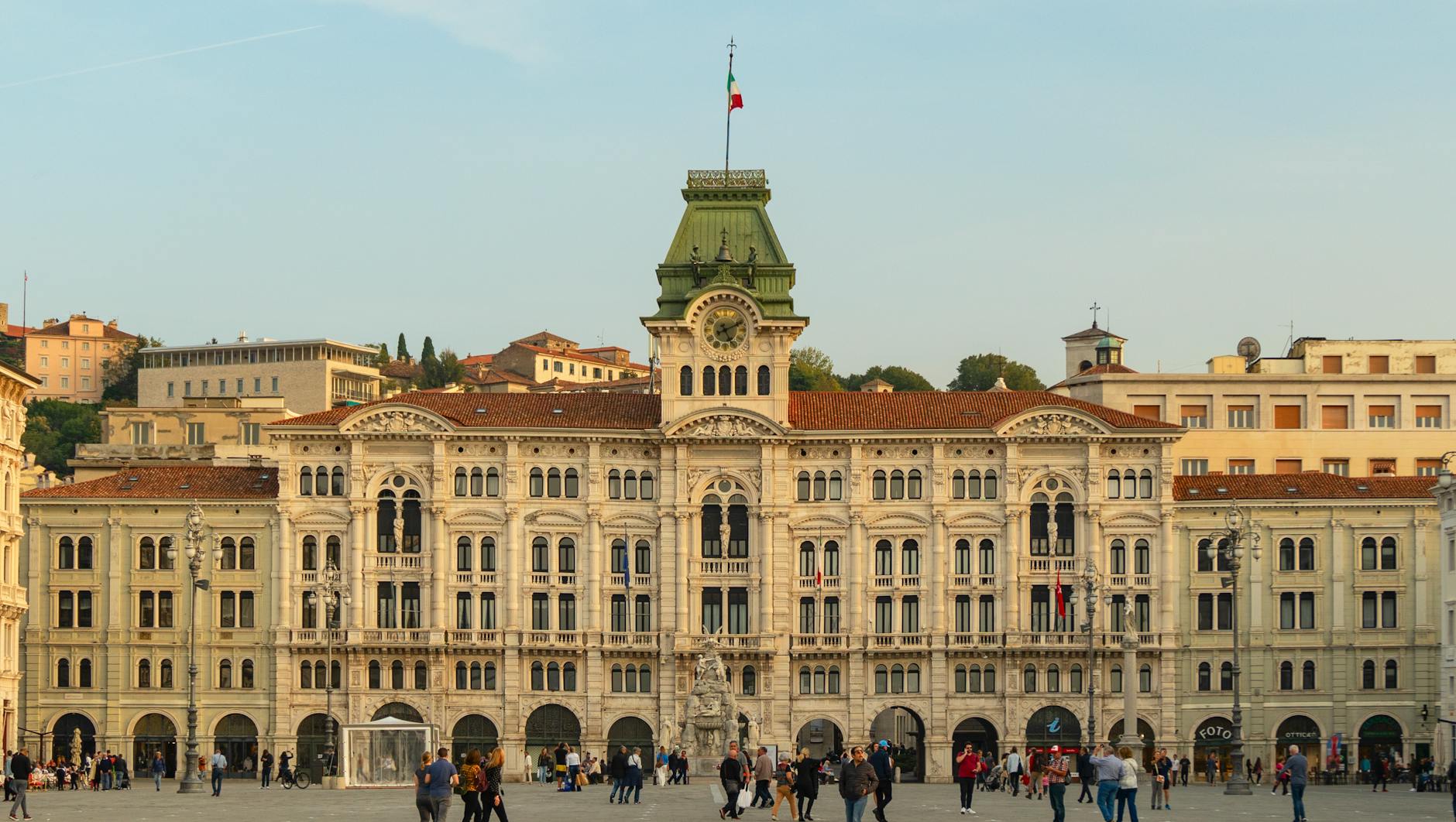
Trieste rewards a visit more than most Italian cities its size because it does not feel much like Italy. The centre is Piazza Unità d’Italia, the grand Habsburg square that opens directly onto the Adriatic — the largest sea-facing square in Europe, ringed by the palaces of the old maritime empire. The city has a Slovene-speaking minority, Viennese-style cafés, and a literary association built around James Joyce, who arrived in 1904 and spent much of the following decade here writing early work; the Caffè San Marco on Via Cesare Battisti dates to 1914 and is one of the few from that era still operating on the original premise.
A few kilometres up the coast, Miramare Castle — white, on a promontory above the gulf — was the seafront residence built for Habsburg Archduke Maximilian in the 1850s and 1860s. Behind Trieste, the Carso (Karst) plateau rises with its limestone topography, caves and osmizze — farm-taverns that open seasonally to serve local wine and cured meats. Ljubljana is about 90 minutes by car through completely open Schengen border crossings.
⏱️ Layover math: be honest with yourself
The airport is 33 km out. Even taking the 30-minute train, a round trip to central Trieste and back to the terminal eats close to two hours before you have seen anything. The arithmetic:
- Train in (~30 min) + 90 min around Piazza Unità + train back (~30 min) + check-in and security buffer (~45 min) = around 3 hr 15 min minimum
- Allow for delays and a five-hour-plus layover becomes the sensible lower bound for a city visit
On a layover under five hours, stay airside. Miramare is a half-day trip, not a quick dash; the Carso requires a full day. Worth knowing: the Roman ruins at Aquileia (UNESCO) and the Grado lagoon are actually closer to the airport than Trieste is — if you have a hire car and Friuli rather than the city is the point, those are viable under shorter windows.
⚠️ Layover viability
Under five hours: stay airside. A round trip to Piazza Unità d’Italia takes a minimum of three hours fifteen minutes in transit and queuing alone. On a four-hour layover you reach the city in time to turn around. Save Trieste for a proper visit.
🧭 Practical Notes
- Validate your ticket. Regional train and APT bus tickets must be stamped before boarding. An unvalidated ticket counts as no ticket and draws a fine if inspected.
- Draw cash from a Bancomat (bank ATM), not the exchange desk. Bureau de change rates at the airport are poor. Cards are accepted widely in Trieste, but keep small change for the ticket machine.
- Reduced-mobility assistance is free under EU rules but must be booked through your airline at least 48 hours ahead. The meeting point is signed in the terminal.
- Aquileia and Grado are closer to TRS than Trieste is. The Roman remains at Aquileia (UNESCO World Heritage) and the Grado lagoon both sit between the airport and the coast — worth factoring in if a hire car is already sorted and the city was never the destination.
❓ Frequently Asked Questions
📊 At a glance — TRS 2026
| Feature | Data (2026) |
|---|---|
| Official name | Aeroporto Trieste–Friuli Venezia Giulia (Ronchi dei Legionari) |
| IATA / ICAO | TRS / LIPQ |
| Location | ~33 km northwest of Trieste, near Monfalcone |
| Passengers | Crossed 1 million for first time in 2024 (~+40%); growing |
| Terminals | 1 |
| Train to Trieste | Trieste Airport station (footbridge) → Trieste Centrale, ~30 min, ~€4–5, every 30 min |
| Bus to Trieste | APT G51 → Trieste Centrale, ~€4.05, ~55–60 min |
| Other rail | North to Udine via Palmanova; connections toward Venice |
| Taxi to Trieste | ~€70–90 (33 km) |
| Currency | Euro (€) |
| Schengen status | Member; EES live (10 April 2026); ETIAS pending Q4 2026 |
| Slovenian border | Adjacent; open Schengen crossing; Ljubljana ~90 min |
| Lounge | Sala Calligaris (airside; Priority Pass / Mastercard) |
| Dominant carriers | ITA Airways (~half of arrivals), Lufthansa/Air Dolomiti, Ryanair (base), Wizz Air, Volotea |
| Best layover move | Train to Piazza Unità d’Italia — 5 hr+ layover only |