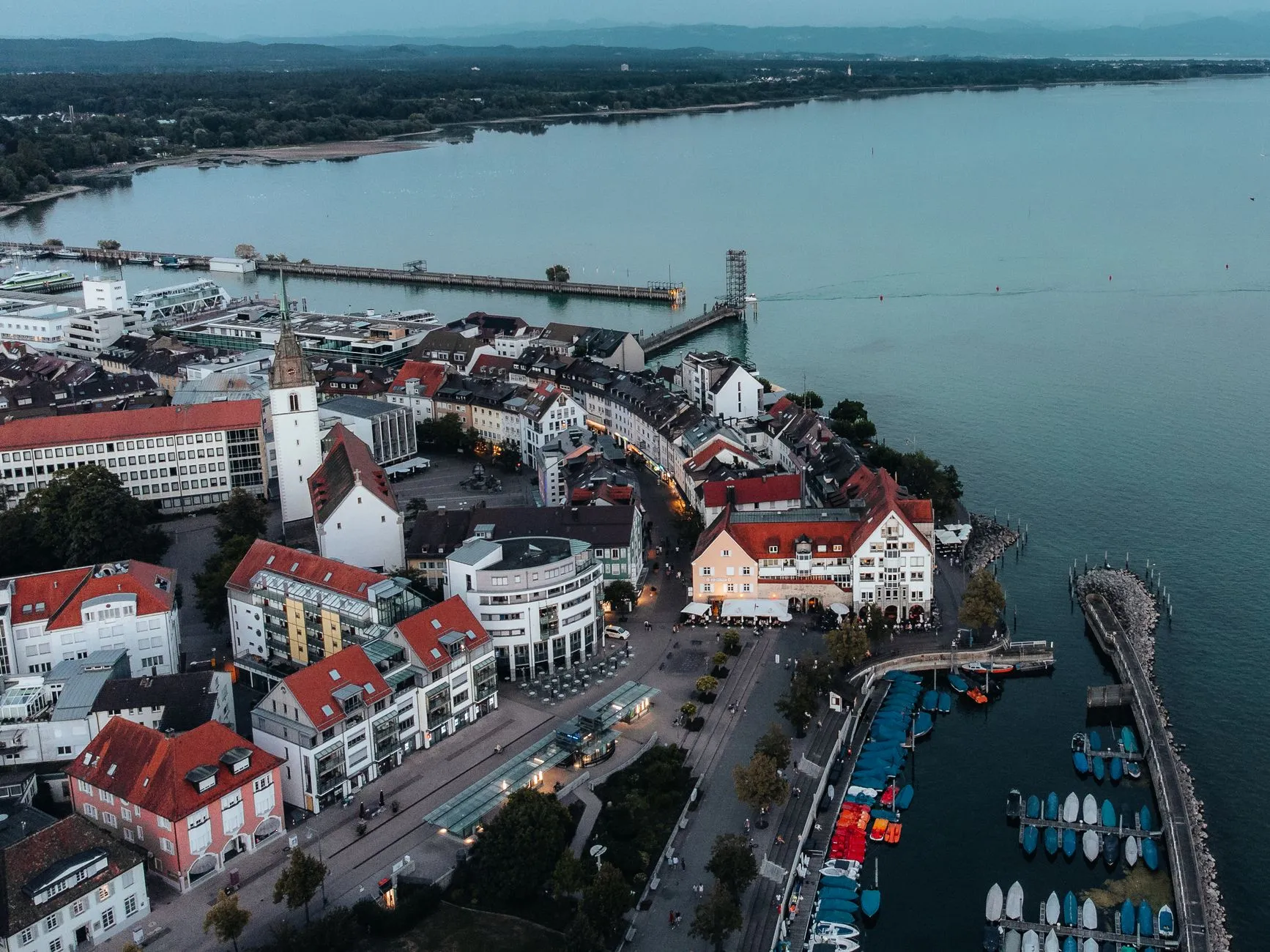
Friedrichshafen Airport (FDH) — Airport Guide 2026
Friedrichshafen airport — officially the Bodensee-Airport — handled around 227,000 passengers last year on a schedule that shrank again when Lufthansa ended its Frankfurt link in March 2024, and the City of Friedrichshafen is now covering operating losses to keep it running.
Quick Reference
FDH / EDNY
Bodensee-Airport Friedrichshafen
~3–4 km
BOB, Friedrichshafen Flughafen → Friedrichshafen Stadt, 3–5 min, ~€2.70 (children ~€1.60)
Line 7586, ~10 min, ~€3.28
~€12–15, ~10 min
Euro (€)
Yes — EES live since 10 April 2026; ETIAS pending
None (no Priority Pass; paid VIP terminal service bookable in advance)
Eurowings (Berlin, Düsseldorf, Hamburg) + seasonal leisure charters
1
🏢 The Airport’s Situation
One terminal, one security line, a café, a kiosk, and a duty-free area. The physical plant is uncomplicated. The financial situation takes a sentence more: passenger numbers sit around 227,000 against an operator target of roughly 295,000, Lufthansa’s Frankfurt departure at the end of March 2024 hit hard, and from 2026 the City of Friedrichshafen is covering operating losses at approximately €1 million per year, with investment subsidies alongside. EU state-aid rules will end public operating subsidies from April 2027 — which is why the airport’s future route network stays uncertain.
None of this touches safety or the daily passenger experience. Security is quick; the terminal is navigable in under five minutes. The consequence is a thin schedule: Eurowings to Berlin, Düsseldorf, and Hamburg, seasonal leisure charters to Turkey and similar, and an Amsterdam connection via KLM that the airport has been pursuing but which is not yet confirmed.
⚠️ Thin network — verify before travel
Friedrichshafen’s schedule has contracted twice in two years. Confirm your specific route is still operating close to departure, particularly off-season.
🛂 Border & Visa: EES Live, ETIAS Pending
Germany is a Schengen member, so flights arriving from within Schengen clear with no passport check — which covers most of Friedrichshafen’s domestic and short-haul European schedule.
For arrivals from outside Schengen, the Entry/Exit System (EES) became fully operational at Germany’s external border on 10 April 2026, after a phased rollout from October 2025. It replaces the manual passport stamp with biometric registration — facial image and fingerprints — used to enforce the 90-in-180-day short-stay limit. First-time entry in a new cycle takes longer while the biometric record is created; factor that in at the border.
The European Travel Information and Authorisation System (ETIAS) is separate and not yet running. It is expected in the last quarter of 2026. When live, visa-exempt non-EU arrivals — UK, US, Canadian, Australian, and similar passports — will need a paid online authorisation before flying. Until it launches, a valid passport is sufficient.
| Passport | Visa for short stay? | EES applies? | ETIAS once live? |
|---|---|---|---|
| EU / EEA / Swiss | No | No | No |
| UK | No (≤90/180 days) | Yes | Yes |
| USA / Canada / Australia / NZ | No (≤90/180 days) | Yes | Yes |
| Japan / South Korea / Singapore | No (≤90/180 days) | Yes | Yes |
| India / China / South Africa | Yes — Schengen visa | Yes (recorded at entry) | N/A while visa required |
🛂 EES live since 10 April 2026
First entry in a new 90/180-day cycle takes extra time at the border for biometric registration. Allow for this on arrival from outside Schengen.
🚆 Getting Into Town: Train First
For a regional airport of this size, the ground connection is unusually straightforward. Friedrichshafen has its own railway station — Friedrichshafen Flughafen — built into the terminal.
The Bodensee-Oberschwaben-Bahn (BOB) runs from there to Friedrichshafen Stadt — the central, lakeside station — in 3–5 minutes for around €2.70 (children approximately €1.60). Friedrichshafen Stadt is on the lakefront, by the harbour and the ferry piers. The same BOB line continues inland toward Ravensburg and Aulendorf.
The bus (line 7586) covers the same route in about 10 minutes for approximately €3.28. There is no good reason to take the bus unless the train timing does not work for your arrival.
Taxis cost around €12–15 into town, roughly 10 minutes. The short distance keeps the fare reasonable. Use the official rank.
🚆 BOB train: 3–5 min, ~€2.70
The station is inside the terminal building. This is the right option — faster and cheaper than the bus, and it deposits you on the lakefront at Friedrichshafen Stadt. Services are regular but not metro-frequent; check the timetable for your flight time.
🛋️ Lounges & Terminal Facilities
There is no Priority Pass lounge at Friedrichshafen and no contract lounge of any description. A lounge card does nothing here. The only paid upgrade is a VIP terminal service — a private waiting area with expedited processing — that must be booked in advance through handling agents.
For everyone else: café, duty-free, and public seating. Given that the BOB puts you at the lakefront in five minutes, if you have time before a flight the town is a better option than the terminal. The airport is compact enough that returning from Friedrichshafen Stadt and clearing security on a 45-minute buffer is comfortable.
🛋️ No lounge — use the town instead
If you have two or more hours before your flight, the train to Friedrichshafen Stadt is more useful than waiting in the terminal. Security at a 227,000-passenger airport is fast.
🍽️ Food Before You Fly
The food worth eating is not at the airport. Felchen — the Bodensee whitefish — and perch, pan-fried and served simply at the harbour-side restaurants in Friedrichshafen Stadt, are the reason to eat before you fly rather than after landing. Fresh lake fish does not travel; eat it at the harbour.
The wider regional repertoire is Swabian-Baden: Spätzle (soft egg noodles, served as a side or as Käsespätzle with melted cheese as a main) and Maultaschen (Swabian stuffed pasta, roughly the local answer to ravioli) appear on most menus in town.
For the carry-home: Bodensee wine is the practical choice. The lake’s warm, south-facing slopes produce light Müller-Thurgau whites and Spätburgunder (Pinot Noir). Regional Most — apple cider or pressed apple juice depending on the producer — travels equally well. Both clear EU customs without restriction.
🐟 Felchen at the harbour — not at the airport
Bodensee whitefish is the one dish tied specifically to this lake. The airport café does not serve it. The harbour restaurants in Friedrichshafen Stadt do. Worth the train trip if you have time.
💡 The Layover Math and the Zeppelin Story
Friedrichshafen’s civic identity is aviation. Count Ferdinand von Zeppelin built and flew his first rigid airship here from 1900, and the lakefront reflects it. The Zeppelin Museum on the harbour holds the world’s largest Zeppelin collection, including a full-scale walk-through reconstruction of a section of the LZ 129 Hindenburg. The Dornier Museum, adjacent to the airport, covers the region’s other aviation pioneer.
The story extends to the present: the modern Zeppelin NT semi-rigid airship still operates sightseeing flights over the Bodensee from Friedrichshafen in season. These require advance booking, are weather-dependent, and are a planned day out — not something to attempt on a transit.
The layover math is favourable for a small airport. The 3–5 minute train makes Friedrichshafen Stadt accessible in a way that few airports of this scale can offer. A three-hour layover is enough for the lakefront promenade and a visit to the Zeppelin Museum on the harbour, with a return-security buffer — security at an airport this size is fast enough that 45 minutes is a generous margin. Mainau (the flower island) and Meersburg (the medieval lakeside town) are half-day outings, not layover activities. The ferry across to Konstanz or to Romanshorn in Switzerland falls in the same category.
💡 Three-hour layover: Zeppelin Museum is viable
Friedrichshafen Flughafen to Friedrichshafen Stadt by train (3–5 min), walk to the harbour, Zeppelin Museum, return. Security at this scale is fast. Three hours works; two is tight.
💡 Zeppelin NT flights: book well ahead
The modern semi-rigid airship operates from the airport in season, subject to weather. This is a reserved-in-advance destination, not a spontaneous layover activity.
🧭 Before You Travel
- Take the train. Friedrichshafen Flughafen station is inside the terminal. BOB to Friedrichshafen Stadt: 3–5 minutes, ~€2.70. Check the timetable — regular but not metro-frequent.
- No lounge card will help here. Priority Pass and equivalent do nothing at FDH. The only premium option is a paid VIP terminal service booked in advance. Otherwise: café and public seating.
- Use a bank ATM. Airport bureau-de-change rates are poor. Small German airports and regional transport still expect cash in places; draw euros from a bank machine before you go.
- Verify your route. The schedule has contracted twice in two years. Reconfirm your specific connection is still operating, particularly off-season.
❓ Frequently Asked Questions
📊 At a glance — FDH 2026
| Feature | Detail |
|---|---|
| Official name | Bodensee-Airport Friedrichshafen |
| IATA / ICAO | FDH / EDNY |
| Location | ~3–4 km from Friedrichshafen, on Lake Constance |
| Annual passengers | ~227,000 (operator target ~295,000) |
| Terminals | 1 |
| Train to centre | BOB, Friedrichshafen Flughafen → Friedrichshafen Stadt, ~3–5 min, ~€2.70 |
| Bus to centre | Line 7586, ~10 min, ~€3.28 |
| Taxi to centre | ~€12–15, ~10 min |
| Currency | Euro (€) |
| Schengen status | Member; EES live 10 April 2026; ETIAS pending |
| Lounges | None — no Priority Pass; paid VIP terminal service only |
| Dominant carriers | Eurowings (Berlin, Düsseldorf, Hamburg) + seasonal leisure charters |
| Financial position | Municipally subsidised from 2026; EU ends operating subsidies April 2027 |
| Best layover use | BOB to Friedrichshafen Stadt + Zeppelin Museum (three hours minimum) |