Heraklion International Airport “Nikos Kazantzakis” (HER) — Airport Guide 2026
One thing to keep on your radar for the years ahead: Heraklion is due to be replaced by a new airport at Kasteli, about 35 km inland, which was past 65% complete in late 2025. But it is not imminent — the opening is not expected before February 2027 at the earliest, and that date has already slipped more than once. Through 2026 and beyond, Nikos Kazantzakis stays fully open and is the airport you will fly into; when Kasteli eventually opens, the handover is expected to be phased in over months rather than a single-day switch.
Quick Reference
Heraklion International Airport “Nikos Kazantzakis”
HER / LGIR
~5 km east of Heraklion city, central Crete
~10 million/year
One passenger terminal
City bus (lines 6/10/11/12) — ~15 min, €1.60 at booth / €2.50 onboard
~€15–20, ~10–15 min
Euro (€)
Yes; EES live since 10 April 2026, ETIAS pending Q4 2026
Goldair Handling Lounge (airside, Priority Pass)
Ryanair, easyJet, Aegean, Sky Express, TUI, Jet2
New Kasteli airport (~35 km inland) — earliest opening ~Feb 2027 (likely later); HER stays open until then
🏗️ One Terminal That Has Outgrown Itself
Heraklion handles around 10 million passengers a year through a terminal built for considerably fewer. In July and August this translates to genuinely slow queues at security and passport control, tight gate areas, and very little margin for error. If you are connecting onward, do not cut it fine in summer — the airport will not help you.
Relief is still years off. The Kasteli airport, about 35 km inland from Heraklion, was past 65% complete in late 2025, but its opening is not expected before February 2027 at the earliest — and that target has repeatedly slipped. When it does open, replacing Nikos Kazantzakis is expected to be a phased transition measured in months, not an overnight closure. For every flight in the 2026 summer season and beyond, unless officially redirected, HER remains the operating gateway for central and eastern Crete.
⚠️ Summer peak — build in time
Heraklion is over capacity. Security and passport control queues are slow on busy summer mornings. Arrive early, and on any layover treat 90 minutes as the minimum return-security buffer — not a cushion.
🛂 Border, EES & ETIAS
Greece is in the Schengen Area. Flights arriving from within Schengen clear with no passport control, which covers most of HER’s summer traffic from Western Europe.
For non-EU arrivals, the Entry/Exit System (EES) became fully operational at the Schengen external border on 10 April 2026, after a phased rollout from October 2025. It replaces the manual passport stamp with a biometric record — facial image and fingerprints — used to enforce the 90-in-180-day short-stay limit. A traveller’s first entry of the cycle takes longer while the record is created. At a congested airport like Heraklion, the non-EU queue at peak can be significant; build time accordingly.
The European Travel Information and Authorisation System (ETIAS) is separate and not yet live — expected in the last quarter of 2026. Once running, visa-exempt non-EU visitors (UK, US, Canadian, Australian and similar) will need an online pre-travel authorisation. Until then, a valid passport is sufficient.
| Passport | Visa for short stay? | EES applies? | ETIAS once live (Q4 2026)? |
|---|---|---|---|
| EU / EEA / Swiss | No | No | No |
| UK | No (≤90/180) | Yes | Yes |
| USA / Canada / Australia / NZ | No (≤90/180) | Yes | Yes |
| Japan / South Korea / Singapore | No (≤90/180) | Yes | Yes |
| India / China / South Africa | Yes — Schengen visa required | Yes (recorded at entry) | N/A while visa required |
🛂 EES live since 10 April 2026
Non-EU arrivals should expect a slower first-entry process while biometrics are recorded. At a peak-summer Heraklion arrival, the non-EU queue will be longer than it was before April.
🚌 Getting Into Heraklion
There are no railways on Crete. Transport from the airport is by urban bus, taxi, or hire car.
🚌 City Bus
The urban bus network connects the airport to the city centre on lines 6, 10, 11, and 12 — about 15 minutes to the centre, continuing to the KTEL intercity bus station in about 20 minutes. Buy a ticket at the booth outside the terminal: €1.60 from the kiosk, €2.50 if you pay onboard. The kiosk queue is also faster than fumbling change on the bus.
From the KTEL station, intercity KTEL coaches run along Crete’s north coast to Chania, Rethymno, Agios Nikolaos, and the main resort towns.
🎟️ Bus fare — buy at the booth
€1.60 from the kiosk versus €2.50 on the bus. Small saving, faster boarding. The booth is just outside the terminal exit.
🚕 Taxi
Taxis from the official rank run around €15–20 into the centre, roughly 10–15 minutes. Use the rank; agree that the meter is running before you move; ignore any approach from drivers offering rides before you reach the rank.
🛋️ The Goldair Handling Lounge
Heraklion’s single airside lounge is the Goldair Handling Lounge, which accepts Priority Pass. Standard contract lounge fare: a seat away from the packed gate hall, coffee and soft drinks, a light buffet, wine and beer. At a leisure airport this size, the value is the seat and the relative quiet rather than the catering. Reviews note the experience varies sharply with crowd levels.
🛋️ Goldair Handling Lounge — Priority Pass
Airside, accepts Priority Pass. Capacity is the variable: on a busy summer morning it can fill. On a congested departure day, a confirmed lounge seat is worth more than the food — the gate hall is genuinely unpleasant at peak.
🍽️ Cretan Food Before You Fly
Cretan cooking is more distinctive than the general Greek-island standard, and several things are worth seeking out if you have time before a departure.
Dakos — a barley rusk soaked and topped with grated tomato, soft mizithra cheese, and olive oil — is the island’s characteristic salad. In Heraklion specifically, bougatsa — warm filo pastry filled with cream or cheese and dusted with icing sugar — is the standard breakfast, sold at dedicated shops throughout the city centre.
For the carry-home, the obvious choices are Cretan olive oil (genuinely excellent and worth the weight), graviera cheese vacuum-packed, and a bottle of raki (also called tsikoudia), the clear grape-pomace spirit poured at the end of every Cretan meal. All three clear EU customs without issue.
🥐 Bougatsa — the Heraklion breakfast
Warm filo with cream or cheese filling, dusted with sugar. Find it at dedicated bougatsa shops in the city centre rather than at the airport — the airport version is not the same thing.
💡 Layover Math: Knossos, the Museum & the Venetian Harbour
The bus to the centre takes about 15 minutes. From there, the choices within reach are:
- Heraklion Archaeological Museum — holds the core Minoan collection: the bull-leaping frescoes, the Phaistos Disc, and the artefacts from the palace sites. Directly in the city centre.
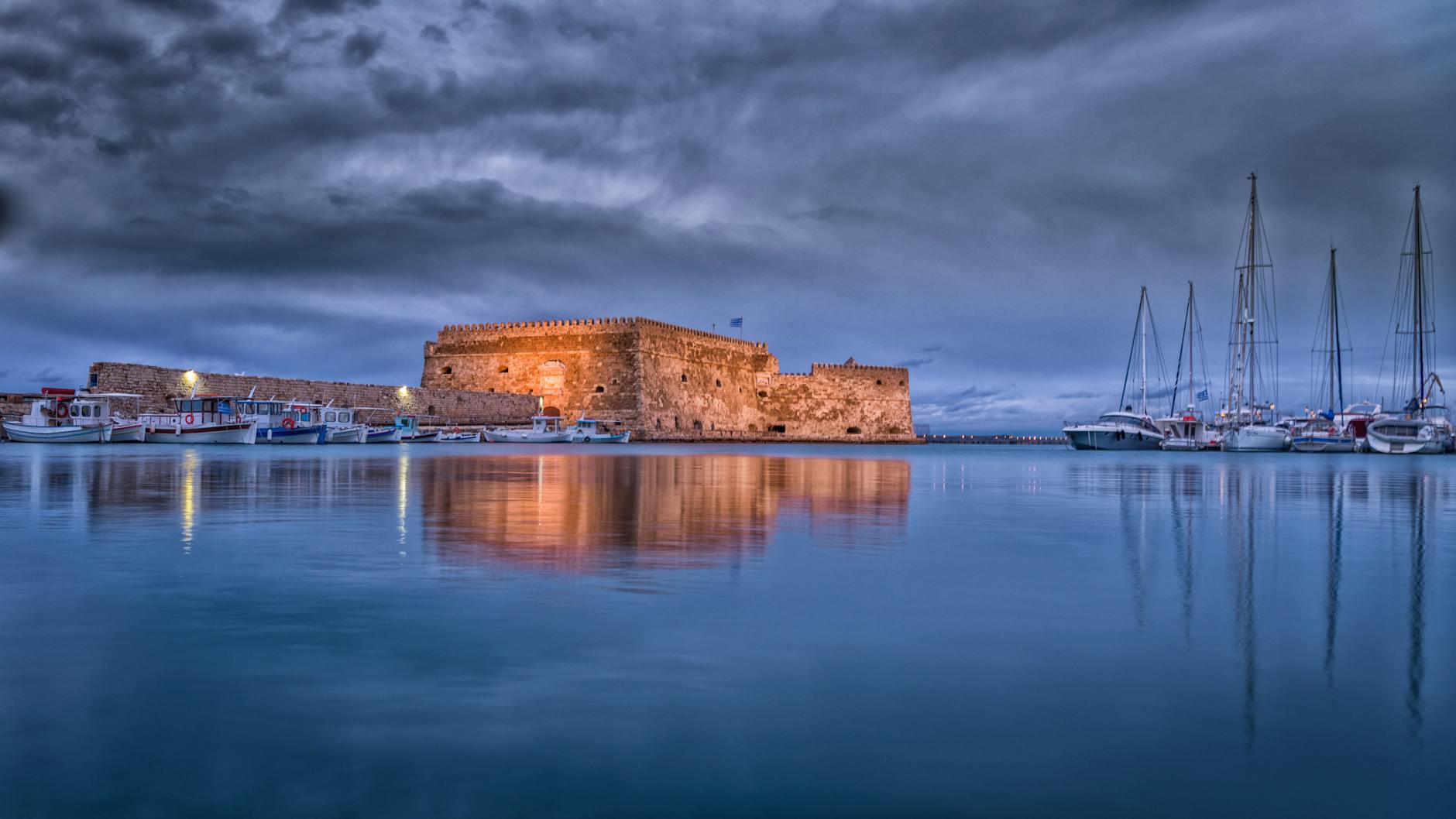
- The Venetian harbour — the Koules sea-fortress at the harbour entrance, the massive Venetian walls ringing the old town, and the tomb of Nikos Kazantzakis (after whom the airport is named) on the Martinengo bastion. Walkable from the museum.
- Knossos — the Bronze Age Minoan palace excavated and controversially reconstructed by Arthur Evans, about 5 km south of the city centre, reachable by city bus.
Four-hour layover: the Archaeological Museum and the Venetian harbour are feasible — 15 minutes bus each way, with 90 minutes as the minimum return-security buffer. In summer, treat that 90 minutes as a floor, because the queues at HER are genuinely slow at peak. The maths works, but it is not relaxed.
Five-hour-plus layover: Knossos becomes viable on top of the above. Under five hours, the round-trip bus to Knossos plus a site visit does not leave enough margin.
Under four hours: stay airside.
⏱️ Layover floor: 90 minutes for return security
In July and August, HER’s security and passport queues are slow. 90 minutes before departure is not a cushion — it is the minimum. Budget from there, not backwards from your gate time.
Crete is a large island. This airport serves the central and eastern end — Heraklion, Knossos, and the resorts east along the north coast. For the western end — Chania, the Samaria Gorge, the beaches around Balos and Elafonisi — the relevant airport is Chania (CHQ), at the other end of the island.
🧭 Practical Notes
Cash and ATMs. Draw euro from a bank ATM rather than the airport bureau de change. Cards are widely accepted across Heraklion and the resorts, but carry some coins for the bus and smaller tavernas.
Reduced-mobility assistance. Free under EU rules, but must be requested through your airline at least 48 hours before departure. The meeting point is signed in the terminal.
Kasteli in 2027. If you are planning travel to Crete in 2027 or beyond, verify which airport is operating before booking transport. The Kasteli airport is about 35 km inland and significantly further from the city and most eastern resorts than the current HER location.
❓ Frequently Asked Questions
📊 At a Glance — HER 2026
| Feature | Data |
|---|---|
| Official name | Heraklion International Airport “Nikos Kazantzakis” |
| IATA / ICAO | HER / LGIR |
| Location | ~5 km east of Heraklion, central Crete |
| Passengers | ~10 million/year (over terminal capacity) |
| Terminals | 1 |
| Train to centre | None — no railways on Crete |
| Bus to centre | City bus (lines 6/10/11/12), ~15 min, €1.60 booth / €2.50 onboard |
| Taxi to centre | ~€15–20, ~10–15 min |
| Currency | Euro (€) |
| Schengen | Yes; EES live 10 April 2026, ETIAS pending Q4 2026 |
| Lounge | Goldair Handling Lounge (Priority Pass; subject to capacity) |
| Dominant carriers | Ryanair, easyJet, Aegean, Sky Express, TUI, Jet2 |
| Replacement airport | Kasteli (~35 km inland), target opening ~February 2027 |
| Best layover move | City bus → Archaeological Museum + Venetian harbour (4 hr+ layover; Knossos 5 hr+) |
| Return-security buffer | 90 min minimum in summer — treat as a floor |