Katowice Airport “Wojciech Korfanty” (KTW) — Airport Guide 2026
Katowice’s airport is not in Katowice — it sits at Pyrzowice, 30 kilometres north of the city, with no rail link and no direct bus, which is the single most consequential fact about travelling through it.
Quick Reference
Katowice Airport “Wojciech Korfanty” (Pyrzowice)
KTW / EPKT
Pyrzowice, ~30 km north of Katowice; ~100 km from Kraków
Polish złoty (PLN) — not euro (~4.3 zł = €1, ~4.0 zł = $1)
Yes — EES live from 10 April 2026; ETIAS pending
Wizz Air (largest Polish base), Ryanair, LOT, heavy charter trade
Terminal A (non-Schengen) · Terminal B (Schengen) · charter terminal
Business Lounge — Priority Pass at Terminal A only (dropped at Terminal B from 1 Jan 2026)
7.3 million (record; +14%)
✈️ Terminals and Carriers
Katowice runs three separate buildings: Terminal A handles non-Schengen flights, Terminal B handles Schengen, and a third handles charters. Check which terminal your flight uses before you arrive — the lounge, Priority Pass acceptance, and border controls all differ by building.
The airline mix is lopsided toward budget. Wizz Air treats KTW as its largest Polish base, operating around seven based aircraft across roughly 35 routes. Ryanair holds three aircraft and runs about 25 routes. LOT provides some network coverage, and a substantial holiday-charter trade fills the rest. The airport recorded 7.3 million passengers in 2025 — up 14% on the year prior — and its owner has announced plans to expand toward 12 million by 2028. At low-cost peaks it runs busy; build transit time accordingly.
⚠️ Check your terminal first
Security, the Business Lounge, and Priority Pass acceptance are different at Terminal A (non-Schengen) and Terminal B (Schengen). Arriving at the wrong building wastes time you may not have.
🛂 Border, EES, and the Złoty Question
Poland is a Schengen member, so intra-Schengen arrivals — most Ryanair and Wizz Air routes — clear with no passport control. Non-Schengen arrivals (Terminal A) face the full border.
The biometric Entry/Exit System (EES) went fully operational at the Schengen external border on 10 April 2026, following a phased rollout from October 2025. It replaces the manual passport stamp: on first entry in a 90/180-day cycle, a non-EU traveller provides a facial image and fingerprints; the record is then used to track the short-stay limit automatically. Allow extra time at Terminal A on a first EES entry.
The European Travel Information and Authorisation System (ETIAS) — the paid online pre-authorisation for visa-exempt non-EU visitors — is not yet live, expected sometime once it launches. Until it launches, a valid passport is the only requirement for UK, US, Canadian, and Australian travellers.
| Passport | Visa for short stay? | EES applies? | ETIAS once live? |
|---|---|---|---|
| EU / EEA / Swiss | No | No | No |
| UK | No (≤90/180) | Yes | Yes |
| USA / Canada / Australia / NZ | No (≤90/180) | Yes | Yes |
| Japan / South Korea / Singapore | No (≤90/180) | Yes | Yes |
| India / China / South Africa | Yes — Schengen visa | Yes (recorded at entry) | N/A while visa required |
Poland uses the złoty (PLN), not the euro. The rate runs around 4.3 zł to the euro and 4.0 to the dollar. Cards and contactless are accepted almost everywhere; the issue is simply remembering that the numbers on the screen are in złoty, not euros.
💱 PLN, not euros
Poland is Schengen but not eurozone. ~4.3 zł = €1. Prices at the airport, on shuttles, and in the city are denominated in złoty. Cards work fine; just read the amount before you tap.
🚌 Getting to Katowice and Kraków
There is no airport train. There is no single direct city bus. The airport is 30 kilometres out at Pyrzowice, and the public transit requires taking a local bus and then changing onto a city line — over an hour, with a connection to navigate, for a fare of around 7 zł for a 90-minute ticket. That is the cheap route; it is not the convenient one.
### For Katowice city
The practical options are a private shuttle or a FlixBus-type coach, both of which run directly to the city in about 50–70 minutes. Pre-book; it is worth the premium over the public route, particularly with luggage.
Taxis and Bolt/Uber run to Katowice, but the 30-kilometre distance makes them expensive relative to the shuttle. Use marked taxis or a ride-hail app — unmarked cars touting in the terminal are a reliable way to overpay significantly.
### For Kraków
Kraków is about 100 kilometres away. Scheduled shuttle coaches take roughly 1.5–2 hours; a taxi runs around 250–350 zł. A substantial share of KTW’s traffic is people flying here to access Kraków at Wizz Air prices — the transfer time and cost are real, but the fare saving often justifies it. It is not, however, a quick hop.
🚌 Pre-book the shuttle
The public bus to Katowice involves a change and takes over an hour. A private shuttle or FlixBus-type coach takes 50–70 minutes and goes directly. For Kraków, budget 1.5–2 hours by coach and around 250–350 zł by taxi — it is 100 km.
⚠️ Avoid unmarked taxi touts
Ride-hail apps (Bolt, Uber) operate in the Katowice region. Use them, or the marked taxi rank. Unmarked cars waiting in arrivals charge substantially over the going rate.
🛋️ Lounges and the 2026 Priority Pass Change
The Business Lounge situation at KTW changed on 1 January 2026, and it catches people out repeatedly.
What changed: Priority Pass and LoungeKey are no longer accepted at the Business Lounge (and Fast Track) in Terminal B — the Schengen terminal. If you are flying within Schengen, your Priority Pass card will not get you into the lounge there.
What still works: The Business Lounge at Terminal A (non-Schengen), located airside near Gate 1, still accepts Priority Pass. Pay-in access (cash or card, at the desk or online) is also available at Terminal A. The lounge itself is a standard contract space: a seat, drinks, light catering — adequate, not remarkable.
🛋️ Priority Pass: Terminal A only in 2026
As of 1 January 2026, Priority Pass and LoungeKey no longer work at the Terminal B (Schengen) Business Lounge or Fast Track. The Terminal A Business Lounge near Gate 1 still accepts both. If you are flying within Schengen from Terminal B, your card will not open the lounge door.
🍽️ Food Before You Fly
Katowice is the centre of Upper Silesia, and the regional cooking is distinct enough to be worth noting — not in an airport context (airport food here is standard), but if you are spending any time in the city before flying.
The defining plate is rolada śląska — a rolled beef roulade stuffed with bacon, onion, and pickle, served with kluski śląskie (round potato dumplings with a thumbprint dimple) and modra kapusta (stewed red cabbage). The soups are żur śląski (sour rye) and wodzionka, a bread-and-garlic soup that originated in the mining towns and has no particular elegance, but is good.
The carry-home items are a kołocz śląski — a yeast cake made with poppy seed, cheese, or apple filling, protected under EU PGI rules — and Tyskie beer, brewed in nearby Tychy. Polish vodka travels fine. Sealed goods clear EU customs without difficulty. Prices are in złoty.
🥩 Rolada śląska is the plate to order
Rolled beef roulade with kluski śląskie (the potato dumplings with the thumbprint dimple) and red cabbage is Upper Silesia’s canonical Sunday dish. The airport food hall is not the place for it; the city is.
💡 Katowice Culture Zone and Layover Reality
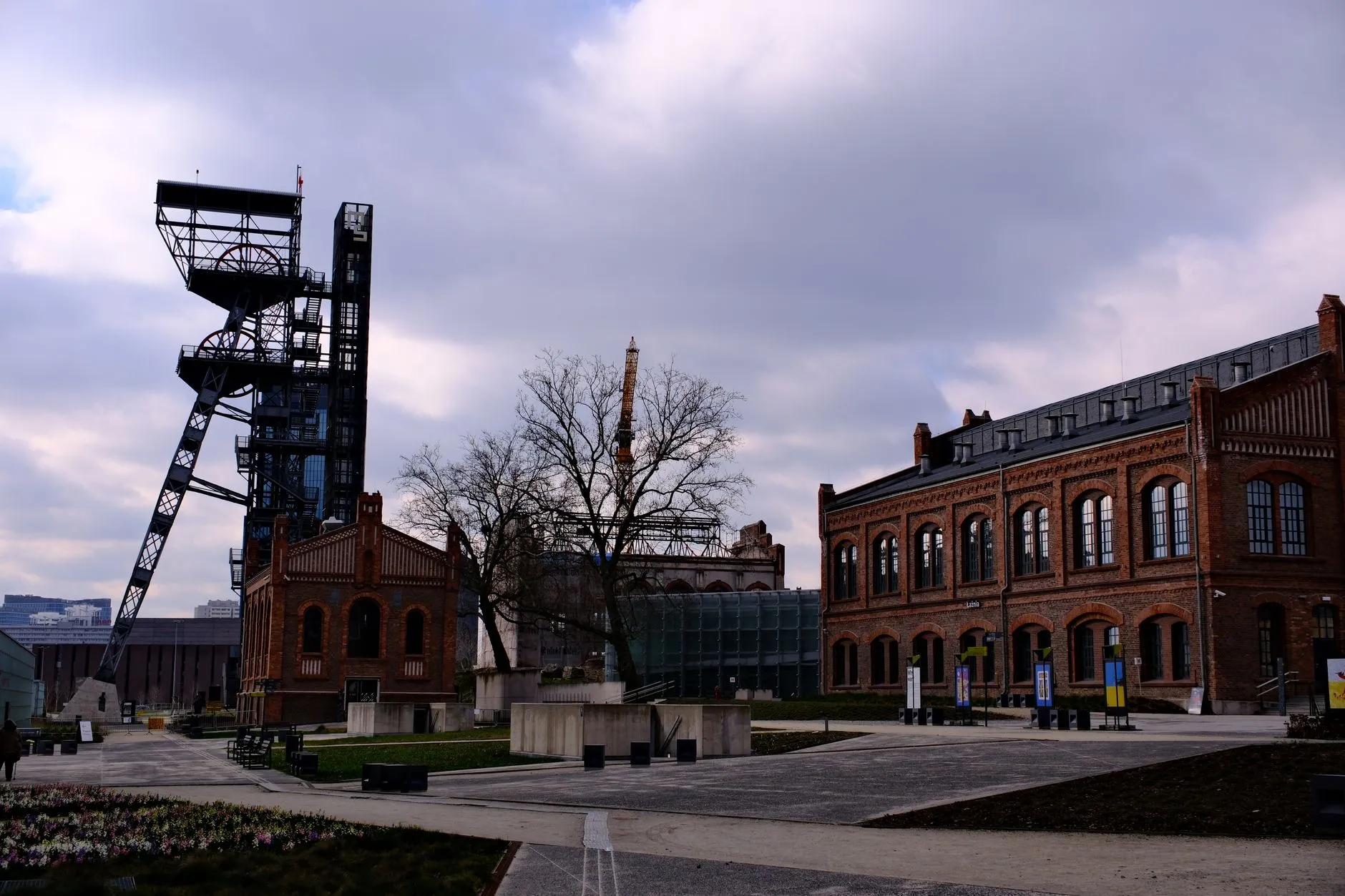
Katowice spent the past 30 years converting from a coal-and-steel industrial city into a culture and conference centre. The results are concentrated in the Strefa Kultury (Culture Zone), built on the site of a former colliery.
Three buildings define the zone: the Spodek — the flying-saucer-shaped arena completed in 1971, which is the city’s most recognisable structure — the NOSPR concert hall, home of the Polish National Radio Symphony Orchestra and acoustically serious, and the Silesian Museum, built mostly underground in the old mine workings and entered through glass cubes on the surface. On the eastern edge of the city, Nikiszowiec is an early-20th-century red-brick miners’ housing estate, largely intact, now a heritage district. Katowice holds UNESCO “City of Music” designation and hosted the COP24 climate summit.
### The layover maths
The airport is 30 kilometres out with no convenient public link. A Katowice visit from a layover requires:
- A five-hour-plus layover minimum
- A pre-booked shuttle or taxi each way (not the public bus connection)
- A 90-minute return buffer for the shuttle journey and re-clearing security
That is the honest minimum. Kraków, at 100 kilometres each way, is not layover material at any realistic connection time. For anything under five hours at KTW, staying airside is the correct call.
💡 Katowice culture zone: five hours minimum
The Strefa Kultury (Spodek, NOSPR, Silesian Museum) is worth the trip if your layover is long enough. Allow a 90-minute return-security buffer and pre-book the shuttle. For anything shorter, or for Kraków (100 km), stay airside.
🧭 Before You Go
- The airport is not in Katowice. It is 30 km north at Pyrzowice. Pre-book a shuttle or coach rather than hoping for an easy public connection.
- Priority Pass works at Terminal A only in 2026. The Terminal B (Schengen) lounge dropped Priority Pass from 1 January 2026.
- Poland is Schengen but not eurozone. PLN, approximately 4.3 to the euro. Cards are universally accepted; the amounts are in złoty.
- EES is live; ETIAS is not yet. Biometric border processing (EES) has been operational since 10 April 2026. ETIAS has no announced launch date — until it launches, a valid passport is sufficient for visa-exempt travellers.
- Kraków is 100 km. Allow 1.5–2 hours by coach, roughly 250–350 zł by taxi.
- Use Bolt/Uber or the marked taxi rank. Unmarked car touts in the terminal charge substantially over the going rate.
❓ Frequently Asked Questions
At a glance — KTW 2026
| Feature | Current Data (2026) |
|---|---|
| Official name | Katowice Airport “Wojciech Korfanty” (Pyrzowice) |
| IATA / ICAO | KTW / EPKT |
| Location | Pyrzowice — ~30 km north of Katowice, ~100 km from Kraków |
| Passengers (2025) | 7.3 million (record; +14%) |
| Terminals | Terminal A (non-Schengen) · Terminal B (Schengen) · charter terminal |
| Train to centre | None |
| To Katowice | Private shuttle / FlixBus ~50–70 min; public route involves a change (~7 zł) |
| To Kraków | ~100 km — shuttle/coach ~1.5–2 h, taxi ~250–350 zł |
| Currency | Polish złoty (PLN) — not euro (~4.3 zł = €1) |
| Schengen status | Member; EES live from 10 April 2026; ETIAS pending |
| Business Lounge | Priority Pass at Terminal A only (dropped at Terminal B from 1 Jan 2026) |
| Dominant carriers | Wizz Air (largest Polish base), Ryanair, LOT + charters |
| Best layover move | Shuttle to Katowice Culture Zone (5 hr+ only); Kraków not viable |