Aéroport international Jean-Lesage de Québec (YQB) — Airport Guide 2026
The lounge answer changed in June 2026: Air Canada opened an Air Canada Café after security near gate 29, and the replacement for the shuttered Club Med lounge — the Boréal Lounge by YQB — is listed as opening in fall 2026. What the airport also has is Vieux-Québec, 11 km east: the only walled city north of Mexico, and about 30–40 minutes by bus from the terminal.
Quick Reference
Aéroport international Jean-Lesage de Québec
YQB / CYQB
Sainte-Foy, ~11 km west of downtown Québec City
French — working language of airport and city
One (modern, single terminal)
Canada (CBSA)
Canadian dollar (CAD) — check the current rate before travel
Yes — most visa-exempt foreign nationals; CAD $7 online before travel
US citizens and US permanent residents
RTC route 80 → downtown via Les Saules, terminus Parc-Victoria (~30–40 min); route 76 → Ste-Foy train/bus stations, then routes 800/801
CAD $3.85 single-trip ticket; $4.00 cash onboard (exact change)
Fixed rate CAD $41.40 day / $46.60 night (11 p.m.–5 a.m.) plus a $0.90 fee, ~20–25 min
Air Canada Café — opened 16 June 2026, after security near gate 29, posted 04:00–20:00 daily, eligible Air Canada / Star Alliance passengers; Boréal Lounge by YQB due fall 2026; no Maple Leaf Lounge at YQB
Air Canada, WestJet, Porter, Air Transat (seasonal sun); also Air France, Air Inuit, American, Central Mountain Air, PAL Airlines, Pascan, United
🏗️ Terminal & Carriers
Jean-Lesage runs from a single modern terminal in Sainte-Foy, west of the old city. Air Canada and WestJet hold the trunk routes — Montréal, Toronto, western Canada. Porter has been expanding its presence. Air Transat runs the winter sun programme that defines a significant slice of YQB’s passenger volume in the cold months. The airport’s own carrier list runs to eleven airlines, taking in Air France, Air Inuit, American Airlines, Central Mountain Air, PAL Airlines, Pascan and United Airlines alongside those four, and there is US transborder service. No single carrier hubs here.
✈️ No hub carrier at YQB
Neither Air Canada nor any other airline controls YQB as a hub — it serves city-pair and leisure routes. Most onward connections clear through Montréal (YUL) or Toronto (YYZ), but the airport’s own destination list also carries Paris, Marseille, Nantes and Martinique, so check YQB itself before assuming a change of plane.
The airport’s most distinctive feature is linguistic rather than structural: signage and frontline service operate primarily in French, more consistently than at Montréal–Trudeau. Anglophone travellers should expect to start interactions in French and find English when needed — it is understood, but not the default register.
🛂 Border, eTA & Language
🇨🇦 The Canadian Border
International arrivals clear the CBSA (Canada Border Services Agency) through Primary Inspection Kiosks and the Advance CBSA Declaration system. Service is available in both French and English — French first.
⚠️ Caution — eTA required before boarding
Visa-exempt foreign nationals flying into Canada — citizens of the UK, most EU countries, Japan, Australia, and many more — need a Canadian Electronic Travel Authorization (eTA) before they board. Cost: CAD $7, applied for online. US citizens and US permanent residents are exempt. NEXUS and Global Entry holders can use dedicated lanes to expedite arrival. If your passport requires a Canadian visitor visa rather than an eTA, that is a separate application and must be arranged in advance.
The currency is the Canadian dollar. Rates move through the year — verify current exchange before travel.
🗣️ French First
This is the most consistently French-first major airport in Canada. The practical adjustment is small — start interactions in French, switch to English when needed — but it is worth registering before arrival. Menus, signage, and PA announcements are in French first.
🚌 Getting Into the City
There is no rail link directly to YQB. RTC route 76 reaches the train and bus stations in Sainte-Foy in under 30 minutes, and the airport itself points travellers on from there to downtown on the high-frequency 800 and 801. Route 80 is the direct option.
🚌 RTC Route 80 — CAD $3.85, ~30–40 min to Old Québec
The RTC (Réseau de transport de la Capitale) route 80 runs from the airport to downtown via the Les Saules terminus, ending at Terminus Parc-Victoria. Buy a ticket at the machine facing the check-in counters inside the terminal (CAD $3.85); cash onboard is CAD $4.00 and requires exact change. The trip takes 30–40 minutes with intermediate stops.
🚌 RTC Route 76 — Sainte-Foy stations, then 800/801 downtown
Route 76 runs to the train and bus stations in Sainte-Foy in under 30 minutes. Use it for onward trains, or change there to the high-frequency 800 or 801 for downtown; route 80 is the direct line.
🚕 Fixed-rate taxi zone — CAD $41.40 day / $46.60 night
Taxis to downtown operate on a fixed-rate zone: CAD $41.40 by day and $46.60 between 11 p.m. and 5 a.m., with a $0.90 fee plus tax added to the base fare of every trip; roughly 20–25 minutes. Confirm the flat fare at the door before the cab moves. There is no ambiguity once you establish it; don’t assume.
Reduced-mobility assistance is provided free of charge — arrange it in advance through your airline.
🛋️ Lounges in 2026
⚠️ Caution — lounge access here is narrow
The V.I.P Lounge by Club Med — for years the airport’s only lounge — has been closed since August 2025 for a complete overhaul; the previous card-based access arrangements, including the Mastercard / Priority Pass setup, have ended. Air Canada opened an Air Canada Café here on 16 June 2026 — 97 seats, after the security checkpoint near gate 29, run with Plaza Premium Group, posted hours 04:00–20:00 daily — but entry is for Aeroplan Elite 50K and above, Star Alliance Gold, Aeroplan premium co-brand cardholders and Business Class passengers on Air Canada or Star Alliance departures. The Club Med replacement, the Boréal Lounge by YQB, is listed by the airport as opening in fall 2026. Check the airport’s site for current status and access terms before counting on entry.
There is no Air Canada Maple Leaf Lounge at YQB — the nearest one is in Montréal — but the Air Canada Café near gate 29 serves the same passengers. The Boréal Lounge by YQB, when it opens, sits on the second floor behind the Lobbie resto-bar facing gate 29, sold pay-in to same-day departing passengers through a travel agent, the airport website or the lounge door, and valid four hours a visit. Without either, plan for gate seating.
🍽️ Food Before You Fly
Québec’s food culture is regional and worth engaging with, particularly if the departure counters are your only window before the gate.
Poutine is the obvious starting point — fries, fresh cheese curds, and gravy, served in its home province. The cheese curds need to be fresh to be worth eating; the curd squeak matters and tends to be present here in a way that airport versions elsewhere rarely replicate.
Tourtière is a spiced meat pie, a staple of Québécois home cooking and a workable pre-flight meal.
Maple everything: the province produces the bulk of the world’s maple syrup, and sugar-shack fare — maple-glazed meats, maple butter, maple pastry — runs through the food culture from late winter through spring. The standard carry-home item is a tin or bottle of pure Québec maple syrup, labelled with a colour grade: Golden, Amber, Dark, Very Dark, indicating flavour intensity from mild to robust.
French-style bread and pastry: Québec’s bakery tradition is the Franco-Quebec variant of the French original, and the quality is consistently high.
🍁 Maple syrup as carry-on
Pure Québec maple syrup in a sealed tin travels fine as checked luggage; a small bottle under the liquid limit works as carry-on. The colour grading on the label indicates flavour intensity, not quality — Amber is the general-purpose choice. Avoid the blended grocery-store product; look for labelled Québec origin and the gradient grade.
Prices in Canadian dollars. Tipping 15–20% is standard at sit-down counters. The federal GST and Québec’s provincial QST are added to listed prices at the till — the sticker price is not the final price.
💡 Layover: Vieux-Québec
Québec City rewards a layover more reliably than almost any other mid-size Canadian city. Vieux-Québec — the historic core — is UNESCO-listed, compact, and the main sights are within walking distance of each other once you arrive.
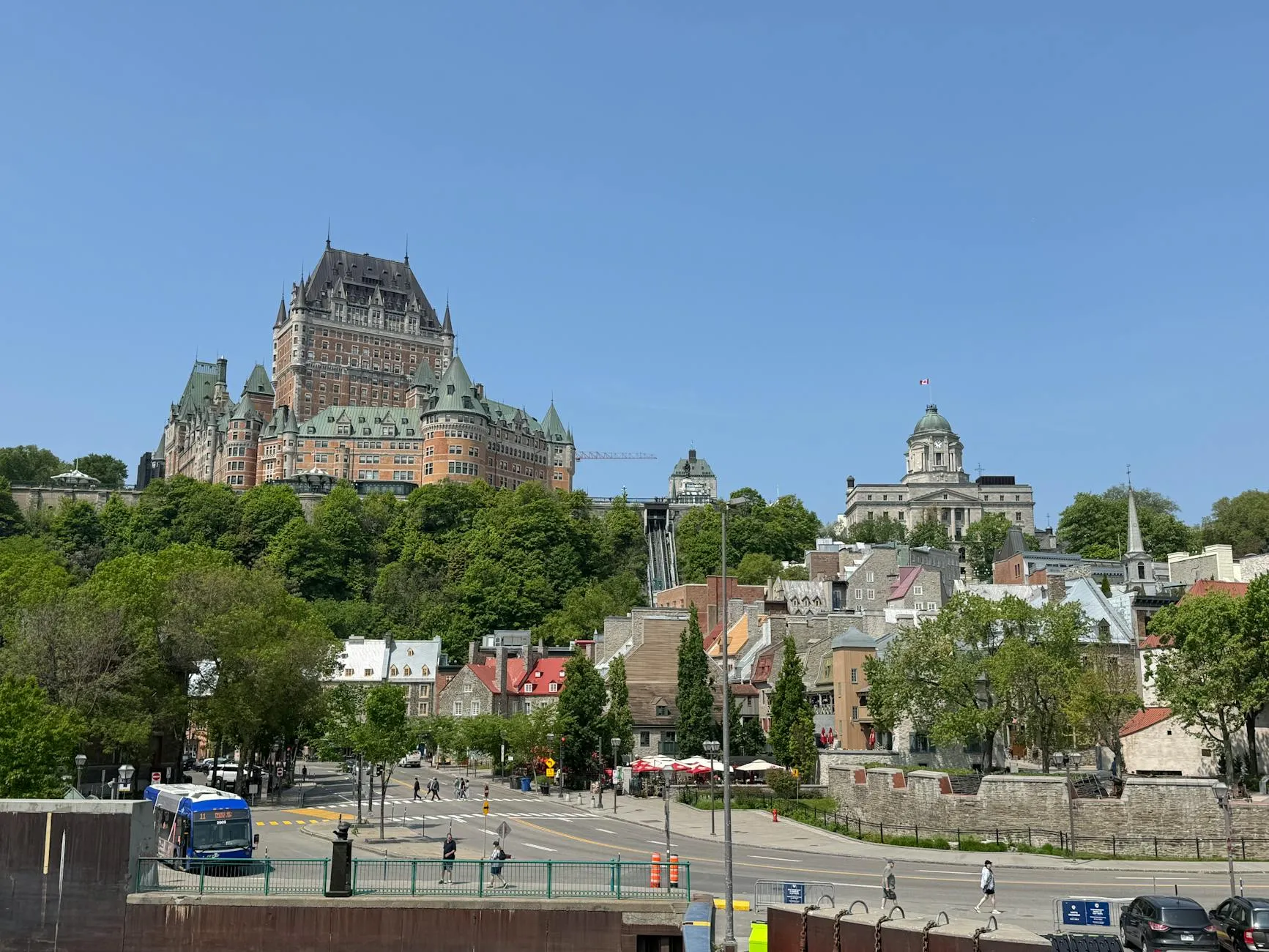
The Château Frontenac dominates the bluff above the St. Lawrence — a railway hotel built in 1893, still operating, now primarily a landmark and orientation point. You will not need to search for it.
The Dufferin Terrace is the boardwalk below the Château, above the river. It is free to walk and provides the main view of the St. Lawrence.
The funicular connects the Upper Town (Haute-Ville) down the cliff to the Quartier Petit-Champlain — a short lane of shops and cafés at the foot of the bluff. The funicular charges a small fare; the descent on foot via the stairs is free and takes a few minutes longer.
The ramparts and the Citadelle: the walls that make Vieux-Québec the only walled city north of Mexico can be walked at the outer rampart level for free. Guided entry to the Citadelle is a separate ticket. The stone streets of the Upper Town — narrow, closely built — are the texture of the place.
The Plains of Abraham: a battlefield park a short distance west and large. Skip it on a layover unless you have most of a day; the compact historic core repays time more densely.
💡 Layover math
The airport is 11 km west of the old city. One-way: 30–40 minutes on RTC route 80 or 20–25 minutes by cab. A four-to-five-hour layover comfortably reaches Old Québec — Château Frontenac, Dufferin Terrace, and Petit-Champlain are clustered on the bluff — with a 90-minute return-and-security buffer built in. Three hours is workable for a quick look if bus timing is clean, but tight. Under three hours, stay airside. In deep winter, add slack for snow delays on the road — the bus schedule does not adjust for weather.
🧭 Practical Notes
Language: Frontline service and signage are French-first, more consistently than at Montréal–Trudeau. Starting interactions in French is the correct move; switching to English when needed is understood. This is the most French-first major airport in Canada.
Transport: RTC route 80 (CAD $3.85 ticket / $4.00 cash onboard) is the direct bus to downtown and Old Québec. Taxis operate on a fixed-rate zone — CAD $41.40 by day, $46.60 between 11 p.m. and 5 a.m., plus a $0.90 fee — confirm the flat fare before departure.
Border: Canada requires a CAD $7 eTA for most visa-exempt foreign nationals flying in; US citizens are exempt. Apply online before travel.
Lounge: Air Canada Café since 16 June 2026 — after security near gate 29, posted 04:00–20:00 daily, for eligible Air Canada and Star Alliance passengers. No Maple Leaf Lounge at YQB. Boréal Lounge by YQB due fall 2026; otherwise plan for gate areas.
Accessibility: Reduced-mobility assistance is free, arranged in advance through your airline.
❓ Frequently Asked Questions
📊 At a glance — YQB 2026
| Feature | Current Data (2026) |
|---|---|
| Official name | Aéroport international Jean-Lesage de Québec |
| IATA / ICAO | YQB / CYQB |
| Location | Sainte-Foy, ~11 km west of downtown Québec City |
| Language | French (working language of airport and city) |
| Terminals | One |
| Rail to centre | None direct — VIA Rail station in Sainte-Foy (RTC route 76, under 30 min) |
| Bus to centre | RTC route 80 → downtown via Les Saules, terminus Parc-Victoria (~30–40 min); route 76 → Ste-Foy train/bus stations, then 800/801 |
| Bus fare | CAD $3.85 ticket / $4.00 cash onboard (exact change) |
| Taxi / rideshare | Fixed rate CAD $41.40 day / $46.60 night (11 p.m.–5 a.m.) plus $0.90 fee, ~20–25 min |
| Currency | Canadian dollar (CAD); GST + Québec QST added at till |
| Border | Canada (CBSA) |
| eTA | CAD $7 online; US citizens exempt |
| Lounges | Air Canada Café — opened 16 June 2026, after security near gate 29, posted 04:00–20:00 daily; Boréal Lounge by YQB due fall 2026; no Maple Leaf Lounge |
| Dominant carriers | Air Canada, WestJet, Porter, Air Transat (seasonal sun); also Air France, Air Inuit, American, Central Mountain Air, PAL Airlines, Pascan, United |
| Best layover move | RTC route 80 or cab to Old Québec — Château Frontenac, Dufferin Terrace, Petit-Champlain (4–5 hr layover) |