Fuzhou Changle International Airport (FOC) — Airport Guide 2026
For most of its history, Fuzhou Changle sat 50 km out from the provincial capital it serves — long enough that the transfer ate an hour and cost real money. Since 29 September 2025, there’s a direct metro line covering the whole distance.
Quick Reference
Fuzhou Changle International Airport
FOC / ZSFZ
~50 km south-east of Fuzhou, at Changle on the coast, Fujian province
F1 Binhai Express Line → Fuzhou Railway Station ¥17; city core ~55 min on the all-stations local, every 8–10 min (6:00–22:30)
Line 1 → Fuzhou Railway Station ¥20 (~50 min); Line 2 → South Railway Station ¥25 (~60 min)
~¥120–180 to downtown, ~50 min; ~20% late-night surcharge
Chinese yuan / renminbi (CNY); ~US$0.14 / ~€0.13 per yuan
30-day unilateral (40+ countries, through end 2026); 240-hour transit (55 countries)
First Class Lounge — Priority Pass & DragonPass; separate domestic (Level 3, by Gate 8) and international departures locations
XiamenAir, China Eastern
🏢 Terminal Layout
Two terminals, standing directly opposite each other. From 05:00 on 16 September 2026 the new T2 takes all international and Hong Kong / Macau / Taiwan flights, together with the domestic flights whose operating carrier is XiamenAir — Fujian’s home carrier — Hebei Airlines or Jiangxi Airlines; the rest of the domestic schedule stays at T1. Check the terminal printed on your booking before you set off. XiamenAir and China Eastern run the bulk of the schedule alongside the other mainland majors, with heavy domestic coverage, regional international routes to South-East and North-East Asia, and seasonal links. The airport is large and modern. The defining practical constraint has always been the distance from Fuzhou, not anything about the building.
🛂 Border & Visa
Arrivals from international flights clear China Immigration Inspection: fingerprints and a facial image are taken on entry. Two visa-free routes apply at Fuzhou.
🗓️ 30-Day Unilateral Visa-Free
Citizens of more than 40 countries — including France, Germany, Italy, Spain, the Netherlands, and many other European states — can enter China for up to 30 days without a visa under the unilateral scheme China has extended through at least the end of 2026. This applies on direct arrival; no onward transit is required.
⏱️ 240-Hour Transit Visa-Free
Citizens of 55 countries (the US, UK, Canada, Australia, most of Europe) transiting to a third country can stay visa-free for up to 240 hours — 10 days. Fujian province is among the designated eligible ports. The scheme excludes Xinjiang, Tibet, and several other regions, but not Fujian.
Outside either scheme, a Chinese tourist visa (the L visa) is required in advance.
⚠️ Verify your visa category before travel
The 30-day and 240-hour schemes cover different countries and have different conditions — the 240-hour route requires a confirmed onward ticket to a third country. Confirm which applies to your passport before arriving at FOC without a visa.
The currency is the Chinese yuan / renminbi (CNY), worth roughly US$0.14 or €0.13.
🚆 Getting Into the City
The F1 Binhai Express Line opened on 29 September 2025. It runs 62 km from Changle Airport to Fuzhou Railway Station and the city core at up to 140 km/h, and the published fare between the airport and Fuzhou Railway Station is ¥17. The all-stations local covers the downtown area around Dongjiekou in about 55 minutes. Trains run every 8–10 minutes at peak, and the service window is 6:00 to 22:30, with the last trains leaving both ends of the line at 22:30. Not every train stops everywhere: a direct express runs twice a day from Fuzhou Railway Station, at 6:00 and 6:15, reaching the airport in about half an hour, and a semi-express calling at five key stations runs hourly from 7:00 to 22:00. For an airport 50 km out, this is the obvious choice — reliable timing, immune to traffic, and a fraction of the cab fare.
🚆 F1 Binhai Express — ¥17 to Fuzhou Railway Station, ~55 min to downtown
The line opened 29 September 2025. Any guide or app that says Fuzhou Airport has no rail connection is out of date. Trains every 8–10 min; the service window is 6:00 to 22:30, with the last trains leaving both ends of the line at 22:30.
The older options remain. Airport bus Line 1 runs to Fuzhou Railway Station for ¥20 in about 50 minutes (roughly 07:00–22:30). Line 2 goes to South Railway Station for ¥25 in about 60 minutes. A taxi costs ¥120–180 to downtown — about 50 minutes — with a roughly 20% surcharge late at night. Given the 50-km distance, the taxi is an expensive choice unless you’re travelling outside the metro’s hours.
🛋️ Lounge
🛋️ First Class Lounge — Priority Pass & DragonPass
Priority Pass lists two First Class Lounge locations at FOC. The domestic departures one is on Level 3, to the right after the escalator beside Gate 8. The international departures one is reached after security and the moving walkway, about 25 metres further on the right hand side, and opens 06:00 to 20:45. Both listings predate the 16 September 2026 move of international flights to T2, so check the Priority Pass app for the current location. Maximum two-hour stay. Hot food served at service windows through the day — roughly breakfast, midday, and early evening. Standard contract lounge: seating, Wi-Fi, hot and cold food and drinks.
The First Class Lounge is accepted on both the Priority Pass and DragonPass networks. On a long connection, it earns its time.
💳 Paying in China
China’s day-to-day economy runs on mobile payment. Alipay and WeChat Pay QR codes handle most transactions — restaurants, shops, transport. Since 2024, overseas cards can be linked to either app, and major airports have improved foreign card acceptance, but setting up one of the apps and linking your card before travel removes most of the friction. Cash (CNY) is still accepted everywhere; it’s just increasingly the backup rather than the default.
📱 Set up Alipay or WeChat Pay before you travel
Linking an overseas card is easier to do from abroad than on the ground in China with a foreign SIM. Do it before departure.
🍽️ Food Before You Fly
Fujian cuisine — Min cuisine — is one of China’s eight recognised regional styles, built heavily on seafood and delicate broths. The signature dish is Buddha Jumps Over the Wall (fo tiao qiang), an elaborate stew of seafood, meat and dried ingredients — a sit-down affair, not airport food, but worth knowing the name if you have time in the city. The accessible street options are fish balls (yuwan) and rou yan, a meat-wrapped meat dumpling. Priced in renminbi.
For the carry-home, Fujian produces two of China’s most respected teas: oolongs from the Wuyi Mountains and white teas from Fuding. Both travel well and are cheaper bought here than almost anywhere else.
🍵 Fujian tea — the practical carry-on
Wuyi Mountain oolongs and Fuding white tea are the specific local products worth buying before departure. Airport shops stock them; city tea shops have better selection if you have the layover time. Priced in renminbi.
💡 Layover: Is Fuzhou Worth It?
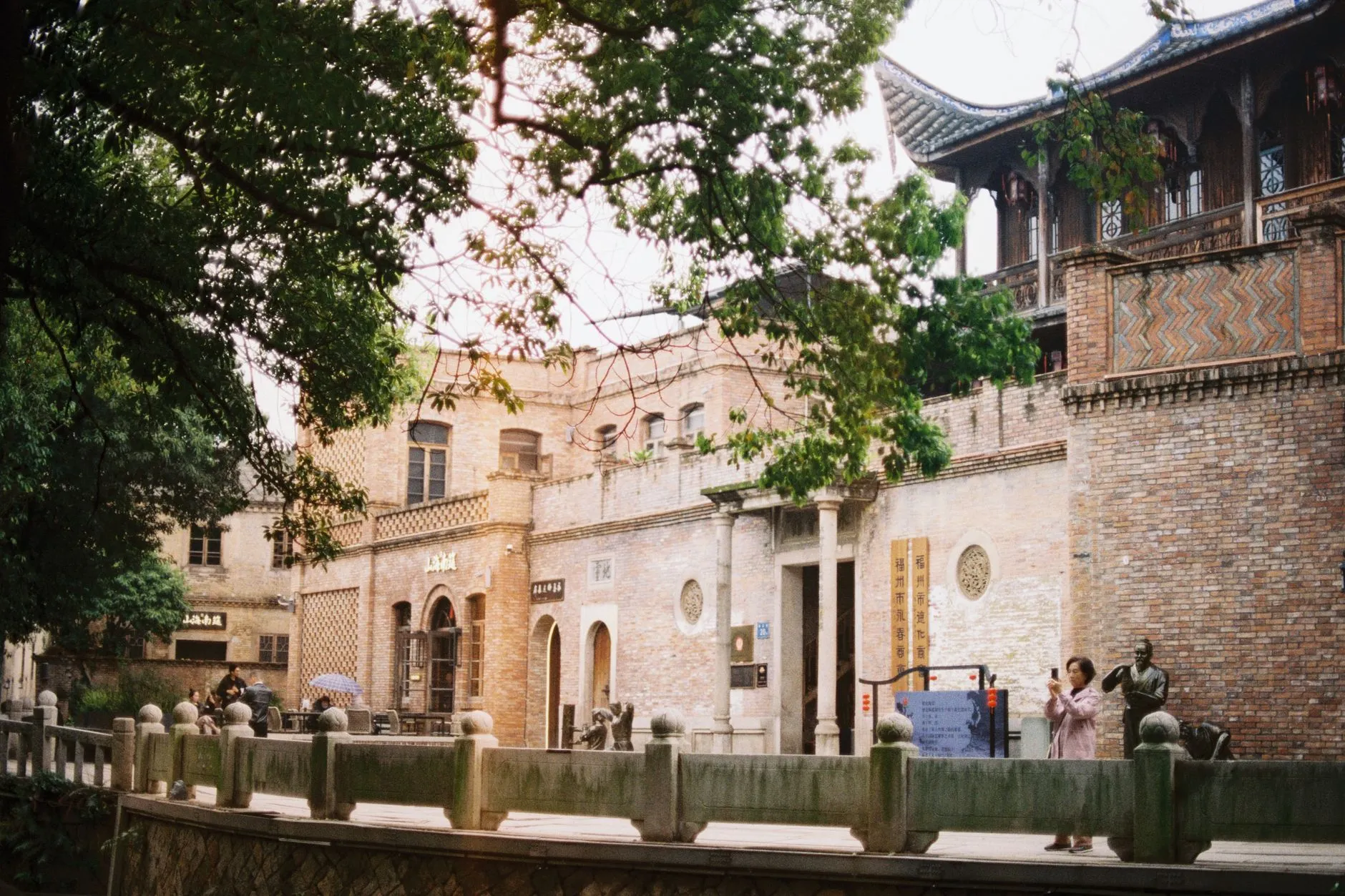
The city’s main draw is Three Lanes and Seven Alleys (Sanfang Qixiang), a restored historic quarter of whitewashed Ming and Qing courtyard houses, former scholars’ residences, and narrow lanes in the heart of Fuzhou — a coherent, walkable historic district. Fuzhou is known as the “Banyan City” for the ancient banyan trees planted throughout the urban core, and it’s one of the few major Chinese cities with hot springs accessible within the city itself. Gushan — Drum Mountain — with the Yongquan Temple sits on the eastern edge.
Before the F1 line, the 50-km distance ruled out any casual layover. Now the calculation is different.
🕐 Layover math: airport to Three Lanes and Seven Alleys
F1 each way: ~55 min. Return through security: allow 45–60 min minimum. A five-hour layover gives roughly 90 minutes on the ground — enough to walk the quarter, not enough to walk it and eat. Under four hours: stay airside.
⚠️ Watch the last metro
The F1 line’s service window is 6:00 to 22:30, with the last trains leaving both ends of the line at 22:30. An evening departure with a prior city trip requires timing the return carefully — missing the last train puts you in a ¥120–180 taxi.
Under four hours, or if your flight sits outside the metro’s operating window, the city is not a practical option. The 50-km distance doesn’t compress for a short layover.
🧭 Practical Notes
- Metro first. F1 Binhai Express (¥17 to Fuzhou Railway Station; ~55 min to downtown on the all-stations local) is the default into the city. The ¥120–180 taxi is for when the metro isn’t running.
- Verify your visa status. Forty-plus countries get 30 days visa-free; 55 countries get 240-hour transit visa-free. Outside either scheme, get a Chinese L visa in advance.
- Mobile payment. Set up Alipay or WeChat Pay and link your overseas card before departure — easier done at home than on arrival.
- The lounge. First Class Lounge — Priority Pass and DragonPass, two-hour maximum. Domestic departures on Level 3 by Gate 8; a separate international departures location after security and the moving walkway, 06:00–20:45.
- Reduced-mobility assistance is available; arrange it through your airline before travel.
❓ FAQ
📊 At a Glance — FOC 2026
| Feature | Details |
|---|---|
| Official name | Fuzhou Changle International Airport |
| IATA / ICAO | FOC / ZSFZ |
| Location | ~50 km south-east of Fuzhou, at Changle on the coast, Fujian province |
| Terminals | T1 and T2, directly opposite each other; from 05:00 on 16 Sep 2026 all international and Hong Kong / Macau / Taiwan flights use T2, along with XiamenAir, Hebei Airlines and Jiangxi Airlines domestic flights |
| Metro to centre | F1 Binhai Express Line → Fuzhou Railway Station ¥17; downtown core ~55 min on the all-stations local, every 8–10 min (opened 29 Sep 2025) |
| Airport bus | Line 1 → Fuzhou Railway Station ¥20 (~50 min); Line 2 → South Railway Station ¥25 (~60 min) |
| Taxi | ~¥120–180 to downtown, ~50 min; ~20% late-night surcharge |
| Currency | Chinese yuan / renminbi (CNY); mobile payment (Alipay / WeChat Pay) dominant |
| Border | China — 30-day visa-free (40+ countries, through end 2026); 240-hour transit visa-free (55 countries) |
| Lounge | First Class Lounge, Priority Pass + DragonPass, 2-hr max — domestic departures (Level 3 by Gate 8) and a separate international departures location (06:00–20:45) |
| Dominant carriers | XiamenAir, China Eastern |
| Best layover move | F1 metro to Three Lanes and Seven Alleys (Sanfang Qixiang) — 5 hr+ layover; line runs 6:00–22:30 |