Kelowna International Airport (YLW) — Airport Guide 2026
Kelowna is the airport for British Columbia’s Okanagan Valley, and it has quietly become one of Canada’s busier regional airports — a record 2.3 million passengers in 2025 for a city of about 150,000, which tells you the draw is the valley, not the city. The big recent change is operational and welcome: a $108-million terminal expansion that doubled the departures area opened to the public in late 2025 and January 2026, and YLW became the first minor-class airport in Canada to get the full CATSA Plus security system. This guide is the practical one — the new terminal, the Canadian border basics, how to reach town and Big White, and the honest truth about lounges (there isn’t one yet).
Quick Reference
Kelowna International Airport
YLW / CYLW
Kelowna, British Columbia, Canada
2,315,432 — a record; B.C.’s 2nd-busiest airport
$108M terminal expansion; new departures area opened Jan 2026
One terminal, single departures level
First Canadian Class-II airport with full CATSA Plus
About 10 km (≈15 min by car)
None
Taxi/Uber (C$27–36), or BC Transit Route 23
None currently; a premium lounge is planned for later in 2026
WestJet (Calgary the main connecting hub)
Canadian dollar (CAD)
Canada CBSA; eTA for visa-exempt foreign nationals
🛫 1. What changed: a $108M expansion that doubled departures
YLW’s growth had outrun its building — 2.3 million passengers through a terminal sized for far fewer meant security lines that backed up at peak. The fix is a $108-million expansion built partly in B.C. mass timber, adding about 60,000 square feet of new space plus 13,000 renovated, with the new departures area opening to the public on 28 January 2026. The headline for a traveller is the doubled departures hall and faster screening: YLW is the first minor-class (Class II) airport in Canada to run the full CATSA Plus system, the parallel-divestment security lanes that move people through more quickly.
The new space is built partly from British Columbia mass timber, a deliberate local-materials choice, and it’s the most visible result of the airport’s multi-year improvement program. For a city airport that has climbed up the Canadian rankings on the strength of the Okanagan’s pull, it’s the difference between a building that fights its own traffic and one that finally fits it.
🚧 Still to come in 2026
A few pieces are still being finished through the end of 2026 — additional washrooms, a pet relief station and more grab-and-go food and drink. A premium pay-per-use lounge is also planned for the upper level of the new departures area, expected to open later in 2026.
The practical upshot for 2026: security is genuinely quicker than it was, and the departures area no longer jams at the December and August peaks. Expect some active finishing work landside through the year, but the part that matters — getting from the door to your gate — is the upgraded bit.
🛬 2. The terminal and getting through
This is a single, compact terminal with one departures level, so there are no inter-concourse hikes or trains — once you’re through security, your gate is a short walk. The expansion added food-and-beverage options past the checkpoint, which matters because, as a smaller airport, what’s airside is what you get.
The flip side of YLW’s success is that it gets genuinely busy in its two peaks — winter ski-and-sun season around December and the summer lake season around August, when monthly traffic now tops 220,000. CATSA Plus has eased the screening crunch, but at those peaks the airport is full, so don’t treat it like a sleepy regional field on a Saturday in late July.
Set your expectations to “good regional airport,” not “international hub.” The expansion added food-and-beverage choices airside and the building is bright and new, but the dining and shopping are modest by big-airport standards, and the seating fills at peak. Eat before security or grab something quickly once you’re through, rather than planning a long sit-down meal at the gate.
🛂 3. The border: Canada, mostly domestic
Most YLW flights are domestic Canadian routes, so for the majority of travellers there’s no border process at all — you fly within Canada and walk out. The international side is seasonal and small.
The currency is the Canadian dollar, and cards work everywhere.
🚗 4. Getting to Kelowna town (and Big White)
The airport sits about 10 km north of downtown Kelowna, roughly 15 minutes by car. There is no rail anywhere near Kelowna, so the options are road.
If your destination is a winery or a lakeside resort rather than downtown, plan on a rental car or a booked transfer — the Okanagan is spread out and public transit won’t get you to most of it. Rental desks are in the terminal.
For winter travellers, Big White is the main draw within reach, about an hour by road; SilverStar near Vernon is a similar distance to the north. Both are why YLW’s December is now busier than its summer.
🛋️ 5. Lounges — none yet
Be plain about this: YLW currently has no airport lounge. There is no Plaza Premium, no Air Canada Maple Leaf Lounge, and no Priority Pass-accessible lounge, so a Priority Pass or lounge-access card buys you nothing here in 2026. A premium pay-per-use lounge is planned for the upper level of the new departures area and is expected to open later in 2026 — until it does, the airside cafés and the new food options are the waiting room.
🍷 6. The Okanagan: why you’re really here
The reason 2.3 million people use a small-city airport is the valley around it. The Okanagan is Canada’s leading wine region, with a long string of wineries down the lakeshores around Kelowna, the Naramata Bench and further south toward Oliver. It’s a genuine year-round destination: wine and water in summer, Big White and SilverStar skiing in winter.
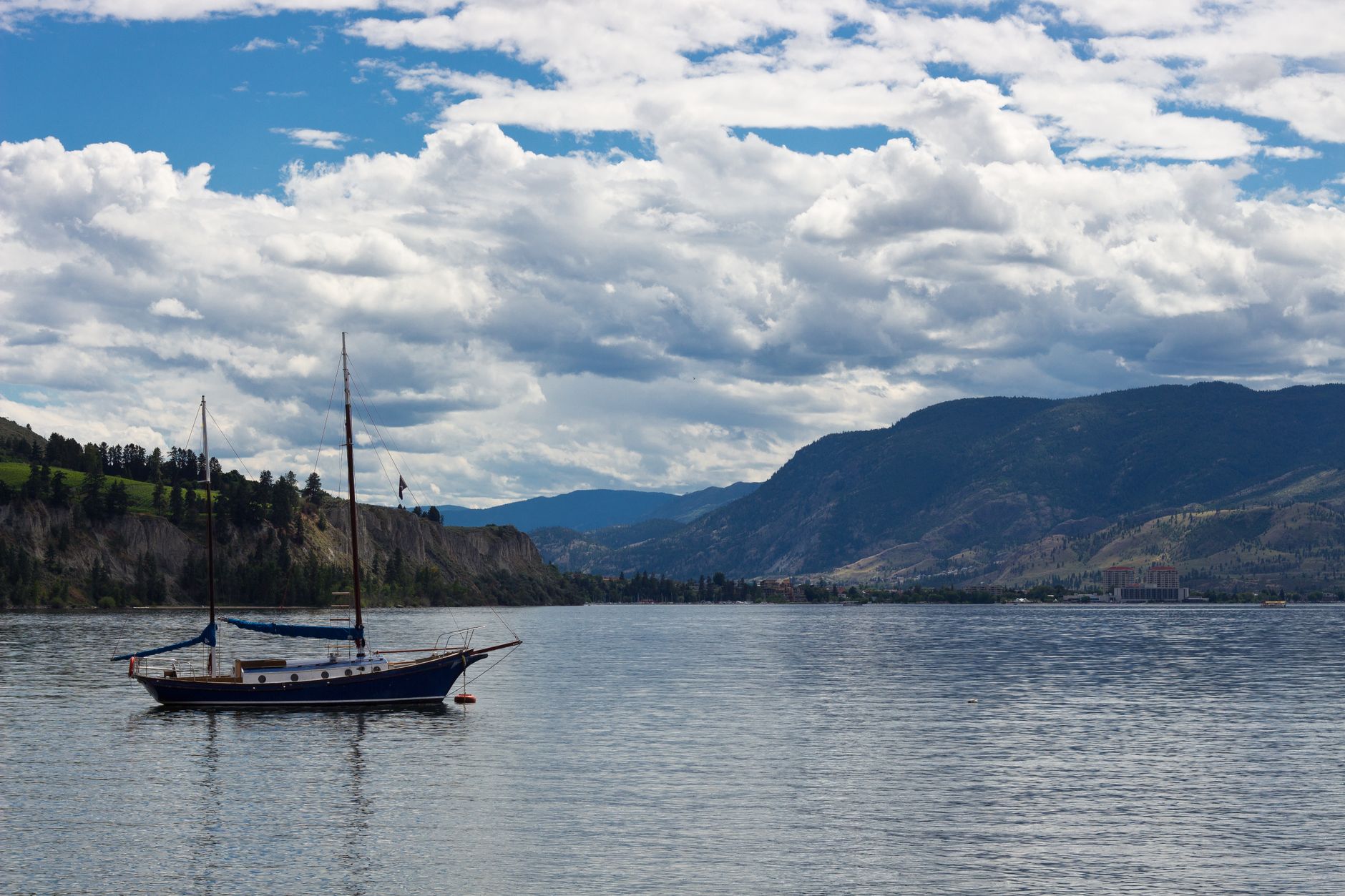
Summer here is built around Okanagan Lake — the beaches, the boats and the warmest large-lake water in the region — strung between Kelowna, Penticton and Vernon. The towns sit an hour or so apart down the valley, so where you base yourself matters: Kelowna for the city and the airport, the Naramata Bench near Penticton for the densest run of wineries, the higher country for the ski hills.
If you’re wine-touring, use a designated driver, a tour van or a hired car-and-driver rather than driving yourself between tastings. The rural roads are patrolled, and a tour also means someone else handles the back-road navigation between cellar doors.
The other honest caution is fire. The Okanagan has had serious wildfire seasons in recent years, and late-summer smoke or fire activity can affect air quality and, occasionally, travel. If you’re visiting in August, check current conditions before committing to an outdoor-heavy itinerary, and keep a little flexibility in the plan.
❓ Frequently asked questions
📊 Kelowna Airport (YLW) at a glance — 2026
| Item | Detail |
|---|---|
| Codes | YLW / CYLW |
| 2025 passengers | 2,315,432 (record; B.C.’s 2nd-busiest) |
| Recent change | $108M expansion; departures area opened Jan 2026 |
| Security | First Canadian Class-II airport with full CATSA Plus |
| Terminal | One, single departures level |
| Distance to downtown | ~10 km (≈15 min by car) |
| Taxi | C$27–36 to downtown |
| Uber | Available; C$2 surcharge on trips over 3 km |
| BC Transit | Route 23 (most frequent), Airport Way stop |
| Big White | Dedicated ski-season shuttle, ~1 hour |
| Rail | None |
| Lounge | None yet; premium lounge planned later 2026 |
| Dominant carrier | WestJet (Calgary hub); Air Canada, Flair, Porter (Ottawa, new 2026) |
| Currency | Canadian dollar (CAD) |
| Border | CBSA; eTA (~C$7) for visa-exempt visitors |
Explore more
- Cheap flights from Kelowna: current tracked fares from YLW across Canada and beyond.
- Canadian airport guides: operational guides to other Canadian gateways for onward connections.