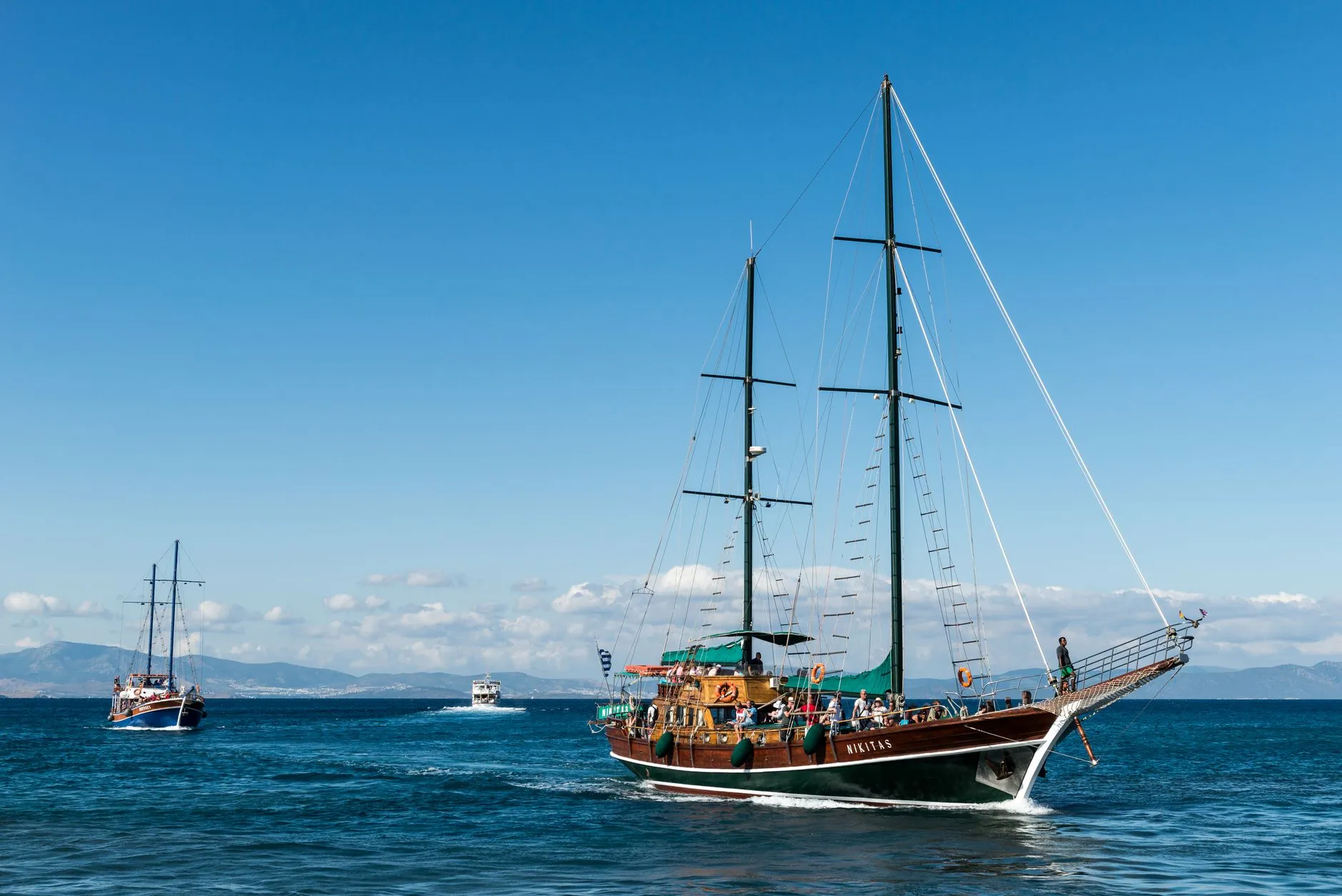
Kos Airport (KGS) — Airport Guide 2026
Quick Reference
Kos “Hippocrates” International Airport
KGS / LGKO
Kos, Dodecanese, Greece — the airport sits at Antimachia, in the centre of the island
~24 km from Kos Town; ~7 km from Kardamena
One terminal (Fraport Greece)
3,069,569 passengers (+3.9%) — over three million, a summer-led airport
Greece — Schengen, euro; EES live since April 2026, ETIAS expected, date not announced
Euro (€)
Bus €3.50 (~40 min) or taxi ~€40–50; Kardamena bus €2.30 (~15 min)
One — the Filoxenia Lounge, airside in the Schengen zone (~€36 day pass)
Jet2, easyJet, TUI, Ryanair, Condor (seasonal); Sky Express (Athens)
🛫 1. What Kos Airport is
Kos is a proper mid-size island airport — over three million passengers in 2024 — and a busy, multinational charter machine in summer, far larger than the small Aegean fields. It’s the gateway to a flat, beach-rimmed Dodecanese island that the British, Germans, Italians and Dutch all pour into between May and October. The one structural thing to grasp before you book is geography: the airport sits at Antimachia, in the middle of the island, not next to the capital.
The airport is named Hippocrates, and it means it. Kos was the birthplace of the man who gave medicine its founding figure, around 460 BC, and the Asklepieion — the ancient healing sanctuary and medical school on a pine hill 3 km from Kos Town — is where his tradition took shape. Medical graduates still travel here to swear the Hippocratic Oath on the site; for everyone else, it’s the rare package island with the birthplace of Western medicine attached.
There’s no dramatic recent change to flag — the terminal is the modernised Fraport one, and traffic has grown steadily. The practical work is all in the transfer and, for a change at a Greek island airport, the lounge.
🛬 2. The terminal and the lounge
One terminal, busy but straightforward, built around the summer charter turnaround. Security is the pinch point when several flights leave together on a peak morning, so allow two to three hours for a summer departure — this is a genuinely busy airport in August, not a sleepy strip. Walks are short and there’s nothing to connect to.
Unusually for a Greek island this size, there is a lounge: the Filoxenia Lounge, airside, with a walk-in pass around €36. Two honest caveats. It sits in the Schengen airside zone, so if you’re flying to a non-Schengen destination such as the UK you may be processed in a separate area and unable to reach it — check before you pay. And Priority Pass affiliation isn’t reliably confirmable here, so treat it as a pay-at-the-door option rather than a card perk unless you’ve verified otherwise.
✈️ 3. Carriers, and the seasonal reality
Kos has one of the broadest carrier mixes in the Greek islands. Jet2 flies the most, from a long list of British cities, with easyJet close behind; Condor brings the German market from Frankfurt, Munich, Stuttgart and Hamburg; Ryanair adds Italian and Irish routes from Bari, Bergamo, Bologna and Dublin; and TUI, plus Dutch and Scandinavian operators, fill out the rest. Year-round, the airport leans on the domestic flight to Athens, on Sky Express and the Aegean group.
The pattern is the island norm at a bigger scale. In summer you can fly direct from much of northern Europe; in winter the international map mostly closes and you connect through Athens. There’s no long-haul and nothing to change onto — every trip is point-to-point or a hop via the mainland. With so many school-holiday markets feeding it, fares climb steeply for July and August across all of them, and the shoulder weeks of late spring and September are where the value sits.
That breadth is an opening for a deal-hunter. Because Kos is fed from so many countries, the cheapest week can surface from a German, Italian or Irish departure point as readily as a British one — the same beach reached just as cheaply via Cologne or Bologna. If you’re flexible about where you start, compare across the markets rather than only from your home airport.
🛂 4. The border: Greece, Schengen, the euro
Greece is in the Schengen Area and uses the euro. EU/EEA and Swiss nationals pass straight through; UK, US, Canadian, Australian and many other passport-holders enter visa-free for up to 90 days in any 180-day period.
Greece’s EES biometric registration has been live since April 2026, and it applies to arrivals from outside Schengen — a big share of Kos traffic, given how many flights come from the UK. At a busy summer terminal that new check can mean a slow passport queue, so leave a little slack. German, Dutch, Italian and other Schengen arrivals skip it.
ETIAS, the pre-travel authorisation for visa-exempt visitors, is expected to follow, with no launch date announced, ahead of becoming mandatory on a date the EU has not announced — worth checking before you book on a non-EU passport. Prices are in euros, there are ATMs in the terminal, and cards work nearly everywhere, but carry some cash, because the airport bus takes coins and small notes only.
🚌 5. Getting to your resort — a central airport with a real bus
Because the airport is in the middle of the island rather than beside the capital, your transfer time depends entirely on where you’re staying — and, helpfully, there’s a proper public bus to use.
Where you’re staying decides your transfer. Kardamena, the big package resort, is barely 15 minutes away on a €2.30 bus; Kos Town, on the far east end, is a 40-minute, €3.50 ride. The public bus stop is 50 metres from the terminal and serves the capital and the main resorts — but bring cash, because the driver won’t take a card.
The bus network — run by the local operator, with the stop right outside — reaches Kos Town, Kardamena, Mastichari and Kefalos, which covers most of where visitors stay. Taxis are at the rank for door-to-door: roughly €16–20 to nearby Kardamena, and €40–50 across to Kos Town. For the quieter far west around Kefalos, or to roam a flat island made for it, a hire car or a bike is the move; the desks are in the terminal.
The central location cuts both ways on the way out. From Kardamena you’re ten minutes from the gate; from Kos Town or Kefalos you’re a 40-minute-plus drive across the island, on roads that fill with transfer coaches on a summer changeover Saturday. If you’ve based yourself at either end, treat the airport as further than the map suggests when you time the trip back.
Nobody connects through Kos, so the only planning that matters is the transfer at each end — and, on the way out, allowing for the drive back across the island if you’ve based yourself at the far end.
⚕️ 6. The reason this airport is interesting: the birthplace of medicine
Most arrivals come for the beaches and the all-inclusive, and never look up the island’s real claim — which is unusual enough to be worth the detour. The Asklepieion, on a pine-covered hillside 3 km southwest of Kos Town, was a sanctuary of Asclepius, a healing centre and a school of medicine, and it is bound up with Hippocrates, who was born on Kos and is the reason every doctor still meets the word “Hippocratic.” The site is genuinely moving in a way a ruin rarely is, and new physicians still come here to swear the oath.
By tradition, the great plane tree in Kos Town is the spot where Hippocrates taught — and while the living tree is a centuries-old descendant rather than the 2,400-year-old original, the harbour around it is worth the wander, watched over by the Castle of the Knights, the Hospitaller fortress that guards the entrance.
Beyond the history, Kos is flat — properly flat — which makes it one of the better Greek islands for cycling, and its long beaches stretch from Tigaki near the capital to Kefalos in the west. A frank word: the Kardamena strip is package-tourism at full volume, fine if that’s the holiday, less so if it isn’t, and the harbourfront tavernas in Kos Town are priced for the crowds, so eat a street back. There’s no aifly guide to Kos yet, so take this as orientation rather than a tour — and if you fancy a day in Turkey, the boat is right there.
❓ 7. FAQ
📋 8. At a glance
| Item | Detail |
|---|---|
| Airport | Kos / Hippocrates (KGS / LGKO), Antimachia, centre of the island |
| Terminal | Single terminal; arrive 2–3h in summer peak |
| To Kos Town | ~24 km; bus €3.50 (~40 min) or taxi ~€40–50 |
| To Kardamena | ~7 km; bus €2.30 (~15 min) or taxi ~€16–20 |
| Bus | Public bus 50 m from terminal — Kos Town, Kardamena, Mastichari, Kefalos; cash only |
| Border | Greece; Schengen; euro; EES live since April 2026; ETIAS expected, date not announced |
| Currency | Euro (€); cash needed for the bus |
| Lounge | Filoxenia Lounge, Schengen airside, ~€36 (may be unreachable on UK/non-Schengen departures) |
| Carriers | Jet2, easyJet, TUI, Ryanair, Condor (summer); Sky Express to Athens |
| Near the airport | Asklepieion & Hippocrates’ Kos Town (~24 km); Bodrum/Turkey by ferry from the port |
🔗 9. Explore More
- Rhodes Airport (RHO) guide — the larger Dodecanese island airport to the south, a natural comparison
- Bodrum Airport (BJV) guide — the Turkish coast across the strait, reachable from Kos by ferry