Frankfurt Airport (FRA) — The Complete 2026 Airport Guide
Frankfurt just rewrote its own map. In spring 2026 the brand-new Terminal 3 opened, every non-Star-Alliance airline moved out of Terminal 2, and Terminal 2 then shut its doors for a decade of rebuilding. If you flew a Gulf, Asian or SkyTeam carrier through FRA before this year, your terminal has changed — and the biggest trap here was never the terminals anyway. It’s the two separate railway stations, and picking the wrong one is how people miss high-speed trains they already paid for.
Last verified: July 2026. Terminal assignments, fares and entry rules for Germany and the Schengen area change often — confirm the terminal on your boarding pass and the current fare at the machine before you travel.
Quick reference
| Detail | What you need to know |
|---|---|
| Airport | Frankfurt Airport, IATA FRA — Germany’s busiest and Europe’s third-busiest, ~63 million passengers in 2025; the global home hub of Lufthansa and a huge Star Alliance connecting point |
| Terminals now | T1 — Lufthansa and Star Alliance partners (plus Condor for now). T3 — everyone else: Emirates, Qatar, Etihad, Singapore’s SkyTeam rivals, Delta, Air France, KLM, Turkish, Cathay, Korean, easyJet, Ryanair, Wizz. T2 is closed (shut 9 June 2026 for a rebuild) |
| Into the city | S-Bahn S8/S9 to Frankfurt Hauptbahnhof, ~11–15 min, RMV single/airport ticket €6.90 · Taxi ~€35–45, 20–30 min |
| Beyond the city | Direct ICE high-speed trains from the airport’s own long-distance station — Cologne ~1 hr, plus Stuttgart, Mannheim, Basel and more without ever entering Frankfurt |
| Entry | Schengen external border. EES biometric checks live since 10 April 2026 (longer queues for non-EU arrivals); ETIAS expected, date not announced. EU/EEA/Swiss use e-gates |
| Watch out for | The regional vs long-distance rail stations · a cross-terminal connection (T1↔T3) via the new, still-glitchy Sky Line · the Schengen / non-Schengen passport split adding time |
The 2026 change: Terminal 3 is open, Terminal 2 is gone
This is the single most important thing to get right in 2026. Frankfurt’s new Terminal 3 — a €4-billion building on the southern side of the airfield — opened to passengers on 23 April 2026. Over four waves through spring, 57 airlines moved into it, and on 9 June 2026 the old Terminal 2 closed entirely for a €1.5-billion, decade-long modernisation. It won’t reopen to passengers until the mid-2030s. So forget everything you knew about T2 — it no longer exists as a place you fly from.
The split now is clean and easy to remember: Terminal 1 is Lufthansa and the Star Alliance (Lufthansa, SWISS, Austrian, United, Air Canada, Singapore, ANA, Turkish’s Star partners and the rest), and Terminal 3 is almost everyone else — Emirates, Qatar Airways, Etihad, Delta, Air France, KLM, Turkish Airlines, Cathay Pacific, Korean Air, China Airlines, plus the low-cost carriers easyJet, Ryanair and Wizz Air. Terminal 3 opened with three piers — G, H and J — and capacity for about 19 million passengers a year.
Getting between the terminals: the Sky Line and its rocky launch
Terminals 1 and 3 sit well apart — T3 is roughly 3 km south, alongside the A5 motorway — so you do not walk between them. The link is the Sky Line, the free automated people-mover, which was extended in 2026 to run T1 → (old T2 stop) → T3. End to end, Terminal 1 to Terminal 3 takes about eight minutes, with trains every two to three minutes, free, and it also stops right by the railway stations at T1.
Be honest about its reliability, though. The extended Sky Line had serious teething problems after launch — it was suspended for a period and is running again only after software and hardware fixes. Fraport still pauses it overnight (roughly 23:00–04:00), when shuttle buses cover the route; those buses (up to 20, every few minutes) also run all day at arrivals level as a backup. It usually works, but build a buffer if your connection depends on it.
Getting into Frankfurt — and beyond by train
Frankfurt is one of the best-connected airports in the world by rail, and that’s genuinely its superpower. But it comes with a trap that catches thousands of travellers, so read the next bit carefully.
Two railway stations — and they are not interchangeable
The airport has two completely separate train stations, both attached to Terminal 1, and mixing them up is how people miss trains:
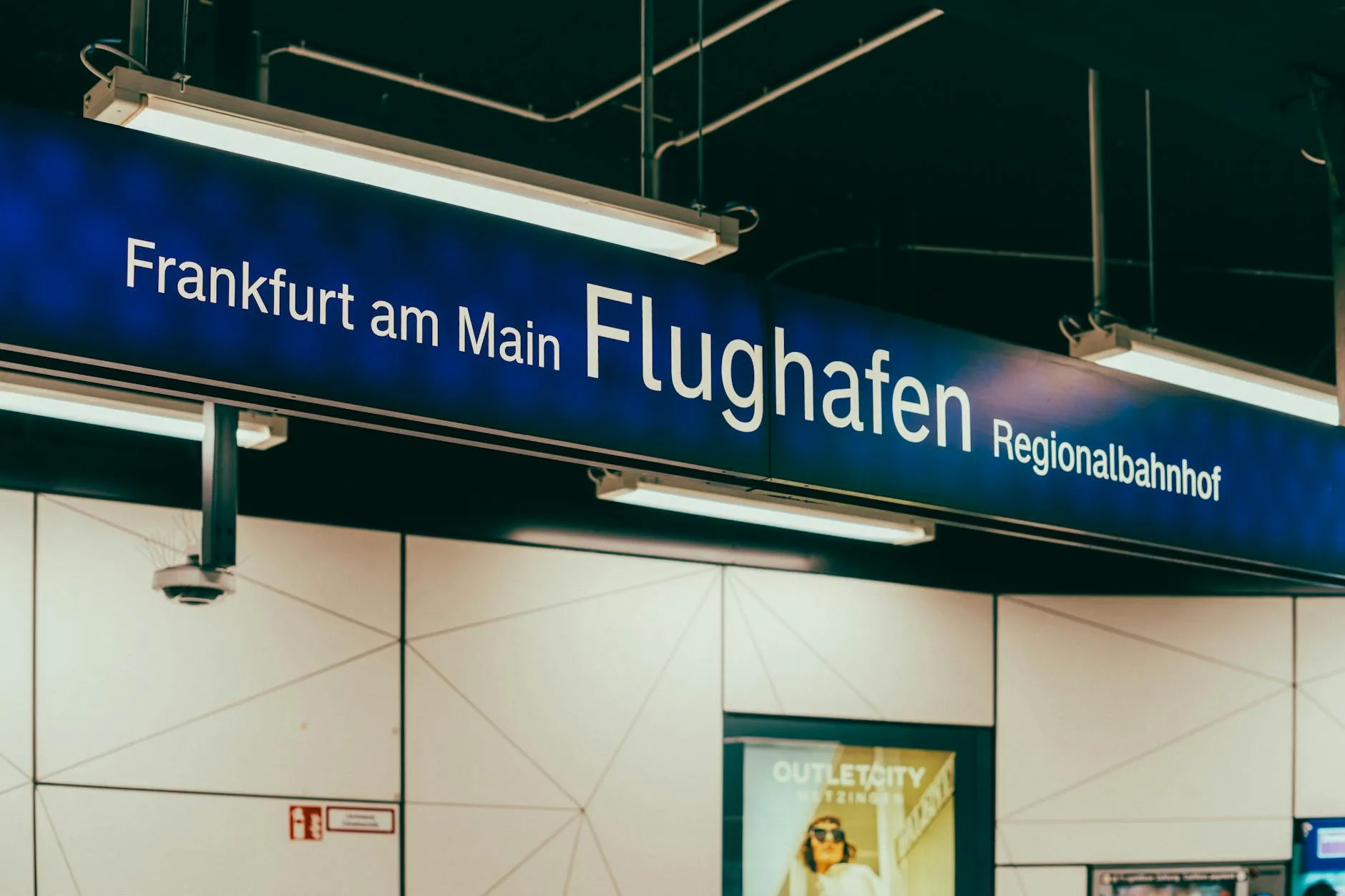
- Regionalbahnhof (Regional Station) — underground, beneath Terminal 1. This is where the S-Bahn (S8/S9) commuter trains and regional services depart for Frankfurt city, Mainz, Wiesbaden, Offenbach and the surrounding region. If you’re heading into central Frankfurt, this is your station.
- Fernbahnhof (Long-Distance Station) — a separate building linked to Terminal 1 by a covered walkway. This is where the ICE and IC high-speed trains depart on the Cologne–Frankfurt line and across Germany. If you booked a Deutsche Bahn ticket to another city, this is almost certainly your station.
Into central Frankfurt: take the S-Bahn
For the city, the S-Bahn is the obvious choice. Lines S8 and S9 leave the Regionalbahnhof and reach Frankfurt Hauptbahnhof (main station) in about 11–15 minutes, continuing to Hauptwache and Konstablerwache in the centre. They run every 15 minutes or so, effectively around the clock. The fare is a single RMV ticket at €6.90 (the “Airport-to-City” single, valid onward on tram, bus, U-Bahn and S-Bahn as long as you keep moving in one direction). Buy it from the machines or the RMV app before boarding — there are no barriers, but fare inspections are real and fines are steep.
Across Germany without touching the city: the ICE
Here’s what makes FRA special. Because the long-distance station sits on the high-speed line, you can step off your flight and be on an ICE to another city in minutes, without going into Frankfurt at all. Direct trains reach Cologne (Köln) in about an hour, and there are frequent through services to Mannheim, Stuttgart, Bonn, Düsseldorf, Basel and beyond. For a lot of onward journeys the train beats a connecting flight door to door. Lufthansa even sells some of these as “Lufthansa Express Rail” segments on a single ticket with a flight number — worth knowing if your bag needs to be checked through.
Taxi and ride-hail
A taxi into central Frankfurt runs about €35–45 and takes 20–30 minutes depending on traffic — five to seven times the train fare, so it only makes sense with heavy luggage, a group, or a very early/late arrival. Uber, Bolt and FreeNow all operate; pickup is at designated points outside the terminals.
| Option | Price | Time to Frankfurt Hbf | Verdict |
|---|---|---|---|
| S-Bahn S8/S9 | €6.90 single (~$7.50) | ~11–15 min | The default into the city — cheap, fast, frequent |
| ICE / regional to other cities | Varies by route/booking | Cologne ~1 hr | Skip Frankfurt entirely; often beats a connecting flight |
| Taxi | ~€35–45 (~$38–49) | ~20–30 min | Only for luggage, groups or odd hours |
| Ride-hail (Uber/Bolt/FreeNow) | Similar to taxi | ~20–30 min | Fine; use designated pickup points |
Entry, EES and the Schengen split
Frankfurt is a Schengen external border, so the paperwork depends entirely on whether you’re arriving from inside or outside the Schengen area — and 2026 added a new biometric step.
- EES is live. The EU’s Entry/Exit System went live across Schengen on 10 April 2026. On your first arrival from outside the area, non-EU visitors now have fingerprints and a facial photo registered at the border in place of a passport stamp. It’s a one-off enrolment that speeds up later trips, but during rollout it has lengthened queues at busy arrival banks — allow extra time on a first post-EES entry, especially at peak.
- ETIAS is coming, not here yet. The ETIAS travel authorisation — a cheap online pre-registration for visa-exempt visitors (US, UK, Canada, Australia and others) — is with no announced launch date, with a grace period after launch. As of July 2026 you do not yet need it, but check the official etias.europa.eu (not a copycat site) before you book for later in the year.
- The passport split. Frankfurt separates Schengen and non-Schengen areas, with passport control between them. Arriving from another Schengen country (say Munich or Madrid) means no border check at all; arriving from outside (London, Dubai, New York) means immigration on arrival. EU, EEA and Swiss passport holders can use the automated e-gates; others go to the staffed desks.
- Connecting non-Schengen to Schengen (e.g. a US arrival onward to Italy) means clearing immigration and re-clearing security in the middle — factor that into your connection time, not just the walk.
Lounges: Lufthansa’s home turf and the First Class Terminal
Frankfurt is Lufthansa’s flagship, so Terminal 1 has one of the densest lounge networks anywhere — a full ladder of Business, Senator and First Class lounges spread across Concourses A, B and Z, including the huge non-Schengen Z-gates lounges for long-haul departures. If you’re flying Lufthansa or Star Alliance premium, or you hold Star Gold status, you’re spoiled for choice here.
The Lufthansa First Class Terminal
The jewel is the First Class Terminal (FCT) — and it’s genuinely a separate building, not a lounge inside T1. It has its own security, immigration and check-in, a restaurant, cigar lounge, bathtubs and nap rooms, and departing guests are driven to their aircraft in a Porsche or Mercedes. Access is tightly limited: a same-day Lufthansa, SWISS or Discover Airlines First Class ticket, or HON Circle status. It’s open daily roughly 05:30–22:00. If you qualify, it is one of the best airport experiences in the world; if you don’t, no amount of Priority Pass gets you in.
Over in Terminal 3, the lounge scene is newer and thinner but growing — a SkyTeam Lounge and an Emirates Lounge opened with the terminal, alongside contract lounges, with more (including airline lounges) being added. If you rely on Priority Pass, check the app for what’s actually open in T3 on your travel date rather than trusting an old listing.
Connections and minimum connecting time
FRA is a connecting machine, but it’s a big, spread-out one, and 2026’s terminal shuffle changed the maths. As a rule of thumb, a same-terminal connection needs roughly 45–60 minutes as a published minimum (Lufthansa uses around 60 minutes at FRA), and that’s fine if both flights are in Terminal 1 and on the same side of the Schengen line.
The connection to plan carefully is the cross-terminal one — and it’s now common. Because Star Alliance sits in T1 while its former SkyTeam, Gulf and Asian neighbours moved to T3, an itinerary that used to stay in one building may now hop T1 ↔ T3 via the Sky Line. Add the ~8-minute ride (or the shuttle bus if it’s paused), the walk at each end, and any passport/EES check if you cross the Schengen boundary, and a realistic figure is 90 minutes to two hours. If you’re self-connecting on separate tickets between the terminals, give yourself much more and re-check in.
If your bags are checked through and both flights are on one ticket, the airline owns a missed connection and will rebook you. On separate tickets across T1 and T3, you own it — treat it like connecting between two different airports in the same city.
Food, money and practicalities
Food: Terminal 1 has the deeper choice after years of build-out — sit-down German and international restaurants plus plenty of grab-and-go. Terminal 3 is new and modern, its dining still filling in with contemporary food halls. Prices are airport-typical: a sandwich-and-coffee stop runs €8–12.
Money: cards work almost everywhere, though Germany is more cash-friendly than most of Europe. Use bank ATMs over the exchange booths, and if a machine offers to bill you in your home currency, decline and choose euros.
Practicalities: free Wi-Fi throughout; left-luggage and lockers in Terminal 1; pharmacies, medical services and shops in both active terminals. Note that some of the best Lufthansa lounges and the FCT sit on the non-Schengen side, reachable only once you’ve passed passport control for a long-haul departure.
Frequently asked questions
Which terminal do I fly from at Frankfurt in 2026?+
Terminal 1 is Lufthansa and Star Alliance partners (plus Condor until summer 2027). Terminal 3, which opened on 23 April 2026, is now home to almost everyone else — Emirates, Qatar Airways, Etihad, Delta, Air France, KLM, Turkish Airlines, Cathay Pacific, Korean Air, easyJet, Ryanair and Wizz Air among them. Terminal 2 closed to passengers on 9 June 2026 and won’t reopen until the mid-2030s, so always go by the terminal on your current boarding pass.
What’s the difference between the Regionalbahnhof and Fernbahnhof?+
They are two separate stations at Terminal 1. The Regionalbahnhof (underground) handles the S-Bahn S8/S9 and regional trains into Frankfurt city and the surrounding region. The Fernbahnhof (a separate building via a walkway) handles long-distance ICE and IC high-speed trains across Germany. If your Deutsche Bahn ticket is to another city it’s almost always the Fernbahnhof — and the two are a 10-minute walk apart, which is how people miss trains.
How do I get from Frankfurt Airport to the city centre?+
Take the S-Bahn (S8 or S9) from the Regionalbahnhof under Terminal 1 to Frankfurt Hauptbahnhof — about 11–15 minutes, on a €6.90 RMV single ticket, running every 15 minutes or so around the clock. A taxi costs roughly €35–45 and takes 20–30 minutes, worthwhile mainly for heavy luggage, groups or odd hours. Ride-hail (Uber, Bolt, FreeNow) is similar to taxi pricing.
Can I take a direct train to Cologne or other German cities from the airport?+
Yes — that’s one of FRA’s biggest advantages. The long-distance station (Fernbahnhof) sits on the high-speed line, so direct ICE trains reach Cologne in about an hour, with frequent services to Mannheim, Stuttgart, Bonn, Düsseldorf, Basel and beyond, all without going into Frankfurt city. Lufthansa also sells some routes as “Express Rail” segments on your flight ticket.
Do I need ETIAS or anything new to enter Germany in 2026?+
Not ETIAS yet — it’s with no announced launch date, so as of July 2026 visa-exempt visitors (US, UK, Canada, Australia and others) still enter on their passport. However, the EU’s biometric Entry/Exit System (EES) went live on 10 April 2026: on your first arrival from outside Schengen, non-EU travellers now have fingerprints and a photo taken at the border instead of a stamp, which can lengthen queues during the rollout.
How long should I leave for a connection at FRA?+
For a same-terminal connection in Terminal 1, the published minimum is around 45–60 minutes. If your connection crosses between Terminal 1 and the new Terminal 3 — now common, since Star Alliance is in T1 and its former partners moved to T3 — allow 90 minutes to two hours, because you use the Sky Line people-mover (about 8 minutes when running) plus any passport and EES check if you cross the Schengen boundary. On separate tickets, give yourself much more.
How do I get between Terminal 1 and Terminal 3?+
Use the free Sky Line automated people-mover, which was extended in 2026 to link T1, the old T2 stop and T3 — Terminal 1 to Terminal 3 takes about eight minutes, running every two to three minutes. Note the Sky Line had reliability problems after launch and is paused overnight (roughly 23:00–04:00), when free shuttle buses cover the route; shuttle buses also run all day as a backup at arrivals level.
Who can use the Lufthansa First Class Terminal?+
The First Class Terminal is a separate building with its own security, immigration, restaurant and car-to-plane transfers. Access needs a same-day First Class ticket on Lufthansa, SWISS or Discover Airlines, or HON Circle status — Priority Pass and business-class tickets don’t get you in. It’s open daily roughly 05:30–22:00. Everyone else has an excellent ladder of Business, Senator and First Class lounges inside Terminal 1.
At a glance
| Codes | FRA / EDDF — Frankfurt Airport (Flughafen Frankfurt) |
| Terminals | T1 (Lufthansa / Star Alliance, + Condor to 2027) · T3 (all others, opened Apr 2026) · T2 closed for rebuild |
| Terminal transfer | Sky Line people-mover, T1↔T3 ~8 min, free; shuttle buses as backup and overnight |
| Into the city | S-Bahn S8/S9 to Frankfurt Hbf, ~11–15 min, €6.90 |
| Onward by rail | ICE from the Fernbahnhof — Cologne ~1 hr, plus much of Germany |
| Taxi to city | ~€35–45, 20–30 min |
| Entry | EES biometrics live since 10 Apr 2026; ETIAS expected, date not announced; EU/EEA/Swiss e-gates |
| Wi-Fi | Free, airport-wide |
Before you fly
- 📊 Check what a good fare through Frankfurt looks like — our price-check tool shows the typical deal range so you know a bargain when you see one.
- 🧳 Baggage checker — confirm your airline’s carry-on and checked allowance before you pack, whether you’re in Terminal 1 or Terminal 3.
✈️ Hunting a fare through Frankfurt? Run the route through our price-check tool to see the typical deal range before you book.