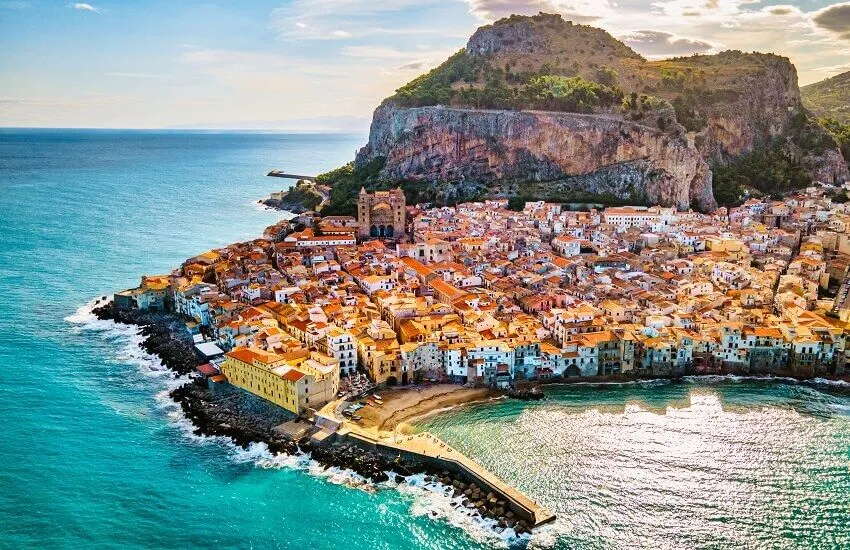
Sicily — The Complete Island Guide 2026
A four-layer palimpsest — Greek temples older than Rome, Arab-Norman chapels that fused Islam and Byzantine Christianity, the baroque ensemble that rebuilt the southeast after the 1693 earthquake, and the working Sicily of Etna winemakers, Palermo markets, and the anti-mafia legacy of Falcone and Borsellino. An honest guide to all four, for 2026.
CTA ✈️ Catania
TPS ✈️ Trapani
€75–220/day budget
Mediterranean: 10–33 °C
Schengen / EUR €
UNESCO Arab-Norman + Val di Noto
Why Sicily? An Editor’s Note
The plane banks low over the Conca d’Oro, and you see three things at once: a medieval cathedral the size of a cargo ship, a working-class suburb that extends in beige grids to the foot of a 600-metre mountain, and a coastline that is mostly container ports interrupted by beaches. Nothing about the landing approach is designed to impress you. Sicily does not do brochure work from the air, and the drive in from the airport offers no improvement.
Sicily is best read as a palimpsest: an island repeatedly overwritten, with every conqueror leaving a legible layer of stone, vocabulary, or flavour that the next conqueror failed to paint over. For a first-time visitor this is too many layers to hold in your head at once. Collapse it into four.
The first layer is Greek Sicily — older than Rome, and in places older than classical Greece itself. Between the 8th and 5th centuries BCE, the coast of Sicily hosted some of the largest Greek colonies in the Mediterranean. Syracuse at its peak was larger than Athens. Agrigento’s Valley of the Temples contains Doric architecture on a scale that never existed on the mainland. Segesta is the temple that may have been commissioned to impress Athenian inspectors sent to arbitrate a border dispute. Archimedes was a Syracusan; he died there, by a Roman soldier’s sword, during the siege of 212 BCE. When you stand inside the Temple of Concordia at Agrigento you are inside a building that predates almost everything else still standing in Italy. This is the sediment layer. Sicily’s Greek substrate is older than the word “Italy.”
The second layer is Arab-Norman Sicily — a 130-year anomaly (roughly 1061 to 1194) when the Hauteville Normans inherited the Islamic Emirate of Sicily and, remarkably, chose to keep it running. Roger II issued his charters in Latin, Greek, and Arabic from a trilingual chancery in Palermo. The royal chapel he commissioned used Islamic muqarnas vaulting above Byzantine gold mosaics on a Romanesque floor-plan, with Arabic inscriptions on the walls of a Christian church. The technical word is convivenza — coexistence — and it was the most religiously and linguistically hybrid civilization medieval Europe produced. The political project collapsed; the buildings are still standing. UNESCO listed nine of them in 2015.
The third layer is Baroque Sicily — specifically Val di Noto, the eight towns of southeastern Sicily that were rebuilt after the earthquake of 11 January 1693, which killed roughly 60,000 people in one afternoon and levelled seventy settlements. The survivors reconstructed on the ruins in a fever of golden tufa limestone, competitive façades, staircase-piazzas, and church domes that read as architectural defiance. Noto, Modica, Ragusa Ibla, the centro storico of post-1693 Catania, Scicli, Palazzolo Acreide, Militello Val di Catania, Caltagirone — eight towns, one style, built in a half-century of civic recovery and inscribed together by UNESCO in 2002. If you have not understood that Sicily has a baroque tier, you have not understood the island.
The fourth layer is Working Sicily — the one happening now. The island that built modern Italy’s anti-mafia jurisprudence after Giovanni Falcone and Paolo Borsellino were murdered in 1992, fifty-seven days apart; that makes some of Europe’s most exciting volcanic wine on Etna’s north slope; that feeds itself out of three of Italy’s greatest urban food markets; that administers Lampedusa and has become Europe’s frontline on Mediterranean migration. This is the Sicily you actually eat in, sleep in, and argue with taxi drivers in. Tourists underweight it.
A note on Lampedusa. Sicily administers Lampedusa, the Pelagie Islands cluster closer to Tunisia than to the Sicilian mainland, where thousands of migrants have landed — and thousands have died trying — over the past fifteen years. On 3 October 2013 a single shipwreck killed 368 people a kilometre from the port. Mimmo Paladino’s Porta d’Europa (2008) — a five-metre terracotta-and-iron open gate on the road from the harbour — is one of the most important public monuments Italy has commissioned this century. Lampedusa is not in this guide as a beach destination. Its beaches exist, and Spiaggia dei Conigli is regularly rated among Europe’s best, but sending readers there for a holiday while ignoring what the island means is the gratuitous move.
Taormina’s Corso Umberto in high season. White Lotus Season 2 (filmed in 2022) converted an already-busy town into a cruise-ship funnel, and now 11,000 residents host upwards of two million visitors a year. The Greek Theatre at sunrise is still one of the great views in Europe. The Corso in August is unusable. This guide sends you to Taormina — in April, in October, and at dawn — and to Noto, Modica, and Ragusa Ibla for the baroque cliff-towns that Taormina-seekers will enjoy more.
Who this guide is for. You have a flight, seven to fourteen days, and enough curiosity to actually look at what you are standing in front of. You are not here for an all-inclusive hotel in Cefalù. You can hold four historical layers in your head at once. You want the markets, the Greek temples, the Norman chapels, the baroque staircases, and the granita, and you have no interest in being lied to about any of them. This guide moves you through the four layers, names the tourist traps, and tells you which access fees are earned and which are a tax on laziness.
Sicily, like its language, is not a version of Italian. It is older, drier, denser.
Table of Contents
- Top 12 Attractions
- The Five Regions of Sicily
- Where to Stay — by Budget
- Where to Eat
- Drinking — Etna DOC, Marsala, and the Granita Ritual
- Getting Around
- Best Time to Visit
- Month-by-Month Weather
- Daily Budget Breakdown
- Sample Itineraries
- Best Day Under €25
- Hot Day Plan
- Day Trips
- Safety & Practical Information
- Visa & Entry Requirements
- Hidden Sicily
- What’s New in 2026
- Frequently Asked Questions
- Explore More AiFly Guides
Top 12 Attractions
1. The Valley of the Temples, Agrigento — Doric on a Scale Greece Never Built
In the fifth century BCE the Greek colony of Akragas, on the south coast of Sicily, was one of the richest cities in the Mediterranean. The philosopher Empedocles was born here, and complained that his neighbours built houses as if they would live forever and ate as if they would die tomorrow. What survives of their ambition is a ridge five kilometres outside modern Agrigento where a line of Doric temples runs east-to-west along a limestone spine, built between roughly 510 and 430 BCE. The Temple of Concordia, the best-preserved, is intact to its pediment and entablature because a sixth-century bishop converted it into a basilica; you can still see the windows he cut into the cella walls. The Temple of Heracles, collapsed by earthquakes, was partially re-erected in the 1920s by a British archaeologist funded with his own money. The Temple of Olympian Zeus, had it been finished, would have been the largest Greek temple ever built; it was knocked down by Carthaginians before completion and quarried for Agrigento’s harbour walls, leaving an eight-metre stone telamon — a colossal male figure who once held up the architrave — lying flat on the ground, staring at the sky.
The park is 1,300 hectares. You cannot see it in ninety minutes. Enter at the lower gate (Porta V, near the Temple of Hera), walk up the ridge in morning shadow, and end at the museum. Do not do this walk between 11:00 and 16:00 in July or August; inside the park, in high summer, temperatures touch 40°C with almost no shade between temples. The archaeological museum two kilometres uphill holds the original telamon, the bronze figurines, and the painted Attic vases the ridge has been producing since the nineteenth century; add it to your ticket.
- Price: €14 park only, €19.60 park + museum, €20 park + Kolymbetra gardens (the Hellenistic irrigated garden west of the Temple of Dioscuri). Free first Sunday of each month.
- Hours: Daily 08:30–19:00 (last exit 20:00); closes earlier in winter.
- How to get there: By car from Palermo 2h 15min (A29 + SS189), from Catania 2h 30min. By bus: Cuffaro runs Palermo–Agrigento direct (~€9, 2h). From Agrigento town to the park: TUA city bus 1 or 2 from Piazzale Rosselli.
- Accessibility: The paved main axis is largely accessible; individual temples involve stepping onto ancient uneven stonework. The Temple of Hera and Temple of Concordia are the best for visitors with mobility constraints.
- Book: lavalledeitempli.it — go direct, skip the aggregators.
- Editor’s tip: The park opens for floodlit evening visits on selected summer Friday and Saturday nights (~€17, 20:30–23:00). If you are visiting in July or August, book the night tour instead of the day. Concordia under floodlight is one of the great European archaeological experiences, and at 22:00 the air is ten degrees cooler.
2. Ortigia and the Neapolis Archaeological Park, Syracuse — Where Archimedes Died
Syracuse at its peak, around 400 BCE, was larger than Athens and one of the three or four richest cities in the Greek world. Cicero called it the greatest and most beautiful of all Greek cities. What the Athenians never managed to conquer, and what survives today, is an island-harbour called Ortigia connected to the mainland by two short bridges. Ortigia is a working Sicilian neighbourhood that happens to sit on top of 2,700 years of continuously occupied stone. The cathedral is a Doric temple of Athena converted to a church in the seventh century, with the original fluted columns still visible in the external wall; the cathedral is the building. Walk the Duomo piazza at dusk when the limestone turns honey, eat swordfish in a trattoria where the dining room used to be a Byzantine cistern, and swim off the rocks at Forte Vigliena at sunrise.
The archaeology sits across the bridge in the Neapolis park. The Greek Theatre, cut into the hillside in the fifth century BCE, still stages a classical Greek drama festival every May and June — in 2026 the season runs 8 May to 28 June with Antigone, Alcesti, I Persiani, and an Iliade, and the theatre seating is partially reconfigured for the festival build. Next to the theatre is the Latomia del Paradiso, a limestone quarry that became the prison where the defeated Athenian expedition of 413 BCE was worked to death, and at its centre the Orecchio di Dionisio — the Ear of Dionysius — a 23-metre tall S-shaped cave whose acoustic is so sensitive that Caravaggio, who visited in 1608, first proposed the legend that the tyrant Dionysius had used it to eavesdrop on prisoners. Clap once at the entrance, walk deep in, clap again from the back. The echo is the point.
- Price: Neapolis archaeological park €13.50 adult / €6.75 EU 18–25 / free under 18. Ortigia itself is free; the cathedral is a separate €2 contribution.
- Hours: Neapolis 08:30–16:30 (winter) / 08:30–19:00 (summer). Ortigia cathedral 09:00–17:30 (shorter on Sundays).
- How to get there: Syracuse Centrale station is a 20-minute walk from Ortigia across the Ponte Umbertino. From Catania 1h by train (€7.20). Neapolis is a 25-minute walk north of the station or a €7 cab.
- Accessibility: The theatre has steep steps; the lower park levels are accessible with effort. Ortigia’s cobbled lanes are walkable but not wheelchair-friendly.
- Book: parchiarcheologici.regione.sicilia.it for Neapolis; indafondazione.org for the classical festival.
- Editor’s tip: If you are visiting during the festival (May 8 – June 28 in 2026), book a classical drama performance months in advance. Seats sell out; the experience of watching Antigone performed in ancient Greek in the theatre where Aeschylus’s Persians was first staged in 472 BCE is not a thing you get in many other places. Off-festival: sit on the stone tiers alone at 09:00 on any Tuesday in April and you will have the place essentially to yourself.
3. Segesta and Selinunte — The Greek West
Western Sicily has two archaeological sites in the top tier of European archaeology that get a fraction of Agrigento’s foot-traffic. Both were Greek settlements, both were destroyed — Selinunte by the Carthaginians in 409 BCE, Segesta by competing factions in the fourth century — and both preserve monuments that no other Greek site has.
Segesta is a single Doric temple from about 420 BCE that stands on a hillside, intact to its pediment, never roofed. Scholars argue about whether it was ever finished. The columns are unfluted. The cella was never built. The most likely explanation is that Segesta commissioned the temple specifically to impress an Athenian delegation sent to arbitrate the town’s border dispute with Selinunte, then stopped work the moment the Athenians had committed to an alliance. Two kilometres uphill sits a Greek theatre cut into the crest of Monte Barbaro, from which you can see the Gulf of Castellammare on a clear day. The walk between them is steep; a shuttle bus (€1.50 one way, every 30 minutes) runs the gap.
Selinunte, 100 km south, is the largest Greek archaeological park in Europe — 270 hectares containing the ruins of an entire Greek city, seven temples across two hills, and a quarry (the Cave di Cusa) that still holds the unfinished column drums the city was cutting when the Carthaginians arrived. Temple E was partially re-erected in the 1950s and sits photogenically on the eastern hill. Temple G, the largest ever attempted in Sicily, was never finished; its tumbled column drums lie on the ground in the order they fell. The site is too large to walk in one day. Rent the electric shuttle (€6) or accept that you will be in the sun for six hours.
- Price: Segesta park €6 (or €17 combined with Pianto Romano); Selinunte park ~€6 (verify on day at coopculture.it — vendor pricing is inconsistent).
- Hours: Segesta 09:00–17:30 winter / 19:00 summer. Selinunte ticket office closes 19:00 May 1 – Sept 14 (last entry); earlier otherwise.
- How to get there: Car essential for both. Segesta: A29 from Palermo, 1h. Selinunte: 1h 45min from Palermo by car, no good public transport link.
- Accessibility: Segesta temple is approached on paved ramps; the theatre is not accessible. Selinunte’s east hill is largely accessible with the shuttle; west hill is not.
- Book: coopculture.it.
- Editor’s tip: Do Segesta at sunset. The temple is on a ridge facing west, and the last hour of light turns the stone the colour of pale honey. Bring a sandwich and water. There is no café, and the nearest town (Calatafimi) is a ten-minute drive.
4. Cappella Palatina and the Palazzo dei Normanni, Palermo — The Room That Explains Sicily
If you have one hour in Palermo, spend it here. In 1132 Roger II, the first Norman king of Sicily, commissioned a private chapel inside his royal palace. His architects took a Romanesque basilica plan and fused it with a Byzantine sanctuary and an Islamic wooden ceiling, used Greek mosaicists on the walls, Arab carpenters on the ceiling, Latin scribes for the inscriptions, and ended up with a room that should not exist. The Cappella Palatina is 12 metres wide, 30 metres long, and contains every major Mediterranean Christian and Islamic aesthetic tradition of the twelfth century, laid on top of each other without friction. The nave ceiling is a muqarnas honeycomb painted with scenes of court life — musicians, hunters, eating, drinking, a woman nursing a child — which means that Muslim craftsmen, working for a Christian king, covered the ceiling of his private chapel with images of their own world while Byzantine artists, a metre below the ceiling, were covering the apse with a Greek Christ Pantocrator. Nothing else in medieval Europe survives at this quality and this hybridity.
The chapel sits inside the Palazzo dei Normanni, which remains the seat of the Sicilian regional assembly (the parliament). The Royal Apartments, accessible Friday to Monday, contain the twelfth-century Roger Room — a private bedroom whose walls are frescoed with Norman-era mosaics of leopards and peacocks under palm trees, the courtly Islamic iconography Roger II clearly liked looking at. If the apartments are open during your visit, they are included in the combined ticket; this is the single most overlooked room in Palermo.
- Price: €19 combined ticket (Cappella Palatina + Royal Apartments + Royal Gardens) during the access window; €12 when the apartments are closed. Reduced €10–12 for EU 18–25.
- Hours: Mon–Sat 08:15–17:40; Sun 08:15–13:00 (the chapel closes for Mass roughly 09:45–11:45 on Sundays). Last entry 45 min before closing.
- How to get there: Any bus to Piazza Indipendenza (101 from Palermo Centrale). Walking from the Quattro Canti: 12 minutes along the Cassaro.
- Accessibility: The chapel entrance involves a short flight of steps; the apartments have further steps. The gardens are accessible.
- Book: federicosecondoonline.tm.vivaticket.com.
- Editor’s tip: Be at the gate by 08:15 on a weekday. The chapel holds about 200 people comfortably; by 10:30, when the cruise-ship buses arrive from the port, it holds 600 and you cannot look at the ceiling. On Sundays, check the Mass schedule — you will be locked out 09:45–11:45, and a surprising number of travellers lose their only chapel visit to this.
5. Monreale Cathedral — The Mosaic Ceiling That Justifies a Sicily Trip by Itself
Seven kilometres inland from Palermo, on a hillside overlooking the Conca d’Oro, sits William II’s 1174 answer to the Palatine Chapel: a full-scale cathedral whose interior walls, from floor to apse, are covered with 6,340 square metres of Byzantine gold mosaic. The biblical cycle runs chronologically from Genesis in the nave to Christ Pantocrator in the apse, and for scale: the Pantocrator alone measures 13 metres tall, and makes eye contact with you from the far end of the nave. Monreale was built in about ten years — impossibly fast for a cathedral of this scale — on the strength of William II’s political anxiety that the archbishop of Palermo had too much power. William wanted a new royal basilica outside the city; he got the most ambitious mosaic cycle in the medieval Mediterranean.
The cathedral’s nave is free to enter. The terraces (€4 extra) climb the outside wall to roof level and let you look at the apse mosaic at eye level instead of from 40 metres below. The cloister next door (€8, separate ticket, different operator) contains 228 paired columns, each pair carved with different capitals — biblical scenes, mythological scenes, scenes of medieval life — and a carved fountain with Islamic geometry in the centre. The cloister is the quiet masterpiece; visitors skip it because it is a separate ticket.
- Price: Cathedral nave free. Terraces €4. Cloister €8. Treasury and crypt €4.
- Hours: Cathedral Mon–Sat 08:30–12:30 and 14:30–17:00; Sun access limited to worshippers during services.
- How to get there: AST bus 389 from Piazza Indipendenza (€1.60, 45 min). Or Palermo city bus 389. A taxi from central Palermo is €20–25 one way.
- Accessibility: Cathedral nave accessible via side door (ask the custodian). Terraces involve a tight spiral staircase; not viable for limited mobility.
- Book: monrealeduomo.it.
- Editor’s tip: Go at 09:00 on a weekday. The east-facing apse lights up between 09:30 and 11:00 when direct sun crosses the Pantocrator. After 11:00, the apse falls into relative shade for the rest of the day. Pair with Monreale’s cloister and the panoramic terrace at Piazza Guglielmo II — then eat lunch at La Botte 1962 (Contrada Lenzitti) on the way back down to Palermo. Do not eat in Monreale town itself; tourist-grade.
6. Palermo Cathedral, La Martorana, and San Cataldo — The Arab-Norman Walking Triangle
The rest of Palermo’s UNESCO-listed Arab-Norman circuit sits in three buildings within a fifteen-minute walk of each other, and this walk is the single most efficient way to understand Sicily’s twelfth-century synthesis.
Palermo Cathedral itself is a palimpsest of a building — a ninth-century mosque, built on a sixth-century basilica, converted into a Norman cathedral in 1185, heavily modified in the eighteenth century, and with a neoclassical dome added in 1781 that most Sicilians secretly think is a mistake. The nave is baroque and relatively modest; the treasure is in the right-hand chapels where the royal tombs sit — Roger II (d. 1154), his daughter Constance, her husband Henry VI, and their son Frederick II. Frederick II is the interesting one; stupor mundi, crusader, poet, Arab-speaker, king of Sicily, Jerusalem, and the Holy Roman Empire, excommunicated twice by different popes. Pay the €4–7 for the rooftops — the view across the Arab-Norman city to Monreale is the one that makes sense of the landscape.
La Martorana (Santa Maria dell’Ammiraglio), five minutes east in Piazza Bellini, was built in 1143 by George of Antioch, Roger II’s Greek-Syrian admiral, as a family chapel. Inside: Byzantine gold mosaics matching Monreale in density, on a church a fraction of the size. The ceiling holds a mosaic of Roger II being crowned by Christ — a political statement as much as a religious one. La Martorana is a working Italo-Albanian Catholic parish; services are in Greek.
San Cataldo, fifteen metres away in the same piazza, is a 1160 Norman church with three red Islamic domes and essentially no interior decoration — almost defiantly austere after the ornament of the Martorana next door. The two together make the architectural argument.
- Price: Cathedral nave free; rooftops €4–7; full monumental ticket (tombs + treasury + rooftops) €12–15. La Martorana €2 contribution. San Cataldo €2.50.
- Hours: Cathedral Mon–Sat 09:30–19:00, Sun 10:00–19:00. La Martorana weekday 09:30–13:00 and 15:30–17:30; shorter Sunday hours. San Cataldo daily 09:30–18:30.
- How to get there: All three within ten minutes of the Quattro Canti. Any bus or tram to Piazza Verdi.
- Accessibility: Cathedral nave accessible. Rooftops not. La Martorana and San Cataldo have small step entrances.
- Editor’s tip: Climb the Cathedral rooftops just before sunset, when the light turns the Norman crenellations pink and Monreale lights up on its hill. From the rooftop you can see almost the entire Arab-Norman UNESCO itinerary mapped out below you.
7. Val di Noto — The Baroque Triangle (Noto, Modica, Ragusa Ibla)
On the afternoon of 11 January 1693, an earthquake estimated at magnitude 7.4 destroyed seventy settlements in south-eastern Sicily in under two minutes and killed around sixty thousand people. What followed was one of the most concentrated acts of civic reconstruction in European history: the eight towns of Val di Noto were rebuilt between 1700 and 1750 in a single baroque style, with identical honey-gold limestone, competitive staircase-piazzas, church façades that read as architectural speeches, and a self-conscious project of using new architecture to re-found civic identity. UNESCO inscribed the eight towns together in 2002 as the single most coherent baroque ensemble on earth.
Three of the eight are day-trippable from each other as a cluster. Stay the night in one.
Noto is the showcase — Corso Vittorio Emanuele is a straight 800-metre baroque stage-set with three church façades ascending a ridge, and the Cattedrale di San Nicolò sits at the top of a theatrical staircase designed to be climbed slowly. Noto’s Infiorata festival covers the Via Nicolaci with flower-petal tableaux every May — in 2026 from 15 to 19 May, themed “Pop Culture Tells Its Story.” Caffè Sicilia on the Corso, run by Corrado Assenza, is arguably the most important pastry bar in Italy; the almond granita with brioche is the serious contender for best breakfast in Europe. €5. Eat it standing.
Modica is the chocolate town — its cold-processed, cocoa-grained chocolate (never heated above 40°C) is a direct Aztec inheritance, brought by Spanish governors in the sixteenth century, and best bought at Antica Dolceria Bonajuto (€3.50 a bar). Modica has two great baroque churches on two hills — San Giorgio and San Pietro — connected by a staircase alley that is the single most photographed street in the Val di Noto.
Ragusa Ibla is the one to sleep in. The old town sits on a rocky outcrop opposite the newer Ragusa Superiore, connected by a ravine. The Duomo di San Giorgio façade rises in three convex tiers above a paved sloping piazza, and the surrounding lanes have more restaurants per square metre than the rest of the interior. Ciccio Sultano’s Duomo (two Michelin stars since 2006) sits two steps from the cathedral steps. The lower town, Ibla, is almost entirely pedestrian.
- Price: Noto cathedral free; Palazzo Nicolaci €4. Modica San Giorgio free; Bonajuto chocolate free to enter the shop. Ragusa cathedral free; Hyblaean gardens free.
- Hours: All three centres open air. Individual churches typically close 12:30–16:00 for lunch and then reopen until 19:00.
- How to get there: Noto: 35 min train from Syracuse (€4.60). Modica and Ragusa: easier by car; trains exist but are slow. Bus connections via AST.
- Accessibility: All three have significant stepped streets. Noto’s main Corso is the flattest.
- Editor’s tip: Stay two nights in Ragusa Ibla at a small palazzo hotel, and day-trip to Modica and Noto. Eat the almond granita at Caffè Sicilia at 09:00 before the bus tours arrive. The Ibla streets between 22:00 and midnight, after the tourist restaurants have closed and the local passeggiata is in full swing, are one of the quietly best evening walks in Italy.
8. Villa Romana del Casale, Piazza Armerina — The Mosaic Floor of a Roman Who Liked Wild Animals
In the middle of Sicily, 10 km south-west of the hill town of Piazza Armerina, sits the fourth-century Roman country villa of a very rich aristocrat — possibly Marcus Aurelius Maximianus, emperor from 286 to 305, but scholars are not sure — whose 3,500 square metres of preserved mosaic floor are the most extensive surviving from the Roman world. Buried by a landslide in the twelfth century and not re-excavated until the 1950s, the mosaic floors are in such good condition that you can trace the chisel marks of the North African mosaicists who laid them.
The subjects are secular, detailed, and gently appalling. The main corridor — the Great Hunt — is a 66-metre ribbon showing wild animals being caught in North Africa and transported to Rome for games: lions, elephants, a rhinoceros, leopards, tigers, an ostrich, a gryphon (apparently the mosaicists believed in those), and the ships that carried them. The Palaestra, often called the Bikini Girls, shows ten young women in athletic competition wearing what look like two-piece bathing costumes from 320 CE; this is the image that appears on every Sicilian postcard. The Small Hunt has dogs attacking a boar, a hunter on horseback, and a picnic scene that gave Italian archaeologists their best insight into what fourth-century aristocrats ate on a country weekend. A few mosaics have erotic content; these are in a side room with a discreet age sign at the entrance.
- Price: €8 full / €4 reduced. Combined ticket with the Aidone Archaeological Museum (Morgantina silver) €12.
- Hours: Daily 09:00–18:00 April to October, 09:00–16:00 November to March.
- How to get there: Car strongly preferred. 45 min from Catania, 1h 15min from Agrigento, 2h from Palermo. Public transport is difficult — SAIS bus from Catania to Piazza Armerina town takes 1h 45min and you still need a taxi (€15) for the last 5 km to the villa.
- Accessibility: The raised walkways that cover the mosaics are largely accessible; the entrance ramps are steep but manageable.
- Editor’s tip: Do this on a transit day between Agrigento and Syracuse, or Catania and Agrigento. It adds 90 minutes to a drive and it is worth every one of them. Go at 09:00 — direct morning light through the transparent roof illuminates the Great Hunt corridor, and by 11:30 the tour-bus groups have arrived.
9. Mount Etna — Europe’s Largest Active Volcano (and What It Means in 2026)
Mount Etna is 3,357 metres tall, the largest active volcano in Europe, and is currently in flank eruption. The present episode began on 1 January 2026 with a fissure opening at about 2,100 metres on the eastern slope, and has continued with lava flows moving east into the uninhabited Valle del Bove. On 2 June 2025 the south-east crater partly collapsed, which closed the cable car and the summit route outright for several weeks. Paroxysmal activity from the north-east crater on 27 December 2025 — the first from that crater in 28 years — contributed to the current cycle. Check ct.ingv.it (the National Institute of Geophysics and Volcanology Catania observatory) on the morning of any summit plan, and never rely on a tour operator’s website alone. The safety section later in this guide returns to this; please read it if Etna is in your plans.
In a normal week, when the summit is accessible, three tiers of Etna experience exist. The cheapest is the cable-car day: drive to Rifugio Sapienza (1,923 m) on the south side, take the Funivia dell’Etna cable car to 2,500 m (€30 return, or €78 including the 4×4 shuttle to 2,920 m and a short guided walk around a lower crater), and come down again. This is what most tourists mean when they say they “climbed Etna.” It is not a summit trek; you turn around at the old Torre del Filosofo site, 400 metres vertically short of the true summit craters.
The second tier is a proper guided summit trek to 3,329 m — six to eight hours, €90–130 per person, with certified vulcanological guides, and subject to daily authorisation from the Prefect of Catania. Above 2,900 metres Sicilian regional law has required a certified guide since 2013; this is not a bureaucratic nicety, it is because people have died walking into flank vents that are not visible in cloud. The two recognised guide associations are Gruppo Guide Alpine Vulcanologiche Etna Sud (south side) and Etna Guide (Nicolosi). Both are honest about which days the summit is accessible and which days you will do a lateral traverse instead.
The third tier — and the one this guide rates above the cable car or the summit trek — is an Etna wine country day on the north flank around Linguaglossa, Randazzo, and Passopisciaro. Volcanic Nerello Mascalese (red) and Carricante (white) from terraced lava vineyards are some of the most exciting wines being made in Italy; producers worth visiting include Planeta’s Sciaranuova estate, Tasca d’Almerita’s Tascante, and Frank Cornelissen, a Belgian non-interventionist who has been working the north slope since 2001. A full north-slope tasting day with lunch runs €90–140 per person.
- Price: Cable car €30 return. Cable car + 4×4 + guide €78. Summit trek €90–130. Wine day €90–140.
- Hours: Cable car typically 09:00–16:00; closes below 0°C or in high wind — call the morning of.
- How to get there: Rifugio Sapienza: AST bus from Catania Piazza Giovanni XXIII at 08:15, returns 16:30 (€6.60 return). North slope: car essential.
- Accessibility: Cable car is accessible; the 4×4 shuttle is not. Summit trek requires full mobility.
- Book: funiviaetna.com; etnaexperience.com; etnaguide.it; guidevulcanologicheetna.it.
- Editor’s tip: If your Etna day is between January and April 2026, assume the summit is closed, book the Linguaglossa wine day instead, and plan the cable car only if ct.ingv.it shows activity has paused that morning. The mountain will still be there on your next trip; walking into an active flank vent in bad visibility is not a thing you recover from.
10. Teatro Antico di Taormina — The View That Has a Problem
Taormina sits on a ridge 200 metres above the Ionian Sea, with a Hellenistic theatre cut into the crest of the ridge that faces Mount Etna across the bay. The theatre was built by the Greeks, rebuilt by the Romans, and survived because the medieval town of Taormina used the same limestone for its houses. From the top tier of seats you look down through the proscenium — the stone stage wall — and Etna sits centre-frame, usually smoking, occasionally erupting. On a clear evening with a performance on, it is one of the great theatre views in Europe.
It is also the centre of Sicily’s biggest tourist crush. The White Lotus Season 2 (HBO, 2022) filmed in Taormina and at the nearby San Domenico Palace hotel, and between the show’s release and 2026 the town has seen a structural surge in visitor numbers. Eleven thousand residents now host over two million visitors a year. Corso Umberto in August is wall-to-wall linen shorts and €12 Aperol. A coffee at a Corso café is €6.
How to actually enjoy Taormina:
– Visit in April, early May, or October. The town is functional in the shoulder season. The theatre stages almost daily concerts and recitals in June–August and the view still works, but everything else about the town suffers.
– Take the cable car down to Isola Bella in the morning (€3 one way), swim off the rocks, come back up, and do the theatre at 17:00 when the tour groups have departed.
– Sleep elsewhere. Castelmola, 15 minutes above Taormina by bus, is a stone village without the crush, with a genuine viewpoint from the castle ruin. Or stay in Catania and day-trip.
The combined ticket with Isola Bella nature reserve (€4 extra) is best purchased at the Taormina booth. Two new 2026 Taormina hotel openings — Villa Timeo Belmond (May) and Grand Hotel Miramare Kimpton (July, first Italian Kimpton) — see Where to Stay → Luxury → Taormina.
- Price: Teatro Antico €14 / €7 EU 18–25 (regional park rate) or €10 / €5 on alternate channels; under-18 free; free first Sunday of each month. Verify pricing at the gate. Isola Bella nature reserve €4.
- Hours: Theatre 09:00–16:00 (winter) / 09:00–19:00 (summer). Isola Bella 09:00 until one hour before sunset, closed Mondays.
- How to get there: Taormina-Giardini train station is 200 m below the town; Interbus shuttle €4 up. From Catania: train 45 min to Taormina-Giardini.
- Accessibility: The theatre has significant steps; a ramp provides access to the lower seating.
- Editor’s tip: Book a classical concert at the theatre. The recital programme runs June to September; a ticket is €35–70, and you will sit in a Greek theatre facing a live volcano at 21:00 on a warm evening and understand why this town exists.
11. The Albero Falcone and Palazzo Steri, Palermo — Standing in the Right Place
On 23 May 1992 the Mafia detonated 500 kilograms of explosive under the Punta Raisi motorway near Capaci, fifteen kilometres west of Palermo, as Giovanni Falcone — Italy’s most significant anti-Mafia investigating magistrate — was driven home from the airport. He and his wife Francesca Morvillo and three police bodyguards were killed. Fifty-seven days later, on 19 July 1992, the Mafia detonated another car bomb on Via D’Amelio in Palermo as his colleague Paolo Borsellino arrived to visit his mother. Borsellino and five bodyguards were killed. The two bombings, in combination, are the inflection point in modern Italian anti-Mafia jurisprudence — the event that broke the silence that Palermitan civil society had maintained for three generations. The Maxi Trial of 1986–87, which Falcone and Borsellino had built, had already convicted 338 Mafiosi. Their murders converted Sicilian public opinion in a way that the trial itself had not.
In front of Falcone’s apartment building at Via Notarbartolo 23, Palermo, stands a large Ficus macrophylla — a Moreton Bay fig, not a magnolia despite the common nickname l’albero Falcone. In the days after the Capaci bombing neighbours began pinning photographs, messages, and drawings to the tree. They have not stopped. The tree is still actively tended — a doorman at No. 23 has become its informal guardian — and a photograph taken on any ordinary afternoon in 2026 will show recent additions. The Falcone apartment itself is private; a small memorial occupies the building’s entrance hall.
A twenty-minute walk south-west is Via D’Amelio, where the Borsellino bombing happened. The street is shaded by a single tree and a plaque with a list of names. Emanuela Loi, 25, the first female state police officer killed on duty in Italy, is one of them.
Pair these with Palazzo Steri on Piazza Marina, where from 1604 to 1782 the Spanish Inquisition ran its Sicilian tribunal. The basement cells are open for guided tours (hourly, 09:00 onward, one-hour, €7 full, included in the Palermo University art cycle). The cell walls are covered in graffiti drawn in soot, charcoal, and blood by prisoners — Muslim converts, alleged heretics, members of Palermo’s Jewish community — between the seventeenth and eighteenth centuries. Texts in Latin, Sicilian, English, Greek, and Judaeo-Arabic. The art historian Giuseppe Pitrè first documented them in 1906; the current tour guides speak with appropriate gravity.
- Price: Via Notarbartolo and Via D’Amelio are public streets — free. Palazzo Steri guided tour €7 full / €5 reduced.
- Hours: Albero Falcone always accessible. Palazzo Steri tours on the hour, 09:00–18:00 (Mon–Fri); reduced weekend hours.
- How to get there: Via Notarbartolo — Metro Francia or Notarbartolo. Palazzo Steri — Piazza Marina, walking from Ballarò or the Kalsa.
- Accessibility: Both street sites are accessible. Palazzo Steri cells involve a steep staircase.
- Editor’s tip: Walk between the two sites. The route from Via Notarbartolo south into the old city, past the Teatro Politeama, through Via Ruggero Settimo to the Quattro Canti and south to the Kalsa, is a forty-minute line that crosses the whole social and architectural stratigraphy of Palermo. Do it slowly. Eat afterwards at an Addiopizzo-certified restaurant (map at addiopizzotravel.it) — Palermo’s anti-extortion movement since 2004 has signed up over 1,000 businesses, and eating at one of them is the simplest way to participate in what Falcone’s generation started.
12. Catacombe dei Cappuccini, Palermo — The Honest Entry
The Capuchin friars of Palermo began mummifying their dead in 1599 when they ran out of room in the traditional crypt and a process accidentally preserved the first set of remains so effectively that they were put on display. Over three centuries the crypt grew into a 8,000-strong municipal burial practice used by Palermo’s middle and upper classes — dress your dead in their best clothes, pay for the Capuchins to dry them on specially ventilated terracotta racks for a year, and then stand them up against the walls of the catacomb. The corridor walls of the catacomb are lined with fully clothed preserved bodies of men, women, children, and religious. The last committal was in 1920. The most famous and the most shattering is Rosalia Lombardo, a two-year-old who died of pneumonia in 1920 and whose body was chemically preserved by the Palermitan chemist Alfredo Salafia using a formula that kept her essentially lifelike for over a century. She appears to be asleep.
This is a museum in Sicily’s guide that requires an honest framing. A photograph of Rosalia Lombardo is forbidden by the Capuchin order — there is a sign on her glass case — and the prohibition is respected by the guardians. Do not photograph her. The visit itself is twenty minutes; it is not a place to linger, and the corridors are dim enough that speed-walking through them feels appropriate. The intellectual question the catacomb poses — whether to visit at all — is one readers should answer for themselves, and the guide’s recommendation is: if you are ambivalent, do not go. If you do go, go quietly, treat it as a cemetery (which it is), and leave as the next group arrives. This is not a TikTok stop.
- Price: €5 full / €3 reduced.
- Hours: Daily 09:00–13:00 and 15:00–17:30.
- How to get there: Bus 327 from Piazza Indipendenza (€1.60). Or a 25-minute walk west from the Quattro Canti.
- Accessibility: A gentle ramp into the crypt; the corridor floor is uneven but navigable.
- Book: catacombefraticappuccini.com.
- Editor’s tip: Go at 09:00, with the morning light coming through the corridor skylights. Not on a school-tour day.
The Five Regions of Sicily
Palermo & the Northwest
Palermo is the capital, the island’s largest city (640,000), and the densest single concentration of Arab-Norman architecture in the Mediterranean. Base yourself here for any trip that prioritises the architectural layers. The city’s rhythm is pedestrian between the Quattro Canti (the 1608 baroque octagon at the city’s main crossing) and the sea — Via Maqueda, Via Roma, the Vucciria market, the Kalsa, and the Foro Italico waterfront. The nearby coast reaches west to Monreale (7 km), north to the cliffside town of Cefalù (70 km, a good day-trip), and further west to the salt flats of Trapani, the walled hill town of Erice (accessed by cable car up from Trapani — €9.50 one way), the limestone-ringed beaches of Scopello, the cove-beach at San Vito Lo Capo at the island’s north-western tip (home of the September Couscous Fest), and the Zingaro Nature Reserve between Scopello and San Vito Lo Capo. The Aegadian Islands — Favignana, Levanzo, Marettimo — lie off Trapani, and Favignana’s tuna traps (the Tonnara di Favignana) are one of Sicily’s most quietly powerful industrial museums.
Catania & the East Coast
Catania (300,000) sits at the foot of Etna with a ring of lava-stone baroque buildings constructed after the 1693 earthquake and the 1669 eruption that destroyed the previous city. The fish market (La Pescheria) behind the Duomo, from 06:00 to 14:00 daily except Sunday, is the single loudest and most theatrical urban food market in Italy — arrive at 07:00 and eat swordfish carpaccio at a metal table five metres from the fishmonger’s block. Via Etnea runs north from Piazza Duomo to the 19th-century Villa Bellini gardens, and the baroque Via Crociferi is the most concentrated single street of Sicilian baroque church façades. From Catania, Etna is 45 minutes west, Taormina 45 minutes north, Syracuse 60 minutes south, and Savoca — the Godfather-tour village — 40 minutes north. The eastern coast between Catania and Messina includes Acireale (baroque in miniature) and Aci Trezza, the fishing village Giovanni Verga used for I Malavoglia in 1881.
Syracuse & the Southeast
The island’s southeastern tip is the baroque belt — eight towns of Val di Noto UNESCO, of which Noto, Modica, Ragusa Ibla, and Scicli are the four worth visiting; the others are smaller variations on the same architectural language. Syracuse/Ortigia (125,000) is the regional capital and the area’s best overnight base: a working city with a restored island core, a functioning fish-and-produce market (Mercato di Ortigia, 07:00–14:00), and one of Italy’s more sophisticated small-restaurant scenes. Marzamemi, 40 km south of Syracuse, is a former tuna-trap fishing village converted into a small-but-pleasant waterfront dining destination; go in September when the anchovy harvest is on, skip it in August. The southeast’s beaches — Calamosche, Vendicari Nature Reserve, Sampieri — are the island’s quietest in July.
Agrigento & the South
The south coast is Sicily’s driest, hottest, and least-visited major region, and home to its three most important Greek sites — Agrigento’s Valley of the Temples, Selinunte, and Eraclea Minoa. The Scala dei Turchi near Realmonte is a white marl cliff that looks like a staircase descending into the sea; since 2022 direct climbing on the marl has been prohibited (erosion + fines), and photographs should be taken from the adjacent beach, not from the cliff itself. Sciacca is a working fishing town with a coralline-baroque centre and some of the better seafood on the south coast. Mazara del Vallo, further west, has a preserved Arab Casbah that is walkable and still residential, and the Dancing Satyr — a 4th-century BCE Greek bronze recovered in 1998 by a trawler from 480 metres down in the Sicily Channel — in its own single-room museum (€6). Ferries to Lampedusa depart from Porto Empedocle (8h 30min, €60 one way) — see the Editor’s Note for the honest context on visiting.
The Interior
Away from the coasts, Sicily becomes agricultural, depopulated, and archaeologically dense. Enna, at 950 metres, is the highest provincial capital in Italy — a medieval hilltop town with a Norman castle and the best weather escape on the island in August. Piazza Armerina holds the Villa Romana del Casale (attraction 8 above). Caltagirone is the island’s ceramic capital — the 142-step Scalinata di Santa Maria del Monte has every riser tiled with a different majolica pattern, and local workshops have produced architectural ceramics since the thirteenth century. Corleone, in the Palermitan interior, is the setting for the Godfather novels and home of the CIDMA international anti-Mafia documentation centre (Via G. Valenti 7, €10, guided tour only, advance booking). Gibellina — destroyed by the 1968 Belice Valley earthquake, rebuilt 20 km away as an open-air modernist experiment, and designated Italy’s first-ever Capital of Contemporary Art 2026 — is the interior’s serious 2026 pick. Alberto Burri’s Cretto (1984–2015), a 65-hectare concrete shroud poured over the ruins of the old town, is one of the largest land-art works on earth and visible from space.
Sidebar: The Aeolian Islands
Off the north-east coast, administratively Sicilian (Messina province) and reached by hydrofoil from Milazzo (1h to Lipari, €20–30) or the Messina-area ports, the Aeolian archipelago is seven volcanic islands with wildly different character. Lipari is the working capital; Vulcano has fumaroles and mud baths (and the two-Michelin-starred I Tenerumi — see Where to Eat → Michelin); Stromboli is the active volcano with nightly eruptions; Salina is the quiet green one with the DOC Malvasia; Panarea is the party rock; Alicudi and Filicudi are the ones without cars. A three-day Aeolian circuit is possible but tight; most visitors do Lipari + Stromboli as a two-night trip. These islands are not a Sicily day-trip; add them to the itinerary as a separate leg.
Where to Stay — by Budget
Palermo, Catania, and Syracuse all reward staying in the historic centre. Taormina punishes you for staying on Corso Umberto in high season (noise, price); stay just off. Ragusa Ibla is worth sleeping in for at least one night. The interior is best handled as day-trips from the coast, with the exception of Enna in August.
Budget (€50–90 / night)
- Palermo — Hostel Hostage (Via Castrofilippo 6) from €28 dorm, €70 private double; Kalsa-adjacent, ten minutes to the Quattro Canti. Domus Corso (Via Maqueda 318) from €75 double; simple, clean, opposite Teatro Massimo. B&B Dimora delle Zagare (Via Collegio dei Giudici 8) from €80; 17th-century palazzo with four rooms.
- Catania — B&B Crociferi (Via Crociferi 81) from €70 double; inside the baroque street. Globetrotter Catania Hostel (Via Duca di Carcaci) from €22 dorm, €65 private. Etnea 316 Rooms from €70.
- Syracuse/Ortigia — Antico Hotel Roma 1880 (Via Minerva 10) from €85; one block from the Duomo, family-run since 1880. Ortea Palace Luxury Hotel has a budget annexe from €80.
- Ragusa Ibla — Il Barocco (Via Santa Maria La Nuova 1) from €85.
- Taormina — Villa Nettuno (Via Luigi Pirandello 33) from €90 in shoulder season; Taormina’s cheapest decent bed, and you cannot do better without spending twice as much in August.
Mid-range (€120–260 / night)
- Palermo — Palazzo Natoli Boutique Hotel from €180; 17th-century palace on Via Allegra. Grand Hotel Piazza Borsa from €160; in the old Camera di Commercio building. Artemisia Palace from €170.
- Catania — Palace Catania UNA Esperienze (Via Etnea 218) from €180; on the main artery, rooftop pool with Etna view. Asmundo di Gisira (Via Gisira 40) from €200; eleven themed rooms inside a 17th-century palazzo.
- Syracuse/Ortigia — Algilà Ortigia Charme Hotel from €200; Arab-Sicilian courtyard hotel facing the Port. Henry’s House (Via del Castello Maniace 68) from €220; eight rooms on the seawall.
- Ragusa Ibla — Locanda Don Serafino from €220; small hotel + one-Michelin-star restaurant (though the restaurant’s star status warrants separate booking).
- Taormina — NH Collection Taormina from €260; edge of town, away from the Corso.
- Noto — Seven Rooms Villadorata (Via Cavour 53) from €250; inside a baroque palazzo on Via Nicolaci.
Luxury (€400+ / night)
- Palermo — Grand Hotel Villa Igiea (Rocco Forte) from €500; Art Nouveau palace on the marina, 2021 restoration by Olga Polizzi. Villa Trabia and Palazzo Castrocoucco are the boutique options.
- Taormina — Belmond Grand Hotel Timeo (the main Timeo adjacent to the Greek Theatre) from €950. San Domenico Palace, Four Seasons (the White Lotus hotel itself) from €1,800. Villa Sant’Andrea, Belmond on the beach from €900. Reopening May 2026: Villa Timeo, Belmond — the Timeo’s sister property, Laura Gonzalez redesign, 21 rooms. Opening July 2026: Grand Hotel Miramare, Kimpton — first Italian Kimpton.
- Noto — Seven Rooms Villadorata Country House (outside town) from €450.
- Ragusa Ibla — Eremo della Giubiliana (outside town) from €380; converted 14th-century monastery on a private estate with olive groves.
- Syracuse/Ortigia — Ortea Palace from €400; waterfront palazzo converted by Hilton.
- Etna — Monaci delle Terre Nere (Zafferana Etnea, north slope) from €450; volcanic-rock eco-resort on 12 hectares of Nerello Mascalese vineyards.
Where NOT to Stay
- Taormina Corso Umberto in July–August — noise until 02:00 every night; window doors onto a street used as an open-air piazza; €400+ for a mid-range room that is €180 in October.
- Palermo Stazione Centrale area — the blocks immediately around the station have an uptick in petty theft, and the nearest good eating is 15 minutes’ walk.
- Cefalù in July–August — hotels near the cathedral triple their shoulder-season rates; restaurants become set-menu factories. Day-trip instead, or go in May.
- Airport hotels — Palermo and Catania both have airport hotels used by overnight transit passengers; do not use as a base for sightseeing.
Tourist Tax 2026
Per person, per night, age 12 and over. Palermo: €1.00 (1★) to €5.00 (5★), max 4 consecutive nights. Catania: €2.00 (B&B) to €5.00 (5★ Luxury Superior), max 4 nights. Taormina: €1.00 (1★) to €5.00 (5★), max 10 nights. Syracuse: 4% of room rate (excl. VAT). These are collected at check-out and do not appear in the hotel’s published rate.
Where to Eat
Sicilian food is the Mediterranean’s oldest fusion cuisine. Greek bread-and-olives substrate; Arab rice, dried fruit, saffron, almond paste, and ices; Spanish tomatoes and chocolate; Norman wheat culture; Bourbon sugar. Every dish is an import naturalised over centuries. Pasta con le sarde — sardines, wild fennel, pine nuts, raisins, saffron, breadcrumbs — is the island in a single bowl. The Palermitan street-food circuit you can walk in an afternoon is an Arab food map with a Spanish surcharge.
Breakfast — Granita with Brioche col Tuppo
This is the island’s morning ritual, eastern Sicilian in origin, now standard everywhere. Granita is not sorbet; it is a frozen fruit-purée made by stirring the mix as it freezes so that the crystals remain separate, producing a texture between ice and cream. The defaults are mandorla (almond, the Arab heritage flavour), pistacchio (from Bronte, east of Etna), gelsi neri (black mulberry, summer only), limone, and caffè con panna (coffee granita with whipped cream — the morning coffee alternative). Brioche col tuppo is a topknotted yeast roll; you split it open and load it with granita. Eat standing at a bar counter. €3.00–4.50.
- Caffè Sicilia (Noto, Corso Vittorio Emanuele 125) — Corrado Assenza, arguably Italy’s most important pastry chef, has been running this bar since 1892; the almond granita is made with fresh almonds ground to order. €4.50. Mon–Sat 10:00–16:00.
- Bar Touring (Palermo, Via Roma 252) — since 1959, famous for its 400g Arancina Bomba and a classical granita selection.
- Prestipino (Catania, Piazza Duomo 1) — beside the Pescheria; the almond granita is served with a warm brioche at 07:00.
- Savia (Catania, Via Etnea 302) — since 1897, opposite Villa Bellini; the standing-at-the-bar clientele are Catanese pensioners.
- Pasticceria Russo (Santa Venerina, Catania province) — if you are driving to Etna, this is the granita stop; pistachio from Bronte is the house specialty.
Palermo Street Food — The Walking Lunch
Do this on foot, across Ballarò or Capo market, between 11:00 and 14:00.
- Arancina — Palermitan deep-fried rice ball, feminine in gender (arancina, from arancia “orange”). Catania uses arancino, masculine, and in 2016 the Accademia della Crusca ruled both correct. Say arancina in Palermo, arancino in Catania, do not argue. Standard stuffing: ragù meat. Also burro (butter and prosciutto), spinach-ricotta, and seasonal variants. €2.50–3.50. Ke Palle (Via Maqueda 270) — designer arancine with an actively experimental rotation. Bar Touring — the classic.
- Pani ca’ meusa — “bread with spleen” — beef spleen and lung, sliced, simmered in lard, piled onto a sesame bun. Order schietta (unmarried — plain) or maritata (married — with ricotta and caciocavallo). €3.00. Nino u’ Ballerino (Corso Camillo Finocchiaro Aprile 76) is the committed answer. Rocky Basile (Vucciria) and the Porta Carbone cart (Via Cala) are both legitimate; the Antica Focacceria San Francesco is the tourist-safe sit-down version — a second Focacceria venue opened at Via Maqueda 298 in April 2026.
- Sfincione — spongy tomato-anchovy-caciocavallo flatbread, served in rectangular slabs at room temperature. €2.00 a slice. Also the sfincione bagherese white-onion variant from Bagheria.
- Panelle e crocchè — chickpea-flour fritters (panelle, Arab heritage) and potato croquettes (crocchè), eaten together in a sesame roll. €2.50.
- Stigghiola — grilled skewers of lamb or kid intestines wrapped around a sprig of parsley and spring onion, charcoal-cooked, eaten with lemon. €2.00 a skewer. Best at the evening carts along Borgo Vecchio (Piazza Sturzo) and Vucciria.
- Polpo bollito — boiled octopus slices with lemon and olive oil from the Vucciria stalls. €5 a portion.
- Frittola — boiled-then-fried beef cartilage, gristle, and odd meats, served from a cloth-lined basket in Borgo Vecchio. The most hardcore item on the circuit. €3. Skip if you are ambivalent.
Sit-Down Traditional — Named Dishes
- Pasta alla Norma (Catania) — named by Nino Martoglio after Vincenzo Bellini’s 1831 opera Norma. Tomato, fried aubergine, salted ricotta, basil. Me Cumpari Turiddu (Catania, Via Collegio Cutelli 2) is the current benchmark.
- Pasta con le sarde (Palermo) — sardines, wild fennel, pine nuts, raisins, saffron, toasted breadcrumbs over bucatini. This is the Arab-Sicilian dish. Trattoria Piccolo Napoli (Palermo, Piazzetta Mulino a Vento 4) and Ai Cascinari (Palermo, Via D’Ossuna 43) are both honest.
- Sarde a beccafico — sardines rolled around a breadcrumb-pine-nut-raisin stuffing, the peasant version of a noble dish.
- Caponata — vinegar-sugar aubergine stew, east/west split; the Palermo version uses celery, tomato, capers, and olives, the Catania version adds peppers. Room-temperature.
- Busiate alla trapanese — twisted pasta with pesto trapanese: almond, tomato, garlic, basil. The Arab almond arrives via Trapani.
- Involtini di pesce spada — rolled swordfish stuffed with breadcrumb and pine nut; best on the Messina strait.
- Couscous di pesce — North African heritage brought by Trapani’s fishing families 700 years ago; best at San Vito Lo Capo during the Couscous Fest (18–27 September 2026) or at La Pentolaccia in Trapani.
- Cassata siciliana — sponge, ricotta cream, marzipan shell, candied fruit. Named for the Arab word qas’at, “bowl.” Pasticceria Cappello (Palermo, Via Colonna Rotta 68) does it daily.
- Cannolo — fried pastry tube filled to order with sweetened ricotta. The Palermitan version is longer and thinner, pistachio dust on the ends; the Catanese is plumper, often candied-fruit topped. If the shell is pre-filled, walk out. I Segreti del Chiostro (Palermo, inside the former Santa Caterina convent on Piazza Bellini) is made-to-order by cloistered nuns’ historical recipes. The roadside stand on the SS118 from Palermo to Corleone — Cannoli di Piana degli Albanesi — is the other serious contender, and deeply local.
Michelin Guide Italy 2026 — Sicily
Sicily has 22 starred restaurants in the 2026 guide. The 2-stars:
- Duomo — Ciccio Sultano, Ragusa Ibla, two stars since 2006. The most decorated single Sicilian restaurant.
- La Madia — Pino Cuttaia, Licata (south coast). Two stars since 2009. Childhood-memory cuisine referencing Cuttaia’s Sicilian immigration return.
- I Tenerumi — Davide Guidara, Isola Vulcano (Aeolian islands). Promoted to two stars in the 2026 guide. Plant-based tasting menu; the only two-starred plant-based kitchen in Italy. Off the main island — plan a Vulcano overnight.
1-star houses worth singling out: I Pupi (Tony Lo Coco, Bagheria, east of Palermo); Coria (Caltagirone, interior ceramic town); Shalai (Giovanni Santoro, Linguaglossa, Etna north slope — the address for an Etna wine-and-tasting menu evening); Crocifisso (Marco Baglieri, Noto); Votavota (Causarano & Colombo, Marina di Ragusa); Vineria Modì (Dalila Grillo, Taormina — new 1-star for 2026, one of the few Taormina entries that’s not a hotel dining room).
Taormina leads Sicily on star count (5 starred houses in 2026). Ragusa province is the quiet regional leader on quality per square kilometre.
Casual Mid-Range — Reliable Sicilian Dinners
- Palermo: Osteria Ballarò (Via Calascibetta) for a working-market atmosphere and honest pasta. Ferro di Cavallo (Via Venezia 20) for late-night crowd cooking. Gagini Social Restaurant (Via dei Cassari 35) for a contemporary take on Sicilian seafood.
- Catania: Me Cumpari Turiddu (Via Collegio Cutelli 2), opposite the Roman theatre. A Putia dell’Ostello (Piazza Federico di Svevia 63) for modern seafood.
- Ortigia: Don Camillo (Via Maestranza 92/96) is the grande-dame Siracusan restaurant; La Foglia (Via Capodieci 29) is the vegetable-forward alternative.
- Noto: Trattoria Crocifisso (Via Principe Umberto 48) — the original Crocifisso, not the starred one. Caffè Sicilia again for a sweet lunch.
- Trapani: Cantina Siciliana (Via Giudecca 32) inside the Jewish quarter; couscous di pesce that earns the name.
- Etna: Shalai (above); Cave Ox (Solicchiata) for volcanic wine and pizza next to the vineyards.
Avoid List
- Restaurants on Fontana Pretoria, Quattro Canti, and anywhere on Via Maqueda between Piazza Pretoria and the Cathedral — tourist-grade set menus at 2× the real price.
- Taormina Corso Umberto restaurants with menu boards in six languages and a tout at the door — skip.
- The Piazza Duomo Catania cluster of restaurants — eat at the Pescheria (five metres away) or walk two streets inland.
- The Cefalù waterfront in July–August — every restaurant becomes a set-menu seafood factory. Walk two streets uphill.
Drinking — Etna DOC, Marsala, and the Granita Ritual
Wine
Sicilian wine has quietly become the most exciting Italian regional wine of the last fifteen years. The three grape stories you need:
- Etna DOC — on the north slope of the volcano, around Linguaglossa, Randazzo, and Passopisciaro, Nerello Mascalese (red) and Carricante (white) grown on terraced lava-ash vineyards have become the Italian wine world’s obsession. The wines are minerally, low-alcohol, and read closer to Burgundy than to southern Italy. Producers worth seeking: Frank Cornelissen (Belgian, non-interventionist, terracotta ageing, since 2001); Planeta Sciaranuova; Tasca d’Almerita Tascante; Passopisciaro; Graci; Benanti. Bottles typically €25–90; entry-level good Etna DOC is about €25 retail.
- Nero d’Avola — Sicily’s workhorse red, full-bodied, dark-fruited, best at Vittoria and Pachino in the south-east. The family name for serious versions is COS (Vittoria) — Giusto Occhipinti’s estate, a pioneer of Cerasuolo di Vittoria DOCG.
- Marsala — fortified wine from the west-coast town of the same name, historically the everyday drink of the Sicilian middle class and more recently a revived serious category. Cantine Florio in Marsala runs honest tastings in its eighteenth-century cellars (€15, includes four pours). Marco De Bartoli’s unfortified Vecchio Samperi is the local serious wine person’s pick.
- Other: Cerasuolo di Vittoria DOCG (Nero d’Avola + Frappato blend from the south-east); Malvasia delle Lipari (sweet wine from the Aeolian island of Salina); Zibibbo / Moscato di Pantelleria (sweet dessert wine from the volcanic island).
Liqueurs
- Amaro Averna — from Caltanissetta; the default Sicilian amaro, bitter-sweet, citrus and gentian.
- Mirto — myrtle-berry digestivo, shared with Sardinia.
- Limoncello, in Sicily less consistently good than on the Amalfi coast; if you buy one, make it Limoncello di Taormina from the lemon orchards around Etna.
The Granita Ritual
Covered under Breakfast above. Worth repeating: granita + brioche at Caffè Sicilia in Noto, Prestipino in Catania, or Bar Touring in Palermo is the single most defensible €4 on this island. The brioche goes inside the granita, not beside it.
Coffee
Sicily drinks strong, short, bitter espresso; nobody orders a cappuccino after 11:00. Caffè del Kassaro (Palermo, Corso Vittorio Emanuele 132) is the best espresso bar in the Palermitan old city. Prestipino in Catania. The long black is called an americano; the Sicilian iced coffee is a granita al caffè with cream in a glass.
Nightlife
- Palermo — the Kalsa and Vucciria after 22:00 become open-air piazza gatherings of young Palermitans drinking Peroni or Nero d’Avola on the street. Piazza Magione and Piazza Sant’Anna are the bar hubs. Cocktail: Malox (Via Niccolò Turrisi 13).
- Catania — the Via Montesano / Via Gemmellaro corridor around the university is the local student-bar scene. Etoile d’Or and Mercati Generali are the longer-standing clubs.
- Ortigia — quieter, but the Ronco del Pozzo piazzetta has five good bars in a fifty-metre radius.
- Taormina — after midnight in the shoulder season it is genuinely pleasant; in August, expect cruise passengers.
Getting Around
From the Airports
- Palermo Falcone-Borsellino (PMO) — 35 km west of the city. Prestia e Comandè bus runs every 30 minutes to Palermo Centrale via Politeama (55 min, €6 one way / €10 return; prestiaecomande.it). Night departures up to 00:20. Trinacria Express train (€5.90 one way, trenitalia.com) connects the airport station to Palermo Centrale (1h 05min), 05:32–22:10. Taxi flat rate Palermo airport to centre: ~€50. First bus from the airport departs at 06:30.
- Catania Fontanarossa (CTA) — 5 km south of the centre. Alibus runs every 20–25 minutes (04:40–00:00, €4 one way, 20–28 minutes to Stazione Centrale; amts.ct.it). Ticket valid 90 minutes and transferable to city buses. Taxi ~€30. Occasionally disrupted by Etna ash — the December 2025 paroxysm briefly grounded arrivals.
- Trapani-Birgi (TPS) — 15 km south of Trapani. AST bus (€4.90, 30 min) links to Trapani bus station; onward Segesta Autolinee to Palermo (2h, €11).
- Comiso (CIY) — serves Ragusa province with low-cost connections to Rome FCO and Milan LIN. Limited onward public transport; rent a car.
Car Rental — When It’s Necessary
You need a car for: Val di Noto (Noto/Modica/Ragusa), Selinunte, Segesta, Piazza Armerina, Scala dei Turchi, San Vito Lo Capo, Etna north slope, and any island-wide circuit. You do not need a car if your trip is Palermo + Monreale + Cefalù + day trip to Trapani (trains and buses all work), or Catania + Taormina + Syracuse + Noto (trains connect all four).
Rental offices at PMO, CTA, TPS. Reputable operators: Sixt, Hertz, Avis, Locauto, Sicily by Car (local, often cheapest). Budget a week from €200 (small car, shoulder season) to €500 (week in August). Diesel is still widely available at €1.70–1.85/litre. Italy requires the International Driving Permit on top of a non-EU licence — carry both.
Trains
Trenitalia runs the east-coast line (Messina–Taormina–Catania–Syracuse–Noto) reliably. The Palermo–Catania cross-island route is slower than the drive (~3h vs 2h 30min). Major infrastructure work is underway: the Bicocca–Catenanuova double-track line has cut Catania to Catenanuova from 25 to 17 minutes, and on 17 February 2026 the Forza d’Agrò tunnel — the first 2.5-km breakthrough on the new high-capacity Messina–Catania line — was completed. Target: Palermo to Catania in 2h, Messina to Catania in 45 min. Expect no impact on 2026 travel — these are still multi-year projects. Messina Bridge construction begins May 2026, with delivery pushed to 2034.
Buses
Interprovincial: SAIS, Interbus, Cuffaro. Palermo to Agrigento: Cuffaro, €9, 2h. Catania to Syracuse: Interbus, €6.50, 1h 15. Catania to Taormina: Etna Trasporti, €4.50, 1h.
City Transit
- Palermo — Metro lines 1 and 2 are minimal and mostly suburban; you will not use them. The AMAT tram (line 4) runs airport-adjacent and is useful only if you are staying north. City bus (AMAT, €1.60 single, €3.50 day pass) covers the centre.
- Catania — AMTS city bus; €1.00 single 90-min. Metro Catania is one useful line from Stesicoro north to Nesima.
- Syracuse, Taormina, Trapani — walk.
Ride-Hailing
Uber is limited in Sicily (Uber Black in Palermo and Catania only). itTaxi app works in all major cities and pre-prices the ride. FreeNow works in Palermo.
Ferries
- Messina to mainland Italy: car ferry 20 min, €40 with vehicle.
- Palermo to Naples / Genoa / Civitavecchia: overnight ferries; Grimaldi Lines and Grandi Navi Veloci.
- Aeolian Islands from Milazzo: hydrofoil (1h to Lipari, €20–30 one way) or slower car ferry. Liberty Lines and SNAV.
- Aegadian Islands from Trapani: hydrofoil to Favignana 30 min, €13 one way. Liberty Lines.
- Lampedusa: Siremar overnight ferry from Porto Empedocle, 8h 30min, €60 one way.
Best Time to Visit
Sicily has four meaningful seasons:
April and May are the sweet spot. Wildflowers are at peak (the Valley of the Temples in April is a field of asphodel and wild oats); days are 18–25°C; sea is not quite warm enough for swimming but everything else works. The shoulder pricing is real — hotels at 40% of peak. Infiorata di Noto (15–19 May 2026) and the Syracuse Greek Theatre Festival (8 May–28 June 2026) both fall in this window.
June and September are the second-best option — warmer, swimmable, lengthening days in June and grape-harvest season in September. Taormina Film Fest is 10–14 June 2026; Couscous Fest at San Vito Lo Capo is 18–27 September 2026. Prices climb through June toward August peak.
July and August are inferno and crowd-season. Interior temperatures touch 40°C; tourist sites push 45°C inside archaeological parks. Coastal towns double and triple their prices. If you must visit in August, base yourself at altitude (Erice at 750 m, Enna at 950 m, Nebrodi mountains) and treat the coast as a swim destination only.
October and early November are the other shoulder — quieter than spring, food at its best (chestnut, pistachio, the first olive oil pressing), sea still 20°C for a late swim. After mid-November the weather becomes genuinely wet (coastal rainfall peaks in November–December), and many coastal restaurants and small island hotels close until March.
Winter (December to March) is functional for urban Sicily — Palermo, Catania, Syracuse — but rainy, with rare snow above 500 m. The Valley of the Temples in February is nearly empty and 14°C; this is the connoisseur’s Sicily. Sant’Agata festival in Catania (core 3–5 February 2026, full cycle 30 January–12 February) is one of Europe’s great religious events — a million people in the streets for three days.
Month-by-Month Weather
Palermo (north coast, milder) and Catania (east coast, slightly drier and hotter). ⭐ marks the two or three best months.
| Month | Palermo High/Low | Catania High/Low | Rain days | Key events & notes |
|---|---|---|---|---|
| January | 15/9 °C | 14/7 °C | 10–12 | Epifania (6 Jan); Sant’Agata cycle begins 30 Jan; Etna eruption ongoing |
| February | 15/9 °C | 15/7 °C | 9–11 | ⭐ Sant’Agata Catania 3–5 Feb; carnival season; quietest archaeology |
| March | 17/10 °C | 17/9 °C | 8–10 | Spring wildflowers begin; daylight savings from last Sunday |
| April | 19/12 °C | 19/11 °C | 6–8 | ⭐ Wildflowers peak; Easter processions; perfect archaeological weather |
| May | 23/15 °C | 23/14 °C | 4–6 | ⭐ Infiorata Noto 15–19 May; Siracusa Greek Theatre Festival 8 May–28 Jun; swimmable from mid-May |
| June | 27/19 °C | 28/18 °C | 2–4 | Taormina Film Fest 10–14 Jun; high season starts mid-month; 14-hour days |
| July | 30/22 °C | 32/20 °C | 1–2 | Santa Rosalia Palermo 10–15 Jul; inferno begins; archaeology dangerous 12:00–16:00 |
| August | 30/22 °C | 32/21 °C | 2–3 | Peak crush and peak prices; interior 40°C+; base at altitude |
| September | 27/20 °C | 28/18 °C | 4–6 | ⭐ Couscous Fest San Vito 18–27 Sep; grape harvest; second sweet spot |
| October | 23/16 °C | 24/15 °C | 8–10 | First olive oil pressing; chestnut festivals in Nebrodi; sea still 22°C |
| November | 19/13 °C | 20/12 °C | 10–12 | Rains return; coastal resorts close mid-month |
| December | 16/10 °C | 16/8 °C | 10–13 | Wettest month; Palermo Christmas markets at Politeama |
Source: Servizio Meteorologico Aeronautica Militare; climatestotravel.com cross-reference. Catania averages 2,785 hours of sunshine annually — the second-highest of any Italian provincial capital, after Siracusa.
Daily Budget Breakdown
| Category | Budget | Mid-Range | Luxury |
|---|---|---|---|
| Accommodation | €50–90 | €140–260 | €400+ |
| Meals & Drinks | €20–35 | €50–90 | €150+ |
| Transport | €5 (city bus) | €25 (car day-rate) | €80 (car + parking + fuel) |
| Activities | €10–20 | €25–40 | €60+ |
| Daily Total | €75–150 | €240–420 | €700+ |
A budget day in Palermo looks like: hostel dorm €28, granita + brioche breakfast €4, street-food lunch €8, dinner at a market-adjacent trattoria €20, Cappella Palatina €19, bus €3.20. Total €82.
A mid-range day: double room in a central palazzo hotel €180, coffee and pastry €5, light lunch €20, dinner with wine at a mid-range trattoria €60, two monuments €25, city transit €5. Total €295.
A luxury day: hotel in a Belmond or Four Seasons property €900–1,800, breakfast at the hotel, private driver for the day €450, dinner at a Michelin-starred restaurant €150–250 per person. Total €1,600+. Sicily can easily swallow €2,000 a day in Taormina in August.
Sample Itineraries
3-Day Essential (Palermo focus)
Day 1 — Arab-Norman walking day. 08:15 at the Palazzo dei Normanni, Cappella Palatina first (ahead of the cruise buses). Walk 15 minutes to Quattro Canti, then south to Piazza Bellini for La Martorana and San Cataldo. Lunch at Osteria Ballarò or a Ballarò market walk (arancina + panelle + sfincione, €8). Afternoon at Palermo Cathedral — nave, then rooftops at 16:00 for the sunset over Monreale. Dinner at Ferro di Cavallo or Gagini Social Restaurant. Granita tomorrow morning at Bar Touring.
Day 2 — Monreale morning, Falcone memorial afternoon. 09:00 bus from Piazza Indipendenza to Monreale; cathedral and cloister by 11:30. Back to Palermo for lunch at Trattoria Piccolo Napoli — pasta con le sarde. Afternoon: walk from Via Notarbartolo to Via D’Amelio (the Albero Falcone; a quiet reading of Via D’Amelio). Close with Palazzo Steri tour at 17:00. Dinner at an Addiopizzo-certified restaurant (addiopizzotravel.it).
Day 3 — Cefalù day trip. 09:00 train from Palermo Centrale to Cefalù (€6, 45 min). Cathedral mosaic apse, lunch on the rocks, swim if season permits, back to Palermo for dinner. Alternative: Erice + Trapani salt pans (needs a car).
5-Day Expansion — Greek Temples Add
Day 4 — Agrigento. Drive or Cuffaro bus to Agrigento (2h). Start at Porta V. Full archaeological morning, museum 11:30. Lunch in Agrigento town. Return via Scala dei Turchi (photo stop) and overnight in Agrigento or return to Palermo.
Day 5 — Villa Romana del Casale transit. Driving from Agrigento to Syracuse: stop at Villa Romana del Casale in Piazza Armerina (9:00 opening, two hours), then continue to Syracuse (1h 30 more). Overnight in Ortigia.
7-Day Full East (Catania base)
Day 1 Catania — Pescheria 07:00, Piazza Duomo, Via Crociferi, Teatro Romano, dinner at Me Cumpari Turiddu (pasta alla Norma).
Day 2 Etna — assuming summit access (check ct.ingv.it): cable car + 4×4, or proper guided trek. If summit closed: Linguaglossa wine day (Cave Ox lunch, Shalai dinner).
Day 3 Taormina — early train to Taormina-Giardini, cable car to Isola Bella morning swim, Teatro Antico at 17:00, evening concert if scheduled.
Day 4 Syracuse — train 1h. Ortigia walk, cathedral, lunch at Don Camillo, Neapolis archaeological park afternoon, sunset in Ortigia. Overnight.
Day 5 Noto — bus/train 35 min. Full Noto morning (Corso, cathedral, Caffè Sicilia granita), Modica via bus afternoon (Bonajuto chocolate, San Giorgio), overnight in Ragusa Ibla.
Day 6 Ragusa Ibla — full morning of Ibla streets, Hyblaean gardens, lunch. Afternoon Scicli (45 min drive) if the baroque budget isn’t exhausted. Dinner at Duomo if you reserved weeks ago, or Locanda Don Serafino.
Day 7 Return to Catania via Marina di Ragusa or Vendicari Nature Reserve for a final swim. Flight out.
10-Day Island Circuit
Adds to the East a three-day Palermo + Monreale + Cefalù leg at the start, with rail transfer Palermo → Catania on Day 4. A ten-day circuit is the minimum to see both the east and west sides without rushing.
Best Day Under €25
Location: Palermo. This is the guide’s budget leaderboard entry for 2026. Every stop is a named institution, and the full day — food, wine, and one serious historical tour — lands at €26, with a tighter food-only version at €19.
- 07:30 — Breakfast at Bar Touring, Via Roma 252. Granita di mandorla with a brioche col tuppo, standing at the counter. €3.50.
- 08:30 — Walk the Cassaro. Via Roma south to Quattro Canti, then Via Maqueda to the Cathedral. Nave free. (30 minutes of urban architecture at no cost.)
- 09:45 — Ballarò market. Walk Via Ballarò with a single purpose: eat one arancina at Ke Palle (Via Maqueda 270) and one slice of sfincione from a cart. €5 combined.
- 11:30 — Pani ca’ meusa at Nino u’ Ballerino, Corso Camillo Finocchiaro Aprile 76. Order it maritata (with ricotta and caciocavallo). €3.00.
- 13:00 — Walk south to the Kalsa. Piazza Magione, Piazza Marina, the Fontana del Garraffo. (Free.)
- 14:30 — Antica Gelateria Ilardo, Foro Italico. Since 1860. A scoop of pistachio and one of gelsi neri. €3.50.
- 15:30 — Palazzo Steri guided tour. The Inquisition cells with the prisoner graffiti. ~€7. (This is the one paid historical entry — skip to hit the tighter budget.)
- 17:30 — Sunset walk Foro Italico to Porta Felice. Pick up a small bottle of Nero d’Avola (~€4 at a nearby enoteca; most will open it for you at a counter).
Honest totals:
– Food + gelato only (full Palermo street-food arc): €3.50 + €5 + €3 + €3.50 = €15.00.
– Food + wine at sunset: €15 + €4 = €19.00.
– Food + Palazzo Steri (food plus the one serious cultural stop): €15 + €7 = €22.00 — the Best Day Under €25 flagship.
– Add a glass of Nero d’Avola at sunset and the day comes in at €26 — the only version that crosses the €25 line.
On this day you have walked the urban spine from the Politeama passeggiata to the sea, eaten the four-stop Palermitan food arc, and paid for one serious historical tour — for less than half of one Taormina dinner.
Catania alternate: granita at Prestipino (~€4), Pescheria browse + arancino at Savia (~€3), pasta alla Norma lunch at a working trattoria (~€10), afternoon gelato (~€3), evening cartocci (~€2). Total ~€22.
Hot Day Plan
Sicily in July–August is not a place to walk archaeology at noon. Use this when the temperature is 35°C+ and the Valley of the Temples is out of the question.
Comfortable version — €65
- 08:00 — Cool-air breakfast at an air-conditioned café. Bar Touring or Caffè del Kassaro. Granita + brioche. €4.
- 09:30 — Museo Archeologico Salinas, Palermo (Piazza Olivella) — reopened 2024 after fifteen years. Air-conditioned, with the metopes from Selinunte on display. €8.
- 12:00 — Long lunch at a courtyard trattoria. Ferro di Cavallo (Via Venezia) has a shaded internal courtyard. Pasta plus carafe wine €25.
- 14:00 — Indoor siesta at hotel.
- 16:30 — Palazzo Abatellis (Via Alloro 4) — the Regional Gallery of Sicily. Antonello da Messina’s Virgin Annunciate (c. 1476) is the single most important painting on the island, and the gallery is air-conditioned. €8.
- 18:30 — Up to Monte Pellegrino (bus 812 from Politeama, standard city fare €1.60). The mountain catches the Tyrrhenian breeze and the city temperature drops by several degrees. Santuario di Santa Rosalia at the top. (Free.)
- 20:30 — Late dinner on the terrace of a rooftop restaurant — Anima & Cuore, Grand Hotel Piazza Borsa, for example (€40 with wine).
Budget version — €25
- Granita at Bar Touring €4.
- Mondello beach — the city’s swimming beach, AMAT bus 806 from Politeama, 40 minutes (€1.60). Free entry to the public stretch. Bring lunch. Swim from 10:00 to 15:00 with long breaks under umbrellas at a paid lido (rates vary by operator, roughly €10–15 for a chair).
- Afternoon siesta, ice cream on the beach.
- Evening — Foro Italico passeggiata free. Street-food dinner in Vucciria €8.
- Total: under €30 with a lido chair.
Day Trips
From Palermo
1. Monreale + Cefalù combined (full day, car or bus)
Start at Monreale 09:00. Back to Palermo by 13:00 for lunch. Then train to Cefalù (45 min, €6). The Cefalù Cathedral mosaic Christ Pantocrator is the smaller cousin of Monreale’s. Beach, dinner, late train back. If you only have one day for Arab-Norman architecture outside Palermo, do this.
2. Erice + Trapani + salt pans (full day, car)
Drive west 1h 45min to Trapani. The Erice cable car (€9.50 one-way) climbs 750 metres to the walled medieval town. Lunch at Monte San Giuliano, genovesi pastries at Maria Grammatico. Back down to the Trapani salt pans on the Via del Sale road — the eighteenth-century working salt flats still harvest sea salt between May and September. Sunset over the windmills at Nubia is one of the quietly best views on the island.
3. Scopello, Zingaro Nature Reserve, San Vito Lo Capo (full day, car)
The north-west coast. Scopello is a small stone village above a former tuna trap; the Zingaro Nature Reserve (€5) runs seven kilometres of coastal limestone path with swim-stops at every cove; San Vito Lo Capo at the far end is the archetypal Sicilian white-sand crescent beach. Bring water and food — there are no bars inside Zingaro.
From Catania
4. Etna wine country (full day, car)
Linguaglossa, Randazzo, Passopisciaro on the north slope. Cave Ox for a volcanic-pizza lunch beside the vineyards. Cellar tours at Planeta Sciaranuova or Tasca d’Almerita Tascante (book ahead, €30–50 for a tasting). Dinner at Shalai (Michelin-starred, Linguaglossa) if you have a driver. This is the Etna day the guide actively recommends over the cable car.
5. Taormina + Castelmola (half to full day)
Train to Taormina-Giardini, shuttle up. Skip most of the Corso. Teatro Antico at 16:00 (quieter). Isola Bella cable car down, swim, back up. Dinner in Castelmola 15 minutes above — Bar Turrisi is legitimately strange (the carved wooden phalli are a 1990s folk-art joke) and the Castelmola views outmatch Taormina’s.
From Syracuse/Ortigia
6. Noto + Modica + Ragusa Ibla (long day, car)
The Val di Noto triangle as a single day. Start Noto at 08:30 (coffee at Caffè Sicilia, Palazzo Nicolaci, cathedral climb), drive 40 minutes to Modica (San Giorgio, Bonajuto chocolate, lunch at Accursio for the restaurant experience, otherwise a quick panino), drive 30 minutes to Ragusa Ibla for the late afternoon (Giardino Ibleo, Duomo di San Giorgio, dinner). Drive back to Ortigia (1h 15) or, better, sleep in Ragusa Ibla.
7. Marzamemi + Vendicari (half day, car)
A former tuna-trap fishing village and a nature reserve beach. Fish the September anchovy harvest. Skip in August.
Aeolian Islands (Two to Three Days)
From Milazzo hydrofoil to Lipari (1h, €20). Base yourself in Lipari town. Day-trip boat to Stromboli for the volcano night climb (guided only, €35; the “sciara del fuoco” nightly fire is visible from the sea without a climb — the boats cut engines at 22:00 and you watch from the water). Vulcano for I Tenerumi if you have booked. Salina for the Malvasia wine and the laid-back quiet. This is a separate leg, not a day trip.
Safety & Practical Information
Mount Etna — Live 2026 Status
Etna’s current flank eruption is fully covered in attraction #9. Two safety-critical operational rules: check ct.ingv.it (INGV Catania observatory) on the morning of your tour, not the night before; and only book summit treks through certified operators — Gruppo Guide Alpine Vulcanologiche Etna Sud or Etna Guide. If your operator does not mention “Prefect authorisation” for summit access above 2,900 m, they are not a summit operator. The mountain is not dangerous to respect; it is dangerous to underestimate.
General Safety
Sicily is not a high-crime destination by European standards. The risks are specific and mostly manageable:
- Pickpocketing is real in Palermo’s Ballarò market, the Vucciria after dark, and on crowded city buses (particularly the 101 to Indipendenza during cruise-ship days). Standard precautions apply: front pockets, no phone on a back pocket, keep a hand on your bag.
- Scooter bag-snatching — less common than a decade ago but still happens in central Palermo and Catania. Walk on the inside of the pavement, bag on the building-side shoulder.
- Tourist-trap restaurants — see the Avoid List.
- August sun — heat-stroke is the single most common visitor medical event. Water, hat, shade. Archaeology before 11:00 or after 16:00, not between.
- Taormina in August is less a safety risk than a life-quality risk. Do not pay for dinner at a restaurant with a tout outside.
- Driving in Palermo is theatrical and not actually dangerous once you accept that the traffic signals are opening positions for negotiation. Outside Palermo, Sicilian roads are significantly easier than Naples or Rome.
Currency, Cards, ATMs
Euro. Cards widely accepted in urban centres; cash genuinely useful in the interior, at rural trattorie, at street-food carts, and at smaller archaeological site kiosks. ATMs (Bancomats) everywhere; use bank-branded ATMs rather than the independent yellow Euronet machines, which charge a 5% conversion fee. Sicilian notes are exactly the same as the rest of the eurozone.
Language
Standard Italian is universal. Sicilian (sicilianu) is a separate language — Ethnologue and UNESCO both list it as distinct, not a dialect — with Latin, Greek, Arabic, Norman French, and Spanish substrata. You will not hear it from shopkeepers addressing you, but you will hear it in the markets. English is functional in Palermo, Catania, Syracuse, and Taormina; patchy in the interior. Basic Italian courtesy phrases matter more than vocabulary; learn buongiorno, grazie mille, and il conto, per favore.
Connectivity
Italian mobile networks (TIM, Vodafone, WindTre) cover almost all of Sicily. EU roaming applies to EU residents. US/UK visitors: eSIM via Holafly (unlimited Italy, €22/7 days) or Airalo (€10/5GB). Wi-Fi at hotels is standard; in the markets, assume no coverage.
Tipping
Not obligatory and not expected. If service was genuinely good, 5–10% for sit-down meals is generous. The coperto (cover charge, €2–4 per person) is not a tip — it covers bread and table linen. Do not tip at bar-counter coffees.
Tourist Information
- Palermo — APT at Piazza Castelnuovo 34 and Villa Zito.
- Catania — Via Vittorio Emanuele II 172.
- Syracuse — Via San Sebastiano 43 (Ortigia), also at the train station.
- Online — visitsicily.info is the regional tourism authority site; less useful for real-time than Instagram accounts like @palermocitytours or @sicilian_wanders.
Emergency Numbers
112 (EU single emergency). 118 ambulance. 115 fire. 113 state police. 1515 Forestry Corps (for wildfires).
Visa & Entry Requirements
Sicily is in Italy, which is in the Schengen area. Entry rules are the standard Schengen rules.
EU/EEA/Swiss citizens — no visa; national ID card sufficient.
UK, US, Canadian, Australian, NZ, Japanese citizens — visa-free for up to 90 days in any 180-day period.
Other nationalities — check visitsicily.info or the Italian embassy website.
EES — Entry/Exit System — launched 10 April 2026 at all Schengen external borders. Non-EU arrivals at Palermo, Catania, and Trapani airports now complete a biometric registration (fingerprints + face scan) on first entry; subsequent entries within three years check against the record. This replaces manual passport stamping. Expect 15–25 minutes of processing on first arrival; subsequent arrivals are significantly faster.
ETIAS — European Travel Information and Authorisation System — delayed to a date that has not been announced; mandatory enforcement will follow a transition period after launch. ETIAS is a pre-arrival online authorisation (€20, valid 3 years) that visa-exempt non-EU travellers will need before boarding a Schengen-bound flight. Not required until it launches. Do not confuse ETIAS with the UK ETA (a separate scheme for entering the UK) or the US ESTA.
Passport validity — EU rules require at least three months of validity on the day of departure from the Schengen area, and the passport must have been issued within the previous ten years.
Hidden Sicily
The guide’s off-the-obvious list. All reward a traveller who has done the main circuit and wants more.
1. Gibellina — Italy’s Capital of Contemporary Art 2026
In 1968 an earthquake destroyed fourteen towns in the Belice Valley in western Sicily. The town of Gibellina was rebuilt 20 kilometres away from its ruins in a self-consciously modernist experiment, commissioning public art from Beuys, Burri, Consagra, and Quaroni. The most important work is Alberto Burri’s Cretto di Gibellina (1984–2015), a 65-hectare concrete shroud poured directly over the ruins of the old town, with the original street grid preserved as narrow paved lanes that you walk through, at human scale, inside the concrete itself. It is one of the largest land-art works on earth and visible from space. In February 2026 Gibellina was designated Italy’s first-ever Capital of Contemporary Art by the Ministry of Culture — a year of exhibitions, performances, and architectural commissions.
- Price: Cretto di Burri free, open air. Gibellina town museums €6 combined.
- Editor’s tip: Drive to the Cretto in late afternoon; the concrete turns ochre at sunset and the shadow-lines in the preserved street grid become legible. A full-day Gibellina + Segesta + Erice west-Sicily loop is one of the least-tourist-crowded architectural days you can put together.
2. La Zisa and La Cuba, Palermo — The Arab-Norman Pleasure Palaces
Two of the nine UNESCO Arab-Norman sites that visitors routinely skip. La Zisa (from Arabic al-ʿazīza, “the magnificent”) is a 12th-century royal summer residence built by William I in a style so Islamic in form that you would not guess it is a Christian king’s palace without the Latin inscriptions. The ground-floor fountain hall with its muqarnas vaulting and its horseshoe arches is a medieval Islamic palace-room preserved intact in Europe. La Cuba (from Arabic kubba, “cube”) is a smaller summer pavilion built by William II in 1180, now stranded inside a Palermo army barracks courtyard and reached through a gate on Corso Calatafimi.
- Price: La Zisa €6. La Cuba €2.50.
- Hours: Zisa 09:00–18:30 Tue–Sun. Cuba 09:00–13:00 weekdays.
3. Museo Archeologico Salinas, Palermo
Reopened in 2024 after a fifteen-year restoration. Holds the metopes from Selinunte Temple C (the most important Greek architectural sculpture on the island) and the largest collection of nuragic bronzes outside Sardinia. Almost always empty.
- Price: €8. Hours: Tue–Sun 09:00–18:00.
4. Mazara del Vallo — The Casbah and the Dancing Satyr
Mazara has a working Arab quarter (the Casbah) still residential, with Tunisian bakeries, Moroccan tea shops, and street signs in Arabic. In the middle of town, in a purpose-built single-room museum, sits the Dancing Satyr — a 2.5-metre Greek bronze from the 4th century BCE, recovered in 1998 by a trawler from 480 metres down in the Sicily Channel, and one of the great archaeological finds of the last fifty years. The satyr dances, arched back, caught mid-leap.
- Price: Dancing Satyr Museum €6.
- Editor’s tip: Pair with Selinunte to the east (45 minutes) for a serious southwest-coast archaeology day.
5. Favignana and the Tonnara
A 45-minute hydrofoil from Trapani, Favignana is the largest of the Aegadian Islands. The Tonnara — the former tuna-processing plant, active from the seventeenth century to 1977 — has been converted into an industrial-scale museum of Mediterranean tuna fishing; the mattanza (the ritual killing of the trapped tuna in May) is one of the oldest commercial fishing practices in the world, and the restoration is unsentimental. The rest of the island is rideable by bicycle — limestone quarries converted into swimming coves, the cave-paintings at Levanzo ten minutes by ferry away.
6. Palazzo Branciforte, Palermo
The 2012 Gae Aulenti restoration of a sixteenth-century Palermitan palazzo. Inside: a numismatic collection, a library of rare Sicilian books, and a ground-floor café that is the most architecturally serious single room in modern Palermo.
- Price: €7. Tue–Sun 10:00–19:30.
What’s New in 2026
- Mount Etna flank eruption ongoing since 1 January 2026. Summit intermittently closed; tour operators adjusting weekly. ct.ingv.it for live status.
- EES (Entry/Exit System) launched 10 April 2026 at all Schengen external borders, including Palermo, Catania, and Trapani airports.
- ETIAS pushed back to a date that has not been announced. Not required until it launches.
- Gibellina designated Italy’s first-ever Capital of Contemporary Art 2026 by the Ministry of Culture, running an exhibition calendar through December.
- Messina Bridge construction start confirmed for May 2026 following the Salvini decree of February 2026 (after the Court of Audit rejection in October 2025 was overturned). Full delivery is now pushed to 2034. 3.6 km; would be the world’s longest suspension bridge.
- Forza d’Agrò tunnel breakthrough 17 February 2026 on the new Messina–Catania high-capacity line — see Getting Around → Trains.
- Bicocca–Catenanuova double-track rail delivered (Catania–Catenanuova 17 min, was 25) — see Getting Around → Trains.
- Villa Timeo, Belmond reopens Taormina May 2026 (21 rooms; Laura Gonzalez redesign) — see Where to Stay → Luxury → Taormina.
- Grand Hotel Miramare, Kimpton opens Taormina July 2026 — first Italian Kimpton (see Where to Stay → Luxury → Taormina).
- Antica Focacceria San Francesco opens a second Palermo venue at Via Maqueda 298 (April 2026), beside the Teatro Massimo. The 1851 original at Piazza San Francesco remains.
- Michelin Guide Italy 2026 (Sicily): I Tenerumi promoted to two stars; Vineria Modì (Taormina) gains a new one-star — see Where to Eat → Michelin Guide Italy 2026.
- Taormina Film Fest 10–14 June 2026 (72nd edition).
- Siracusa Greek Theatre Festival 8 May–28 June 2026 (Antigone, Alcesti, I Persiani, Iliade).
- Infiorata di Noto 15–19 May 2026 (47th edition, theme “Pop Culture Tells Its Story”).
- Couscous Fest, San Vito Lo Capo 18–27 September 2026 (29th edition).
- Santa Rosalia festival, Palermo 10–15 July 2026 (main procession 14 July).
- Sant’Agata festival, Catania core 3–5 February 2026 (full cycle 30 January–12 February).
🌍 See the bigger picture: our Italy travel guide covers regions, when to go, and getting around.
Frequently Asked Questions
How many days do I need in Sicily?
Minimum five for either the west or the east; seven to ten for a proper circuit covering both; two weeks for an unhurried trip that includes the Aeolians. A weekend in Palermo alone works if your flight is cheap; a weekend trying to see both Palermo and Taormina does not.
Is Sicily safe?
Yes, for ordinary visitors. Petty theft risks are the same as any Italian city — the Ballarò and Vucciria markets in Palermo, crowded buses, the Catania train station area after dark. The Mafia, since the 1992 bombings and the subsequent prosecutions, does not target tourists and has been largely displaced from commercial visibility in central Palermo by the Addiopizzo movement; the risk is essentially zero for a visitor doing ordinary things. The only genuine safety issue is Mount Etna’s current flank eruption; see the safety section above.
Best month to visit?
Late April to early June and September to mid-October are the two sweet spots. February if you are prioritising the quietest archaeology at the price of some rain. July and August only if you accept heat and crowds and can base at altitude.
Palermo or Catania as my base?
Palermo if you prioritise the Arab-Norman architecture, the markets, and a big-city urban experience. Catania if you prioritise Etna, Taormina, and Val di Noto. If you can only do one week, pick Catania and take the train to Palermo for a two-night mid-trip stopover.
Do I really need a car?
Depends on the itinerary. Palermo + Cefalù + Monreale + Erice/Trapani works on trains and buses. Catania + Taormina + Syracuse + Noto also works on trains. You need a car for: Val di Noto (Modica, Ragusa Ibla, Scicli), Selinunte, Segesta, Piazza Armerina, Scala dei Turchi, and Etna’s north slope. A hybrid approach (trains for cities, rental only for the days you need it) is what most locals recommend.
What’s the best day under €25 in Sicily?
Palermo — breakfast at Bar Touring, Ballarò market walk, pani ca’ meusa at Nino u’ Ballerino, gelato at Ilardo, Palazzo Steri tour, Foro Italico sunset. Food-only version €15; food + Palazzo Steri €22 (the flagship); full day with wine and Steri €26. See the full breakdown under Best Day Under €25.
What do I do when it’s 40°C?
Museo Archeologico Salinas, Palazzo Abatellis (Antonello da Messina), Monte Pellegrino cable car, Mondello beach, or a shaded courtyard lunch. Archaeology before 11:00 or after 16:00. See the Hot Day Plan above.
Can I climb Etna in 2026?
Possibly. The summit has been intermittently closed since 1 January 2026 due to the ongoing flank eruption. The cable car to 2,500 m operates when activity permits. Summit treks above 2,900 m require certified guides (Gruppo Guide Alpine Vulcanologiche Etna Sud or Etna Guide) and daily Prefect authorisation. Check ct.ingv.it the morning of your plan. If the summit is closed, the Linguaglossa wine-country day on Etna’s north slope is the stronger alternative.
Is Sicily expensive?
No, by Mediterranean standards. A budget visitor spends €75–150 a day; a mid-range visitor €240–420; luxury starts at €700 and scales quickly in Taormina. Food at market and trattoria level is among the cheapest quality food in Europe; a full pasta-and-wine lunch for €12 is standard in the Palermitan interior. Taormina in August is the one major exception, with hotel rates tripling over shoulder season.
Sicily or Sardinia?
Different trips. Sicily is older, denser, architecturally richer, with the baroque and Arab-Norman layers Sardinia does not have. Sardinia is wilder, less urban, with better beaches and the Bronze Age nuragic culture Sicily does not have. If you want Greek temples, Arab-Norman mosaics, and a big-city urban experience, Sicily. If you want beach-and-interior with almost no tourism at scale, Sardinia. See our Sardinia guide for the companion trip.
Explore More AiFly Guides
- 🇮🇹 Sardinia — The Complete Island Guide 2026
- 🇮🇹 Rome — The Complete City Guide
- 🇮🇹 Naples — The Complete City Guide
- 🇮🇹 Florence — The Complete City Guide
- 🇮🇹 Milan — The Complete City Guide
- 🇬🇷 Athens — The Complete City Guide
- 🇪🇸 Seville — The Complete City Guide — the Moorish echo to Sicily’s Arab-Norman
- 🇪🇸 Barcelona — The Complete City Guide
- 🇵🇹 Madeira — The Complete Island Guide
- 🇪🇸 Menorca — The Complete Island Guide
- 🇫🇷 Marseille — The Complete City Guide
- 🇭🇷 Dubrovnik — The Complete City Guide
Cheapest Flights to Sicily
Live deal feed populated by AiFly’s autoposter pipeline — updated every two hours.
Flight Deals from Sicily
Looking for cheap flights departing Sicily? Here are deals to 1 destination:
Prices are based on recent deals and may no longer be available. Browse all flight deals