Xiamen — The Complete City Guide 2026
The original Treaty Port the 1842 Treaty of Nanjing opened to British trade, ten kilometres from Taiwan’s Kinmen across the strait, and home to the UNESCO-listed concession quarter on Gulangyu Island. The two anchors are the foreign-concession layer (Gulangyu inscribed 2017) and the still-unresolved cross-strait reality (Mini Three Links ferry crossed its 25th anniversary in January 2026).
¥250–¥3,200+/day budget
Humid subtropical: 9–32 °C, typhoons Jul–Sep
Chinese yuan (¥) — €1 ≈ ¥7.90
30-day visa-free for 50 countries (incl. UK + Canada Feb 2026); 240h transit (US)
3 Michelin one-stars in the 2026 Fujian Guide
Why Xiamen? An Editor’s Note
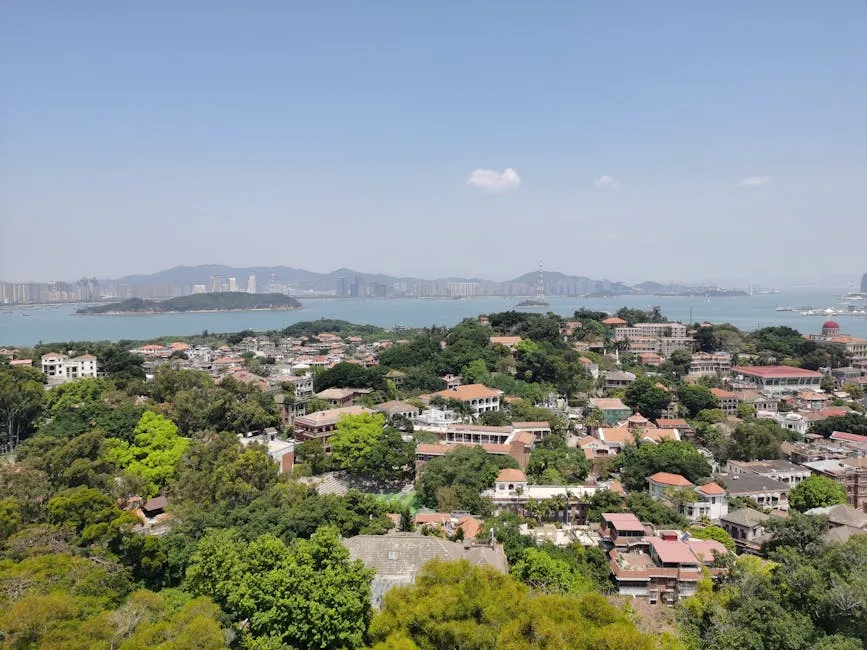
Xiamen is the city the Treaty of Nanjing built and never quite finished demolishing. The 1842 treaty opened five Chinese ports to British trade — Canton, Foochow, Ningpo, Shanghai, and Amoy (the Hokkien-pronounced name still in use for Xiamen on most pre-1949 maps). Of those five, Shanghai industrialised on a different scale, Canton became Guangzhou and absorbed its concessions back into the Pearl River metropolis, Fuzhou and Ningbo got on with provincial-capital business. Xiamen kept its concession layer almost intact, on a small island called Gulangyu, half a kilometre off the main island’s western shore. You can still walk the streets of the international settlement on Gulangyu and read the dates above the doors: 1907, 1912, 1924, 1937. The island has had no cars since the foreign families left.
That is the first thing to understand about Xiamen. The second is that it sits ten kilometres from Kinmen, and Kinmen is in Taiwan. The Second Taiwan Strait Crisis was fought across this water in 1958; from Xiamen’s eastern beaches you can see Kinmen’s hills on a clear day, and the ferry between the two has run since 2001 under the “Mini Three Links” agreement. In January 2026 the route marked its 25th anniversary with cumulative ridership above 24 million passenger trips since opening. The political reality is unresolved; the ferry is not. Both are part of the place.
The third thing is that Xiamen is small. Five million people, an island core of about 158 km² before you cross any of the bridges to Haicang or Jimei. By Chinese standards this is a town. The city designated it a Special Economic Zone in 1980, alongside Shenzhen and Zhuhai, but Xiamen did not become Shenzhen — its growth was slower, its skyline lower, the foreign-concession quarter stayed standing. The most-visited single attraction on Gulangyu is a piano museum. That is also part of the place.
What this guide does: organises Xiamen by its honest fault lines. Gulangyu and the concession layer; the Hokkien diaspora and the Min cooking that came back transformed from Singapore and Penang and Taipei; the working modern city across the Yundang Lake bridge in Siming and Huli; the across-the-water reality of Kinmen as both day-trip and recent history. The university (Xiamen University, 1921, founded by Tan Kah Kee, the Singapore Hokkien rubber-and-pineapple magnate who poured his fortune back into Fujian) is a separate chapter, currently behind a passport-checked reservation system. The new airport at Xiang’an, opening late 2026, is the closing one — Gaoqi will be retired into the city it served for thirty-five years.
If you have three days, this guide is calibrated for three days. If you have one, the Best Day Under ¥250 itinerary will get you the concession-era streets of Gulangyu, an oyster pancake at Bashi market, and Xiamen University’s seawall in the late afternoon. Skip the Window of the World and the Putian-style “world architecture” parks. The city has the actual nineteenth-century buildings; you do not need the reproductions.
Getting There — XMN Gaoqi, the High-Speed Rail, the Ferry from Kinmen
XMN Gaoqi International Airport — and the Xiang’an handover
Xiamen Gaoqi International (XMN, 厦门高崎) sits on the north shore of Xiamen Island, fifteen minutes by metro Line 1 from the city centre. It is the city’s only operating civil airport as of May 2026. Two terminals (T3 for international and most domestic; T4 for short-haul and Xiamen Airlines hub traffic — confirm your terminal at booking).
The replacement, Xiamen Xiang’an International Airport (also IATA XMN, 翔安), is under construction in Xiang’an district on the mainland-side east, with basic construction completed by end of 2025 and opening scheduled for late 2026. Phase I delivers two runways and Terminal 1 (660,000 m², built in the Minnan “dacuo” 大厝 vernacular architecture style — pitched tile roofs, swallowtail eaves), rated for 45 million passengers a year. Full build-out targets 85 million across four runways and three terminals. Once Xiang’an opens, Gaoqi will cease all civil flights. The two airports share the XMN IATA code — your booking will not change, but your physical airport will, and the airport is roughly 25 km further from downtown.
Metro Line 4 — 44.8 km, 12 stations, “tangential express” geometry with 120 km/h running speed — is built specifically to connect Xiang’an Airport to Xiamen North high-speed rail station. As of November 2025, civil engineering was over 90% complete with trial runs scheduled for early 2026, and the line is expected to open synchronously with the airport in late 2026. Until Line 4 opens, ground transfer from the new airport will be airport bus or taxi (¥80–120 metered band, expected).
From XMN Gaoqi into the city today
- Metro Line 1 runs from Gaoqi (T3 station underneath the terminal) to Xiamen Island’s central spine — 6 yuan (~€0.75) to Zhongshan Park, the Bashi/Babaocao neighbourhood, or Mingfa Square.
- Airport taxi — metered, ¥40–60 to Zhongshan Road / Siming district. Insist on the meter (“打表 / dǎ biǎo”). Didi (the Chinese ride-hailing app, foreign-card linkable since 2024) is more transparent for first-time visitors.
- Airport bus — multiple routes to Xiamen North rail station, Jimei, and Haicang; standard ¥6–15 city-bus fare bands apply, varying by route.
Trains — Xiamen on the southeast HSR spine
Xiamen has two high-speed rail stations of consequence:
- Xiamen Station (厦门站, central Siming district) — older terminus, served by conventional rail and slower HSR, walking distance from Zhongshan Road.
- Xiamen North Station (厦门北站, in Jimei district on the mainland) — the main G-class high-speed terminus, served by the Fuzhou–Xiamen, Longyan–Xiamen, and the trunk Beijing–Fuzhou lines. Metro Line 1 connects North Station to Xiamen Island in roughly 40 minutes.
Headline timings (G-class trains, May 2026 — verify on 12306 or Trip.com at booking; fares move within seasonal bands):
– Xiamen North → Fuzhou — 1 h 10 min, ¥75.
– Xiamen North → Shanghai Hongqiao — 5 h 30 min, ¥600–810.
– Xiamen North → Beijing South — 8 h 30 min, ¥730–1,300 (overnight sleeper options also available on conventional rail).
– Xiamen North → Guangzhou South — 4 h, ¥260–410.
– Xiamen North → Shenzhen North — 3 h 15 min, ¥240–380.
– Xiamen North → Longyan (for the Yongding Tulou) — 45 min, ¥40.
– Xiamen North → Quanzhou — 25 min, ¥30.
Book through Trip.com, 12306 (the official China Rail app), or Alipay’s rail-ticket mini-program. Passport entry into 12306 is supported but historically fiddly — bring patience the first time or use Trip.com’s English interface and pay the modest mark-up.
Ferry to Kinmen — the Mini Three Links
The Xiamen–Kinmen ferry runs from Wutong Passenger Terminal (五通客运码头, on Xiamen Island’s eastern shore, ~25 minutes by taxi from Siming district) to Kinmen’s passenger terminal (Taiwan administered) — the new Kinmen Port Passenger Terminal entered trial operation in February 2026, replacing the old Shuitou Pier. Crossing time is approximately 30 minutes. Up to 36 daily sailings across ten operators; departures from Wutong run between 08:00 and 18:30. The 25th anniversary of the route was marked in January 2026, with cumulative ridership above 24 million.
Practical points before booking: this is a Taiwan border crossing, not a domestic ferry. You will need:
– a valid Taiwan-side entry document (Australian, NZ, UK, EU, US passports get visa-free 90 days into Taiwan; mainland Chinese passports require a separate Taiwan Strait permit);
– proof of onward travel from Taiwan or a return ferry ticket;
– your China entry (whether unilateral 30-day or 240-hour transit) preserved — leaving for Kinmen counts as exit, so you will need to re-enter China on arrival back at Wutong if your itinerary continues mainland-side.
Exiting to Kinmen counts as departure from China; re-entry on the same 240-hour transit clock has historically been allowed but the procedure has been re-stated multiple times — verify with the Chinese National Immigration Administration before booking if your itinerary requires it.
Tickets: ¥160 one-way Xiamen → Kinmen via the official “Min-Tai-Tong” / Xiamen Ferry+ mini-programs (~€20). Round-trip is cheaper if booked together.
Top 12 Attractions in Xiamen
1. Gulangyu Island (鼓浪屿) — the Concession Quarter
The UNESCO-listed island half a kilometre off Xiamen’s western shore, inscribed on 8 July 2017 under the title “Kulangsu, a Historic International Settlement” (criteria ii and iv). What’s actually here: a roughly 2 km² island, completely car-free, with the surviving fabric of the foreign concession period that ran from May 1902 (when the Qing government approved the Land Regulations for the international settlement) through Japanese occupation in 1942 and the post-war settlement of foreign claims. Buildings carry dates from the 1860s to the 1930s. The Bagua Mansion itself (built 1907, now the Organ Museum) was designed by John Abraham Otte (1861–1910), the Dutch-American missionary surgeon who founded Hope Hospital on Gulangyu in April 1898 and served as its director until his death from pneumonic plague in 1910.
The island is now classified as a 5A national tourist attraction with reported visitor numbers above 10 million a year. There is a daily visitor cap and a mandatory online booking for ferry passage; tickets must be reserved via the Xiamen Ferry+ WeChat mini-program or website, ideally a day ahead in shoulder season and at least three days ahead in July–October peak. Walk-up tickets are sometimes available at off-peak hours but not reliably.
- Ferry terminals:
- Dongdu (东渡) terminal — the daytime tourist terminal (06:00–18:00 roughly), 20-minute crossing to Sanqiutian (三丘田) on Gulangyu’s east side.
- Lundu (轮渡) terminal at Zhongshan Road — evening departures (after 18:00) to Sanqiutian, shorter crossing (5–7 minutes) but operating reduced hours.
- Tickets: ¥35 standard / ¥80 air-conditioned deluxe, round-trip, valid 20 days for the return leg.
- Attractions inside the entrance fee: the streets are free. Specific museums and gardens are ticketed individually.
What to actually do on Gulangyu:
– Shuzhuang Garden (菽庄花园) — a 1913 private garden on the southern shore, built by Lin Erjia, a Taiwanese-Hokkien merchant who returned from Taipei after the 1895 Japanese cession. The Piano Museum inside the garden holds a collection of around 100 historic pianos collected from Australia, Europe, and the US. Combined ticket ¥40.
– Sunlight Rock (日光岩) — at 92.7 m, the highest point on the island. Climbable in 15 minutes from the base. ¥50, year-round.
– The Catholic Church (天主堂) on Lujiao Road and the Protestant Church (三一堂) — both still active congregations; visit outside service hours.
– The Organ Museum at Bagua Mansion — by published claim the largest organ collection in China; the building is the Eight Diagrams Tower designed by Otte in 1907.
Editor’s tip. Stay overnight if you can — the day-tripper density drops sharply after 18:00 and the island becomes the small foreign-quarter town it actually is. There are small guesthouses inside heritage buildings on Fujian Road and Quanzhou Road; book six weeks ahead in summer.
Pro Tip. Skip the “Bandstand Coffee” and “Pretty Street” Instagram-bait clusters on Long Tou Road. Walk the southern half of the island (Sanming Road, Bishan Road, Fuxing Road) instead — that’s where the actual concession architecture survives without the merchandise overlay.
2. Xiamen University Lujiang Campus (厦门大学)
Founded 4 April 1921 by Tan Kah Kee (陈嘉庚, 1874–1961), the Singapore-Fujianese rubber and pineapple magnate who returned his fortune to Fujian education. The campus sits between Nanputuo Temple and the southern beach, and the Furong Lake (芙蓉湖) and Jiannan Auditorium (建南大礼堂) building cluster appears on most “most beautiful Chinese campus” lists. The architecture is a deliberate Tan Kah Kee hybrid — Western masonry shell, Minnan swallowtail roof, locally called “嘉庚风格” (Jia-geng style).
Access (as of May 2026, after multiple policy changes through 2023–2025): foreign visitors must book a free entrance ticket through the official WeChat mini-program 厦门大学访客预约系统 (Xiamen University Visitors Booking System) between 1–3 days in advance. On arrival you present passport at the gate visitor centre to convert the booking into entry. Daily caps apply; weekend slots typically fill within hours of release.
Open hours during the academic year are limited (typically lunch and after-class windows); the summer (mid-July to early September) and winter (mid-January to late February) holidays are the freest access periods.
Editor’s tip. Walk in through the back gate at Hulishan Battery and exit at the main gate on Daxue Road. That sequence takes you past Furong Lake, the Jiannan complex, and the Lu Xun Memorial Hall (Lu Xun taught here for four months in 1926) before depositing you on Daxue Road for the cafés.
3. Nanputuo Temple (南普陀寺)
Active Buddhist temple immediately adjacent to the university’s south gate. Founded in the Tang dynasty by the traditional account; the current physical complex dates largely from the late Qing and Republican-era rebuilding (post-1875). Free entry. The temple’s own vegetarian restaurant inside the complex serves a Buddhist kitchen at lunch and early-afternoon hours — one of the better-known Buddhist-vegetarian operations in southern China. Confirm operating hours on arrival.
Editor’s tip. Climb the steps behind the main hall to the rocks with the carved character 佛 (Buddha) — the panorama over the temple roofs to the strait is the photograph people come for. Go at 16:00, not midday.
4. Hulishan Battery (胡里山炮台)
A late-Qing coastal artillery battery on the southeast shore, completed 1894 under viceroy Li Hongzhang’s coastal-defence programme. The headline artefact is the 28-cm Krupp coastal-defence cannon (manufactured by Friedrich Krupp AG, Essen, 1893; installed 1894), the largest surviving 19th-century coastal gun by published claim. Daily Qing-uniform drill performance with simulated artillery firing at 10:00 and 16:00.
- Ticket: ¥25 peak season, ¥20 off-season.
- Hours: 07:30–18:30, slightly shorter in winter.
Pro Tip. The battery’s eastern observation deck is where Kinmen is most visible on a clear day — bring a small monocular if you have one. The wartime context is real and the museum doesn’t sentimentalise it.
5. Bashi Market (八市 / 第八市场)
The working morning market on Kaihe Road (Siming district), ten minutes’ walk from Zhongshan pedestrian street. Operating since 1942, this is where Xiamen’s restaurants buy their seafood. Open from roughly 05:00 to early afternoon; the seafood half is largely done by 11:00.
Editor’s tip. Eat breakfast here, not lunch. The pork-bone-broth peanut noodle stalls along the alley between Kaihe and Datong roads open at 06:30 and stop when they run out. ¥12–18 a bowl is typical.
Pro Tip. This is also the most honest place to try haoa jian (蚵仔煎, oyster pancake) cooked the Xiamen way — egg, sweet potato starch, fresh oysters, garlic chives, hot lard. The Bashi vendors do not garnish for tourists. Look for queues at 09:00. Skip the Tourist Street stalls on Zhongshan Road — same dish, less freshness, double the price.
6. Zhongshan Road Pedestrian Street (中山路步行街)
The historic commercial main street of Xiamen, running from Lundu ferry pier inland. Republican-era arcaded shophouse architecture (qilou 骑楼), continuous on both sides for about a kilometre. The macro-shape is intact even as the contents have rotated through to chain stores. Walk it once for the qilou, then turn off into the side alleys (Datong Road, Daxue Road’s eastern end, Siming North Road) where the older food shops still operate.
Editor’s tip. Avoid the central Zhongshan Road blocks at peak weekend afternoons — the foot density is unpleasant. Early morning (08:00) or late evening (after 21:00) is when the architecture reads.
7. Shapowei (沙坡尾) — the Old Fishing Harbour
The horseshoe inlet on the south of Xiamen Island that was the original fishing port before the city pushed industry north. Now a mixed-use creative quarter — small bars, tattoo studios, second-hand bookshops, a few seafood restaurants that pre-date the gentrification. The fishing boats are gone; the basin is now a pleasure-boat anchorage. The conversion is uneven and parts of it are obvious creative-district staging, but the old wholesale-ice warehouse along the south quay is genuinely architecturally interesting and the bars on Daxue Road’s southern end are reliable for an evening.
Editor’s tip. The cluster of small cafés and independent bookshops on Minzu Road is the part of Shapowei that justifies the visit — individual names rotate; the form is what travellers come for. Don’t bother with the Shapowei-branded merchandise outlets on the inner ring.
8. Hulishan to Zengcuo’an Beach (曾厝垵) Coastal Walk
The 4 km seawall walk from Hulishan Battery east to Zengcuo’an village, with the Strait of Kinmen on your right the whole way. The dedicated pedestrian-and-cyclist path is in good condition. Zengcuo’an itself is a former fishing village that has become Xiamen’s main backpacker-and-guesthouse cluster — small lanes of family-run inns, late-night noodle shops, and a noisy main drag of souvenir stalls.
Editor’s tip. Walk it westbound (Zengcuo’an → Hulishan) in the late afternoon so the sun is behind you and you end at the battery for the 16:00 cannon firing.
9. Wuyuanwan (五缘湾) Wetland Park
The northeast bay’s wetland park and mangroves, on the eastern flank of Xiamen Island. Wuyuanwan is the area where the city’s actual residents go for a weekend walk — egret colonies, a sailing centre, the broad lake-frontage that the rebuilt eastern neighbourhood is organised around. Metro Line 2 reaches here directly. Free entry to the public park; the sailing centre charges per session.
Editor’s tip. Combine with a metro ride two stops further to Tianzhushan, where you can hike the small forest park. This is the day-trip locals do when they want a break from the tourist density of Siming.
10. Jimei Schools Village (集美学村)
The school-and-university complex on the mainland north of Xiamen Island, founded by Tan Kah Kee between 1913 and the 1930s as part of the same education-philanthropy project that created Xiamen University. The campus is a coherent cluster of Jia-geng-style buildings — Western shell, Minnan tile-roofed top — and includes the Tan Kah Kee Memorial Hall (free) and his preserved family residence. Metro Line 1 reaches here in ~35 minutes from central Xiamen. The Aoyuan (鳌园, “Turtle Garden”) at the tip of the peninsula is Tan Kah Kee’s mausoleum, designed and built between 1950 and 1961.
Editor’s tip. Lunch at one of the seafood restaurants on Yinjiang Road where the boats still come in. Jimei is also a good place to access the Xiamen Bridge for the photograph back across to the island skyline.
11. Hokkien Cultural Park / Minnan Cultural Tourism Town (闽南文化园 / various)
Several venues across the city present Minnan (Hokkien) cultural heritage — puppet theatre (布袋戏), Nanyin music (a UNESCO Intangible Cultural Heritage tradition centred on Quanzhou but well-represented in Xiamen), the temple architecture of the diaspora-funded clan halls. The Xiamen Cultural Centre and a handful of garden venues programme Nanyin and puppet-theatre evenings on rotating schedules; check current listings via Trip.com or the Xiamen Cultural Affairs Bureau site at booking.
Pro Tip. Skip the over-staged Minnan “cultural park” theme attractions in the outer districts. The Nanyin tradition is a real and difficult musical form — the actual practitioners perform in tea houses and the Cultural Centre, not at tour-bus parks.
12. Tianzhushan Forest Park (天竺山森林公园)
The wooded inland park west of Xiamen Island in Haicang district, accessible from Metro Line 2. About 50 km² of subtropical forest with a series of marked hiking loops (3 km easy, 8 km moderate, 15 km full traverse to the summit at 933 m). The 8 km loop is a half-day, summit-and-back is a full day. Modest entry fee — verify on-site.
Editor’s tip. Do this on a hot week as the substitute for the beach — the forest is reliably 5–7 °C cooler than the city core and the upper ridges catch the strait breeze.
Xiamen’s Districts
Siming (思明) — the historic core
The southwestern half of Xiamen Island. Zhongshan Road, Bashi market, Shapowei, Xiamen University, Nanputuo Temple, the Lundu ferry to Gulangyu, the cluster of mid-range and boutique hotels around Hubin North Road. If you have three days in the city you will spend two of them inside Siming. The neighbourhood code: low-rise pre-1949 architecture, the food, the tourist traffic.
Huli (湖里) — the old SEZ ring
The northern half of Xiamen Island. Gaoqi Airport sits here. Huli was the first 2.5 km² of the original 1980 Special Economic Zone — the export processing zone whose 1981 demolition of village land for factories is the founding industrial moment of Xiamen’s modernisation. Most of that first-wave factory complex has since been redeveloped; what remains is the working-city counterweight to Siming’s heritage zone. The Xiamen Science and Technology Museum is here.
Haicang (海沧) — the petrochemical and port mainland
Across the Haicang Bridge from Xiamen Island. Industrial, with the deep-water port that handles much of the actual container traffic. Visitors come here for Tianzhushan Forest Park and the Haicang ferry terminal (alternative Gulangyu access in peak season).
Jimei (集美) — Tan Kah Kee’s town
The mainland district directly north of Xiamen Island, connected by the Xiamen Bridge and Metro Line 1. The Jimei Schools Village, Tan Kah Kee Memorial Hall, and Aoyuan cluster make this Xiamen’s secondary cultural centre. Xiamen North high-speed rail station is in Jimei.
Xiang’an (翔安) — the new airport, the new growth
The easternmost mainland district. Until 2026 mostly farmland-becoming-suburb; from late 2026 onward, the location of the new Xiang’an International Airport and the eastern terminus of Metro Line 4. The Wutong ferry terminal for Kinmen is at the eastern edge of Xiamen Island, with road and metro access through Xiang’an’s western fringe.
Tong’an (同安) — the deep mainland
The historically rural northeastern district. Old town walls in Tong’an Old City; the Liyuan Stone Forest scenic area; the Beishan Reservoir. Day-trip territory for visitors with a fourth or fifth day in the region.
Gulangyu (鼓浪屿) — the island
Technically administered as part of Siming district. A neighbourhood unto itself, no cars, no e-bikes, no metro. Treated as a separate destination in this guide because it functionally is.
Where to Stay — by Budget
Xiamen’s hotel stock is concentrated in Siming district (heritage core), with a secondary luxury cluster on the eastern shore (Wuyuanwan / SM Plaza area) where the city built its new business district. Gulangyu has small heritage guesthouses but no large hotels — by zoning policy.
Hostels and budget (under ¥250 / night)
- Zengcuo’an village — backpacker dorm cluster on the south of Xiamen Island, ¥80–120 / dorm bed, ¥200–260 / private double. Names rotate; compare on Hostelworld and Booking.com at booking time.
- The Zhongshan Road / Lundu cluster has a dozen Chinese-domestic budget chains (Hanting, 7 Days Inn, JinJiang Inn) at ¥180–260 / private room. Passport-acceptance has improved markedly since 2024 but verify by phone before booking — some smaller chains still refuse foreign passports without notice.
- Hostels: foreigner-friendly options exist on Gulangyu and around Shapowei harbour; compare on Hostelworld at booking.
Mid-range (¥400–900 / night)
- Lujiang Harbourview Hotel (鹭江宾馆) — 1950s-era waterfront hotel on the Lundu pier, opposite Gulangyu. Period architecture, the views across to the island are the reason to book it. ¥600–900 / night.
- The Wuyuanwan business-hotel cluster — large-format four-star business hotels near the wetland park, ¥550–800. Compare on Trip.com / Booking.com — branding and operators rotate.
- Heritage-conversion boutiques on Gulangyu — courtyard doubles ¥450–800, two-night minimum in peak. The colonial-era mansions on Fujian Road and Quanzhou Road house most of these operations; names and operators rotate, so compare on Trip.com or Booking.com at booking.
Premium (¥1,200+ / night)
- Shangri-La Xiamen — currently operating; the city’s longest-running international five-star anchor. North-Island location, Yundang Lake.
- Conrad Xiamen — Hilton-portfolio five-star in the Wuyuanwan business cluster.
- International five-star brands additionally operate in Siming and at Wuyuanwan; Marriott and IHG both list Xiamen properties — compare on Bonvoy / IHG / Booking.com at booking.
Note on absent brands. As of May 2026, Xiamen does not have a Mandarin Oriental, Four Seasons, or Aman property. Multiple openings have been in announced-pipeline status for 2026–2027; re-verify at booking.
Where (and what) NOT to book
- The chain budget hotels on Wenzao Road and the western Zhongshan extension look cheap but the foot traffic at 23:00 is loud. Book one street back (Datong Road, Siming South Road) instead.
- “Gulangyu Beach Hotels” listed on aggregator sites are not actually on Gulangyu — they’re in the Dongdu industrial waterfront area with a “view of” the island. Verify the address against a map before booking.
Where to Eat — Hokkien Cooking, Xiamen Style
Xiamen sits inside Minnan cooking — the food of southern Fujian, the cuisine that Hokkien emigration carried to Taiwan, Singapore, Penang, Manila, and Bangkok and that came back transformed. Xiamen’s modern food layer is what happens when those returned regional variants meet the original.
Three categories to navigate:
- Old Xiamen dishes still made the way Bashi-market vendors learned them — oyster pancake (蚵仔煎 haoa jian), shacha noodles (沙茶面 sha-cha mian), pork-bone peanut soup (花生汤), satay rice (沙茶饭), sweet potato porridge (番薯粥), spring rolls (薄饼 bobing).
- Returned-diaspora dishes — laksa, Penang assam laksa, Bak Kut Teh (especially the white-pepper Singaporean style), Hainanese chicken rice as Hokkien refilters. Found in the small Nanyang-cuisine restaurants in Siming.
- Modern Fujian / Chaoshan fine dining — including the city’s three Michelin one-star restaurants (see below).
Old Xiamen — the working kitchens
- Bashi Market vendors (see attraction #5) — oyster pancake, peanut soup, pork-bone broth peanut noodle, ¥12–25 a dish.
- Shacha noodle shops on Datong Road — long-running specialists, ¥18–30 a bowl. Look for queues at lunch.
- Spring-roll (bobing) specialists on Siming North Road — ¥10–20 a roll, sold from corner stalls and small shops.
- Late-afternoon oyster-pancake stalls near Lundu pier open around 17:00 and run into the evening; the form rather than any single brand is what travellers come for.
Returned-diaspora kitchens
- Singapore-style Bak Kut Teh — the white-pepper Singaporean variant is served at small Nanyang-cuisine restaurants concentrated around Hubin Road.
- Penang laksa kitchens — small returned-diaspora restaurants cluster around Zhongshan Park and the eastern end of Siming North Road.
Michelin one-star (2026 Fujian Guide, second edition, unveiled 21 November 2025)
The Fujian Michelin Guide debuted in 2025 (covering Fuzhou, Xiamen, Quanzhou) and the 2026 second edition added Ningde and Quanzhou’s first one-star. Xiamen’s three one-stars all retained their distinction.
- Fleurs Et Festin (16 Liaohua Road, Siming district) — Chaoshan (Teochew) cuisine in a three-storey historic building. The Chaoshan tradition is from the next coastal cluster south (Shantou / Chaozhou in Guangdong); having it at Michelin level inside Fujian is a Xiamen-specific phenomenon.
- Hokklo (Siming district) — modern Minnan Fujian. The head chef is Minnan-region trained.
- Yanyu (Jiahe Road) (烟雨 / Jiahe Road) — modern Fujian. Chef Wu Rong received the inaugural Michelin Mentor Chef Award in the 2026 Fujian Guide. The kitchen treats Fujian’s local seafood and stock-base culture as the centre of the cooking, not the decoration.
Reservation lead time on all three is typically 2–4 weeks in peak season; Yanyu (Jiahe Road) is the hardest to get into.
Bib Gourmand (Xiamen, 2026 Fujian Guide)
The 2026 guide lists 31 Xiamen restaurants in the Bib Gourmand category (excellent value, capped roughly at ¥250 / head). The full list rotates and is published on the Michelin Guide Fujian Province site — pull the current names at booking.
Recurring Xiamen Bib categories: shacha noodles, Hokkien seafood, hot-pot, regional Cantonese, and the new wave of modern-Minnan small kitchens.
Vegetarian and Buddhist cuisine
- The vegetarian restaurant inside Nanputuo Temple — the temple’s own Buddhist kitchen, one of the better-known operations of its type in southern China. Lunch is the reliable seating; confirm operating hours and reservation procedure on arrival.
Coffee, dessert, and a tea note
Xiamen has a small but real specialty coffee scene concentrated around Shapowei, Daxue Road’s southern end, and Wenzao Road. Standard for a Chinese coastal city of this size — ¥35–55 for a flat white. Café names rotate; the cluster geography is what holds.
Tea is the older and more interesting story. Anxi county in Fujian’s interior is the home of Tieguanyin (铁观音), the iron-goddess oolong; the Wuyi Mountains further north produce rock oolong (岩茶, “yancha”) including Da Hong Pao and Shui Xian. Both traditions are easily encountered in Xiamen — every old-style restaurant serves them, and dedicated tea-tasting rooms exist in the side streets off Zhongshan Road and on Gulangyu.
Drinking — Tea Houses, the Shapowei Bars, the Hotel Cocktail Bars
Three drinking layers.
- Tea houses (茶馆 chaguan). The functional version of “going out for a drink” for the older half of Xiamen’s population. Concentrate in the side lanes off Zhongshan Road, on Gulangyu, and along the southern Daxue Road extension. A two-hour tea session for two (Tieguanyin, Wuyi rock oolong, snacks) runs ¥80–200. The unwritten rule is that the proprietor pours the first three rounds for you; after that you handle the kettle.
- Shapowei bars + Sailor’s Bar district. The actual independent-bar scene of the city. Daxue Road’s southernmost block, the lanes immediately around Shapowei harbour. Beers ¥30–60, cocktails ¥60–95. The bar density is highest from Friday 22:00 to Sunday 03:00.
- Hotel cocktail bars. The Shangri-La and Conrad anchor the international-five-star rooftop and skyline bar tier, with several other branded hotels in the same band — ¥90–160 a cocktail.
Craft beer specifically: Xiamen has a small local-brewery cluster (some Sailor’s Bar district stalwarts brew or partner with local breweries). The scene does not approach Shanghai or Beijing depth. If you specifically want craft, plan one night around it; do not plan five.
Getting Around the City
Metro. Xiamen Metro has five lines either operational or in final commissioning in 2026: Lines 1, 2, 3, 4 (under final commissioning, connects to Xiang’an Airport — synchronous opening expected in late 2026), and Line 6. ¥2 minimum / ¥10 maximum cross-city. Card payment via Alipay (linked to a foreign card since 2024) is the easiest method; QR-code single tickets at machines also work. Operating hours 06:30–23:30 typically.
- Line 1 — the spine. Gaoqi Airport (current) → Siming → Xiamen Bridge → Jimei → Xiamen North Rail. 24 stations, 30.3 km, opened 31 December 2017.
- Line 2 — Wuyuanwan to Tianzhushan via Haicang Bridge.
- Line 3 — North-south on the mainland east, linking to Xiamen North.
- Line 4 — the tangential express from Xiamen North to Xiang’an Airport, 120 km/h running, designed for airport-to-rail-station express travel. Trial runs began early 2026; opens synchronously with the airport in late 2026.
- Line 6 — operational; outer-ring intermediate density.
BRT (Bus Rapid Transit). An elevated bus network completed 2008, the first BRT in China at this scale. Runs along the eastern and northern spines of Xiamen Island. ¥1 starting fare. Functional but the metro now duplicates most of its routes.
Buses. Dense network, ¥1–2. Operate roughly 05:30–22:30.
Taxis and Didi. Taxis are metered: ¥10 first 3 km, then ¥2/km. Tipping is not expected. Didi (滴滴) is the dominant ride-hailing app and supports foreign-card linkage via Alipay; you will see fewer English-speaking drivers than in Shanghai/Beijing, but the app handles destination input and pickup.
Bicycles and e-bikes. Mobike, Hellobike, and Meituan shared bicycles are everywhere. ¥1.5 / 30 min. Helmet not enforced.
Walking and the Around-the-Island promenade. Xiamen Island has a dedicated coastal pedestrian-and-cyclist loop of approximately 30 km. Worth knowing about even if you only walk 5 km of it — the southern Hulishan-to-Zengcuo’an stretch (see attraction #8) is the most-cited segment.
When to Visit
Xiamen has three useful seasons and one to avoid.
- October–early December — best weather of the year. 16–25 °C, dry, no typhoons. The October National Holiday week (1–7 October) is the only domestic-traveller peak inside this window; otherwise this is the planning bullseye.
- Late February–April — the second-best window. 14–24 °C, with rising humidity but still well short of summer. April school holidays push some volume but not overwhelming.
- Mid-May–June — warm, increasingly humid, the start of plum-rain (黄梅) drizzle that lasts a few weeks. Acceptable shoulder season; book hotels easily.
- July–September — typhoon season. This is the period to plan around. Temperatures 28–34 °C, humidity 85%+, four to five named typhoons hit the Fujian coast in an average year, August is the most-affected month. Flights are routinely diverted or cancelled; ferries to Gulangyu suspend on typhoon-warning days; the Kinmen ferry suspends for tropical-cyclone watches. Domestic Chinese summer-school-holiday traffic also hits in this window, so prices peak as service reliability bottoms.
- January–early February — cool, sometimes raw, possible cold-front rain. The least crowded season but with the most variable weather. 9–16 °C typical, occasional cold-snap to 5 °C. Chinese Spring Festival (CNY) week is a domestic-travel peak and should be either planned around (book six months ahead) or avoided.
Month-by-Month Weather
| Month | High °C | Low °C | Rain mm | Typhoon risk | Notes |
|---|---|---|---|---|---|
| Jan | 16 | 10 | 35 | Nil | Cool, occasional damp; Spring Festival peak some years |
| Feb | 17 | 10 | 80 | Nil | Spring Festival often falls here |
| Mar | 20 | 13 | 110 | Nil | Plum-rain starts late month |
| Apr | 23 | 17 | 140 | Nil | Shoulder peak begins |
| May | 27 | 21 | 175 | Low | Plum-rain peaks |
| Jun | 30 | 24 | 200 | Moderate | Humidity climbs into the 80s % |
| Jul | 32 | 26 | 165 | High | Typhoon window opens |
| Aug | 32 | 26 | 200 | Very high | Peak typhoon month, 38 °C extreme recorded |
| Sep | 31 | 25 | 145 | High | Typhoons taper through the month |
| Oct | 27 | 21 | 60 | Low | The planning bullseye |
| Nov | 23 | 17 | 35 | Nil | Continuation of best season |
| Dec | 18 | 13 | 30 | Nil | Cool, dry, low traffic |
Rainfall figures rounded from climatological summaries; check China Meteorological Administration data for current-month detail.
Daily Budget Breakdown
| Tier | Sleep | Eat | Move | Sights | Total |
|---|---|---|---|---|---|
| Backpacker | ¥80–150 (hostel dorm) | ¥60–100 (street food, market breakfast, noodle lunch, hotpot dinner shared) | ¥10–20 (metro and bus all day) | ¥60–100 (Gulangyu ferry + one museum) | ¥220–370 (~€28–47) |
| Mid-range | ¥350–650 (4-star Siming district) | ¥150–300 (mix of one sit-down and street food) | ¥30–60 (metro + occasional taxi) | ¥100–180 (two attractions) | ¥600–1,200 (~€76–152) |
| Upper-mid | ¥900–1,400 (5-star, off-peak) | ¥400–700 (one Michelin Bib + casual) | ¥80–150 (Didi most rides) | ¥150–250 | ¥1,500–2,500 (~€190–316) |
| High-end | ¥1,800+ (Shangri-La, Conrad) | ¥1,000+ (one Michelin one-star) | ¥200+ | ¥250+ | ¥3,200+ (~€405+) |
Currency conversion at €1 ≈ ¥7.90 (late May 2026, ECB).
Sample Itineraries
One Day in Xiamen (the Concession + the Campus)
- 07:00 — Breakfast at Bashi market (peanut soup + oyster pancake), ¥30.
- 08:30 — Walk Zhongshan Road early (before the foot traffic), exit south onto Lundu pier.
- 09:30 — First ferry of the day to Gulangyu (pre-booked the night before). Spend three hours: Shuzhuang Garden + Piano Museum, Sunlight Rock, the southern Sanming Road / Bishan Road heritage walk, the Catholic and Protestant churches.
- 13:00 — Ferry back. Lunch at a Hokkien noodle shop on Datong Road.
- 15:00 — Metro Line 1 + connecting walk to Xiamen University (booked the day before). Furong Lake → Jiannan complex → Lu Xun Memorial → out the south gate.
- 16:30 — Through Nanputuo Temple. Tea on the temple plateau.
- 17:30 — Walk east to Hulishan Battery. Catch the 16:00 cannon firing if your timing has slipped earlier; otherwise dusk over the Kinmen strait.
- 19:30 — Dinner at Hokklo (Michelin one-star) or a small returned-diaspora Bak Kut Teh kitchen on Hubin Road. ¥150–280.
Two Days in Xiamen (add the working city)
Day 1: as above.
Day 2 — the wider city:
– Morning: Metro Line 1 to Jimei. Tan Kah Kee Memorial Hall, the Jia-geng-style campus walk, Aoyuan at the peninsula tip. Lunch in Jimei.
– Afternoon: Metro Line 2 to Wuyuanwan. Walk the wetland park, then up to Tianzhushan Forest Park (the easy 3 km loop, not the summit) — escape the city density.
– Evening: Shapowei bars + the Daxue Road southern strip for dinner and drinks. Sleep in central Siming.
Three Days in Xiamen (add the layers — and Quanzhou or Kinmen)
Day 3 option A — Quanzhou as day trip. 25 minutes on the high-speed train. Quanzhou was the eastern terminus of the maritime Silk Road from the Song through early Ming dynasties; UNESCO inscribed 22 of its sites in 2021 under the title “Quanzhou: Emporium of the World in Song-Yuan China.” The Kaiyuan Temple complex, the Twin Pagodas, and the She’ren Yi’an mosque sequence inside Quanzhou’s old town are a coherent half-day. Lunch and back to Xiamen by 18:00.
Day 3 option B — Kinmen via the Mini Three Links ferry. Crosses into Taiwan territory. Wutong → Shuitou (30 min). Kinmen’s interest is military-history-meets-Hokkien-village: the Granite Hospital tunnels, the August 23 War Memorial (1958), the Maestro Wu cleaver workshop (where artisans turn shells from the 1950s shelling into kitchen knives — see attraction layer of Day Trips below). Last ferry back ~18:00. Requires Taiwan-side entry permission appropriate to your passport; budget for the visa-status complexity if you’re not from a Taiwan-visa-free passport country.
Day 3 option C — Yongding Tulou. Earth-castle Hakka roundhouses, 45 minutes by HSR to Longyan, then 1 hour by road to the Hongkeng cluster. Best done as a guided day-trip (cars and English-language drivers are easily booked through Trip.com or local agencies for ~¥600–900 per car).
Best Day Under ¥260 — Concession-Era Xiamen + the Campus Strait
Target: a full day in Xiamen for ¥260 (~€33) per person, all-in.
| Item | ¥ | Notes |
|---|---|---|
| Hostel breakfast | 0 | If your room includes breakfast |
| Bashi market — oyster pancake + peanut soup | 25 | Skip if breakfast was at hostel; replace with 11:00 noodle lunch later |
| Metro to Lundu | 2 | Line 1, one station |
| Gulangyu round-trip ferry (standard) | 35 | Pre-booked via Xiamen Ferry+ |
| Shuzhuang Garden + Piano Museum | 40 | Combined ticket |
| Sunlight Rock | 50 | Year-round fare |
| Lunch on Gulangyu — small noodle/dumpling shop | 35 | The streetside vendors south of Longtou Road |
| Metro back + walk to Xiamen University | 4 | Free if booked entry ticket secured |
| Nanputuo Temple | 0 | Free |
| Hulishan Battery | 25 | Peak-season fare; ¥20 off-season |
| Dinner — shacha noodles + local beer | 35 | Datong Road shacha-noodle shops |
| Bus back to lodging | 2 | Or walk |
Total: ¥253 (~€32).
The under-¥260 day stretches further if you skip Sunlight Rock (the view from Shuzhuang’s higher terrace is comparable, free with the garden ticket) or substitute Xiamen University’s free morning walk for one of the paid sights. Drinks on Daxue Road after dinner add ¥30–60 per round.
For context against the AiFly Best-Day leaderboard: this places Xiamen between Munich (€12) and Nicosia (€32.60) — closer to Sicily/Corsica (€35–40) than to KL (€8.50) or Bogotá (€6), but cheaper than Western European capitals at the same heritage density.
Hot Day, Typhoon Day, Off-Season Plans
Hot day plan (July–September, 32+ °C, humidity 85%+)
- 07:00–10:30: outdoor — early Gulangyu, the Around-the-Island promenade, or Hulishan + Zengcuo’an beach.
- 11:00–16:30: indoor / shaded — Overseas Chinese Museum, the Piano and Organ museums on Gulangyu, Nanputuo Temple’s covered cloisters, mall lunch at SM Plaza or Magnetic Hai Wan Cheng with strong AC.
- 17:00–20:30: back outdoors — Shapowei in the cool-down hour, sunset at Hulishan or the Wuyuanwan boardwalk.
- 21:00 onward: Daxue Road / Shapowei bars stay open late, the heat eases to 28 °C with breeze.
Typhoon day plan (warning posted)
- Stay on Xiamen Island, off Gulangyu (ferries suspended) and off Kinmen (route suspended).
- Indoor stack: Museum + tea house + cinema + market lunch + hotpot dinner. The Magnetic Hai Wan Cheng mall, SM Plaza, and the Pinghu shopping cluster all have foreign-card-friendly food courts.
- Confirm flight status the night before and re-confirm at 06:00 — Xiamen Airlines and China Eastern publish typhoon-day adjustments on Weibo and on their official sites by 08:00.
Off-season plan (January, February, early March)
- Cool but stable weather; the city is at its quietest. The heritage walking — Gulangyu, Zhongshan, Xiamen University — is at its best with one-third the foot traffic of October.
- The drawback is rainy days. Build in indoor backup: the Overseas Chinese Museum, the Xiamen Botanical Garden’s tropical houses (heated), and the tea-house network across Siming.
Day Trips
Yongding / Nanjing Tulou (UNESCO 2008)
Earth-castle multi-storey communal Hakka roundhouses and rectangles, primarily in Yongding County (southwestern Fujian, the older and more dramatic concentration) and Nanjing County (southeastern Fujian, the more compact and accessible Tianluokeng cluster). Inscribed by UNESCO in 2008 as “Fujian Tulou.”
- Distance from Xiamen: 2 hours by car to Tianluokeng (Nanjing County); 3 hours by car or 45 min HSR + 1 h road to the Yongding Hongkeng cluster.
- Notable structures:
- Chengqi Lou (承启楼, Yongding County) — built 1709 in the Gaobei cluster. Four concentric rings around a central ancestral hall; outer ring is four storeys with 288 rooms, then 80 + 32 in the inner rings (≈400 total by some counts, 370 by the official sign). Nicknamed “the king of tulou” (土楼之王) — the largest by room count, though Shunyu Lou in Nanjing County is wider at 74.1 m diameter (Chengqi is ~62 m). The king-of-tulou title attaches to room count, not diameter.
- Zhencheng Lou (振成楼, Yongding County) — built 1912 in the Hongkeng cluster by descendants of a Hakka tobacco-cigarette-cutter merchant family. Double-ring tulou: outer ring four storeys, 184 rooms partitioned into four bagua-aligned segments; inner ring two storeys, 32 rooms; Greek-style columns and wrought-iron balustrades show period Western influence. Nicknamed “the prince of tulou” (土楼之子) in deliberate contrast to Chengqi’s “king.”
- Tianluokeng cluster (田螺坑, Nanjing County) — five tulou arranged in the “four dishes and a soup” plan, the most-photographed tulou aerial.
- Tickets: ¥70–90 per cluster combo (Hongkeng ¥90, Tianluokeng ¥90, Chuxi ¥70 — each includes several buildings within the cluster).
- How to do it: book a car + driver day-trip via Trip.com or a local agency (~¥600–900 per car, 5–6 hours total round-trip including the cluster visit). The DIY option (HSR Xiamen North → Longyan → public bus) saves money but burns the entire day on transit logistics.
Quanzhou (UNESCO 2021)
The northern coastal city, 25 minutes by HSR from Xiamen North. The eastern terminus of the maritime Silk Road in the Song and Yuan dynasties, when it was probably the largest port in the world. UNESCO inscribed 22 of its sites in July 2021 under the title “Quanzhou: Emporium of the World in Song-Yuan China.” The Kaiyuan Temple complex (Twin Pagodas, 13th century), the She’ren Yi’an mosque, the Confucius Temple, the maritime museum, and the old-town arcaded street are an honest one-day visit.
- Best done as: half-day to full-day round-trip.
- HSR cost: ¥30–50 each way.
Kinmen via the Mini Three Links ferry
See “Getting There” above for the ferry mechanics. Once on Kinmen:
– Maestro Wu kitchen-knife workshop (金合利, Jin He Li) — fourth-generation knife-maker whose forge has been turning shells fired during the 1958–1979 cross-strait bombardments into kitchen cleavers and chef knives. A working artisan operation, not a museum performance. Confirm current shop address and operating hours via the Kinmen tourism portal at booking.
– August 23rd Artillery War Museum (823砲战胜利纪念馆) — commemorates the August–October 1958 artillery duel that the Republic of China names the “Eight-Two-Three” campaign and the PRC remembers as part of the Second Taiwan Strait Crisis. The museum is on the western side of Kinmen.
– Granite Hospital and tunnel systems — Cold War military infrastructure, now open as visitor sites.
– Sorghum liquor (Kinmen Kaoliang). The state-owned Kinmen Kaoliang Distillery is the island’s largest revenue source. Distillery tours and tastings available.
A Kinmen day-trip is logistically straightforward but politically loaded — you are crossing the actual Taiwan Strait into territory that has not been administered by the PRC since 1949. Read your passport’s Taiwan-entry rules carefully before booking. EU, UK, US, Australian, NZ, and Canadian passports all get 90-day visa-free entry to Taiwan; mainland Chinese travellers require a separate Taiwan Strait permit; Hong Kong/Macau SAR passports have their own arrangements.
Wuyi Mountains (武夷山)
The UNESCO mixed-criteria site (1999, cultural+natural) in northern Fujian. 3 h 30 min by HSR from Xiamen North, so functionally a two-night side trip rather than a day trip. Worth it if your itinerary includes rock-oolong tea (the mountains are the home of Da Hong Pao) and a peg of subtropical wilderness. Skip if your trip is short.
Safety & Practical Information
Personal safety. Xiamen is, in the Chinese context and the regional context, very safe. Violent street crime is rare. Petty theft exists at the level of any tourist-dense city. The most common practical risks are typhoon-related (flooded streets, suspended ferries, cancelled flights in July–September) and traffic — e-bikes and scooters cross pedestrian zones at speed.
Health. Standard hospitals are good in central Xiamen (Xiamen No. 1 Hospital, Zhongshan Hospital, the Xiamen University hospital). English-speaking foreign-friendly options are more limited; international SOS-style clinics and a small set of private practices handle expats — the specific cohort rotates, so check current listings via your insurance provider or the consulate liaison at booking.
Payment infrastructure. Cash and foreign Visa/Mastercard remain accepted at international five-star hotels and some department stores; almost nowhere else. Alipay (支付宝) and WeChat Pay (微信支付) have supported foreign-card linkage since 2024, and you should set both up before arrival. The Xiamen metro, taxis, restaurants, market stalls, museum tickets, and the Xiamen Ferry+ booking all run through QR code payment via these apps. Bring some cash (¥1,000 in small notes) as backup.
Air quality. Better than the northern mega-cities. AQI is usually below 60 in autumn and winter; rises into the 80s in spring. Not the determinative factor in trip planning.
Drinking water. Tap water is not drinking-safe — use bottled. ¥2–4 per 500 ml.
Language. Mandarin is the official and universal language; English is spoken at hotels and at major museums but is hit-or-miss in markets, on taxis, and at smaller restaurants. Hokkien (闽南语 / Minnan-yu) is the indigenous and majority-spoken local language, particularly among older Xiamen residents. The Tong’an dialect of Hokkien is the most-spoken variant. Tan Kah Kee, the diaspora, the food, and the cross-strait relationship are all anchored in Hokkien — a small phrasebook of Hokkien greetings is a courtesy older locals notice.
Power and plugs. Type A (US flat-blade), Type C (Euro round), and Type I (Australia) plugs are all common. Voltage 220 V / 50 Hz. UK Type G is rare; bring an adapter.
Internet. Xiamen has full mobile 4G/5G coverage. Foreign SIM cards work; Western apps (Google, WhatsApp, Instagram, Facebook, Western news sites) require a VPN that you should install before arrival in mainland China. WeChat works without VPN and is functionally required for daily life — local restaurants, museums, taxi booking.
Visa & Entry Requirements
The single most important paragraph in this guide for trip planning.
Unilateral 30-day visa-free (the simplest option)
China’s unilateral 30-day visa-free entry currently covers 50 countries for ordinary passport holders, validity through 31 December 2026 (Russia through 14 September 2026; Brunei with no listed expiry). Per the Chinese National Immigration Administration list as of February 2026:
- Europe (35 countries): Andorra, Austria, Belgium, Bulgaria, Croatia, Cyprus, Denmark, Estonia, Finland, France, Germany, Greece, Hungary, Iceland, Ireland, Italy, Latvia, Liechtenstein, Luxembourg, Malta, Monaco, Montenegro, Netherlands, North Macedonia, Norway, Poland, Portugal, Romania, Russian Federation, Slovakia, Slovenia, Spain, Sweden, Switzerland, United Kingdom (added 17 February 2026).
- Asia (7 countries): Bahrain, Brunei Darussalam, Japan, Kuwait, Oman, Republic of Korea, Saudi Arabia.
- Oceania (2 countries): Australia, New Zealand (both extended through 31 December 2026).
- Americas (6 countries): Argentina, Brazil, Canada (added 17 February 2026), Chile, Peru, Uruguay.
Conditions: ordinary passport (not diplomatic/service), valid for at least six months from entry date, purpose of visit is tourism, business, family visit, exchange, or transit, maximum stay 30 days per entry. Proof of onward travel (printed return ticket or onward ticket out of China within 30 days) is recommended at immigration.
The United States is not in the unilateral 30-day programme.
240-hour visa-free transit (for US passport holders and other 240h-only nationals)
US passport holders, and citizens of 54 total nations under the 240h transit policy, can stay in China visa-free for up to 10 days (240 hours) provided they have:
1. An onward ticket to a third country/region with confirmed seat departing within 240 hours of arrival.
2. Entry through one of the designated 60 transit ports — Xiamen Gaoqi (XMN) is included.
3. A passport valid at least three months from arrival.
4. Travel only within the 24 designated provinces/regions during the transit period — these now include essentially every coastal and major-city province, so a Xiamen-Shanghai-Beijing or Xiamen-Hong Kong-Shenzhen itinerary all fit comfortably within scope.
This is the path most US travellers planning a Xiamen visit should use. Book the third-country onward ticket (Singapore, Bangkok, Seoul, Kuala Lumpur, Hong Kong) before flying in, present it at immigration, declare the 240h transit, get the stamp.
Note on Kinmen and the 240h clock: leaving for Kinmen counts as departure from China. Re-entry on the same 240h transit window has historically been allowed but the procedure has been re-stated multiple times — verify with the Chinese National Immigration Administration before booking if your itinerary requires re-entry on the same transit clock.
Standard tourist visa (L)
For travellers from outside both the 30-day unilateral list and the 240h transit list (relevant nationalities are a minority but include Russia, Israel, several Middle Eastern states, India, etc.), the standard L-class tourist visa applies. Apply through the Chinese embassy/consulate in your home country; typical lead time is 7–15 business days. The visa allows 30, 60, or 90-day single or multiple entries depending on the consular review.
Hidden Xiamen
The locally-known but tourist-thin layer of the city.
- Liyuan Stone Forest (李园石林, Tong’an district) — a karst limestone outcrop with marked walking trails. Modest entry fee — check on-site. The northeast district side of Xiamen that most tour itineraries skip.
- Beishan Reservoir (北山水库) — Tong’an district mountain reservoir, walking and cycling. The deep-mainland weekend escape for locals.
- Daping Mountain (大屏山, Haicang district) — a 320 m hilltop with a viewing platform from which Xiamen Island is visible across the strait. Free entry, 90-minute up-and-down hike.
- Overseas Chinese Museum (华侨博物院) — founded by Tan Kah Kee in 1959. The museum of the global Hokkien diaspora — Singapore, Malaysia, Indonesia, Philippines, Thailand, the Americas. Free entry, typically closed Mondays — verify current hours at the museum site.
- Old-school Xiamen-style cafés and bakeries in central Siming — a few 1980s-era operations survive on cash-only billing. The mooncake-and-egg-tart counters at these places have pricing that has barely moved in years; ask at your hotel for current locations as names rotate.
- The Treaty Port-era Foreign Cemetery on Gulangyu — small, walking distance from the Catholic Church, contains burials of consular families, missionaries, and merchant-class foreigners from the concession period. Often empty.
Romantic Xiamen
- Sunset at the Wuyuanwan boardwalk with the city skyline behind you.
- Late afternoon on Gulangyu’s southern coast at Gangzaihou Beach — the day-trip crowds have left, the small inn restaurants set tables outside.
- Tea at one of the heritage-building tea rooms on Bishan Road, Gulangyu — book the late-afternoon two-person table.
- The Lujiang Harbourview’s upper-floor bar at dusk — across the strait to Gulangyu’s silhouette, with the slow boat traffic in the harbour below. Operator has rotated; the view is the constant.
- The lawn at the south of Xiamen University, immediately above the seawall — the most-photographed view of the Strait of Kinmen with the campus pinewoods at your back. Free; the security gate accepts visitors with same-day campus reservations.
Xiamen with Kids
- Gulangyu itself reads well with children — car-free, walking distances are short, and the Piano Museum and Organ Museum hold most age groups for an hour each.
- Xiamen Underwater World (鼓浪屿海底世界) on Gulangyu — large, somewhat dated, still a reliable rainy-day stop. ¥100 typical.
- The Xiamen Botanical Garden (万石植物园) — large landscape garden in central Siming with a tropical-greenhouse cluster and walking paths. Modest entry fee (typically ¥20–40 for botanical gardens at this scale; verify on-site).
- The Science and Technology Museum in Huli district — Chinese-language-dominant but interactive enough to work without translation.
- Around-the-Island bike rental — the Hulishan-to-Zengcuo’an section is doable by 8+ year-olds.
- Hulishan Battery’s cannon firing — works as the kid-friendly point of a coastal-history visit, especially the 10:00 morning session.
What’s New in 2026
- Xiang’an International Airport opening, late 2026. Basic construction was completed by end of 2025; the new 660,000 m² Minnan dacuo-style terminal, four-runway long-term build, Phase 1 with 45 million-passenger annual capacity is scheduled for late-2026 commissioning. Once it opens, Gaoqi (the current XMN) will close to civil flights and your ticket airport code stays XMN but your actual airport moves about 25 km east.
- Metro Line 4 commissioning. Built specifically for the new airport’s connection back to Xiamen North rail station. 120 km/h tangential express service. Opens with or shortly after the airport.
- 30-day visa-free policy extension through 31 December 2026 for the full 50-country list (35 European, 7 Asian, 2 Oceanian, 6 Americas). UK and Canada were added on 17 February 2026; Australia and New Zealand were extended on the same timeline. This is the single biggest planning variable for any Xiamen trip from a Western country.
- 2026 Michelin Guide Fujian (second edition). Unveiled in Xiamen on 21 November 2025. Three Xiamen restaurants retained their one-star (Fleurs Et Festin / Hokklo / Yanyu (Jiahe Road)); 31 Xiamen restaurants listed Bib Gourmand. Chef Wu Rong of Yanyu (Jiahe Road) received the Province’s inaugural Mentor Chef Award.
- Mini Three Links 25th anniversary marked January 2026 with cumulative ridership above 24 million passenger trips since the 2001 launch.
- Foreign-card support on Alipay and WeChat Pay has matured through 2025 — most overseas-issued Visa and Mastercard cards now link successfully to both wallets, removing the cash-only friction that defined Western travel in China through 2023–2024. Issuer-by-issuer compatibility still moves; if you carry Capital One, American Express, or a smaller US issuer, test the linkage before flying.
🌍 See the bigger picture: our China travel guide covers regions, when to go, and getting around.
Frequently Asked Questions
How many days do I need in Xiamen?
Two days delivers the core (Gulangyu, Xiamen University, Nanputuo, Hulishan, Bashi market, an evening on Shapowei). Three days adds either Jimei + the wider city or a day-trip to Quanzhou, Kinmen, or the Tulou. One day is workable but compressed — see the Best Day Under ¥250 itinerary.
Do I need a visa for Xiamen in 2026?
If you hold an ordinary passport from any of the 50 countries on the unilateral list — 35 European (including UK), 7 Asian, 2 Oceanian (Australia, New Zealand), or 6 Americas (Argentina, Brazil, Canada, Chile, Peru, Uruguay) — no, up to 30 days, through 31 December 2026. If you hold a US passport: you do not qualify for unilateral visa-free, but you do qualify for 240-hour visa-free transit via XMN if you have an onward ticket to a third country within 240 hours. Otherwise apply for the standard L-class tourist visa.
Is the Xiang’an airport open yet?
As of May 2026 — no. Scheduled to open in late 2026, with basic construction completed by end of 2025. Until then, the existing Gaoqi airport (XMN) is the only civil airport. Once Xiang’an opens, Gaoqi closes and your XMN ticket arrives at the new airport, 25 km further east of central Xiamen.
How do I get to Gulangyu?
Book the ferry on the Xiamen Ferry+ WeChat mini-program 1–3 days ahead. Daytime departures are from Dongdu terminal (¥35 standard return); evening departures (after 18:00) from Lundu at Zhongshan Road. Crossing is 5–20 minutes.
Can I day-trip to Kinmen?
Yes, via the Mini Three Links ferry from Wutong terminal to Kinmen’s new passenger terminal (which entered trial operation February 2026, replacing the old Shuitou Pier). 30 minutes, ¥160 one-way from the Xiamen side. The crossing is a Taiwan border entry — your passport must qualify for Taiwan visa-free or hold a Taiwan visa, and your China visa status (240h transit or 30-day unilateral) needs to support re-entry if you’re continuing in China.
Are there Michelin-starred restaurants in Xiamen?
Yes. Three one-stars in the 2026 Fujian Michelin Guide: Fleurs Et Festin (Chaoshan cuisine, Liaohua Road), Hokklo (modern Minnan-Fujian), and Yanyu (Jiahe Road) (modern Fujian; the kitchen of Mentor-Chef-Award holder Wu Rong). Reserve 2–4 weeks ahead.
What’s the food I have to try?
Oyster pancake (蚵仔煎 haoa jian), shacha noodles (沙茶面 sha-cha mian), peanut soup (花生汤), satay rice (沙茶饭), Hokkien spring rolls (薄饼 bobing), and the returned-diaspora layer (Singapore Bak Kut Teh, Penang laksa). Tea is the central drink — Tieguanyin from Anxi and Wuyi rock oolong from the same province.
When is Xiamen too crowded?
National Day Week (1–7 October), Spring Festival week (Chinese New Year, varies), and the July–early-August domestic summer-school holiday peak. Outside these, Xiamen handles its visitor numbers without difficulty; Gulangyu can feel saturated 10:00–15:00 in any October–December weekend but quiets after 17:00.
When is the typhoon season?
July through September, with August the most-affected month. Four to five typhoons strike Fujian in an average year. If you must travel July–September, build in 1–2 buffer days in your itinerary and book refundable hotels for the back half of the trip.
How safe is Xiamen?
Very safe. Petty theft at tourist-dense levels; almost no violent crime; typhoon and traffic (e-bikes) are the practical risks worth attention.
Can I pay with foreign cards?
At international five-star hotels and some department stores, yes. Almost nowhere else. Set up Alipay and WeChat Pay with foreign-card linkage before you arrive (both have supported this since 2024). Carry ¥1,000 cash backup.
How do I get to the Tulou Hakka roundhouses?
The Tianluokeng cluster (Nanjing County) is the easier visit — 2 h by car each way. The Yongding Hongkeng cluster is the more dramatic — 45 min by HSR to Longyan plus 1 h by road. Easiest: book a car + driver day-trip (~¥600–900 per car) via Trip.com or an agency in your hotel.
Will I be understood in English?
At hotels and major museums, yes. At markets, on local buses, in mid-range restaurants, often not — but most younger Xiamen residents speak some English, and WeChat’s built-in translator handles point-and-show transactions reliably.
Where are the airport options moving in 2026?
Same IATA code (XMN), but moving from current Gaoqi airport (north Xiamen Island, Metro Line 1) to new Xiang’an airport (eastern mainland, Metro Line 4) when Xiang’an opens late 2026.
Explore More AiFly Guides
If this guide helped, the AiFly fleet has companion city guides on Shenzhen, Chengdu, Chongqing, Xi’an, Shanghai — and the budget-anchored Best-Day series running across Cairo, Bogotá, Kuala Lumpur, Munich, Cyprus, Sicily, Corsica. Browse all city guides at aifly.one.
If this guide helped, the AiFly fleet has companion city guides on Shenzhen, Chengdu, and the wider China network — and the budget-anchored Best-Day series running across Cairo, Bogotá, Kuala Lumpur, Munich, Nicosia, Sicily, and Corsica. Browse all city guides at aifly.one.
Cheapest Flights to Xiamen
We track flight deals to Xiamen from 1 city worldwide. Here are the best recent fares:
Prices are based on recent deals and may no longer be available. Browse all flight deals