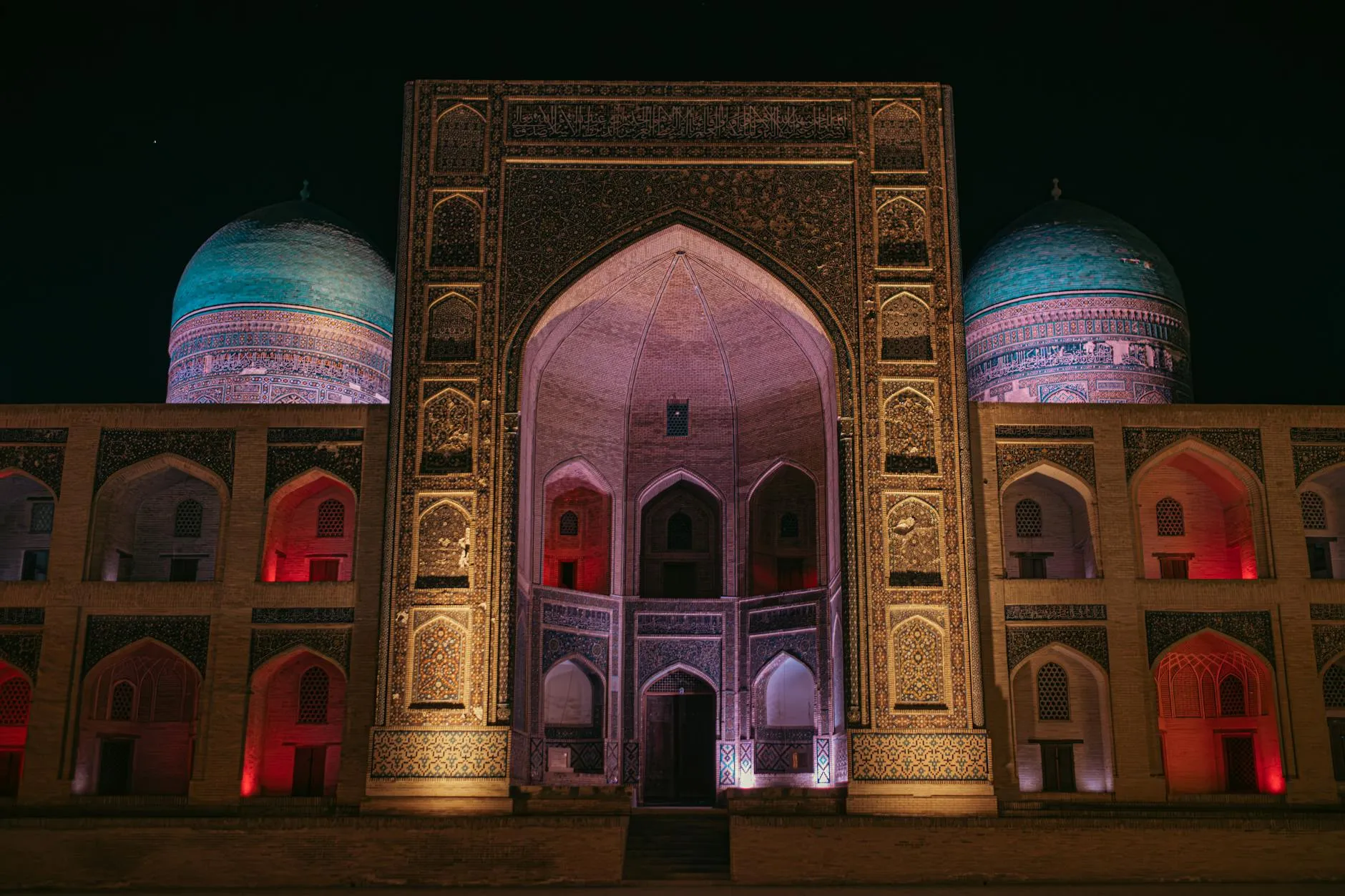
Bukhara International Airport (BHK) — Airport Guide 2026
The main thing to know about Bukhara Airport is that it will cease to exist in roughly its current form by early 2027 — a replacement facility is under construction 20 km away — but for every flight you book in 2026, you land at the existing terminal, 5 km from one of the most intact medieval city centres in Central Asia.
Quick Reference
BHK / UTSB
~5 km northeast (Lyabi-Hauz / Po-i-Kalyan core)
10–15 minutes
~25,000–40,000 UZS (≈$2–$3.30) — confirm in-app
~30,000–50,000 UZS — agree before you get in
Uzbekistani som (UZS) — cash-first economy
≈12,150 UZS/USD; ≈14,100 UZS/EUR (May 2026 — verify)
Visa-free 30 days (since 1 Jan 2026)
Visa-free 30 days (90+ countries) or $20 e-visa
Hotel slip required per night if staying >3 days; keep every one
Uzbekistan Airways, Turkish Airlines, Aeroflot, Pobeda, Red Wings, UTair
~11 destinations, ~56 flights/week
One VIP-style departures lounge; no Priority Pass/LoungeKey/DragonPass listing
Afrosiyob ~1h20–1h45, $10–$25, ~4 departures/day (from Kagan station)
Shared taxi ~100,000–130,000 UZS/seat, 6–8 hours
~20 km away, Q1 2027 commissioning target, 48,500 m² terminal, 3.3-km runway
Level 1 normal caution (US); routine caution (UK)
Not drinkable; bottled water universal and cheap
90 min before international departure; need 3+ hours free time to leave airside
🏛️ Terminal Layout & the Airport It’s About to Become
Bukhara operates from a single modest terminal that handles around 56 departures a week across roughly 11 destinations. On a busy afternoon you share the building with one or two flights’ worth of passengers, not a concourse crowd. International and domestic operations share the same building — the separation is a passport desk, not separate piers.
Layout is compact. One landside hall with check-in counters, a security line, a passport-control bank, and an airside waiting area with a café and a duty-free counter. If you arrive 90 minutes before an international flight, you will spend most of that time sitting.
Arrivals are equally quick: passport control, one baggage belt, a customs channel, and a kerb where taxi drivers will reach you before you reach them.
⚠️ New airport: arriving 2027, roughly
A replacement facility is under construction in the Kumsulton area, about 20 km from the current terminal. The new site has a 48,500 m² terminal, a 3.3-km runway built for wide-bodies, and 20 aircraft stands. Construction began May 2024 under a public–private partnership worth approximately US$226 million; a construction-and-operation tender opened 12 March 2026. Official statements through early 2026 target Q1 2027 for commissioning, with capacity for more than 3 million passengers a year. For any flight you book in 2026, assume the existing terminal — but check which airport code your ticket shows if you’re booking for 2027 or later.
The practical upshot for 2026: you are landing at a Soviet-bones terminal 5 km from the old city. Kerb to gate takes less time than finding parking at a real hub. That’s a feature on a route network this thin.
🛂 Visas, Som, Cash & Registration
Uzbekistan has systematically dismantled its visa wall since 2022, and 2026 is the year that effort became genuinely convenient for Western passports.
🌍 Entry Rules by Nationality
- US citizens: visa-free for 30 days since 1 January 2026. No e-visa, no letter of invitation. Older guides still say Americans need an e-visa — they’re out of date.
- EU, UK, Canada, Australia, New Zealand: visa-free up to 30 days.
- Japan, South Korea, UAE, Saudi Arabia, Qatar, Kuwait, Bahrain, Oman, Malaysia, Indonesia, Singapore, Turkey, Azerbaijan, Georgia, Belarus: a February 2026 expansion raised all these countries from a 10-day allowance to the full 30 days visa-free.
- Everyone else: apply online at e-visa.gov.uz. Single-entry $20 (up to 30 days, valid 90 days from issue), double-entry $35, multiple-entry $50. Processing is usually within a day.
In total, 90+ nationalities qualify for visa-free entry. Always verify against your specific passport before booking.
🛂 Registration is not optional
If you stay in Uzbekistan for more than three days, you must be registered each night. Any licensed hotel, hostel, or guesthouse does this automatically through the E-Mehmonxona system and hands you a paper slip per night. Keep every one. Border officers on departure can ask you to account for every night, and missing slips can mean a fine or a prolonged interview. Couch-surfing or informal accommodation without registration is where this bites people — book registered accommodation.
💵 The Som and Cash Reality
Uzbekistan runs on the som (UZS). The rate sat near 12,150 UZS to the dollar and 14,100 to the euro in late May 2026 — verify before you travel, as the som has drifted over the past year. Banknotes run up to 100,000 and 200,000 UZS denominations; a few hundred dollars in som is a thick stack.
By law all transactions settle in som, even where a hotel quotes you a dollar price. Exchange dollars at banks or exchange-ATMs (which swallow a USD note and dispense som). Regular ATMs dispense som on Visa/Mastercard, with a per-withdrawal ceiling around 2–5 million som, but they run dry on weekends and holidays. Card acceptance is rising in tourist-facing restaurants and hotels in Bukhara, but a teahouse, a bazaar stall, or a taxi driver wants cash.
Bring crisp, new dollar bills — large-denomination notes get the best exchange rate.
🚖 Getting Into the City
The old city is about 5 km from the terminal, a 10–15-minute drive. The distance is short enough that airport touts bank on tourists not caring to negotiate, so it’s worth knowing the real fares before you hit the kerb.
📱 Yandex Go — the correct option
Yandex Go covers Bukhara and shows you the fare before you confirm, so there’s nothing to argue about at the car. An airport-to-old-town trip typically lands in the 25,000–40,000 UZS range (≈$2–$3.30) — check the live quote. Coverage is thinner than Tashkent, and near Lyabi-Hauz or the Ark you may wait 8–12 minutes for a car, longer after dark. Register with your home mobile number for the SMS code. International Visa and Mastercard generally work in-app; Amex usually doesn’t.
Cash taxis at the kerb will open at 100,000–150,000 UZS or a convenient round dollar figure. The real cash fare for a 5-km airport run is around 30,000–50,000 UZS — agree it before you get in, and have small som ready so you’re not handing over a 100,000-note for a 40,000-ride.
There is no scheduled airport bus worth planning around for a tourist arrival. Local marshrutkas pass nearby for a few thousand som but drop you on a main road rather than at a guesthouse door, and they’re not practical with luggage.
🚂 Onward by Rail and Road
Bukhara’s main railway station is at Kagan, about 12–15 km southeast of the old city — not at the airport. That’s where you catch the Afrosiyob.
- To Samarkand: the Afrosiyob high-speed train covers it in roughly 1h20–1h45 for about $10–$25 depending on class, with around four departures a day. Book a day or two ahead in season; it sells out. Verify the current timetable before travel.
- To Tashkent: the Afrosiyob continues to the capital in about 3h40–4h.
- To Khiva: there’s no fast train. The practical option is a shared taxi or marshrutka for roughly 100,000–130,000 UZS ($15–$20) per seat over 6–8 hours of desert driving, or a private car for more. Arrange a shared taxi through your guesthouse the night before; treat Khiva as a destination in its own right.
A taxi from the airport directly to Kagan station, if you’re connecting straight onto a train, is a short hop — price it on Yandex Go rather than at the kerb.
🛋️ Lounges
Set expectations low. One VIP-style lounge operates in the departures area. Travellers report a quiet seat away from the main hall and decent service, which on a busy departure is worth something. What it is not: Priority Pass, LoungeKey, or DragonPass have no listed acceptance at BHK on any major aggregator network. Assume it operates on a walk-in-pay or business-class basis, and verify at the desk on the day — do not count on a Priority Pass card getting you in.
There is no separate Turkish Airlines or Uzbekistan Airways business sanctuary here. Premium-cabin passengers on those carriers are routed to the same single room or simply wait in the terminal. If lounge access is a priority, this is not the airport to bank on it.
The whole airside area is small and calm. A café table near the gate does most of what a budget lounge would. Clear security late rather than early, carry your own water and snacks, and you’ll be fine — there’s little reason to spend two hours airside when the building is this compact.
🍽️ Food Before You Fly
The airport is not where you eat in Bukhara. The airside café handles a coffee, a pastry, and a bottle of water. The duty-free counter runs to spirits, cigarettes, and boxed sweets. Eat in the old city before you leave; the price and quality gap is significant.
🍚 Eat before you go to the airport
A plate of plov in an old-city restaurant runs about 30,000–45,000 UZS ($2.50–$3.70). Somsa from a town tandoor is a few thousand som. The same food at the airport café, where it exists at all, costs more for less. Buy any travel snacks in the old city.
The dishes to know. Bukhara’s signature is plov (osh) — rice cooked with mutton, carrots, and onions — but the local version runs lighter and slightly sweet, often made with sesame oil and studded with chickpeas and raisins. Beyond it: shashlik (charcoal-grilled meat skewers), somsa (flaky baked pastries stuffed with meat or pumpkin from a tandoor), lagman (hand-pulled noodle soup), and non, the round stamped bread stacked at every bakery. Green tea is poured endlessly and is the default drink.
Where to eat in the old city (verified locations):
- Chinar — in the heart of the old centre, mid-priced, known for kebabs and soups, terrace seating.
- Old Bukhara — courtyard tables under trees plus a rooftop; solid all-round Uzbek menu.
- Labi Hovuz — beside the Lyabi-Hauz pond, good shashlik and generous portions; plov runs around 30,000 UZS.
- The Plov — about a 10-minute taxi from the old town, a dedicated plov house; budget 40,000–45,000 UZS a head.
Tipping is loose: many restaurants add a 10–20% service charge to the bill, so check before you add more. Rounding up or leaving a small note for good service is normal but not expected.
💡 The Old City, Day-Trips & Layover Math
Bukhara’s draw is that the old city is small, walkable, and concentrated. The headline monuments sit within a 15-minute stroll of each other, which is exactly why the airport’s 5 km distance barely matters once you’re in.
🕌 The Walkable Core
- Po-i-Kalyan complex — the Kalyan Minaret (built 1127, ~46 m, once the tallest structure in Central Asia), the Kalyan Mosque, and the Mir-i-Arab Madrasa. The obvious centre of gravity.
- The Ark — a walled royal citadel with foundations going back over a thousand years; served as palace, garrison, and seat of government. Effectively a town inside walls.
- Lyabi-Hauz — the pond-and-madrasa ensemble that functions as the social heart of the old city, ringed by teahouses. The easiest place to orient yourself.
- Chor Minor — the four-turret gatehouse tucked into a residential lane, about a 15-minute walk east of the Po-i-Kalyan complex. Quieter than the headline sites and worth the detour.
- The covered Toki bazaars (trading domes) sit between these monuments; you’ll walk through them regardless.
Just outside the centre (taxi territory):
- Sitorai Mokhi-Khosa — the last emir’s summer palace, built 1912–1918, about 4 km north of the centre; a 10–15-minute taxi each way.
- Bahauddin Naqshband Memorial Complex — shrine of the 14th-century founder of the Naqshbandi Sufi order (died 1389), roughly 10–12 km northeast; a working pilgrimage site, about 20–25 minutes by car.
Day-trips from the city: Samarkand is the obvious one — 1h20–1h45 by Afrosiyob, doable as a long day but better as an overnight. Khiva is 6–8 hours west by shared taxi and belongs on its own itinerary, not as a day-out.
⏱️ Layover Math
⚠️ Do the transit arithmetic before you plan a sightseeing dash
A round trip to the old city is roughly 30–40 minutes of driving alone. An international departure wants you back at the terminal 90 minutes before wheels-up. That means you need at least 3 hours of free time before it makes sense to leave the airport at all — and a comfortable 4+ hours to see Po-i-Kalyan and the Ark without rushing. The out-of-centre sights (Sitorai Mokhi-Khosa, the Naqshband shrine) only make sense on a layover of 5 hours or more. Anything under 3 hours: stay in the terminal.
🔧 Practical Notes
📶 SIMs and Connectivity
Buy a local SIM for data; the main operators — Beeline, Ucell, Uzmobile, Mobiuz — sell tourist SIMs cheaply in town. Bring your passport, since registration is required to buy a SIM. Airport and hotel Wi-Fi exists but is patchy and slow; don’t rely on it for anything time-sensitive like ordering a Yandex ride.
💸 Currency Reminders
Cash outside the tourist-restaurant bubble. Carry a mix of som denominations so you can pay a taxi or a bazaar stall without needing change for a 100,000-note. Exchange dollars or euros at banks or exchange-ATMs; cards work in better hotels and restaurants, but never assume it.
🔒 Safety and Scams
Uzbekistan is rated Level 1 “exercise normal caution” by the US State Department — the same category as Japan — and the UK advises routine caution for the main tourist cities of Tashkent, Samarkand, Bukhara, and Khiva. The Afghan border region in the far south is the exception and nowhere near the tourist circuit.
The realistic hazards are petty rather than violent: airport-taxi overcharging (use Yandex Go) and ATM skimming.
⚠️ ATM skimming is the local scam
Never let a “helpful” stranger touch your card or keypad at any ATM. Skimming is the documented local trick. Use machines attached to bank branches where possible, and cover the keypad.
Carry your passport at all times; police checks are legal and routine, and you’ll want your registration slips on you near departure.
🌡️ Health and Water
Tap water is not for drinking; bottled water is universal and costs almost nothing. No vaccination certificate is required for ordinary arrivals from Europe or North America. Bring any prescription medication in its original packaging — Uzbekistan restricts certain drugs, including some common codeine-based painkillers. Summer heat (June–August) is the bigger risk than anything else: Bukhara bakes, so carry water and pace old-city walking around the worst of the afternoon.
❓ FAQ
📊 At a Glance — BHK 2026
| Feature | 2026 Detail |
|---|---|
| Airport name | Bukhara International Airport |
| IATA / ICAO | BHK / UTSB |
| Terminals | One combined domestic/international terminal |
| Distance to old city | ~5 km northeast |
| Airport transfer | Yandex Go ~25,000–40,000 UZS; cash taxi ~30,000–50,000 UZS |
| Drive time to centre | 10–15 minutes |
| Currency | Uzbekistani som (UZS) |
| Exchange rate | ≈12,150 UZS/USD; ≈14,100 UZS/EUR (May 2026) |
| Entry — US | Visa-free 30 days (since 1 Jan 2026) |
| Entry — most others | Visa-free 30 days (90+ countries) or $20 e-visa |
| Registration | Hotel slip required per night if staying >3 days |
| Main carriers | Uzbekistan Airways, Turkish Airlines, Aeroflot, Pobeda, Red Wings, UTair |
| Route network | ~11 destinations, ~56 flights/week |
| Lounges | One VIP-style departures lounge; no Priority Pass/LoungeKey/DragonPass listing |
| Rail to Samarkand | Afrosiyob ~1h20–1h45, $10–$25, ~4/day (Kagan station, 12–15 km from old city) |
| Road to Khiva | Shared taxi ~100,000–130,000 UZS/seat, 6–8 hours |
| New airport | ~20 km away, Q1 2027 target, 48,500 m² terminal, 3.3-km runway |
| US / UK advisory | Level 1 normal caution (US); routine caution (UK) |
| Tap water | Not drinkable; bottled water universal |
| Layover buffer | 90 min before international; need 3+ hours free time to leave airside |
🌍 Planning the trip? Read our Uzbekistan travel guide — best time to go, where to stay, and how to get around.