Urgench International Airport (UGC) — Airport Guide 2026
Almost nobody who lands at Urgench is going to Urgench. They are going to Khiva, the walled mud-brick city 35 km south — and as of 1 January 2026, the United States joined the roughly 90 nationalities that can make that trip with nothing but a valid passport.
Quick Reference
UGC / UTNU
Urgench city + Khiva (~35 km south)
One (domestic + international)
13/31 asphalt, 3,373 m
Uzbekistani som — ~12,000 UZS ≈ US$1, ~13,700 UZS ≈ €1 (cash economy)
Visa-free 30 days (~90 nationalities incl. EU, UK, US from 1 Jan 2026); e-visa for others
~70,000–100,000 som ($8–15) negotiated
None on Priority Pass / DragonPass / LoungeKey
Jaloliddin Manguberdi high-speed train Tashkent↔Khiva launched 5 May 2026
Apr–May, late Sep–early Nov; avoid Jul–Aug (40°C+)
🏢 Terminal, Layout & the Airport’s Role
UGC has one building handling both domestic and international flights. Arrivals from Tashkent and from Istanbul queue at the same passport control. The runway — 13/31, asphalt, 3,373 m — was built to take Soviet-era wide-bodies serving a region that wouldn’t get a functioning railway link until 2018; it can handle modern wide-bodies, and Uzbekistan Airways uses the full length on seasonal European service. The airport’s elevation is 320 ft (98 m), coordinates 41.584°N, 60.642°E, and the desert setting means a July afternoon on the tarmac is punishing — July and August regularly exceed 40°C and the terminal’s air-conditioning does not keep up near the gates. Board in spring or autumn if you can choose.
The terminal is genuinely small: one baggage belt, a row of check-in desks, a couple of cafés, and security that moves quickly outside the Tashkent rush hours. No airside rail, no people-mover, no second concourse — you walk from the door to the gate. The standard “arrive two hours early” advice for international departures still applies, but 75 minutes is realistic for the Tashkent domestic flight, given that the airport rarely handles more than two or three flights simultaneously.
Uzbekistan Airways dominates the board at Urgench, and Tashkent is the backbone route — the airline’s own schedule carries several Tashkent–Urgench services inside any two-day window, at around 1h35m over 719 km. Neither the airport operator nor the airline publishes a per-airport timetable for UGC, so treat the carrier counts, destination totals and weekly-frequency figures that booking sites quote for this airport as estimates rather than a schedule. International direct service is thinner and partly seasonal: Uzbekistan Airways covers Istanbul plus seasonal European capacity, along with Russian routes; Turkish Airlines flies Istanbul; Azerbaijan Airlines flies Baku; S7, Ural Airlines, Red Wings, and Centrum Air, plus rotating Iranian charter capacity, fill out the board. Confirm any European routing with Uzbekistan Airways directly before you build a return around it — seasonal and charter series come and go, and a series that ends leaves no fallback at an airport this size. Bukhara is served domestically, which matters if you want to chain Khiva with Bukhara without backtracking through Tashkent.
The new Jaloliddin Manguberdi high-speed train is genuine competition for the Tashkent–Urgench flight. See the transport section for times.
🛂 Border & Visa
Around 90 nationalities enter Uzbekistan visa-free for up to 30 days: the full EU, the UK, Canada, Australia, New Zealand, Japan, South Korea, most Gulf states, and the United States. US citizens gained full visa-free entry on 1 January 2026 — a valid passport at the border is sufficient, with no prior application required. Everyone outside the visa-free list uses the e-visa, applied for online before travel, valid up to 30 days.
The list expands regularly — roughly every quarter over the past few years — so confirm your own nationality’s current status on gov.uz before booking. Third-party travel sites lag behind the official portal.
There is no airport entry fee and no tourist tax collected at the border. The Soviet-era currency declaration on arrival has been relaxed for normal traveller amounts; if you’re carrying a large cash sum, declare it honestly and keep the form. Yellow fever vaccination is not required unless you are arriving from an endemic country. Hotel registration — the system where each accommodation registers your passport with the authorities and gives you a slip — still technically applies. A registered hotel handles this automatically; keep the slips in case they’re checked at departure, though enforcement has loosened.
⚠️ Visa status — verify on gov.uz before booking
The visa-free list updates roughly quarterly. US citizens gained full visa-free entry on 1 January 2026. For other nationalities, check the official portal rather than third-party travel sites, which consistently lag behind.
💵 Currency & the Cash Reality
The Uzbekistani som trades around 12,000 to the US dollar and 13,700 to the euro on the Central Bank’s September 2026 rate — verify before travel, as the rate moves. Notes cap at 200,000 som, which is roughly $16–17 at current rates, meaning a modest cash withdrawal arrives as a thick brick of paper that won’t fit in a standard wallet. This is a cash economy outside the better hotels. In Khiva specifically, the bazaar, the marshrutkas, most cafés, and every taxi negotiation happen in som, in hand, on the spot.
ATMs exist in Urgench and Khiva but run dry and can reject foreign cards without warning. If you connect through Tashkent, pull cash there. Otherwise bring clean, unmarked US dollars to exchange at a bank or licensed exchange desk — the real rate. Avoid street changers. Cards work at upper-tier hotels and a handful of restaurants in Khiva; assume everything else is cash-only.
💵 Cash before you arrive in Khorezm
Pull som in Tashkent if you connect there — ATMs in the Khorezm region run dry and reject foreign cards more reliably than you’d like. If arriving from abroad, bring clean US dollars to exchange at a licensed desk in Urgench or Khiva. Notes cap at 200,000 som (~$16), so carry mixed denominations; nobody breaks a large note for a taxi fare.
🚆 Getting to Khiva and Beyond
Khiva is 35 km south — a flat, straight desert road, roughly 45 minutes. There is no direct airport bus and no train from UGC itself.
🚕 Airport Taxi
Drivers wait outside arrivals. A negotiated fare to Khiva runs 70,000–100,000 som ($8–15). The opening quote will be higher — agree the price before you get in, confirm it is for the whole car rather than per person, and have small notes ready. A ride into Urgench city centre (5 km) runs 20,000–30,000 som. This is not a metered culture; the negotiation is the system.
🚐 Pre-Booked Transfer
Fixed-price airport-to-Khiva transfers are sold online from around $20–35 for a sedan, with a driver holding a name sign at arrivals. The sensible option after a long-haul red-eye when negotiating at midnight is unappealing. The premium over a street taxi buys certainty, not speed.
🚌 Public Transport (Two Steps)
The trolleybus between Urgench and Khiva is a genuine curiosity — it does not start at the airport. Take a taxi or city bus the 5 km to Urgench city first, board the trolleybus near Tinchlik street by the bazaar (roughly every 30 minutes, about 1,500 som), and ride the 35 km to Khiva. Shared marshrutkas cover the same route for around 7,000 som and leave when full. This makes sense if you are already in Urgench city. From the airport with luggage, the direct taxi wins.
📱 Rideshare
Yandex Go operates in Uzbekistan but is thin and unreliable in the Urgench/Khiva area. Do not plan on summoning a car at the airport. The street taxi is plan A; Yandex Go is a backup in town.
🚅 The 2026 Train — Jaloliddin Manguberdi High-Speed Service
🚆 Launched 5 May 2026 — Tashkent to Khiva in ~7 hours
Departs Tashkent 07:00 on Tue/Thu/Sat, arrives Khiva 14:31; returns Wed/Fri/Sun at 07:20. Stops at Samarkand, Bukhara, and Urgench. Arrives at Khiva’s own station, a 15-minute walk from the Itchan Kala gates. This cuts the old 14-hour journey in half and is real competition for the Tashkent flight. Three times weekly means a missed departure costs days — check railway.uz or eticket.railway.uz before building a tight connection around it.
🏜️ Onward to Bukhara and the Silk Road Chain
Bukhara is ~450 km southeast. The high-speed train links Khiva–Urgench–Bukhara–Samarkand–Tashkent on its operating days, making the Silk Road chain by rail straightforward in a way it wasn’t before May 2026. When the train is not running, shared taxis cross the Kyzylkum desert to Bukhara in roughly 6–7 hours.
🛋️ Lounges
There is no Priority Pass, DragonPass, or LoungeKey lounge verifiable at Urgench as of 2026. Lounge-network aggregators return no results for UGC. The “lounges may be available” boilerplate text on some booking-adjacent sites is not a real networked lounge you can enter with a card.
What does exist is a premium/CIP facility, but nobody publishes its access rules: Uzbekistan Airways’ lounge pages carry no airport list, and the airport operator publishes nothing per-airport at all. If you are flying business class or hold airline elite status, ask your carrier at check-in rather than counting on it. Paid VIP/CIP services — meet-and-greet, fast-track, a private waiting area — are sold through handling agents, but these are concierge products priced accordingly, not day passes.
Build your timing around a short pre-flight buffer. The terminal is functional, the cafés are your real holding area, and there is nowhere comfortable to spend three hours airside.
⚠️ No lounge network access at UGC
Priority Pass, DragonPass, and LoungeKey are not verified at Urgench. A premium/CIP facility exists, but neither the airport nor the airlines publish who may use it — ask your carrier rather than assuming a business-class ticket or elite card opens it. Paid meet-and-greet products through handling agents exist but are priced as concierge services.
🍽️ Food Before You Fly
Two cafés and a handful of kiosks landside, a minimal airside selection, and airport pricing throughout. A samsa or a plate of plov that costs 15,000–25,000 som in a Khiva teahouse will run noticeably more here, with lower quality. Eat in Khiva; buy food at UGC only if a delayed flight leaves no alternative.
Khorezm cuisine is regionally distinct enough from the rest of Uzbekistan to be worth arriving hungry for. The two dishes that don’t travel well out of the region: tukhum barak — egg-filled dumplings, roughly ravioli-like, boiled and served with sour cream, a Khorezm speciality you won’t find reliably elsewhere — and shivit oshi, bright-green dill-infused noodles served with a meat-and-vegetable stew and sour milk. Khorezm plov uses yellow carrot and white rice, and tastes different from the Tashkent, Ferghana, and Samarkand versions. A full sit-down meal in Khiva runs roughly 40,000–80,000 som per person.
🍽️ Terrassa Café & Restaurant — rooftop over the Itchan Kala
Central Khiva. The “Eight Tastes” set menu works through the local dumplings, shivit oshi, tukhum barak, gumma, and shashlik in one sitting — a practical way to cover the regional dishes without ordering à la carte across three meals. Art-Restaurant, inside the Allakuli-Khan Madrassah, and the home-style Zaynab-opa house are also cited independently for traditional Khorezm cooking. Hours shift seasonally; check on the day.
Duty-free at UGC is a small shop: spirits, tobacco, and perfume. If you want Uzbek goods to take home — dried fruit, spices, ceramics, a suzani textile — buy them in Khiva’s bazaar or from the workshops inside the walls. The selection is better, the prices are negotiable, and the quality is verifiable. The airport shop is none of those things.
💡 Khiva: The Itchan Kala and What Surrounds It
The Itchan Kala — Khiva’s walled inner city, UNESCO World Heritage Site — charges a single combination ticket: 250,000 som as of early 2026, valid for two full days, covering most of the 16–18 monuments inside the walls. A few sites charge separately: climbing the Islom Xoʻja minaret runs about 100,000 som, the Ak Sheikh Bobo watchtower another 100,000, and the city-wall walk around 40,000. Tickets are sold at the north, south, east, and west gates.
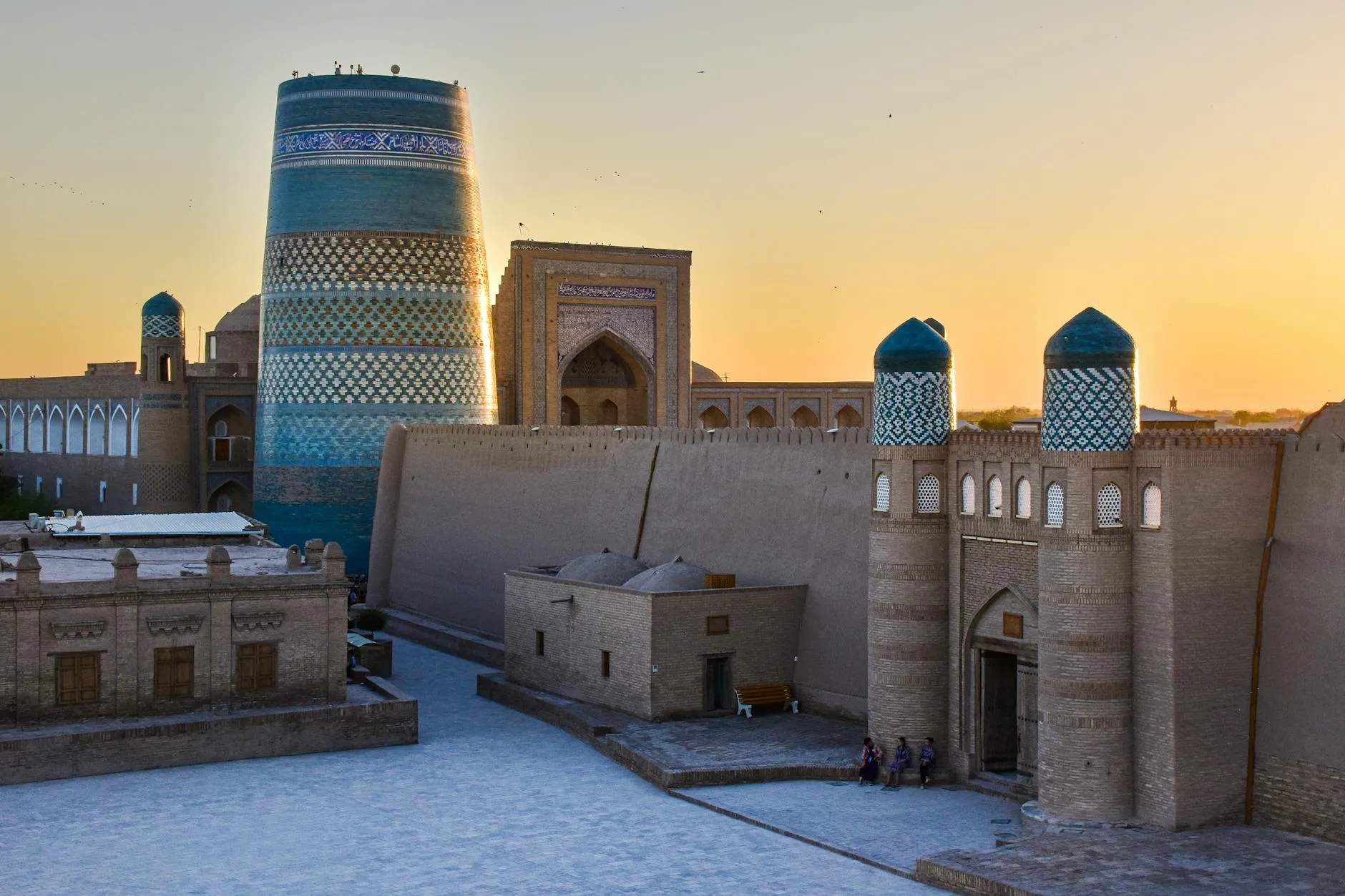
What is inside is dense and walkable. The Kalta Minor — the fat, turquoise-tiled stump of a minaret that was never finished — sits just inside the west gate and is the image most people came for. The Kunya Ark citadel has the old khans’ quarters and a rooftop view. The Juma Mosque is known for its forest of more than 200 carved wooden columns under a single flat roof. The Islom Xoʻja complex holds the tallest minaret in Khiva; the Toshhovli Palace has the best-preserved tilework. The headline sites take two to three focused hours. A full unhurried day covers the minaret, lets you sit in the madrassahs, and catches the late-afternoon light — which is when the brickwork earns the journey.
Beyond the walls, the Khorezm desert fortresses — the Ayaz-Kala and Toprak-Kala group, often marketed as the “Elliq-Qala” (fifty fortresses) — are ancient mud-brick citadels on bluffs over the Kyzylkum, 1–2 hours’ drive northeast depending on which sites you target. A hired car and driver is the practical approach; this is not a public-transport excursion.
⏱️ Layover Maths — Stated Plainly
Airport to Itchan Kala: ~45 minutes. Minimum honest visit inside the walls: 2 hours. Return to airport: ~45 minutes. Return security buffer for an international departure: 2 hours. That is 5.5 hours of committed time before any buffer for traffic, a slow taxi negotiation, or a delayed morning departure.
A layover under 6 hours does not work. With 7 or more hours you can do a calm half-day inside the walls and still make your flight. Under 6 hours, stay in Urgench.
⏱️ Layover under 6 hours — do not attempt Khiva
The round-trip transit plus a minimum visit plus the return security buffer adds to 5.5 hours before cushion. With 7+ hours the half-day is comfortable. With less, you will spend the entire connection in transit and anxiety, and likely arrive back at UGC sweating.
📡 Connectivity, SIMs & Practical Notes
Wi-Fi and SIM Cards
Terminal Wi-Fi at UGC exists and is patchy. Do not rely on it for anything time-sensitive.
Four operators serve Uzbekistan: Uzmobile (Uztelecom), Beeline, Ucell, and Mobiuz. A tourist SIM is cheap — roughly $5 for 30GB on Beeline, from $2 for smaller bundles. Uzmobile has the strongest rural coverage, which matters on the desert roads around the Khorezm fortresses. The catch: a physical SIM legally requires your passport and, officially, proof of hotel registration. An eSIM skips the paperwork and can be activated before landing — but all eSIM options for Uzbekistan currently run on the Beeline network, which has the weakest rural reach. Buy a physical Uzmobile SIM in Urgench or Khiva if the desert-fortress excursion is on the agenda. Use an eSIM if you just need connectivity in town.
💡 Physical SIM vs eSIM for Khorezm
All Uzbekistan eSIMs run on Beeline — weakest rural coverage. A physical Uzmobile SIM from a shop in Urgench or Khiva (around $5) gives substantially better signal on the Kyzylkum desert roads. For city use only, the eSIM is fine and requires no passport or registration paperwork.
Safety, Water, and Tipping
Uzbekistan is broadly low-crime. Most government advisories rate it exercise-normal-caution, with caveats about areas near the Afghan border in the south — which has no bearing on a Khiva trip. The practical hazards are: summer heat in July and August that genuinely endangers the unprepared, taxi overcharging if you skip the fare agreement before getting in, and ATMs that eat foreign cards. Drink bottled water; tap water is best avoided, and bottled is cheap and available everywhere.
Tipping is not deeply embedded. Rounding up a restaurant bill or leaving 5–10% at a tourist-facing place in Khiva is appreciated, not expected; check the bill for an included service charge before adding more. Taxi fares are negotiated upfront — there is nothing to tip on top.
Language
Uzbek and Russian. English is limited outside the Khiva tourist core. A translation app and a few destination names written in Cyrillic cover most situations with taxi drivers.
❓ FAQ
📊 At a Glance — UGC 2026
| Feature | Detail |
|---|---|
| IATA / ICAO | UGC / UTNU |
| Full name | Urgench International Airport (Urganch Xalqaro Aeroporti) |
| Owner / operator | Government of Uzbekistan / Uzbekistan Airways |
| Serves | Urgench city + Khiva (~35 km south) |
| Coordinates / elevation | 41.584°N, 60.642°E / 320 ft (98 m) |
| Terminals | One (domestic + international) |
| Runway | 13/31 asphalt, 3,373 m |
| Distance to Khiva | ~35 km / ~45 min |
| Distance to Urgench centre | ~5 km / ~10 min |
| Airlines (2026) | Uzbekistan Airways, Turkish Airlines, Azerbaijan Airlines, S7, Ural Airlines, Red Wings, Centrum Air + others |
| Busiest route | Tashkent (~1h35m, 719 km) |
| International direct | Istanbul, Baku; seasonal European capacity; Russian routes |
| Entry | Visa-free 30 days (~90 nationalities incl. US from 1 Jan 2026); e-visa for others |
| Currency | Uzbekistani som — ~12,000/USD, ~13,700/EUR; cash economy; notes cap at 200,000 som |
| Airport taxi to Khiva | ~70,000–100,000 som ($8–15) negotiated; pre-booked transfer $20–35 |
| Trolleybus (Urgench–Khiva) | ~1,500 som; board near Tinchlik street in Urgench city, not at airport |
| Marshrutka (Urgench–Khiva) | ~7,000 som, departs when full |
| Itchan Kala ticket | 250,000 som, valid 2 days; minaret, watchtower, and wall walk cost extra |
| Lounges | None on Priority Pass / DragonPass / LoungeKey; airline business-class + paid VIP only |
| SIM cards | Beeline ~$5/30GB; physical SIM needs passport; eSIM (Beeline network only) needs none |
| 2026 rail change | Jaloliddin Manguberdi high-speed train Tashkent↔Khiva from 5 May 2026; 3× weekly; ~7 hours |
| Best season | Apr–May, late Sep–early Nov; avoid Jul–Aug (40°C+) |