Hiroshima Airport (HIJ) — Airport Guide 2026
Hiroshima Airport sits 50 km northeast of the city centre — in Mihara, technically, not in Hiroshima — and has no rail link, a fact that is not an accident but the direct result of West Japan Railway blocking every proposal to build one, on the reasonable grounds that a fast train to the airport would undercut its Shinkansen revenue.
Quick Reference
HIJ / RJOA
~50 km northeast of central Hiroshima, in Mihara, Hiroshima Prefecture
Single terminal; domestic and international under one roof
None — access by bus or car only
Hiroshima Bus Center (Kamiyacho): ~55 min, ¥1,500 adult one-way
Shinkansen gate: ~50 min, ¥1,500 adult one-way
JPY (¥) — ≈ ¥159/US$1, ≈ ¥185/€1 (May 2026)
Cards and IC transit cards widely accepted; carry yen for the bus and small vendors
~74 countries/regions; up to 90 days (UK up to 6 months)
Not in force in 2026 — planned for FY2028
YAMANAMI VILLA (domestic, 3F, after security, ¥1,760) · Maple (international, airside, ¥1,980) — closed 17 Aug 2026 to 28 Feb 2027
ANA (largest), JAL; IBEX as regional partner
🏢 Terminal & Airlines
The building handles domestic and international flights in a single structure — international departures and arrivals occupy a compact wing rather than a separate hall, so there is no inter-terminal shuttle and no guesswork about which building you need. Arrivals, departures, bus stops, and both lounges are within a short walk of each other.
ANA operates the largest schedule by departures, running the main domestic trunk routes to Tokyo Haneda, Sapporo, Sendai, Naha and others. Japan Airlines is the second carrier; IBEX Airlines flies the regional Sendai route, and its HIJ flights are ANA codeshares — IBX040/ANA3140, IBX042/ANA3142, IBX044/ANA3144 — not JAL ones. Spring Japan is a Japanese carrier and it operates a domestic route here, Hiroshima–Narita, five days a week. The international side is thinner and entirely foreign-operated: China Airlines to Taipei, China Eastern to Shanghai Pudong, HK Express to Hong Kong, Jeju Air to Seoul Incheon, Aero K to Cheongju and VietJet to Hanoi. Air China’s Dalian and Beijing-via-Dalian services are both suspended in the current schedule, as is Bangkok. None of the international carriers are based at HIJ. The longest scheduled route is approximately 4 hours 50 minutes to Hanoi; everything else is short or medium-haul within East Asia.
✈️ Self-transfer reality check
Cheaper international fares routed through Hiroshima are typically point-to-point with no through-checked baggage. A self-connection here means clearing immigration, reclaiming your bag, and re-checking it — allow at least three hours and read the border section below before you book.
🛂 Border & Visa
Japan’s national entry regime applies at Hiroshima. Nothing HIJ-specific overrides it.
✅ Visa-free entry
Ordinary-passport holders from roughly 74 countries and regions enter Japan visa-free for a short stay, most receiving 90-day landing permission stamped on arrival. The list covers the United States, Canada, Australia, New Zealand and most of Europe. Some nationalities get a shorter window: Indonesia and Thailand 15 days, Brunei and Qatar 30 days. The United Kingdom gets up to six months — the outlier in the other direction. No paperwork is filed before flying; you arrive, your passport is checked, you’re admitted. Confirm your own country’s current status against Japan’s Ministry of Foreign Affairs list before booking — the arrangement is reciprocal and occasionally adjusted.
📋 Visas and eVisas
If your nationality is not on the exemption list, or you’re staying longer or for a purpose beyond short-term tourism or business, you need a visa arranged before departure. Japan issues eVisas to eligible nationalities through its online system; standard visas go through embassies and consulates. There is no visa-on-arrival for tourism at Hiroshima.
🚨 JESTA does not exist as a requirement in 2026 — ignore any site selling one
Japan’s electronic travel authorisation (JESTA) is not operational this year. On 29 May 2026, Japan’s Diet passed the enabling legislation that creates the legal basis for the system, but the system itself is planned for fiscal 2028 (April 2028 to March 2029). Until then, visa-free entry requires no advance authorisation. Any third-party site selling a “JESTA” for 2026 travel is charging you for a document that has no legal standing.
🚌 Getting to the City
The ~50 km from HIJ to central Hiroshima is road the whole way. Allow about an hour in either direction and factor it into any connection plan.
🚌 Limousine bus — the default
The airport limousine bus is how the vast majority of passengers reach the city. Two main routes depart from stops directly outside the terminal:
- Hiroshima Bus Center (Kamiyacho), in the city centre near the Prefectural Office and about a 15-minute walk from the Peace Memorial Park: approximately 55 minutes, ¥1,500 adult one-way (¥750 child).
- JR Hiroshima Station (Shinkansen gate), for onward bullet-train connections: approximately 50 minutes, ¥1,500 adult one-way.
A discounted return ticket is available at the counter and is valid for seven days. Buses run timed to flights through the day, but the two routes do not start at the same hour: the first airport departure for JR Hiroshima Station is around 07:20, while the first for the Hiroshima Bus Center is 08:50, arriving 09:45. If you land early and are heading for the Peace Memorial Park, that gap is most of an hour and a half. Confirm the current timetable at the ground-transport desk on the day — 2026 schedules are published in dated blocks covering spring through summer, and seasonal changes do occur.
🚌 Buy the return ticket at the airport
The discounted return is sold at the airport bus counter and is valid for seven days — enough flexibility for most trips. Two separate singles cost more. Buy it before you head into the city.
🚆 Continuing beyond Hiroshima
If your destination is Osaka, Kyoto or Hakata, take the limousine bus to JR Hiroshima Station and pick up the Shinkansen from there. The bus and the train operate under different companies, which is part of why the airport has no rail link of its own.
🚕 Taxi and car
A metered taxi or pre-booked car covers the same 50 km and runs well into five figures of yen — significantly more than the bus. It makes sense for late arrivals or groups carrying a lot of luggage. Use the official taxi rank outside the terminal; anyone inside offering a ride at a special price is running the standard airport overcharge. Rental-car desks are available at the airport and are worth considering if you’re heading into the Setouchi countryside, where a car is genuinely useful.
⚠️ No rail link — and this is not about to change
West Japan Railway has declined repeated proposals to build a railway connection to HIJ, partly to protect Shinkansen revenue against air competition on the Hiroshima corridor. A rail link is not in any near-term construction plan. The limousine bus is the system, not a temporary measure.
🛋️ Lounges
Hiroshima has two lounges, and the thing most guides get wrong about them is that both sit on the far side of the security check — one domestic, one international, and the international one is shut for most of 2026.
The domestic lounge is Hiroshima Airport Lounge YAMANAMI VILLA, and the thing to get right about it is that it is airside: the airport’s own page opens by saying it is for use after the domestic security check. It is on the 3rd floor, inside the domestic departure waiting area. Entry is ¥1,760 per person including tax, and the hours are 06:45–20:40. It is not a Priority Pass lounge — Priority Pass does not serve Hiroshima at all; its Japan index lists eleven other airports and this is not one of them. Free entry goes to holders of a long list of Japanese premium cards: Diners, domestically issued American Express, JCB Gold and above, Rakuten Gold and above, MUFG, and Epos Gold and Platinum among others.
Lounge Maple, on the 2nd floor of the international departures area after security, is temporarily closed from 17 August 2026 until 28 February 2027 while the terminal building is extended and refurbished. Do not plan around it on any 2026 trip. When it reopens it is free for first- and business-class passengers and for guests invited by certain carriers — China Airlines, Air China, China Eastern and VietJet are among those — and the walk-in rate is about ¥1,980 per adult (¥990 for children aged 3 to under 13; free for under-3s).
🛋️ The domestic lounge is after security — clear the check first
YAMANAMI VILLA sits inside the domestic departure waiting area on the 3rd floor, so you reach it by clearing security and then walking to it. There is nothing to use on the landside concourse. Entry is ¥1,760 including tax, 06:45–20:40.
🛋️ Lounge Maple is shut until 28 February 2027
The international lounge closed on 17 August 2026 for the terminal extension works and is not due to reopen until 28 February 2027. It is not on Priority Pass or any equivalent network in any case — Priority Pass does not serve Hiroshima — so on an international departure in 2026 there is no lounge here to plan around at all.
🍜 Food Before You Fly
Hiroshima’s regional cooking is specific enough to be worth the effort, and the terminal does a serviceable job — Hiroshima-style okonomiyaki is on the menu and edible — but edible airport food and the real thing are different experiences. If you have time in the city first, eat there.
The Hiroshima version of okonomiyaki differs from the Osaka version in a way that matters to both cities: rather than mixing everything into the batter, the Hiroshima style builds it in layers — a thin crepe base, a heap of cabbage, pork, and a nest of fried soba or udon folded in, topped with egg and sweet-savoury sauce, assembled on the griddle in front of you. The distinction is not a tourist talking point; the two cities maintain a genuine and mildly territorial rivalry about it. The real concentration of okonomiyaki restaurants is around Okonomimura in the city.
Hiroshima Prefecture is Japan’s largest oyster producer, farming across the Seto Inland Sea. They are at their best in the cold months — grilled, fried as kaki furai, or in a hotpot. Conger eel (anago) over rice is the other regional plate worth seeking out. Setouchi lemons, grown on the offshore islands, turn up in dressings and sweets and travel better than most perishable alternatives.
🍜 Eat before you get to the terminal
Airside food at HIJ carries the usual airport markup. The terminal okonomiyaki serves its purpose; Okonomimura in the city does not disappoint. If the itinerary allows, eat in Hiroshima and use the airport mainly for coffee and the bus.
🎁 Duty-free and souvenirs
International departures carry a standard duty-free selection of spirits, tobacco and cosmetics. The Hiroshima-specific purchases are momiji manju — maple-leaf-shaped cakes filled with red-bean paste, the regional sweet — Setouchi lemon products, and Kumano calligraphy brushes from the nearby town that supplies most of Japan’s brush-making industry. All of these are cheaper bought in the city than at the departure gate.
⏱️ Layover Reality: the Peace Memorial Park
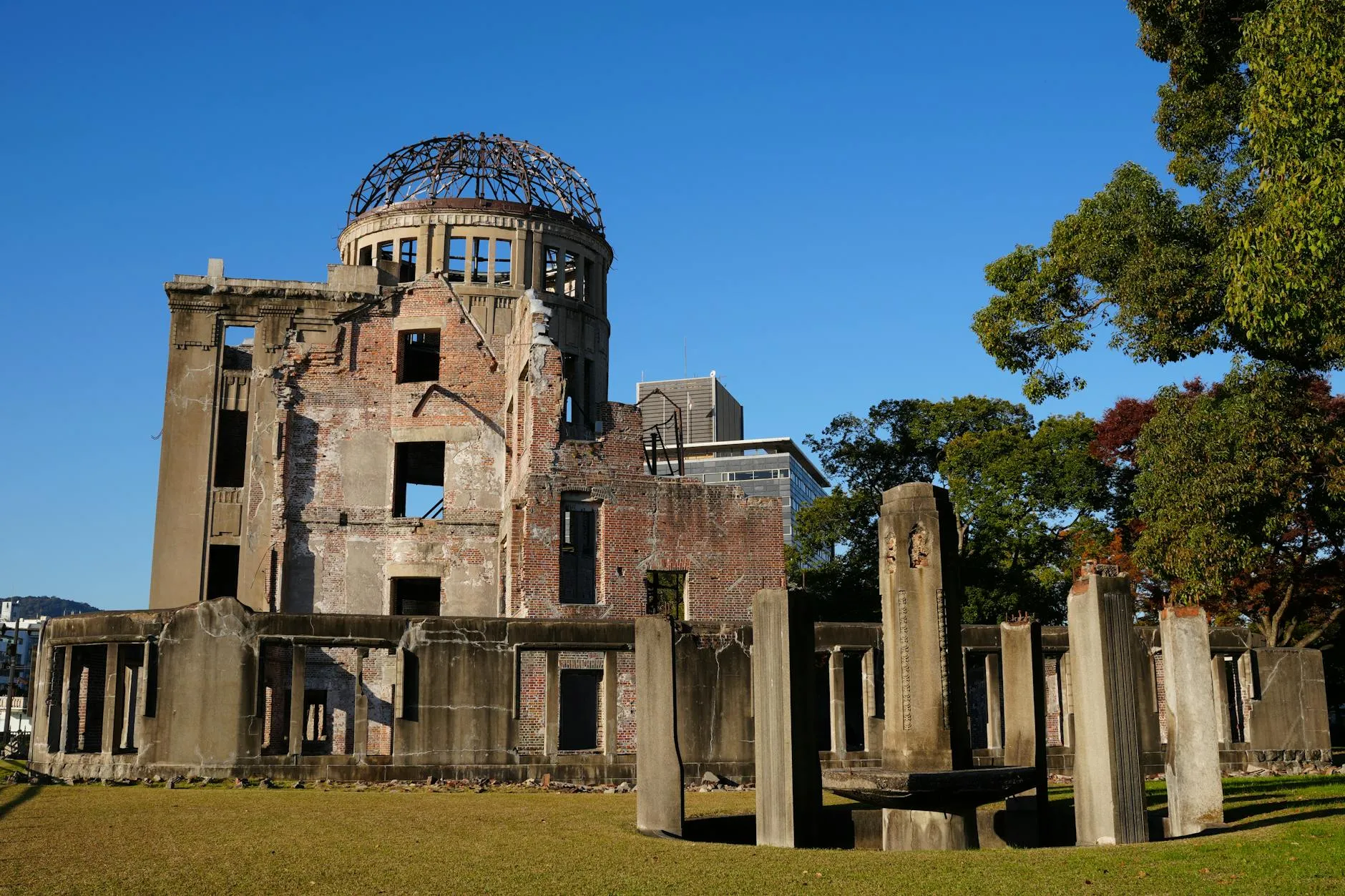
The Peace Memorial Park — the Atomic Bomb Dome, the cenotaph, and the Peace Memorial Museum — is the reason most people pass through Hiroshima, and it is accessible on a layover, but only a long one.
The calculation is straightforward and unforgiving. The limousine bus to Hiroshima Bus Center takes about 55 minutes; from Kamiyacho the park is roughly 15 minutes on foot or a short tram ride. One-way transit is 1 hour 10 to 1 hour 20 minutes. Round-trip on the bus alone is about 2 hours 30 minutes. Add an hour to see the museum and the park without rushing, and add the standard two-hour check-in and security buffer for an international departure. The minimum viable layover for a Peace Park visit is around six hours, and seven is the honest threshold if you want any margin.
⏱️ Six hours minimum for the Peace Memorial Park — and that’s tight
Bus to park and back: ~2 hr 30 min. Time at the site: 1 hr minimum. International check-in buffer: 2 hrs. Total: ~5 hr 30 min at the absolute best, assuming no bus wait and no queue at security. Seven hours is the safe number. Under six, stay in the terminal.
The airport sits in rural Mihara — not in a walkable town with anything worth leaving the terminal for. Unlike airports with a market district or a neighbourhood café strip five minutes away, HIJ has nothing proximate that justifies a short exit. Under about six hours, the terminal and a lounge is the right call. Save the city for a trip where you have the day.
💳 Practical Notes
Payment. Japan has moved significantly toward card and contactless acceptance, and credit cards plus IC transit cards (ICOCA, Suica and equivalents) work at the airport, on most transport and at larger vendors. Smaller shops, some bus routes and rural spots can still be cash-only or prefer it. Carry enough yen for the limousine bus and a meal at minimum.
Currency. The yen trades at roughly ¥159 to the US dollar and ¥185 to the euro as of May 2026. Airport exchange counters carry the standard markup over the interbank rate — change only what you need immediately and use ATMs in the city for the rest. Japan Post and 7-Eleven ATMs reliably accept foreign cards; most Japanese bank ATMs do not.
Connectivity. Free Wi-Fi covers the terminal. For the road and the city, a travel eSIM or pocket Wi-Fi rental (available at major Japanese airports including HIJ) is the standard solution. Set up a travel eSIM before landing so you’re connected immediately after clearing immigration.
💴 ATMs: 7-Eleven and Japan Post work — most others don’t
The majority of Japanese bank ATMs decline foreign-issued cards. 7-Eleven and Japan Post ATMs accept Visa, Mastercard and Maestro reliably. HIJ has ATM facilities in the terminal — confirm the type before you need cash urgently.
❓ FAQ
📊 At a glance — HIJ 2026
| Item | Detail |
|---|---|
| IATA / ICAO | HIJ / RJOA |
| Distance to centre | ~50 km northeast (in Mihara) |
| Terminal | Single terminal; domestic + international |
| Rail link | None — bus or car only |
| Bus to city centre | Hiroshima Bus Center (Kamiyacho): ~55 min, ¥1,500 adult |
| Bus to JR Station | Hiroshima Station Shinkansen gate: ~50 min, ¥1,500 adult |
| Child bus fare | ¥750 one-way |
| Return bus ticket | Discounted; valid 7 days |
| First bus departure | ~07:20 to JR Hiroshima Station; 08:50 to the Bus Center |
| Taxi | Official rank only; ~50 km; far more expensive than bus |
| Currency | JPY (¥) — ≈ ¥159/US$1, ≈ ¥185/€1 (May 2026) |
| Payment | Cards + IC transit cards widely accepted; carry yen for bus and small vendors |
| ATMs | 7-Eleven and Japan Post ATMs accept foreign cards reliably |
| Border — visa-free | ~74 countries; up to 90 days (UK up to 6 months) |
| Shorter visa-free windows | Indonesia & Thailand: 15 days; Brunei & Qatar: 30 days |
| JESTA | Not in force 2026 — legal basis passed 29 May 2026; launch planned FY2028 |
| Domestic lounge | YAMANAMI VILLA — domestic, 3F, airside (after security), ¥1,760 incl. tax, 06:45–20:40; not on Priority Pass |
| Lounge Maple | International, airside (after security), ¥1,980 walk-in; free for F/J + carrier-invited — CLOSED 17 Aug 2026 to 28 Feb 2027 |
| Hub carriers | ANA (largest), JAL; IBEX regional partner |
| International carriers | China Airlines, China Eastern, HK Express, Jeju Air, Aero K, VietJet (Air China’s Dalian/Beijing services suspended) |
| Longest route | ~4 hr 50 min to Hanoi |
| Peace Memorial Park | ~1h 10–1h 20 one-way; 6 hr layover minimum — not viable on shorter stops |