Kagoshima Airport (KOJ) — Airport Guide 2026
Kagoshima Airport is not in Kagoshima. It sits in Kirishima, about 30 km inland and northeast of the city, ringed by volcanic hills and onsen towns — a geography that determines almost every decision you’ll make here.
Quick Reference
KOJ / RJFK
Kirishima, ~30 km northeast of central Kagoshima
Domestic (nine gates) + separate international terminal (single gate)
JPY (¥) · ≈ ¥159/US$1, ≈ ¥186/€1 (May 2026)
Airport limousine → Kagoshima-Chuo Station, ¥1,500, ~40 min, ~every 20 min
Direct → Kirishima Onsen (Maruo area), ~35 min · Kagoshima Kotsu ¥870 point fare, four departures a day (11:10, 12:50, 16:35, 17:40) · Kirishima City access bus needs the ¥1,500 day pass · last bus back to the airport 16:36
Japan Air Commuter (HQ); ANA & JAL dominate domestic, with Peach, Jetstar Japan, Fuji Dream, Solaseed Air, IBEX and Skymark; international: Korean Air, Eastar Jet, Jeju Air, China Airlines, China Eastern, Hong Kong Airlines, HK Express
Sky Lounge Nanohana, domestic landside, ¥1,100, 07:00–20:00 — Priority Pass not accepted
Oyattosa, domestic terminal ground floor by Exit 3, free, 09:00–19:30
Visa exemption (~74 countries, usually 90 days) or visa/eVisa; use Visit Japan Web for arrival
Law passed 29 May 2026 — NOT operational, targeted fiscal 2028; not required in 2026
🏢 Terminals & Airlines
Two buildings, clearly separate. The domestic terminal is the main event: nine gates, the full run of shops and restaurants, the lounges, and the bus stops out front. The international terminal is a single-gate annex handling a handful of routes to South Korea, Taiwan, mainland China and Hong Kong. Fewer shops, limited food, no airline lounge.
Japan Air Commuter — the regional carrier that runs the inter-island network across Kagoshima’s southern archipelago — is headquartered here. Skymark flies here too but is not based here: its head office is at Haneda Airport in Ota-ku, Tokyo. Day-to-day, ANA and JAL dominate the trunk routes to Tokyo, Osaka and Nagoya. Low-cost domestic flying comes from Peach and Jetstar Japan; Fuji Dream Airlines, Solaseed Air and IBEX Airlines cover regional gaps.
On the international side: Korean Air, Eastar Jet and Jeju Air serve Seoul; China Airlines flies Taipei; China Eastern, Hong Kong Airlines and HK Express are on the airport’s own international carrier list alongside them. Confirm your specific route before you build a connection around it — the international schedule is thin and changes.
⚠️ Self-transfer warning
Domestic and international are not connected airside. A connection between the two buildings requires clearing immigration, collecting your bag, re-checking it, and walking between terminals. Allow real time — this is not a 30-minute transfer.
🛂 Border & Visa
Japan’s national entry system governs everything at Kagoshima. Two routes cover almost all foreign arrivals, and there’s one widely-misunderstood future scheme worth correcting.
🌏 Visa Exemption
Ordinary-passport holders from around 74 countries and regions enter visa-free for short stays, typically classed as “Temporary Visitor.” The permitted duration is not a flat 90 days for everyone — this is the detail people get wrong. UK, German, Irish, Swiss, Austrian, Liechtenstein and Mexican passport holders can be granted up to six months. Thai and Indonesian nationals get 15 days; Brunei and Qatar get 30. Check your own nationality’s allowance against Japan’s Ministry of Foreign Affairs list before you book.
The exemption covers tourism, family visits, business meetings and transit. It does not permit paid work or long-term study.
📋 Visa exemption ≠ guaranteed entry
Duration varies by nationality — not a flat 90 days. UK and several European nationalities get up to six months; Thailand and Indonesia get 15 days. Check Japan MOFA’s current list against your specific passport before booking.
📱 Visit Japan Web
Japan handles immigration and customs declarations through Visit Japan Web, an online portal where you register your details and receive QR codes for the counters. Completing it before you land is faster than paper forms at a busy international hall. Paper forms remain available if you skip it. This is a processing step, not a permit — it doesn’t grant entry, it speeds the counter.
🚫 The JESTA Non-Issue
Japan has legislated a future electronic travel authorisation, informally called JESTA. The bill passed the House of Representatives on 28 April 2026 and the House of Councillors on 29 May 2026. The system itself does not exist yet. The government is targeting a launch in fiscal 2028, with a legal deadline of 31 March 2029. For any trip in 2026, there is nothing to apply for. If a third-party site tells you that you need JESTA to fly to Japan in 2026, it’s wrong.
🚌 Getting Into the City — and the Case for Going the Other Direction
The airport is 30 km out with no rail link. Buses do the work.
⭐ Airport Limousine Bus
🚌 Limousine bus to Kagoshima-Chuo: ¥1,500, ~40 min
Run jointly by Nangoku Kotsu and Kagoshima Kotsu. Departures roughly every 20 minutes; no reservation needed. Buy at the ticket machine, tap a contactless card, use a Rapica IC card, or pay cash on board. Kagoshima-Chuo is the Kyushu Shinkansen terminus and the city’s main transport hub — everything radiates from there.
A metered taxi covers the same 30 km for several times the bus fare. It’s a comfort choice, not a value one — useful late, with heavy luggage, or in a group splitting the cost. Use the official rank outside the terminal; ignore anyone inside offering an unmetered “fixed price” ride.
🏔️ Kirishima Onsen — Closer Than the City
The detail most people miss: the Kirishima hot-spring area is nearer the airport than the city is. Direct buses run to Kirishima Onsen (Maruo area) in about 35 minutes, but two different operators run them and they are not the same product. Kagoshima Kotsu’s Kirishima line charges a ¥870 point fare to Maruo and leaves the airport four times a day — 11:10, 12:50, 16:35 and 17:40, nothing earlier. Kirishima City’s Kirishima Jingū access bus also reaches Maruo, at 09:30, 12:30 and 14:30 (plus 17:20 at weekends and on public holidays), but it is not sold as a point fare at all: it requires the Kirishima one-day bus pass, ¥1,500 adult and ¥750 child. The catch — and it is a real catch — is the return. The last Kagoshima Kotsu bus back leaves Maruo at 14:28 and the last access bus at 16:36; after that there is nothing to the airport on either operator.
🏔️ Kirishima bus: ~35 min, ¥870 point fare or a ¥1,500 day pass — check the return first
Four Kagoshima Kotsu departures a day (11:10, 12:50, 16:35, 17:40), plus the Kirishima City access bus at 09:30, 12:30 and 14:30. The last bus back to the airport from Maruo is 16:36, and on the ¥870 line it is 14:28. Confirm the return departure before you commit, not after you’ve already soaked and relaxed. Missing the bus back means a taxi at full 30 km rates.
🛋️ Lounges — the Honest Picture
⚠️ Priority Pass does not open the lounge here
The Priority Pass listing at KOJ is Body Care LUCK, a landside spa that gives cardholders a discount on treatments. That is not lounge access. There is no traditional Priority Pass lounge at Kagoshima Airport.
The one general pay-lounge is Sky Lounge Nanohana, on the second floor of the domestic terminal, landside before security. Open 07:00–20:00 daily; walk-in admission is ¥1,100 for adults (¥550 for children aged 3–11). Soft drinks, Wi-Fi, newspapers and, on a clear day, a view across to Sakurajima. A long list of premium Japanese-issued credit cards — Visa Infinite, JCB Platinum, American Express, Diners Club and others — waives the admission fee with a same-day boarding pass.
The ANA and JAL lounges exist on the domestic side and are for their own premium-cabin and status passengers only. The international terminal has no airline lounge.
🍽️ Food Before You Fly
Kagoshima’s food identity is specific, and the domestic terminal shops carry the regional staples rather than the generic airport run.
Kurobuta — Kagoshima black pork, a Berkshire-derived breed the prefecture treats as its primary culinary export — is worth eating before you leave. Tonkatsu cutlets or shabu-shabu. It’s significantly better here than in Tokyo versions made with different pork.
Satsuma-age are deep-fried fishcakes; Satsuma is the old name for the Kagoshima region. Keihan is a chicken-and-rice dish from the Amami Islands, present here given the airport’s island network. Shirokuma — shaved ice with condensed milk and fruit, the name meaning “polar bear” — is the regional dessert.
For drinking: this is imo-jōchū country, sweet-potato shōchū, the distilled spirit Kagoshima is most associated with. The departures shops sell it.
💡 Buy shochu and souvenirs in the city, not airside
Bottles of imo-jōchū shōchū, Kagoshima black-pork products and karukan (a steamed yam-and-rice-flour sweet) are generally cheaper in the city’s department stores and Tenmonkan shopping district than at the gate. Buy in town if you have the time; the airport shops are for what you forgot.
🦶 The Oyattosa Footbath — Actually Do This
🦶 Oyattosa footbath — free, ground floor by Exit 3, 09:00–19:30
A natural sodium-chloride hot spring built into the domestic terminal. “Oyattosa” is Kagoshima dialect, roughly “you’ve worked hard.” Twenty minutes here is a better use of a connection than the departures shops, and it is the one airport footbath in Japan worth planning around.
💡 Layover Reality — Do the Maths
The airport’s inland position in Kirishima changes the calculation compared with most Japanese airports.
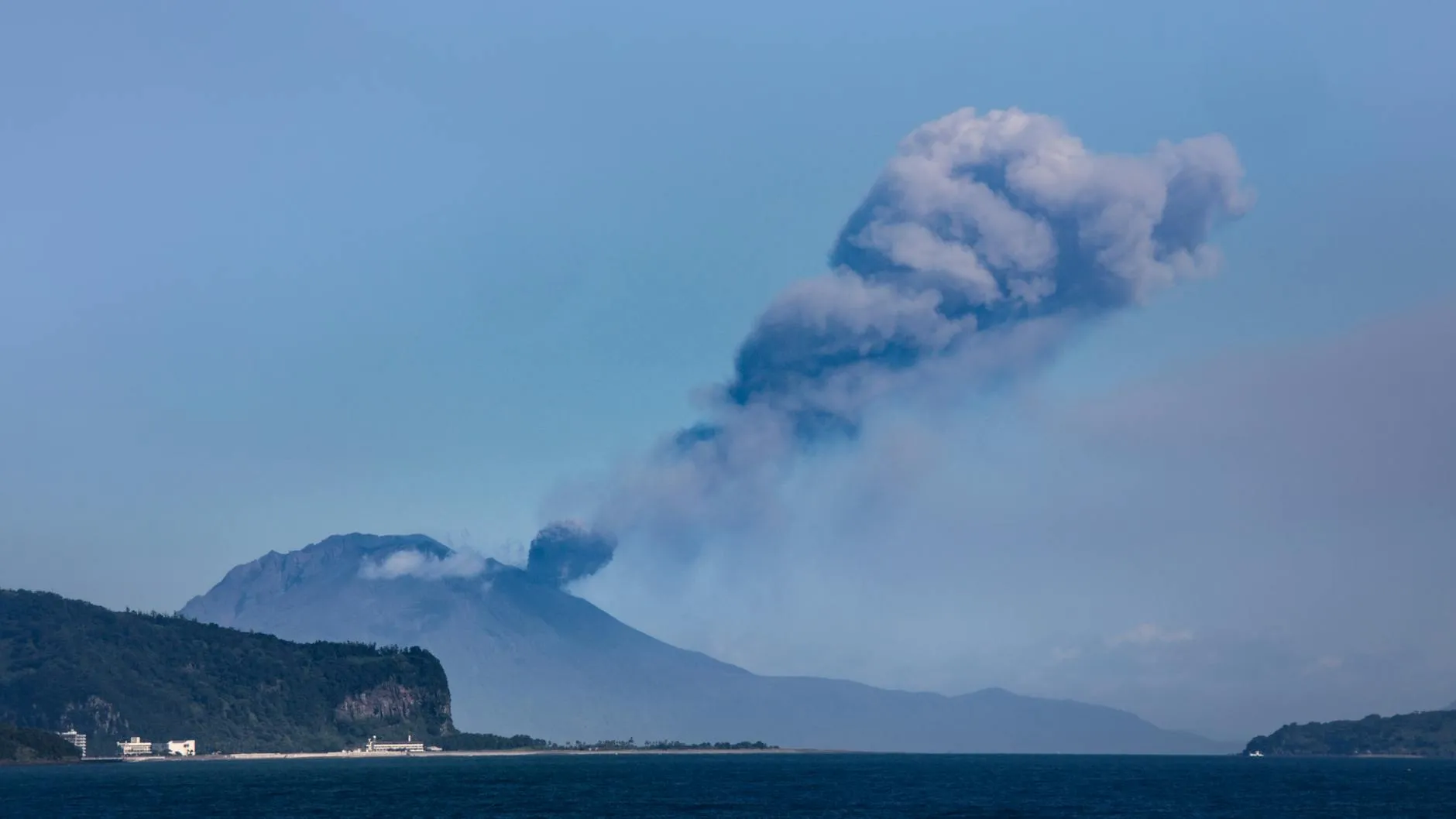
Sakurajima from the airport: free, no transit. On a clear day, the active volcano in Kagoshima Bay is visible from the terminal viewing areas and from Sky Lounge Nanohana. Actually visiting it means going to the city and taking a ferry across the bay — a full half-day minimum, not a connection filler. The airport view is the realistic version of “seeing Sakurajima” on any layover.
Kirishima onsen — viable at four to five hours, with caveats. The maths: 35 minutes out by direct bus, an hour or so in the baths, 35 minutes back, plus buffer for international check-in. Tight but real — if the timetable cooperates, and the timetable is thin. The ¥870 Kagoshima Kotsu bus leaves the airport at 11:10, 12:50, 16:35 and 17:40 only, and its last return from Maruo is 14:28; Kirishima City’s access bus fills in at 09:30, 12:30 and 14:30 on a ¥1,500 day pass, with the last airport-bound departure from Maruo at 16:36. Nothing runs back after that, so an afternoon soak can leave you at the onsen overnight. Check the return bus time before you leave the terminal, not when you’re standing at the stop in a towel. Kirishima Jingū, the area’s main shrine, is easier than the baths rather than harder: the same Kirishima City access bus runs from the airport to the shrine with no transfer in 45 minutes, at 09:30, 12:30 and 14:30 (plus 17:20 at weekends and on public holidays), on the same ¥1,500 day pass.
Kagoshima city — needs six hours or more. Forty minutes each way by limousine bus. A round trip plus anything worth doing — Tenmonkan, Sengan-en garden, the Sakurajima ferry — plus check-in buffer doesn’t fit under six hours without cutting something. Under four hours, don’t attempt the city; use the footbath, eat the black pork, watch the volcano.
⏱️ Layover verdict at a glance
Under ~4 hrs: stay airside. ~4–5 hrs: Kirishima onsen is viable if the bus timetable lines up. ~6 hrs+: Kagoshima city is feasible. Sakurajima: airport view only unless you have a full day.
🔧 Practical Notes
Cash. Japan is more cash-friendly than its reputation in travel media suggests, and rural Kyushu more so than Tokyo. Cards and contactless work at the airport, the limousine bus and city shops. IC cards — Suica, Icoca and the local Rapica — cover transit and convenience stores. Carry some yen for smaller onsen towns, local buses and family-run restaurants, where card acceptance thins out. Convenience-store and Japan Post ATMs reliably take foreign cards.
Currency. ¥159 to the US dollar, ¥186 to the euro as of May 2026. Airport exchange counters charge a poor rate with a markup on top; change only what you need there and use ATMs or card payment for the rest.
Connectivity. Japan does not block Western apps and services. Airport and public Wi-Fi is widely available. A travel eSIM or pocket Wi-Fi arranged before arrival is the most reliable option and lets you run Visit Japan Web and transit apps from the moment you land.
❓ FAQ
📊 At a Glance — KOJ 2026
| Item | Detail |
|---|---|
| IATA / ICAO | KOJ / RJFK |
| Location | Kirishima, ~30 km northeast of central Kagoshima |
| Terminals | Domestic (nine gates) + smaller international terminal (single gate) |
| Bus to city | Airport limousine → Kagoshima-Chuo Station, ¥1,500, ~40 min, ~every 20 min (Nangoku Kotsu / Kagoshima Kotsu) |
| Bus to onsen | Direct → Kirishima Onsen (Maruo), ~35 min · Kagoshima Kotsu ¥870 point fare, four airport departures a day (11:10, 12:50, 16:35, 17:40) · Kirishima City access bus needs the ¥1,500 day pass · last bus back to the airport 16:36 |
| Taxi | Official rank; several times the bus fare over 30 km |
| Currency | JPY (¥) · ≈ ¥159/US$1, ≈ ¥186/€1 (May 2026) |
| Payment | Cards/contactless widely accepted; carry cash for onsen towns and local buses |
| Border | Visa exemption (~74 countries, usually 90 days; some up to 6 months, some 15–30 days) or visa/eVisa; Visit Japan Web for arrival |
| JESTA | Law passed 29 May 2026; NOT operational, targeted fiscal 2028 — not required in 2026 |
| Pay lounge | Sky Lounge Nanohana, domestic landside, ¥1,100, 07:00–20:00 — Priority Pass not accepted |
| Priority Pass | No lounge; Body Care LUCK spa discount only |
| Free footbath | Oyattosa, domestic terminal ground floor by Exit 3, free, 09:00–19:30 |
| Based carriers | Japan Air Commuter (HQ); ANA & JAL dominate, plus Peach, Jetstar Japan, Fuji Dream, Solaseed Air, IBEX and Skymark; international: Korean Air, Eastar Jet, Jeju Air, China Airlines, China Eastern, Hong Kong Airlines, HK Express |
| Short-layover verdict | Under ~4 hrs stay airside; Kirishima onsen ~4–5 hrs (bus timetable permitting); Kagoshima city ~6 hrs+; Sakurajima = airport view only |