Mashhad Shahid Hasheminejad International Airport (MHD) — Airport Guide 2026
Mashhad’s airport reopened to international traffic on 21 April 2026, 52 days after conflict with Israel and the United States closed every Iranian airport simultaneously — the fact that makes confirming your specific route’s operational status the obligatory first step before purchasing anything.
Quick Reference
MHD / OIMM
Mashhad Shahid Hasheminejad International Airport
1951; renamed Shahid (Martyr) Hasheminejad after the Iran–Iraq War
Mashhad, Razavi Khorasan, Iran
~8 km each; ~15 min by road
T1 domestic (~35,000 m²) · T2 int’l arrivals (~21,000 m²) · T3 int’l departures (~10,000 m²)
~8 million passengers
22,000+ passengers; ~170–240 flights
Iranian rial (IRR); quoted in toman (1 toman = 10 rials)
~1,708,000 IRR ≈ 170,800 toman per US$1 (30 May 2026)
~42,000 IRR per US$1 (unobtainable in practice)
None work — bring physical USD or EUR
Visa on arrival or e-visa
Pre-arranged visa + licensed guided tour mandatory; ~40 working days
Line 1, Hasheminejad Airport station (indoor link); Haram station for the shrine
10,000 IRR (1 toman); day pass 50,000 IRR
CIP Lounge, T2 — pay-per-use; no Priority Pass / LoungeKey / DragonPass
Level 4: Do Not Travel
International flights suspended 28 Feb 2026; resumed 21 Apr 2026
✈️ The 2026 Reopening
All Iranian airports closed on 28 February 2026 when conflict with Israel and the United States began. MHD’s international service was suspended for 52 days and restarted on 21 April 2026. The civil-aviation authority described the restart as gradual, prioritising regional connections and returning residents before a fuller visitor-facing schedule. As of late May 2026, the international network is thinner than its pre-February state.
⚠️ Routes are provisional — confirm before booking
The post-conflict schedule is still rebuilding. Any route you find online for MHD may not be operating by the time you fly. Reconfirm directly with the carrier before purchasing.
Before the closure, MHD’s international service was regional and concentrated on the Persian Gulf and Iraq, with pilgrimage-charter traffic layered on top. Iranian carriers — Iran Air, Mahan Air, Iran Aseman and Kish Air — carry the domestic and regional load. Given the post-conflict rebuild, do not assume any single foreign carrier is operating MHD this month; check live schedules. There are no direct flights to Europe or North America in either direction, and that was true before 2026 as well.
🏢 Terminals & Layout
The split here is functional, not by airline. Terminal 1, the largest at about 35,000 m², handles all domestic flights — the Tehran, Shiraz, Isfahan, Kish and Ahvaz services that make up the bulk of the airport’s volume. Terminal 2 (~21,000 m²) is international arrivals: passport control, customs and baggage reclaim for everyone landing from abroad. Terminal 3 (~10,000 m²) is international departures, where check-in, outbound border control and the duty-free zone sit.
Because the domestic operation so overwhelms the international one, most of the airport’s retail and food concentrates in T1. The international terminals are smaller, calmer and thinner on amenities — which has a practical consequence: if you have time before clearing airside at T3, eat and shop first. The departures side offers considerably less.
A layover or a domestic-to-international connection can require a landside transfer between buildings rather than an airside walk to the next gate. Allow 15–20 minutes for the move, account for re-clearing security, and do not assume bags are checked through unless the airline confirms it.
Prayer rooms are throughout the building — this is a pilgrimage city and the airport is organised around that fact. Signage is bilingual Persian and English. The pace follows the religious calendar: calmest in the small hours, packed around Nowruz (Persian New Year, late March) and the Imam Reza commemoration dates, when pilgrim numbers spike and the queues at T2’s passport control stretch noticeably. There is a left-luggage facility, a post office, and basic pharmacy and medical provision. The airport’s address is 15 Khordad Square at the end of Islamic Republic Boulevard. The intercity rail station sits about 11 km away — relevant if you are continuing by train, since Iran’s rail network reaches Mashhad and is a cheaper if slower alternative to a domestic flight onward.
🛂 Border & Visa
Iran operates a two-track visa system, and your passport determines which track before you arrive.
Easy track — most nationalities. Citizens of most countries can get a visa on arrival at MHD (typically 30 days) or an e-visa through the Ministry of Foreign Affairs portal in advance.
Hard track — US, UK and Canada. These three cannot get a visa on arrival and cannot travel independently. They must obtain a pre-arranged visa with a Ministry-issued authorisation code before flying, and — under policy revised in September 2025 — must travel as part of a guided tour booked through a registered Iranian agency, accompanied by a licensed guide for the duration of the trip. The same guided-tour requirement extends to certain European, Australian and New Zealand nationals. Processing for US, UK and Canadian applicants runs roughly 40 working days, making this a months-ahead arrangement, not a last-minute one. The exclusion list that also bars the standard e-visa includes Afghanistan, Bangladesh, Colombia, Iraq, Jordan, Pakistan and Somalia alongside the US, UK and Canada. Verify your nationality against the official portal before booking anything.
Iran stamps passports, though it has at times issued visas on a separate sheet for travellers concerned about onward entry to countries that scrutinise Iranian stamps. Ask your agency about this if it matters. Evidence of travel to Israel — including an Israeli stamp — can complicate or block Iranian entry.
⚠️ Dual-national detention risk — read this before anything else
Iran does not recognise dual nationality. A US–Iranian, UK–Iranian or Canadian–Iranian dual national is treated solely as an Iranian citizen, must enter and exit on an Iranian passport, and has no consular protection from their other country. The US State Department explicitly names dual nationals — alongside journalists, academics and people with US government backgrounds — as being at serious risk of wrongful detention. This is not a paperwork inconvenience; it is the central reason the Western advisories sit where they do.
Health entry requirements: no vaccinations are required from most countries; a yellow-fever certificate applies only if arriving from an endemic zone. Tap water in Mashhad is generally considered safe, though many visitors default to bottled water early in a trip. Bring any prescription medication in original packaging with a doctor’s letter and verify nothing in your kit is restricted under Iranian import rules.
💸 Currency & the Sanctions Wall
The official unit is the Iranian rial (IRR), but nobody quotes prices in rials. Shopkeepers, taxis and menus speak in toman, where 1 toman = 10 rials. A price of “fifty toman” means 500,000 rials. Get this conversion wrong once and you overpay; get it wrong habitually and the entire trip is a series of overpayments.
There are two exchange rates with an enormous gap between them. The official Central Bank rate sits near 42,000 IRR per US dollar — a subsidised figure used for state imports that no traveller ever receives. The operative rate is the free market: on 30 May 2026 it ran approximately 1,708,000 IRR (≈ 170,800 toman) per dollar, having risen roughly 44% over the prior six months. Change money at a licensed exchange office — a sarrafi — not at a bank and not at the official counter.
💵 Cash only — no exceptions, no backstop
Iran is cut off from SWIFT, Visa, Mastercard, American Express, Apple Pay and Google Pay. No foreign card works anywhere in the country — every ATM, every hotel counter, the duty-free till all run on domestic rails that international cards cannot reach. Bring physical US dollars or euros in clean, undamaged notes sufficient to cover the entire trip plus a realistic emergency cushion. Torn or marked bills get rejected or discounted at sarrafis. Some tour operators offer a local tourist card preloaded with your cash on arrival — worth arranging in advance if you are uncomfortable carrying a thick stack.
🚆 Getting Into the City
The shrine and city centre are both around 8 km from the terminals — about 15 minutes in clear traffic, longer on pilgrimage peaks. Four options.
🚇 Metro
MHD is one of relatively few airports worldwide with a metro station built into the terminal. Line 1 of the Mashhad Urban Railway runs to Hasheminejad Airport station, connected indoors to the building via an extension completed in 2016. Line 1 stops at Haram station, which serves the Imam Reza shrine directly — terminal to shrine without a taxi or transfer. A single journey costs 10,000 IRR (1 toman); a day pass costs 50,000 IRR. Pay with a rechargeable Zaer Card or Mancard, topped up at station machines or counters; both cards are also valid on buses and parking. Students, seniors and disabled travellers get 50% off.
🚇 Metro Line 1 — 10,000 IRR, terminal to shrine
Hasheminejad Airport station connects indoors to the terminal. One ride to Haram station puts you at the Imam Reza shrine with no transfers. At the free-market rate, the 10,000-IRR fare is a fraction of a cent. Get a Zaer Card at the station counter.
🚕 Taxi
Taxis wait outside the terminals around the clock. The fare to the city centre or shrine runs roughly 200,000–300,000 IRR (about US$1–2 at the free-market rate). Agree the fare before getting in — airport taxis quote high to arrivals and there is no meter culture for this run. The local rideshare apps Snapp and Tapsi (Uber does not operate in Iran) are cheaper and remove the negotiation, but require a working Iranian phone number and cash payment to the driver. Get a SIM first, or have your guide order the car.
🚌 Bus
City buses connect the airport to the Kaveh terminal and the centre for around 50,000 IRR (~US$0.30). They are the cheapest motorised option but slow, infrequent and awkward with luggage. For most international arrivals, the metro or a taxi is the better call.
🛋️ Lounges
MHD has one lounge: the CIP Lounge (Commercially Important Person) at Terminal 2, on the international side. It operates two covered spaces overlooking the runway, an open garden area, and — this is the distinguishing feature — its own dedicated passport, police and customs gates. CIP users bypass the main terminal queues entirely. On a heavy pilgrimage day, those queues at T2 are the slow part of arriving at MHD, and that queue-skip is more valuable than anything else the lounge offers.
🛋️ CIP Lounge — the queue bypass is what you’re buying
Pay-per-use or arrange through your tour operator; pricing is per person, settled in cash, so confirm the figure before you commit. Book in advance rather than turning up and hoping. The value is the dedicated passport and customs gates, not the food or the runway view.
None of the Western lounge networks operate in Iran. Priority Pass, LoungeKey, DragonPass and Amex Platinum lounge access are all unavailable — not because the airport lacks a lounge, but because those networks settle through the same sanctioned payment rails that make your bank card useless. The CIP Lounge is the only option, and it is cash only.
For a returning resident or a leisure traveller with time, the standard terminal is fine. The CIP product makes sense for anyone on a tight connection, travelling with elderly relatives, or arriving during a religious peak when the main T2 queues are visibly long.
🍽️ Food & Duty-Free
🥩 Khorasani Food
Mashhad’s kitchen is Khorasani, built around two dishes. Shishlik is the regional signature: lamb ribs marinated overnight in onion and lemon juice, saffron and oil, then charcoal-grilled on long skewers — the dish people make the deliberate drive out to the Shandiz district specifically to eat. Sholeh Mashhadi is the other: a slow-cooked porridge of lamb, mung beans, lentils, red beans, bulgur and rice with cardamom, cinnamon and ginger, traditionally prepared for religious gatherings and the mourning months of Muharram and Safar. Dizi (lamb-and-chickpea stew mashed at the table) and saffron rice round out the standard table.
Airport catering is the predictable downgraded version at a premium price. Expect basic kebab counters, sandwiches and café fare rather than charcoal-grilled ribs. A shishlik plate running 1.5–2.5 million IRR (150–250 toman, roughly US$1–1.50) at a working grill in town will cost noticeably more inside the terminal for a worse result. Eat in the city before you clear airside at T3 if your schedule allows; the international departures side carries less catering than the domestic terminal.
For the real thing: Padideh Shandiz and Erum Shandiz are the most-cited names in the Shandiz dining belt, 20–30 minutes west of the centre, built around shishlik and grills. In the city, Baba Ghodrat is a long-standing traditional kitchen; Rastgoo and Pesaran-e Karim appear on Khorasani-cuisine shortlists for dizi and sholeh. Operating hours shift with the religious calendar — Muharram and Safar affect what is open and what is being cooked; reconfirm locally.
🛒 Duty-Free
The duty-free zone is in Terminal 3. Khorasan province produces most of the world’s saffron, the quality is high, and the free-market exchange rate makes it dramatically cheaper to a visitor holding dollars than the same grade commands abroad.
🌿 Buy saffron — this is one purchase that makes genuine sense
Khorasan is where most of the world’s saffron comes from. Quality is high and the free-market rate makes it dramatically cheaper than what the same grade costs abroad. The city bazaars are cheaper still and let you choose grade by weight — treat T3 duty-free as a fallback if you run out of time before departure.
Beyond saffron, the sensible buys are pistachios, dried barberries (zereshk), rosewater, sohan (a saffron brittle) and gaz (a nougat). Alcohol does not exist here — Iran is dry, so there is no liquor in duty-free at all. All purchases are cash-only; the sanctions card wall applies to the duty-free till exactly as it does everywhere else.
🕌 The Imam Reza Shrine
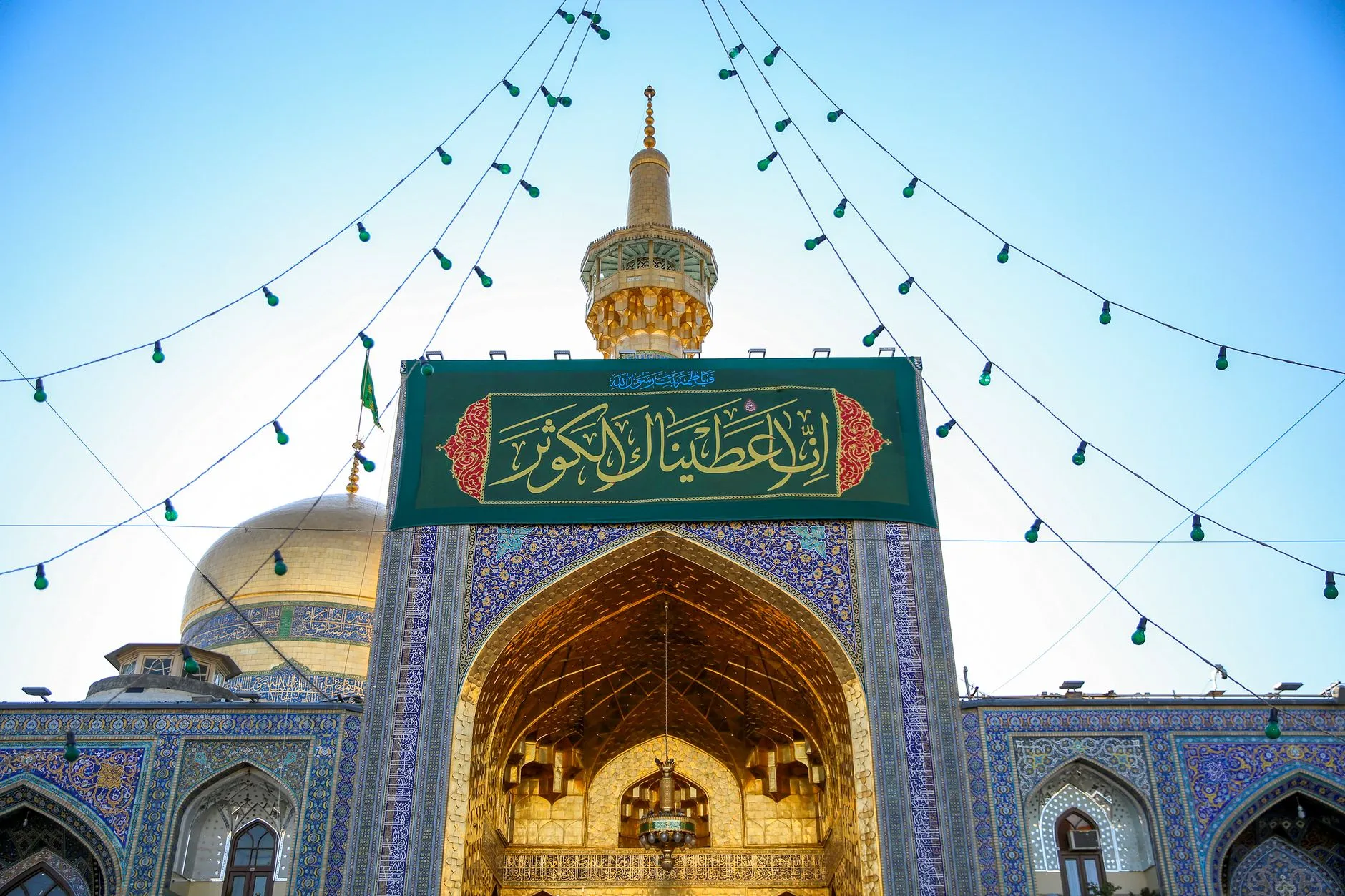
The shrine is why almost everyone who passes through MHD is in Mashhad. The complex covers approximately 1.2 million m², making it the third-largest mosque in the world after Mecca’s Masjid al-Haram and the Prophet’s Mosque in Medina, and draws roughly 30 million pilgrims a year. Those numbers are what generate the airport’s volume — MHD is a pilgrimage airport that also happens to serve domestic routes.
Non-Muslims are welcome in the courtyards and most of the complex. Two areas — the Goharshad Mosque and the inner tomb chamber (the Rowzeh) — are off-limits unless you are accompanied by an official shrine guide, arranged at the visitor desk. Dress rules are strict and enforced: women must wear a chador (provided at the entrance), and everyone must cover shoulders and knees. Cameras must be checked at the entrance; mobile phones are allowed, and photography is tolerated in the courtyards while restricted in prayer halls and museums. The Astan Quds Razavi Central Museum, founded in 1937 and drawing over a million visitors a year, is worth an hour for its manuscripts, carpets and the shrine’s historic fittings.
🧭 Shrine layover math — be honest with the arithmetic
The shrine is ~8 km from the terminal, a direct Line 1 metro ride to Haram station. A genuine visit — metro in, an hour in the courtyards and museum, metro back — requires at least 5–6 hours of layover, with bags checked through and a minimum 2-hour buffer before your onward flight for re-clearing departure security and the international-terminal process. Under 4 hours of layover: the transit time alone consumes the window. Do not attempt it.
🗺️ Day-Trips from Mashhad
Tus / Ferdowsi’s tomb (25 km northwest, ~30-minute drive): The mausoleum of Ferdowsi, who wrote the Shahnameh and — the traditional account holds — effectively preserved the Persian language, sits in the ancient city of Tus. City bus 202 runs there from central Mashhad, or a taxi makes it a straightforward half-day. Hours run roughly 09:00 to 16:00 or 17:00 depending on season; verify before going. This is the most accessible day-trip from Mashhad.
Nishapur / Omar Khayyam and Attar (115 km west, ~1.5 hours by road): The tombs of Omar Khayyam — mathematician, astronomer, poet of the Rubaiyat — and the mystic Attar are both here. The distance makes this a full-day outing rather than a half-day; it is impossible on any layover. Treat it as a trip in its own right.
Shandiz (20–30 minutes west): The dining and greenery district where Mashhadis go for shishlik and a day out in the foothills. Pairs naturally with a Tus visit; more about eating than monuments.
🔒 Safety & Travel Advisories
The US State Department rates Iran Level 4: Do Not Travel, citing terrorism, civil unrest, kidnapping, arbitrary arrest and the wrongful detention of US nationals. The UK, Canada and Australia hold their highest advisory levels. The detention risk is documented, not hypothetical, and falls acutely on dual nationals, who the Iranian government treats as solely Iranian citizens with no consular access from their other country.
There is no US embassy in Iran. US interests are handled by the Swiss embassy in Tehran acting as the protecting power, meaning the consular response available elsewhere is indirect and limited. The same constraint applies in varying degrees to other Western nationals.
The regional context matters: the conflict that closed MHD for 52 days in early 2026 is recent. Conditions can change quickly. Check your government’s current advisory immediately before travel — not when you book, but in the days before you fly — and register with your embassy or its protecting power on arrival.
Street crime in Mashhad is low by international standards. Petty theft clusters around the crowded pilgrimage areas and transport hubs; keep cash split across more than one location and documents secure. Exercise judgment about photography near government buildings, military sites and some religious sites, and follow your guide’s lead on what is acceptable. Tipping is customary but modest — round up taxi fares and leave a small amount at restaurants; given the gap between the dollar’s free-market value and local wages, a modest tip from a visitor carries more weight than the arithmetic suggests.
📱 Connectivity & Practical Notes
Airport WiFi exists but is patchy. The practical fix is a local SIM: Iranian operators Irancell and Hamrah-e Aval (MCI) sell prepaid tourist SIMs, sometimes available at the airport and otherwise easy to find in town. A local number is also what unlocks the Snapp and Tapsi ride apps.
📱 Install your VPN before landing — the app stores may be blocked once you’re in
Iran filters the internet heavily. Instagram, WhatsApp, Google services and the app stores are blocked or throttled intermittently. You will want a VPN; the problem is that the app store you would download it from may itself be inaccessible once you are in-country. Install and test the VPN before departure.
On currency, one final practical note: bring clean, undamaged US dollar or euro bills — torn or marked notes get rejected or discounted at sarrafis. Change only at a licensed sarrafi, not on the street and not at the official bank window. Keep your running tally in toman, not rials, to match how prices are quoted. The cash you bring when you land is all you have; there is no card network, no international ATM and no wire transfer available as a fallback anywhere in Iran.
❓ FAQ
📊 At a Glance — MHD 2026
| Category | Detail (verified late May 2026) |
|---|---|
| Airport | Mashhad Shahid Hasheminejad International (MHD / OIMM) |
| Established / renamed | 1951; renamed Shahid Hasheminejad after the Iran–Iraq War |
| Terminals | T1 domestic (~35,000 m²) · T2 int’l arrivals (~21,000 m²) · T3 int’l departures (~10,000 m²) |
| Annual capacity | ~8 million passengers |
| Daily flights / passengers | ~170–240 flights; 22,000+ passengers on a busy day |
| Distance to centre / shrine | ~8 km each; ~15 min by road |
| Airport address | 15 Khordad Square, end of Islamic Republic Boulevard |
| Metro | Line 1, Hasheminejad Airport station (indoor link); Haram station for the shrine |
| Metro single ticket | 10,000 IRR (1 toman); day pass 50,000 IRR |
| Metro concessions | 50% for students, seniors, disabled travellers |
| Metro card | Zaer Card or Mancard (rechargeable; valid on buses and parking) |
| Taxi to city / shrine | ~200,000–300,000 IRR (US$1–2 free-market); agree fare first |
| Bus to centre | ~50,000 IRR (~US$0.30) |
| Ride apps | Snapp, Tapsi (need Iranian SIM; cash payment to driver) |
| Currency | Iranian rial (IRR); quoted in toman (1 toman = 10 rials) |
| Free-market rate | ~1,708,000 IRR ≈ 170,800 toman / US$1 (30 May 2026) |
| Official rate | ~42,000 IRR / US$1 (unobtainable in practice) |
| Cards / ATMs | None work — cash USD or EUR only |
| Visa (most nationals) | Visa on arrival or e-visa at MHD |
| Visa (US / UK / Canada) | Pre-arranged visa + licensed guided tour; ~40 working days processing |
| Lounge | CIP Lounge (T2); no Priority Pass / LoungeKey / DragonPass |
| Duty-free | Saffron, pistachios, barberries (zereshk), rosewater, sohan, gaz — no alcohol |
| Imam Reza shrine | ~1.2 million m²; third-largest mosque worldwide; ~30 million pilgrims/year |
| Shrine access | Non-Muslims welcome in courtyards; Goharshad Mosque and Rowzeh require shrine guide |
| Shrine museum | Astan Quds Razavi Central Museum (founded 1937; 1 million+ visitors/year) |
| Day-trips | Tus / Ferdowsi 25 km; Nishapur / Khayyam & Attar 115 km; Shandiz 20–30 min |
| Intercity rail | Mashhad rail station ~11 km from airport |
| US advisory | Level 4: Do Not Travel; acute dual-national detention risk |
| 2026 change | International flights suspended 28 Feb 2026; resumed 21 Apr 2026 |