Sharjah International Airport (SHJ) — Airport Guide 2026
Air Arabia launched twice-daily nonstop service between Sharjah and London Gatwick on 29 March 2026, flown by the Airbus A321neo LR in a 215-seat all-economy configuration — a direct statement that low-cost long-haul out of SHJ is no longer experimental.
Quick Reference
SHJ / OMSJ
Sharjah, UAE
~15 km (20–30 min by road)
~30 km (45 min–1h45 depending on traffic)
Air Arabia (~80% of movements)
32 airlines on the airport’s roster, including Qatar Airways, IndiGo, Air India Express, Pakistan International, Fly Jinnah, flynas, EgyptAir, AJet, Pegasus, Uzbekistan Airways, Biman, RwandAir and Kenya Airways
UAE dirham (AED); pegged at 3.6725 AED = 1 USD
AED 1 ≈ USD 0.27 ≈ EUR 0.23
Visa-free 30/90 days for many nationalities; visa-on-arrival for others
Banned emirate-wide — no airport bar, no duty-free liquor
“The Lounge” — Priority Pass + walk-in, airside, 24h
Air Arabia coach to Al Ghurair, AED 20 (~1h)
AED 20 flat, on top of the metered fare
AED 2.4bn expansion targets 20M by 2027; the airport publishes no current capacity figure
Desalinated and safe; most residents drink bottled
✈️ Terminal & Air Arabia
Sharjah runs a single passenger terminal for both arrivals and departures. That simplicity has a cost: at peak Air Arabia banks — typically early morning and late evening — the check-in hall and the single central security checkpoint back up. Budget three hours before a long-haul departure, two for a short Gulf or Indian hop. Through 2026, active expansion works mean temporary signage and occasional re-routing; the layout you see one trip may differ from the next.
The airport’s history runs deeper than the country it sits in. The original RAF Sharjah airfield opened in 1932 as the first airport on the Arabian side of the Gulf, built by Imperial Airways to route its London-to-India service down the western shore. It served as a colonial staging post on the Empire air route. The modern terminal at the current site opened in 1977, and for years it remained a quiet cargo and charter field overshadowed by Dubai next door.
That changed in 2003, when Air Arabia launched from here as the region’s first low-cost carrier. Today roughly 80% of all movements at SHJ are Air Arabia, and that dominance shapes the passenger experience completely: the terminal is built for point-to-point budget travel. There is no sprawling airside retail mall and the arrivals experience is functional rather than premium. This is not a gap waiting to be filled — it is the entire premise.
The other half of SHJ’s identity is freight. The airport is embedded in the Sharjah Airport International Free Zone (SAIF Zone), one of the UAE’s largest free-trade zones, and the cargo operation is a serious regional player — Sharjah has historically ranked among the Middle East’s top air-freight hubs by tonnes moved. As a passenger you will not see this directly, but it explains why the airport runs around the clock and why the apron is busier with freighters than the passenger schedule alone would suggest.
A substantial expansion programme is underway: AED 2.4 billion (around USD 650 million) to add a new Air Arabia check-in lobby, a fresh sterile arrivals corridor, a centralised screening checkpoint, and a new baggage system. The target is 20 million passengers a year by 2027. The airport publishes no current annual capacity figure; for scale, its own newsroom reported around three million passengers across July and August 2026, and 392,700 in the single week of 10 to 16 August.
Beyond Air Arabia, the airport’s own operating-airlines list runs to 32 carriers. IndiGo and Air India Express are the two you are most likely to share the terminal with, both running dense schedules to Indian cities. Qatar Airways is the second name on that list; the Pakistan corridor is flown by Pakistan International, Fly Jinnah, Airblue and Serene Air, Turkey by Pegasus and AJet, Saudi Arabia by flynas, Egypt by EgyptAir, Air Cairo, Nile Air and Fly Egypt, and Africa by RwandAir and Kenya Airways, alongside Uzbekistan Airways, Belavia, Biman, US-Bangla, Jordan Aviation, Cham Wings and Syrian Arab Airlines. IndiGo began scheduled UAE operations in March 2026 and added a daily Kochi–Sharjah service on 7 May 2026, alongside flights to Lucknow, Hyderabad, Kozhikode and Thiruvananthapuram. The India-UAE labour and family corridor is the backbone of SHJ’s traffic.
Orientation: Arrivals immigration is on the ground level; the baggage hall and a row of car-rental and SIM-card desks are beyond it. Departures check-in and the food court are on the floor above. The single lounge is airside on the first floor — details below.
⚠️ Caution: Construction through 2026
The AED 2.4bn terminal expansion is live. Expect temporary signage, diverted walkways, and a layout that can differ from your last visit. Add at least 15 minutes to any pre-flight calculation.
🛂 Border & Visa
A UAE visa covers all seven emirates, so your Sharjah arrival stamp is the same document that lets you cross into Dubai an hour later. The rules split three ways by nationality, and you should verify your own case against the official UAE government portal before you fly — lists do shift.
90-day visa-free on arrival for the UK, Ireland, the United States, Canada, Australia, New Zealand, and most of Western and Central Europe — Germany, France, Italy, Spain, the Netherlands, and comparable.
30-day visa-free for GCC neighbours: Saudi Arabia, Kuwait, Bahrain, Oman, and Qatar.
E-visa or conditional visa-on-arrival for nationalities outside both groups, including many South Asian, African, and CIS passports. Indian passport holders can obtain a 14-day visa on arrival — but only if they already hold a valid US, UK, EU, Australian, or Canadian visa or residence permit. Without one of those qualifying documents, an e-visa arranged through the airline or a sponsor before travel is the correct route.
There is no separate departure tax payable at the check-in counter; passenger fees are built into the ticket price.
💱 Currency
The UAE dirham (AED) has been pegged to the US dollar at a fixed 3.6725 AED per USD since 1997. That rate does not move. Against the euro it floated near AED 1 = EUR 0.23 in May 2026 (verify before travel, as the euro leg is unpegged). Notes run from AED 5 to AED 1,000; coins from 1 dirham down. There is no parallel or black-market rate to seek out — the airport exchange desks and city banks quote essentially the same number. Carry cash for the Air Arabia coach and small street purchases; the RTA intercity bus accepts only the Nol card.
🚫 The Dry-Emirate Reality
Sharjah is the only UAE emirate that bans alcohol outright. The prohibition covers the entire territory — public and private, the airport included. There is no airside bar, no duty-free liquor counter, and no licensed venue anywhere in the emirate. Arriving with alcohol in checked luggage is a genuine legal risk: possession can mean a fine, detention, or deportation. This is not in the category of rules that get overlooked with a warning; enforcement is real.
⚠️ Warning: No Alcohol in Sharjah
The ban applies at the airport, in taxis, inside The Lounge, and in every hotel in the emirate. Do not arrive with liquor in your bag. Travellers who want a drink fly into Dubai or Abu Dhabi — but the moment you return to Sharjah, the rules apply again.
The conservatism extends past alcohol. Sharjah’s public-decency code, in force since 2001, expects modest dress in public — shoulders and knees covered in malls, lobbies, and the airport, with swimwear confined to the beach or hotel pool. Public displays of affection between couples are not tolerated beyond a handshake. During Ramadan — expected to run from around 19 February to 19 March in 2026, dates pending the moon sighting — eating, drinking, and smoking in public during daylight hours is prohibited and enforced. These penalties are real; treat the rules as binding.
No vaccination is required for entry from most countries; a yellow-fever certificate is requested only if arriving from a country where the disease is endemic.
🚆 Getting Into the City
The Dubai Metro does not reach Sharjah. It stops inside Dubai’s emirate boundary. To use it you must first cross the border by road, then board at a Dubai station. Your real options are the Air Arabia coach, the RTA intercity bus, a metered taxi, and a ride-hailing app.
Air Arabia Coach — AED 20 to Dubai
The cheapest direct run to Dubai is the Air Arabia coach from the terminal to Al Ghurair Centre in Deira. A single is AED 20 (roughly USD 5.40). From the airport the service runs approximately 08:00–23:30; from Al Ghurair toward the airport, approximately 10:30–23:30 — verify current timings on the Air Arabia site, as schedules flex with the flight programme. Journey time is typically one hour but can stretch past that in rush-hour traffic. A second Air Arabia coach runs to Ras Al Khaimah for AED 30, and the airport also lists coach services to Abu Dhabi and Al Ain.
🚆 Air Arabia Coach — AED 20 to Dubai
Four destinations: Dubai (Al Ghurair Centre in Deira), Abu Dhabi, Al Ain and Ras Al Khaimah. Cash only. The Dubai run goes approximately 08:00–23:30 from the terminal. Not available after that window — late-night arrivals need a taxi or Careem.
🚌 RTA Intercity Bus — AED 10–12 with Nol Card
Dubai’s RTA runs intercity buses between Sharjah and Dubai; the E306 ends at Al Ghubaiba station in Bur Dubai, near the old gold souk and the abra crossings. The catch: these services depart from Sharjah’s own bus stations — Al Jubail and others — not from the airport door. You first take a local hop to reach them. The fare runs roughly AED 10–12, but RTA intercity buses accept only the Nol card. No cash, no contactless bank card on board. Buy and top up a Nol card at a Dubai metro or bus station before you need one; they are not available at SHJ. End to end, the combination comes to around AED 20 and 1.5 hours to a Dubai station.
🚕 Metered Taxi — AED 70–130
Official airport taxis are metered, and the AED 20 airport surcharge on every trip originating here catches people off guard. A run into Sharjah city, metered at roughly AED 50–60, totals AED 70–80 with the surcharge. A taxi to central Dubai costs roughly AED 100–130 all in and takes about 45 minutes in clear traffic — the fastest option, and competitive when split among three or four passengers.
⚠️ Airport Taxi Surcharge — AED 20
Every taxi originating at SHJ carries a flat AED 20 airport fee on top of the meter. It is not negotiable and not a scam — budget for it.
📱 Ride-Hailing
Careem is the dominant app in Sharjah; Uber also operates across the UAE. App pickups carry the same AED 20 airport surcharge passed through in the quoted fare. The advantage over a street taxi is a visible fixed price before you commit and no ambiguity at the end of the trip — useful late at night.
The Dubai Trade-Off
The reason to fly SHJ for a Dubai trip is the airfare differential. You pay for it in the 30 km of road and the congestion on Al Ittihad Road and the E11, which backs up on weekday mornings (roughly 07:00–10:00) and evenings (roughly 17:00–21:00). For a couple heading to central Dubai with luggage: the Air Arabia coach is AED 20 per head and roughly one hour, but only runs to Al Ghurair in Dubai and not after 23:30. The taxi is AED 100–130 for the whole car, 45 minutes in good traffic, and available any hour. There is no train.
If the saving over DXB beats the AED 20–130 transfer cost and you are not on a tight schedule, SHJ is the sound choice. If you are arriving at rush hour with a hotel in Dubai Marina, plan for 90 minutes door to door and decide whether the saving still holds.
🛋️ Lounges
SHJ has one lounge. There is no airline flagship, no premium-carrier suite, no competing options — SHJ is not that kind of airport, and the single offering reflects that honestly.
The Lounge is airside on the first floor, opposite the Transfer Desk — after duty-free, turn left and follow the signs. It runs 24 hours a day, seats over 230 guests, and accepts Priority Pass as well as walk-in payment (around EUR 37 for a three-hour stay at the door; under-2s free, ages 2 to 12 charged at half the adult rate, over-12s at the full adult fee). The offer inside: an international buffet with full breakfast, lunch, and dinner service; a quiet zone; Wi-Fi; televisions; international newspapers and magazines; a dedicated check-in counter for airline guests. There are no showers: the operator’s published facility list does not include them. Check the access rules before you plan a long wait around it — the charge covers up to three hours, admission starts three hours before your scheduled departure and can be restricted when the lounge is full, and sleeping in the lounge is not permitted. The doors are open 24 hours; the stay is not.
🛋️ The Lounge — Priority Pass or ~EUR 37 walk-in
Airside, 24h, first floor opposite the Transfer Desk. Seats 230+. Solid contract lounge — not a five-star showcase, but the only option here, and a real improvement over the departures hall. The charge covers up to three hours, entry starts three hours before departure, and sleeping is not permitted. Confirm Priority Pass, DragonPass, or LoungeKey acceptance in your app before relying on it, as contracted partners can change.
Being in Sharjah, The Lounge serves no alcohol. The buffet and soft drinks are the extent of it.
🍽️ Food Before You Fly
The food court is above the check-in level and runs 24 hours. The airport’s official listing confirms its existence without committing to a fixed roster of named outlets — an honest position given the ongoing construction works, which shift the line-up. Rather than name a counter that may have moved, plan on fast-food outlets, a coffee chain or two, and shawarma and biryani counters reflecting the airport’s heavy Gulf-and-India traffic. Check the airport’s live dining page close to travel for current named brands.
🫓 Eat in the City, Not Airside
A shawarma that runs AED 12–18 at the food court costs AED 7–10 at a roadside counter in Sharjah city. Karak chai — one dirham in town — can be five times that airside. On a budget airline, the practical move is to eat before you go out or after you arrive, not in the terminal.
The regional staples that perform well at counters here: shawarma (spit-roasted chicken or lamb in flatbread), biryani (spiced rice with meat, an Indian-Gulf crossover that dominates the passenger mix), machboos (the Emirati spiced-rice-and-meat dish), and karak chai — strong milky tea boiled with cardamom and sugar, widely available for a dirham or two and the closest thing to a universal drink in the working UAE.
If you have time landside before a flight, the Al Majaz Waterfront in Sharjah city offers sit-down options at markedly better prices than anything in the terminal; the Rolla district, roughly 15 km from the airport, has the busy, cheap South Asian canteens that feed the city’s workforce. Neither is airport-convenient, but both are worth knowing if time allows.
Airport pricing is inflated by design. The food court is for convenience, not value.
🛍️ Duty-Free
The duty-free shop carries fragrances, cosmetics, tobacco, chocolate, and souvenirs. Alcohol is absent entirely — no liquor counter, full stop. If you want a bottle for elsewhere, this is not the airport at which to buy it. Items worth the shelf space: dates (Medjool and Khalas grades), Arabic sweets, oud and attar perfumes, and packaged karak or Arabic coffee — all reasonably priced and all more genuinely Gulf than the generic chocolate towers that fill the centre shelves.
💡 Layovers & Day-Trips
A layover at SHJ divides cleanly by duration. Short connections stay airside. Anything under five hours is not worth clearing immigration for.
⏱️ Layover Math
Clearing arrivals immigration, taking a taxi to central Sharjah (30 minutes each way), spending two hours at a site, and returning with a two-hour pre-departure buffer requires a minimum of five hours of layover. Below that, the arithmetic does not work. Dubai’s sights are 45 minutes to 1h45 away each way — only attempt them on a layover of eight hours or more.
📍 Layover Thresholds
Five hours minimum before it is worth leaving the airport for Sharjah. Eight hours minimum before Dubai is a rational call. Below five hours, stay airside — The Lounge is an option, but it admits you only from three hours before departure and the charge covers three hours.
Sharjah — Sites Feasible on Medium Layovers
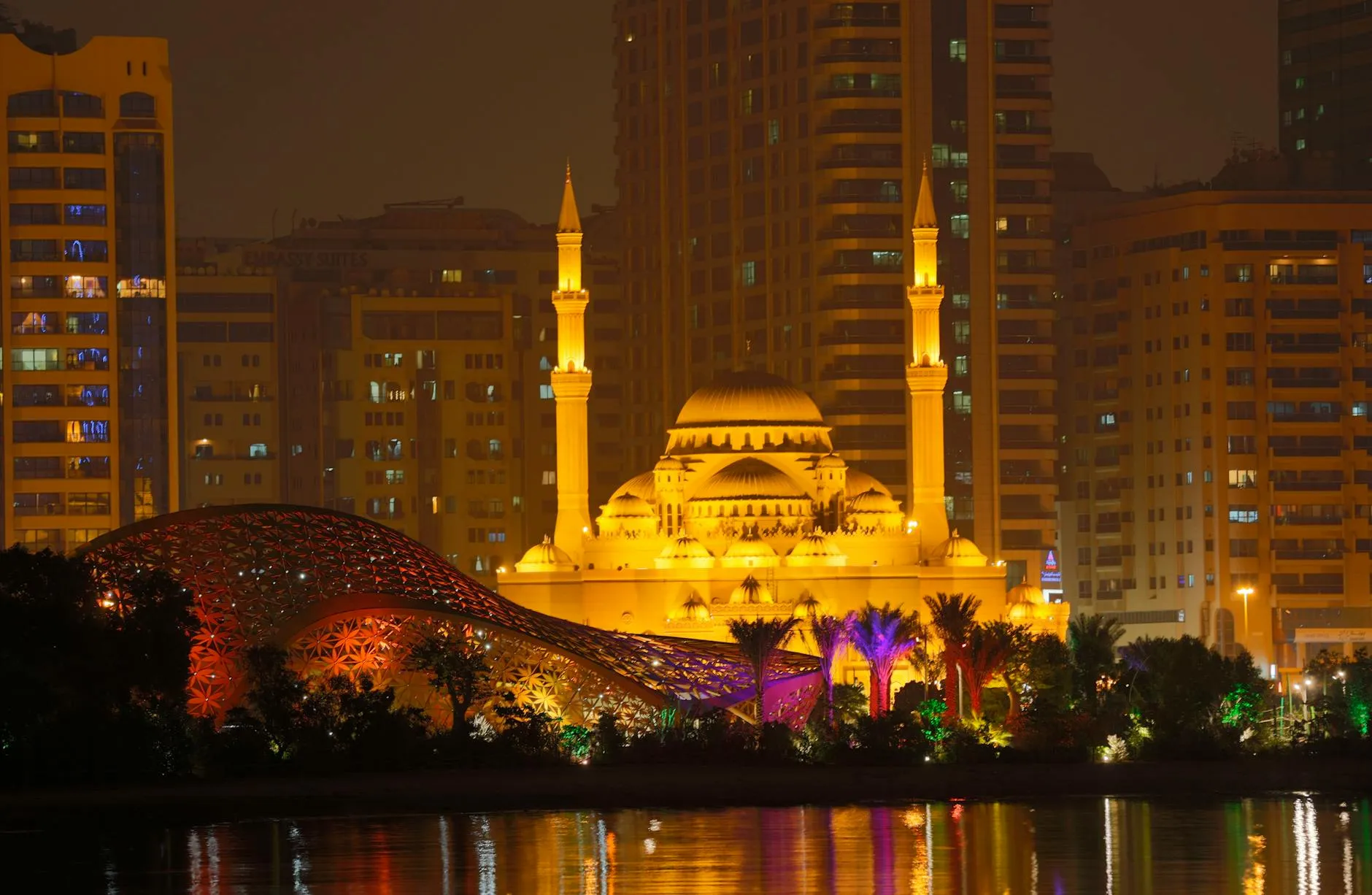
Al Noor Island (~17 km, 20–25 min by taxi). A landscaped island park in the middle of Khalid Lagoon, opened 2015, with a walkable boardwalk, light installations after dark, and a butterfly house. Entry is AED 35 for adults, AED 20 for children (verify before travel). Open 09:00–23:00 on weekdays and until midnight on weekends; the butterfly house closes at 18:00. Compact, walkable in 60–90 minutes, and lit after dark — the most practical Sharjah sight on a medium layover.
Heart of Sharjah (~15 km, 20 min). A restored heritage quarter of coral-walled houses, courtyards, and the old souk near the Corniche — the largest historical-preservation project in the region. Free to wander the lanes; paid museums inside. An hour or two of walking, and more convincingly old than anything in Dubai’s reconstructed heritage areas.
Sharjah Museum of Islamic Civilization (~15 km, 20 min). Housed in a former souk building on the Corniche, with galleries of Islamic art, science, and manuscripts under a planetarium-style dome. Entry is AED 10 (verify before travel). Open Saturday to Thursday 08:00–20:00 and Friday 16:00–20:00. The standout indoor sight if your layover lands in summer heat or after dark; an hour does it justice. Sharjah markets itself as the UAE’s Culture Capital, and this is the institution that earns the claim.
Sharjah Art Museum (~15 km, 20 min). One of the largest art museums in the Gulf, free to enter, with a permanent collection and rotating exhibitions. Same Corniche cluster as the Islamic Civilization Museum, so the two combine naturally on a single trip. Open Saturday to Thursday 08:00–20:00, Friday 16:00–20:00 (verify before travel).
Blue Souk (Central Souk) (~15 km, 20 min). The blue-tiled twin-building market near Al Noor Island: carpets, gold, pashminas, souvenirs. No entry fee. Trading hours run roughly 09:00–13:00 and 16:00–23:00, with a midday closure — a Gulf retail rhythm worth knowing if you turn up at 14:00 to find the shutters down. The first price quoted is not the price.
For Long Layovers
Mleiha Archaeological Centre (~65 km, ~45 min drive). A desert site with Bronze Age and pre-Islamic tombs, fossil rock, and dune-and-archaeology tours set against red dunes in Sharjah’s interior. Too far for anything under six hours and requires a car or guided tour. The most distinctive site the emirate offers, and the one that turns a long layover into a reason to deliberately route through SHJ.
Dubai — with eight or more hours, central Dubai is manageable. The Burj Khalifa and Dubai Mall area is roughly an hour by coach or taxi in good traffic, longer at rush hour. Realistically that leaves two to three hours on the ground: enough for Downtown or the old Deira souks reached off the AED 20 Air Arabia coach to Al Ghurair. Not a beach day.
🔧 Practical Notes
Wi-Fi. Free and terminal-wide; connection involves a short registration.
SIM cards. Etisalat (branded e&) and du both run desks in the arrivals area selling tourist data packages — roughly AED 50–100 for a short-stay data-and-calls bundle, passport required for mandatory registration. Airport desks are convenient but not always cheapest; city shops sometimes undercut them.
Currency on the ground. Cards work nearly everywhere in the UAE, including in Dubai taxis. Carry cash for the Air Arabia coach (cash only) and small street purchases; the RTA intercity bus requires the Nol card. ATMs are in the arrivals hall. Because the dirham is pegged to the dollar, airport exchange desks and city banks quote essentially the same number — change only what you need at the airport and top up in the city if you prefer.
Safety and conduct. The UAE has very low violent crime; petty theft is rare at SHJ. The risks are legal and cultural rather than criminal. Respect the alcohol prohibition, dress modestly in public, avoid public displays of affection, and be especially attentive during Ramadan daylight hours. Photographing government buildings, military installations, or people without consent can create legal problems. Enforcement is real and penalties can be severe.
Tipping. Not embedded in the culture the way it is in North America. Rounding up a taxi fare or leaving 10% at a sit-down restaurant is appreciated; airport porters are happy with a few dirhams. Neither is expected.
Water and heat. Tap water is desalinated and safe to drink; most residents and visitors drink bottled by preference, and it is cheap and sold everywhere. Summer (May–September) regularly exceeds 40°C. If you leave the terminal in those months, carry water and limit time in direct midday sun.
❓ FAQ
📊 At a Glance — SHJ 2026
| Category | Detail |
|---|---|
| Airport | Sharjah International (SHJ / OMSJ) |
| Location | Emirate of Sharjah, UAE |
| Distance to Sharjah city | ~15 km (20–30 min) |
| Distance to downtown Dubai | ~30 km (45 min–1h45) |
| Terminals | One passenger terminal (arrivals + departures) |
| Home carrier | Air Arabia (~80% of movements) |
| Other carriers | 32 on the airport’s roster, incl. Qatar Airways, IndiGo, Air India Express, Pakistan International, Fly Jinnah, flynas, EgyptAir, AJet, Pegasus, Uzbekistan Airways, Biman, RwandAir, Kenya Airways |
| 2026 change | Air Arabia SHJ–London Gatwick twice daily, A321neo LR, from 29 March 2026 |
| Expansion | AED 2.4bn programme; 20M capacity target by 2027 |
| Currency | UAE dirham (AED); 3.6725 AED = 1 USD (pegged) |
| Approx FX (May 2026, verify) | AED 1 ≈ USD 0.27 ≈ EUR 0.23 |
| Entry | Visa-free 30/90 days many nationalities; visa-on-arrival others |
| Alcohol | Banned emirate-wide; no airport bar or liquor duty-free |
| Cheapest to Dubai | Air Arabia coach to Al Ghurair, AED 20, ~1h |
| Taxi to Sharjah city | ~AED 70–80 (meter + AED 20 airport surcharge) |
| Taxi to central Dubai | ~AED 100–130, ~45 min clear traffic |
| Metro to airport? | No — Dubai Metro does not reach Sharjah |
| Lounge | “The Lounge,” airside, 24h, Priority Pass + walk-in (~EUR 37/3h) |
| Nearest sight | Al Noor Island ~17 km (AED 35 adult) |
| Day-trip | Mleiha Archaeological Centre ~65 km, ~45 min drive |
| Tap water | Desalinated, safe; bottled by preference |
| Tipping | Optional; round up taxis, ~10% sit-down meals |