Larnaca International Airport – Glafcos Clerides (LCA) — Airport Guide 2026
Cyprus’s main airport has been doing the work of two since 1974, when Nicosia’s closed after the island’s division and never reopened; it now handles close to ten million passengers a year from a single 2009 terminal on the south-east coast.
Quick Reference
Larnaca International Airport – Glafcos Clerides
LCA / LCLK
~5 km south-west of Larnaca city centre
Bus 425 → Finikoudes / Central Station, €1.50, every 30 min, ~15–20 min
Kapnos Airport Shuttle, ~40 min, €9, roughly hourly
Limassol Airport Express, ~50 min, €10, ~13 times daily
~€15, ~10 min (metered)
Euro (€)
EU but not Schengen — passport stamped; no EES; no ETIAS; Schengen accession pending
Skala Lounge (Priority Pass; 3rd floor, open 24h, max 3h stay)
Wizz Air (base), Aegean, Cyprus Airways, TUS Airways
🏢 The Terminal & Who Flies Here
The terminal opened in 2009 and is operated by Hermes Airports, which also runs Paphos — Cyprus’s smaller, more resort-focused airport to the west. Larnaca is the larger of the two, carrying roughly nine to ten million passengers in 2025 and still growing.
Wizz Air is the growth engine, basing aircraft here and building toward five A321neos for summer 2026 with new or expanded routes to Athens, Madrid, Barcelona, and Varna — roughly a quarter-million extra seats added in a single season. Aegean, Cyprus Airways, and TUS Airways use Larnaca as a hub; Ryanair — whose Cyprus base is Paphos — and the European low-cost field fill out the European leisure routes. The airport also has a substantive Middle East gateway role that has nothing to do with leisure traffic and keeps it busy year-round — including through the mild Cyprus winter, which is the practical season advantage over the Black Sea or Aegean.
🛂 Border & Visa
Cyprus is the outlier in any EU airport comparison, and the outlier runs in the direction opposite to what most travellers expect.
Cyprus is in the EU and uses the euro, but it is not in the Schengen Area — sitting alongside Ireland as one of the last EU states outside it. The practical consequences flow directly from that status.
⚠️ No EES at Larnaca — and confirmed
The EU’s biometric Entry/Exit System went live at Schengen external borders on 10 April 2026. Cyprus confirmed in February 2026 that it would not participate while it remains outside Schengen. Your passport is checked and stamped the traditional way.
⚠️ No ETIAS either
ETIAS is a Schengen authorisation. It does not apply to Cyprus. Travellers who would otherwise need ETIAS for Schengen countries do not need it for Cyprus.
💡 Schengen visa accepted as entry document
A valid multiple-entry Schengen visa is accepted for entry into Cyprus — a direct consequence of Cyprus’s not-yet-Schengen status. Nationals who would normally need a Cyprus visa can use a valid multiple-entry Schengen visa instead.
Schengen accession is the live 2026 story. Cyprus is pushing hard for membership; EU evaluations have been positive and a Council decision is anticipated by the end of 2026 or early 2027. When Cyprus does join, EES and ETIAS follow automatically. Until then, none of it applies here.
| Passport | Visa for short stay? | Passport stamped? | EES / ETIAS? |
|---|---|---|---|
| EU / EEA / Swiss | No | No (EU free movement) | N/A |
| UK | No (≤90 days) | Yes | No |
| USA / Canada / Australia / NZ | No (≤90 days) | Yes | No |
| Japan / South Korea / Singapore | No (≤90 days) | Yes | No |
| India / China / South Africa | Cyprus visa required (Schengen multi-entry accepted) | Yes | No |
One piece of background that affects arrivals more broadly: the island is divided. The Republic of Cyprus controls the south, where Larnaca is. The self-declared northern administration sits outside the Republic’s effective control; crossing the Green Line is done at designated checkpoints, not at Larnaca arrivals.
🚌 Getting Into the City — and Beyond
There are no trains anywhere in Cyprus, which concentrates all airport transfers onto road options.
🚌 Bus 425 — €1.50 into Larnaca
Local bus 425 runs from the airport to Larnaca Central Station and the Finikoudes seafront every 30 minutes, roughly 05:55 to 23:25. The trip takes about 15–20 minutes. Adult single fare: €1.50. It is the straightforward option for anyone staying in Larnaca.
🚐 Kapnos Shuttle to Nicosia — €9, ~40 min
The Kapnos Airport Shuttle runs direct to the capital roughly hourly, with a couple of night services. Around 40 minutes, €9. For the capital it is the practical choice — taxis run €50–70 and do not save time.
🚐 Limassol Airport Express — €10, ~50 min
Around 13 services a day, 50 minutes, €10. Taxis to Limassol are €50–70, the same story as Nicosia.
Taxis into Larnaca are metered; the fare to the city centre runs around €15 for a 10-minute ride. Bolt operates in Cyprus and is the sensible app-based alternative. Unmarked cars approach arrivals at the terminal doors — avoid them; there is no enforcement mechanism on any price quoted at the kerb.
Reduced-mobility passengers: EU rules entitle you to free assistance from check-in to aircraft door (and in reverse). Book through your airline at least 48 hours before the flight.
🛋️ Lounges
Larnaca’s lounge arrangement changed recently, and older guides get it backwards if you are travelling on Priority Pass.
🛋️ Skala Lounge — Priority Pass accepted
The Skala Lounge is the Priority Pass lounge — 3rd floor, open 24 hours, with a maximum stay of 3 hours. Standard contract lounge: seating, Wi-Fi, drinks, light buffet. At an airport with concentrated morning departure banks, the value is the seat and the quiet.
The Aspire Aphrodite Lounge is permanently closed. If your card or travel insurance comes with Priority Pass access, the Skala is the lounge you use — and any guide still pointing you to the Aphrodite is out of date.
🍽️ Cypriot Food & What to Carry Home
Cypriot food is Eastern-Mediterranean and runs generous. Two things to eat before you fly:
Halloumi (hellim in Turkish Cypriot) is the island’s signature cheese — firm, squeaky when grilled, and found everywhere from the airport cafés to the corner bakeries. It is not the same product when bought outside Cyprus. Vacuum-packed halloumi travels fine in a carry-on and clears EU customs without issue.
Meze is the long sit-down meal — a parade of small dishes built around dips, salads, and the centrepiece of souvla (large cuts of pork or lamb grilled on skewers). Not a quick airport option, but worth noting for a layover meal in Larnaca.
For the carry-home: vacuum-packed halloumi, a bottle of Commandaria (a sweet fortified wine with a centuries-long production history, usually described as one of the oldest named wines still in continuous production), local village wine, Cypriot olive oil, or carob syrup. Everything on that list is priced in euros and clears EU customs.
☕ Cyprus coffee — order by sweetness
Cyprus coffee is unfiltered and served in a small cup. Sketo means unsweetened, metrio is medium, glykys is sweet. Ordering by name moves the transaction along.
To drink otherwise: zivania is the local clear spirit, strong and grape-based. Commandaria is the alternative if you want something you can sip rather than brace for.
💡 The Layover Math
The airport is 5 km from Larnaca city centre, which makes this one of the more layover-viable airports in the region — but only with the right window.
⏱️ Four-hour layover — Finikoudes and Saint Lazarus are realistic
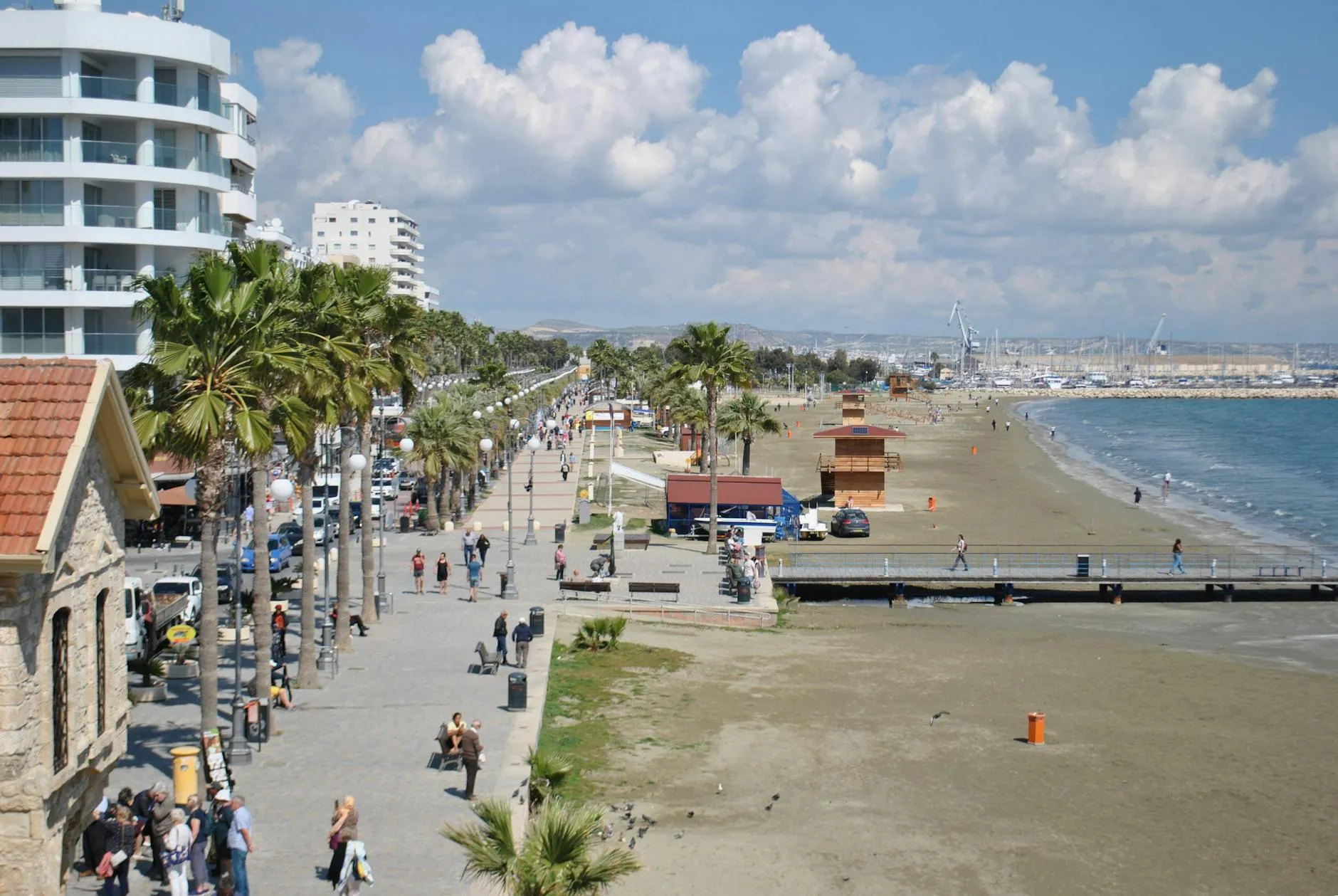
Bus 425 takes 15–20 minutes each way. A 4-hour layover gives you roughly two hours in the city after allowing for return transit and security re-entry buffer. The Finikoudes promenade and beach are a 10-minute walk from the bus stop. The Church of Saint Lazarus — built over the tomb of the biblical Lazarus and the architectural anchor of the old centre — is a short walk from there.
🦩 Salt Lake & Hala Sultan Tekke — right beside the runway
The Larnaca Salt Lake sits directly beside the airport perimeter. From roughly November to March it fills with water and draws flamingos. On its shore stands the Hala Sultan Tekke, one of Islam’s significant pilgrimage sites, set among palm trees. You do not need to go into the city for this — a taxi from the terminal runs a few euros.
⏱️ Nicosia and Limassol need six hours or more
The Kapnos shuttle is 40 minutes each way to Nicosia; the Limassol Express is 50 minutes each way. Add transit time at both ends and a security buffer and you need at least six hours. Under that, you will be watching the departure board from the wrong side of passport control.
Under three hours: stay airside. The maths do not work for anything else.
🧭 Practical Notes
- No EES, no ETIAS. Cyprus is in the EU, uses the euro, but is outside Schengen. The April 2026 biometric border system does not apply. Passport stamped on entry. Watch for the Schengen accession decision, expected by end of 2026 or early 2027.
- No trains, anywhere on the island. Every transfer is by road.
- Priority Pass means the Skala Lounge. 3rd floor, open 24 hours, maximum stay 3 hours. The former Aspire Aphrodite Lounge is permanently closed.
- Taxis are metered. Use the meter, or use Bolt. Ignore the touts at the terminal exit.
- Schengen visa accepted. Nationals who would otherwise need a Cyprus visa can enter on a valid multiple-entry Schengen visa.
- Accessibility assistance is free under EU rules, but must be pre-booked through your airline at least 48 hours before departure.
❓ Frequently Asked Questions
📊 At a glance — LCA 2026
| Feature | Data |
|---|---|
| Official name | Larnaca International Airport – Glafcos Clerides |
| IATA / ICAO | LCA / LCLK |
| Location | ~5 km south-west of Larnaca, south-east Cyprus |
| Terminal | One terminal (opened 2009); operator Hermes Airports |
| Passengers (2025) | ~9–10 million (Cyprus’s larger airport) |
| Train to centre | None — no railways anywhere in Cyprus |
| Bus to Larnaca | Bus 425 → Finikoudes / Central Station, €1.50, every 30 min, ~15–20 min, ~05:55–23:25 |
| Bus to Nicosia | Kapnos Airport Shuttle, ~40 min, €9, roughly hourly |
| Bus to Limassol | Limassol Airport Express, ~50 min, €10, ~13 times daily |
| Taxi to Larnaca | ~€15, ~10 min (metered) |
| Currency | Euro (€) |
| Border | EU but not Schengen — passport stamped; no EES (opted out of 10 Apr 2026 rollout); no ETIAS; Schengen accession decision expected end-2026 or early 2027 |
| Lounges | Skala Lounge (Priority Pass; 3rd floor, open 24h, max 3h stay) |
| Dominant carriers | Wizz Air (base), Aegean, Cyprus Airways, TUS Airways |
| Best layover option | Bus 425 or taxi to Finikoudes + Saint Lazarus (4 hr+); Salt Lake & Hala Sultan Tekke by the airport |