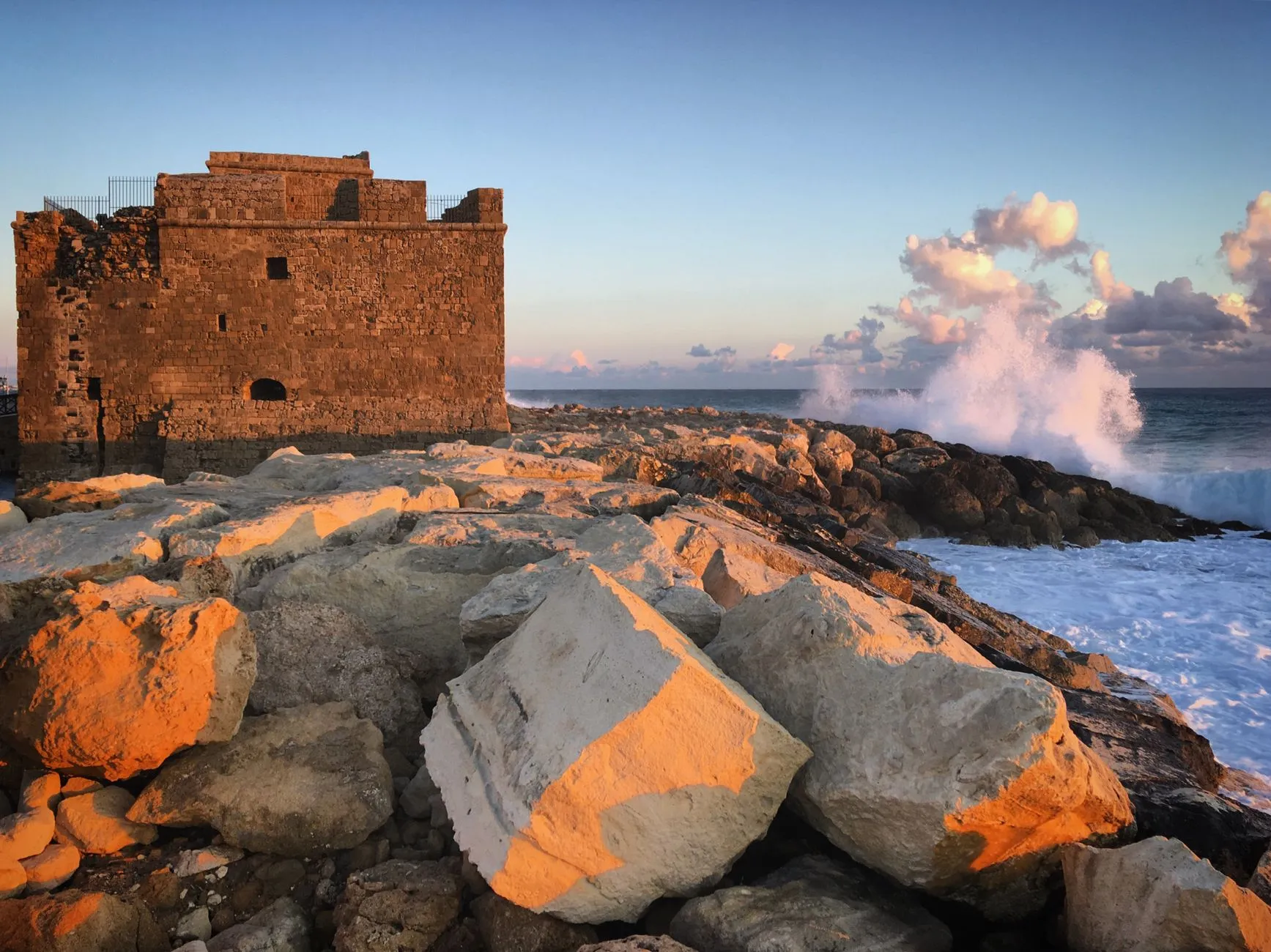
Paphos International Airport (PFO) — Airport Guide 2026
Paphos is Cyprus’s western airport — the leisure end of the island, where Ryanair lands from most of Europe and the UK charter trade comes in for the Kato Paphos resorts — and the border fact that catches travellers out every year is that Cyprus is in the EU, uses the euro, and is not in the Schengen Area, which means the biometric EES that launched on 10 April 2026 does not apply here, your passport is stamped the traditional way, and ETIAS is irrelevant.
Quick Reference
PFO / LCPH
~15 km east of Paphos, western Cyprus
One terminal (opened 2008), operated by Hermes Airports
~3.8 million (2025)
Euro (€)
EU but not Schengen — no EES, no ETIAS; passport stamped
612 → Tombs of the Kings Station via the Kato Paphos strip; 613 → Karavella; €2 one way (€3 after 21:00)
~€25–35, ~20 min
Premium Lounge (Priority Pass; walk-in €30/€15)
Ryanair, Jet2, easyJet, TUI, British Airways, Lufthansa
🏢 The Terminal
Paphos’s single terminal opened in 2008 and is run by Hermes Airports, which also operates Larnaca. The two airports have opposite personalities: Larnaca is the capital-and-business mix, PFO is pure leisure. Ryanair flies here from the widest spread of European cities; Jet2, TUI and easyJet handle the UK holiday packages; British Airways and Lufthansa provide the flag-carrier links, and there is a substantial Israeli block — El Al, Arkia, Israir, Air Haifa and TUS Airways — alongside LOT, Aegean, Wizz Air and Transavia. About 3.8 million passengers a year (3,837,155 in 2025), the bulk of them inbound British holidaymakers and second-home owners, arriving and departing in lockstep with resort changeover days.
PFO serves the western end of the island — Kato Paphos, Coral Bay, the Akamas peninsula. If you are heading to Nicosia or Limassol, Larnaca is the easier arrival. If your destination is anywhere along the west coast, this is the right airport.
🛂 Border — EU, Euro, Not Schengen
Cyprus is a full EU member and uses the euro, but it is one of the last two EU states sitting outside the Schengen Area, alongside Ireland. In 2026, that matters more than usual.
The EU’s biometric Entry/Exit System launched at Schengen external borders on 10 April 2026. Cyprus confirmed in February 2026 that it would not join that rollout while it remains outside Schengen. Arriving at PFO, your passport is checked and stamped in the same way it has always been — no fingerprints, no facial scan, no EES queues. ETIAS is a Schengen authorisation; it does not apply to Cyprus entry either.
⚠️ No EES, no ETIAS — passport stamped the old way
Cyprus opted out of the 10 April 2026 EES biometric rollout. ETIAS does not apply here. Arrivals at PFO have their passport inspected and stamped in the traditional way. This will change only when Cyprus formally joins the Schengen Area.
The live development: Cyprus is pushing for Schengen accession, with positive EU evaluations in progress and a Council decision expected by end of 2026. When it actually joins — not before — EES and ETIAS will follow automatically.
Visas and who needs them
For stays of up to 90 days: UK, EU/EEA, US, Canadian, Australian, New Zealand, Japanese and South Korean passport-holders need no visa. The passport is stamped on entry.
Nationals of India, China and South Africa need a Cyprus visa — but Cyprus also accepts a valid double- or multiple-entry Schengen visa, a Bulgarian, Croatian or Romanian national visa, or a residence permit issued by a Schengen state or by Bulgaria, Croatia or Romania, for stays of up to 90 days.
One piece of geography worth understanding: Cyprus is divided. The Republic of Cyprus (south) is the EU member; the self-declared Turkish Republic of Northern Cyprus (north) is outside the Republic’s control and legal framework. Flying into PFO, only the Republic’s rules apply. The north is accessed via designated checkpoints — a separate matter entirely, irrelevant to the border process at Paphos Airport.
| Passport | Visa required? | Passport stamped? | EES / ETIAS? |
|---|---|---|---|
| EU / EEA / Swiss | No | No (EU free movement) | N/A |
| UK | No (≤90 days) | Yes — stamped | Neither applies |
| USA / Canada / Australia / NZ | No (≤90 days) | Yes — stamped | Neither applies |
| Japan / South Korea / Singapore | No (≤90 days) | Yes — stamped | Neither applies |
| India / China / South Africa | Yes (Cyprus visa; or a double/multi-entry Schengen visa, a BG/HR/RO national visa, or a Schengen/BG/HR/RO residence permit) | Yes | Neither applies |
🚌 Getting to Paphos — Bus or Taxi
Cyprus has no railways anywhere on the island. From the airport, the choice is bus or taxi — and the 15 km into town is further than it sounds, making it a more substantial transfer than arrivals at airports closer to their city centres.
🚌 Bus 612 — Tombs of the Kings Station, €2 one way
Runs from the airport down Poseidonos Avenue — the Kato Paphos resort waterfront, with the old town behind it — and terminates at Tombs of the Kings Station. The Pafos district fare is a flat €2 one way, rising to €3 after 21:00; a day ticket is €6.50. Services run to a timetable, not continuously — check the Pafos Buses timetable against your flight before assuming there is a bus waiting.
Bus 613 runs to Karavella station, north of the city centre — more useful for the upper town or onward connections from there.
For Coral Bay: stay on the 612 to its terminus at Tombs of the Kings Station and change there to the 615, which runs Tombs of the Kings Station to Coral Bay. For the harbour and the Archaeological Park, get off along Poseidonos Avenue, or take the 611 from the same terminus.
🚕 Taxi — ~€25–35 to Kato Paphos, ~20 min
Cyprus taxis are metered — insist the meter is running before you set off. Bolt operates on the island as a ride-hail alternative and is worth using. Avoid unmarked touts at arrivals; they are not metered.
For a layover, take the taxi. The 612 makes a string of stops on the way in and runs to a sparse timetable; the time the taxi saves is often the margin between making the archaeology and not.
🛋️ Lounge
🛋️ Premium Lounge — Priority Pass accepted; walk-in €30/€15
Operated by Hermes Airports. Airside in departures, opposite Gate 7. Opens approximately two hours before each scheduled departure. Walk-in rate: €30 for adults, €15 for children. Self-service buffet with hot and cold drinks, light snacks, alcoholic drinks, Wi-Fi, flight information screens.
There is one lounge. At a holiday airport that bunches departures on resort changeover mornings, the value is the seat away from an overcrowded gate — not the quality of the buffet.
🍽️ Food and What to Carry Home
The airport food is standard airport fare. Cypriot food — halloumi (locally also written hellim), meze plates, grilled souvla — is better eaten in Kato Paphos before you head out to the airport than in departures.
For the carry-home, Paphos is well stocked:
🍬 Loukoumi from Geroskipou — Cyprus delight, not the airport kind
The nearby village of Geroskipou is the island’s famous source of loukoumi — rosewater-and-nut jelly, the Cyprus version of what the English call Turkish delight. Buy it in town in boxed form; the airport packaging is a poor substitute.
The Paphos region is western Cyprus’s main wine country, with village wineries in the hills behind the town. Commandaria, the ancient sweet wine from the Troodos foothills, is the other bottle to consider. The local spirit is zivania; the coffee is Cyprus coffee.
Vacuum-packed halloumi, loukoumi, a bottle of western-Cyprus village wine or Commandaria, and Cypriot olive oil all clear EU customs without issue. Everything is priced in euro.
💡 Paphos on a Layover — UNESCO and the Layover Math
Paphos is, unusually for a mid-sized holiday airport, a UNESCO World Heritage Site in its entirety. The heritage is concentrated in Kato Paphos — the harbour and the Archaeological Park at one end, the Tombs of the Kings at the other — and the 612 runs down Poseidonos Avenue to its terminus at Tombs of the Kings Station, so all of it sits on the bus’s line. That makes the layover case more credible than the airport’s resort reputation implies.
🏛️ Paphos Archaeological Park — among the finest Roman mosaics in the eastern Mediterranean
The park holds the mosaic floors of the Houses of Dionysos, Theseus and Aion — scenes from mythology in extraordinary preservation — a short walk from the harbour. This is the centrepiece of a Paphos layover and the one site to prioritise.
⚰️ Tombs of the Kings — Hellenistic rock-cut burial chambers
Near Kato Paphos: underground chambers cut from coastal rock in the Hellenistic period. Compact and atmospheric. Pair with the mosaics on a five-hour layover; skip it on four hours and go straight to the park.
The layover math: the airport is 15 km out, so reckon about 20 minutes each way by taxi plus a 90-minute return-security buffer. The 612 stops on the way in and runs to a sparse timetable, so it is the slower and less predictable half of the plan. On a five-hour layover the Archaeological Park mosaics and the Tombs of the Kings are both achievable if you move. On a four-hour layover, the harbour and one of the two sites is the realistic plan. Take the taxi both ways — the time saving is the margin.
Aphrodite’s Rock (Petra tou Romiou), the legendary birthplace of the goddess, is about 25 minutes east along the coast. Coral Bay is north of town. Both are trip destinations, not layover moves.
Under three hours at PFO: stay airside.
PFO versus Larnaca for a layover: Larnaca is a shorter run into town, making it the easier layover airport. Paphos has stronger archaeology, but you pay for it with more transit time on both legs. At five hours-plus, Paphos is worth it; at four or under, Larnaca is the better call if you have the choice.
🧭 Practical Notes
- Reduced-mobility passengers: EU rules guarantee free airport assistance. Book it through your airline at least 48 hours before departure.
- Bus payment: carry coins — the Pafos district fare is a flat €2 one way, €3 after 21:00, and €6.50 for a day ticket. Coin payment is standard.
- Bus timetables: check the Pafos Buses timetable in advance. Services run to a schedule, not on demand.
- Schengen accession: Cyprus is working toward membership, with a Council decision expected by end of 2026. Until Cyprus formally joins, EES and ETIAS remain inapplicable.
- UK ETA: the UK Electronic Travel Authorisation is for entering Britain. Flying from the UK to Cyprus, it is irrelevant — you face the Cyprus border, not the UK one.
❓ Frequently Asked Questions
📊 At a glance — PFO 2026
| Feature | Details |
|---|---|
| Official name | Paphos International Airport |
| IATA / ICAO | PFO / LCPH |
| Location | ~15 km east of Paphos, western Cyprus |
| Terminal | One terminal (opened 2008); operator Hermes Airports |
| Annual passengers | 3,837,155 (2025) |
| Rail to town | None — no railways in Cyprus |
| Bus to Paphos | 612 → Tombs of the Kings Station via the Kato Paphos strip; 613 → Karavella; €2 one way (€3 after 21:00, €6.50 day ticket); change at Tombs of the Kings for the 615 to Coral Bay |
| Taxi to Kato Paphos | ~€25–35, ~20 min (metered) |
| Currency | Euro (€) |
| Border | EU but not Schengen — no EES (opted out of 10 Apr 2026 rollout); passport stamped; no ETIAS; Schengen accession decision expected end-2026 |
| Lounge | Premium Lounge (Hermes Airports; Priority Pass; walk-in €30 adult / €15 child; opposite Gate 7) |
| Dominant carriers | Ryanair, Jet2, easyJet, TUI, British Airways, Lufthansa |
| Best layover move | Taxi to Paphos Archaeological Park mosaics + Tombs of the Kings (5 hr+ layover); under 3 hr, stay airside |