Rhodes — The Complete Island Guide 2026
A four-regime palimpsest on the edge of Anatolia: Knights (1309–1522), Ottomans (1522–1912), Italians (1912–1947), Greeks (1947–today). The 2023 wildfires are the newest layer, and the evacuation of nineteen thousand tourists in a single weekend was the largest in modern Greek history. This guide covers the rest of it — what the Italians actually built, where the Jewish community was, and when to arrive at Lindos.
€35–300+/day budget
Mediterranean: 12–30°C
🇬🇷 EU / Schengen / EUR €
Climate levy €1.50–10/night
EES active · ETIAS Q4 2026
Why Rhodes? An Editor’s Note
On 22 July 2023, the Greek government executed the largest civilian evacuation in its modern history. Nineteen thousand tourists — most of them British, German and Scandinavian — and roughly two thousand residents were moved out of the south-east coast of Rhodes as a wildfire outpaced the emergency plan. Sixteen thousand went by road; three thousand went by sea, often on requisitioned fishing boats and day-cruise catamarans. Seventeen thousand, seven hundred and seventy-three hectares of the island burned — twelve-and-a-half per cent of its total surface. No tourist died. Two summers on, the hotels are open again. The hillside has regrown only in patches. The images — families walking down smoke-dark roads with just passports and pool shoes — reached every front page in Europe.
That memory is worth carrying into the rest of the guide, because it is the newest layer on a rock that has been inhabited continuously for around thirty-five hundred years and governed, in the last seven centuries, by four distinct regimes. The Knights of St John built it as a Latin-Christian fortress between 1309 and 1522, and the old town’s walls and most of its street plan date from this period. The Ottomans inhabited the same buildings for three hundred and ninety years after Suleiman’s six-month siege of 1522, converting churches to mosques and expanding the Jewish Quarter in the east. The Italians — who took Rhodes from the Ottomans in 1912 and held it until 1947 — “restored” the medieval city through a combination of archaeology and invention, reconstructed the Palace of the Grand Master between 1937 and 1940, and built Mandraki harbour as a colonial rationalist capital. The Greeks inherited the whole assembly in March 1948, after a half-century gap in Hellenic rule, and have since turned Rhodes into one of the two most visited Greek islands. What a visitor walks through in 2026 is every one of those regimes at once, with the Italian layer often presenting itself as “medieval” even though the specific facade in front of them was reconstructed a decade before Greece regained the island.
The practical effect is that Rhodes rewards historical knowledge unusually well. Walk the Street of the Knights without knowing that it was heavily rebuilt by Mussolini’s architects and you see a Gothic street. Walk it with the knowledge and you see a specific political project — the fascist invention of a “Latin” Rhodes — that happened to end up preserving more of the Hospitaller plan than almost any other comparable city in Europe. Stand inside the Palace of the Grand Master and the mosaics on the first floor were brought from Kos in the 1930s by the Italians to dress up an empty reconstruction. The thin-but-constant thread of the Jewish community, continuous for around four centuries until the deportation of 23 July 1944, runs through streets the modern visitor mostly passes unaware of.
This guide is written for the traveller who wants to understand the layers. If you are after an all-inclusive resort on the east coast with a water slide and an evening animation team, Rhodes has those in industrial quantity and you do not need a guide — pick any package tour and you will have a perfectly adequate week. If you are after the island as it actually reads, this is the longer route in. It assumes you will want to walk the old town slowly, take at least one day-trip to Lindos by road rather than by cruise tender, and spend an afternoon in the Jewish Quarter with your phone in your pocket. It also assumes you know that summer on Rhodes now routinely touches thirty-five degrees, that a second 2023-scale wildfire is a real risk over the next decade, and that the sensible thing is to schedule outdoor sites for early morning and museums for the afternoon.
Two traps to call out in advance. Faliraki, fifteen kilometres south of Rhodes Town, is a British-package party strip with no meaningful connection to Rhodes itself — skip it entirely unless that is specifically the holiday you came for. And Lindos between about 10:00 and 15:00 in July and August is functionally a conveyor belt, with up to six thousand cruise day-trippers climbing the acropolis stairs in a single peak afternoon. Lindos is genuinely one of the great villages of the Aegean, but only if you arrive before 09:00 or after 17:00.
Everything else in this guide, in order.
Table of Contents
- Top Attractions
- Neighbourhoods of Rhodes Town
- Where to Stay — by Budget
- Where to Eat
- Drinking & Evening Culture
- Getting Around
- Best Time to Visit
- Month-by-Month Weather
- Daily Budget Breakdown
- Sample Itineraries
- Best Day Under €30
- Hot Afternoon / Off-Season Day Plan
- Day Trips
- Safety & Practical Information
- Visa & Entry Requirements
- Hidden Rhodes
- Romantic Rhodes
- What’s New in 2026
- Frequently Asked Questions
- Explore More Aifly Guides
Top Attractions
1. The Street of the Knights and the Old Town Walls
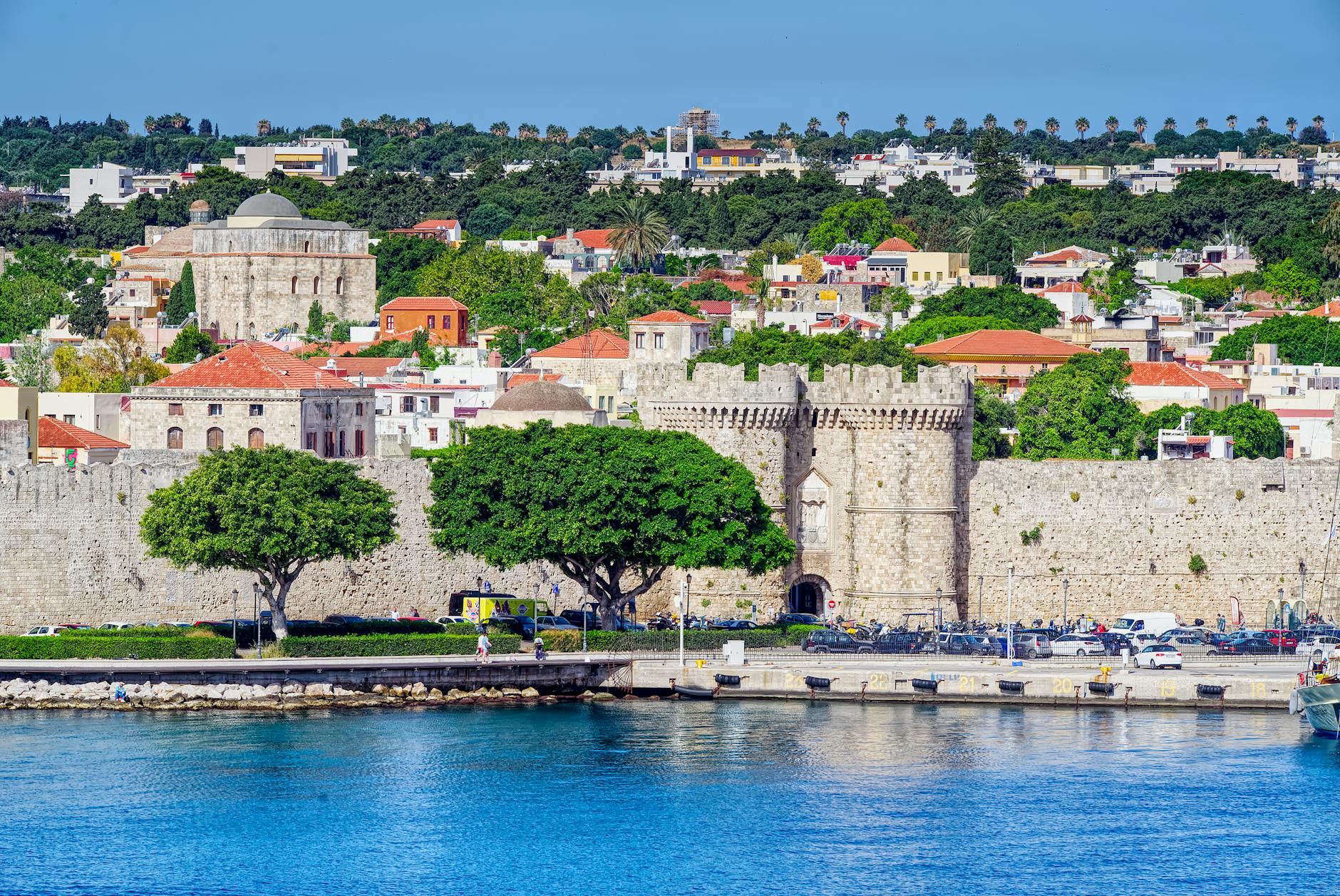
The Street of the Knights — Odos Ippoton in Greek — runs roughly six hundred metres east-to-west from the Palace of the Grand Master down to the Hospital of the Knights (now the Archaeological Museum). It was laid out in the fourteenth century as the administrative spine of the Hospitaller order, and the inns along its length housed the “tongues” — the national sub-units — of Italy, France, Spain and Provence. What a visitor sees today is partly original fourteenth- and fifteenth-century stonework and partly a heavy-handed Italian reconstruction undertaken between 1912 and the end of the 1930s, primarily under governors Mario Lago and Cesare Maria de Vecchi. The Italians stripped away Ottoman additions — the wooden balconies, the mashrabiyyas, the mosque minaret that stood at the eastern end of the street — and rebuilt what they considered the “original” medieval appearance, with varying degrees of documentary support. The result is the most atmospheric reconstructed medieval street in the eastern Mediterranean, and one of the most instructive for anyone interested in how colonial regimes use archaeology.
Walk it twice. Once at around 18:00, when the afternoon light rakes along the east-west axis and the photographs come easily. And once, separately, at 07:00 or 07:30 before the guides arrive, when you can hear your own footsteps on the limestone and see the scale of the Hospital of the Knights without a queue. The walls themselves — roughly four kilometres around the old town, up to twelve metres thick in places, designed by Italian military engineers in the fifteenth century to stop exactly the kind of Ottoman siege that eventually broke them — are walkable in sections from the Palace of the Grand Master. Access to the walls is free during summer but check opening days at the palace ticket desk; it is often restricted to certain hours or weekdays.
2. The Palace of the Grand Master
The Palace is the single most visited building on Rhodes, and it is also the single most misread. The core of the structure is genuinely medieval: a seventh-century Byzantine citadel which the Knights repaired and expanded through the fourteenth century, and which served as both residence of the Grand Master and command centre of the order. But the building you walk through today was substantially reconstructed between 1937 and 1940 by the Italian architect Vittorio Mesturino, on a commission from Governor de Vecchi that was explicitly intended to produce a vacation residence for Mussolini or King Victor Emmanuel III, neither of whom ever used it. The reconstruction demolished what remained of the Ottoman-period buildings on the site. Most of the mosaic floors on the upper floor were brought from Kos in 1936 — they are genuine Hellenistic and early Imperial Roman mosaics, but they were never in the Palace of the Grand Master before the Italians installed them there.
Knowing this transforms the visit. The ground-floor exhibitions on medieval Rhodes are informative but relatively thin. The real prize is upstairs: room after room of mosaics on the walls and floors, displayed without the visitor-management infrastructure that would be standard at Knossos or the National Museum in Athens. You can walk close. You can sit on the benches and look up. The medusa-head mosaic, the Nine Muses panel, the late-Hellenistic geometric floor from the agora of Kos — all of them worth ten minutes of attention each, and most visitors walk past them in under three.
Price: €20 full (as of 1 April 2025 ticket reform); free for EU citizens under 25 and non-EU under 18; 50% discount for over-65s. Free-admission days: 6 March (Melina Mercouri Memorial Day), 18 April (International Day for Monuments and Sites), 18 May (International Museum Day) and the last weekend of September (European Heritage Days). Hours: summer (1 April – 31 October) daily 08:00–20:00; winter shortened. Access: at the top of the Street of the Knights; walk from Mandraki harbour in 10 minutes. Tickets: hhticket.gr.
3. The Archaeological Museum (Hospital of the Knights)
The Hospital of the Knights was built between 1440 and 1489 as an infirmary for the Hospitaller order — the word “hospital” in the order’s name is literal, not metaphorical — and in that respect it is one of the oldest surviving purpose-built hospital buildings in Europe. Since 1916 it has housed the Archaeological Museum of Rhodes, a collection that concentrates on finds from Hellenistic and early Roman Rhodes, including the Aphrodite of Rhodes (the “Marine Venus” of Lawrence Durrell’s 1953 book, a Hellenistic statue recovered from Rhodes harbour in 1929), fragments from the sanctuary at Kamiros, and a series of grave stelae from ancient Ialysos that are some of the finest examples of their period anywhere.
The building itself rewards attention independently of the collection. The main courtyard is a quiet, cross-vaulted arcade with a well in the middle and a staircase leading up to the infirmary ward — a long, high-roofed room with deep-set windows that was used for patients through the order’s two centuries on Rhodes. The Italian restoration of the building was, for once, careful and well-documented; the arched ceilings and most of the original stonework survive.
Price: €10 full / €6 reduced. Hours: summer daily 08:00–20:00 from 1 April 2026; winter 08:30–15:30 with one closing day. Access: at the eastern end of the Street of the Knights. Tickets: hhticket.gr or at the door.
4. Kahal Shalom Synagogue and the Square of the Jewish Martyrs
Kahal Shalom, in the eastern quarter of the old town, was built in 1577 and is the oldest surviving synagogue in Greece. It is a plain, square-plan building with a raised teba (reading platform) in the centre, Ottoman rugs, and a small museum in the side rooms documenting the history of the Sephardic community on Rhodes. Sephardic Jews settled on Rhodes in the decades after the Spanish expulsion of 1492, and were the dominant community in this quarter for four centuries. The Rhodes Jewish Museum, adjacent to the synagogue, runs a small bookshop and can arrange guided tours of the quarter in English. Entry is by donation.
The square outside is called Platia Evraion Martyron — the Square of the Jewish Martyrs. It commemorates the deportation of 23 July 1944. Three days earlier, on 20 July, the SS had corralled the remaining Jewish community of Rhodes into a makeshift concentration camp on the pretext of an identity-document check. On 23 July the Germans packed one thousand six hundred and seventy-three people — nearly the entire surviving community — into the cargo holds of three livestock ships at Mandraki harbour. The ships sailed to the port of Athens, picking up eighty-five more Jews from Kos on the way. From Athens the deportees were taken by train to Auschwitz. The journey took twenty-four days in total — the longest journey of any Jewish community deported to the camps. One hundred and fifty-one people came back.
A smaller chapter runs alongside the main one. Selahattin Ülkümen, the Turkish consul in Rhodes, was able to exempt more than forty Jews by claiming them (in several cases correctly, in others not) as Turkish citizens. He was later recognised by Yad Vashem as Righteous Among the Nations. His wife was killed in a German reprisal bombing raid on Rhodes in 1944.
Kahal Shalom survives. A small community of a few dozen Jewish residents remains on the island today — some elderly, some second-generation returnees — and the synagogue holds services twice a year, on the High Holidays. A handful of the deportees’ descendants now live in the United States, Argentina, Israel and the Congo; several return each July for a commemoration.
Price: donation; Rhodes Jewish Museum €6 suggested. Hours: museum Monday–Friday 10:00–15:00, closed Saturday; the synagogue is open during museum hours. Guided tours of the Juderia can be arranged through jewishrhodes.org. Access: five minutes’ walk east of the Archaeological Museum, on Simiou Street. Look for the Hebrew-language plaques on the square.
5. The Acropolis of Lindos
Fifty kilometres south of Rhodes Town, on the east coast, Lindos sits on a headland crowned by a Doric-temple acropolis that has been continuously sacred for more than two-and-a-half thousand years. The Temple of Athena Lindia dates from around 300 BCE, built on the site of an earlier temple destroyed by fire in 392 BCE, which itself replaced a Geometric-period shrine on the same spot. The Knights Hospitaller added a late-medieval fortress on top of the sanctuary, with walls and a crenellated perimeter that survives largely intact. The Italians restored the fortress in the 1930s and carried out the first systematic excavation of the sanctuary. The result is one of the most densely layered archaeological sites in Greece: Geometric, Classical, Hellenistic, Byzantine, Hospitaller and Italian fascist restoration, on a single rock, with an Aegean Sea view in three directions.
The village below is a clean-white Cycladic-Dodecanesian hybrid built on the slope below the acropolis, with seventeenth- and eighteenth-century “captains’ houses” — rebuilt after the strong earthquake of 1610 by the village’s wealthy ship-owners — whose black-and-white pebble-mosaic courtyards (hohlakia) are the local signature. Most of them now operate as boutique hotels, restaurants or short-term rentals. Saint Paul’s Bay, immediately below the acropolis to the south-east, is named after a sheltered cove where the apostle is supposed to have landed in 51 CE; it is one of the better swimming beaches on the east coast and is only properly accessible on foot from Lindos village.
Price: €6 full. Hours: from 1 April 2026 daily 08:00–20:00; from 1 September 08:00–19:30; from 16 September 08:00–19:00; shorter in winter. Access: by KTEL bus from Rhodes Town (roughly 80 minutes, €5.50 each way) or by rental car (60 minutes via the east-coast road). The final climb from the village up to the acropolis takes around 20 minutes on a cobbled path at a moderate pace in cool temperatures.
6. Ancient Kamiros
On the north-west coast, thirty-four kilometres south-west of Rhodes Town, Kamiros is the best-preserved of the three Hellenistic city-states that formed the federation of ancient Rhodes (with Lindos and Ialysos). Unlike Lindos or the acropolis on Monte Smith, which have been built over and reconstructed, Kamiros was abandoned after a series of earthquakes in the second century BCE and never reoccupied. What you walk through is essentially a Hellenistic town plan — a lower agora, a residential quarter on the middle terrace, an acropolis with a Temple of Athena Kameiras and a six-metre-long cistern at the top — preserved almost intact at ground level. There are no medieval, Ottoman or Italian overlays. It is one of the few places in the Greek world where you can read a Hellenistic domestic street without cognitive effort.
The site is entirely unshaded. In June, July and August the only viable visit is before 10:00 or after 17:00, and you should carry at least a litre of water per person.
Price: €10 adult; free for EU under-25s. Hours: summer daily 08:00–20:00 from 1 April 2026; winter 08:30–15:30, closed Tuesday. Access: by car (45 minutes from Rhodes Town) or by RODA bus (around €5, roughly 90 minutes). There is a small café 400 metres from the site entrance.
7. The Acropolis of Rhodes (Monte Smith)
A short walk — or a €2.20 RODA bus ride — from Mandraki harbour, the Acropolis of Rhodes sits on a hill the Italians renamed Monte Smith after a British admiral who used it as a lookout during the Napoleonic Wars. The site contains the Temple of Apollo, a two-hundred-and-ten-metre-long third-century BCE stadium, an odeon (small theatre, partly reconstructed) and the remains of the Temple of Athena Polias and Zeus Polieus. All of it is free, unenclosed, and almost entirely deserted in the early morning or at sunset. The Temple of Apollo was damaged by Italian military works during the Second World War, when the Italians installed artillery positions on the hill and the site was bombed in the 1943–45 fighting; the columns standing today are post-war Greek Archaeological Service reconstructions.
This is the honest answer to “where can I see a Hellenistic site in Rhodes without paying for anything or queuing for anything.” You can. Go at 07:30 in summer or at 17:30 for the sunset. Bring water. The stadium track, which is preserved at its north-south ends with the proedries (officials’ seats) and a partial spectator section, is the best-preserved feature.
Price: free. Hours: open site, no fixed hours. Access: 25-minute walk uphill west from the old town, or RODA city bus from Mandraki (ask at the Nea Agora ticket booth for the current Monte Smith / Acropolis route, which stops within a short walk of the site).
8. Kallithea Springs (Thermes Kallitheas)
Nine kilometres south of Rhodes Town, on the road to Faliraki, Kallithea is an Art Deco thermal spa designed in 1930 by the Italian architect Pietro Lombardi for Governor Lago’s Italianisation programme. The building is an almost perfectly preserved example of 1930s Mediterranean Rationalism — a rotunda, a palm-fringed lower terrace, mosaics, and a small beach below that is one of the most protected swimming coves on the east coast. The springs themselves were considered therapeutic by Hippocrates and were renowned through the Byzantine period; the Italian restoration was meant to turn them into a colonial destination spa, which it did briefly. The complex fell into disuse after the Second World War and reopened to the public on 1 July 2007 after an eight-year restoration led by the Municipality of Kallithea.
Kallithea is not a functioning spa — the springs have been closed for bathing for decades — but the building, the mosaics, the cafés on the lower terrace and the swimming beach below are a worthwhile half-day. It is a rare Italian-period civic building that has been preserved with proper attention to its original 1930s architectural intent, rather than plastered over with Greek-national signage.
Price: €5 adult / €2.50 children under 12. Hours: daily 08:00–20:00. Access: RODA bus from Rhodes Town (around 25 minutes, €2.20) or taxi (€15). The bus stop is roughly 200 metres from the entrance.
9. Butterfly Valley (Petaloudes)
Twenty-six kilometres south-west of Rhodes Town, the Petaloudes valley is a shaded gorge of Liquidambar orientalis (oriental sweetgum) trees whose scent attracts enormous seasonal aggregations of the Jersey tiger moth (Euplagia quadripunctaria rhodensis), a subspecies endemic to the island. The moths arrive around the last week of June, reach peak density in July and August, and disperse by late September. When they are in residence, the forest canopy is covered in thousands of them — a phenomenon quiet enough that you can hear them land.
Outside the season, the valley is simply a pleasant forest walk without moths. The seasonal entrance fee (€6 from 30 June to 30 September) reflects this — it is free out of season and not worth the trip unless you specifically want the walk.
Price: €6 from 30 June – 30 September; free out of season; free for children under 12. Hours: daily 08:30–18:30 in season. Access: RODA bus from Rhodes Town (around 90 minutes, €5–6) or rental car. No onsite café; bring water.
10. Tsambika Monastery and the east-coast headlands
Twenty-six kilometres south of Rhodes Town, a small whitewashed church sits on top of a three-hundred-metre limestone outcrop above the east-coast beaches at Kolymbia and Tsambika. The Monastery of Panagia Tsambika is reached by a stepped path from the saddle road or, for those committed to the tradition, barefoot from the base of the hill. The tradition — still observed by several hundred women a year, mostly Rhodian and mainland Greek — holds that a woman experiencing fertility difficulties who walks up barefoot and prays before the icon will conceive a child, whom tradition then requires her to name Tsampikos (male) or Tsampika (female). Birth records on Rhodes show the names remain surprisingly common, both from direct pilgrimages and from families following the naming convention into later generations.
The view from the top — three hundred metres above the beach, with the coast arcing north and south — is the single finest on the east coast. The walk from the saddle car park takes around fifteen minutes one-way; from the base of the hill, around forty-five minutes.
Price: free. Hours: open daily, daylight hours. Access: by car, 35 minutes from Rhodes Town via the east-coast road. KTEL buses stop at Kolymbia village but not at the saddle car park — from Kolymbia you add another hour uphill on foot.
Neighbourhoods of Rhodes Town
Rhodes Town divides cleanly into three areas, each with its own rhythm.
The Medieval City (old town, inside the walls). The UNESCO World Heritage area. Divided historically into the Chora (Christian quarter, west of the Suleymaniye mosque) and the Turkish and Jewish quarters (east). Tourist crush concentrated on Socrates Street and the stretch between the palace and the Hospital of the Knights; quieter to the east and south, where the Jewish Quarter, the remnants of the Ottoman bazaar and the residential alleys behind the Ibrahim Pasha mosque offer substantially better walking. This is where you want to stay if you are prioritising atmosphere and walkability over amenities.
The New Town (Nea Agora and Mandraki). The post-1912 Italian-built city outside the walls. Mandraki harbour itself is framed by Italian colonial rationalist public buildings — the New Market (Nea Agora), the former Governor’s Palace, the Post Office and the Bank of Greece, all designed in the 1920s and 1930s by Florestano Di Fausto and others. This is Rhodes’s functional city: banks, government offices, the main bus station, most of the mid-range hotels, the evening passeggiata for local families. Walkable from the old town in ten minutes. The stretch north to Elli Beach is where Rhodians actually swim on weekends.
Acandia and the south-east suburbs. South of the old town, along the commercial harbour. Acandia is a working port — cruise berths, ferry terminal, customs warehouses — with residential neighbourhoods behind it that see very few tourists. The better local ouzeries and fish tavernas are here, and room rates are half what they are inside the walls. Walkable into the old town in under twenty minutes.
Beyond the town, the island divides into east coast (the resort strip — Faliraki, Afandou, Kolymbia, Tsambika, Archangelos, down to Lindos and eventually Prasonisi) and west coast (quieter, windier, with ancient Kamiros, Kritinia, Monolithos castle and the road down to Prasonisi from the western side). Inland villages — Siana, Embona, Arnitha — are seeing slow depopulation but retain working tavernas and occasional festivals, and are the right target for a rental-car day away from the coast.
Where to Stay — by Budget
Rhodes has more beds per capita than almost any Greek island, which means price competition is real and a Greek family running a small pension can still compete with international chains. Book early for June–August; off-season (October–May) rates drop by 40–60% and some of the best old-town hotels reopen for Easter with a shoulder-season calm.
Budget (€50–100/night, double room). Marco Polo Mansion in the Jewish Quarter (a restored Ottoman-Italian townhouse with nine rooms and a tiny garden breakfast space — book months ahead); Hotel Spot in the old town (simple, clean, well-located, run by a family who have been in the building since the 1970s); the small pensions along the south wall of the old town near St Catherine’s Gate. Budget in Rhodes does not mean hostel — dorms exist but the value equation tips towards small private pensions at €60–80.
Mid-range (€100–220/night, double room). Nikos Takis Fashion Hotel in the Jewish Quarter (seven rooms, courtyard, pebble-mosaic floors), Avalon Boutique Suites inside the walls (medieval-style building with modern bathrooms), Kókkini Porta Rossa near the Gate of St John (five suites, grand-piano lobby). For seaside, the mid-range options cluster around Ixia and Ialysos, three to eight kilometres west of the old town — walkable to the beach, with pools, typically at €130–180 in July.
Luxury (€220–700+/night, double room). Inside the old town: the Kókkini Porta Rossa suite rates reach the lower end of this tier. On the coast: the 2026 openings are the new benchmark. Aulūs Lindos Rhodes (Curio Collection by Hilton, 188 rooms near Lindos, ultra-all-inclusive, opened April 2026 — first Curio on Rhodes) and Amoh Rhodes (Luxury Collection by Marriott, 197 rooms on a private peninsula near Lindos, opens 12 May 2026 — first Luxury Collection in Greece outside Athens, with a spa built into an old quarry on the grounds). Further south, the Lindos Blu (adults-only, cliffside, Aegean view) and Lindos Grand Resort & Spa fill the established-five-star category.
Climate Resilience Levy (tourist tax). Charged per room per night, not per person, paid at check-out. High season (March–October): €1.50/night (1–2) to €10/night (5). Low season (November–February): significantly lower. The levy is collected directly by the accommodation — it will not appear in your online booking total. Budget €30–50 for a week at mid-range, €70 for a week at five-star.
Where NOT to stay. Faliraki for anything other than a specific package-holiday preference. The airport-adjacent beach strip at Ialysos and Ixia is fine if you want a pool and a short transfer, but it is functionally a suburb of the airport and has minimal Rhodes character. The inland villages can be magical for a night but have almost no restaurant options after 21:00 — drive in for dinner, back to a coast or town hotel for the night, unless you specifically want the silence.
Where to Eat
Rhodian food is more distinctive than the average Aegean package menu suggests. The island has four food signatures: pitaroudia (chickpea-and-herb fritters, served as meze, often with tzatziki or skordalia); melekouni (sesame-and-honey bars, traditionally eaten at weddings and christenings and available year-round from local bakeries); souma, a grape-based spirit similar to tsipouro but distilled traditionally on Rhodes using a single pot; and the wines of the CAIR cooperative, the island’s main producer, whose sparkling wines and Athiri-grape whites are served across Greek airlines and are worth ordering even when a foreign-label alternative is cheaper.
Budget eats (€5–12). Street-food gyros at Pipas in the new town (the best in the area), generic souvlakia from the New Market stalls (expect €3–5, decent), bakeries on Sophocleous Street for spanakopita and pitaroudia to take away. A proper sit-down meal at a Rhodian taverna in the Jewish Quarter can still land under €15 per person if you order one meze, one main and share a small carafe of house wine.
Mid-range (€15–35 per person). Marco Polo Café (attached to Marco Polo Mansion, in the Jewish Quarter courtyard): a long-running, reliably-sourced menu with one-ingredient mains and seasonal specials. To Meltemi in Mandraki (fish-forward, better-than-average location, lamb kleftiko that is actually slow-cooked). Koykos near the Grand Master’s Palace: Rhodian specialities in a family-run setting, with actual pitaroudia and a local-wine list. Ta Kardasia in the old town, a classic Greek working taverna at low prices for the area.
Special occasion. Mavrikos, in the main square of Lindos, has been continuously run by the Mavrikos family since 1933 and is currently in the hands of brothers Dimitris and Michalis. It is the single best-known serious restaurant on the island: seasonal, sourced, with an emphasis on Rhodian classics rendered carefully. Reservations are essential — book three to four weeks ahead for July and August. Expect €45–75 per person with wine. Mavrikos sits in the conversation with the best tavernas of Crete and the Peloponnese; in the Dodecanese it has no competitor.
Michelin status. Rhodes and the Dodecanese are not currently covered by the Michelin Guide. The Guide’s 2026 expansion in Greece adds Santorini and Thessaloniki to existing Athens coverage — Rhodes remains outside the selection. Restaurants on Rhodes that market themselves as “Michelin-recommended” are relying on other publications’ language; no Rhodes establishment currently holds a Michelin star, Bib Gourmand or Green Star. Eat based on recommendation, not on borrowed badges.
Traditional dishes to look for. Pitaroudia (chickpea fritters, always meze, usually the best dish in a mediocre menu). Melekouni (wedding-sweet sesame bar, sold in bakeries year-round). Giouvetsi (slow-baked lamb or beef with kritharaki pasta in clay pot). Moussaka (obvious but still reliably good in Rhodes). Grilled octopus (look for it on ouzo menus; Rhodes has some of the best octopus grillers in the Aegean thanks to the Turkish-fishery supply). Greek dakos (Cretan import but well done in Rhodes). Loukoumades (honey-drenched doughnut spheres, best at Gyros Papageorgiou in the new town). Anari cheese (local, soft, served with honey as dessert).
Avoid. The restaurants on Socrates Street in the old town tourist corridor — particularly the ones with aggressive touts — tend to be the worst meals you will eat on Rhodes, at prices two or three times the Jewish Quarter equivalents. The fish restaurants with aquarium tanks near Mandraki also tend to be overpriced and under-sourced. The generic “Greek Night” with dancers and tourist menu that several east-coast resorts offer is a packaged experience, not a meal. Walk further, book smaller, order the pitaroudia.
Drinking & Evening Culture
Rhodes is not a cocktail-bar island. It is an ouzerie and a kafenio island, with a recent but modest craft-beer wave in the new town. The classic evening pattern is a 19:00–20:30 ouzo-and-meze session at a standing-only ouzerie, followed by dinner at 21:00–22:30 at a nearby taverna, followed by a late-evening walk along Mandraki harbour. This is the default rhythm; follow it once and you understand how Rhodes works socially.
Ouzeries worth the detour. Nikos in the old town (plastic tables, paper tablecloths, excellent fried anchovies, four varieties of ouzo, €10-per-head meze routine). Zebekikos near Acandia (same format, slightly more expensive, bigger seafood selection, better tables for a group). Meltemi Beach at Elli in summer (the one ouzerie on the north-town beach — sunset drink with an actual meze plate for €8–12).
Cafés. Kafenio Evripidi in the old town (the last genuine single-proprietor kafenio inside the walls, traditional Greek coffee, exactly one cake option per day). Bakaliko in the new town (speciality coffee, single-origin beans, busy with local office workers on weekday mornings). Marco Polo Café opens its courtyard for coffee on most afternoons and it is the most beautiful place in the old town to drink anything.
Wine bars. The wine culture in Rhodes is still developing, but CAVA at Mandraki (CAIR cooperative tasting room — €8 for a four-wine flight with meze) is the single best way to understand Rhodian wine in forty-five minutes.
Clubs and late night. Faliraki has the mainstream club strip; the old town has a handful of quieter places around Orfeos Street. Nothing on Rhodes competes with Mykonos or Ibiza for club culture, and the best evenings tend to end at a taverna or on a hotel rooftop rather than at a club.
Getting Around
From Diagoras International Airport (RHO) to Rhodes Town. The airport bus costs €3 (some sources list €2.50) and runs roughly half-hourly from 06:30 to 22:30; the journey takes 40 minutes and drops you at the main RODA station outside the New Market in Mandraki. The bus stop is 300 metres from Terminal 1 door 1. Taxis cost €30–40 by meter to Rhodes Town, €70–90 to Lindos. Pre-booked transfers often come in cheaper than taxis for groups of three or more.
Public buses inside Rhodes. Two operators: RODA covers the west side of the island (Kamiros, Butterfly Valley, Ialysos direction) at €2.20 per ticket. KTEL covers the east side (Kolymbia, Tsambika, Lindos, Prasonisi) at €1.60–€8 depending on distance. Both depart from the Nea Agora / Mandraki terminals in Rhodes Town. Urban routes inside Rhodes Town run roughly 06:30–22:30 and cost €2.20. Long-distance routes to Lindos run every 45–90 minutes; to Kamiros every 90 minutes; to the western inland villages, two or three times a day only (verify against current timetables before travel).
Rental cars. €25–50 per day in summer depending on category, more at the airport than in town. Roads are good on the main coastal loop; inland they become narrower and winding but are passable. Parking inside the old town walls is not possible — use the municipal car parks near Acandia (€5–8/day) or at Mandraki.
Taxis and ride-hailing. Taxis are abundant, metered, and reasonable in Rhodes Town (typical cross-town ride €5–8). Uber does not operate; Beat and FreeNow (both accepted) function in Rhodes Town but call-outs can be slow at night.
Ferries to other Dodecanese. The Dodekanisos Seaways operates daily from Rhodes’s commercial port to Symi (~€6, 1 h), Kos (€14.50–39, 2–7 h), Nisyros (€12–35, 2h45+), Kastellorizo (€15–70, 3.5 h, six times weekly), and onward through Kalymnos and Leros. Buy through ferryhopper.com or directly at the port. Book ahead in peak July/August.
Walking. Rhodes Town old town is walkable end-to-end in under fifteen minutes, and most of it is impassable to cars anyway. Mandraki to the Palace of the Grand Master is 10–15 minutes on foot. Lindos acropolis from Lindos village square is 20 minutes uphill on a cobbled path.
Best Time to Visit
The answer is late April to late May, and late September to mid-October. Temperatures are 18–25°C, the major sites are open on summer hours, the sea is swimmable from late May onwards, and the visitor density is roughly a third of the July peak. Easter on Rhodes (dates vary; in 2026 Greek Orthodox Easter falls on 12 April) is one of the great travel weekends in the Greek year, with church processions in the old town on Good Friday and Saturday night.
June and early September are the fallback choice: warmer (25–30°C), still tolerable at Lindos and Kamiros, and the crowd surge not yet at peak levels. July and August are the island at its most pressured: temperatures routinely touch 35°C, the cruise schedule is daily, wait times at Lindos are measured in hours, and wildfire risk is at its annual peak. If July or August is your only option, schedule morning-and-evening outdoor activity and afternoon indoor time.
Winter (November–March) is unusual on Rhodes: temperatures of 10–17°C, rain more days than not in December and January (the wettest month is December, 186 mm over 14 rainy days), several of the coastal restaurants closed, and a genuine seasonal quiet. Several major hotels close November to March. The old town in January is at its most beautiful and most empty; if you can tolerate the weather, it is a different, quieter holiday altogether.
Month-by-Month Weather
| Month | High / Low (°C) | Rain (mm / days) | Sea (°C) | Key events & notes |
|---|---|---|---|---|
| January | 15 / 9 | 147 / 12 | 17 | Off-season; many hotels closed |
| February | 15 / 9 | 115 / 11 | 17 | Off-season continues |
| March | 17 / 10 | 77 / 8 | 18 | Site hours shift to summer 1 April |
| April ⭐ | 20 / 12 | 32 / 5 | 19 | Orthodox Easter (12 April 2026); shoulder opens |
| May ⭐ | 24 / 16 | 18 / 3 | 21 | Sweet spot; sea warming; sites open |
| June | 28 / 20 | 5 / 1 | 23 | Peak-season prices begin; still tolerable heat |
| July | 30 / 23 | 0 / 0 | 25 | Peak crowds; wildfire risk highest |
| August | 31 / 24 | 0.2 / 0 | 27 | Peak of peak; 35°C+ spikes common |
| September ⭐ | 28 / 21 | 18 / 2 | 26 | Shoulder returns; sea still warm; crowds falling |
| October | 24 / 17 | 82 / 7 | 24 | Best-value month for culture travel |
| November | 20 / 14 | 103 / 9 | 21 | Most hotels begin winter closure |
| December | 16 / 11 | 186 / 14 | 19 | Wettest month; old town quiet |
Data source: averages compiled from Hellenic National Meteorological Service historical records and Rhodes Town municipal climate summaries. Extreme readings in summer now routinely exceed 35°C and should be planned around. Annual rainfall averages 822 mm, concentrated November–February.
Daily Budget Breakdown
| Category | Budget | Mid-range | Luxury |
|---|---|---|---|
| Accommodation (double) | €50–100 | €100–220 | €220–700+ |
| Meals & drinks | €20–35 | €50–100 | €120–300+ |
| Transport | €5–10 (buses) | €15–30 (taxis / car-day) | €50+ (private driver) |
| Attractions | €6–15 | €15–25 | €25–40 |
| Daily total (2 people) | €100–170 | €220–400 | €450–1100+ |
Budget (€100–170/day for two people). Small old-town pension, RODA bus everywhere, one sit-down meal per day plus bakery breakfasts, one paid attraction. Rhodes at this level is a real holiday — the island is cheap enough that budget does not mean deprivation. Expect to eat well at Jewish Quarter tavernas, swim at free beaches, and see the main sites.
Mid-range (€220–400/day for two people). Boutique old-town hotel or a mid-range coast property, two paid sit-down meals, rental car for the Lindos-Kamiros days, two to three paid attractions. This is the tier at which Rhodes gives full value: you see everything, eat well, and move around the island freely.
Luxury (€450–1100+/day for two people). One of the new 2026 openings (Aulūs Lindos or Amoh Rhodes) or a suite at Lindos Blu, private driver for key days, fine-dining evenings at Mavrikos with wine. Rhodes has a credible luxury ceiling but remains less expensive than comparable Santorini or Mykonos luxury at the same season.
Sample Itineraries
3-Day Essential
Day 1 — The old town and the Italian layer. 07:30 coffee at Kafenio Evripidi inside the walls. 08:00 Street of the Knights walk from east to west. 08:30–11:30 Palace of the Grand Master (focus: upstairs mosaics). 11:45–13:30 Archaeological Museum (Hospital of the Knights). 14:00 lunch at Koykos or Marco Polo Café. 15:30 Jewish Quarter walk, Kahal Shalom Synagogue, Square of the Jewish Martyrs. 17:30 walk the walls section near the Palace. 19:30 ouzerie at Nikos. 21:00 dinner at Marco Polo Café. 22:30 Mandraki evening walk.
Day 2 — Lindos. 07:00 KTEL bus from Rhodes Town OR rental-car departure. 08:30 arrive Lindos village. 09:00 on acropolis. 10:30 descend. 11:00 Saint Paul’s Bay swim. 13:00 late lunch at Mavrikos (reserved) or Dimitris Fish Taverna. 15:30 walk to the Tomb of Kleoboulos on the north headland (free, open, quiet). 17:30 return bus or drive. 19:30 back in Rhodes Town.
Day 3 — The north-west coast: Kamiros, Monte Smith, Kallithea. 07:30 RODA bus to Kamiros. 08:00–10:00 Ancient Kamiros. 10:30 bus or drive back to Rhodes Town. 11:30 Acropolis of Rhodes (Monte Smith) — 45 minutes. 13:00 lunch at Ta Kardasia. 15:00 RODA bus or drive to Kallithea Springs. 15:30–18:00 Kallithea Springs and beach below. 19:00 return. 20:00 sunset at Elli Beach. 21:30 dinner at To Meltemi.
Days 4–5 add-ons
Day 4 — Butterfly Valley and the inland villages. Butterfly Valley in the morning (07:30 departure, 08:30 on-site, before heat peaks). Drive south-west afterwards to the inland villages: Salakos for lunch (to Nymfi), up to Embona for the vineyard (Emery Wine or Ktima Alexandris tours by arrangement), back via Monolithos castle and the west-coast road. Long day with a car, not viable on bus.
Day 5 — Symi by ferry. Early morning ferry from Rhodes port (07:30 or 08:30 departures are typical), one-hour crossing. Day on Symi — Chorio village, Panormitis monastery, swim at Nos. Return late afternoon. Check ferry timetables day-of; sea conditions vary.
Best Day Under €30
Rhodes is genuinely affordable at the bottom of the budget, and this is the proof.
- 07:30 coffee and spanakopita at a Sophocleous Street bakery: €2.50
- 08:00 walk into the old town, Street of the Knights empty, free
- 09:00 Palace of the Grand Master: €20 (free for under-25 EU citizens, and on the four free-admission days listed in attraction #2)
- 12:30 gyros lunch at Pipas: €3.50
- 13:30 free walk through the Jewish Quarter and Square of the Jewish Martyrs
- 14:30 RODA bus to Acropolis of Rhodes (Monte Smith): €2.20
- 15:00–16:30 Monte Smith acropolis and stadium: free
- 16:30 walk down through Italian-era new town back to Mandraki: free
- 17:30 swim at Elli Beach: free
- 19:30 ouzerie meze plate (fried anchovies, bread, ouzo) at Nikos: €8
Total: €36.20 on a non-free-day; €16.20 on a free-admission day. Rhodes lands near the middle of the fleet leaderboard — between Munich (€12) and Nicosia (€32.60). On a free-admission day at the Palace, it competes with Kuala Lumpur (€8.50) for value.
Hot Afternoon / Off-Season Day Plan
Rhodes in August at 15:00 is hostile. Rhodes in January on a rainy afternoon is quiet, cold and short on daylight. Both require a different plan.
Hot-afternoon plan. 12:30 indoor lunch at a taverna inside the old town walls (the limestone keeps internal temperatures 8–10°C below the street). 14:00–17:00 Archaeological Museum (Hospital of the Knights) — two-and-a-half hours of cool, high-ceilinged rooms. 17:00 coffee in the Marco Polo Café courtyard (shaded). 18:30 early swim at Elli Beach as the heat lifts. Total cost: €10–15 for the museum plus meal and drinks.
Off-season / rainy-day plan. Morning: Palace of the Grand Master (€20 or free, indoor, 2–3 hours). Lunch: sit-down taverna (€15–25 per person). Afternoon: Rhodes Jewish Museum and Kahal Shalom Synagogue (under cover, 1 hour). Coffee at Marco Polo Café or Bakaliko. Evening: early dinner at Koykos (most resort restaurants are closed in low season), early night. Low-season Rhodes is suited to a reader who likes January-in-Venice quiet — and it is dramatically cheaper.
Day Trips
Symi (essential). A two-hour ferry hop north of Rhodes, Symi is one of the most visually distinctive villages in the Aegean: a natural amphitheatre of nineteenth-century neoclassical sea-merchants’ houses in ochre, rose and cream, painted according to a strict municipal colour code. The harbour is the postcard; the real Symi is ten minutes uphill at Chorio, where the houses are older and the tourists thinner. The Panormitis monastery at the south of the island is a working pilgrim site with a small museum of Second World War-era relics. Allow a full day, take the early ferry back for the best returning-to-Rhodes light. €6 each way in the high season.
Halki. Smaller, quieter, and thirty minutes west by ferry from Kamiros Skala harbour. No major attractions — this is the point. A whitewashed harbourfront, two or three tavernas, no cruise ships. The day-trip for people who have done Symi and want something a step quieter.
Marmaris (Turkey). Forty minutes by fast catamaran from Rhodes Town. This is the lowest-friction way to visit Turkey from Greece and a required stamp for EES/ETIAS-era travellers who want to reset the 90-day Schengen clock. Marmaris itself is a big Turkish resort town, not particularly distinctive, but the Grand Bazaar is a genuine working market and the lunch culture is excellent. Bring passport, not national ID card. The EES biometric system now records your Schengen exit at Rhodes port and your re-entry on return. Allow a full day. Ferries run April–October, typically €55–80 return (verify against current schedule before travel).
Kastellorizo. The eastern-most Greek island — closer to Turkey than to any Greek landmass. A small, stone-built harbour village of around five hundred year-round residents. Reachable from Rhodes in 3.5 hours by fast ferry (six times weekly in summer; verify against current schedule before travel). This is a full-commitment day trip or a two-night stay; the return ferry schedule makes a tight day-trip possible but rushed. Best known internationally as the setting of the 1991 Italian film Mediterraneo. €15–70 depending on class.
Embona wine villages (inland). Not exactly a day trip, more a half-day detour on a car day. Embona is the highest-altitude village on Rhodes at 700 metres and the centre of the island’s wine industry — Emery Wines and CAIR have their main vineyards here. Call ahead for cellar visits; no walk-in tastings in high season.
Monolithos Castle. South-west coast. A Knights-era castle on a 236-metre rock pillar — unrestored, unmanned, free. The approach is on foot up a twenty-minute path from the car park. No facilities. The best “ruined medieval castle in dramatic landscape” photograph on Rhodes, entirely outside the tourist economy.
Safety & Practical Information
Safety. Rhodes is one of the safer islands in the Mediterranean for tourists; violent crime is rare and street crime is overwhelmingly pickpocketing in concentrated tourist areas (Socrates Street, Mandraki harbour at peak times, the cruise-ship disembarkation path in Lindos). The main real risks are summer heat (heat-stroke on unshaded sites — Kamiros and Monte Smith are the worst) and wildfire risk between June and October. Check the Civil Protection daily-risk map (available via the 112 emergency app) before any hike or inland drive in peak summer.
Language. Greek is the official language; English is spoken fluently in the tourism and hospitality sector everywhere on the island; Turkish is still spoken in the old town by some older residents from mixed-heritage families; Italian survives among the oldest generation. Road signs are bilingual Greek/Latin-alphabet on the main roads.
Currency and ATMs. Euro. ATMs ubiquitous in Rhodes Town and Lindos, rarer in the inland villages. Cards are accepted almost everywhere in tourist-facing businesses; cash is still preferred by smaller village tavernas, markets, and for tipping. Carry €50–100 in cash for a typical day.
Tipping. 5–10% is standard in restaurants where service is not already included; round up taxis; €1–2 per bag for hotel porters; €2–5 per day for housekeeping. Tipping is not aggressive or expected to the degree found in North America, and Greeks themselves tend to round rather than calculate.
Connectivity. 4G is strong across the island, including inland villages. 5G is available in Rhodes Town and along the east-coast resort strip. EU-wide roaming applies for EU visitors. Free public Wi-Fi in Mandraki, in the Nea Agora square, and in most cafés.
Tourist information. Rhodes Tourist Information Office at Rimini Square in Mandraki (north-east of the old town); smaller kiosk near the Palace of the Grand Master entrance.
Emergency numbers. 112 (EU-wide emergency, English-language dispatch available). 166 (ambulance direct). 199 (fire). 100 (police).
Healthcare. General Hospital of Rhodes (Agios Andreas) is the main island hospital on Papalouka Street, 3 km south of Mandraki. EU citizens with EHIC/GHIC cards are covered for emergency state care. Private clinics in Rhodes Town offer faster service for non-emergency issues.
Visa & Entry Requirements
EU / Schengen citizens. No visa, no ETIAS. National ID card or passport. Stay unlimited.
UK, US, Canada, Australia, New Zealand. Visa-free for 90 days in any 180-day period within the Schengen area (of which Greece is a full member). Passport required, valid six months beyond departure date.
EES (Entry/Exit System). Live since 10 April 2026 at Greek borders including Rhodes airport and port. Non-EU travellers now have biometric data (facial image + fingerprints) recorded on each first entry into Schengen, and entry/exit is digitally tracked, replacing the passport stamp. Children under 12 are not required to provide fingerprints. The first Schengen entry will take 10–15 minutes longer than previously; subsequent entries (within three years) are faster.
ETIAS. Expected to launch in Q4 2026 (October–December). Will apply to visa-exempt non-EU travellers visiting Schengen — the UK, US, Canadian and Australian passport holders most affected. €20 charge, valid for three years or until passport expires. Completed online ahead of travel. A transitional period of at least six months is planned: during that window, travellers will be asked to apply but will not be refused entry solely for lacking an ETIAS authorisation. Check the Greek Foreign Ministry or etias.com closer to travel for the current status; the rules are being refined as the system goes live.
Note on the Schengen 90-day clock. A day-trip to Turkey from Rhodes (to Marmaris) functionally resets your daily count for the day you are out of Schengen. For travellers planning longer Greek-island hops, the Marmaris day-trip is the standard pressure-relief option.
Hidden Rhodes
The Mustafa Hammam. An Ottoman bathhouse in the old town at Arionos Square, dating from the mid-sixteenth century and still operating as a working hammam on certain days, open to visitors. Entry around €5–10 depending on service. One of the few active continuations of Ottoman-period public life on the island.
The Suleymaniye Mosque. Opposite the hammam. From the same Ottoman period. Currently closed for restoration; the minaret was renovated in 2018 and interior work continues. Check the exterior — the Ottoman layer that most visitors walk past without seeing.
The Kastellos of Archangelos. A Knights-era castle above the village of Archangelos on the east-coast road to Lindos. Free, unattended, substantially ruined. Ten-minute walk from the village car park. Empty even in August.
The Jewish Cemetery. On the western edge of the city, behind the new town. Accessible by appointment only through the Jewish Community of Rhodes. Graves from several centuries of Sephardic settlement on the island. The grass is kept cut, the paths are maintained, there are few visitors.
The Tomb of Kleoboulos (Lindos). On the north headland above Lindos village, reached by a 20-minute walk along the ridge from the acropolis car park. A small, circular, roofless rock tomb traditionally identified with Kleoboulos of Lindos, one of the Seven Sages of ancient Greece. Free, open, almost always empty.
The Italian military cemetery at Rodini Park. South of the old town, at the edge of a working city park. An Italian colonial cemetery with several hundred graves of Italian civil servants, soldiers and colonists from the 1912–1947 period. Shaded, undervisited, and a concrete trace of the Italian layer the rest of the city has largely absorbed.
Romantic Rhodes
Sunset spots. Elli Beach at 19:30 in summer, with the sun setting into the Aegean off the north tip of the island. Prasonisi — the southernmost point, with the Aegean and the Mediterranean meeting on either side of a thin sandspit — for a sunset reached only by car. Kritinia Castle on the west coast for a late-afternoon cliff drink. The Kleoboulos Tomb above Lindos, walked at dusk when the village below goes quiet.
Restaurants. Mavrikos in Lindos with an 18:00 reservation for the earliest summer slot — book ahead. The Marco Polo Café courtyard after 21:30, when the guided tours have left. Koykos on a weekday evening for the smallest of the old-town courtyards. For a single long-table evening, Elias Taverna in Embona is worth the inland drive.
Hotels. Lindos Blu (adults-only cliffside, Aegean view, 47 rooms). Kókkini Porta Rossa in the old town. Marco Polo Mansion’s three premium suites. The 2026 openings — Aulūs Lindos and Amoh — are the new high-end, but quieter boutique rooms inside the old town walls are often the better romantic fit.
What’s New in 2026
Aulūs Lindos Rhodes (Curio Collection by Hilton, 188 rooms, opened April 2026) and Amoh Rhodes (Luxury Collection by Marriott, 197 rooms, opens 12 May 2026) — the two new luxury openings near Lindos, both first-of-brand on the island. See Where to Stay (Luxury) for full details.
EES and ETIAS. EES has been fully operational at Rhodes airport and port since 10 April 2026. ETIAS is expected to launch in the last quarter of 2026 — see Visa & Entry Requirements for full detail.
Palace of the Grand Master ticket reform. Full adult admission has been €20 since 1 April 2025 — see attraction #2 for free-admission days and discounts.
Michelin Guide Greece 2026 expansion. The Guide is adding Santorini and Thessaloniki to its Greek coverage; Rhodes is not in the selection. See Where to Eat (Michelin status) for the working detail.
Climate Resilience Levy rates remained at the 2025 schedule for 2026 after a proposed increase was postponed. The levy now funds a specific climate-adaptation and disaster-reconstruction fund, post-2023. See Where to Stay for the per-star schedule.
Wildfire-zone regrowth. A municipal and private-sector reforestation programme is replanting stone pine and cypress across the 17,774 hectares burned in July 2023; several hotel groups in the south-east are contributing land and funds. The full canopy will take 15–20 years. See Editor’s Note above for the 2023 evacuation account.
🌍 See the bigger picture: our Greece travel guide covers regions, when to go, and getting around.
Frequently Asked Questions
How many days do I need in Rhodes?
Three days for Rhodes Town plus Lindos plus one major western or inland site. Five days lets you add Symi and a second inland-and-coast loop. The culture load tops out around day five; anything over seven is resort territory.
Is Rhodes expensive?
Rhodes is cheap-to-mid-tier for a Greek island — €100–170/day for two on a budget, €220–400 mid-range, €450–1100+ at the new luxury ceiling. See Daily Budget Breakdown above. The single biggest cost drop is the EU under-25 free admission to all state-run archaeological sites.
What is the best day under €30 on Rhodes?
The Rhodes Town walking day at €36.20 / €16.20 on a free-admission day — see the dedicated Best Day Under €30 section above.
What do I do if the afternoon is too hot?
See the Hot Afternoon / Off-Season Day Plan above. The old town’s limestone keeps internal temperatures 8–10°C below the street.
Is Lindos worth the day trip?
Yes, and only if you go at the right time. Arrive before 09:00 or after 17:00. The acropolis in the 10:00–15:00 peak is a queue, not a visit. Take the early KTEL bus (07:00 from Rhodes Town) or drive by car.
Do the donkeys at Lindos still run?
They still operate despite persistent animal-welfare concerns. The Lindos Donkey Association, Animal Action Greece and the Municipality of Rhodes are continuing to work on reforms, including stricter rest periods and rider-weight enforcement (the legal 100 kg limit is frequently not observed in practice). If you walk up yourself rather than ride, you are contributing to the welfare pressure for change. A light electric shuttle has been proposed but not confirmed as of April 2026.
What happened in the 2023 wildfires and is it still visible?
A wildfire on the south-east coast (Kiotari, Gennadi, Lardos area) between 18 and 28 July 2023 burned 17,774 hectares (12.6% of the island) and triggered the largest civilian evacuation in modern Greek history, with roughly 19,000 people moved out. No tourist died. Reforestation will take 15–20 years; some hillsides are still visibly bare in 2026. See Editor’s Note above for the full account.
Is Rhodes safe for solo female travellers?
Yes, with the usual caveats. The old town, Mandraki and the east-coast resorts are very safe by any comparative measure; Faliraki’s nightlife strip has the typical problems of a British-package drinking destination and is worth avoiding if you are not there for that specific scene. Taxis are metered and reliable; public transport is safe by day and evening.
What should I know about the Jewish Quarter and Kahal Shalom?
See attraction #4 above for the full account of the deportation of 23 July 1944, Selahattin Ülkümen’s exemptions, and the surviving community. Visit the synagogue and Square of the Jewish Martyrs quietly; do not photograph individual people in the square.
Do I need a rental car?
For the three-day essential itinerary, no — the buses cover Rhodes Town, Lindos, Kamiros, Monte Smith, Kallithea. For a five-day visit that includes Embona and the inland villages, yes — buses to the inland villages run only two or three times per day and the village schedules are not well-integrated with the coastal routes. For a three-night Lindos stay, a car is convenient but not essential; KTEL from Rhodes Town is reliable.
When does the Michelin Guide cover Rhodes?
It does not. The 2026 expansion adds Santorini and Thessaloniki only — no Rhodes restaurant currently holds a Michelin distinction. See Where to Eat (Michelin status) above.
What is the climate resilience levy and when do I pay it?
A per-room per-night tax collected at check-out, not in your online booking total. €1.50/night (1–2) to €10/night (5) in high season; about €42 for a week in a 4-star in July. See Where to Stay above for the full schedule.
Explore More Aifly Guides
- 🇬🇷 Santorini Island Guide 2026 — Akrotiri excavations, caldera, 2025 earthquake swarm, cruise cap
- 🇬🇷 Crete Island Guide 2026 — Minoan Knossos, Samaria Gorge, Cretan diet, Battle of Crete
- 🇨🇾 Cyprus Island Guide 2026 — Nicosia divided capital, Varosha ghost town, Troodos churches
- 🇲🇹 Malta Island Guide 2026 — Hypogeum, Valletta, Knights of St John, Caravaggio
- 🇮🇹 Sicily Island Guide 2026 — Greek, Arab-Norman and Baroque layers; Mount Etna active 2026
- 🇪🇸 Ibiza Island Guide 2026 — Puig des Molins Phoenician necropolis, Dalt Vila
Closing
Rhodes has been inhabited continuously for around thirty-five hundred years and governed, in the last seven centuries, by four distinct regimes. A week on the island in 2026 gives you enough time to meet all of them if you are patient, willing to walk the old town twice, and prepared to arrive at Lindos before the cruise schedule does. The hillsides on the south-east coast are still patchy from the 2023 burn, and they will be for another fifteen years.
Cheapest Flights to Rhodes
We track flight deals to Rhodes from 3 cities worldwide. Here are the best recent fares:
Flight Deals from Rhodes
Looking for cheap flights departing Rhodes? Here are deals to 1 destination:
Prices are based on recent deals and may no longer be available. Browse all flight deals