Xi’an Xianyang International Airport (XIY) — The Complete Master Guide 2026
XIY is the gateway to Xi’an — China’s ancient imperial capital and the home of the Terracotta Army. 48.5 million passengers in 2025, one of mainland China’s busiest airports. Terminal 5 opened on 20 February 2025 as the marquee piece of the Phase III expansion: 700,000 m², “main hall + six corridors” layout, designed to handle 50 million additional annual passengers. China Eastern Airlines now operates primarily from T5. The 240-hour transit-without-visa policy (TWOV) applies at XIY for 55 eligible nationalities (US, Canada, all EU, UK, Australia is NOT on the list — check current status — most European countries plus Russia, Brazil, Argentina, Chile, Mexico are). Shaanxi province is fully covered since December 2024. Currency: Chinese yuan (CNY / ¥); ¥1 ≈ €0.13 ≈ $0.14 (May 2026). Metro Line 14 to Xi’an’s North Railway Station in 40 minutes for ¥2-9.
📍 ~40 km NW of city · ~50-65 km to Terracotta Army
🚇 Metro Line 14 + bus
🛂 240-hour TWOV (55 nationalities)
⚡ 2026 Quick Reference — Key Facts at a Glance
¥2-9 (~€0.30-1.20) · ~40-54 min · runs 06:00-23:26 · 18 stations · transfer to Line 2 for the Bell Tower
~¥25 (~€3.30) to city stops · several lines covering Bell Tower / Xi’an Railway Station / hotels district · slower than the metro
~¥120-180 (~€16-24) · 45-60 min · use the official metered queue, not the touts
~¥100-150 (~€13-20)the dominant rideshare app in China · English-language interface available; payment usually via Alipay or WeChat Pay (or international cards on the DiDi app)
10 days visa-free transit for 55 nationalitiesShaanxi fully covered since Dec 2024 · need onward 3rd-country ticket + China Digital Arrival Card QR (s.nia.gov.cn)
700,000 m² · 50M annual capacityChina Eastern hub · “main hall + six corridors” layout · the marquee new infrastructure
V22 China Eastern Lounge (T5) — operated by Plaza Premium, Priority Pass / Amex Platinum access · plus China Southern + Air China lounges per terminal
Chinese yuan (¥ / CNY) · €0.13 / $0.14 per ¥1 (May 2026) · cards work less than you’d think — Alipay or WeChat Pay are the universal payment methods; set up in-app before arrival
🏢 1. Terminals 2 + 3 + 5, the T5 Expansion & China Eastern Hub
XIY’s main passenger terminals are T2 (smaller, used by selected Chinese carriers), T3 (the previous main terminal), and T5 (opened 20 February 2025, now a primary international and China Eastern domestic terminal). T4 doesn’t exist (the number 4 is considered unlucky in Chinese tradition and routinely skipped). The airport handled 48.5 million passengers in 2025, making it one of mainland China’s busiest airports. T5’s 700,000 m² “main hall + six corridors” layout is designed for an additional 50 million annual passengers — the airport is positioning itself as the Western China international gateway. China Eastern Airlines is the dominant carrier (inherited the hub when China Northwest Airlines merged into China Eastern in 2002); Air China and China Southern also operate substantial schedules.
🛫 Terminal 5 — the New International Hub
Opened 20 February 2025 as the marquee piece of the Phase III expansion. 700,000 m², “main hall + six corridors” layout, designed for 50 million additional annual passengers.
China Eastern is the primary occupant; longer-haul international routes are operated mainly by Chinese carriers plus regional services to Seoul and Hong Kong — check current schedules.
V22 China Eastern Lounge (operated by Plaza Premium, Priority Pass accepted) is the standout post-security lounge.
📍 Terminals 2 + 3 — Domestic + Selected International
T3 was the previous main international terminal — domestic operations of Air China, China Southern, Hainan, Spring, Juneyao continue here. International routing varies by airline; check your boarding pass.
T2 is the smaller terminal handling selected Chinese low-cost carriers, plus some domestic operations.
Operating airlines at XIY (May 2026)
- China Eastern Airlines — the dominant carrier; XIY hub since the China Northwest merger in 2002. Primary occupant of T5; extensive domestic + selected international.
- Air China — Beijing-based Star Alliance hub-and-spoke; T3 mainly.
- China Southern Airlines — major domestic + Asian regional operator.
- Hainan Airlines — domestic + selected international.
- Spring Airlines, Juneyao Airlines, China Express, Lucky Air, Beijing Capital, Tianjin Airlines, Xiamen Airlines — Chinese domestic LCC and regional operators.
- Cathay Pacific / HK Express — Hong Kong (HKG) — useful for non-mainland routing.
- Asiana, Korean Air — Seoul (ICN).
- Longer-haul international routes — operated mainly by Chinese carriers (to Europe, the Gulf and Japan) plus Turkish Airlines; foreign long-haul carriers change frequently, so check current schedules.
🛂 2. 240-Hour TWOV, China Visa Reality & the Digital Arrival Card
China operates its own visa regime, which now includes one of the most significant transit policies in Asia: the 240-Hour Transit Without Visa (TWOV) — 10 calendar days of visa-free transit for citizens of 55 eligible countries. The policy was expanded substantially in late 2024 and now covers 65 open ports of entry across 24 provinces, municipalities and autonomous regions including Xi’an and the whole of Shaanxi. Currency: Chinese yuan (CNY / ¥); ¥1 ≈ €0.13 ≈ $0.14 (May 2026). The bigger practical issue at XIY is payments: Alipay and WeChat Pay are the universal Chinese payment apps — Visa/Mastercard work less reliably than at any other major Asian airport.
240-Hour TWOV — 10 Days Visa-Free
55 eligible nationalities can transit China visa-free for up to 240 hours / 10 days. The list includes the US, Canada, UK, Ireland, all EU member states, Russia, Brazil, Argentina, Chile, Mexico, Switzerland, Norway, Iceland, Monaco, Albania, North Macedonia, Belarus, plus several others. Australia and New Zealand are NOT on the 240-hour list (they’re on a separate visa-exemption arrangement). Shaanxi (and Xi’an) are fully covered since December 2024.
China Digital Arrival Card (QR)
Apply for the China Digital Arrival Card at s.nia.gov.cn — needed for TWOV eligibility, generates a QR code that you present at the border. Apply 3-30 days before travel. You also need a confirmed onward ticket to a third country within 240 hours of arrival (i.e. not back to your origin).
Geographic Restrictions
240-hour TWOV does not cover: Xinjiang, Tibet, Inner Mongolia, Ningxia, Qinghai, Gansu, Jilin. Other provinces (24 in total including Shaanxi, Beijing, Shanghai, Guangdong, Sichuan, Yunnan, etc.) are covered. Travel beyond covered provinces during TWOV requires a regular Chinese visa.
Who needs what to enter China via XIY
| Passport | Visa needed? | 240-hour TWOV? | Entry process |
|---|---|---|---|
| US, Canada, UK, Ireland, EU member states, Russia, Brazil, Argentina, Chile, Mexico, Switzerland, Norway, Iceland (55 countries total) | No (TWOV) — if onward ticket to 3rd country in 10 days | Yes — 240 hours / 10 days | Digital Arrival Card QR + onward ticket · TWOV stamp at border |
| Australia, NZ, Japan, South Korea, Singapore, others on separate visa-free arrangements | No (verify current Chinese policy — separate visa-exemption agreements) | Verify current — separate scheme | Visa-free entry per bilateral agreement |
| India, Indonesia, Philippines, Egypt, South Africa, most African and South Asian nationals | Yes — Chinese visa | No | Apply at Chinese embassy in advance · standard L/M/F visa |
| Iranian, Syrian, North Korean, restricted nationalities | Yes — additional vetting | No | Apply in advance · longer processing |
Before December 2024, Xi’an was on the 144-hour list at best — six days, awkward for a real Terracotta Army + Xi’an visit. The 240-hour expansion turns XIY into a real “stopover destination”: fly through Xi’an for 5-9 days en route to Tokyo/Seoul/Bangkok, see the Warriors + the city walls + Huashan, then continue. The whole of Shaanxi province is now valid TWOV territory.
🚇 3. Metro Line 14, Airport Shuttle, DiDi & Taxi
XIY sits ~40 km north-west of Xi’an city centre — further out than most Chinese airports, partly because the city expanded to Xianyang. Metro Line 14 connects XIY to Xi’an North Railway Station in ~40-54 minutes for ¥2-9; from North Railway Station, transfer to Line 2 to reach the Bell Tower (the city centre) in another ~25 minutes. The metro is the realistic best option for solo travellers with carry-on; airport shuttle buses serve specific city districts and the high-speed rail station; taxi and DiDi are the door-to-door options.
⭐ Metro Line 14 — the Standard Move
- Line: the dedicated XIY airport metro line.
- Fare: ¥2-9 (~€0.30-1.20) zone-based.
- Operating: 06:00-23:26 daily.
- Stations: 18 stations total; the XIY station is integrated with T3.
- Journey: ~40-54 minutes to Xi’an North Railway Station.
- To the Bell Tower / city centre: transfer at North Railway Station to Line 2 → Bell Tower station, ~25 more minutes. Total ~70-80 min XIY to Bell Tower.
- Payment: ticket machines (cash or QR code), single-ride paper ticket, or contactless via Alipay/WeChat Pay.
🚌 Airport Shuttle Buses
- Fare: ~¥25 (~€3.30) per ride — slightly more than the metro but covers different destinations.
- Routes: several lines covering Bell Tower / Xi’an Railway Station / Western Suburbs / specific hotels.
- Journey: 50-75 min depending on destination and traffic.
- Useful if: your hotel is near a specific shuttle stop and you want to avoid the metro transfer.
📱 DiDi — the Chinese Rideshare
- Uber pulled out of China in 2016 — DiDi Chuxing is the universal rideshare app.
- Fare: ~¥100-150 (~€13-20) airport to Bell Tower.
- English-language interface available; payment via Alipay, WeChat Pay, or international cards on the DiDi global app.
- Time: 45-65 min depending on traffic.
- Pickup zone: designated at each terminal — verify in the app.
🚕 Taxi — Use the Metered Queue
- Fare: ~¥120-180 (~€16-24) to the Bell Tower / city centre.
- Use the official metered taxi queue at the designated taxi stand outside each terminal.
- Tout drivers in the terminal hall will quote ¥250-400+ — that’s the markup scam, refuse.
- Receipts (fapiao): always ask for a printed fapiao receipt with the taxi number — useful if you leave something in the cab.
🚄 High-Speed Rail Connection
Metro Line 14 connects XIY to Xi’an North Railway Station (北客站), the high-speed rail hub for the Beijing-Xi’an-Chengdu HSR corridor. From XIY → North Railway Station = ~45 min. The HSR onward to Beijing is ~4.5 hours; to Chengdu ~3.5 hours; to Shanghai ~6 hours. For travellers combining XIY arrival with a multi-city China itinerary, the metro-to-HSR connection is the standard move.
🛋️ 4. V22 China Eastern Lounge + the Carrier Lounges
XIY’s lounge map is built around the carrier-operated spaces. The V22 China Eastern Lounge in T5 is the standout — operated by Plaza Premium, with Priority Pass and Amex Platinum access on top of the standard China Eastern premium-cabin entry. Each of T2, T3 and T5 has additional carrier lounges from China Eastern, China Southern, Air China and Hainan; access depends on your ticket and status. No Centurion Lounge, no Capital One Lounge, no Chase Sapphire Lounge at XIY — these flagship card-network lounges have no mainland China presence beyond the limited Centurion footprint in HKG and SHA.
🛋️ V22 China Eastern Lounge — Plaza Premium-Operated
Location: Terminal 5, domestic departures, post-security.
Access: Priority Pass, LoungeKey, DragonPass, Amex Platinum (via Priority Pass), China Eastern premium-cabin, SkyTeam Elite Plus on China Eastern operated travel.
What’s inside: Shaanxi-themed hot buffet (biangbiang noodles, roujiamo, dim sum), full bar including baijiu and Tsingtao beer, work zones, runway views. The standout option for Priority Pass holders at XIY.
🛋️ Air China + Star Alliance Lounge
Location: T3, domestic departures, post-security.
Access: Air China premium-cabin, Star Alliance Gold (on partner-airline travel), paid day pass. Plaza Premium not affiliated here.
🛋️ China Southern + Hainan Lounges
Locations: T3 and T2 respectively, carrier-specific.
Access: respective carrier premium-cabin + elite status. Hainan’s lounge accepts Hainan Gold/Silver members.
⚠️ No Centurion / Capital One / Chase Sapphire
None of the US flagship card-network lounges operate at XIY (or in mainland China beyond limited city presence). Amex Platinum holders use V22 via Priority Pass at T5. Capital One Venture X and Chase Sapphire Reserve holders the same.
🍜 5. Shaanxi Food: Biangbiang Noodles, Roujiamo, Liangpi, Yangrou Paomo
Shaanxi cuisine — anchored in Xi’an — is one of China’s most distinctive regional traditions: wheat-noodle-heavy (the Silk Road end of the historic east-west grain trade), heavy use of cumin and chili (from the Muslim Quarter Hui community), influenced by Central Asian and Persian cooking from the Tang dynasty’s cosmopolitan capital era. The four signature dishes are biangbiang noodles, roujiamo (the “Chinese hamburger”), liangpi cold noodles, and yangrou paomo (lamb soup with bread). XIY’s airside food has improved with the T5 expansion — credible Shaanxi-themed concepts now sit alongside the standard chain offerings; tenant lineup varies, verify at the airport directory.
Biangbiang noodles are wide, hand-pulled, belt-shaped Shaanxi noodles named for the slapping sound (biang!) the dough makes against the worktop. The Chinese character for “biáng” is famously one of the most complex characters in any writing system — 58 strokes, not standardised, used essentially only for these noodles. The noodles are typically tossed with cumin lamb, soy + vinegar + chili oil, or in a tomato-and-egg sauce. ¥20-35 per bowl at a Xi’an restaurant. The Muslim Quarter (Beiyuanmen Street) is the densest area.
Roujiamo (肉夹馍) is the Xi’an street-food classic — slow-stewed meat (most commonly pork shoulder with 30+ spices, or in the Muslim Quarter version, lamb) chopped and stuffed into a freshly-griddled flatbread called bai ji mo. The descendent of a Qin dynasty Persian-influenced sandwich. ¥10-15 each, ubiquitous across the city. The lamb version at Lao Sun Jia or the pork version at Fan Ji Roujiamo are the named institutions.
Liangpi (凉皮) are cold “skin” noodles made from steamed wheat-starch dough, sliced into wide ribbons, served chilled with chili oil, vinegar, garlic, sesame paste, cucumber and bean sprouts. The Xi’an summer dish — refreshing, vegan-by-default, the workhorse street snack. ¥10-18 per bowl. Pairs well with a roujiamo for a complete cheap meal.
Yangrou paomo (羊肉泡馍) is the Xi’an Muslim Quarter signature — the diner is given a piece of dense flatbread and a knife, expected to tear the bread into pea-sized pieces (the participation ritual is half the dish), which is then taken back to the kitchen and added to a deep lamb-bone broth with vermicelli and stewed lamb. ¥40-70 per bowl. Lao Sun Jia on Dongguan Beijie is the most famous version, working for 100+ years.
Duty-Free & Souvenir Reality at XIY
🏺 Terracotta Warrior Replicas
¥30-500+. Small ceramic Terracotta Warrior figurines (¥30-80 for desktop size), full life-size replicas (¥300-800+, ship-only), Tang dynasty pottery replicas. The on-site museum shop at the Bingmayong has the licensed-souvenir authority; the airside duty-free has functional options. The street-stall versions outside the Warriors site are cheap but lower quality.
🥃 Xifeng Baijiu
¥150-2,000+ per 500ml. Xifeng Liquor (西凤酒) — one of the four traditional Chinese famous liquors, from Shaanxi’s Baoji region; the Shaanxi answer to Moutai. The 15-year and 20-year aged versions in red porcelain bottles are the gift-grade splurge. Drink with extreme caution — baijiu is typically 52-60% ABV.
🌹 Shaanxi Yan’an Persimmons
¥30-80 per gift box. Yan’an dried persimmons (柿饼) — a regional sweet specialty, soft-dried fruit dusted with the natural sugar bloom, gift-boxed for travel. Available at the airside duty-free and Xi’an street markets.
🌶️ Hot Sauce + Spices
¥20-60. Shaanxi chili oil, Sichuan peppercorns, cumin-and-chili spice blends — the home-kitchen souvenir, ideal for travellers carrying back a real flavour. Lao Gan Ma (the famous Guizhou hot sauce) is also available at most airport shops.
💡 6. Insider: Terracotta Army, City Wall, Muslim Quarter, Big Wild Goose Pagoda
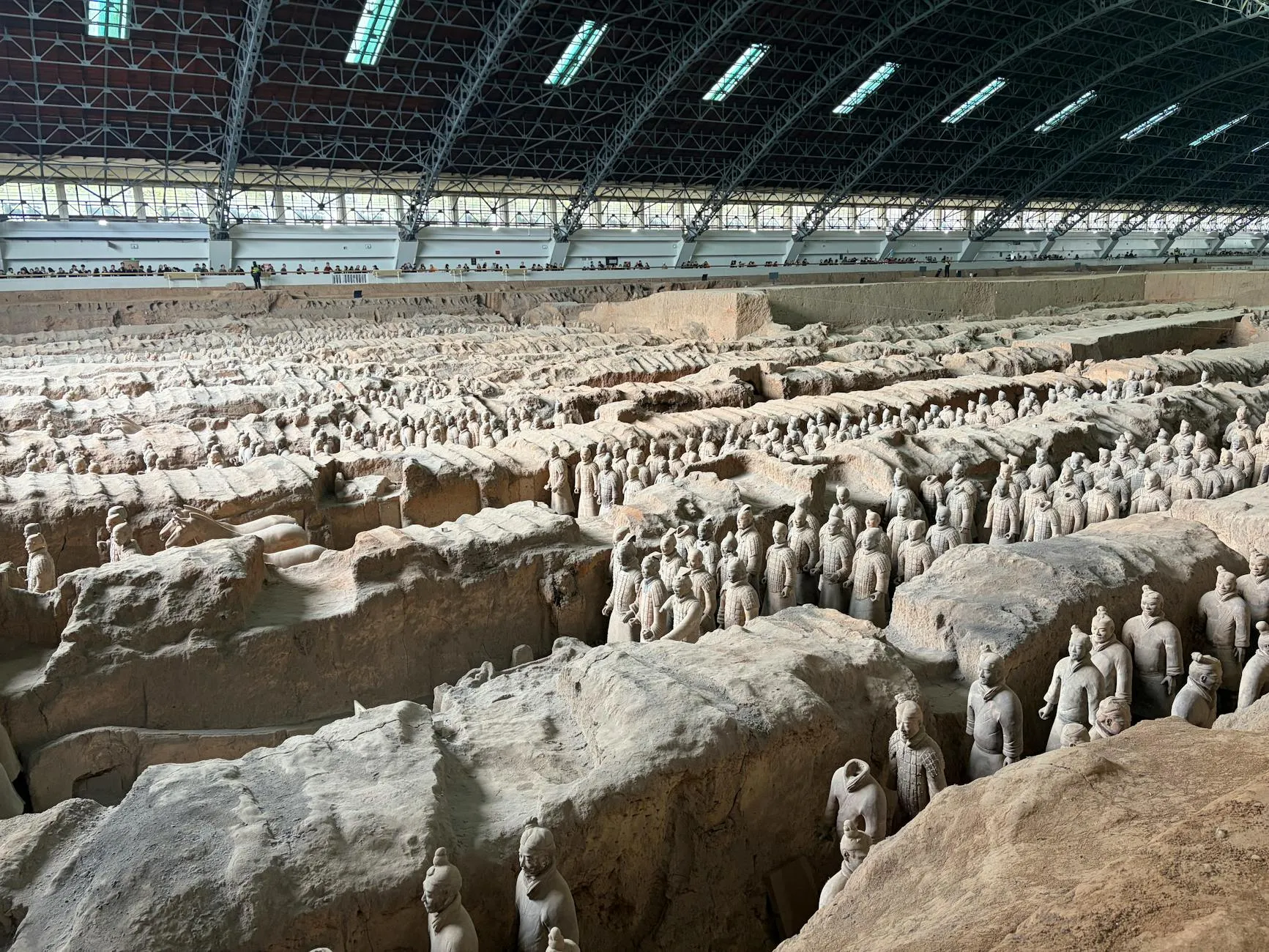
The Mausoleum of the First Qin Emperor (Qin Shi Huang’s mausoleum, c. 210 BC) and the famous Terracotta Warriors (Bingmayong) — discovered in 1974 by a farmer digging a well — sit ~50-65 km east of XIY by road (the precise figure depends on routing around the Xi’an ring road; cite a practical 1.5-2 hr transit time). Entry ticket: ¥120 (~€16) during March-November high season; ¥90 off-season. Combined ticket includes the three excavation pits + the Mausoleum site. From XIY: Metro Line 14 to Xi’an North Railway Station → bus #5 (¥7) or shuttle from Chengbei Bus Station to Bingmayong = ~1.5-2 hours each way. Or DiDi direct (¥200-300, faster). Honest layover math: 3-4 hours each way + 90-120 min at the site + airport buffer = 8-9 hours total minimum. This is a TWOV-stopover destination, not a quick layover move.
Xi’an’s Ming-era city wall (1370, restored multiple times) is the largest and best-preserved walled defence in China — 13.74 km long, 12 m tall, walkable and bikable along its entire perimeter. Entry ¥54; bike rental ¥45 for 3 hours at the South Gate. The full lap by bike takes ~90-120 min. From XIY: Metro Line 14 + Line 2 to Yongningmen (South Gate) station = ~75 min. The wall fits a 5-6 hour layover — a partial walk (1-2 km) plus a Muslim Quarter dinner is realistic in less.
The Muslim Quarter (回民街, Huímín Jiē) is the historic Hui (Chinese Muslim) neighbourhood centred on Beiyuanmen Street, north of the Bell and Drum Towers. This is the densest food street in Xi’an — biangbiang noodles, roujiamo, persimmon cakes, lamb skewers, hand-pulled noodles, pomegranate juice. The Great Mosque of Xi’an (a UNESCO-eligible 8th-century mosque blending Tang Chinese and Islamic architecture, entry ¥25) is the cultural anchor. From XIY: Line 14 + Line 2 to Zhonglou (Bell Tower), then 10-min walk north. The standard 4-hour layover move from XIY if you want the city’s flavour without the full Terracotta-Army commitment.
Big Wild Goose Pagoda (大雁塔, Dayan Ta) — a 64 m, 7-storey brick pagoda built 652 AD in the Tang dynasty, originally to house Buddhist sutras brought back from India by the monk Xuanzang. Entry ¥50 to climb. The Tang Paradise park nearby ¥150 — a recreated Tang-era pleasure park with shows. From XIY: Line 14 + Line 2 → Dayanta = ~75 min. The Pagoda fits within a 4-5 hour layover.
For early flights: Holiday Inn Xi’an Greenland Century City Hotel, Hilton Xi’an Hi-Tech Zone, Sheraton Xi’an North City Hotel — multiple chain hotels along the Metro Line 14 corridor, ¥400-800. Closest to airport: Xi’an XIY Airport Hotel at T5 itself. For a real Xi’an stay: Sofitel Xi’an on Renmin Square, Westin Xi’an on the Bell Tower square, Kempinski Hotel Xi’an, or boutique options in the Muslim Quarter / South Gate area. ~75-90 min back to XIY via Metro Line 14.
🔧 Practical Notes — Connectivity, Currency, Border
Chinese yuan (CNY / ¥). ¥1 ≈ €0.13 ≈ $0.14 (May 2026). Alipay and WeChat Pay are the universal payment methods in China — set up an account in-app before travel, link an international card (Visa/Mastercard now work on both for tourists), or load via cash. Foreign Visa/Mastercard credit cards work at airport duty-free, international hotels and Starbucks, but not at most local restaurants, street stalls, taxis, or convenience stores. ATMs at XIY dispense CNY. Cash is increasingly rare — many vendors only accept QR-code payment apps.
Chinese networks — China Mobile, China Unicom, China Telecom. Local prepaid SIM ~¥80-150 with passport at the airport kiosk. The Great Firewall blocks Google, Gmail, WhatsApp, Instagram, Facebook, X/Twitter, YouTube, the New York Times, BBC News, and most western services — you’ll need a VPN configured BEFORE arrival (Chinese networks generally block VPN downloads). Wi-Fi at XIY and most hotels has the same restrictions. International roaming on a non-Chinese SIM often bypasses the Firewall but is expensive.
4-hour layover: Metro Line 14 + Line 2 to the Muslim Quarter (Bell Tower stop) — biangbiang noodles + roujiamo + 60 min walk through Beiyuanmen Street — back to XIY. ~75 min each way + 90-120 min on the ground = 4 hours minimum. 5-6 hours: add a partial walk on the City Wall or Big Wild Goose Pagoda. Terracotta Army needs 8-9 hours minimum — feasible only with a long layover or proper TWOV stopover. Under 3 hours: stay airside in T5 with V22 Lounge access.
❓ Frequently Asked Questions
📊 2026 Summary Data Table
🌍 Planning the trip? Read our China travel guide — best time to go, where to stay, and how to get around.