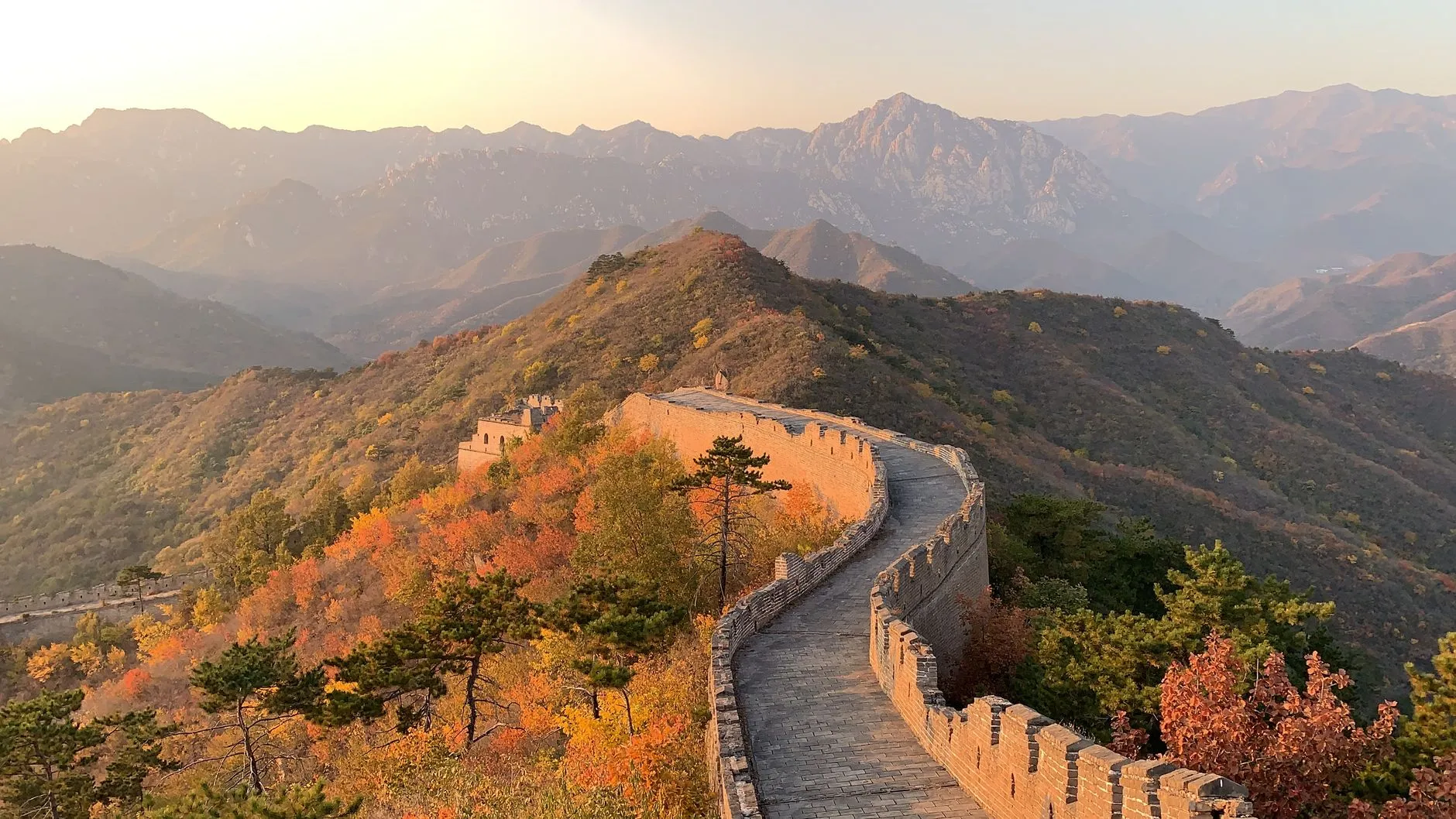
China — Complete Travel Guide 2026
For twenty years China was the great country everyone meant to visit “one day” and almost nobody did, because the visa was a hassle, you couldn’t pay for anything, and your phone went dark the moment you landed. In 2026 all three walls have quietly come down at once — most Europeans now fly in with nothing but a passport, link a normal Visa card to Alipay in the time it takes to clear immigration, and ride a 350 km/h train across half a continent for the price of a cheap dinner. China didn’t get easier by accident; it threw the doors open on purpose, and the window is stamped through 31 December 2026. It’s still the most demanding trip in this guide — it rewards the prepared and punishes the lazy — but for the first time in a generation, the payoff is right there for the taking.
Quick Reference
East Asia — the third-largest country on Earth, from the Gobi to the tropics
Beijing (PEK/Capital, PKX/Daxing), Shanghai (PVG/Pudong, SHA/Hongqiao), Guangzhou (CAN), Shenzhen (SZX), Chengdu (TFU/Tianfu, CTU), Xi’an (XIY), Chongqing (CKG)
Chinese yuan / renminbi (CNY / RMB, ¥). Roughly €1 ≈ ¥7.7 in mid-2026
Mandarin Chinese (plus Cantonese in the south and dozens of regional tongues). English is rare outside top hotels and airports
30-day visa-free for ~50 nationalities incl. most of the EU, UK, Switzerland, Norway and Canada through 31 Dec 2026; 240-hour (10-day) visa-free transit** for ~55 nationalities (incl. the US) at 65 ports
Late September to early November, and April to May. **Skip Golden Week, 1–7 October
The Great Wall, the Terracotta Army, the Li River karst, giant pandas, bullet trains, the food, and a scale nothing prepares you for
Beijing and Shanghai as the two anchors; then Xi’an, Chengdu, Guilin/Yangshuo and Zhangjiajie as the showpieces
Editor’s Note: The Door Just Opened — and It Has a Date On It
Let me be blunt about why this guide exists now. The single most important fact about China in 2026 is that the country has made itself dramatically, almost unrecognisably easy to enter — on a deadline.
Since late 2023 Beijing has been rolling out unilateral visa-free entry, and by 2026 the list runs to roughly 50 countries: France, Germany, Italy, Spain, the Netherlands, Belgium, Austria, Switzerland, Poland, Portugal, Ireland, the Nordics, almost the whole of the EU — plus, from 17 February 2026, the United Kingdom and Canada. Hold one of those passports and you can now land in China, walk up to immigration, get a stamp, and stay up to 30 days for tourism, business or visiting family. No application, no embassy queue, no fee, no agency. The only fine print: your passport needs six months’ validity, and you genuinely have to leave inside the 30 days — there are no extensions and the overstay fines are real (¥500 / about €65 a day, plus a future ban).
This is a deliberate policy, not a permanent fixture. The scheme has been extended twice and is currently guaranteed only through 31 December 2026. It may well be renewed — Beijing likes the tourist numbers — but it’s a unilateral favour, not a treaty, and favours can be withdrawn. That is the honest case for going this year rather than vaguely intending to.
The bottom line on the visa: if you carry an EU, UK, Swiss, Norwegian or Canadian passport, a two- or three-week China trip in 2026 needs exactly as much paperwork as a weekend in Lisbon — which is to say, none. Five years ago the same trip meant a visa agency, bank statements and a fortnight of waiting. Check your own nationality on the list before you book, but for most of Europe the answer is now simply yes, just go.
And if your passport isn’t on the 30-day list — Americans, most obviously, are not — China has a second door: the 240-hour (10-day) visa-free transit, covering around 55 nationalities, which lets you stay up to ten days as long as you’re transiting to a third country or region (Beijing → Tokyo, or anywhere → Hong Kong, counts). I’ll cover the catches in the entry section, but the headline is the same: China wants you in, and in 2026 it has built more ways than ever to let you.
Should You Go? Who China Is For — and Who It Isn’t
I want to talk you out of this trip before I sell it to you, because China is the one destination in this guide where the wrong traveller has a genuinely bad time.
China is for you if you are curious, organised, and a bit stubborn. It rewards the person who installs the apps before the flight, screenshots the train tickets, learns to point at a phone screen, and treats the friction as part of the adventure. If you’ve done independent travel in Japan, Vietnam or India and enjoyed the puzzle of it, China is the boss level — and it is magnificent. The history is on a scale that makes Europe feel like a village. The food is, route for route, the best eating on the planet. The infrastructure — the trains especially — will quietly humiliate whatever you’re used to at home.
China is not for you if you want a country to happen to you. There’s very little English outside the big cities, your normal phone is half-dead behind the firewall, Google Maps doesn’t work, and the menu is a wall of characters. None of it is insurmountable — translation apps and pointing get you a long way — but if any of that raises your blood pressure rather than your pulse, go to Thailand instead and come to China later.
The honest one-liner: China in 2026 is easier to enter than it has ever been, and no easier to function in than it ever was. The border is open; the language and the firewall are exactly as hard as they always were. Plan for that gap and you’ll have the trip of a lifetime.
A word on first-timers: do not try to “do China” in one trip. It’s the size of a continent — Beijing to the Yunnan highlands is further than London to Moscow. Pick a lane. For two weeks, the classic east-coast triangle plus one wildcard (Beijing → Xi’an → Shanghai, then add Guilin or Chengdu or Zhangjiajie) is the perfect first taste. Save Yunnan and the deep west for the return trip you’ll already be planning on the flight home.
Set Up Your Phone Before You Fly — The Hour That Saves Your Trip
This is the most important practical section in the guide. Almost everything that goes wrong for first-timers goes wrong because they landed unprepared. Do this work at home, on your own wifi, while you still have Google and the app stores. You cannot fix it once you’re behind the wall.
1. Payment — set up Alipay (and ideally WeChat Pay). China is effectively cashless: street vendors, taxis, museums, noodle stalls, vending machines — everything is a QR code. The transformative change for 2026 is that Alipay and WeChat Pay now fully accept foreign Visa, Mastercard and Amex cards. Download Alipay, register with your home phone number, link your bank card, photograph your passport for verification, and you’re paying like a local within minutes of landing. The 2026 upgrade raised the single top-up cap to ¥2,000 (about €260) and the daily ceiling to ¥6,000 (about €780) — plenty for normal travel. Alipay is the smoother one for tourists — more intuitive, better English, with a translator, transit-card and ride-hailing baked in. Set up WeChat Pay too as a backup, since a stubborn minority of small merchants only take WeChat.
Do the payment setup before you fly, on home wifi. Card verification sometimes needs an SMS code and a stable connection, and you do not want to be wrestling with it on airport wifi behind the firewall with a queue forming. Land with Alipay already working, and China becomes frictionless. Land without it and you’ll spend day one hunting for an ATM.
2. Carry a little cash anyway. Pull out ¥200–300 (€26–39) at an airport ATM as a fallback for the rare stall, a dead phone, or a network blip. You’ll barely spend it, but you’ll be glad it’s there.
3. The firewall — install a VPN and an eSIM before you fly. The “Great Firewall” blocks Google entirely (Search, Gmail, Maps, Drive, Photos), plus WhatsApp, Instagram, Facebook, Signal, Telegram, X, YouTube, Wikipedia (intermittently) and most Western news. If you need any of those, you need a workaround. Two options:
- A travel eSIM that roams on a foreign network — the cleanest solution, and the one I’d push hardest in 2026. Because the data routes out through a non-Chinese carrier, it never touches the firewall at all — Maps, WhatsApp and Gmail just work, no VPN required. Airalo, Holafly and Nomad sell them; buy and install before you fly.
- A VPN — but install two, before departure. A serious crackdown through early 2026 knocked the large majority of consumer VPNs offline, and the survivors are unstable. Install at home: you cannot download a VPN once you’re inside, because the providers’ websites are blocked. Two apps on every device, so when one dies the other might hold.
Reframe the firewall instead of fighting it. The smart move isn’t to recreate your home internet in China — it’s to go local for the duration. Use Alipay’s maps and translator, ride-hail inside Alipay or DiDi, and let an eSIM handle the few Western apps you can’t live without. Travellers who brute-force Google through a flaky VPN all day end up frustrated; those who lean into the Chinese super-apps barely notice the wall.
4. Download a translation app that works offline. Google Translate works if you’ve pre-downloaded the Chinese language pack at home (the app itself can misbehave behind the wall). Alipay and WeChat both have built-in photo-translate tools that read menus and signs in real time — point your camera and the characters become English. It’s genuinely one of the small miracles of travelling here in 2026.
Getting Around: The Bullet Trains and the Sky
Here is where China stops humbling you with difficulty and starts humbling you with competence. The country’s high-speed rail network passed 50,000 km in late 2025 — about two-thirds of all the high-speed track on Earth, more than the rest of the world combined — and riding it is the most pleasant surprise of the trip.
The flagship G-class “Fuxing” trains cruise at up to 350 km/h, on time to the minute, quiet, spacious and absurdly cheap by European standards. Beijing to Shanghai — 1,300 km, roughly London to beyond Rome — takes about 4.5 hours, and a second-class seat (perfectly comfortable) costs around ¥550–660 (€72–86); first class is rarely worth the premium for daytime runs.
Booking is easy in 2026. Use the official 12306 app (it has a working English version now), or Trip.com / Klook for a friendlier interface and a small fee. You book on your passport; seats typically open about 15 days ahead, and popular routes sell out around holidays, so don’t leave the Beijing–Shanghai or Xi’an legs to the last day. At the station you go paperless — scan your passport at the orange automated gates and walk to your platform. Arrive 30–40 minutes early; Chinese stations are vast.
Take the train wherever it’s under about five hours. City-centre to city-centre, no airport schlep, no two-hour check-in, no weather delays — the train wins on almost every classic route (Beijing–Xi’an, Xi’an–Shanghai, Shanghai–Guilin region). Fly only for the genuinely long hops: the east coast out to Chengdu, Yunnan or Zhangjiajie, where a flight saves you most of a day.
Within cities, the metros are excellent, clean, cheap and English-signed — and Alipay generates a metro QR code so you skip the ticket machine. For taxis, use DiDi (China’s Uber, embedded in Alipay) rather than hailing on the street: you set both ends on the map and pay through the app, sidestepping the language problem entirely. Hailing a street cab with no Mandarin and no destination written in characters is a recipe for a long, expensive misunderstanding.
Beijing & the Great Wall
Start in the capital. Beijing is China’s history made monumental, and it’s the obvious first base — a huge, flat, grey, endlessly impressive city that runs on imperial scale.
The Forbidden City (¥60 / about €8, closed Mondays) is the un-skippable one: 600 years of emperors, a city-within-a-city of vermilion halls and golden roofs that takes a good half-day. Book it online days in advance through the official channel — it’s timed-entry, capped, and routinely sells out; turning up at the gate hoping for a ticket is the classic rookie mistake. Pair it with a climb up Jingshan Park behind for the postcard view over the whole golden expanse, and Tiananmen Square in front. Then escape into the hutongs — the grey-brick alley neighbourhoods around the Drum Tower and Houhai lake, where old Beijing still breathes in courtyard homes, tiny restaurants and the smell of grilling lamb. The hutongs, not another temple, are where you’ll actually feel the city.
But you came for the Wall. The Great Wall is one of the few world-famous sights that exceeds the hype — and which section you choose makes or breaks it.
- Mutianyu is the sweet spot for most visitors: dramatically restored, sweeping through forested ridges about 1.5–2 hours from the city, with a cable car up and a toboggan down. Busy but never crushing.
- Jinshanling is for the romantics — a partly-wild, crumbling, gloriously empty stretch about 2.5 hours out, where you can walk for hours over watchtowers with barely another soul. My personal favourite, if you have the day and the legs.
- Badaling is the one to avoid: the closest and most heavily marketed, which makes it a scrum of tour groups and selfie sticks. The Wall deserves better than your first photo being someone’s umbrella.
The Wall is a day, not an afternoon. Leave Beijing early, give yourself hours to actually walk it rather than tick it, and go to Mutianyu or Jinshanling, never Badaling. Standing on an empty watchtower at Jinshanling as the ridgeline disappears into the haze in both directions is the moment China stops being a place on a map and becomes the trip you’ll talk about for years.
A note on Beijing’s air: pollution is hugely improved from the notorious “airpocalypse” years of the early 2010s — the famously bad days are now the exception — but it’s still variable. Autumn after the first cold fronts gives the clearest skies; check the AQI on the morning of your Wall day, and if it’s grey, the hutongs and museums are a fine plan B.
Xi’an & the Terracotta Army
A 4.5–6 hour bullet train southwest of Beijing brings you to Xi’an, the ancient capital where China’s first emperor built himself an army for the afterlife. The Terracotta Warriors — thousands of individually-faced clay soldiers, unearthed by farmers digging a well in 1974 — are exactly as staggering in person as you hope, especially the vast Pit 1 hangar where rank after rank stretch into the distance. Entry runs around ¥120 (€15.50); go early or late to dodge the tour-bus crush, and take a guide or audio guide, because without the story the scale lands but the meaning doesn’t.
Xi’an itself rewards the time. The intact Ming city walls (cycle the full 14 km circuit on a rented bike) and the lantern-lit Muslim Quarter — a riot of cumin-lamb skewers, hand-pulled noodles and roujiamo “Chinese hamburgers” — make it one of the best eating cities in the country, far richer than a day-trip-and-leave for the Warriors alone. The full picture is in the Xi’an city guide.
Shanghai & the East Coast
Where Beijing is imperial and grey, Shanghai is electric and vertical — China’s show-off, a city of neon, glass towers and old-world glamour that makes the perfect counterpoint and a natural end to the classic route. Stand on the Bund at dusk as the colonial-era waterfront faces off against the science-fiction skyline of Pudong across the river, get lost in the plane-tree lanes of the former French Concession, and eat your way through a city that takes its food as seriously as anywhere on the mainland. It’s also the easiest soft landing in China — the most English, the best place to recover if the rest of the country has worn you out. I’ve kept it brief because it earns a guide of its own: the full breakdown is in the Shanghai city guide.
From Shanghai the rail spokes run everywhere. Water-town day trips (Zhujiajiao, Tongli) do the “Venice of the East” cliché well; Hangzhou’s West Lake and Suzhou’s classical gardens are each under an hour by train and worth a night. Further south sit Xiamen, a relaxed semi-tropical port city with the colonial island of Gulangyu offshore (the Xiamen city guide), and the tech-boomtown energy of Shenzhen, the mainland’s gateway to Hong Kong (the Shenzhen city guide).
Guilin, Yangshuo & the Li River Karst
If you only add one “wildcard” to the classic triangle, make it this. The limestone karst peaks of Guangxi — those impossible jade-green sugarloaf mountains rising sheer out of the rice paddies and rivers — are the China of every scroll painting and the back of the ¥20 note, and seeing them in the flesh is one of the great landscape experiences anywhere on earth.
The move is to fly or train into Guilin, then get straight out — Guilin the city is fine but forgettable. The magic is the Li River cruise downstream to Yangshuo, a four-hour drift past karst peaks reflected in the water, fishermen, water buffalo and bamboo rafts. Base yourself in Yangshuo, a small town turned backpacker-and-cyclist hub, and spend your days renting a bike or e-scooter and getting properly lost among the peaks along the Yulong River — quieter, gentler and more beautiful than the main river, threaded with stone bridges and rice fields. The centre of Yangshuo is touristy; ignore the schlock, get out into the countryside on two wheels, and the place delivers completely.
Spend your Guilin time on the river and in the fields, not in the city. The cruise plus two or three nights in Yangshuo with a bike is one of the most purely lovely things you can do in China. Go in spring or autumn — summer is gorgeously green but punishingly hot and humid, and the river runs low in deep winter.
Chengdu: Pandas, Hotpot, and the Art of Slowing Down
Chengdu, the laid-back capital of Sichuan in the southwest, is the city travellers fall hardest for — and it’s a fly-in (the high-speed line from the east is long; a flight from Shanghai or Beijing is the sane choice). It runs at a different tempo from the coast: teahouses, mahjong in the parks, a famous local devotion to not being in a hurry.
You come for two things. First, the giant pandas — the Chengdu Research Base on the city’s edge is the world’s best place to see them, and the secret is to arrive at opening time (around 7:30–8:00 am), because pandas are active in the cool of the morning and turn into furry sofa cushions by mid-day. Second, the food — Chengdu is a UNESCO City of Gastronomy and the home of mouth-numbing Sichuan pepper, and a blood-red hotpot here is a rite of passage: hotter than you think, better than you imagine. Order a split pot if your stomach is nervous, and don’t fight the má là tingle — lean into it.
Chengdu is also the launchpad for the wild west — Tibetan Kham, the Jiuzhaigou valleys, the road to Lhasa. The full city breakdown, including the Leshan Giant Buddha day trip, is in the Chengdu city guide. Sichuan’s other giant, the vertical megacity of Chongqing — hotpot’s spiritual home, a surreal cityscape of skyscrapers stacked on cliffs — has its own Chongqing city guide and pairs naturally with Chengdu on a southwest loop.
Zhangjiajie & the Avatar Pillars
In the mountains of Hunan stands the landscape James Cameron’s Avatar borrowed for its floating mountains, and the real thing is stranger and more vertiginous than the film. Zhangjiajie National Forest Park is a forest of thousands of sheer quartzite-sandstone pillars — some over 1,000 metres tall — wreathed in mist, and walking among them (or riding the glass elevators and cable cars) is genuinely otherworldly.
It’s a commitment to reach — fly in, or take the high-speed line and transfer — and it deserves at least two full days, because the park is enormous and the famous Bailong “Hundred Dragons” elevator, the Tianmen Mountain cable car and glass skywalk, and the canyon trails are spread across a big area. In peak season it’s busy — domestic tourism discovered Zhangjiajie in a big way after Avatar, and the queues for the headline viewpoints can be brutal in July, August and on national holidays.
Zhangjiajie is worth the detour, but go in the shoulder season and go misty. Spring and autumn weekdays are the sweet spot. And don’t pray for blue sky here — the pillars are at their most spellbinding half-swallowed in cloud, which is exactly when the crowds thin and the photos turn magic.
Yunnan: The Highlands of the Southwest
Save this for your second China trip, or a slower first one — Yunnan, tucked into the far southwest against the Tibetan and Southeast Asian borders, is a country unto itself and the antidote to everything fast and hard-edged about the east coast. It’s the most ethnically diverse province in China — Bai, Naxi, Tibetan and dozens of other peoples — and the landscapes climb from rice-terraced subtropics to Himalayan foothills.
The classic circuit runs Kunming → Dali → Lijiang → Shangri-La. Dali, on a lake under a wall of mountains, is the mellow old-town-and-cafés stop. Lijiang‘s UNESCO old town is ravishing and shamelessly touristy in equal measure — go, but stay in a quieter courtyard guesthouse and walk the cobbles at dawn before the tour groups wake. From there you climb toward Shangri-La (the town renamed itself after the novel) and the edge of the Tibetan world, past Tiger Leaping Gorge — one of the deepest river canyons on earth and a superb two-day trek. Altitude is real up here (Shangri-La sits above 3,200 m) — take the climb gently.
What’s Overrated — and What to Skip
A guide that only tells you what to see isn’t doing its job. After the highlights, here’s where I’d save you time, money and disappointment.
- Badaling Great Wall — said it above, saying it again. The most crowded, most commercialised section, full of tour groups. Mutianyu or Jinshanling, every time.
- The big night-time light shows — the Impression-style mega-productions are slick, expensive and oddly soulless. One, maybe, for the spectacle; not three.
- “Ancient towns” that are 90% souvenir stalls — China has a habit of over-restoring old quarters into identical lanes of the same jade shops and rice-wine kiosks. Some (Pingyao, parts of Lijiang) survive the treatment; many are pure tourist theatre. If a “1,000-year-old town” is selling the same Bluetooth-speaker tat as the last one, walk on.
- Cramming the country — the single biggest mistake. Five cities in ten days means you spend the trip in transit and remember none of it. Three places done slowly beat seven done as a checklist.
- Hong Kong and Macau as “China lite” — wonderful places, but they run on their own visa rules, currency and systems, and they’re not a substitute for the mainland experience. Treat them as separate trips, not a toe-in-the-water version of China.
Eating in China
If you take one thing from this guide, take this: what we call “Chinese food” in the West is a single faint dialect of one of the richest food cultures on Earth, and eating across the real thing is reason enough to come.
China’s cuisines are regional to the point of being different countries on a plate. Sichuan (Chengdu, Chongqing) is the famous one — the numbing-and-hot má là of hotpot, mapo tofu, dan dan noodles. Cantonese in the south is the subtle, fresh, seafood-and-dim-sum tradition. The north is a land of wheat, not rice — hand-pulled noodles, dumplings, and Peking duck, which in Beijing is a genuine event: lacquered, carved tableside, rolled into pancakes with scallion and sweet bean sauce. Xi’an does cumin-lamb and chewy biang biang noodles; Yunnan leans toward Southeast Asia with wild mushrooms and crossing-the-bridge rice noodles.
The best food is rarely in the fancy restaurant. It’s the hole-in-the-wall noodle shop with a queue of locals, the night-market skewer stall, the dumpling counter where someone folds by hand in the window. Be brave: point at what the next table is having, photo-translate the menu, accept that you’ll occasionally order something baffling — that’s the price of the best meal of your trip. And it’s cheap: a bowl of noodles that ruins you for life runs ¥15–30 (€2–4), a sit-down hotpot blowout for two maybe ¥150–250 (€20–32).
Eat where the locals queue, order by pointing, and let the menu translate itself. The traveller who insists on an English menu and a “safe” choice eats the worst food in China. The one who follows the crowd into the steamy little place with no English sign eats the best.
A practical note: tap water isn’t drinkable — stick to bottled or boiled (hotels and trains provide hot water everywhere). And the spice is real; “not spicy” (bú là) is a phrase worth learning, though in Sichuan it’s treated as a gentle suggestion.
Money, Costs & When to Go
The yuan and what things cost. At roughly €1 ≈ ¥7.7 in mid-2026, China is excellent value for a European wallet — not the dirt-cheap backpacker country it was twenty years ago, but a long way below Western Europe. A comfortable midrange budget lands around €60–110 a day per person: a clean hotel double for €40–80, those €2–4 noodle bowls and €20-ish hotpot dinners, museum entries of €5–15, bullet-train legs of €30–90. Backpackers do it on far less; luxury has no ceiling. The big train legs and any domestic flights are the costliest items, so book those early.
Cash, cards and tipping. As covered up top: it’s an Alipay/WeChat world, foreign cards now link cleanly, carry a little cash for emergencies, and Western cards are still not accepted at the till outside top hotels — your card lives inside Alipay, not in your hand. Tipping is not expected anywhere in mainland China; the price is the price.
When to go. The two golden windows are late September to early November and April to May — mild temperatures, the clearest skies of the year (autumn especially, once the first cold fronts scrub the air), and the photogenic seasons of autumn colour and spring bloom. Mid-to-late October over Beijing and the Wall is about as good as China travel gets.
Mark three blackout periods in red and route around them: Golden Week (1–7 October) and Chinese New Year (late Jan / Feb 2026), when the entire country travels at once and every train, hotel and attraction is mobbed and dear; and high summer (July–August), which is hot, humid, the rainy season across much of the south, and peak domestic-tourism crush at headliners like Zhangjiajie. Spring and autumn are not just nicer — they’re meaningfully cheaper and emptier.
Winter has its own austere appeal — the Wall under snow, the Harbin ice festival in the far northeast — but it’s cold and short on daylight. For a first trip, aim for the shoulder seasons and you can’t go wrong.
Entry & Visa, Verified
Because this is the part that has changed most and matters most, here is the 2026 detail — checked, not remembered. Always confirm against your own government’s travel advice and a Chinese embassy page before booking, as the lists are extended and tweaked periodically.
The 30-day visa-free scheme (the big one). Citizens of roughly 50 countries can enter China and stay up to 30 days with no visa at all, for tourism, business, family visits or transit, through 31 December 2026. The list covers most of the EU — France, Germany, Italy, Spain, the Netherlands, Belgium, Austria, Portugal, Ireland, Poland, Greece, the Nordics, the Baltics and more — plus Switzerland, Norway, Iceland, and, since 17 February 2026, the United Kingdom and Canada. Requirements are minimal: a passport valid at least six months, and you must leave within 30 days (no extensions, no border-hops to reset). It applies to entry by air, land or sea at ordinary ports.
The 240-hour (10-day) visa-free transit (for everyone else). If your nationality isn’t on the 30-day list — US citizens are the obvious case — China offers a separate 10-day (240-hour) visa-free transit for around 55 nationalities. The catch is in the name: you must be transiting to a third country or region — you arrive from country A with an onward ticket to country C, not back to A (a Tokyo–Beijing–Seoul routing qualifies; so does anything → China → Hong Kong/Macau/Taiwan, which count as “third regions”). It’s valid at 65 ports across 24 provincial-level regions, you show a passport with at least three months validity plus the onward ticket, and the clock starts the day after entry. It does not cover Xinjiang, Tibet, Inner Mongolia and a few other regions.
Two different doors — know which is yours. EU / UK / Swiss / Norwegian / Canadian passport? Use the 30-day visa-free door: book a return ticket, bring your passport, done. American (or otherwise off the 30-day list)? Use the 10-day transit door: build an onward flight to a third country into your itinerary and you can still see Beijing, Xi’an and Shanghai visa-free. If neither fits — you want longer, or to visit Tibet — get a proper tourist (L) visa from a Chinese embassy.
A few universal points. Register your address with the local police within 24 hours of arrival — hotels do this automatically at check-in, but in a private home you must do it yourself at the local station. Tibet always requires a separate permit and an organised tour, whatever your visa status. And keep your passport on you: it’s your payment ID, train ticket and hotel check-in all in one.
Frequently Asked Questions
Cheapest Flights to China
We have tracked 7,570 fares to China from 232 cities. As of June 2026, here is what a good price looked like from each — the lowest fare we recorded, and a “great-deal” benchmark to judge a quote against. These are tracked observations, not live prices: by the time you read this they will have moved, so treat them as a yardstick, not a quote.
| From | Lowest fare we tracked | Great-deal benchmark |
|---|---|---|
| Tbilisi (TBS) | €308 | €440 |
| Florence (FLR) | €377 | €538 |
| Batumi (BUS) | €379 | €541 |
| Frankfurt (FRA) | €402 | €574 |
| Frankfurt Hahn (HHN) | €424 | €606 |
| Yerevan (EVN) | €428 | €611 |
| Valencia (VLC) | €430 | €614 |
| Paris (BVA) | €453 | €647 |
Recent deals we have posted to China:
- Seattle to Beijing, China from $661
- Prague to Beijing, China from €401
- Vancouver to Beijing, China from C$1039
- Dublin to Beijing, China from €545
- Vienna to Beijing, China from €637
- Basel to Beijing, China from CHF 527
- Oslo to Beijing, China from €576
- Milan to Beijing, China from €520
- Bucharest to Beijing, China from €600
- Prague to Beijing, China from €422
These are fares aifly tracked to this destination, not live quotes — they have changed since and several of the deals above may have expired. Browse current flight deals →