Aeropuerto Internacional General Juan N. Álvarez (ACA) — Airport Guide 2026
The airport recovered faster than the city. Hurricane Otis made landfall as Category 5 on the night of 24–25 October 2023, blew out the control-tower glazing, wrecked the small-aircraft apron, and damaged the terminal — yet scheduled commercial flights were back at 07:00 on 17 November 2023, three and a half weeks later, while much of Acapulco was still clearing wreckage.
Quick Reference
Aeropuerto Internacional General Juan N. Álvarez
ACA / MMAA
Grupo Aeroportuario Centro Norte (OMA)
16 km (≈26 km by road) southeast of central Acapulco, Guerrero
30–45 min depending on traffic
One terminal, two levels, ~19,000 m², capacity ~1.3M/yr
6 — 3 jet-bridges, 3 walk-out tarmac stands
10/28 (3,302 m × 45 m); 06/24 (1,700 m × 35 m)
684,452 — up 13.8% on 2024’s 601,610; 2008 peak: 1,087,974
1954
Aeroméxico, Volaris, Viva Aerobus
Air Transat (Montréal), American (Dallas/Fort Worth), United/United Express (Houston), WestJet (Toronto)
Mexican peso (MXN) · ≈16.9/USD · ≈19.7/EUR (September 2026)
FMM Digital — passport stamp, up to 180 days
US, Canada, UK, EU, most Western nationalities
~MXN 400–600 (≈USD 23–35), in-terminal booth
~MXN 250–400; informal pickup point
One Priority Pass lounge listed; OMA Premium temporarily closed
US Level 4 “Do Not Travel” — all of Guerrero, incl. Acapulco
Not potable — use bottled
🏗️ Terminal & the Otis Recovery
One terminal, two stories, roughly 19,000 square metres, rated for 1.3 million passengers a year — a ceiling Acapulco last touched in 2008 and is nowhere near today. The building opened in 1954, during the stretch when US carriers including Eastern, Braniff, and American were flying Americans down for the weekend. That era is long over, and the terminal serving the post-Otis recovery is the same footprint that served the boom, which means it rarely feels crowded.
The layout is simple because the building is small. Check-in and bag drop sit on the eastern side; arrivals, baggage reclaim, and customs occupy the western side. Departures funnel into a single ~3,600 m² lounge area feeding six gates — three with jet-bridges, three walk-out tarmac stands, which is standard for a Volaris or Viva Aerobus A320 turn at a secondary Mexican airport. The long runway, 10/28, runs 3,302 m × 45 m and can handle a 747; the short 06/24 (1,700 m) handles light aircraft. The field is rated for about 40 operations an hour, which it never approaches now.
The claim that “the airport is destroyed” still circulates online, so the timeline is worth stating plainly. Otis intensified from tropical storm to Category 5 in under 12 hours — one of the fastest recorded intensifications in the region — and struck overnight on 24–25 October 2023. At the airport, the control-tower glazing was destroyed and light aircraft on the small-aircraft apron were wrecked, but OMA stated the damage “did not limit operation.” The tower was patched back into service within days. Scheduled commercial flights restarted at 07:00 on 17 November 2023. By 2025 the airport carried 684,452 passengers, a 13.8% recovery over 2024’s 601,610.
What the terminal does not have: no rail connection (Acapulco has never had metro or intercity rail), no attached airport hotel, and none of the premium amenity stack — spa, premium food hall, branded airline lounges — you would find at Cancún or Los Cabos. A duty-free shop, convenience retail, a handful of food counters, and the OMA Premium Lounge — currently closed — are what’s there. Plan around captive-audience pricing on a thin selection.
🛂 Border, Visa & Entry Fees
📋 Entry permit — FMM Digital
Mexico’s tourist permit is the FMM (Forma Migratoria Múltiple). At air arrivals it is now issued digitally as the FMMD: the immigration officer stamps your passport with the number of authorised days rather than handing you a paper card. The default is “up to 180 days,” but the officer exercises discretion and may write fewer. Check the number on the stamp before leaving the desk — it is your legal proof of admission and you will need it on departure.
🛂 Check your stamp before you walk away
The officer can authorise fewer than 180 days without saying so. Look at the number written on the stamp before leaving the immigration desk. Arguing about it at departure is far harder than catching it at arrival.
For stays of seven days or less, the FMM carries no fee. For longer stays, the immigration fee runs around MXN 983 (roughly USD 57) and is normally bundled into your airline ticket on a flight arrival, so most passengers never pay it as a separate charge.
🌎 Who needs a visa
US, Canadian, UK, and EU passport holders enter Mexico visa-free as tourists, along with most of Latin America and the broader Western world. A widely used shortcut extends this further: travellers who already hold a valid visa or permanent residence from the United States, Canada, the UK, or Japan can typically enter Mexico without a separate Mexican visa, regardless of their own nationality. If your passport isn’t obviously on the visa-free list and you don’t hold one of those qualifying documents, check the Mexican consulate for your country before booking.
💵 Currency
The Mexican peso (MXN, symbol $) trades at around 16.9 to the US dollar and 19.7 to the euro as of September 2026. A menu listing “$500” is roughly USD 30 or EUR 25 — not a cause for alarm, just a notation convention that trips up first-time visitors. Notes run from 20 to 1,000 pesos; the 20-peso note has largely been replaced by a 20-peso coin in everyday circulation.
Mexico has no parallel exchange market — the peso floats freely and the posted rate is the real rate. Anyone offering a “special” rate is offering a worse one.
💱 Use an ATM, not the airport exchange desk
Bank-network ATMs give the interbank rate. Airport currency counters at ACA, like at most Mexican airports, charge a visible markup. Hit an ATM after baggage claim rather than the exchange window.
🧾 Departure fee
Mexican airports levy a TUA (Tarifa de Uso de Aeropuerto) per departing passenger. At ACA it is almost always bundled into the ticket price for commercial itineraries, so you won’t face a separate payment at the gate. Confirm with your carrier if you’re price-sensitive; the TUA is revised periodically and no single published figure stays current for long.
🏥 Health — altitude and vaccinations
Acapulco is at sea level, so the altitude sickness that catches arrivals in Mexico City or San Cristóbal is not a factor here. Yellow-fever vaccination is not required or recommended for Mexico — there is no transmission risk. The real health consideration on the Guerrero coast is dengue: mosquito-borne and circulating on the Pacific coast. Repellent and covered skin at dawn and dusk are the practical precaution, not a vaccine certificate.
🦟 Dengue precaution — pack DEET
Dengue circulates on the Pacific coast of Guerrero. Pack a DEET-based repellent and cover up at dawn and dusk. No widely available vaccine exists for dengue as of 2026; prevention is avoidance. Yellow fever is not required and poses no risk.
🚕 Getting to the City
The terminal sits 16 km from central Acapulco as the crow flies and roughly 26 km by road, southeast along the coast. Reckon on 30–45 minutes to the Costera (the main hotel strip along Acapulco Bay) and slightly less to Diamante, the newer resort development between the airport and the bay. There is no train, no metro, and no purpose-built airport bus a first-time visitor should rely on.
🟡 Official airport taxi — the in-terminal booth
Buy a ticket from the authorised taxi counter inside the terminal after collecting your bags. Fares are zone-based — Diamante, Puerto Marqués, Costera — and the published figure to the Costera runs approximately MXN 400–600 (≈USD 23–35). You pay at the booth, get assigned a car, and the price is fixed before the wheels turn. After dark, this is the right choice: fixed price, assigned driver, no negotiation with a stranger at the kerb.
⚠️ Ignore touts in arrivals — use the booth
Unofficial drivers approach passengers inside the terminal and on the kerb. The authorised taxi counter is inside the building, past baggage claim. Pay there, get assigned a car, and decline every approach before that point.
📱 Uber
Uber operates in Acapulco and runs cheaper than the booth taxi for the same trip — often MXN 250–400 to the Costera, traffic depending. The catch: ACA’s rideshare pickup point is informal and poorly signed compared to larger airports, and there is documented friction between app drivers and the airport taxi cooperative. Follow the pin the app gives you exactly and be prepared to walk a short distance. In daylight with a clear head, the saving is worth it. For a late-night arrival, the certainty of the official booth taxi is worth the premium.
🚗 Rental car
Major agencies have desks at the terminal. A rental makes sense only if you plan to move between Diamante, the bay, and somewhere like Pie de la Cuesta on your own schedule. Given the security environment in Guerrero — see the Safety section below — intercity self-driving, especially after dark or off the main coastal corridor, is precisely what the travel advisories warn against. Inside the guarded tourist zones, a car is a convenience; outside them it is an elevated risk.
🏨 Pre-booked hotel transfer
Resorts in Diamante and along the Costera will arrange a transfer if you ask at booking. A named driver waiting with your name on a card is the lowest-decision option after a long flight, typically running USD 30–45. For the security-conscious first-timer, it is worth the cost.
Understanding the zones
The booth prices each zone separately, so know which zone your hotel falls in before you pay. Diamante is the newer resort strip between the airport and the bay — the closest tourist concentration to the terminal, usually the cheapest fare. The Costera is the classic bayfront strip curving around Acapulco Bay, further, pricier, 30–45 minutes out. Puerto Marqués is a separate bay just east of Diamante. If your hotel confirmation doesn’t make the zone obvious, ask at the booth before paying.
🛋️ Lounges
Set expectations low. The OMA Premium Lounge — normally on the third floor, accessible via Priority Pass, LoungeKey, and Diners Club, or a Day Pass the operator prices at MXN 499 online and MXN 600 at the counter, with standard air-conditioning, wifi, snacks, drinks, and a three-hour cap — has been listed as temporarily closed with no confirmed reopening date. Treat it as unavailable until you verify otherwise on the Priority Pass app the day you fly.
⚠️ OMA Premium Lounge — temporarily closed
The OMA Premium Lounge (Priority Pass, LoungeKey, Day Pass MXN 499 online / MXN 600 at the door) has no confirmed reopening date as of 2026. On a closed day there may be no lounge open at ACA at all. Eat in the terminal, use the gate wifi, and treat any open lounge as a bonus rather than a plan.
The airport publishes exactly one lounge, and OMA’s own network page lists Acapulco once among the airports where the OMA Premium Lounge operates. No second lounge and no Aeroméxico Salón Premier appear anywhere on the operator’s own surfaces. Coverage and hours on regional Mexican airport lounges shift, and a portion of ACA’s premium estate has been in flux since Otis, so the only reliable move is to check live status on the Priority Pass or LoungeKey app at the gate before banking on access.
There is no independent pay-per-entry premium lounge of the Cancún or Los Cabos calibre here, and no flagship airline business lounge a transit passenger can count on. While the one lounge is closed, you eat at a terminal counter and use the gate wifi.
🍽️ Food Before You Fly
Eat before you arrive, or eat knowing you’re paying airport prices for a thinner selection. ACA’s food estate is small — convenience outlets, a coffee chain or two, a sit-down option or two airside — and the markup over town is real. A bottle of water that costs MXN 15–20 at an Oxxo runs MXN 50–70 past security. A torta or quesadilla that goes for MXN 60–80 at a Costera fonda is closer to MXN 150–200 inside the terminal. ACA’s selection is thin enough that you pay the captive-audience premium for fewer choices than a larger airport offers. If you have a morning flight, buy a torta or a couple of tamales in town the night before and carry them through.
🌶️ What Acapulco is actually worth eating
Pozole verde is the Guerrero state dish — a hominy and pork or chicken stew, the green version thickened with pumpkin seed and tomatillo. Thursday is the traditional pozole day across the state; a bowl at a town fonda runs MXN 90–150. You will not find a decent one in the terminal.
Ceviche acapulqueño is tomato-forward and served with crackers or on a tostada — the everyday lunch of the coast. A tostada de ceviche in town costs MXN 40–80; the airport equivalent, where it exists, doubles that.
Pescado a la talla — whole fish butterflied, marinated in a red-chile adobo, and grilled — is the signature of the Barra Vieja beach strip southeast of the airport. It is a beach-shack dish, not a terminal dish. It does not exist airside in any meaningful form.
For the flight itself: tortas and tamales, bought in town, are both cheaper and better than anything at the gate.
🛍️ Duty-free
The shop carries the standard tequila and mezcal range. The local buy worth making is a Guerrero-origin mezcal — the state is a serious mezcal producer alongside the better-known Oaxaca, and a bottle labelled with a Guerrero origin is a more honest souvenir than a generic national tequila brand you could have bought at any airport in the country. Check your home country’s duty-free alcohol allowance before loading up.
🥃 Buy Guerrero mezcal, not generic tequila
Guerrero is a legitimate mezcal-producing state. A bottle with a Guerrero provenance costs roughly the same in duty-free as a generic national brand and is a more defensible purchase — one you couldn’t have made in most airport shops.
On named restaurants in town: a lot of Acapulco’s restaurant scene closed, moved, or rebuilt after Otis. The one durable name worth stating is La Perla at the Hotel Mirador above La Quebrada — the restaurant associated with the cliff-diver show for decades, tourist-priced and real. Ask your hotel for a current local recommendation beyond that; a stale address from a guide is worse than none.
⚠️ Safety — the Defining Context
This is not standard boilerplate at the end of the practical section. It defines whether you come at all.
All of Guerrero state — Acapulco included — carries the US government’s Level 4 “Do Not Travel” advisory due to crime and the security environment. That is the highest tier, the same classification applied to active conflict zones. US government employees are barred from Acapulco, Zihuatanejo, Taxco, and Ixtapa. Acapulco has carried one of Mexico’s highest official homicide rates for several years. In 2026, security operations and road blockages in the state have prompted shelter-in-place alerts for foreigners.
⚠️ US Level 4 “Do Not Travel” — Guerrero / Acapulco
All of Guerrero state, including Acapulco, carries the US government’s highest travel advisory tier. US government employees are barred from the city. Read the full advisory at travel.state.gov before booking. Tourism continues inside guarded corridors, but the advisory is the highest level that exists and warrants a considered decision.
Tourism continues, concentrated in two guarded corridors: the Diamante zone between the airport and the bay, and patrolled stretches of the Costera. A large military presence backs both zones. Whether that footprint is sufficient for your risk tolerance is a judgment you make with the full advisory in front of you.
If you go: stay inside the tourist corridors (Diamante, patrolled Costera); use the official in-terminal taxi booth or a pre-booked named driver rather than improvised transport; avoid moving around the city after dark; do not venture into hillside neighbourhoods or off the main coastal road; keep valuables out of sight; treat intercity self-driving as off-limits.
💡 What to Do in Acapulco
Read this section alongside the Safety section above. The attractions below are real and visitable. Whether you visit them is your call, not this guide’s.
The layover problem
ACA is roughly 95% domestic with thin schedules. Genuine multi-hour international layovers here are rare to nonexistent — almost everyone arriving is ending their journey, not connecting. Even if you have a long gap, the airport is ~26 km from the bay. A round trip to the Costera plus a 2-hour pre-flight return buffer consumes 4–5 hours before you have looked at anything, and the security calculus argues against crossing the city rather than staying in one guarded corridor. Treat the list below as things to do on a stay, not things to squeeze into a connection.
🤿 La Quebrada cliff divers
Acapulco’s signature spectacle, in Old Acapulco roughly 30–40 minutes from the airport in normal traffic. Professional divers have leapt from the ~35-metre (approximately 130-foot) cliffs as an organised team since 1934, timing each jump to the incoming swell to hit deep water. Shows run at approximately 1:00 PM and across the evening — around 7, 8, 9, and 10 PM — with the late shows featuring divers carrying flaming torches. Entry is approximately MXN 100; gates open around 30 minutes prior. You can watch from the public viewpoint or from La Perla restaurant at the Hotel Mirador above La Quebrada as part of a meal package. Old Acapulco sits outside the most-guarded tourist corridors, which is worth factoring in.
🏖️ Acapulco Diamante
The newer resort development between the airport and the bay, typically 15–25 minutes from ACA. This is where post-Otis tourism has reconcentrated, with the heaviest security presence in the city. If you want beach access inside a guarded perimeter on a short stay, this is the pragmatic choice over Old Acapulco.
🌊 The Costera Miguel Alemán
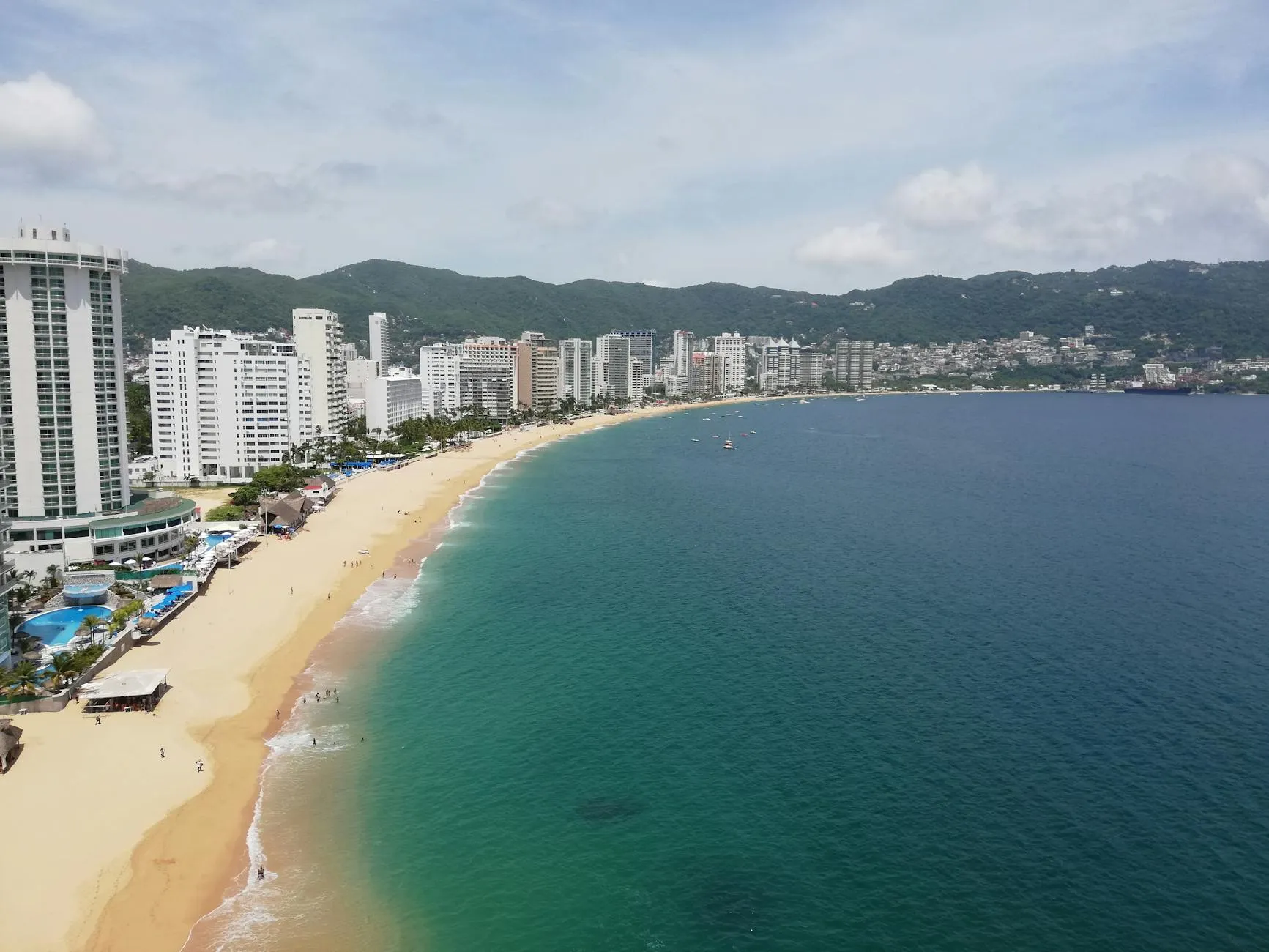
The classic bayfront strip of hotels, restaurants, and nightlife arcing around Acapulco Bay, 30–45 minutes from the airport. The historic heart of the resort, and where the city is rebuilding hardest.
🌅 Pie de la Cuesta
A sandbar roughly 10 km northwest of the city centre — around 50+ minutes from the airport, on the far side of town — with the Pacific on one side and the Laguna de Coyuca freshwater lagoon on the other, known for seafood shacks and a hard west-facing sunset. It is a genuine local spot but the longest haul on this list and the furthest from the guarded core. Worth it only on a settled multi-day stay.
🐟 Barra Vieja
The beach strip southeast of and close to the airport, home of pescado a la talla. A rustic beach-restaurant zone, not a sightseeing destination — its main value is proximity to the terminal and the food.
🔧 Practical Notes
Connectivity
Free wifi is available in the terminal — adequate for boarding passes and messaging, not for heavy uploads. For data on the ground, a Telcel SIM gives the best coverage in Guerrero. Buy it in town at an Oxxo or Telcel shop with your passport rather than relying on a terminal kiosk, or load an eSIM before you fly so you land connected. Coverage in the Diamante and Costera corridors is solid; it thins out quickly in the hills behind the city.
Cash, cards, and tipping
Cards are widely accepted in resorts, hotels, and larger restaurants. Cash in small peso notes is essential for taxis, beach shacks, tips, and markets. Tipping norms: around 10–15% in restaurants (check it hasn’t already been added as “propina”), a few pesos per bag for porters, and rounding up for taxis.
Tap water
Don’t drink it. Bottled water is universal and cheap in town; resorts provide it. Use bottled or filtered water for drinking and brushing teeth, and be cautious about ice and raw produce at low-turnover establishments. The ceviche at a busy, reputable place is fine — it is the quiet shack with slow turnover you avoid.
❓ Frequently Asked Questions
📊 At a Glance — ACA 2026
| Category | Detail |
|---|---|
| Official name | Aeropuerto Internacional General Juan N. Álvarez |
| IATA / ICAO | ACA / MMAA |
| Operator | Grupo Aeroportuario Centro Norte (OMA) |
| Opened | 1954 |
| Location | 16 km (≈26 km by road) southeast of central Acapulco, Guerrero |
| Terminal | One terminal, two levels, ~19,000 m², capacity ~1.3M/yr |
| Gates | 6 (3 jet-bridge, 3 walk-out stands) |
| Runways | 10/28 (3,302 m × 45 m); 06/24 (1,700 m × 35 m) |
| 2025 passengers | 684,452 (2024: 601,610; 2008 peak: 1,087,974) |
| Top route 2025 | Mexico City (≈140,592 pax) |
| Domestic carriers | Aeroméxico, Volaris, Viva Aerobus |
| International | Air Transat (Montréal), American (Dallas/Fort Worth), United/United Express (Houston), WestJet (Toronto) |
| Currency | MXN · ≈16.9/USD · ≈19.7/EUR (September 2026) |
| Entry permit | FMM Digital — passport stamp, up to 180 days |
| Visa-free | US, Canada, UK, EU, most Western nationalities |
| Yellow fever | Not required (no risk in Mexico) |
| Airport taxi to Costera | ~MXN 400–600 (≈USD 23–35), in-terminal booth |
| Uber to Costera | ~MXN 250–400; informal pickup point |
| Drive to bay | 30–45 minutes |
| Lounges | One Priority Pass lounge listed; OMA Premium temporarily closed |
| Rail link | None |
| Safety advisory | US Level 4 “Do Not Travel” — all Guerrero, incl. Acapulco |
| Tap water | Not potable — use bottled |