Lamezia Terme Airport (SUF) — Airport Guide 2026
Quick Reference
Lamezia Terme International Airport (Aeroporto di Lamezia Terme)
SUF / LICA
Lamezia Terme, Calabria, Italy
Tyrrhenian coastal plain in central Calabria, ~40 km from Catanzaro
One passenger terminal (boarding area being expanded)
3,049,594 passengers (2025, +12.4% — a record year)
Italy — Schengen, euro; EES live since April 2026, ETIAS expected, date not announced
Euro (€)
On-airport train: Pizzo ~20 min, Tropea ~1 hr, a few euros
No reliably confirmable Priority Pass lounge — don’t count on one
Ryanair (~123 weekly departures, about 3× ITA Airways)
🛫 1. What’s changing: a bigger airport for a booming Calabria
Lamezia is Calabria’s front door, and right now it is growing faster than its building. It set a passenger record in 2025 — 3,049,594, up about 12% on the year — and the airport operator has committed to a major expansion, including a new boarding area, to keep up. The driver is low-cost: Ryanair treats Lamezia as a focus airport and keeps adding routes, the latest examples reaching into central Europe.
What that means on the ground is an airport handling more people than it was sized for, mid-rebuild. The flow is fine off-peak, but a summer-morning bank of departures fills the single terminal, and the works add the usual temporary detours. None of it changes the fundamentals — Lamezia is a point-to-point leisure and diaspora airport, not a hub — but it does mean you should treat summer departures with a bit more time than the airport’s modest size suggests.
The cheap seats here are Ryanair’s — about 123 departures a week, roughly three times the next airline. That skews the map toward Italian domestic hops and northern-European leisure routes, with a heavy Calabrian-diaspora seam (Germany, Switzerland, and seasonal Air Transat to Canada) layered on top.
🛬 2. The terminal
One passenger terminal, laid out simply, with the new boarding area being added on rather than a wholesale rebuild. Walks are short and there are no inter-terminal transfers. The pinch points are predictable: a single security screening that backs up when two or three Ryanair flights push out together, and a compact departures area that feels full in peak August. Allow two hours for a summer departure and ninety minutes off-season, and the construction detours won’t catch you out. Airside is cafés and a shop — enough for a coffee, not a reason to come early.
✈️ 3. Carriers, and what that means for your booking
Lamezia runs on three overlapping streams of traffic, and Ryanair sits on top of all of them:
- Ryanair, dominant: around 123 departures a week, far ahead of anyone else, covering Italian domestic routes (Milan, Rome, Turin, Bergamo and more) and a wide European leisure spread.
- Italian flag and other low-cost: ITA Airways is the clear number two, with easyJet and Wizz Air also present.
- Diaspora and leisure from the north: Lufthansa, Eurowings and Condor from Germany, Edelweiss from Switzerland, Neos and TUI fly on charters, and seasonal Air Transat across the Atlantic to Canada — a route that exists because so many Calabrians emigrated there.
For booking, the read is straightforward: most of the value is Ryanair, the frequencies favour summer, and outside the season the schedule thins. There is no long-haul scheduled service and nothing to connect onto — you fly here to be in Calabria, not to change planes.
🛂 4. The border: Italy, Schengen, the euro
Italy is in the Schengen Area and uses the euro, so the standard Schengen rules apply. EU/EEA and Swiss nationals walk through. UK, US, Canadian, Australian and many other passport-holders enter visa-free for up to 90 days in any 180-day period.
Most arrivals here are intra-Schengen — Italian domestic, or from Germany and Switzerland — and skip passport control entirely. If you fly in from the UK or on the seasonal Canada service, Italy is a Schengen external border, so the EU’s EES biometric registration has applied since 10 April 2026.
ETIAS, the pre-travel authorisation for visa-exempt visitors, is expected to follow in the last quarter of 2026, ahead of becoming mandatory in 2027 — worth checking before you book if you hold a non-EU passport. Prices are in euros, ATMs are in the terminal, and cards work nearly everywhere, though the regional train machines and small coastal bars are happier with a bit of cash.
🚆 5. Getting to the coast — the train is at the airport
This is where Lamezia earns its keep as a small airport: it has its own railway station, Lamezia Terme Aeroporto, on the Tyrrhenian coastal line. Regional (Regionale) trains run from here down the coast — Pizzo in about twenty minutes, Tropea in roughly an hour — for only a few euros, with the regional operator Trenitalia running the service. Some departures are direct; others involve a quick change at Lamezia Terme Centrale, one stop inland and the region’s main interchange for longer-distance trains.
Skip the €100-plus “fixed” private transfer to Tropea. The airport’s own station puts you on a Regionale down the coast — Pizzo in about twenty minutes, Tropea in roughly an hour — for a few euros. Just check the last departure: the regional trains stop in the evening, and a late landing means the taxi after all.
The honest version of the layover question: there isn’t one. Nobody connects at Lamezia. You arrive to reach Tropea, Pizzo, Catanzaro or the resorts of the Costa degli Dei, and the train is the cheap, frequent way to do it by day.
On whether to hire a car, the answer splits cleanly. The coast doesn’t need one — the train and your own feet cover Tropea, Pizzo and the beach towns. The interior is the opposite: the Sila plateau, the Aspromonte mountains and the inland villages that many diaspora visitors are actually here for sit beyond any useful bus or train. If your trip is about the mountains rather than the sand, pick up a car at the terminal; if it isn’t, skip the expense and ride the rails.
🛋️ 6. Lounge
Be realistic here: Lamezia does not have a well-known walk-in contract lounge, and there is no reliable confirmation of Priority Pass access. Small Italian regional airports frequently have none, or only a pay-per-use or meet-and-greet product sold through a concierge service rather than a true lounge. Don’t build your wait around lounge access at SUF — plan on the airside cafés, and if lounge access matters to you, verify it on the airport’s own site close to your travel date rather than assuming.
🌶️ 7. Food, and what to carry home
The terminal food is functional Italian airport fare — a decent espresso and a panino, not a meal worth planning around. The eating is in Calabria, and Calabria has a distinct, fierce kitchen: ‘nduja, the soft, spreadable, chilli-loaded pork sausage from Spilinga near Tropea; the sweet Cipolla Rossa di Tropea red onion; and, in Pizzo, the tartufo gelato, a chocolate-cored ice-cream ball that is genuinely worth the stop and cannot be carried anywhere.
What survives the trip home is the preserved stuff. A jar of ‘nduja, Tropea-onion marmalade or Calabrian chilli oil travels well, and you’ll get a better one from a town alimentari than from the departure-gate shelf.
Don’t pack the ‘nduja for a non-EU trip: cured meat and other animal products are barred from luggage entering the UK, Canada, the US and Australia. The diaspora classic that actually survives those borders is a sealed jar of Tropea-onion preserve or a bottle of chilli oil.
🏖️ 8. The reason you’re here: Tropea and the Costa degli Dei
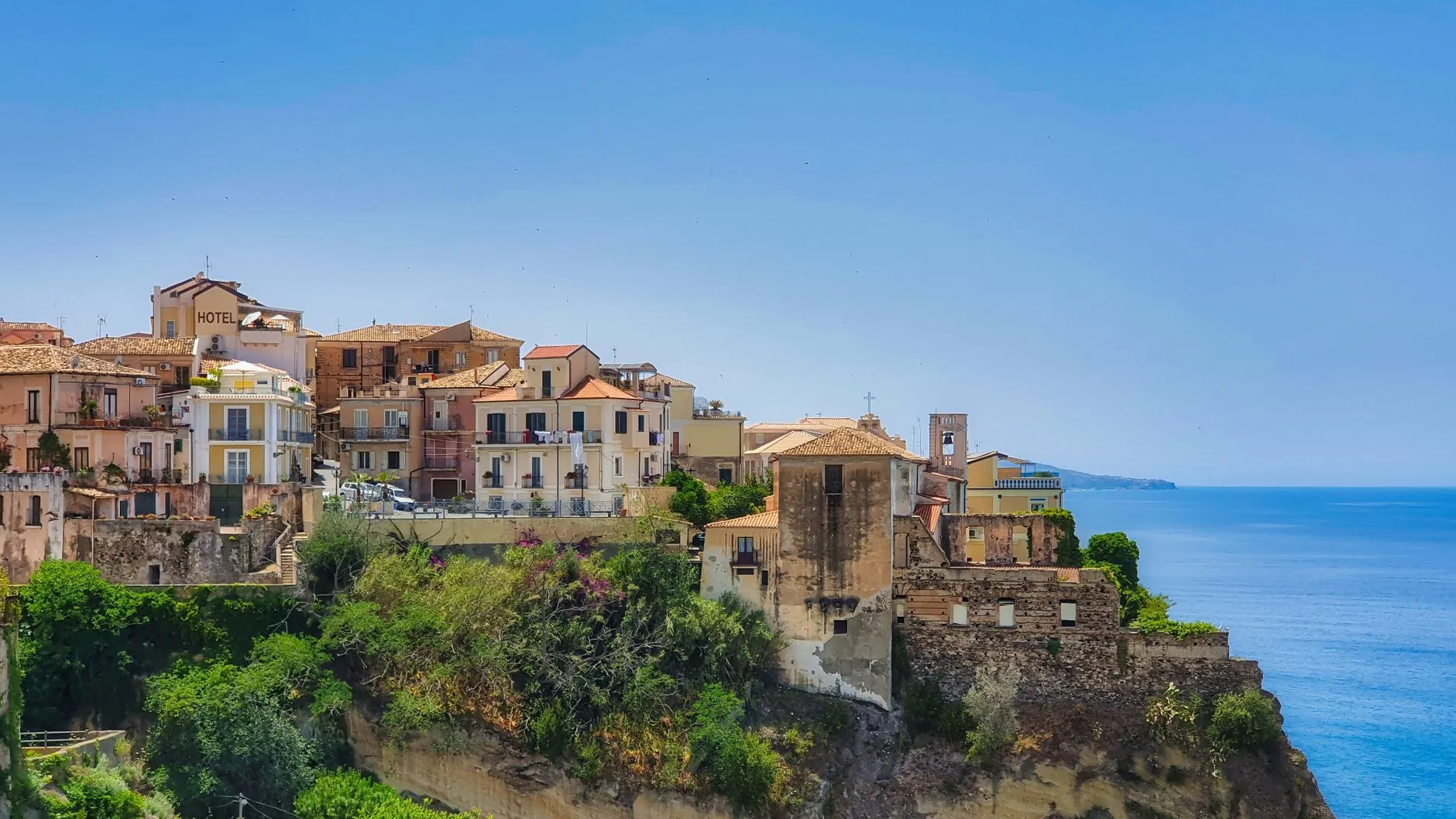
Lamezia is the access airport for one of the most photographed stretches of the Italian coast. Tropea sits on a cliff above a turquoise bay, with the church of Santa Maria dell’Isola on its rock below the old town, and the beach beneath it is the postcard. The wider Costa degli Dei — the “Coast of the Gods” between Pizzo and Capo Vaticano — is the reason the German and British charters come, and the reason a Calabrian airport now handles over three million people.
It is also, quietly, a homecoming airport. Calabria sent huge numbers of emigrants to Germany, Switzerland, the Americas and Australia across the last century, and a real share of SUF’s summer traffic is the diaspora returning — which is why a seasonal Air Transat jet from Canada lands at a regional airport in the toe of Italy. If you came for the beaches, the best move is to base yourself on the coast and treat the train as your shuttle; if you came to see where your grandparents left from, you already know the inland villages the guidebooks skip. Either way, skip the over-priced resort-strip restaurants on the Tropea seafront and eat one street back.
❓ 9. FAQ
📋 10. At a glance
| Item | Detail |
|---|---|
| Airport | Lamezia Terme (SUF / LICA), central Calabria |
| Terminal | Single terminal, boarding area being expanded; arrive 2h in summer |
| Train | Lamezia Terme Aeroporto station at the airport: Pizzo ~20 min (~€3), Tropea ~1 hr (~€5–6) |
| Taxi / transfer | Rank outside; private “fixed” transfers to Tropea are a markup (~€100+) |
| Border | Italy; Schengen; euro; EES live since April 2026; ETIAS expected, date not announced |
| Currency | Euro (€); some cash useful for trains and small bars |
| Lounge | None reliably confirmable; don’t count on Priority Pass access |
| Carriers | Ryanair (dominant), ITA Airways, easyJet, Wizz; Lufthansa/Eurowings/Condor/Edelweiss; seasonal Air Transat (Canada) |
| Busiest period | July–August, peaking at mid-August Ferragosto |
| Carry home | Tropea-onion preserve or chilli oil (cured meat barred from non-EU borders) |
🔗 11. Explore More
- Bari Karol Wojtyła Airport (BRI) guide — the nearest other Southern-Italy airport, over on the Puglia side
- Naples City Guide — the major city up the coast, a common pairing with a Calabria trip