Pula Airport (PUY) — Airport Guide 2026
Quick Reference
Pula Airport
PUY / LDPL
Pula, Istria, Croatia
About 6–8 km northeast of Pula’s centre
One terminal, built for around 1 million a year
509,397 passengers (+18.1%); summer-led, ~5th busiest in Croatia
Ryanair largest (~14 weekly departures); Croatia Airlines year-round; seasonal others
Croatia — Schengen and euro since 1 Jan 2023; EES live since 10 April 2026, ETIAS expected, date not announced
Euro (€) — the kuna is gone
Shuttle bus ~€6 (~20 min); taxi ~€15; no rail at the airport
One business-class-only lounge; no Priority Pass, no pay-per-use
🛫 1. What Pula Airport is
Pula is the airport for Istria, the heart-shaped peninsula at Croatia’s northwest tip — the bit closest to Italy and Slovenia, and the part of the Croatian coast that fills with central Europeans every summer. It is a small, seasonal leisure airport: a single terminal, a short run of carriers, and a calendar that swings hard between a busy July and a quiet January. Most people coming through it are arriving for the Istrian coast, not connecting anywhere.
The honest recent story here is growth rather than a new building. The airport carried 509,397 passengers in 2024, up about 18% on the year, in a terminal sized for roughly double that — so it has room, and the trend is up, but it remains a modest regional field rather than a hub. There is no rail link, no second terminal and no dramatic change to announce; what there is, is a steadily busier summer.
The seasonality is the fact to plan around. Ryanair is the biggest operator with around fourteen departures a week, and Croatia Airlines runs the year-round link to Zagreb, but most of the network — easyJet, Eurowings and the rest, across some 35 routes — is summer-only. The cheap direct flight you find for August often does not exist in February, when reaching Istria means connecting through Zagreb or a neighbouring hub instead.
So treat Pula as an arrivals airport for a coast. You land here for Pula itself, for Rovinj and Poreč up the coast, or for the resorts around Medulin and Fažana, and the question that matters on the ground is the short transfer into town.
The seasonality also dictates how you book. Summer seats to a small Istrian airport go early, and with a thin international map there is rarely a true last-minute bargain — set a price alert months out and fly the shoulder weeks if your dates flex. Off-season, the Croatia Airlines link to Zagreb is the reliable lifeline: when the direct summer routes stop, reaching Istria usually means a connection through Zagreb or a hub like Vienna or Frankfurt, which is slower and costs more than the July direct ever did.
🛬 2. The terminal and the lounge
One terminal handles everything, and it is an easy building to read — a single departures hall, security, and a compact airside a short walk from the gates. Off-season it is calm; on a peak-summer Saturday, when several flights turn around together, the one security line is the bottleneck, so allow two hours then and ninety minutes is plenty the rest of the year.
Airside food and shopping stay at the café-and-newsstand level, so this is not a terminal for a proper meal. Eat in Pula before you come back, or carry something through.
Boarding is the small-airport kind — expect walk-out gates and steps onto the aircraft rather than air bridges, and a short walk across the apron. On a busy turnaround the gate area fills fast, so have your boarding pass and passport or ID ready before you reach it; the line moves quicker when nobody is hunting for a phone screen at the desk.
On lounges, be clear-eyed: Pula’s one lounge is a business-class facility, open only to premium passengers on a short list of airlines, and it does not take Priority Pass or sell pay-per-use entry. For the low-cost crowd who make up most of the traffic, there is effectively no lounge to buy your way into — plan to wait in the general seating, and time your arrival so that wait is short.
🛂 3. The border: Croatia, now Schengen and euro
The single most useful border fact about Croatia is recent and easy to get wrong: since 1 January 2023 the country is in both the Schengen Area and the euro. That changed how arriving here works, and old guidance still tells people to bring kuna — they should not, because the kuna no longer exists as currency.
Because Croatia is in Schengen, arriving from elsewhere in the zone — most of Pula’s traffic — means no passport control at all. Arriving from outside it, chiefly the summer UK flights, you now meet the EU’s EES biometric system, live since 10 April 2026, which takes fingerprints and a photo on entry; at a small terminal in peak season that can mean a slow first queue. ETIAS, the pre-travel authorisation, is expected to follow, with no launch date announced.
Visa-exempt visitors from the UK, US, Canada, Australia and many other countries enter the Schengen Area for up to 90 days in any 180; EU and Swiss nationals come and go freely. Everything is priced in euros now, with ATMs in the terminal and cards taken almost everywhere, including the airport shuttle.
Worth knowing which queue you are in: the year-round Zagreb flights are domestic Croatian, and the bulk of the summer routes come from elsewhere in Schengen, so neither involves a border check. The EES system only touches the smaller set of arrivals from outside the zone — in practice the summer UK flights — so on most days the border is a non-event, and it is the British arrivals in peak season who should leave the extra few minutes.
🚌 4. Getting into Pula — the €6 shuttle, and no train
The airport sits about 6–8 km from central Pula, and the good news is that the cheap option is also the easy one.
A shuttle bus, run by the operators Brioni and FILS, meets arriving flights and runs into Pula for around €6, taking roughly 20 minutes; it typically leaves about half an hour after a flight lands, and beyond the city it also serves the coast at Fažana, Verudela and Medulin, with seasonal runs onward to Umag and Rabac. A taxi from the rank is about €15 into the centre. Buy the shuttle ticket from the desk or the driver; check its timing against a late arrival, as it follows the flight schedule rather than a clock.
There is no rail at the airport, and Istria’s railway is its own oddity — the local line runs toward Slovenia rather than connecting Pula to the rest of Croatia, so you cannot simply take a train from here to Zagreb or Split. For practical purposes, ground transport at Pula is the shuttle, a taxi, or a hire car, and the bus station in town is where the long-distance coaches to the rest of the country leave from.
For anyone heading beyond Pula to Rovinj, Poreč or the smaller resorts, a hire car is the comfortable answer — the desks are in the terminal — though the summer coastal traffic and parking in the old towns are real frictions. If you are staying in Pula itself or on the nearby coast, the shuttle or a taxi covers it, and you do not need a car for a town-and-beach trip close to the city.
One word of caution on a late arrival: the taxi rank is small, and on a delayed evening flight it can be picked over fast, while the shuttle follows the flight schedule and will not always be sitting there. If you are landing late or in a group with bags, pre-booking a transfer to your hotel removes the gamble — it costs more than the €6 bus but spares you standing outside a quiet terminal hoping a car turns up.
🏛️ 5. The reason to come: Istria and the Arena
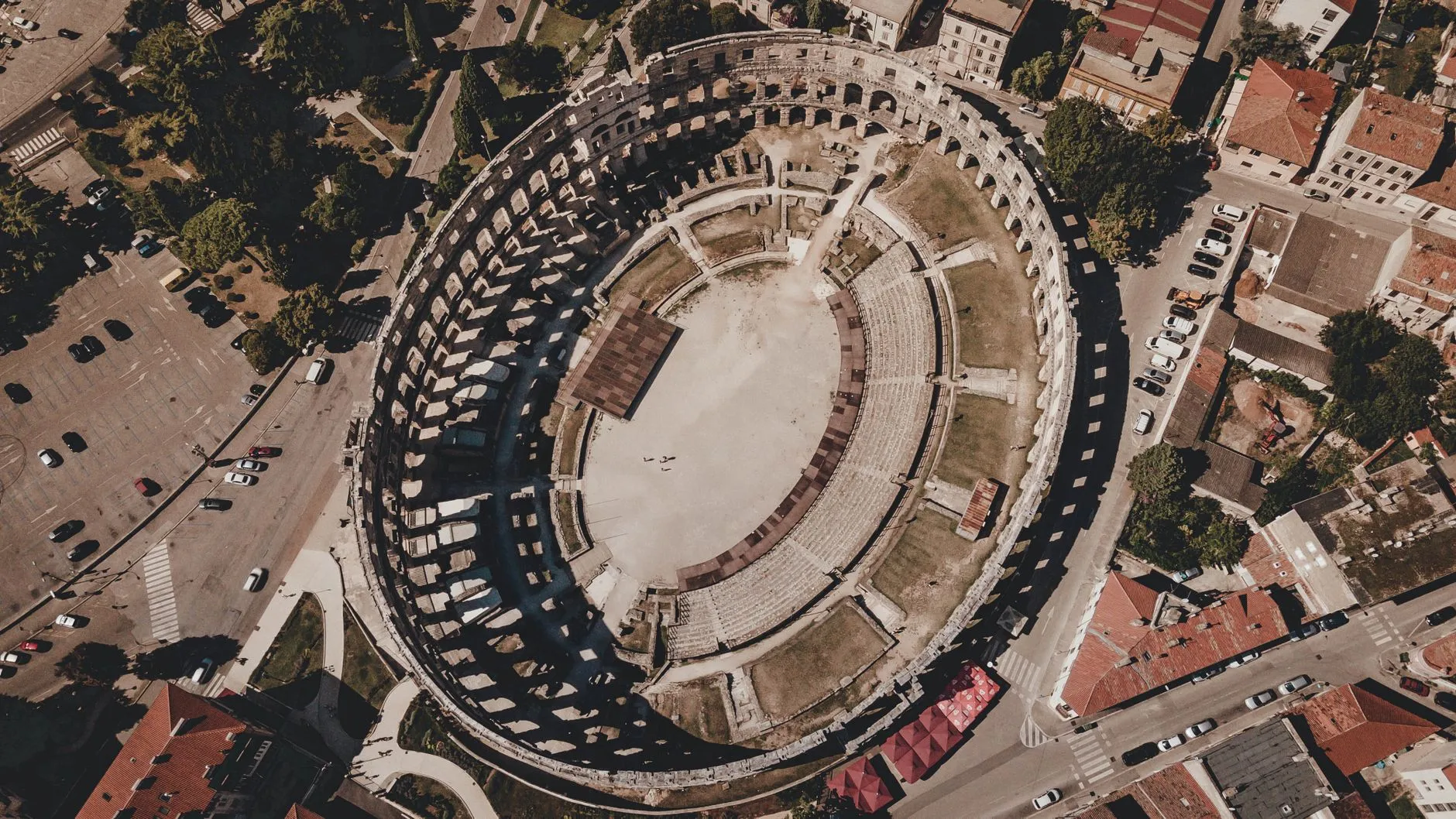
Istria is the part of Croatia that feels half-Italian — bilingual towns, a Venetian past, and a food culture built on truffles, olive oil and wine rather than just the coast. Pula itself is a working port city with a Roman core, and the set-piece is unmissable in the literal sense: the Arena, a 1st-century amphitheatre and one of the six largest the Romans built, the only one to keep all four of its outer walls standing. It still holds concerts and a summer film festival inside the ancient ring, which is the way to see it if your dates line up.
Pula is more than its Arena, and it is worth a slow afternoon before you chase the coast. The Roman forum still works as the main square, with the 1st-century Temple of Augustus standing on it; the streets climb to a Venetian fortress over the harbour, and the whole place keeps the feel of a working shipyard town rather than a polished resort, which is part of its appeal. It is a city to walk, not a strip to lie on.
Beyond Pula, the draw spreads up the coast. Rovinj, with its campanile and tight Venetian lanes, is the prettiest town on this shore and knows it; Poreč has its UNESCO-listed Byzantine basilica; and just offshore lies the Brijuni archipelago, a national park about 15 km from the airport that was Tito’s summer retreat and keeps a faintly surreal safari park from his era. Inland, the hill towns of Motovun and Grožnjan sit above truffle-rich oak forests, and the autumn truffle season is reason enough to come out of high summer.
A practical opinion on timing and traps: Istria is at its best in late spring and September, when the sea is warm, the truffle and wine country is at its turn, and the coast is not at its August crush. In peak season the Rovinj waterfront restaurants and the busier Pula seafront spots trade hard on the view — eat a street or two back, or inland in the hill towns, where the cooking is better and the bill is smaller.
The food is a genuine reason to come, not a footnote. Istria’s cooking is closer to northern Italy than to the Dalmatian coast — fresh pasta with truffle, manestra bean soup, Adriatic fish, and the peninsula’s prized olive oil and Malvazija whites — and the best of it is in the konobas, the family taverns, in the hill villages and the back streets rather than the marina terraces. Sit down where the menu is short and in Croatian first; that is usually the tell.
There is no separate aifly Istria guide yet, so this is the short orientation: Pula for the Arena and the city, Rovinj for the prettiest evening, Brijuni for the islands, and the interior for truffles and wine. What is worth carrying home is Istrian — a bottle of the local olive oil, which is among Europe’s most awarded, a Malvazija or Teran wine, or a jar of truffle paste from a proper producer rather than an airport shelf.
❓ 6. FAQ
📋 7. At a glance
| Item | Detail |
|---|---|
| Airport | Pula (PUY / LDPL), ~6–8 km from central Pula |
| Terminal | One terminal (built for ~1M); arrive ~2h in summer peak, ~90 min off-season |
| 2024 traffic | 509,397 passengers (+18.1%); summer-led; ~5th busiest in Croatia |
| Carriers | Ryanair (~14 weekly), Croatia Airlines year-round to Zagreb; easyJet, Eurowings seasonal |
| To Pula | Shuttle bus ~€6 (~20 min, meets flights); taxi ~€15 |
| Rail | None at the airport; Istria’s line runs toward Slovenia, not the rest of Croatia |
| Border | Croatia; Schengen and euro since 1 Jan 2023; EES live since 10 April 2026; ETIAS not yet live |
| Currency | Euro (€) — kuna withdrawn |
| Lounge | One business-class-only lounge; no Priority Pass, no pay-per-use |
| Worth your time | Pula’s Roman Arena, Rovinj, the Brijuni islands, Istrian truffles and wine |
🔗 8. Explore More
- Zagreb Airport (ZAG) guide — the Croatian capital’s airport and the year-round connecting point for Istria off-season
- Split Airport (SPU) guide — the airport for central Dalmatia and Split, further down the coast
- Dubrovnik Airport (DBV) guide — the far-southern Croatian airport for Dubrovnik and the deep south
🌍 Planning the trip? Read our Istria travel guide — best time to go, where to stay, and how to get around.