Dalaman Airport (DLM) — Airport Guide 2026
Quick Reference
Dalaman Airport (YDA Dalaman)
DLM / LTBS
Dalaman, Muğla, southwest Turkey
Serves Fethiye (~45 km), Marmaris (~95 km), Ölüdeniz, Göcek, Dalyan
Two terminals ~500 m apart — one international, one domestic
5,577,142 passengers (down 1.1% on 2024); heavily summer-led
UK charter and low-cost — Jet2, easyJet, TUI; Pegasus flies heavily here
Turkey
Turkish lira (₺)
Havaş/MUTTAŞ shuttle to Fethiye & Marmaris; private transfer; no rail
CIP Lounge / Primeclass (international terminal) — Priority Pass; separate domestic lounge
🛫 1. What Dalaman Airport is
Dalaman is the airport for the southwest corner of Turkey — the Turquoise Coast that runs from Marmaris round to Fethiye, Ölüdeniz and the resorts in between. It is a large, seasonal, almost entirely leisure airport, and it is one of the most British airports outside Britain: the schedule is built around UK charter and low-cost flights, with German and a few other European routes filling in. Around 5.58 million passengers came through in 2025, down about 1% on 2024, almost all of them in the summer half. International traffic fell about 4% while domestic rose about 5%.
There is no big recent change to lead with — no new terminal, no rail link, no shift in who flies here — so the honest opening is what the airport actually is and does. It exists to land package and independent holidaymakers and move them to a coast that starts 45 km away and runs to 95 km. You do not connect through Dalaman; you arrive, clear a Turkish border, and face a real transfer.
That transfer is the single most important thing to grasp before you fly. Dalaman is not at the resort — Fethiye is about 45 km and roughly 50 minutes, Ölüdeniz about an hour, and Marmaris around 95 km and an hour and a half. This is an arrivals-and-transfer airport, not a six-kilometre hop into a town, so plan the journey to your hotel as a real leg of the trip rather than an afterthought at the rank.
So treat the airport as a gate to a coast, and read the rest of this guide for the three things that actually matter here: the Turkish border, the long transfer to your resort, and which stretch of the Turquoise Coast you are heading for.
The seasonality also shapes how and when to book. The summer schedule is dense and the UK routes competitive, so fares can be cheap if you book early or fly the shoulder months of May, June and September, when the heat is kinder and the coast less mobbed. Winter is the opposite: most of the leisure flying stops, the airport quietens to a handful of routes, and reaching the coast off-season usually means a longer connection through Istanbul.
🛬 2. The terminals and the lounge
Dalaman has two terminals about 500 metres apart — the international terminal, where almost every foreign visitor arrives and leaves, and a separate domestic terminal for flights within Turkey. The international building is the larger, three-level one; if you are connecting from a domestic Turkish flight onto an international one, allow time and a short shuttle or walk between the two, because they are not the same building.
For the typical UK or European arrival, the flow is straightforward: you land, clear passport control, collect bags, and meet your transfer in the arrivals hall or just outside. The drivers for pre-booked transfers wait with name boards beyond the doors; if you booked a shared minibus, there can be a short wait while it fills with other passengers from the same flight before it sets off.
On a peak-summer changeover day the terminal is busy and the security and passport lines on departure can be long, so the standard advice to arrive about three hours before an international flight is worth following here, not ignoring. Departures is where the queues bite, not arrivals, so on the way home give yourself the margin.
Unlike many small leisure airports, Dalaman has a usable lounge for ordinary travellers. The CIP Lounge in the international terminal, which Priority Pass lists as Primeclass, sits airside after passport control and takes Priority Pass and comparable cards, with pay-per-use entry generally available too; the domestic terminal has its own separate lounge for internal flights. If you have lounge access and a long wait after security, it is a genuine option here — check the current access terms with your programme before relying on it.
🛂 3. The border: Turkey,
The currency is the Turkish lira, and entry runs on Turkey’s own rules.
For most holidaymakers the entry is easy. UK citizens enter visa-free for up to 90 days in any 180-day period; most EU nationals and US citizens are likewise visa-free for tourism. Some nationalities still need Turkey’s official e-visa, bought in advance online — and if you do, use the government site rather than a look-alike that charges a markup.
A practical money note: the lira is volatile and inflation has been high, so prices in shops and on menus move, and you will generally get a better rate paying in lira than in euros or pounds. Cards are widely accepted at the airport and in the resorts; carry some lira for the shuttle, small cafés and tips. Many resort businesses will quote in euros or sterling, which is convenient but rarely the best rate.
Avoid changing all your money at the airport, where the rate is poorest; draw lira from an ATM or change a little for the journey and the rest in the resort towns, where the bureaux are more competitive. The bazaar haggling that comes with the territory is part of the experience, but the first price on a market stall or a “free” carpet-shop tea is rarely the real one — walk away and the number usually drops.
🚌 4. Getting to your resort — long transfers, no train
The honest headline is distance. There is no railway anywhere near Dalaman, and the coast it serves is spread along an hour or more of road, so your options are a public shuttle coach, a private or shared transfer, or a hire car.
The cheap public option is the Havaş and MUTTAŞ shuttle coaches, which run between the airport and the town centres of Fethiye and Marmaris for a modest lira fare (check the current price on the operators’ sites, as it changes with inflation). The catch is that they serve the main bus stations, not individual hotels, and run to the flight schedule rather than frequently — so if your hotel is out along the resort strip or up in Hisarönü or Ölüdeniz, you will still need an onward taxi or dolmuş at the other end.
For that reason most visitors pre-book a transfer to the hotel door, shared or private, and for a family with luggage after a long flight that is usually the sensible call. Book it before you travel rather than haggling at the airport, where the late-evening arrivals hall is not the place to negotiate a good price. A private car to Fethiye or Marmaris is the comfortable end; a shared minibus is cheaper but stops at several hotels on the way.
A hire car makes sense only if you intend to explore — Dalyan, Saklıkent, Kayaköy and the smaller bays reward a car, but the resort towns themselves do not require one, and Turkish coastal driving plus resort parking can be a chore.
Once you are based in a resort, the local dolmuş is the thing to learn. These shared minibuses run constantly between the towns and along the strips — Fethiye to Ölüdeniz, Marmaris to İçmeler — for a few lira, flagged down anywhere and paid in cash to the driver, and they make a hire car unnecessary for a stay-put beach week. They are how locals and seasoned visitors get around, and far cheaper than the resort taxis.
🏖️ 5. The reason to come: the Turquoise Coast
This stretch of Turkey is one of the Mediterranean’s great coastlines, and which bit you fly in for matters, because the resorts have different characters. Marmaris is the big, brash one — a long bar strip, a marina and package hotels at scale, lively and cheap and not pretending to be quiet. Fethiye is the more rounded base, a working town with a marina, markets and the ruins of ancient Telmessos, and it sits closest to the famous stretches of the coast.
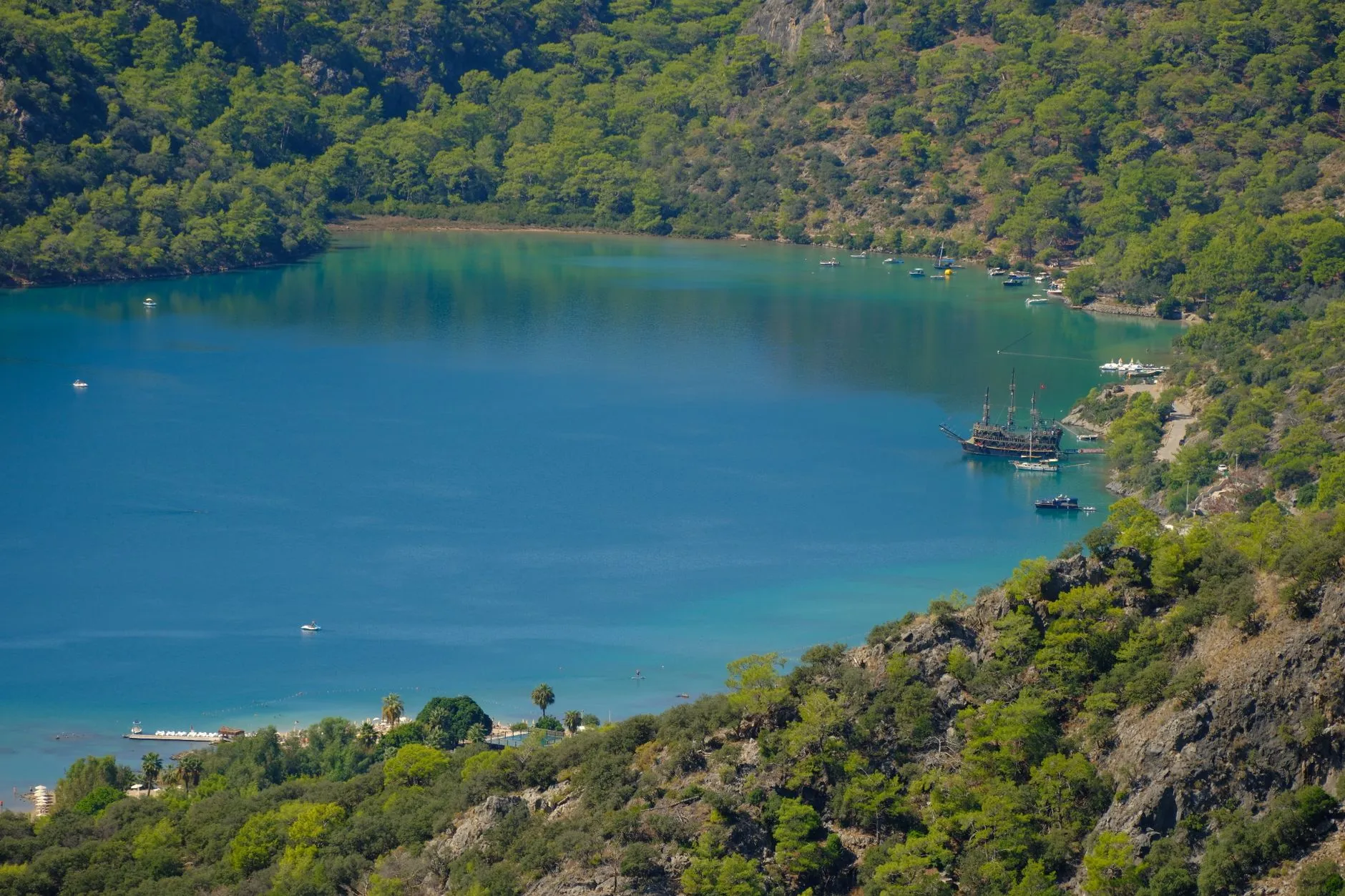
The standout is Ölüdeniz, just south of Fethiye: the Blue Lagoon, a sheltered turquoise inlet behind a sand spit, and above it Babadağ mountain, one of the world’s top tandem-paragliding sites — running off the summit and spiralling down to the beach is the thing people come back raving about, weather permitting, and it is genuinely worth doing. The beach itself gets packed in August; go early or late in the day.
The water itself is half the reason people come, and the boat day is a local institution. From Fethiye and Göcek the gulets — broad wooden sailing boats — run day trips around the bays and islands, and a “Twelve Islands” cruise out of Göcek is the classic version; book through your hotel or at the marina rather than the first tout on the promenade, and check what lunch and stops are actually included.
Beyond the headline resorts, the coast rewards a day out. Dalyan, close to the airport, pairs Lycian rock-cut tombs in a cliff face above the river with İztuzu beach, a protected loggerhead-turtle nesting strand reached by boat. Göcek is the quiet, moneyed sailing base for the Twelve Islands; Saklıkent is a dramatic river gorge you can wade into; and Kayaköy is an abandoned Greek village in the hills above Fethiye, emptied in the 1923 population exchange and left as a ghost town of roofless stone houses. On timing, the shoulder months are the smart choice. May, June and September give you warm sea and long days without the August furnace and the August crowds, when the Ölüdeniz beach and the Marmaris strip are at their fullest and the transfers their slowest. July and August are reliably hot and reliably packed; if your dates flex, lean either side of them.
The cooking worth seeking is the simple coastal kind — grilled fish and meze, gözleme, fresh figs and pomegranate — eaten a street back from the marina rather than on it, where the view costs you. The Fethiye fish market, where you buy your fish from a stall and a surrounding restaurant cooks it, is the local set-piece and better value than the marina terraces.
There is no separate aifly Dalaman guide, so this is the orientation: pick Marmaris for nightlife, Fethiye and Ölüdeniz for the scenery, Göcek for sailing, and carry home Turkish delight, dried fruit or spices from a market stall rather than the airport shelf.
❓ 6. FAQ
📋 7. At a glance
| Item | Detail |
|---|---|
| Airport | Dalaman / YDA (DLM / LTBS), Muğla, southwest Turkey |
| Terminals | Two (~500 m apart): one international, one domestic; arrive ~3h for an int’l departure |
| 2025 traffic | 5,577,142 passengers (down 1.1% on 2024); overwhelmingly summer-led |
| Carriers | Jet2, easyJet, TUI (UK charter/LCC); Pegasus a major operator; German + European seasonal |
| To Fethiye | ~45 km, ~50 min — shuttle to town, or pre-booked transfer to the hotel |
| To Marmaris | ~95 km, ~1.5 h — Havaş/MUTTAŞ coach to town, or transfer |
| Rail | None anywhere near; dolmuş minibuses within the resorts |
| Border | Turkey |
| Currency | Turkish lira (₺) — pay in lira for the better rate |
| Lounge | CIP Lounge / Primeclass (international, Priority Pass / pay-per-use); separate domestic lounge |
| Worth your time | Ölüdeniz Blue Lagoon + Babadağ paragliding, Dalyan turtles & rock tombs, Göcek sailing |
🔗 8. Explore More
- Antalya Airport (AYT) guide — the big airport for the eastern Turkish Riviera, further along the coast
- Bodrum Airport (BJV) guide — the airport for the Bodrum peninsula, to the west
- Rhodes Island Guide — the Greek island a short ferry across the water from Marmaris