Xi’an — The Complete City Guide 2026
The capital of 13 Chinese dynasties across 1,100+ years, the eastern terminus of the Silk Road, home of the Terracotta Army (discovered 1974). Three Xi’ans (Imperial Tang, Hui Muslim, Modern Industrial), the country’s largest and best-preserved pre-modern city wall, and the working compression of 3,000 years of Chinese history into a single walkable centre.
¥150–¥1,500/day budget
Temperate continental: −4 to 32 °C
Chinese yuan (¥) — €1 ≈ ¥7.90
Visa-free 30 days (EU/UK/CA); 240h transit (US)
Capital of 13 Chinese dynasties
Why Xi’an? An Editor’s Note
Stand on the Yongning Gate — the south gate of the Xi’an City Wall, the most-photographed gate of the country’s most-photographed surviving city wall — at twilight on any clear evening. The wall stretches in both directions for what feels like a long way and is in fact 13.74 kilometres long, a complete circuit around the historic core, built between 1370 and 1378 under the founding Ming emperor Hongwu, expanded onto Tang-period foundations that themselves rest on earlier earth-and-rammed-earth fortifications going back to the Sui Dynasty’s 583 CE establishment of the imperial capital here. At the moment when the lanterns come on along the parapets and the lights of the modern city begin to brighten beyond the wall, you can see both Xi’ans at once: the imperial capital that was the largest city in the world in the 8th century, and the working 13-million-person metropolis of 2026, sharing the same physical centre. No other Chinese capital city still has its complete pre-modern walls; Beijing, Nanjing, Kaifeng, Luoyang and Hangzhou all lost theirs in the 20th century. Xi’an’s wall survived essentially because the city was provincial for most of the 19th and 20th centuries — too peripheral to attract the demolition campaigns that came to the other imperial seats. The accident is now the city’s signature, and a slow circuit of the wall by bicycle (you can rent at the gate for ¥45 / 3 hours) is the closest you can come anywhere in the world to physically inhabiting a complete pre-modern Chinese capital.
Xi’an is read most honestly as the country’s deep-history city — the place where most of what is now Chinese was first crystallised. The conventional account holds the city has been the capital of 13 Chinese dynasties over approximately 1,100 years of imperial history, with the major eras being:
- Western Zhou (1046–771 BCE) — the earliest archaeologically-confirmed capital here at nearby Fenghao.
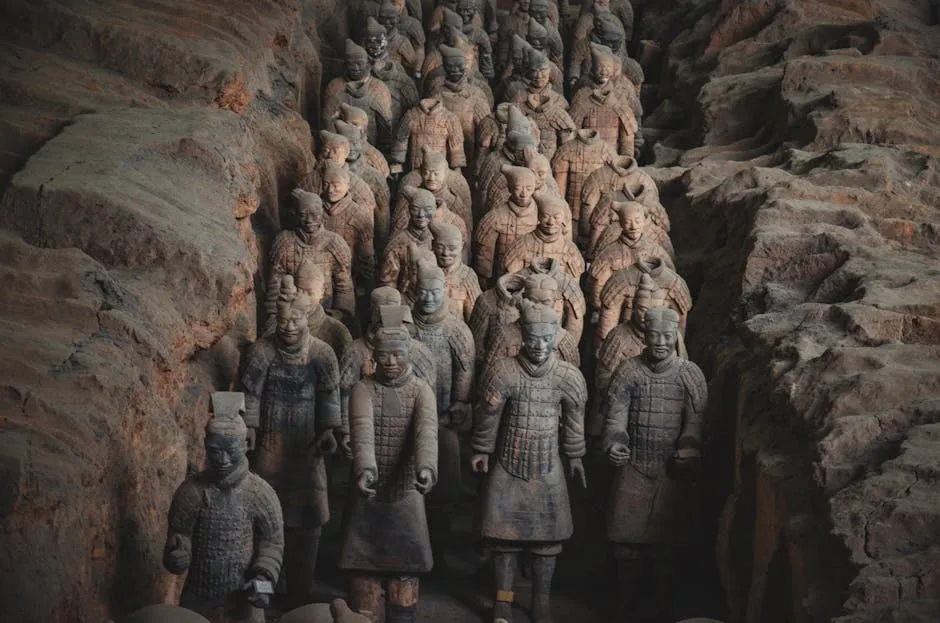
- Qin (221–207 BCE) — Shi Huangdi, the First Emperor of unified China, was buried 35 kilometres east of the modern city. His tomb mound is still un-excavated; the Terracotta Army pits guarding the burial complex were discovered by local farmers in March 1974 while digging a well. Roughly 8,000 figures unearthed across three pits; the full tomb complex is estimated to be roughly 56 square kilometres and is the largest unexcavated archaeological site on Earth.
- Western Han (202 BCE–9 CE) — capital at Chang’an, just north-west of the modern city centre.
- Sui (581–618 CE) — Sui Wendi’s 583 CE Daxing-cheng new capital, which became Tang Chang’an, was laid out on a grid plan that influenced Japanese Heijō-kyō (Nara) and Heian-kyō (Kyoto) directly.
- Tang (618–907 CE) — the most cosmopolitan capital of the medieval world. Chang’an at its 8th-century peak held approximately one million residents, was the eastern terminus of the overland Silk Road, hosted Persian, Sogdian, Arab, Indian, Korean, Japanese and Central Asian diplomatic-and-merchant communities, and produced the Tang poetic tradition (Du Fu, Li Bai, Wang Wei) that remains the canonical reference of Chinese literary culture.
The modern street grid of central Xi’an still preserves the basic Tang Chang’an axes — the Bell Tower at the geometric centre, the four cardinal-direction main streets, the south-facing imperial-axis orientation that the Ming-period builders inherited. The Tang capital occupied roughly seven times the area of the Ming walled city you walk today; what you see is the smaller post-Tang heart, with the broader Tang archaeology fanning out into the modern districts beyond.
The honest second layer of Xi’an is the Hui Muslim community centred on the Great Mosque in the Muslim Quarter (Huimin Jie) north of the Drum Tower. The mosque dates from 742 CE — that is, from the height of the Tang Dynasty — and is architecturally one of the most distinctive religious buildings in China, built in traditional Chinese temple-courtyard form with Islamic functional elements (the prayer hall is mosque-oriented toward Mecca, the courtyards hold the standard Chinese pavilion-and-screen sequence). The Hui community has been continuously present in Xi’an for approximately 1,200 years, descended from the Persian, Sogdian and Arab merchants who settled at the Tang capital. The Muslim Quarter today is a working ethnic-minority neighbourhood, the only one of its kind in any major Chinese city at this scale; the Beiyuanmen food street that runs north from the Drum Tower is one of the country’s most-discussed Chinese street-food destinations.
The third layer is modern industrial Xi’an — the post-1949 capital of Shaanxi Province, a working manufacturing-and-aerospace centre (the country’s aviation industry has substantial Xi’an clusters), the working Belt-and-Road overland-logistics hub (the China–Europe freight trains that the Belt-and-Road initiative has scaled since 2013 substantially terminate or originate in Xi’an), and the working technology-services city (Xi’an Jiaotong University, one of the country’s top engineering universities, anchors a substantial tech-and-research scene). The city’s 13-million metropolitan population sits at the historical convergence of the Wei River valley and the Loess Plateau, in the northern-central Chinese agricultural heartland that has been the demographic centre of Chinese civilisation since the Bronze Age.
A note on the 1936 Xi’an Incident — a working political-historical event that most visitors miss but is one of the most consequential moments of 20th-century Chinese history. On 12 December 1936, at the Huaqing Hot Springs Tang-period imperial pleasure palace 30 km east of Xi’an, Generalissimo Chiang Kai-shek was kidnapped by his own subordinate generals Zhang Xueliang and Yang Hucheng, who forced him to agree to a Second United Front between the Kuomintang and the Chinese Communist Party against the imminent Japanese invasion. The kidnapping ended on Christmas Day 1936 with Chiang’s release and acceptance of the front. The marble pavilion at Huaqing where Chiang was sleeping when the kidnappers came, and the bullet holes in the stone walls of the surrounding palace complex, are preserved as a working historical-site museum. The Xi’an Incident is the working bridge between the warlord-Republican period and the wartime national-unity period, and is the modern political-historical anchor of the city.
A working 2026 visa note: as of November 2025, most EU citizens, UK, Canada, Australia, New Zealand, Japan and ~30 other jurisdictions hold a free 30-day visa-on-arrival for mainland China; US citizens use the 240-hour (10-day) visa-free transit policy at Xi’an Xianyang Airport for travellers transiting to a third country. The policy was extended through 31 December 2026; verify the current list at the Chinese Foreign Ministry consular page before booking.
Come for at least three days — Terracotta Army, city wall, Muslim Quarter, Shaanxi History Museum is the minimum useful set. Five days lets you add Huaqing Hot Springs, the Big Wild Goose Pagoda, and a Mount Hua day-trip. Plan for the working cashless-China reality (set up Alipay Tour Pass or WeChat international wallet on arrival); bring a working VPN if you need Google or WhatsApp; and accept that the city’s defining experience is the working compression of 3,000 years of Chinese history into a single walkable centre. There is no other place in China where the deep-history layer is this visible from a single bicycle ride.
Getting There — Xianyang Airport and the High-Speed Rail
Xi’an has one major international airport — Xi’an Xianyang International (XIY) — 50 kilometres north-west of central Xi’an, in Xianyang. The airport handles approximately 50 million passengers per year and is the largest airport in north-west China. Terminal 5 opened in 2024 as part of a multi-phase expansion and is the working primary terminal for most major airlines; Terminals 2 and 3 continue to handle other carriers, with Metro Line 14 connecting all terminals in 8 minutes.
The direct routes that matter for European, North American and Asian visitors:
- Major Chinese carriers — Air China, China Eastern, China Southern, Hainan, Shenzhen Airlines all operate substantial Asia-and-onward networks.
- Direct international routes include Frankfurt, London, Paris, Rome, Helsinki, Bangkok, Singapore, Seoul, Tokyo, Hong Kong, Almaty, Tashkent and (under the working Belt-and-Road airline expansion) a growing roster of Central Asian and Middle Eastern destinations.
- Hub connections through Beijing (PEK or PKX), Shanghai (PVG), Guangzhou (CAN) or via the SE Asia hubs (Singapore, Bangkok) are often cheaper than direct.
From XIY into the city
The airport is genuinely far from central Xi’an — 50 km north-west, an hour on a clear day, 90 minutes in evening rush.
- Metro Line 14 (Airport Express) is the working cheapest serious option. The line runs from Airport (Terminal 5) Station to Heshao Station in the east, via Xi’an North Railway Station (the working high-speed rail terminal). Terminal 5 → Xi’an North in 33 minutes; Xi’an North → city centre via Line 2 (transfer at Xi’an Beizhan) → Yongningmen or Bell Tower in another 25–30 minutes. Total city-centre journey approximately 55–60 minutes. ¥10 (€1.30) on a Chang’an Tong transit card. Operates 06:00 to 23:26.
- Airport shuttle buses run from the terminals to Bell Tower Hotel, Melody Hotel and several other central pickup points. ¥25–¥30 (€3.20–€3.80), 60–70 minutes, every 30 minutes. Useful if your hotel is on one of the working routes.
- Didi (China’s Uber) is the working ride-hail app. Expect ¥110–¥180 (€14–€23) to central Xi’an, 60–80 minutes. Set to roaming on Western Uber or install Didi separately.
- Taxi from the airport rank — ¥120–¥150 metered. Use only the official taxi rank, not the touts who approach inside the terminal.
High-speed rail
Xi’an is one of the country’s working high-speed-rail hubs, with the Xi’an North Railway Station (Xi’anbei) as the primary station — connecting to the Beijing-Guangzhou high-speed corridor, the Lanxin (Lanzhou-Xinjiang) westward line, and the new Xi’an-Chongqing and Xi’an-Yinchuan lines that opened in 2022 and 2024 respectively. Major travel times from Xi’an:
- Beijing → Xi’an: 4 hours 20 minutes, ¥515 (€65) second-class.
- Shanghai → Xi’an: 6 hours, ¥670 (€85) second-class.
- Chengdu → Xi’an: 3 hours 10 minutes, ¥263 (€33) second-class.
- Guangzhou → Xi’an: 7 hours 50 minutes, ¥849 (€107) second-class.
- Luoyang → Xi’an: 90 minutes, ¥175 (€22). The right way to combine the two ancient capitals.
Tickets through Trip.com / Ctrip apps with a foreign passport, or via the working 12306 Chinese-railway booking system if you have a working Chinese-side ID setup. Trains require passport-verified entry at the station gate; arrive 30 minutes early.
Editor’s tip: Metro Line 14 from XIY is the right answer for most visitors. The trip is air-conditioned, the line is new (opened 2023), and the connection at Xi’an North to the central-city Line 2 is straightforward. The single biggest practical tip for foreign visitors: install the Alipay Tour Pass at the airport on arrival — link your Western credit card, top up in yuan, and the working cashless QR-payment system that runs almost all of China is immediately accessible. Without Alipay or WeChat Pay set up, you will struggle with most everyday transactions.
Pro Tip: If you are arriving via Beijing, Shanghai or Chengdu, take the high-speed rail rather than connecting by air. Beijing → Xi’an on the high-speed rail is 4h 20m city-centre-to-city-centre at ¥515; the equivalent flight is 2h 15m gate-to-gate plus 90 minutes of airport-security time each end, plus the working airport-transfer time, plus the higher cost. The high-speed rail is materially better for any major China-domestic Xi’an connection.
Top 12 Attractions in Xi’an and Around
A first-time visitor to Xi’an should plan three to five days for the city and the immediate ring. The Terracotta Army, the city wall, the Shaanxi History Museum, and the Muslim Quarter / Great Mosque are the four non-negotiables; everything else is the working second tier.
1. The Terracotta Army (Bingmayong)
The country’s defining archaeological tourism site, in Lintong District 35 km north-east of central Xi’an. The complex is the burial-army installation guarding the tomb of Qin Shi Huangdi, the first Emperor of unified China (reigned 221-210 BCE). The army was discovered on 29 March 1974 by local farmers (Yang Zhifa and a small work crew) digging a well at the village of Xiyang. The three pits open to visitors hold approximately 8,000 figures — infantry, cavalry, archers, charioteers, officers — each with individually-distinguished facial features and uniforms, originally painted in bright pigments that have largely faded after exposure. Pit 1 is the largest and most-photographed (the main “army” formation, 230 metres long); Pit 2 holds the chariots, cavalry and command structures; Pit 3 is the small command-headquarters group. The actual tomb mound of Qin Shi Huangdi, a kilometre east of the pits, remains unexcavated — the Chinese government’s working policy is to wait until preservation technology is advanced enough to manage the working oxidation problem before opening the burial chamber itself.
- Hours: 16 March–15 November (peak): 08:30–17:00; 16 November–15 March (off-peak): 08:30–16:30.
- Entry: ¥120 (€15.20) off-peak / ¥150 (€19.00) peak; includes Pit 1, Pit 2, Pit 3, the Lishan Garden subsidiary site, and the shuttle bus between them. Book through the official Bingmayong WeChat mini-program or via Trip.com 7 days in advance — same-day tickets are usually unavailable.
- Access: Tourist Bus 5 (Line 306) from Xi’an Railway Station east-square goes directly to the Terracotta Warriors Museum for ¥8, 1.5 hours; or private car / Didi ¥120–¥200 each way; or organised tour from Xi’an hotels $30–$60 per person including transport, ticket and guide.
Editor’s tip: Visit Pit 3 first (smallest, least crowded), then Pit 2, then Pit 1 (the photo-anchor — save the main hall for last). The morning opening (08:30) is the quietest window; tour-bus crowds peak 10:00–12:00. Allow 3-4 hours for the full complex. Skip the mid-tour gift shops that working tour-bus operators steer visitors through; the on-site museum souvenirs are reliable, the offsite “Terracotta workshops” you may be taken to are working sales operations.
2. Xi’an City Wall (Chang’an Cheng Qiang)
The country’s largest and best-preserved Ming-period city wall, completely circling the historic core. Built between 1370 and 1378 under the founding Ming Emperor Hongwu, on Tang-period foundations. 13.74 kilometres in total circumference, 12 metres high and 12–14 metres wide at the top, with four main gates (Yongning south, Anyuan north, Changle east, Anding west) and the working secondary gates added during the Qing period. The wall is fully walkable on top — a complete circuit takes 4 hours at walking pace, 2 hours by bicycle.
- Hours: 08:00–22:00 (May–October); 08:00–20:00 (November–April).
- Entry: ¥54 (€6.85) adult; free for children under 1.2 m and seniors over 70.
- Bike rental (on the wall top): ¥45 (€5.70) for 3 hours single bike; ¥90 for tandem. ¥100 deposit (refunded on return). Nine working rental points around the wall.
- Access: South Gate (Yongningmen) is the main visitor entry, immediately south of the Bell Tower; Yongningmen Metro Station (Line 2) is directly underneath.
Pro Tip: Rent a bike at the South Gate, cycle the wall counter-clockwise, and end back at the South Gate — the round trip takes 90–120 minutes and gives you the most complete circumnavigation of the historic core. Avoid the wall in deep winter (December–February) — exposed walking, no shade, very cold. Best at twilight in spring and autumn — the lanterns light up, the working evening tourist crowd thins, and the view of the modern city from the wall is the most-photographed twilight scene in central Xi’an.
3. Shaanxi History Museum
The country’s national-tier history museum, on Xiaozhai East Road in southern Xi’an. The collection covers 1.7 million artefacts from the entire arc of Shaanxi’s pre-modern history — Western Zhou bronzes, Qin tomb artefacts, Han Dynasty gold-and-jade tomb items, Tang Dynasty tomb murals (the museum’s signature collection, with murals removed from the tombs of Tang princes and princesses), Tang court ceramics, and the working Silk Road archaeological collection. The Shaanxi History Museum has one of the strongest pre-modern Chinese collections of any provincial museum.
- Hours: 09:00–17:30, Tuesday–Sunday; closed Mondays. May 1–5 special extended hours 07:30–20:30.
- Entry: Free, but advance online reservation required via the Shaanxi History Museum WeChat mini-program (Chinese language only, no English version). Daily visitor capacity is approximately 12,000 (17,500 during national holiday peaks); tickets release 5 days in advance at 17:00.
- Access: Xiaozhai Metro Station (Line 2/3), 15-minute walk.
Editor’s tip: Booking through a Chinese-speaking friend or a tour operator is the working practical answer for most foreign visitors — the museum’s reservation system is genuinely difficult to navigate without Chinese-language WeChat access. Most Xi’an hotel concierges and tour operators offer a booking service for ¥50–¥100. The alternative is the paid Tang Dynasty Treasures exhibit in the same museum, which has separate paid timed entry (¥30) and is often available when the free-entry tickets are not.
4. Big Wild Goose Pagoda (Dayan Ta)
The 64-metre, 7-storey Tang Dynasty pagoda built between 648–652 CE to house the Buddhist sutras that the monk Xuanzang brought back from his 17-year pilgrimage to India (629–645 CE). Xuanzang’s overland journey to India and back is the working historical inspiration for the 16th-century novel Journey to the West (Monkey King), and the pagoda itself was where he installed the sutras and worked on their translation into Chinese after his return. The pagoda is in Da Ci’en Temple complex on the south side of the city; the temple courtyards, the working monks’ residence, and the pagoda itself are open to visitors.
- Hours: 08:00–17:30 daily.
- Entry: ¥40 (€5.10) to the temple complex; additional ¥30 (€3.80) to climb the pagoda (worth it for the city view from the 7th floor).
- Access: Dayanta Metro Station (Line 3), 5-minute walk.
5. Great Mosque of Xi’an (Huajue Lane)
The 8th-century mosque in the heart of the Muslim Quarter, on Huajue Lane north of the Drum Tower. The mosque was founded in 742 CE under the Tang Dynasty; the current building complex is largely Ming Dynasty (14th–16th century) with substantial Qing additions and modern restoration. The architecture is the country’s most distinctive Sino-Islamic synthesis — the complex is laid out as a Chinese temple-courtyard sequence (four sequential courtyards on an east-west axis) with the prayer hall oriented toward Mecca at the western end. The carved-wood phoenix pavilion in the third courtyard, the stone steles in the first courtyard (some with Arabic script), and the working prayer hall are the architectural highlights.
- Hours: 08:00–19:00 April–October; 08:00–18:00 November–March.
- Entry: ¥25 (€3.20) adult.
- Access: Drum Tower (Gulou) Metro Station (Line 2), 5-minute walk through the Muslim Quarter to Huajue Lane.
Pro Tip: The mosque is a working religious site — modest dress is expected (shoulders, knees covered), and the prayer hall is open to non-Muslim visitors only outside the five daily prayer windows. Friday midday is the working community-prayer time; avoid the prayer hall then but the rest of the complex is open. Visit on a weekday afternoon to avoid the working tour-bus crowds that come on weekends.
6. Muslim Quarter and Beiyuanmen Food Street
The historic neighbourhood north of the Drum Tower — approximately 12.5 km² of working ethnic-minority residential streets plus the Beiyuanmen pedestrianised food street that runs north for 500 metres from the Drum Tower. The quarter has been continuously inhabited by the Hui Muslim community for approximately 1,200 years, since the Tang capital’s Persian-Sogdian-Arab merchant settlements. The Beiyuanmen food street is the working tourist anchor — roujiamo (Chinese hamburger), biang biang noodles, lamb skewers, persimmon doughnuts, stewed lamb soup (yangrou paomo), dried fruit and nut snacks, the working halal-food spectrum on a single 500-metre walking street. The wider Muslim Quarter (the residential streets west and north of Beiyuanmen) is the more authentic neighbourhood; the food on Beiyuanmen is tourist-priced and tourist-quality, while the working-local Hui restaurants in the side streets are typically better and cheaper.
- Hours: 24/7 street access; most food stalls 10:00–23:00.
- Entry: Free.
- Access: Drum Tower (Gulou) Metro Station (Line 2), the working pedestrian entry to the quarter.
7. Bell Tower and Drum Tower
The two Ming-period civic-architecture towers at the heart of the walled city. The Bell Tower (Zhonglou) is at the geometric centre of the walled city, at the intersection of the four main cardinal-axis streets; the Drum Tower (Gulou) is approximately 200 metres north-west, traditionally paired with the Bell Tower as the working timekeeping pair (the bell rang in the morning, the drum at evening). Both date to 1384 (Bell Tower) and 1380 (Drum Tower); both have been restored multiple times across the Qing and Republican periods. The Bell Tower stands at 36 metres and holds a working 1,500-kilogram bronze bell; the Drum Tower holds a working 24-drum set timed to Chinese solar terms.
- Hours: 08:00–22:00 April–October; 08:30–18:00 November–March.
- Entry: ¥35 (€4.45) Bell Tower; ¥35 Drum Tower; ¥50 (€6.35) combined ticket. Climbable to the top of both.
- Access: Bell Tower (Zhonglou) Metro Station (Line 2), directly underneath.
8. Huaqing Hot Springs (Huaqing Chi)
The Tang Dynasty imperial pleasure palace 30 km east of Xi’an at the foot of Mount Lishan. The complex was the country’s signature imperial spa and lakeside palace during the 7th–8th centuries, most famously associated with Emperor Xuanzong and his consort Yang Guifei (the central love story of Tang romantic poetry, ending tragically at the 755 An Lushan rebellion). The hot springs themselves are still active (35-43°C geothermal water); the surviving structures are post-Ming restorations of the Tang plans. The complex also includes the 1936 Xi’an Incident site — the marble Five Pavilions (Wujian Ting) where Chiang Kai-shek was sleeping when his subordinates Zhang Xueliang and Yang Hucheng kidnapped him on 12 December 1936, with the bullet holes in the surrounding stone walls preserved as a working memorial.
- Hours: 07:00–18:30 March–November; 07:30–18:00 December–February.
- Entry: ¥120 (€15.20) main complex; ¥220 (€27.85) combined Huaqing Hot Springs + Tang Dynasty Tomb Hall + evening Long Hate Song show (the working evening Tang-history music-and-dance performance on the lakeside).
- Access: Tourist Bus 5 (Line 306) from Xi’an Railway Station east-square; ¥6 each way; combine with the Terracotta Army on a single day-trip from the city. Or Didi ¥80–¥150 each way.
9. Mount Hua (Huashan)
One of the Five Great Mountains of China (the Western Great Mountain, the working sacred Taoist mountain of the western direction). 120 km east of Xi’an, accessible by 30-minute high-speed train from Xi’an North Station to Huashan North Station. The mountain has five named peaks — West (Lianhua, the “Lotus Flower”), South (Luoyan, the highest at 2,154 m), East (Chaoyang, the sunrise peak), Central (Yuyangji, the dragon-pillar peak), and North (Yuntai). Two cable cars — the West Peak Taiping Cable Car (the easier ascent) and the North Peak Sante Cable Car (the shorter, more popular route). The mountain is genuinely steep; the conventional “West Peak up, North Peak down” 5–6 hour itinerary covers all five peaks with minimal hiking. The plank walk at South Peak — a narrow wooden walkway pinned to a vertical cliff face at approximately 2,000 m, with safety harnesses required — is the working signature thrill of Huashan and is a separate paid section.
- Hours: Cable cars 07:00–19:00 March–November; 08:30–16:30 December–February.
- Entry: ¥160 (€20.25) mountain entry; West Peak Cable Car ¥140 single / ¥280 round trip; North Peak Cable Car ¥80 single / ¥150 round trip. Plank walk separate ¥30.
- Access: Bullet train from Xi’an North Station to Huashan North Station, 30 minutes, ¥54.50 second-class / ¥89.50 first-class. Then 20-minute shuttle bus from the station to the cable-car base; ¥20.
Editor’s tip: The full Mount Hua day from Xi’an is a long day — 06:00 train, on the mountain by 08:30, descent by 16:00, back in Xi’an by 18:30 at earliest. Pack water, snacks, layered clothing (the summit is 10°C cooler than the city), and proper walking shoes. Avoid weekends and Chinese national holidays — the cable cars genuinely queue 2+ hours at peak.
10. Banpo Neolithic Village (Banpo Bowuguan)
The 6,000-year-old archaeological site of a Yangshao-culture Neolithic village, excavated 1953–1957 on the eastern edge of modern Xi’an. The site preserved approximately 45 house foundations, 200 storage pits, 6 kilns, 250 graves and 10,000 artefacts — among the most complete pre-Bronze-Age village sites uncovered anywhere in East Asia. The on-site museum (opened 1958, the country’s first archaeological-site museum) displays the original village pit walls, the working reconstructions of Yangshao-period round-houses and rectangular-houses, and the famous painted pottery basins and bowls with the Yangshao-period geometric and fish-faced designs.
- Hours: 08:00–17:30 daily.
- Entry: ¥35 (€4.45).
- Access: Banpo Bowuguan Metro Station (Line 1), 10-minute walk.
11. Forest of Stone Steles Museum (Beilin Bowuguan)
The country’s most-substantial collection of carved-stone inscribed steles — approximately 3,000 stelae from the Han Dynasty through the Qing, in 7 main exhibit halls. The collection includes the Nestorian Stele (781 CE) documenting the arrival of Syrian-Christian Nestorianism in Tang China, working examples of the major Chinese calligraphic schools, the Confucian Stone Classics (Kaicheng era 836–841 CE, a 65-stele set engraving the Confucian classics in standardized text), and the working Tang-Song stelae that were the country’s textual reference system before printing. The museum is in a converted Confucius Temple complex in the south-east of the walled city.
- Hours: 08:00–18:15 May 1–October 7; 08:00–17:45 October 8–April 30.
- Entry: ¥75 (€9.50) peak; ¥50 (€6.35) off-peak.
- Access: Yongningmen Metro Station (Line 2) + 10-minute walk; or walking from the Bell Tower (15 minutes south-east).
12. Small Wild Goose Pagoda (Xiaoyan Ta) and Xi’an Museum
The smaller and slightly later Tang Dynasty pagoda complex south of the walled city. Built 707–709 CE under the Tang Empress Wu Zetian. The pagoda originally had 15 storeys; two were destroyed in earthquake events, and the current pagoda is 13 storeys at 43 metres. Adjacent is the Xi’an Museum (opened 2007), the city-level history museum that holds approximately 130,000 artefacts and is the working alternative to the Shaanxi History Museum when reservations are unobtainable. Park-and-museum-and-pagoda complex is one of the more pleasant half-day visits in the city.
- Hours: 09:00–17:00 daily (museum), closed Tuesdays.
- Entry: Free for both pagoda complex and museum (advance reservation via WeChat recommended at peak season).
- Access: Nanshaomen Metro Station (Line 2), 10-minute walk.
Xi’an’s Neighbourhoods
The city is administratively divided into 11 districts but a visitor encounters approximately four working areas.
Inside the City Walls (Beilin and Lianhu Districts)
The historic core, bounded by the 13.74 km Ming-period wall. The Bell Tower, Drum Tower, Muslim Quarter, Great Mosque, Forest of Stone Steles Museum are all here. Most central hotels (Sofitel Legend, Bell Tower Hotel, Hyatt Regency Xi’an) are inside or directly outside the wall. The right base for a first-time visitor.
Big Wild Goose Pagoda Area (Yanta District)
South of the wall, around the Big Wild Goose Pagoda + Shaanxi History Museum. The post-2000 commercial expansion of the city has concentrated luxury hotels (Shangri-La, Wyndham Grand) and the working middle-class restaurant scene here. The Tang Paradise (Datang Furong Yuan) theme park reconstruction of Tang Chang’an is the working tourist anchor for the area; the Tang West Market restored shopping complex is the post-2010 commercial alternative.
High-Tech Zone (Gaoxin District)
West-south of the wall, the working Xi’an Hi-Tech Industries Development Zone — the city’s working technology-and-corporate centre with Xi’an Jiaotong University anchoring the academic side. Wanda Plaza and the working modern-shopping malls are here. Less tourist-relevant; more business-visitor relevant.
Eastern Lintong District (Terracotta Area)
35 km north-east of central Xi’an. The Terracotta Army Museum is the working anchor; Huaqing Hot Springs is 5 km east of the Terracotta site. Most visitors do this as a day-trip from the city; ger-style overnight is possible but not necessary.
Outer Districts (Weiyang, Yanliang, Lantian, etc.)
The post-2000 residential-and-industrial outer-ring expansion. Includes Xi’an North Railway Station (Weiyang District), the airport-corridor (Xianyang, technically a separate municipality but the working airport area), and the working manufacturing-and-residential outer city. Not tourist-relevant except for the transport infrastructure that passes through it.
Where to Stay — by Budget
Rates per person per night, double occupancy, shoulder season (April–May, September–October). Peak (Chinese National Day Golden Week October 1–7, Chinese New Year, summer school holidays) adds 30–80%; deep low season (January–February non-holiday, August non-holiday) deducts 25–40%.
Budget — ¥150–¥400 per person per night (€19–€51)
The Xi’an hostel scene is well-developed for backpackers. Han Tang House (inside the wall, near the South Gate), 7 Sages International Youth Hostel (Muslim Quarter area), and the Atour Hotel chain branches across the central city are reliable at $25–$50 per night for a double. Hanting and Ji Hotel chains run reliable budget-mid options at ¥250–¥450.
Mid-range — ¥500–¥1,200 per night (€63–€152) for a double
The well-regarded mid-tier business-and-tourism hotels. Mercure Xi’an on Renmin Square, Bell Tower Hotel (the working historic anchor next to the Bell Tower since 1985), Wanda Moments Xi’an Bell Tower, Hyatt Regency Xi’an (inside the walls), and the working InterContinental Xi’an are all in this band at ¥600–¥1,000 per double in shoulder season.
Upper-mid / Luxury — ¥1,400–¥2,800 per night (€177–€354)
- Sofitel Legend People’s Grand Hotel Xi’an — the working flagship luxury anchor in Xi’an, restored from a 1953 Soviet-style state guesthouse that hosted Mao Zedong and most of the country’s mid-20th-century political leadership. Inside the walls, near the West Gate. The restoration is the working hotel-and-history experience in the city; from ¥1,800 (€228) per night for a standard double in shoulder season.
- Shangri-La Hotel Xi’an — the working international-luxury anchor on the south side, in the working financial district. From ¥1,500 (€190).
- Wyndham Grand Xi’an South Hotel — opened 2014 near the Big Wild Goose Pagoda. From ¥1,400.
- The Westin Xi’an — newer entrant, in the high-tech zone. From ¥1,500.
Splurge — ¥3,500+ per night (€443+)
The Sofitel Legend People’s Grand Hotel Presidential and Diplomatic suites are the working upper-tier rooms in the city; ¥3,500–¥8,000 depending on configuration and season.
Where not to stay
Avoid the budget hotels in the outer western districts (around Xianyang) unless you have specific reason — the working tourist-area cluster is inside the walls, around the Big Wild Goose Pagoda, and along the Bell Tower-Drum Tower axis. Also avoid the bottom-tier Booking.com listings that turn out to be 20+ minutes from a metro station — the walking-plus-metro tax at the end of every visit day is real.
Where to Eat — Biang Biang Noodles, Roujiamo and the Hui Quarter
Shaanxi cuisine is one of the under-celebrated regional Chinese food cultures internationally — the country’s culinary scene tends to push Sichuan, Cantonese and Shanghainese forward, but Shaanxi food is genuinely distinct and Xi’an specifically is the working centre of the cuisine. The defining structures:
- Wheat-based, not rice-based — Shaanxi is north of the wheat-rice line, and the working everyday-grain is wheat, mostly in noodle and bread form. This is the most important single fact about the cuisine.
- The Muslim Quarter (Hui) tradition — halal, lamb-and-beef heavy, working medieval-Silk-Road influence visible in the spices (cumin, fennel, coriander seed) and the bread-and-meat structures.
- The working Han (non-Muslim) tradition — pork-and-vegetable focused, working everyday-noodle culture, the local Shaanxi-Han dishes (paomo, gourd-shaped wonton soup).
The defining dishes
- Biang biang noodles — the city’s signature wheat noodle, hand-pulled into long, wide, thick belt-like strips (the name biang is onomatopoeic for the sound the dough makes when slapped against the working table). The character biang (𰻞) is the most complex Chinese character in modern use at 58 strokes; it does not appear in standard dictionaries and is conventionally written by combining several other characters. Served with chili oil, vinegar, garlic, and a topping (typically minced pork or tomato-and-egg). ¥15–¥30 per bowl.
- Roujiamo (rou jia mo) — the working “Chinese hamburger” — slow-stewed pork (Han version) or beef/lamb (Hui version) finely chopped and packed into a hot griddled baijimo flatbread bun. ¥10–¥18 per piece. The single most-iconic Xi’an street food; eat one per day during your visit.
- Yangrou paomo — lamb-stew-soup-and-bread — the working Shaanxi-Hui feast dish. You receive a hard flat bread (mo) and a bowl; you tear the bread into small pieces with your fingers (the slower and smaller, the better the working final dish); the kitchen takes the bread and ladles a strong lamb-broth-with-meat over it, returning it as a heavy stew-soup. ¥30–¥60 per bowl. The country’s working winter-warming dish.
- Liangpi (cold noodles) — wheat-or-rice-based cold noodles dressed in chili oil, sesame paste, vinegar, garlic, julienned cucumber. The working Shaanxi summer dish. ¥10–¥20 per bowl.
- Roujiamo’s other version: tang baozi — Xi’an-style steamed soup-dumplings with lamb. ¥15–¥25 per basket of 6.
- Lamb skewers (yangrou chuan’r) — cumin-and-chili-coated grilled lamb on bamboo skewers. The working street-food anchor at the Muslim Quarter. ¥3–¥6 per skewer.
Where to eat the institutional Shaanxi dishes
- Lao Sun Jia (multiple branches, originals in the Muslim Quarter) — the long-established yangrou paomo anchor; the country’s working definitive lamb-paomo restaurant. ¥40–¥80 per head.
- Wei Jia Liangpi (multiple central locations) — the working liangpi chain.
- De Fa Chang Dumplings (Bell Tower area) — the working Tang-style dumpling banquet restaurant; sets of 12-18 different dumpling shapes representing dragons, phoenixes, peaches and other Tang-court motifs. ¥120–¥300 per head.
- Da Pi Yuan (multiple branches) — the working roujiamo chain; the country’s best-regarded fast-food version of the Chinese hamburger.
The Muslim Quarter Beiyuanmen food street
The pedestrianised 500-metre food street north of the Drum Tower. The working tourist anchor — every Xi’an visitor walks it once. The food is broadly competent and substantially marked-up by Muslim Quarter standards; the back-street alternatives (Xixinjie, Beiguangji Jie, the residential side-streets a block off Beiyuanmen) are typically better and 30–50% cheaper. Walk the main street once for the photographs and the atmosphere; eat in the back streets.
Michelin in Xi’an
The Michelin Guide added Xi’an coverage to its broader China Mainland selection starting in 2024. As of the 2026 edition, Xi’an has one two-star restaurant — Canton 8 (Yuepin Ba) at Huangcheng East Road in Xincheng District, a Cantonese-cuisine restaurant by a Hong Kong-trained chef working through French and Cantonese influences. The Xi’an Michelin coverage is materially smaller than the Beijing/Shanghai/Chengdu editions; the city is part of the broader China Mainland guide rather than a dedicated edition. Other Michelin one-star and Bib Gourmand restaurants in Xi’an cover the working Shaanxi-cuisine fine-dining tier (verify current list at the Michelin Guide site).
What to skip
Avoid the tour-bus-stop “Tang Dynasty Banquet” restaurants near the major tourist sites — overpriced versions of dumpling-and-noodle dishes targeted at captive tour-bus traffic. Avoid the Beiyuanmen working-tourist food street as the primary food experience — walk it once for the cultural visit, but eat the proper meals in the back-street restaurants. The hotel-restaurant buffets at the upper-mid hotels are reliably competent but not specifically Shaanxi.
Editor’s tip: Eat one roujiamo per day, one yangrou paomo (in season — November-March is the right window), one biang biang noodle bowl, and at least one street-food session in the Muslim Quarter back streets. The four together cover what a non-Chinese visitor needs to leave understanding about Xi’an food: the working Hui-Muslim tradition, the wheat-noodle culture, and the medieval-Silk-Road spice influence. The Michelin-recommended fine-dining scene is genuinely real but is a separate, less Xi’an-specific experience.
Drinking — Tea, Local Beer and the Tang-Themed Bar Scene
Tea
The working everyday-drink. Fu cha (Fu brick tea) — the working Shaanxi fermented-pressed-brick tea, a long-standing Silk Road export — is the regional speciality. Other working teas: pu’er (dark-fermented Yunnan, widely available), green tea, flower-and-herbal teas. Working tea-houses cluster around the Big Wild Goose Pagoda area and the Tang Paradise complex. ¥30–¥80 per pot at most working venues, often with unlimited refills.
Beer
The country’s working everyday-beer scene runs on Tsingtao, Snow and Hans (the Shaanxi-local lager brand, the working regional pour). ¥6–¥15 for a 500 ml bottle at a working restaurant; ¥25–¥40 for a pint at the central post-2018 craft-beer bars. The Xi’an craft-beer scene is small but real — Xi’an Brewery (the working post-2018 local craft anchor) is in the high-tech zone.
Baijiu and Western spirits
The Chinese clear-grain spirit baijiu is widely available at sit-down restaurants; the working Shaanxi-local baijiu brand is Xifeng (a national mid-tier label, often used in working business-dinner toasting). ¥40–¥80 per 500 ml bottle in a working restaurant; ¥10–¥30 per shot. Western spirits (whisky, gin, vodka) are available at upper-tier hotel bars at substantial premiums.
Tang-themed bars and the Big Wild Goose area
The post-2010 working bar scene clusters around the Big Wild Goose Pagoda area and the Tang Paradise theme-park complex. Multiple Tang-Dynasty-themed restaurants and bars run working evening shows of Tang music and dance with cocktails and dinner. ¥150–¥400 per head for the full dinner-and-show experience; the more honest evening drinks are at the working post-2018 craft-cocktail bars in the central walled-city area.
What’s not on offer
No wine industry in Shaanxi. All wine is imported and substantially priced at restaurants (¥120–¥240 for a working glass; ¥600–¥1,400 for a bottle). The Chinese domestic wine industry (Ningxia, Yunnan) is improving but reaches Xi’an at modest premiums.
Pro Tip: The right Xi’an drinking ritual is tea-house afternoon at the Big Wild Goose Pagoda area, baijiu-and-Hans-beer with a Shaanxi dinner, and the working Tang-themed evening show if you want the all-in tourist experience. The Tang Paradise (Datang Furong Yuan) water-and-light show in the working evening pond is genuinely impressive — separate from the bars, free entry to the park’s evening hours, and the country’s most-substantial working historical-themed evening cultural attraction.
Getting Around the City
Xi’an Metro
The working 9-line system covering most of the city, with the Airport Express (Line 14) as the dedicated working transport for visitors. Fares are distance-based, ¥3–¥9 (€0.40–€1.15) per ride. The Chang’an Tong card (the working transit card) costs ¥30 with the ¥20 refundable deposit + initial ¥10 load; Alipay’s metro QR mini-program also works for ticketless entry. Trains run 06:00 to 23:00.
The working visitor lines:
– Line 1 — east-west, Banpo Bowuguan (Banpo Neolithic Village) to Hou Wei Zhai.
– Line 2 — north-south, Xi’an North Railway Station (Xi’anbei) to Hancheng Road via Bell Tower, Yongningmen (South Gate), Xiaozhai (Shaanxi History Museum).
– Line 3 — diagonal, Lugang to Yuhuazhai via Dayan Ta (Big Wild Goose Pagoda).
– Line 14 — Airport Express, Terminal 5 to Heshao via Xi’an North.
Didi (the China ride-hail)
The working taxi-and-ride-hail app. Set to roaming on Western Uber or install Didi separately. Most central trips ¥10–¥30 (€1.30–€3.80), airport runs ¥110–¥180, cross-city ¥40–¥80.
Public buses
Comprehensive network, ¥1–¥3 flat fare. Less convenient for non-Chinese-readers; use Baidu Maps or Amap for routing. The Line 5 / Tourist Bus 306 to the Terracotta Army is the working visitor-bus exception.
Bikes (Hello Bike, Meituan Bike)
Dockless-bike share, ¥1.50–¥3 per ride within central Xi’an. Useful for the walled-city interior; less useful for cross-city.
Walking
Central walled-city Xi’an is the most walkable major Chinese city — flat, gridded on the Tang plan, the four main cardinal-direction streets immediately legible, the walking distance Bell Tower → Drum Tower → Great Mosque → Muslim Quarter → city wall South Gate is approximately 1.5 km total. Outside the walls, take the metro.
Editor’s tip: Install Baidu Maps and Alipay before arrival. Google Maps does not work in China without a VPN, and even with one the metro/bus data is dated. Baidu Maps has the working metro real-time data, the walking directions and the working English-language interface buttons. Alipay handles taxis, metro, restaurants, market stalls, and the entire 95% cashless Chinese payments system. Without both set up, the working visitor experience is materially harder.
When to Visit
Xi’an has four working seasons.
- April–May — the best window. Daytime 18–28 °C, dry, occasional spring storms, the cherry blossoms in the Tang Paradise complex in early April. The single best month is late April through mid-May.
- September–October — the second-best window. Daytime 18–26 °C, decreasing humidity, the working autumn light. Avoid the Chinese National Day Golden Week (1–7 October) — domestic-tourism peak, the Terracotta Army queues at 2+ hours, hotel rates 50–100% above shoulder.
- June–August — hot, occasionally humid. Daytime 28–34 °C. Tourist-heavy at the major sites; the working Tang Paradise evening shows peak.
- November–February — cold and dry. Daytime 0–10 °C, night −4 to 0 °C. Hotel rates 25–40% lower; the working Shaanxi cuisine (lamb paomo, hot pot) at its peak. Air quality is materially worse in this window — the city sits in the Wei River basin and winter inversions concentrate the regional PM2.5.
The cyclic calendar:
– Chinese New Year (late January or February) — major travel period, hotel rates 50–100% above shoulder, attractions crowded but the city’s working civic-celebration is genuinely substantial.
– Chinese National Day Golden Week (October 1–7) — domestic-tourism peak.
– City Wall Marathon — November, the working marathon route runs the 13.74 km wall circuit twice.
– Datang Furong Yuan (Tang Paradise) Cherry Blossom Festival — early April.
Month-by-Month Weather
| Month | Day high (°C) | Night low (°C) | Rain days | Notes |
|---|---|---|---|---|
| Jan | 5 | −4 | 4 | Coldest; PM2.5 peaks |
| Feb | 8 | −2 | 5 | Cold; Chinese New Year usually |
| Mar | 14 | 3 | 6 | Spring begins; variable |
| Apr | 20 | 8 | 7 | Best month; cherry blossoms |
| May | 26 | 14 | 8 | Excellent; warm but dry |
| Jun | 31 | 19 | 8 | First serious heat |
| Jul | 33 | 22 | 11 | Hottest; rainy spells |
| Aug | 31 | 21 | 11 | Hot, wet |
| Sep | 25 | 16 | 9 | Excellent — autumn begins |
| Oct | 19 | 9 | 8 | Best autumn weather; Golden Week crowds |
| Nov | 11 | 2 | 4 | Cold begins; quieter |
| Dec | 6 | −3 | 3 | Cold; hot pot peak |
Daily Budget Breakdown
Per person per day, in yuan and euro equivalent, at €1 = ¥7.90.
| Budget level | Per day | What you get |
|---|---|---|
| Backpacker | ¥150–¥350 / €19–€44 | Hostel dorm (¥80), street-food roujiamo + noodles (¥40), metro (¥10), one paid attraction (¥40) |
| Mid-range | ¥600–¥1,200 / €76–€152 | Mid-range hotel per-person (¥400), three sit-down meals incl. one paomo (¥200), Didi + metro (¥40), two attractions (¥120) |
| Higher | ¥1,500–¥2,800 / €190–€354 | Sofitel Legend per-person (¥1,000), a Canton 8 lunch (¥400), Didi everywhere (¥100), full attractions including Mount Hua (¥400) |
| Splurge | ¥4,000+ / €506+ | Sofitel Legend Diplomatic suite, private guided tours, premium baijiu tasting, the working full-day Mount Hua + Terracotta combination |
Xi’an is materially cheaper than tier-1 Chinese cities (Beijing, Shanghai, Shenzhen) by approximately 25–40%, on par with Chengdu, Wuhan and Hangzhou. The Terracotta Army entry (¥120–¥150) is the working biggest single attraction cost; the working free attractions (Shaanxi History Museum, Small Wild Goose Pagoda, the working Muslim Quarter, Xi’an Museum) keep the day-rate manageable.
Sample Itineraries
3 days — the essential first visit
- Day 1 (Walled City). Bell Tower + Drum Tower morning → Muslim Quarter and Great Mosque + roujiamo lunch → Yongningmen (South Gate) of city wall + 90-minute bicycle circuit → dinner at Lao Sun Jia (yangrou paomo) → evening walk along the wall lit up.
- Day 2 (Terracotta Army + Huaqing). Early morning departure for Terracotta Army (08:30 opening) → Pit 3 + Pit 2 + Pit 1 → lunch at the working Lintong-area restaurant → afternoon Huaqing Hot Springs (Tang palace + 1936 Xi’an Incident site) → return for evening Tang Paradise water-and-light show.
- Day 3 (Tang Period). Morning at Shaanxi History Museum (book 5 days in advance) → lunch in the Big Wild Goose Pagoda area → afternoon Big Wild Goose Pagoda + Da Ci’en Temple → late afternoon Small Wild Goose Pagoda + Xi’an Museum → final-night dinner at De Fa Chang Dumplings.
5 days — adds Mount Hua and a deeper Muslim Quarter
Days 1–3 as above. Day 4: Mount Hua day-trip — early bullet train, cable car up West Peak, hike to four other peaks, plank walk at South Peak if you want the thrill, cable car down North Peak, return to Xi’an for late dinner. Day 5: Forest of Stone Steles Museum morning + working Muslim Quarter back-street food crawl + Banpo Neolithic Village afternoon + final-night working Tang Dynasty banquet dinner.
7 days — adds Luoyang and a deeper countryside
Days 1–5 as above. Day 6: Luoyang day-trip — 90 minutes by bullet train each way (the other great ancient Chinese capital, with the Longmen Grottoes UNESCO Buddhist cave-carving site as the working anchor). Day 7: Famen Temple day-trip (115 km west, the working Buddhist temple holding the Buddha’s finger-bone relic) or a relaxed second day in central Xi’an with a slower neighbourhood walk.
Best Day Under €25 — Wall, Muslim Quarter and the Bell Tower
A genuinely cheap day, walked and metro’d, with the city’s defining experiences.
| Item | Cost | Notes |
|---|---|---|
| Roujiamo breakfast at a working Muslim Quarter stand | ¥18 (€2.30) | 2 roujiamo + tea |
| Metro day pass on Chang’an Tong | ¥15 (€1.90) | Unlimited rides |
| Xi’an City Wall entry | ¥54 (€6.85) | Full circuit access |
| Bike rental on the wall (3 hours) | ¥45 (€5.70) | Single bike + ¥100 deposit (refunded) |
| Lunch: biang biang noodles + Hans beer | ¥35 (€4.45) | Working noodle restaurant |
| Bell Tower + Drum Tower combined ticket | ¥50 (€6.35) | Both towers, climbable |
| Great Mosque | ¥25 (€3.20) | Muslim Quarter walk |
| Sunset on the South Gate wall section | ¥0 | Already paid via wall ticket |
| Dinner: yangrou paomo at Lao Sun Jia | ¥45 (€5.70) | A working bowl |
Running total: ¥287 / €36.40 — over the €25 target.
To genuinely fit under €25, skip the Bell Tower+Drum Tower combined ticket (¥50 saved), do the wall walk without bicycle rental (¥45 saved), and take the bus instead of the metro day pass (¥10 saved). Net ¥182 / €23.05 — under target, with the wall, Great Mosque and Muslim Quarter still covered.
For context, the fleet’s Best Day Under leaderboard reads roughly: Cairo $3.50 · Bogotá $6 · Kuala Lumpur €8.50 · Munich €12 · San Salvador €13 · Bangalore €15 · Tbilisi/Chengdu/Shenzhen €25 · Xi’an €25 · Fiji €29 · Washington €30 · Nicosia €32.60 · Sicily/Corsica €35–40 · Maldives $50. Xi’an slots with the other Chinese cities at the working tier — moderately priced, with the Terracotta Army (the working signature attraction) as the budget-buster that adds ¥150 to any day it’s included.
Editor’s tip: The €25 day excludes the Terracotta Army. Add ¥150 (€19) for the entrance + ¥80 (€10) for the tourist bus + ¥40 (€5) for lunch at the site, and the Terracotta-Army day is ¥270 / €34 on its own without the city wall or Muslim Quarter. Budget the Terracotta day separately from your “city day” budget.
Hot Day, Rainy Day & Off-Season Plans
Hot afternoon (July–August, 30–34 °C)
Xi’an summer is genuinely warm and the working dust-and-loess plateau heat is more enervating than coastal humidity. The right strategy: outdoor attractions at sunrise (07:00-09:00) and after sunset (19:00-21:00); indoor museums and AC retreats during the 12:00-17:00 window. The Shaanxi History Museum is fully AC’d; the Xi’an Museum + Small Wild Goose Pagoda is partially indoor; the shopping mall complexes (Saga Plaza, Wanda Plaza) are working AC retreats with restaurants and shops.
Rainy day
Xi’an rain is most often a 1–3 hour afternoon thunderstorm in summer or a working all-day drizzle in spring/autumn. The right strategy: lean on the indoor museum-and-mosque circuit. Shaanxi History Museum, Forest of Stone Steles, Xi’an Museum, Banpo Neolithic Village, Great Mosque are all working rainy-day anchors with substantial indoor exhibit time.
Off-season (November–February)
Off-season Xi’an is materially different from the summer-tourism version. Hotel rates 25–40% lower; the working Shaanxi-cuisine winter dishes (lamb paomo, hot pot) at their peak; the city’s working day-to-day life visible without the working tour-bus overlay. The trade-off: outdoor attractions (city wall) are cold-limited; air quality is worse (PM2.5 spikes in deep winter); Mount Hua cable cars run reduced schedule. The right answer for a returning visitor or a budget-conscious first-timer; the wrong answer for a first-time visitor with a single-week window who wants reliable weather.
Day Trips
Terracotta Army + Huaqing Hot Springs — full day
See Top Attractions #1 and #8. 35 km north-east. Combined day works well: morning Terracotta, lunch at the Lintong-area restaurants, afternoon Huaqing Hot Springs and the 1936 Xi’an Incident site. ¥80–¥200 by Didi each way or ¥6 by Tourist Bus 5; ¥150–¥250 for tour-operator combined day with English-speaking guide.
Mount Hua (Huashan) — full day
120 km east, 30 minutes by bullet train from Xi’an North. Cable cars to the five peaks, the working plank walk at South Peak, the full-day mountain hike for serious hikers. ¥54.5 each way bullet train + ¥160 mountain entry + ¥150-280 cable car. Avoid weekends and Chinese national holidays.
Luoyang + Longmen Grottoes — full day
90 minutes by bullet train each way to Luoyang, the other great ancient Chinese capital. The Longmen Grottoes (UNESCO World Heritage Site since 2000) is the country’s most-substantial pre-Tang Buddhist cave-carving complex — 100,000+ statues carved into the cliff face along the Yi River across the 5th–10th centuries CE. ¥120 entry; allow 4–5 hours on site. The working “two ancient capitals” combination is the right deep-history day for serious China-history travellers.
Famen Temple + Famen Cultural Heritage Park — full day
115 km west of Xi’an. The working Buddhist temple that holds the Buddha’s finger-bone relic — discovered in 1987 inside a Tang-period underground crypt under the temple pagoda after the pagoda collapsed in a 1981 earthquake. The relic is one of the working most-significant Buddhist relics in East Asia. ¥120 entry; tour-operator day from Xi’an ¥250–¥400.
Banpo Neolithic Village + Eastern Suburbs — half day
The 6,000-year-old Yangshao-culture archaeological site. See Top Attractions #10.
Safety & Practical Information
Crime
Xi’an is one of the safer large Chinese cities by violent-crime metric. Tourists are rarely targeted. Petty crime (pickpocketing in crowded markets, the Beiyuanmen food street at peak crowd, occasional bag-grab on buses) exists at the level you would expect of any 13-million-person megalopolis but is materially less than in many tier-1 Chinese cities. The two specific things to know:
- Counterfeit currency — rare but real. ATM withdrawals from major Chinese banks (Bank of China, ICBC, China Construction Bank) are reliable; avoid changing money at non-bank kiosks.
- Tourist-trap restaurants in the Muslim Quarter Beiyuanmen food street and near the Terracotta Army — overpriced versions of standard Shaanxi dishes aimed at tour-bus traffic. The fix is to walk a block off the main pedestrianised lanes; prices halve and quality improves.
Health
Tap water is not drinkable. Use bottled water (¥3 per 500 ml). Most hotels provide kettles for boiling.
Air quality is the recurring concern, particularly in winter. The Wei River basin and the surrounding Loess Plateau trap PM2.5 in winter inversions; the city’s average AQI runs from “good” (May-September) to “poor” (December-February). The AQICN site or the PM2.5 app gives current readings; consider an N95 mask for winter visits.
Major hospitals: The First Affiliated Hospital of Xi’an Jiaotong University (the working international-tier public hospital, with English-speaking emergency capacity), Xi’an Central Hospital, Xi’an SDE Hospital. For anything serious, the working evacuation pathway is to Beijing, Shanghai or Hong Kong (3-5 hours by air).
Language
Mandarin is the official and working language. Xi’an Shaanxi dialect is the working local dialect (mutually intelligible with standard Mandarin in writing, less so in speech); the working tourism industry runs in Mandarin. English is partial — common at major hotels, international restaurants, the airport and the Terracotta Army Museum; uncommon in the working back-street restaurants and most outer-neighborhood vendors. Pleco and Google Translate (with offline Chinese pack) are essential.
Money
China is heavily cashless. Almost all Xi’an vendors operate on Alipay or WeChat Pay QR codes. Set up the Alipay Tour Pass or WeChat international wallet on arrival — link your Western Visa/Mastercard, top up in yuan, and the system handles taxis, metro, restaurants, market stalls, even temple-donation boxes. Cash works at most large transactions and emergency cases but is increasingly unusual.
Internet and VPN
Most Western services (Google, Facebook, Instagram, WhatsApp, YouTube, X/Twitter) are blocked in China without a VPN. Install a VPN (ExpressVPN, NordVPN, Astrill — the established commercial VPNs generally work in China though the situation is dynamic) before arrival, since the VPN download itself may be blocked from inside China. The Chinese-side alternatives (Baidu for search, WeChat for messaging) work without VPN.
Electrical and SIM
Type A and Type I sockets (Chinese variant), 220V/50Hz. A universal adapter is essential.
Local SIMs from China Mobile, China Unicom, China Telecom sell at the airport for ¥80–¥200 with 20–50 GB data; passport required. Most EU/UK roaming plans do not include China at sensible rates; buy local.
Visa & Entry Requirements
30-day visa-free entry (most EU + UK + Canada + Australia + Japan)
As of November 2025, citizens of approximately 36 countries hold a free 30-day visa-on-arrival, in force through 31 December 2026. The eligible list includes most EU member states, UK (added 17 February 2025), Canada (17 February 2025), Sweden (added 10 November 2025), Australia, New Zealand, Japan, South Korea, Singapore. Valid for tourism, business, family visits and transit.
240-hour (10-day) visa-free transit (US + 55 others)
US citizens are not on the 30-day list but qualify for the 240-hour visa-free transit policy at Xi’an Xianyang Airport. Xi’an is one of the 65 eligible ports under the policy. Eligibility requires:
- Transit to a third country (not your country of origin).
- The 240-hour count starts on arrival; you may travel anywhere in 24 of China’s 31 provinces (Shaanxi is included).
- No application required in advance; declare at immigration on arrival.
Standard tourist visa
L (tourist) visa applied for in advance at a Chinese consulate. Approximately $140 fee, 2–3 weeks processing.
Passport requirements
Valid 6+ months from arrival; one blank visa page. Arrival card required (usually filled via WeChat mini-program or paper form on the inbound flight).
Hidden Xi’an
The genuinely under-visited or under-marketed.
- The Han Yang Ling Mausoleum (Yangling) — the burial complex of Emperor Jing of Western Han (188-141 BCE), 20 km north of Xi’an. The partially-excavated tomb pits hold thousands of 30-cm “mini-terracotta” warrior figures — smaller, more refined, with separately-cast arms (now missing). The on-site museum is a working sunken-glass-floor architectural design that lets visitors walk above the pits. ¥80 entry; substantially less visited than the main Terracotta Army; the right second-day archaeology visit.
- The Tang Paradise / Datang Furong Yuan in the Big Wild Goose Pagoda area — the post-2005 reconstructed Tang Dynasty imperial garden complex, ¥120 entry, the country’s most-substantial working historical-themed park. The evening water-and-light show is genuinely impressive and is the right evening visitor experience.
- The Tang West Market (Datang Xishi) — the post-2010 restored Silk Road market complex on the historical Tang West Market site. Working modern shopping-and-restaurant complex with a substantial underground museum showing the Silk Road archaeology recovered from the area. ¥80 museum entry.
- The City Wall by night cycling — most visitors do the wall in daytime; the night-cycling experience after the lanterns come on (typically 19:00–21:00 in summer) is genuinely atmospheric and substantially quieter. Bike rental same as daytime.
- The Forest of Stone Steles Museum’s Nestorian Stele — the 781 CE Tang-period inscribed stone documenting the arrival of Syriac-Christian (Nestorian) missionaries in Tang China. One of the most-significant pieces of Christian archaeology in East Asia; almost no foreign visitors specifically come for this.
Romantic Xi’an
The city’s romance is concrete and dated rather than postcard-pretty.
- A bicycle ride along the city wall at sunset — the most-photographed twilight scene in central Xi’an. ¥99 (one bike + one wall ticket) per person; allow 2 hours for the full circuit.
- Dinner at the Sofitel Legend People’s Grand Hotel — the 1953 Soviet-style restored landmark inside the walls; the working grand-luxury restaurant with the Mao-era political-history backdrop.
- The Tang Paradise evening water-and-light show — the city’s most-substantial working evening cultural experience; mid-tier ticket ¥120 per person.
- A Mount Hua summit overnight — book a working summit guesthouse and watch sunrise from the East Peak (the working “Sunrise Peak” — Tang poets celebrated it specifically). ¥250–¥400 per person for the working summit-overnight package.
- A working Tang Dynasty dumpling banquet at De Fa Chang followed by a stroll along the lit Bell Tower-Drum Tower square at night — the working “Tang Chang’an evening” experience.
Xi’an with Kids
Xi’an works for children better than most large Chinese cities — the working Terracotta Army is the working child-magnet, the city wall is bicycle-friendly, and the working historical-park complex (Tang Paradise, Datang Xishi) has substantial child programming.
- The Terracotta Army — every child responds to the working “found by farmers” story and the scale of the army.
- The City Wall bicycle circuit — tandem bikes available, the working flat top is genuinely safe for older children.
- Tang Paradise — the working theme-park complex with rides, water-and-light shows, and substantial Tang-history dressing-up activities.
- The Banpo Neolithic Village — the working “6,000-year-old village” archaeology, with substantial child-engaging exhibits.
- The Shaanxi History Museum — the working dinosaur-and-mummy halls, the gold-and-jade treasures.
What does not work for kids: the Forest of Stone Steles Museum (working adult-paced calligraphy study); Mount Hua under 8 (the working hike is genuinely steep); the working Muslim Quarter Beiyuanmen food street late evening (crowded, working adult drinking).
What’s New in 2026
- The 30-day visa-free policy continues to expand; Sweden added 10 November 2025; UK and Canada added 17 February 2025, in force through 31 December 2026. The 240-hour transit policy now covers 65 ports.
- Xi’an Xianyang Airport Terminal 5 + Metro Line 14 opened in 2023-2024 and is the working primary airport transport.
- The Shaanxi History Museum has the working post-2024 extended-capacity reservation system (17,500 daily during peak); booking remains genuinely difficult for foreign visitors without Chinese-language WeChat access.
- The Michelin Guide China Mainland 2026 continues to cover Xi’an as part of the broader edition; Canton 8 (Yuepin Ba) holds the working two-star status; the wider city Michelin coverage is materially smaller than Beijing / Shanghai / Chengdu.
- The Belt-and-Road overland freight rail through Xi’an continues to grow; the city’s working role as the eastern terminus of the China-Europe rail freight network has reshaped the working modern economy.
- The Tang Paradise water-and-light show has been substantially upgraded for the post-2024 working season with new LED-and-water-jet sequences.
- The 2026 Shaanxi History Museum added the working Han Yang Ling mini-warriors as a special temporary exhibit through 2026.
🌍 See the bigger picture: our China travel guide covers regions, when to go, and getting around.
Frequently Asked Questions
1. How many days do I need in Xi’an?
Three days is the minimum for the city itself — Terracotta Army (full day), city wall + Muslim Quarter + Bell/Drum Towers (one day), Shaanxi History Museum + Big Wild Goose Pagoda + Tang Paradise (one day). Five days lets you add Mount Hua and Huaqing Hot Springs. Seven days lets you also do Luoyang or Famen Temple as day trips.
2. Is Xi’an safe to visit in 2026?
Yes. Violent crime against tourists is rare. Petty crime is minor and concentrated in the working Muslim Quarter Beiyuanmen food street at peak crowds. The wider political situation has no day-to-day impact on visitors. The two recurring concerns: winter air-quality inversions (PM2.5 spikes November-February) and the working summer heat (July-August).
3. Do I need a visa for Xi’an in 2026?
Most EU citizens, UK, Canada, Australia, NZ, Japan: NO — free 30-day visa on arrival under the unilateral visa-free policy through 31 December 2026 (Sweden added 10 November 2025). US citizens: YES, generally — but you qualify for the 240-hour (10-day) visa-free transit at Xi’an if you are transiting to a third country (US → China → Japan → US, for example). Verify the current eligible-passport list before booking via the Chinese Foreign Ministry consular page.
4. Does Xi’an have any Michelin-star restaurants?
Yes. The Michelin Guide China Mainland covers Xi’an as part of its broader selection. Canton 8 (Yuepin Ba) holds two stars in the 2026 edition — a Cantonese-cuisine restaurant on Huangcheng East Road with a Hong-Kong-trained French-influenced chef. The wider Xi’an Michelin coverage is materially smaller than the Beijing / Shanghai / Chengdu editions; verify the current list at the Michelin Guide site.
5. How much does a Xi’an trip cost?
A backpacker week runs ¥150-350 per person per day (€19-44). A mid-range week runs ¥600-1,200 per person per day (€76-152). A luxury week runs ¥1,500-2,800 per day (€190-354). The Terracotta Army is the working biggest single attraction cost (¥120-150). The city is materially cheaper than Beijing or Shanghai by approximately 25-40%.
6. What is the best time to visit Xi’an?
April-May for the best general weather and the cherry blossoms at Tang Paradise. September-October is the second-best, with the working autumn light and pre-Golden-Week shoulder. Avoid Chinese National Day Golden Week (1-7 October) — the Terracotta Army queues 2+ hours. Winter (November-February) is cold and air-quality-poor but materially cheaper.
7. How do I get from Xi’an Airport to the city?
Metro Line 14 (Airport Express) is the working answer for most visitors: ¥10, 33 minutes Terminal 5 to Xi’an North, then transfer to Line 2 for the central city (another 25 minutes). Total ~55-60 minutes. Didi ¥110-180. Taxi from rank ¥120-150. Airport shuttle bus ¥25-30 to Bell Tower Hotel.
8. Is Xi’an expensive?
Cheaper than Beijing or Shanghai by approximately 25-40%. Comparable to Chengdu, Wuhan, Hangzhou. Materially cheaper than Western European cities. The €25 day is genuinely achievable (without Terracotta); the €40 day includes the Terracotta Army; €60-day gives you mid-range hotel and full restaurants.
9. What is the Terracotta Army and how do I visit?
The burial-army installation guarding the tomb of Qin Shi Huangdi, China’s First Emperor (reigned 221-210 BCE). Approximately 8,000 figures across three pits, discovered by local farmers in March 1974. Located in Lintong District 35 km north-east of central Xi’an. ¥120-150 entry, 7-day advance online booking required via the official Bingmayong WeChat mini-program or Trip.com. Allow 3-4 hours for the full complex. Tourist Bus 5 from Xi’an Railway Station east-square is the working cheap transport (¥8 each way).
10. What’s the deal with Xi’an food?
Wheat-based, Hui-Muslim-influenced, distinct from southern Chinese cuisines. The defining dishes: biang biang noodles (hand-pulled wide wheat noodles, the famous 58-stroke character), roujiamo (Chinese hamburger — stewed meat in a baijimo flatbread), yangrou paomo (lamb stew with crumbled bread), liangpi (cold noodles). The working anchor neighbourhood is the Muslim Quarter north of the Drum Tower, with the Beiyuanmen food street as the tourist version and the back streets as the working local version.
11. Should I climb the Xi’an City Wall?
Yes, by bicycle. The 13.74 km Ming-period city wall (built 1370-1378) is the country’s largest and best-preserved pre-modern city wall. ¥54 entry, ¥45 bicycle rental for 3 hours from any of the 9 working rental points around the wall. The full circuit by bicycle is 90-120 minutes; on foot 3-4 hours. The South Gate (Yongningmen) is the main visitor entry, immediately south of the Bell Tower.
12. Can I climb Mount Hua as a day-trip?
Yes. 30 minutes by bullet train from Xi’an North Station to Huashan North Station (¥54.5 each way second-class). Cable cars to the five peaks (West Peak Taiping ¥140 single, North Peak Sante ¥80 single). The recommended “West Peak up, North Peak down” 5-6 hour itinerary covers all five peaks with minimal hiking. The plank walk at South Peak is the working signature thrill, separate ¥30 fee. Allow a full day including transport.
13. What is the 1936 Xi’an Incident?
On 12 December 1936 at the Huaqing Hot Springs Tang imperial palace 30 km east of Xi’an, Chinese Nationalist generalissimo Chiang Kai-shek was kidnapped by his subordinate generals Zhang Xueliang and Yang Hucheng, who forced him to agree to a Second United Front between the Kuomintang and the Chinese Communist Party against the imminent Japanese invasion. The kidnapping ended on 25 December 1936 with Chiang’s release. The marble pavilion at Huaqing where Chiang was sleeping when the kidnappers came, and the bullet holes in the surrounding stone walls, are preserved as a working historical-site museum within the Huaqing complex.
14. Can I combine Xi’an with other Chinese cities?
Yes, via high-speed rail. Beijing → Xi’an: 4h 20m (¥515). Shanghai → Xi’an: 6h (¥670). Chengdu → Xi’an: 3h 10m (¥263). Luoyang → Xi’an: 90 minutes (¥175). The natural pairings are Beijing + Xi’an (the imperial-and-Tang capital combination), Xi’an + Luoyang (the two ancient capitals), and Xi’an + Chengdu (deep-history + pandas/Sichuan). The high-speed rail is materially better than connecting flights for any major China-domestic Xi’an journey.
Explore More AiFly Guides
City guides: Tbilisi, Georgia · Yerevan, Armenia · Bangalore, India · Ahmedabad, India · Kolkata, India · Chengdu, China · Shenzhen, China · Xi’an, China · Chongqing, China · Ulaanbaatar, Mongolia · Halifax, Canada · Washington, D.C. · San Salvador, El Salvador
Island guides: Seychelles · Cape Verde · Maldives · Fiji · Crete · Cyprus · Corfu · Mykonos · Naxos · Zakynthos · Rhodes · Santorini · Sicily · Sardinia · Corsica · Malta
Cheapest Flights to Xian
We track flight deals to Xian from 3 cities worldwide. Here are the best recent fares:
Prices are based on recent deals and may no longer be available. Browse all flight deals