Jeju International Airport (CJU) — Airport Guide 2026
The Jeju–Seoul Gimpo corridor is the busiest commercial air route on the planet — roughly 14.4 million scheduled seats in 2025, about 39,000 a day — and CJU is one end of it, a single terminal three kilometres from central Jeju City that handles more leisure traffic than most hub airports handle everything.
Quick Reference
CJU / RKPC
~3 km north of central Jeju City, island’s north coast
One passenger terminal; domestic and international wings under the same roof
South Korean won (KRW, ₩) — ≈ ₩1,500/US$1, ≈ ₩1,758/€1 (May 2026)
Near-cashless; cards and contactless everywhere; T-money card for buses
Local buses inc. route 365 (downtown loop); Airport Limousine 600 to south coast (distance-based fare)
Korea national visa-free short stay (many nationalities); Jeju 30-day island waiver; Korean visa — all require the 2026-mandatory e-Arrival Card
e-Arrival Card mandatory for all foreign arrivals from 1 January 2026
Waived for 67 countries/territories through 31 December 2026
Both landside, before passport control, 3rd floor: Korean Air (KAL) Lounge — Priority Pass open access; Asiana Lounge — Priority Pass only if flying Asiana that day
Korean Air, Asiana, Jeju Air, Trinity Airways, Jin Air, Air Busan, Air Seoul, Eastar Jet
Jeju ↔ Seoul Gimpo (world’s busiest, OAG 2025, ~14.4M seats)
🏢 Terminal & Route Context
CJU runs all passenger operations through a single terminal. The domestic and international sides share the same building, split into adjacent wings rather than separate structures. That’s an important layout point: the international operation here is relatively small, and the terminal’s scale is calibrated to it. What drives the volume — and what fills the terminal to capacity at peak hours — is the domestic operation, and specifically the air-metro to Seoul Gimpo.
On that route, Korean Air and Asiana each run more than 200 weekly departures; Jeju Air follows at around 150, with Trinity Airways (the carrier formerly branded T’way Air), Jin Air, Air Busan, Air Seoul, and Eastar Jet filling out the rest. A note worth making about the name: Jeju Air is hubbed in Seoul, not on the island. CJU is a destination for every carrier here, not a base of operations — so Jeju has no hub bank, no complex transit function, and no meaningful connecting traffic. Almost everyone arriving here is stopping.
International service is a thinner layer, oriented toward East Asia and a band of Southeast Asian leisure markets. The international departures experience is compact rather than sprawling, which means the retail offer and gate spread are not on the scale you’d find at Incheon.
🛂 Border Rules: K-ETA, the e-Arrival Card & Jeju’s Separate Waiver
Entry runs on South Korea’s national system with one island-specific wrinkle.
📋 The e-Arrival Card — the genuine 2026 change
⚠️ e-Arrival Card: mandatory from 1 January 2026
South Korea’s digital arrival card replaced the old paper disembarkation slip and is now required of all foreign arrivals. Complete it within the three days before landing. Being K-ETA-exempt does not exempt you from the card — a common mistake that wastes time at a busy arrivals hall.
The e-Arrival Card captures the same information as the K-ETA. The only people who skip it are those who voluntarily hold a current K-ETA — which pre-populates the arrival record — so if you applied for K-ETA voluntarily during the waiver window, you don’t need to file the card separately. Everyone else does.
🪪 K-ETA — currently suspended for most nationalities
Korea’s Electronic Travel Authorization is normally required before boarding for visa-free visitors. As of 2026, it is temporarily waived for citizens of 67 countries and territories, including the United States, United Kingdom, Canada, Australia, New Zealand, and EU member states, through 31 December 2026. From 1 January 2027 the requirement is set to return. Travellers aged 17 and under or 65 and over are exempt regardless of the waiver.
🗺️ Jeju’s 30-day island waiver — and the mainland trap
⚠️ Jeju waiver ≠ mainland Korea access
Jeju’s 30-day visa waiver lets you enter the island only. It does not authorise onward travel to Seoul or anywhere on the Korean mainland. Fly in on the waiver and you cannot continue to the mainland without the appropriate national entry status.
Jeju Province runs its own separate visa-waiver scheme: most ordinary-passport holders can arrive through CJU or the island’s seaports and stay up to 30 days without a visa. Twenty-three nationalities are excluded from it — among them Afghanistan, Bangladesh, Iran, Iraq, Myanmar, Nepal, Pakistan, Sri Lanka, Syria, Uzbekistan, and Yemen. Mainland Chinese travellers operate under a different arrangement: a temporary scheme running through 30 June 2026 permits registered tour groups of more than three people a 15-day visa-free stay.
The waiver is not a guaranteed right of entry. A February 2026 detention-and-deportation case prompted an advisory from the Indian Embassy in Seoul and was widely covered in Indian media. Immigration officers at CJU can and do ask for printed hotel bookings, a day-by-day itinerary, proof of funds, and a return ticket. Inconsistent or vague answers are grounds for refusal. Carry the paperwork.
✈️ Visa-free short stay and standard visas
Beyond Jeju’s scheme, many nationalities can enter mainland Korea for short stays under national visa-waiver and reciprocal arrangements. Those who don’t qualify need a Korean visa arranged before travel at a consulate or visa centre. There is no tourist visa-on-arrival for mainland Korea.
🚌 Getting Into the City: Buses, the 600 & Taxis
The useful fact here is the distance: central Jeju City is about 3 km from the terminal. Jeju has no rail of any kind — no metro, no train anywhere on the island — so all options below are road transport, but the distance means none of them involve a major journey.
🚏 City buses
Local city buses serve the airport directly from stops outside arrivals. Route 365 is the most useful to arriving visitors: it loops through the three main downtown nodes — Jeju City Hall, the Jungang Rotary and Dongmun Market area, and the New Jeju district — and calls at the airport on its circuit. Pay with a T-money card or a local Jeju transit equivalent tapped on boarding, or cash. Fares are low; the ride into the centre is short. Confirm the exact fare from the stop signage when you arrive rather than from any figure that may have drifted.
🚐 Airport Limousine 600 — south coast only
🚐 Airport Limousine 600 — the south-coast run to Seogwipo
Runs from ground-floor gate 5 to the Jungmun resort complex and Seogwipo on the south coast, roughly 1 hour 45 minutes end-to-end. Samyeong Transportation operates it at an interval of 16 to 40 minutes — first departure from the airport 06:00, last 22:40 — and the fare is distance-based inside Jeju’s integrated bus system, with no flat price published. Ride only as far as Jungmun and you pay less than the full run to the Seogwipo KAL Hotel. For Jeju City itself it’s the wrong tool; for the Jungmun hotels it’s the standard public option.
The 600 is a cross-island express, not a downtown shuttle. Don’t take it unless you’re heading for the south coast.
🚕 Taxis
💡 Taxi into Jeju City — cheap and quick
Given the 3 km gap, a metered cab from the official rank outside arrivals costs little and takes minutes. Use the rank, not any unsolicited offer inside the terminal. For a solo or paired arrival into the city, a taxi competes easily with the bus on both time and money.
For the south coast, a taxi fare is a real number across the island’s width; the 600 wins there unless you have luggage or timing constraints.
Korean ride-hailing apps operate on the island. A metered cab from the official rank is the default for a short city run.
🛋️ Lounges: Which Card Gets You In
Both lounges are on the 3rd floor of the departures level, operated by the two flag carriers — and both are landside, before passport control. Clear immigration and security first, which is the instinct on a connection, and you cannot go back for either one.
Korean Air (KAL) Lounge
Open roughly 06:00–21:00, near the Korean Air check-in counters opposite Gate 2. Admits Korean Air First and Prestige Class passengers, qualifying SKYPASS and SkyTeam Elite Plus members on same-day flights — and Priority Pass cardholders regardless of which airline they’re flying, subject to capacity. If you hold Priority Pass and are not on Asiana, this is your lounge.
Asiana Lounge
On the same floor next to Asiana check-in desks, open from the early morning to around 21:00–22:40. Serves Asiana Business Class, Asiana Club elite tiers, and Star Alliance Gold members. Priority Pass is accepted here — but only when the cardholder is flying an Asiana-operated service that day, and there is no buying your way in: this lounge does not accept payment cards for entry.
🛋️ Priority Pass at CJU — know the restriction
The Korean Air Lounge takes Priority Pass with no airline condition. The Asiana Lounge takes Priority Pass only on Asiana metal, and takes no payment cards at the door. Both sit landside, before passport control, so visit them before you clear immigration. DragonPass coverage at CJU is unconfirmed for both lounges — verify directly at the desk before counting on it.
🍽️ Jeju Food: Black Pork, Galchi & Hallabong
Jeju’s food identity is specific enough to justify leaving the terminal.
Heuk-dwaeji — Jeju black pork, from the island’s native pig breed — is grilled at the table and eaten with coarse local salt and dipping sauces. The black-pork restaurant streets in Jeju City are where this is done properly. Airport versions exist and are serviceable; they are not the reason to eat it.
Galchi (cutlassfish, also called hairtail) is the island’s signature fish, served either grilled whole or as a brothy stew with radish and pepper. It’s a staple in a way it isn’t on the mainland.
Haemul — the broad seafood category — runs to the abalone the island is known for and to catch sold by Jeju’s haenyeo, the female free-divers whose shellfish is available fresh along the coast.
Hallabong is the local citrus: a knobbly tangerine-orange hybrid named after the volcano, sold fresh and worked into juice, chocolate, and cakes island-wide. It’s cheaper bought in the city than airside. If a hallabong souvenir is the plan, pick it up in town and leave the departure-gate version as an emergency option.
The terminal has food outlets with serviceable versions of the staples. Airport prices are airport prices; a short bus or taxi ride to the city’s restaurant streets is the better call if time allows.
🛍️ Duty-Free
Jeju’s tourist economy supports large downtown duty-free halls as well as airside retail, so the airside run covers the standard liquor, cosmetics, and tobacco offer. The island-specific items — hallabong products, Jeju green-tea goods — are cheaper bought in the city than at the gate. Pick them up in town.
💡 Layover Reality
At 3 km from central Jeju City, CJU sits in a category of its own among major airports. The city is a sub-15-minute taxi ride from the terminal, or a short hop on the 365 bus. That changes the layover calculation considerably.
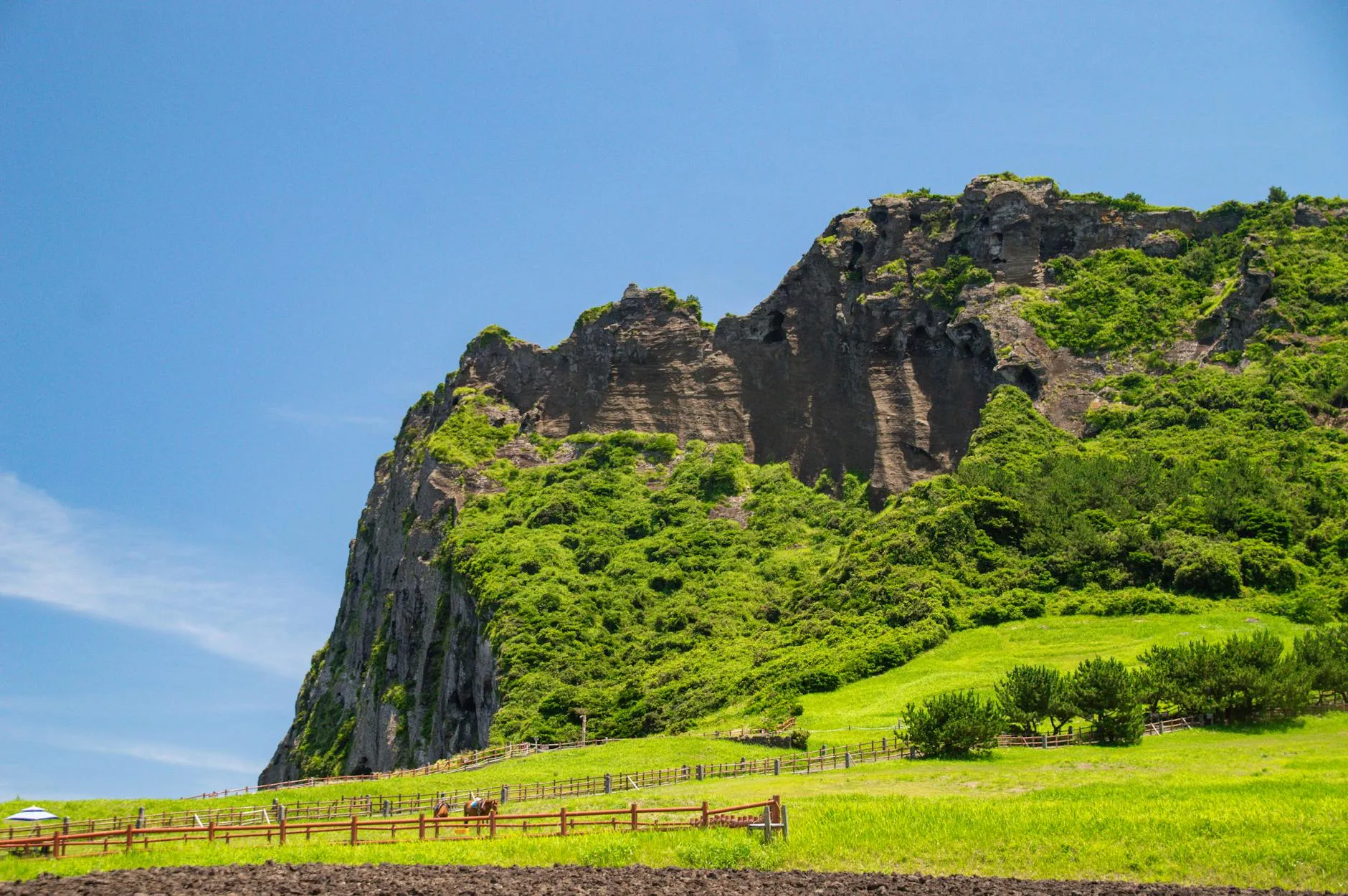
Run the math honestly. Into central Jeju City and back: call it 15–20 minutes each way by cab, with traffic and the walk to the rank. Add an international check-in and security buffer for the onward flight — typically 90 minutes before departure for an international service — and a 4-hour layover leaves real time in town. Enough for a black-pork lunch on the restaurant streets near Jungang-ro, a pass through Dongmun Market (the central traditional market, near the Jungang Rotary), or a look at Yongduam (Dragon Head Rock), a coastal formation a short ride northwest of the terminal. None of that is a gamble against your boarding time the way a city run would be from an airport 40 km out.
💡 4-hour layover: city is viable; volcano is not
A 4-hour international connection gets you Jeju City comfortably — lunch, Dongmun Market, or the nearby coast. It doesn’t get you Hallasan, the south coast, or the eastern sunrise peak. Those need a full day or an overnight.
What 4 hours does not buy you:
Hallasan — the shield volcano at the island’s centre — is a full-day undertaking. Summit trails require many hours; the trailheads are well inland from the city. A layover does not reach it.
Seogwipo and the Jungmun resort strip are on the far south coast. The Limousine 600 alone is the better part of two hours each way, so the south coast requires a full day, not a connection.
Seongsan Ilchulbong — the UNESCO-listed tuff-cone sunrise peak on the east coast — is an hour-plus out by road and is not a realistic layover target.
The rule of thumb: a layover here gets you Jeju City and the near-airport coast with a reasonable buffer; the volcano, the south coast, and the eastern peaks need an overnight.
For a deliberate stopover, a city hotel near Dongmun or in New Jeju is a ten-minute ride from the terminal, and the island’s real geography opens up.
🔧 Practical Notes
Payment. South Korea runs close to cashless. Cards work almost everywhere; contactless and mobile pay are standard; a foreign card will cover hotels, restaurants, and most shops. A T-money transit card — toppable with cash at any convenience store — is the practical way to pay for city buses. Carry some won (₩) for the smallest market stalls, but it won’t get heavy use.
Connectivity. Korea doesn’t block Western apps, so your usual services work normally. Airport and public Wi-Fi are widely available. A Korean travel eSIM or pocket Wi-Fi rental (both available at the airport) gives data immediately on arrival.
Currency. The won has been weak through 2026 — roughly ₩1,500 to the US dollar and ₩1,758 to the euro as of late May 2026, near multi-year lows. Airport exchange counters carry a significant markup; change only enough for immediate use and rely on cards or a city ATM for the rest. Since Korea runs on cards, most visitors barely use a bureau de change.
Border. Two things catch arrivals at CJU specifically. First: the e-Arrival Card is mandatory from 1 January 2026 even if your nationality is K-ETA-exempt — file it within three days of landing. Second: Jeju’s 30-day visa waiver covers the island only, not onward travel to the Korean mainland. Match your entry path to your route before check-in, not at the immigration desk.
❓ FAQ
📊 At a glance — CJU 2026
| Item | Detail |
|---|---|
| IATA / ICAO | CJU / RKPC |
| Distance to centre | ~3 km to central Jeju City |
| Terminals | Single terminal; domestic + international wings |
| City buses | Local routes incl. 365 — Jeju City Hall, Dongmun Market/Jungang Rotary, New Jeju; pay by T-money or cash |
| Limousine 600 | Airport → Jungmun / Seogwipo, distance-based fare (no flat price published), ~1 hr 45 min, every 16–40 min, 06:00–22:40, from gate 5 |
| Rail | None — no metro or train on Jeju |
| Taxi | Metered rank outside arrivals; short fare into Jeju City |
| Currency | KRW (₩); ≈ ₩1,500/US$1, ≈ ₩1,758/€1 (May 2026) |
| Payment | Near-cashless; cards/contactless standard; T-money for buses |
| Border | Korea visa-free short stay · Jeju 30-day island waiver · Korean visa — all require the e-Arrival Card |
| 2026 change | e-Arrival Card mandatory from 1 January 2026 — separate from K-ETA |
| K-ETA | Waived for 67 countries through 31 Dec 2026 |
| Priority Pass lounges | Korean Air Lounge 3rd fl (open access) · Asiana Lounge 3rd fl (Asiana flights only, no pay-in) · both landside, before passport control |
| Dominant carriers | Korean Air, Asiana, Jeju Air, Trinity Airways, Jin Air, Air Busan, Air Seoul, Eastar Jet |
| Busiest route | Jeju ↔ Seoul Gimpo — world’s busiest, 2025 (~14.4M seats) |
| Short-layover verdict | Jeju City viable at 4 hrs; Hallasan, south coast, eastern peaks need a full day or overnight |