Bohol-Panglao Airport (TAG) — Airport Guide 2026
Quick Reference
Bohol–Panglao International Airport (New Bohol International Airport)
TAG / RPSP
Panglao Island, Bohol, Central Visayas, Philippines
Barangay Tawala, Panglao; minutes from Alona Beach, about 20 km from Tagbilaran City
One eco-terminal (~13,337 m²), solar-assisted and naturally ventilated; 2.22M passengers (2025) against a 2M design, so it is already over capacity
Cebu Pacific, Philippine Airlines and Cebgo domestically (Philippines AirAsia’s Manila route ends 30 September 2026); Jeju Air to Seoul–Incheon and Busan, Jin Air to Seoul–Incheon
Philippines
Philippine peso (₱ / PHP)
Van ~₱100–150/pax or taxi/tricycle ~₱200–300 to Alona; ~₱150 bus ~50 min to Tagbilaran; no rail
No major lounge to count on — plan without one
🛫 1. What Bohol-Panglao Airport is
Bohol-Panglao is the air link for Bohol and its beach island of Panglao, and the thing to know first is that it sits on Panglao itself, minutes from the Alona Beach resort strip, rather than across on the Bohol mainland near Tagbilaran. It opened in November 2018 to replace the cramped old Tagbilaran Airport, and it was built to carry the island’s tourism growth — though it has since outgrown the plan, handling 2.22 million passengers in 2025 against a two-million design.
It is also marketed as the country’s first eco-airport, and that is not just branding: the terminal runs partly on solar power and uses natural ventilation, so it is a lighter, airier building than most Philippine regional terminals. That makes the wait pleasant enough, but it is still a single mid-sized terminal, busy at the peaks.
The recent change worth knowing is operational. Aboitiz InfraCapital, which has run the airport on a 30-year concession since June 2025, began phased works in April 2026 under a ₱4.53-billion investment programme, reconfiguring the passenger areas to lift capacity to 2.5 million within a year or two and 3.9 million by 2030 — so expect works in progress and some shifting layouts as you pass through. Alongside that, the international side has been growing: Jeju Air flies from Seoul–Incheon and Busan and Jin Air from Seoul–Incheon, and there have been direct charters from Japan, which is turning Bohol into a genuine international arrival point rather than a purely domestic one.
For most visitors the route in is still domestic, on Cebu Pacific or Philippine Airlines from Manila, and on Cebgo, which flies more routes into Bohol than anyone else — Davao, Iloilo, El Nido and Angeles City/Clark. Philippines AirAsia is withdrawing its Manila–Panglao service, with the last flight on 30 September 2026, so do not plan around it after that. The Korean flights serve their own market. If you are coming from outside Asia, you will almost certainly connect through Manila or Cebu and pick up the short hop down — book that domestic leg early, since fares to a beach island climb hard over peak season.
🛂 2. The border: the Philippines, visa-free but register first
The Philippines runs its own entry system, and the currency is the Philippine peso. Because TAG now takes scheduled international flights, some travellers clear immigration here rather than at Manila or Cebu, but the rules are the same wherever you land.
Most Western nationalities — the UK, US, Canada, Australia, the EU and many others — enter visa-free for up to 30 days, extendable once you are inside the country. Everyone, visa-free or not, must complete an eTravel registration at etravel.gov.ph within 72 hours before arrival: the form is free and browser-based, and the QR code it generates is what you show at the airport. Bring a passport valid at least six months beyond your stay and proof of an onward or return flight.
Get the eTravel QR done before you fly. Cards work in Panglao’s resorts, dive shops and bigger restaurants, but the airport transfer, the tricycles, the market stalls and the small beachfront places run on cash, so arrive with pesos.
🚆 3. Getting to Alona Beach and Tagbilaran
The airport is on Panglao, so for most arrivals this is not a long transfer at all — you are minutes from the beach, not facing a cross-island haul. There is no rail, and none is needed for distances this short.
For the Alona Beach resort strip and the Panglao hotels, a shared van runs about ₱100–150 per person, and a private taxi or tricycle is roughly ₱200–300 for the short ride, taking 15 to 30 minutes depending on where on the island you are headed. For Tagbilaran City, about 20 km away on the Bohol mainland across the causeway, the Southern Star Bus runs from the airport for around ₱150 in roughly 50 minutes, with vans and taxis as the quicker, pricier alternatives.
Most resorts arrange a pickup if you ask when you book, which is the simplest option with luggage and dive gear; otherwise the vans and tricycles at the exit are straightforward. The layover math barely applies here — almost nobody connects internationally through Bohol, so this is an arrival point, and the only timing to mind is leaving enough buffer on the way out for the short transfer back plus the small terminal at peak.
One useful alternative to know: Bohol is also reachable by fast ferry from Cebu City to Tagbilaran in roughly two hours, so if the Cebu-to-Bohol flight is pricey or sold out, the sea route is a genuine option from the bigger hub — though you then face the 20 km from Tagbilaran across to Panglao.
🛬 4. The terminal and the lounges
It is a single two-level terminal of about 13,337 square metres, lighter and better-ventilated than most Philippine regional airports thanks to its eco design, and it handles domestic and international flights together. At the busy banks it fills up, and with the 2026 reconfiguration underway you may meet temporary layouts and works, so follow the signs and the screens. For a domestic departure the usual hour or two is fine; for an international flight to Korea, arrive earlier.
On lounges, this is not an airport with a lounge to plan your day around. If you hold Priority Pass or a lounge card, do not count on it being useful here and expect to wait in the general terminal. The eating worth doing is on Panglao — the beachfront and dive-village restaurants near Alona — rather than at the airport, where the options are limited.
What is worth carrying home is local: Bohol is known for its peanut kisses, the little peanut-studded meringue sweets, and for calamay, a sticky coconut-and-rice confection sold in neat coconut-shell halves. Both keep and travel well, and the dried mangoes and local chips that turn up across the Visayas are reliable too. Buy them in town or at the markets rather than at airport prices.
🌅 5. The reason to come: Bohol and Panglao
Bohol gives you two very different things on one island group, and that combination is the draw. Panglao is the beach-and-dive side: Alona Beach is the main strip of white sand, bars and dive operators, and the diving off Panglao — especially the marine sanctuary at Balicasag Island, with its turtles and wall dives — is among the best-regarded in the central Philippines. This is where most visitors base themselves.
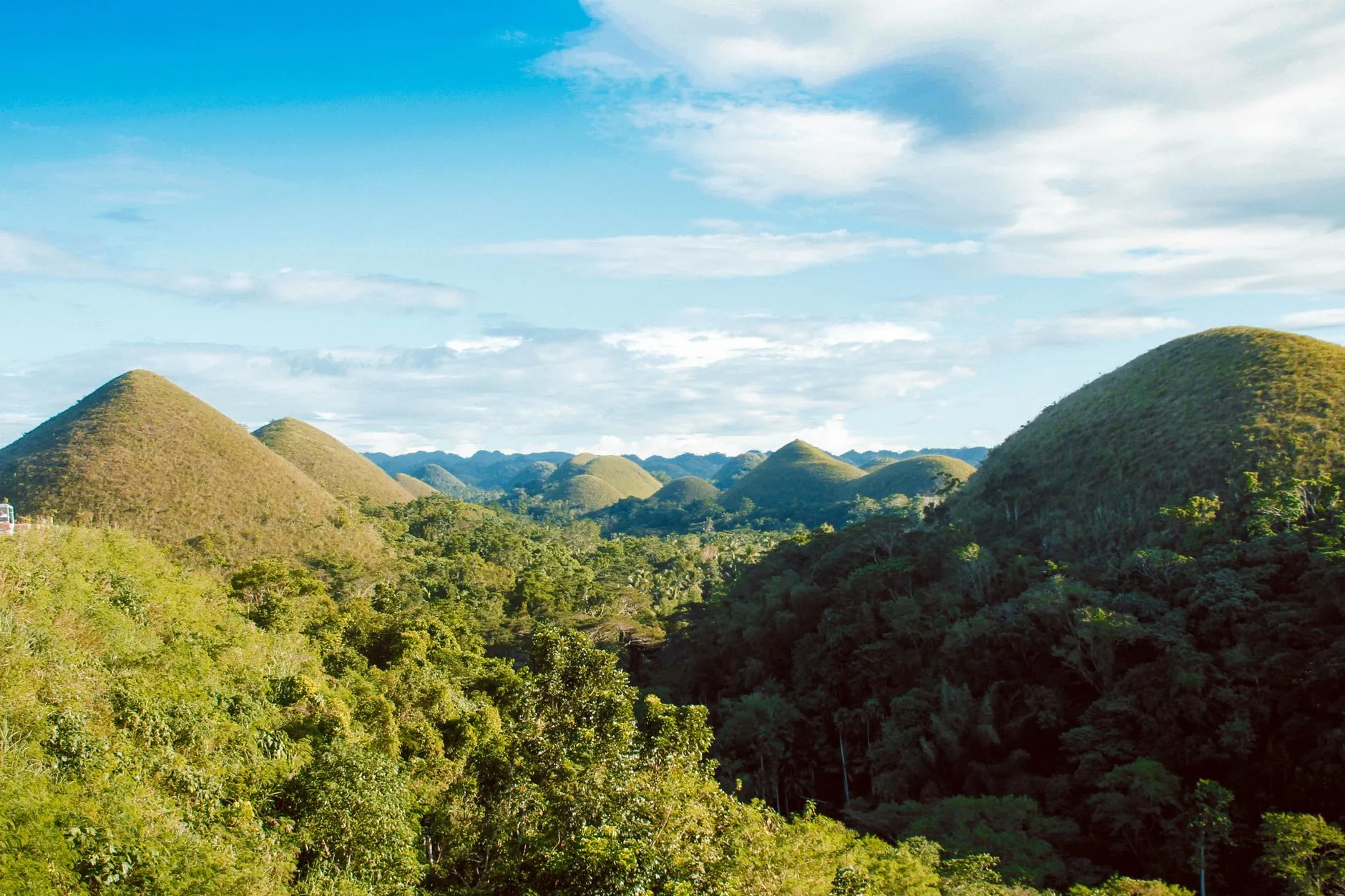
The Bohol mainland, across the short causeway, holds the land attractions. The Chocolate Hills are the signature — over a thousand near-symmetrical grass-covered mounds that turn cocoa-brown in the dry season, which is when the name makes sense and the view is best. Nearby, the Philippine tarsier — one of the world’s smallest primates, with its outsized eyes — can be seen at the conservation sanctuary in the Corella/Loboc area.
A word on doing the tarsiers right: go to the proper sanctuary, where the animals are wild and viewing is quiet and managed, not to the roadside operators who handle stressed animals for photos. They are fragile, easily stressed creatures, and the ethical visit is the sanctuary one. The same honesty applies to the Loboc River cruise — the floating-restaurant buffet boats are touristy and the food is ordinary, but the river scenery is genuinely lovely, so go for the ride and keep your expectations of the lunch modest.
The other thread is heritage and its loss. Bohol’s old Spanish-era stone churches, including the much-loved Baclayon Church, were badly damaged in the 2013 earthquake, and several have been painstakingly rebuilt or are still under restoration — worth seeing, and worth understanding as a recovery rather than an untouched relic. None of this needs a packaged-tour frame: Panglao for the water, the mainland for the hills, tarsiers and river, and a couple of days does the island group justice.
❓ 6. FAQ
📋 7. At a glance
| Item | Detail |
|---|---|
| Airport | Bohol–Panglao International (TAG / RPSP), Barangay Tawala, Panglao Island; ~20 km from Tagbilaran |
| Terminal | One eco-terminal (~13,337 m²), solar-assisted and naturally ventilated; 2.22M passengers (2025) vs a 2M design — already over capacity |
| Recent change | Aboitiz InfraCapital 30-year concession since June 2025; ₱4.53B phased terminal works from April 2026, targeting 2.5M capacity within a year or two and 3.9M by 2030; growing Korea/Japan international service |
| Carriers | Cebu Pacific, PAL, Cebgo (domestic; AirAsia’s Manila route ends 30 Sep 2026); Jeju Air (Seoul–Incheon, Busan), Jin Air (Seoul–Incheon) |
| To Alona/Tagbilaran | Van ~₱100–150/pax or taxi/tricycle ~₱200–300 to Alona; Southern Star bus ~₱150 / ~50 min to Tagbilaran; no rail |
| Border | Philippines |
| Currency | Philippine peso (₱ / PHP); cards in resorts/dive shops, cash for transfers, tricycles, stalls |
| Lounges | No major lounge to count on |
| Worth your time | Panglao’s Alona Beach and Balicasag diving, the Chocolate Hills, the tarsier sanctuary, and the Loboc River |
🔗 8. Explore More
- Cebu–Mactan Airport (CEB) guide — the nearest major hub, and the ferry alternative to reach Bohol
- Manila Ninoy Aquino Airport (MNL) guide — the main hub most international journeys to Bohol connect through