Terceira Airport (TER) — Airport Guide 2026
Quick Reference
Lajes Airport (Lajes Field)
TER / LPLA
Praia da Vitória, Terceira, Azores, Portugal
~10 km from Praia da Vitória; ~20 km from Angra do Heroísmo
One civilian terminal, sharing the field with a military air base
About 1 million passengers — a record, first time over a million
SATA/Azores Airlines, TAP, Ryanair; transatlantic to the US and Canada
Portugal (Azores) — Schengen, euro; EES live since 10 April 2026, ETIAS expected, date not announced
Euro (€)
Bus to Angra ~€4–5 (~52 min, ~3/day); taxi ~€22–26; no rail; hire car common
No dedicated lounge
🛫 1. What Terceira Airport is
Lajes is the airport for Terceira, one of the central islands of the Azores, and it has a split personality that shapes everything about it. The civilian terminal shares a runway with Lajes Field, a long-serving military air base — once a major Cold War staging post for the United States in the mid-Atlantic, still a Portuguese Air Force base today. That history left Terceira with the longest runway in the Azores and a strategic position: this is about the closest European airport to the eastern United States, and it has always been a transatlantic stepping stone.
That transatlantic role is the recent story worth leading with. Terceira crossed a million passengers for the first time in 2024 and is heading higher, and the growth is coming from North America: Azores Airlines added a New York route from late 2024 and runs to Boston, while TAP has flown a seasonal San Francisco service. The big Azorean diaspora in the US and Canada drives a lot of that traffic, alongside the mainland-Portugal links and a slimmer European network on Ryanair and the charters.
That diaspora connection runs deep enough to colour a visit. Generations of Azoreans emigrated to New England, California and Canada, and the summer brings many of them back to family homes on the island, which is why the North American flights matter as much as the tourist ones and why you will hear American-accented Portuguese around Angra in August. It is a two-way island as much as a holiday one, and the airport reflects that.
For a passenger, the read is two-sided. Terceira is genuinely well connected for a mid-Atlantic island — direct to Lisbon and Porto, to several US and Canadian cities, and on the inter-island SATA hops to the rest of the Azores — but much of that is seasonal or low-frequency, so check whether your specific route flies in your month. For the other Azorean islands, the short SATA flights from here are the practical way to island-hop.
So treat Terceira as a small but surprisingly connected island airport: the way into Terceira itself, a transatlantic stop with real history, and a hub for hopping onward across the archipelago.
The transatlantic position opens up one trick worth knowing. Azores Airlines has long offered a free stopover in the Azores on its flights between North America and mainland Europe, so a Boston-to-Lisbon ticket can include a few days on Terceira or São Miguel at no extra airfare — a genuine way to bolt an island break onto a transatlantic trip. If that appeals, look for the stopover fare rather than booking the island leg separately.
🛂 2. The border: Portugal, the Azores, the euro
The Azores are an autonomous region of Portugal, fully in the EU, the Schengen Area and the euro, so the border works as it does anywhere in Portugal — with one wrinkle worth knowing because of the US flights.
Arriving from mainland Portugal or elsewhere in Schengen, you clear no passport control at all. Arriving from outside the zone — the US and Canada routes especially — you now meet the EU’s EES biometric system, live since 10 April 2026, which takes fingerprints and a photo on entry, with ETIAS still awaiting an announced launch date. At a small island terminal, a transatlantic arrival meeting the new system can mean a slower queue than the airport is used to, so leave a little margin off a US flight.
A note on tax, because the Azores are sometimes confused with the Canaries: the islands do have a lower regional VAT rate than mainland Portugal, but they are fully inside the EU’s tax territory, so there is no Canary-style duty-free frontier or special allowance when you fly to the mainland. Everything is in euros, cards are taken widely, and you do not need to plan around a customs line.
Spending is easy and Portuguese in feel. The Azores are not an expensive corner of Europe by Nordic or even mainland-resort standards, cards and contactless work almost everywhere, and tipping is modest and optional rather than expected. A little cash is handy for the smallest village cafés and the island bus, but you can run most of a trip on a card.
🛬 3. The terminal and the lounge
One civilian terminal handles the passenger flights, separate from the military side of the field, and it is a small, straightforward building — quick to cross, with cafés serving Portuguese coffee and snacks and free Wi-Fi, but not much more. For an inter-island or mainland flight an hour or so is plenty; for a transatlantic departure, give yourself the standard couple of hours, more in summer when the US flights and the holiday traffic overlap.
Food and shopping are minimal, so this is not a terminal to linger in by choice. Eat in Praia da Vitória or Angra before you fly, and carry something through for a longer wait.
Boarding the smaller aircraft can be a walk across the apron rather than a jet bridge, which on a windy mid-Atlantic day is a brisk few steps — keep a layer to hand. The flip side of a small island airport is that the whole process is quick and unfussy outside the summer peaks, with none of the queueing a big hub forces on you; it is an easy airport to use.
On lounges, set expectations low: Terceira does not appear to have a dedicated airport lounge, so Priority Pass and the rest are unlikely to get you anything here. Plan to wait in the general seating, which at an airport this size is rarely a hardship except at the summer peaks when a couple of big flights leave together.
🚗 4. Getting to Angra and Praia da Vitória — hire a car
The airport sits near Praia da Vitória, about 10 km away, with the island’s headline town, Angra do Heroísmo, roughly 20 km and 20 minutes further; the catch is that public transport is thin, so plan the transfer before you land.
The public bus to Angra, run by the island’s operator, costs only around €4–5, but it takes about 52 minutes by the roundabout route and runs just a few times a day, Monday to Saturday — so it is cheap but inflexible, and useless for a Sunday or an evening arrival. A taxi to Angra is about €22–26 for the 20-minute run, and pre-booked transfers start a little higher; for most arrivals that is the realistic choice over waiting for a bus.
For all but a short city stay, the honest answer is a hire car. Terceira is a green, rural island with its sights spread around the coast and the volcanic interior, public transport is sparse once you leave the main road, and the distances are small enough that a car turns the island into an easy few days of exploring. The rental desks are at the airport; book ahead in the summer high season when the island’s fleet is in demand.
There is no rail anywhere in the Azores, so a car, a taxi or the occasional bus is the whole of it. If you are staying in Angra and not venturing far, you can manage on taxis and your feet, but for the Algar do Carvão cave, the fumaroles and the coastal villages, the car earns its keep.
If your trip takes in more than one island, the practical link is the air, not the sea. SATA Air Açores runs the short inter-island flights from here on small turboprops, hopping to São Miguel and the smaller islands in well under an hour; there are inter-island ferries too, but they are slower and weather-dependent across open Atlantic water, and serve some routes better than others. For most island-hopping, the SATA flight from Lajes is the dependable option.
🌋 5. The reason to come: Terceira and the Azores
Terceira is one of the most characterful of the Azores, and its centrepiece is Angra do Heroísmo — a UNESCO World Heritage town, one of the great historic ports of the Atlantic, with a grid of pastel houses under the green cone of Monte Brasil and a harbour that sheltered the treasure fleets between Europe and the New World. It is a genuinely handsome small city, walkable and lived-in rather than a museum piece, and the reason most people come to the island.
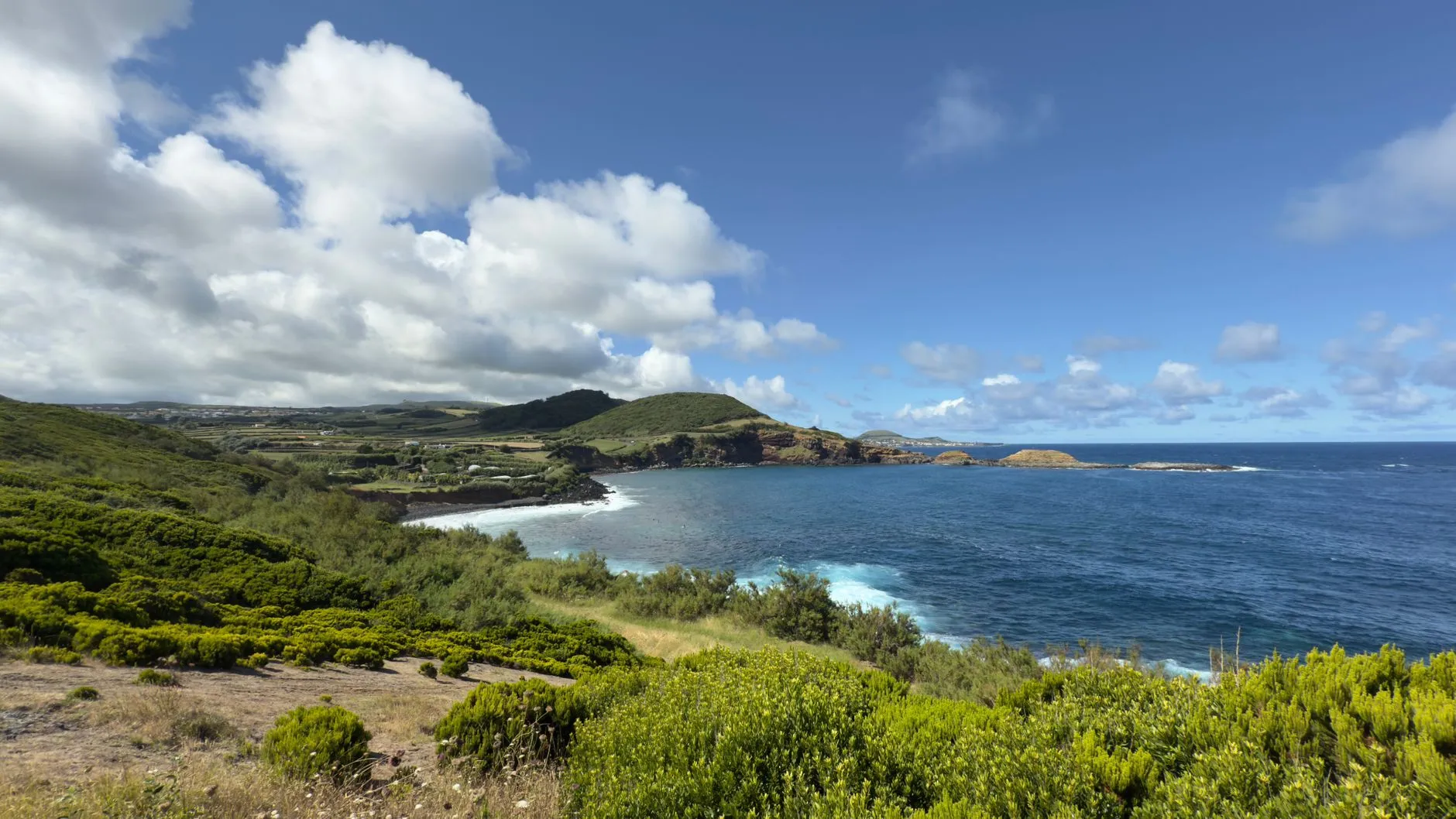
The island around it is volcanic and green. The Algar do Carvão is a rare chance to walk down inside an old volcanic chimney, and the fumaroles at Furnas do Enxofre steam in the highlands; the coast runs from fishing villages to natural lava pools, and the interior is pasture grazed by the dairy cattle that make the island’s cheese. Terceira’s own tradition worth timing a trip around is the tourada à corda, the running of a roped bull through village streets in summer — the bull is not killed, but led on a long rope while young men dodge it, a noisy, divisive, deeply local spectacle that is nothing like a Spanish bullfight.
A practical opinion: Terceira is a doing-and-eating island, not a beach resort, so come for the walking, the volcanic landscape and the food rather than a sun-lounger. Eat the island beef and the Queijo da Ilha cousin-cheese in a working town restaurant rather than a tourist spot, and time a summer visit around a Holy Spirit festival or a tourada if you want to see the island at its most itself. The weather is mid-Atlantic and changeable year-round, so pack for sun and rain in the same day.
On timing, the Azores are a year-round green rather than a summer beach, but the seasons do differ. Summer is the liveliest and driest stretch, when the festivals run, the diaspora returns and the whale-watching is at its best off these waters; spring and autumn are quieter and still mild, while winter is wet and windy though rarely cold. Whenever you come, the mid-Atlantic weather is famously changeable, so plan around the forecast and pack for four seasons in a day.
There is already an aifly Azores guide, linked below, so this is the orientation rather than a full tour: Angra do Heroísmo for the town, the Algar do Carvão and the highlands for the volcano, and a SATA hop if you want to add another island. What is worth carrying home is Azorean — the island cheese, a tin of local tea from the archipelago’s plantations, or a bottle of the regional wine — bought in town rather than at the airport.
❓ 6. FAQ
📋 7. At a glance
| Item | Detail |
|---|---|
| Airport | Lajes (TER / LPLA), Praia da Vitória, Terceira, Azores |
| Terminal | One civilian terminal, shared field with a military base; longest runway in the Azores |
| 2024 traffic | ~1 million passengers (record); growing on transatlantic routes |
| Carriers | SATA/Azores Airlines, TAP, Ryanair, TUI, Air Europa; US/Canada + mainland + inter-island |
| To Angra | Taxi ~€22–26 (~20 min); bus ~€4–5 (~52 min, ~3/day Mon–Sat); hire car common |
| Rail | None anywhere in the Azores |
| Border | Portugal (Azores); Schengen; euro; EES live since 10 April 2026; ETIAS expected, date not announced |
| Currency | Euro (€); lower regional VAT but inside EU tax territory (no Canary-style duty-free) |
| Lounge | No dedicated lounge |
| Worth your time | Angra do Heroísmo (UNESCO), the Algar do Carvão volcano cave, the summer touradas à corda |
🔗 8. Explore More
- Azores Archipelago Guide — the full guide to the islands, including Terceira, Angra and the volcanic landscape
- Ponta Delgada Airport (PDL) guide — the main Azores airport on São Miguel, the archipelago’s busiest gateway
- Lisbon Airport (LIS) guide — the mainland hub and the change point for most onward connections