Curitiba Airport (CWB) — Airport Guide 2026
Quick Reference
Afonso Pena International Airport
CWB / SBCT
Curitiba (airport in São José dos Pinhais), Paraná, Brazil
About 18 km southeast of central Curitiba
One main terminal, rated at about 14.8 million passengers a year
6,082,222 passengers (+17%) — strong growth; an Azul focus city
Azul (focus city), LATAM and GOL; overwhelmingly domestic
Brazil
Brazilian real (BRL)
City buses 515 and E32; taxi ~30 min; ride-hailing apps; no rail
Several — incl. the Advantage VIP Lounge on Priority Pass
🛫 1. What Curitiba Airport is
Afonso Pena is the airport for Curitiba, the capital of Paraná and one of the larger cities of southern Brazil, and it is a busy, growing domestic hub rather than a small regional field. Around six million passengers passed through in 2025, up about 17% on the year, in a terminal the operator rates at about 14.8 million passengers a year. Azul uses Curitiba as a focus city, alongside LATAM and GOL, so the schedule is dense with connections across Brazil.
The honest framing is that this is a domestic airport with an international door rather than a major gateway. The bulk of the flights tie Curitiba to São Paulo, Brasília, Rio and the other big Brazilian cities, with a thinner layer of international routes; for most journeys from outside South America you will arrive via São Paulo or another hub and connect here. The recent story is simply growth — more passengers and a new operator name (Motiva, formerly CCR) — rather than a single dramatic change.
For a passenger, the read is that Curitiba is well connected within Brazil and easy to reach from São Paulo, but it is not somewhere you fly to direct from Europe or North America. Plan it as a connection through a Brazilian hub, and treat CWB as the efficient last leg into a city that rewards the detour more than its low tourist profile suggests.
So this is an arrivals airport for a substantial city, busy with Brazilian domestic traffic and growing fast. The things worth getting right are the new visa rules, the transfer into town, and what Curitiba actually offers once you are there.
On booking, the realistic pattern for a visitor from abroad is to fly into São Paulo — Guarulhos for most long-haul — and pick up a domestic hop to Curitiba, which Azul, LATAM and GOL run frequently through the day. Internal Brazilian fares can be good value when booked ahead, and the southern routes are competitive, so it pays to lock the connection early rather than buy it at the last minute alongside the international ticket.
🛂 2. The border: Brazil, and a visa change that matters
Brazil is not in any European system, so here, and the currency is the Brazilian real — but there is a recent change that catches a lot of travellers out.
As of 10 April 2025, citizens of the United States, Canada and Australia need an e-visa to enter Brazil, reversing years of visa-free access. It is applied for online before travel, costs around US$80.90, and is usually approved within a few days, but it must be in hand before you fly — you cannot get it on arrival. British, Irish and most EU nationals remain visa-free for stays of up to 90 days, so the change hits North American and Australian visitors specifically. Check your own nationality’s rule well before booking.
For everyone, the visa-free or visa allowance is up to 90 days, with a 180-day cap in any twelve months. The real is the currency, cards are very widely accepted in Brazil, and contactless is normal in a city like Curitiba; carry some cash for small purchases and the local bus, but you can run most of a trip on a card.
One more practical note for some travellers: parts of southern Brazil, including the forested Serra do Mar that the Curitiba region borders, carry a yellow-fever vaccination recommendation, and some onward countries ask for proof of it after a Brazil visit. It is not an entry requirement for Brazil itself for most arrivals, but if you are heading into the forest or travelling on afterwards, check the current health guidance for your route before you go.
🛬 3. The terminal and the lounges
One main terminal handles the traffic, and it is a functional modern Brazilian airport — busy at the domestic peaks, straightforward to move through, with the usual run of cafés, shops and a food court. For a domestic flight the standard hour or two is comfortable; for an international departure, give yourself longer.
The food is better than the airport average if you know to look for it — this is Brazil, so a proper café com leite and a pão de queijo, the cheese bread of the region, beat the international chains, and the food court has the local lanchonete options.
The flow is the ordinary mid-sized-hub kind, busiest around the morning and evening domestic banks when the São Paulo and Brasília flights cluster. Boarding on the domestic side can be a bus to the aircraft rather than a jet bridge at the busier moments, which adds a few minutes; none of it is stressful, but follow the screens rather than memory for your gate.
Unlike many airports its size, Curitiba has real lounge choice. There is a Priority Pass option in the Advantage VIP Lounge, which has both an international and a domestic room, and card-linked lounges tied to Visa and other programmes. So if you hold lounge access, you have genuine options here — check which one your card or pass actually covers before you head for it.
🚍 4. Getting into Curitiba — bus, taxi, app, no train
The airport is about 18 km from the centre, in the neighbouring municipality of São José dos Pinhais, and the transfer is easy but has no rail option.
The airport’s public buses are run by Auto Viação São José dos Pinhais: line 515 links the airport to the Terminal Central, and line E32 runs to the Terminal Boqueirão, both plugging into Curitiba’s well-known integrated transit network. Neither the airport nor the bus operator publishes a fare, so have cash ready and check the price at the stop. The taxis are the São José dos Pinhais municipal cooperative’s, from the rank outside the terminal near the car park, 24 hours, and the drive to the centre takes around 30 minutes. Ride-hailing apps work well and are widely used across Brazil, often the simplest option of all.
There is no train or metro link to the airport — despite Curitiba’s fame for public transport, that fame rests on buses, not rail, and the long-discussed metro has never been built. So the choice is a city bus, a taxi or an app, and for a first arrival in an unfamiliar city an app or a taxi is the low-stress pick.
Once you are in town, Curitiba is one of the easier Brazilian cities to get around without a car, precisely because of the transport system it is famous for. The integrated bus network reaches most of the sights, and the Linha Turismo, a dedicated tourist bus, loops the main attractions on a single ticket — a genuinely useful way to cover the museum, the gardens and the parks in a day without working out individual routes.
A brief, honest word on safety: Curitiba is one of the more orderly large Brazilian cities, but it is still a big city, so apply normal urban caution — keep your phone and valuables discreet, use an app rather than a hailed street cab late at night, and you will be fine. It is not a reason to avoid the place, just to travel sensibly.
🏙️ 5. The reason to come: the city that planned itself
Curitiba is the city urban planners talk about, and that is the genuine hook. From the 1970s, under the architect-mayor Jaime Lerner, it reinvented itself around a pioneering bus rapid transit system — the long bi-articulated buses and the tube-shaped boarding stations that cities worldwide later copied — and a network of parks and pedestrian streets that made it Brazil’s model “green city.” Riding the BRT and walking the Rua das Flores pedestrian street is a way of seeing an idea about cities that actually worked.
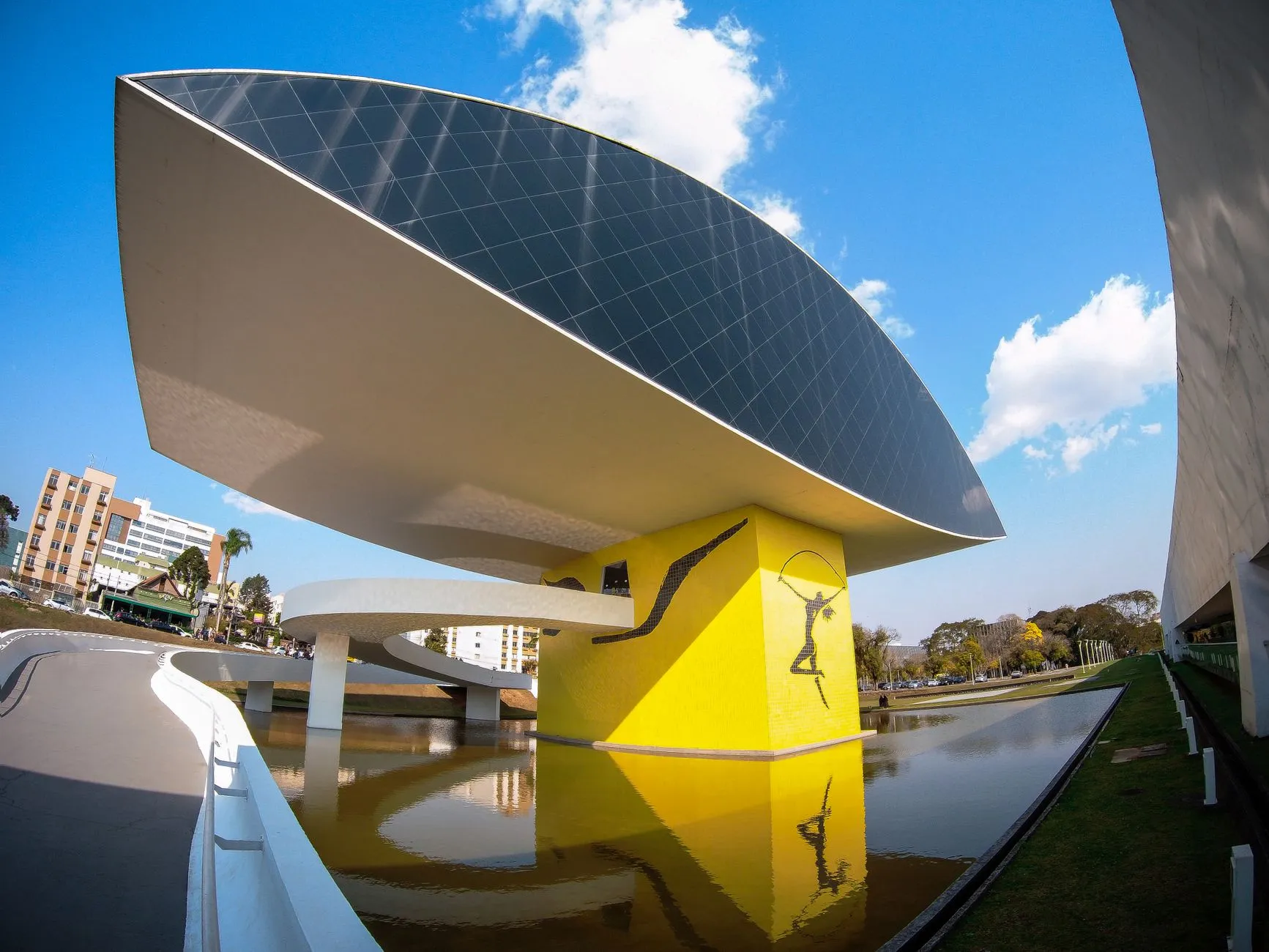
The set-piece sights match that identity. The Oscar Niemeyer Museum, nicknamed the Museu do Olho for the giant eye-shaped pavilion that floats over its plaza, is the architectural showpiece; the Jardim Botânico, with its Art Nouveau glasshouse above geometric gardens, is the city’s postcard; and the Ópera de Arame, a theatre built of tubular steel and glass over a former quarry, is the quietly spectacular one. Curitiba is also one of Brazil’s most European-feeling cities, settled by German, Polish, Italian and Ukrainian immigrants whose neighbourhoods, churches and food still mark it, and it sits high and cool on a plateau, so it is greener, tidier and chillier than the Brazil of the beaches.
That immigrant heritage is something you can eat and walk, not just read about. Santa Felicidade, the historic Italian quarter, is lined with the big cantina-style restaurants the city goes to for a long weekend lunch; the Polish and Ukrainian communities left memorial parks and onion-domed churches on the north side; and the German and Italian influence runs through the bakeries and the beer halls. For a city that does not market itself hard to tourists, the food culture is a genuine reason to stay an extra day.
One day trip is worth planning around: the Serra Verde Express, the scenic railway that drops from Curitiba through the Atlantic Forest of the Serra do Mar down to the colonial town of Morretes near the coast. It is one of Brazil’s great train journeys, winding past waterfalls and viaducts, and Morretes rewards the arrival with its riverside setting and the regional barreado stew. Book ahead, take the left-hand side of the carriage for the views, and make a day of it.
A word on the climate, because it surprises people who expect tropical Brazil: Curitiba sits high on a plateau at around 900 metres, so it is markedly cooler and wetter than Rio or the northeast, with genuinely cold, grey winters from June to August and rain possible any time of year. That is part of its European feel, but pack a jacket whatever the season — this is not a place for the beachwear most people associate with Brazil.
There is no separate aifly Curitiba guide, so this is the orientation: the Niemeyer museum and the botanical garden for the architecture, the BRT and the pedestrian centre for the idea, the immigrant neighbourhoods for the food, and the Serra Verde train if you have a spare day. What is worth eating is the southern-Brazilian and immigrant cooking — the churrasco, the Polish and Ukrainian dishes, the barreado down the line — and what is worth carrying home is Paraná coffee or yerba mate, the regional drink, rather than an airport souvenir.
❓ 6. FAQ
📋 7. At a glance
| Item | Detail |
|---|---|
| Airport | Afonso Pena (CWB / SBCT), São José dos Pinhais, ~18 km from Curitiba |
| Terminal | One main terminal, rated about 14.8M passengers a year; arrive ~2h for international |
| 2025 traffic | 6,082,222 passengers (+17%); Azul focus city; mostly domestic |
| Carriers | Azul (focus city), LATAM, GOL; dense domestic network, limited international |
| To the city | City buses 515 (Terminal Central) and E32 (Terminal Boqueirão); taxi ~30 min; apps; no rail |
| Border | Brazil |
| Currency | Brazilian real (BRL); cards widely accepted |
| Lounge | Several — Advantage VIP (Priority Pass, international + domestic), card lounges |
| Worth your time | The Niemeyer “Eye” museum, the botanical garden, the BRT, the Serra Verde train to Morretes |
🔗 8. Explore More
- Rio de Janeiro Airport (GIG) guide — the major Brazilian gateway and a common connection for international journeys
- Foz do Iguaçu Airport (IGU) guide — also in Paraná, the airport for the Iguaçu Falls, an easy add-on from Curitiba
- Campinas–Viracopos Airport (VCP) guide — the São Paulo–area hub, one of the busiest connection points to the south