Macau International Airport (MFM) — Airport Guide 2026
Macau International Airport sits on reclaimed land off the eastern edge of Taipa island — about 5 km from Senado Square and 10 minutes by road from the Cotai casino strip — making it, in practice, the arrival point for one of the world’s most concentrated gambling economies. It handles roughly 8.5 million passengers a year, operates one terminal, and is completely overshadowed in scale by Hong Kong International Airport an hour’s bridge-ride away, which is exactly why understanding MFM’s own rules, rather than assuming they mirror HKG’s, matters.
Quick Reference
Macau International Airport (Aeroporto Internacional de Macau)
MFM / VMMC
Eastern Taipa island; ~5 km to Macau peninsula, ~10 min to Cotai
One passenger terminal, two concourses
Air Macau (NX)
~8.5 million passengers (2025 CAM forecast)
Macanese pataca (MOP); HKD accepted at par everywhere
≈ MOP 8.07 / USD · ≈ MOP 9.38 / EUR · ~1.03 MOP = 1 HKD
Visa-free, up to 6 months
Visa-free, up to 90 days
Visa-free, up to 30 days
MOP 200 single / MOP 300 multiple (eligible nationalities)
90 days beyond intended departure
Airport station; from MOP 6; ~06:30–23:15
Flat MOP 6 (routes 26, 36, 51A, AP1, MT1, MT4)
~MOP 70–100 + MOP 8 airport surcharge
Free; from arrivals; covers major Cotai and peninsula resorts
Plaza Premium Lounge — Priority Pass / DragonPass accepted
HZMB bridge shuttle ~HK$65; free HKIA→Macau shuttle for foreign passports through 2026
Border Gate (Gongbei) + Lotus Bridge / Hengqin (LRT Hengqin Line, 24h)
Apron/reclamation expansion underway (2026–2028); capacity target ~15M by 2030
🏢 Terminal & Carriers
MFM runs one passenger terminal split nominally into a domestic/Greater China concourse and an international side, but it is compact enough that this distinction is mostly bureaucratic. From check-in to the farthest gate is rarely more than ten minutes on foot. There is no inter-terminal transit to figure out, and if you have flown through Bangkok or Singapore the whole operation will register as comfortably small.
Air Macau (NX) is the home carrier and the reason most of the schedule exists. It flies a dense mainland-China network alongside regional routes to Japan (Tokyo, Osaka, Fukuoka), South Korea, Taiwan, Vietnam (Da Nang and Hanoi), and Southeast Asia more broadly. China Eastern is the next-largest operator, well behind. AirAsia and other low-cost carriers cover Kuala Lumpur and a handful of regional points; Air Macau added Jakarta in March 2026. The network is overwhelmingly East and Southeast Asian — there are no direct long-haul flights to Europe or North America from MFM. A Western traveller arrives here on a connection, typically via a mainland hub, Bangkok, Kuala Lumpur, or Taipei.
The airport is mid-way through a land-reclamation and apron-expansion programme that began in the first half of 2026 and runs through 2028, targeting annual capacity around 15 million by 2030. For a 2026 traveller this is invisible — it is airside groundwork, not a terminal you pass through.
🛂 Border & Visa
Macau controls its own immigration, separately from mainland China. This is a Special Administrative Region with its own entry regime, its own stamps, and its own rules. The mainland’s 240-hour visa-free transit scheme does not apply here. You clear a Macau passport check, not a Chinese one. If your onward plan involves the mainland, that is a separate border crossing — entering Macau gives you no right to enter China.
🗂️ Who enters visa-free
For most Western passport holders, entry is straightforward and generous:
- United Kingdom (all classes of British nationality): visa-free, stay up to 6 months.
- EU member states, Portugal, Norway, Switzerland, Israel, Japan, South Korea, Brazil, New Zealand: visa-free, up to 90 days.
- United States, Canada, Australia, Singapore, the Philippines, Thailand, India, South Africa, the UAE: visa-free, up to 30 days.
You are stamped in on arrival — no advance application, no arrival card for these nationalities. Macau moved to digital arrival slips some years ago, so most visitors clear immigration and walk through.
🪪 Visa on arrival
Nationalities not on the visa-free list can in most cases obtain a visa on arrival, valid up to 30 days. The official fee as of late 2025 was MOP 200 for a single-entry individual visa and MOP 300 for multiple-entry. A short list of nationalities — among them Bangladesh, Nepal, Pakistan, Sri Lanka, Nigeria, and Vietnam — cannot get a visa on arrival and must arrange one in advance through a Chinese diplomatic mission. Verify current fee rates before travel, as immigration fees are revised periodically.
⚠️ Passport validity — 90 days beyond departure
Your passport must be valid for at least 90 days beyond your intended departure from Macau, not merely valid on the day you fly. A passport with two months left will be refused at the gate regardless of how short your stay is.
⚠️ Macau entry ≠ China entry
Crossing from Macau into Zhuhai or Hengqin is a full entry into mainland China and requires whatever Chinese visa or permit your nationality needs. Your Macau stamp is irrelevant at that gate.
🚆 Getting Into the City
Four options, in rough order of how most travellers use them.
🎰 Free casino shuttle buses
Macau’s gaming economy runs complimentary coaches between the airport and the major integrated resorts — The Venetian, The Parisian, The Londoner, Galaxy Macau, City of Dreams, Studio City, Wynn Palace, MGM Cotai, Grand Lisboa Palace, and the peninsula’s Hotel Lisboa, Grand Lisboa, MGM Macau, and Wynn Macau are all covered. You do not need to be a guest; nobody checks. Walk out to the marked shuttle stands at arrivals, board the coach for the resort nearest your actual destination, and walk the rest.
🚌 Free casino shuttles — the obvious choice for Cotai
For the Cotai strip, a casino shuttle is the cheapest and often fastest option, and costs nothing. Departure frequency and hours vary by operator (commonly daytime into the evening, roughly late morning to around 21:00). Check the property’s current shuttle page before relying on a late arrival.
🚇 LRT Taipa Line
Macau’s driverless metro has an Airport station on the Taipa Line. Fares are distance-based, starting at MOP 6 for short hops (three stations or fewer) and rising to around MOP 10–12 for longer rides. The Taipa Line runs from Taipa Pier through the airport and across to Barra on the Macau peninsula — the Barra extension opened December 2023, so the metro now reaches the peninsula directly. Service runs roughly 06:30 to 23:15 on weekdays, later at weekends (verify current timetable before travel). The LRT is clean, signposted in English, and immune to the road traffic that clogs the bridges at peak hours.
🚆 LRT — MOP 6 from the airport, immune to bridge traffic
The Taipa Line Airport station is inside the terminal. Buy your ticket at the platform kiosk. The Barra extension (open since December 2023) means the metro now runs straight through to the peninsula without a bus transfer.
🚌 Public buses
Several Transmac and TCM routes serve the airport at a flat MOP 6 fare — routes 26, 36, 51A, AP1, MT1, and MT4 among them, covering Cotai, Taipa village, the peninsula, and the Border Gate. Exact change is required; the driver gives none. Buses are the budget option but the slowest, and the network takes some decoding on a first visit.
🚕 Taxis
Black taxis queue outside arrivals. The meter starts at MOP 21 for the first 1,600 m, then MOP 2 per 220 m, with a MOP 8 airport-departure surcharge added to anything boarded at the airport rank. Taipa village runs roughly MOP 30–40; Senado Square and the old centre on the peninsula run roughly MOP 70–100, more in traffic.
⚠️ Taxi surcharge and the fixed-price trap
Use the official rank and insist on the meter. The standard trap is a freelance or unmarked driver quoting a flat “fixed price” that runs well above the metered fare. The MOP 8 airport surcharge is legitimate and appears on the meter; anything negotiated off-meter is not.
🌉 Crossing Out: Hong Kong, Zhuhai & Hengqin
MFM’s geographic advantage is how many borders sit within reach. Three matter for travellers.
🌁 Hong Kong — HZMB bridge
The Hong Kong–Zhuhai–Macau Bridge connects Macau to Hong Kong by road. The standard cross-bridge “Golden Bus” shuttle runs 24 hours and costs around HK$65 (HK$70 overnight) for the roughly 40-minute crossing between the two ports, clearing Macau exit and Hong Kong entry formalities at the bridge terminals.
A 2026 development: the Macao Government Tourism Office is running a free direct shuttle from Hong Kong International Airport to Macau for the whole of 2026 (20 January to 31 December), reserved for international travellers holding foreign passports. Crossing this bridge means clearing into Hong Kong — itself a separate immigration jurisdiction from both Macau and the mainland.
🌉 Free HKIA→Macau shuttle — 2026 only
International travellers holding foreign passports can use the MGTO’s free direct shuttle between Hong Kong International Airport and Macau through 31 December 2026. This is a meaningful saving on the standard HK$65–70 Golden Bus fare for the bridge crossing.
🔰 Zhuhai / mainland China — Border Gate (Gongbei)
The peninsula’s northern Border Gate (Portas do Cerco) is Macau’s busiest land crossing into Zhuhai. From the airport, bus route AP1 or a taxi reaches it; you walk through to Gongbei on the Zhuhai side. This is a full entry into mainland China and requires the appropriate Chinese visa — your Macau entry does nothing for you here.
🏝️ Hengqin — Lotus Bridge / Cotai Port
About 8 km west of the airport, the Lotus Bridge links Cotai to Hengqin island in Zhuhai. The Hengqin Port crossing has run 24-hour immigration service since December 2014 and passed 10 million crossings within the first quarter of 2026. The LRT Hengqin Line, which opened to the public in December 2024, now runs across this border directly — the first cross-border metro link from Macau. As with Gongbei, this is an entry into mainland China and needs the appropriate Chinese visa.
🛋️ Lounges
🛋️ Plaza Premium Lounge — Priority Pass and DragonPass accepted
The Plaza Premium Lounge is the only lounge consistently listed as Priority-Pass-accessible at MFM in 2026. Hours run roughly 06:00 to 22:00; walk-in day passes are available for anyone without a card. Check your lounge app at the gate for any other contract lounge that may accept network cards, as coverage shifts.
A couple of other contract lounges operate in the terminal and may accept network cards or pay-per-use entry, but their status changes — treat Plaza Premium as the plan and anything else as a potential bonus.
For a short connection none of this is essential. MFM’s public areas are modern and sparsely crowded, and the food court is a reasonable substitute for a lounge meal at a fraction of the price.
💡 Layover Reality
MFM is small, which works both ways: the airport itself eats very little of your time, and it is close enough to things worth seeing that leaving is tempting. Do the arithmetic honestly before you do.
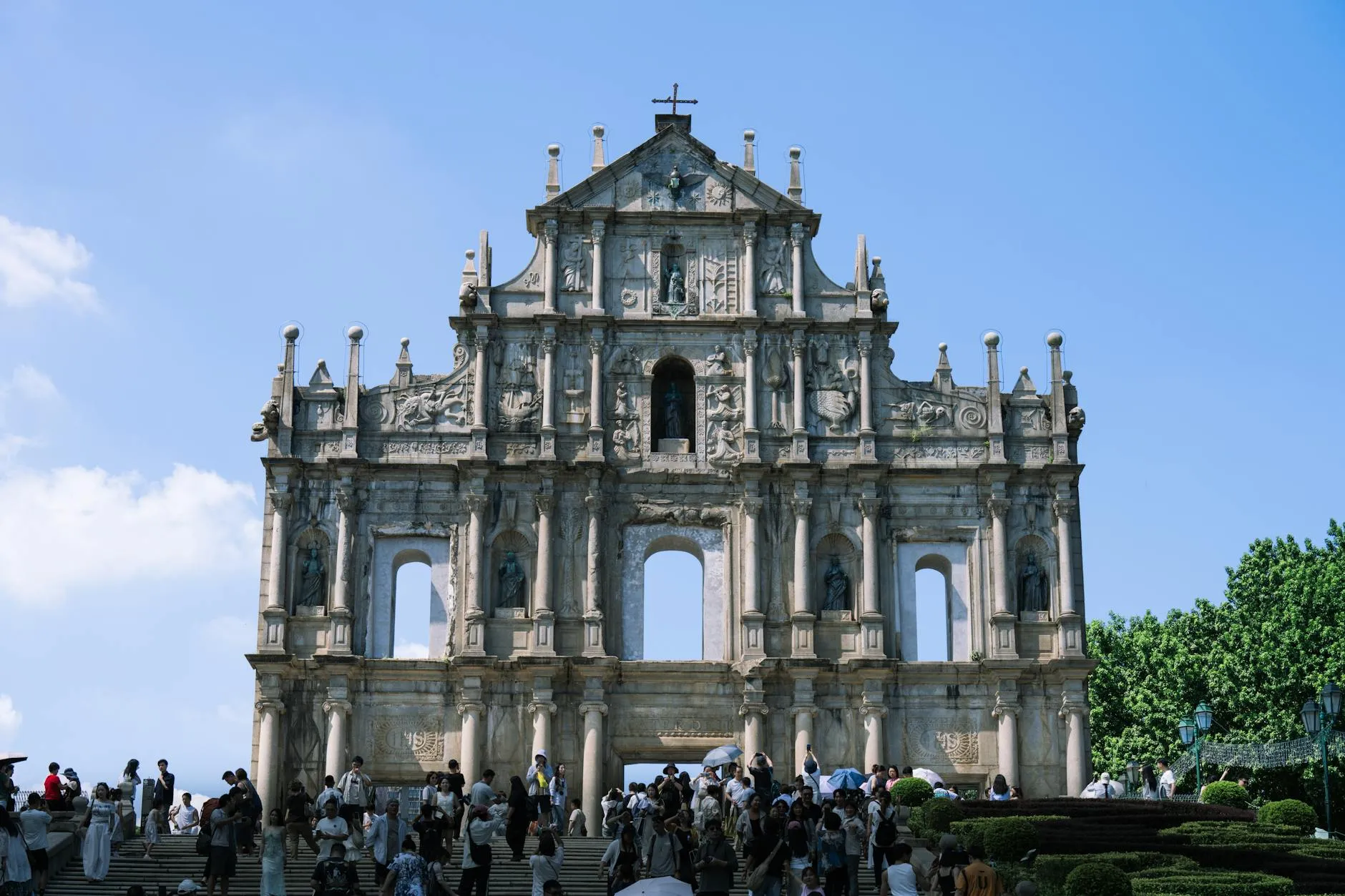
The old centre — Senado Square, the Ruins of St Paul’s, the Portuguese-era streets, the egg-tart shops around them — is the obvious target. By taxi it is roughly 15–25 minutes each way from the airport (longer in peak traffic) at around MOP 70–100 per direction. Senado Square to the Ruins of St Paul’s is a 10–15 minute walk uphill; once you’re there the two sights are a single short loop.
Account for the return buffer. For an international departure, budget 75–90 minutes for the return leg — taxi back plus immigration, security, and gate. Working backward:
- Under 3 hours: stay airside. There is no realistic margin once you subtract the return buffer and two taxi rides.
- 4 hours: workable. You net roughly 60–90 minutes on the ground — enough for Senado Square and the Ruins of St Paul’s loop and a pastel de nata, not much more.
- 6+ hours: comfortable. Add the A-Ma Temple or a wander through the Cotai casino spectacle (free via a casino shuttle), and you’ve used the time well.
Two points worth stating plainly. First, you do not need a visa to leave the airport and return — your visa-free Macau entry covers it, and there is no transit-only zone keeping you airside. Second, leave the mainland out of layover plans entirely: crossing to Zhuhai or Hengqin means a second immigration process and a Chinese visa, which is not viable on a few hours between flights.
💡 Layover arithmetic — 4 hours is the minimum for the city
Factor in 75–90 minutes for the return leg (taxi + immigration + security + gate time). Under 3 hours, stay airside. At 4 hours you can reach Senado Square and the Ruins of St Paul’s. At 6+ hours you have room to add a second stop.
💱 Currency & Connectivity
Currency. The local currency is the Macanese pataca (MOP), pegged to the Hong Kong dollar at roughly 1.03 MOP to 1 HKD. In May 2026, that worked out to approximately MOP 8.07 to the US dollar and MOP 9.38 to the euro. In practice, Hong Kong dollars are accepted almost everywhere in Macau — shops, taxis, casinos, and restaurants take HKD at 1:1, which quietly costs you the ~3% peg difference but saves the hassle of changing money. You rarely need to acquire patacas specifically. If you do, use a bank ATM rather than an airport bureau de change — the markup on a transit-sized exchange at the airport counter is not worth it. Cards are widely accepted at hotels and larger venues; carry some cash for buses (exact change required), small eateries, and taxis.
💴 HKD works — but you lose ~3%
Hong Kong dollars are accepted at 1:1 across Macau, including in casinos. The pataca’s peg to HKD (~1.03 MOP = 1 HKD) means you lose a small percentage on every HKD transaction. For a short visit the convenience is worth it; for a longer stay, draw patacas from an ATM.
Connectivity. Free Wi-Fi is available in the terminal. Macau has its own mobile networks; a Hong Kong or mainland-China SIM does not automatically work without roaming, and Macau is a separate roaming zone from both. Check your plan, or pick up a local or regional eSIM before you land.
❓ Frequently Asked Questions
📊 At a glance — MFM 2026
| Item | Detail |
|---|---|
| Airport name | Macau International Airport (MFM / VMMC) |
| Terminals | One passenger terminal, two concourses |
| Location | Eastern Taipa island; ~5 km to peninsula, ~10 min to Cotai |
| Dominant carrier | Air Macau (NX) |
| Annual traffic | ~8.5 million passengers (2025 forecast) |
| Currency | Macanese pataca (MOP); HKD accepted at par everywhere |
| FX (May 2026) | ≈ MOP 8.07 / USD · ≈ MOP 9.38 / EUR · ~1.03 MOP = 1 HKD |
| Entry — UK | Visa-free, 6 months |
| Entry — EU / Portugal | Visa-free, 90 days |
| Entry — US / Canada / Australia | Visa-free, 30 days |
| Visa on arrival | MOP 200 single / MOP 300 multiple (eligible nationalities) |
| Passport validity | 90 days beyond intended departure |
| LRT (Taipa Line) | Airport station; fares from MOP 6; ~06:30–23:15 |
| Bus | Flat MOP 6 (routes 26, 36, 51A, AP1, MT1, MT4) |
| Taxi to peninsula | ~MOP 70–100 + MOP 8 airport surcharge |
| Casino shuttles | Free; from arrivals; major Cotai and peninsula resorts |
| Lounge | Plaza Premium Lounge — Priority Pass / DragonPass |
| HK link | HZMB bridge shuttle ~HK$65; free HKIA→Macau shuttle through 2026 |
| Mainland links | Border Gate (Gongbei) + Lotus Bridge / Hengqin (LRT Hengqin Line, 24h) |
| 2026 development | Apron/reclamation expansion underway (2026–2028); 15M capacity target by 2030 |