Governor Francisco Gabrielli International Airport (MDZ) — Airport Guide 2026
The Metrotranvía light-rail line is being extended directly into MDZ’s terminal, due October 2026 — making Mendoza the first Argentine airport with rail-to-door service. Until then, the 8 km from the terminal to the city centre is a taxi ride, and the blue-dollar cash-exchange strategy that defined Mendoza travel for a decade has quietly expired.
Quick Reference
MDZ / SAME
Governor Francisco Gabrielli International Airport (El Plumerillo)
8 km northeast of Mendoza centre
~750–800 m
~700 m
One (domestic + international wings)
18/36, 2,789 m concrete
Aeropuertos Argentina 2000
Argentine peso (ARS)
~ARS 1,409 / USD 1
90 days visa-free — US, UK, EU, AU, NZ, CA, JP and most Western passports
Travel medical, min. USD 30,000 cover incl. repatriation
Not required for Mendoza itineraries
~ARS 13,000–15,000 (≈ USD 9–11), 15–20 min
~ARS 809 (≈ USD 0.57) — SUBE card only, no cash
Mendoza by AMAE — Priority Pass / LoungeKey / DragonPass / Diners
Uber & Cabify legal; apps blocked on airport wifi
Metrotranvía extension to terminal due October 2026
Maipú (20 min), Luján de Cuyo (20–30 min), Uco Valley (1–1.5 h)
~185 km / 3+ h — not a layover or easy day trip
Safe to drink
~10% cash in pesos, sit-down dining
🏢 Terminal, Scale & El Plumerillo
MDZ runs on one terminal, one runway, and a nickname that has outlasted the sign above the door. Nobody calls it Gobernador Francisco Gabrielli; everyone calls it El Plumerillo, after the neighbourhood and the 4th Air Brigade military base that occupies the southern half of the airfield. The runway — 18/36, 2,789 m of concrete — is long enough for widebody charters, which fill in March for the wine harvest and in winter for the Andes ski season.
The building was modernised between 2012 and 2014, acquiring the curved white form most travellers photograph on arrival. At current capacity it processes roughly seven simultaneous flights — four domestic, three international — before security and immigration start backing up. That ceiling shows when a full A320 from Santiago unloads into a single immigration hall: a 30–40 minute queue is routine, and there is no fast-track for tourists. Budget for it on international arrivals.
Layout is navigable without a map. Check-in faces you at the entrance; security is past it; international and domestic gate areas branch from a single departures hall. The AMAE lounge sits upstairs near gates 3–4. Duty-free is small and wine-led. Arrivals, baggage and the taxi rank are ground-floor, about 60 seconds from carousel to pavement.
The domestic workhorses are Aerolíneas Argentinas, JetSmart and Flybondi; GOL, LATAM, Sky and Copa add international service. The most-used domestic routes: Buenos Aires Aeroparque (AEP), roughly 1h45–2h, several flights daily; Córdoba (a short hop); Bariloche for the Patagonian Lake District, around 1h45. International direct routes are thin — Santiago de Chile (under an hour over the Andes), São Paulo and Rio (JetSmart added Rio in 2025), Panama City via Copa as the North America bridge, and seasonal Caribbean charters to Punta Cana. Anything else routes through Buenos Aires, which means the AEP-to-EZE transfer — those airports are not adjacent, and that transfer is its own problem covered in the Buenos Aires guides.
MDZ handled around 1.8 million passengers in 2017 and has grown since, but it is sized for a wine-country regional airport, not a hub. Adjust transit assumptions accordingly.
✈️ What Fills These Flights: Harvest Season and Ski Season
Two calendar events drive MDZ traffic and are worth understanding if you are timing a visit.
The Fiesta Nacional de la Vendimia — the national grape-harvest festival — peaks in early March. The 2026 central act falls on 7 March at the Frank Romero Day amphitheatre, the 90th-anniversary edition, with the week prior building through department queen parades and the Blessing of the Fruits in late February. It is the best time to feel Mendoza as a wine city and the worst time to find a reasonably priced room without a booking made months in advance. Show up without a reservation expecting to sort it out on arrival and you will not.
The second season is winter ski — roughly mid-June to late September. Las Leñas, the largest Andean resort to the west and south of Mendoza, was targeting a late-June 2026 opening. This brings ski charters and a different demographic than the summer wine crowd.
Outside those windows: spring (October–November) and autumn (March–April) are quieter shoulders with mild weather and winery access without the festival crush. Summer (December–February) is hot and dry in the city; the plane trees and acequias keep the streets tolerable, but the heat is real.
🛂 Border, Visa & the Insurance Rule People Miss
Visa. Citizens of the US, UK, EU member states, Australia, New Zealand, Canada, Japan and most Western and Latin American countries enter Argentina visa-free for 90 days. There is no online pre-registration form, no arrival fee, and no reciprocity charge — the one that US, Canadian and Australian visitors once paid was abolished years ago. You present your passport at the migrations desk, and that is the entry process. Extensions of a further 90 days are available at the Dirección Nacional de Migraciones for a fee in the low five-figures of pesos, capping a tourist stay at 180 days per year.
⚠️ Mandatory Insurance — This Is an Entry Condition, Not a Suggestion
Since 1 July 2025, every non-resident entering Argentina must carry travel medical insurance covering at least USD 30,000, including hospitalisation, repatriation and emergency evacuation, for the full duration of the stay. Proof can be requested at the border; airlines are entitled to deny boarding without it. Enforcement on tourist arrivals has been uneven in practice, but the regulation is real and current. Buy a policy that names the USD 30,000 figure and keep the certificate on your phone.
No yellow fever certificate applies to Mendoza or standard tourist itineraries. Argentina requests yellow fever documentation only from travellers arriving from or transiting certain risk countries, and the Cuyo region is not among them.
💱 Currency: The Blue Dollar Has Largely Closed
For years, the defining Mendoza travel strategy was arriving with a sealed envelope of clean US hundred-dollar bills and changing them in back-room exchanges (cuevas) at a parallel “blue” rate that sometimes ran fifty percent above the official one. Guides written between 2022 and 2024 treated this as essential knowledge.
That gap has mostly gone. As of late May 2026, the official rate sat near ARS 1,409 per USD, the card (MEP) rate around ARS 1,460, and the blue-cash rate around ARS 1,430. A few percent, not fifty. The practical consequence: pay with a foreign Visa or Mastercard. Card transactions now settle at the MEP-style tourist rate automatically, which matches or beats what a cueva offers, with none of the exposure to counterfeit notes, short-changing or the awkwardness of mid-airport cash logistics.
💳 Use Your Card — The Rate Gap Is Gone
In 2026 a foreign Visa or Mastercard settles at the favourable MEP-style tourist rate automatically. The blue-cash premium has converged to a few percent — not worth the risk of bad notes or short-changing. Carry modest USD cash for taxis, tips and cash-only spots; exchange small amounts as needed.
A practical note on ATMs: Argentine machines dispense pesos in low per-withdrawal maximums with high flat fees. They are an expensive way to get spending money. Bring USD or EUR cash for the fraction you genuinely need physically, and use the card for the rest.
The peso comes in notes up to 10,000 and 20,000 ARS — years of inflation have retired the small denominations that older guides describe. A mid-range restaurant dinner produces a wad of notes; a card avoids that entirely. When you do pay cash, count your change and inspect notes at any informal exchange.
🚆 Getting Into the City
Eight kilometres from terminal to city centre is not a problem. The options differ by effort, cost and what you already have in your wallet.
🚕 Taxi / Remís
The taxi rank is outside arrivals. A metered taxi or pre-agreed remís to the city centre costs roughly ARS 13,000–15,000 (about USD 9–11) in 15–20 minutes. Confirm before getting in whether the fare is metered or fixed — for the airport run, a fixed quote in this range is fair. Pay in pesos. With luggage and no patience for app logistics, this is the default.
📱 Uber & Cabify
Mendoza is the one Argentine city where ride-hailing is explicitly legal — the province fought it to its Supreme Court and Uber won. Unlike Buenos Aires, there is no legal grey area. An Uber from the airport typically undercuts the taxi rank slightly.
⚠️ Uber — The Airport’s Free Wifi Blocks the App
You cannot book Uber or Cabify while on the airport’s wifi network. Use your own mobile data, or walk a short distance from the terminal before requesting a ride. Set up the app and load your payment method before you land.
🚌 Bus Lines 680 / 675
The city buses cost around ARS 809 (roughly USD 0.57). That is a fraction of the taxi.
⚠️ The 680 Bus Takes a SUBE Card Only — No Cash, No Exceptions
Mendoza buses do not accept cash. You must tap a SUBE contactless card, and you can only buy and load a SUBE in the city, not at the airport. The bus works well for the trip out to the airport once you already hold a loaded card; on first arrival with luggage it is not a realistic option. If someone tells you to “just take the 680 from the airport,” ask them how you plan to pay.
🚊 Metrotranvía — Due October 2026
Mendoza is extending its light-rail tram directly into the airport terminal, with the airport station due around October 2026 and works reported past 55% completion in early 2026. Four new stops — Rawson, Espejo, Newbery and the airport itself — and about 25 minutes across Greater Mendoza. It is billed as the first rail-to-terminal-door connection at any Argentine airport.
🚊 The Tram to the Terminal — Check Before You Travel
If you are travelling after October 2026, verify whether the airport station is live. When it opens, it removes both the SUBE-bus payment problem and surge pricing from the arrival calculation. Until it opens, it does not exist for your trip.
🚗 Rental Car
Worth more consideration here than at most city airports, because the wine regions and Andes are spread out and a car turns guided day-tours into self-directed ones. Desks are in the terminal. Argentina drives on the right; an International Driving Permit alongside your home licence is the safe combination for hire firms and traffic police. The mountain route west toward Aconcagua (RN 7) is paved and straightforward in summer but can close or require chains in winter — check conditions before heading up. Fuel stations thin out on the high passes; keep the tank topped before long mountain stretches. For wine days, a car creates a designated-driver problem; the Wine Bus exists specifically to solve it.
🛋️ Lounges
MDZ has one lounge worth naming, and no other product.
🛋️ Mendoza by AMAE — The Only Lounge at MDZ
Located upstairs near gates 3–4, open roughly 06:30–22:00 with a three-hour maximum stay. Access via Priority Pass, LoungeKey, DragonPass or Diners Club. Walk-up rate: ~USD 50. There is no separate Aerolíneas Argentinas or LATAM flagship lounge here; AMAE is the only product. Amenities: snacks and light bites, drinks, showers, wifi, quiet seating — and, for a wine-country airport, a passable Malbec.
The food runs to pastries, sandwiches, soft drinks and a bar. Treat it as a comfortable place to wait with a glass and a snack, not somewhere to eat a full pre-flight meal. Showers matter most for early departures and overnight connections. The USD 50 door rate earns itself on a long delay or when you want the only genuinely quiet seating in the building. On a short wait under two hours, the terminal cafés do the job adequately.
🍽️ Food: Eat Before You Get to the Airport
The airport food hall will show you Mendoza at its least convincing version of itself. Eat in town before you come out.
Mendoza sits at the source of Argentine beef-and-wine culture. The regional repertoire: empanadas mendocinas (baked, not fried, stuffed with beef, olive and hard-boiled egg); the full asado over a wood fire, with bife de chorizo and asado de tira short ribs; provoleta, a grilled provolone disc served as a starter that is one of the better things you will eat anywhere; humita and locro, corn- and stew-based dishes from the Andean northwest that carry into Cuyo cooking. And Malbec, at prices that make wine buyers from other countries sulk when they return home.
The numbers. A single empanada mendocina at a city shop runs roughly ARS 800–1,200 each; three or four make a meal for around ARS 3,500–5,000 (USD 3–5). A mid-range parrilla dinner — appetiser, beef main, a drink, a share of wine — lands around ARS 15,000–25,000 (USD 15–25) per person. By North American or European steakhouse standards, this is underpriced to an embarrassing degree. At the airport, a coffee and two empanadas costs more and tastes worse. Duty-free at MDZ is small and wine-led — a sensible last stop for a bottle or three of Malbec to carry home, where the same wine will cost more.
Verified places in town (confirm hours before going):
- Azafrán, Av. Sarmiento, central Mendoza — Michelin Guide–listed, under chef Sebastián Weigandt, built around local Cuyo produce and a deep Mendoza-heavy wine list of several hundred labels. Dinner-focused; reserve ahead.
- 1884, city centre — Francis Mallmann’s long-standing Mendoza restaurant, the one that put modern open-fire Argentine cooking on the international map well before his streaming fame. Not cheap; the cooking is the reason to go.
- Av. Arístides Villanueva — the bar-and-restaurant strip where locals actually go out. Walk it after 9pm and pick by grill smoke rather than by a single name; most of what is on it is serviceable to good.
- Siete Fuegos (Mallmann’s open-fire restaurant at the Vines Resort, Uco Valley) — about 1.5 hours from the airport. A destination lunch on a winery day in the Uco, not a city excursion. Reserve well ahead.
🍷 Day Trips: Wine, Mountains & Honest Layover Math
This is why most people fly into MDZ. Travel times below are from the city centre; add 20 minutes from the airport.
🍇 The Wine Regions
Maipú — 14 km / 20 minutes south of the city. Dense concentration of wineries, the most accessible and affordable option, and where the bike-and-bodega day was invented. Go to Maipú if you have one day and want volume of tastings over scenery.
Luján de Cuyo — 19 km / 20–30 minutes south. The historic heart of Argentine Malbec and home to the prestige producers. More polished than Maipú, more expensive, better for a focused tasting session rather than a casual loop.
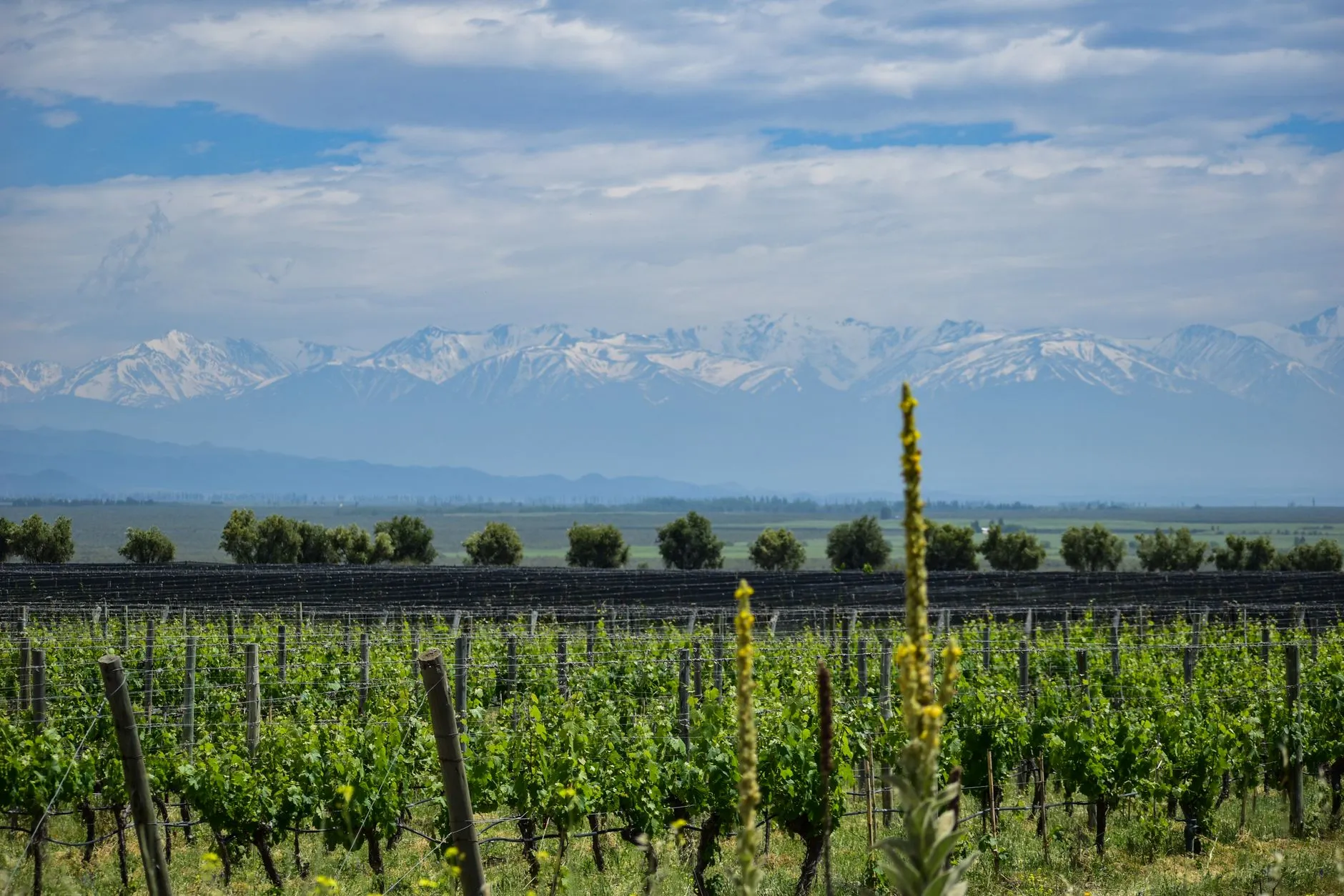
Uco Valley — 1 to 1.5 hours south, at 1,000–1,500 m elevation. The high-altitude frontier of Mendoza wine, where the architecturally ambitious wineries and destination restaurants cluster. This is a committed full day, not a half-day addition to something else.
The Wine Bus — the hop-on-hop-off service connecting wineries across Luján de Cuyo, Maipú and Uco on full- and half-day passes. Tasting and lunch fees at each winery are extra and not included. It exists to solve the designated-driver problem; on a self-guided tasting day it is the sensible choice. Pass prices move with inflation — verify the current ARS fare before booking.
⛰️ The Mountains
⚠️ Aconcagua Is Not a Day Trip
At 6,961 m — the highest peak in the Americas — Aconcagua sits about 185 km and 3-plus hours of driving each way up RN 7. A long full day reaches the park entrance and a viewpoint of the summit. Base camp is a multi-day permitted trek requiring advance booking; it is not a destination you reach by driving up on a free afternoon. For Andean scenery in a single day, target Uspallata and Puente del Inca instead. For the mountain itself, plan a dedicated expedition.
Uspallata and Puente del Inca — Uspallata is the mountain town about 120 km / 1.5 hours west, a realistic full-day target. The corridor combines Andean scenery, the natural rock bridge and thermal deposits at Puente del Inca, and an Aconcagua viewpoint from a distance. This is the honest version of “see the Andes from Mendoza in a day”: Uspallata corridor, yes; Aconcagua summit approach, not in a day.
🏙️ The City, If You Have a Few Hours
Mendoza was rebuilt on a strict grid after the 1861 earthquake destroyed the old town, with wide tree-lined avenues and deep open irrigation channels — acequias — running along the streets. Mind your step: the acequias are real gaps in the pavement. Plaza Independencia is the central square, ringed by the Teatro Independencia and a modern-art museum, with an artisan craft fair most days. Parque General San Martín, about twelve blocks west (10–15 minutes by taxi or a flat walk along Av. Sarmiento and Emilio Civit), is the city’s green lung; at its western edge, Cerro de la Gloria offers a free panorama over the city toward the mountains — a 10-minute drive up or a steep walk. Av. Arístides Villanueva fills after 9pm.
Layover math. A 2–3 hour connection buys nothing beyond the terminal. Even the nearest winery in Maipú is a 40-minute round-trip in a car before you taste anything, and you still need to return through a single-hall security with buffer. A 6-hour gap is the realistic floor for a city excursion — budget 90 minutes round-trip transit plus an hour back through check-in and security. Anything in the mountains needs an overnight. If you are connecting rather than visiting, plan to stay in the terminal.
🔧 Practical Notes
Wifi and SIM. The airport offers free wifi, subject to the Uber/Cabify blocking noted above. For a local SIM or eSIM, the main Argentine carriers — Claro, Movistar, Personal — sell tourist data plans; an eSIM activated before you fly is the lowest-friction option and avoids queues and passport-registration paperwork at a carrier shop in town.
Altitude. Mendoza city sits at 750–800 m. There is no altitude-sickness risk in the city. The only practical effect is that wine can hit slightly harder than at sea level, which on a tasting day is worth pacing around. Altitude becomes a real factor only once you head west: the Uco Valley reaches 1,500 m; the Uspallata corridor and Puente del Inca push toward 2,700–3,000 m; Aconcagua’s approaches go considerably higher. Ascend gradually and hydrate if you are heading up.
Tap water. Safe to drink throughout Mendoza city and the wine regions. Argentina’s water supply is among the better-quality in South America, and Mendoza’s is well maintained. Buying bottled water is a taste preference here, not a health precaution.
Tipping. Ten percent in cash pesos at sit-down restaurants is the established norm and expected. Tip wine-tour guides and drivers in cash pesos as well; card tips are unreliable. Some restaurants add a cubierto — a cover charge for bread and table setting — which is not a tip: the 10% goes on top of it. Carry small notes.
Language. Spanish is the working language, and outside the wineries and larger hotels, English is limited. The wine-tour industry is geared to international visitors; for taxis, buses and smaller restaurants, a few words of Spanish and a translation app carry you through. Argentine Spanish uses a distinctive sh sound for “ll” and “y” — the kind that throws travellers who learned Castilian Spanish elsewhere.
Safety. Mendoza is one of Argentina’s calmer cities. Standard urban caution applies in the centre and around the bar zones at night: watch for pickpocketing in crowds, keep phones and cash from obvious display, and use Uber or a registered remís after dark rather than unmarked cars. Petty theft is the realistic concern, not violence. The wine districts and mountain routes are low-risk; on RN 7, weather and road conditions are the hazard, not crime.
🌍 Planning the trip? Read our Argentina travel guide — best time to go, where to stay, and how to get around.
❓ Frequently Asked Questions
📊 At a Glance — MDZ 2026
| Category | Detail |
|---|---|
| Airport | Governor Francisco Gabrielli International Airport (El Plumerillo) |
| IATA / ICAO | MDZ / SAME |
| City served | Mendoza, Cuyo region, Argentina |
| Distance to centre | 8 km northeast |
| City elevation | ~750–800 m |
| Field elevation | ~700 m |
| Terminals | One (domestic + international wings) |
| Runway | 18/36, 2,789 m concrete |
| Operator | Aeropuertos Argentina 2000 |
| Currency | Argentine peso (ARS) |
| Official USD rate (29 May 2026) | ~ARS 1,409 / USD 1 |
| Visa (Western passports) | 90 days visa-free, no pre-registration |
| Mandatory insurance | Min. USD 30,000 cover, since 1 Jul 2025 |
| Yellow fever | Not required for Mendoza itineraries |
| Taxi / Uber to centre | ~ARS 13,000–15,000 (USD 9–11), 15–20 min |
| Public bus (680/675) | ~ARS 809 (USD 0.57), SUBE card only |
| Lounge | Mendoza by AMAE — Priority Pass / LoungeKey / DragonPass / Diners; ~USD 50 walk-up |
| Rideshare | Uber & Cabify legal; apps blocked on airport wifi |
| Carriers | Aerolíneas Argentinas, LATAM, JetSmart, Flybondi, GOL, Copa, Sky |
| Key international routes | São Paulo, Santiago, Panama City; seasonal Caribbean |
| 2026 change | Metrotranvía tram to terminal, due Oct 2026 |
| Nearest winery region | Maipú (20 min), Luján de Cuyo (20–30 min), Uco Valley (1–1.5 h) |
| Aconcagua | ~185 km / 3+ h — not a layover or easy day trip |
| Uspallata / Puente del Inca | ~120 km / 1.5 h — realistic full-day Andes target |
| Tap water | Safe to drink |
| Tipping | ~10% cash in pesos, sit-down dining |
| Key festival | Vendimia central act: 7 Mar 2026 (90th anniversary) |
| Ski season | Mid-June to late September (Las Leñas targets late-June 2026 opening) |