Ushuaia – Malvinas Argentinas International Airport (USH) — Airport Guide 2026
The world’s southernmost international airport handled roughly 512,000 passengers in 2021, the great majority of them connecting to Antarctic expedition ships — which makes the port-labour dispute running since January 2026, with around 140 dock workers locked out and cruise unions warning of season disruption, the most consequential ongoing story at USH right now.
Quick Reference
USH / SAWH
Aeropuerto Internacional Ushuaia – Malvinas Argentinas
Argentina — Tierra del Fuego
4 km south; 10–15 min by taxi
One; ~9,700 m²; two floors; designed by Carlos Ott
1995
07/25, concrete, 2,804 m
Argentine peso (ARS); USD and EUR widely understood in cruise-tourism contexts
≈ ARS 1,410–1,460 / USD; official, MEP and blue within ~2–3%
Foreign card — MEP conversion ≈ street rate since April 2025
Visa-free, 90 days; reciprocity fee suspended
W Lounge — Priority Pass / pay-per-use, near Gate 6, opens 06:30, ~40 seats
None — licensed taxis and remises only
Aerolíneas Argentinas, Flybondi, JetSMART, LATAM, LADE
GOL (from 7 Jul) and LATAM Brazil (from 1 Jul) to São Paulo–Guarulhos
Port-labour dispute — could affect 2026–27 Antarctic cruise season
Safe to drink
✈️ The Terminal — One Building, Deliberately Modest
USH has a single passenger terminal of roughly 9,700 m² across two floors, and that is the whole airport. The site sits on Peninsula del Río Pipo, pushed out from the shoreline so that a 2,804 m concrete runway could be laid without the obstructions the old in-town strip had. Approaches come in low over the Beagle Channel; the descent past the mountains is theatrical in a way that earns no further elaboration.
The terminal opened in 1995, replacing the older aeroclub airfield closer to town — now the Aeroclub Ushuaia, still in use by light aircraft. Its architect was Carlos Ott, the Uruguayan-born architect best known internationally for the Opéra Bastille in Paris. At USH he worked in a different register: heavy timber, steep roof pitches to shed snow, a structure that reads more like a large mountain lodge than a glass-box terminal. That aesthetic carries through to the W Lounge upstairs.
Inside you will find check-in counters, a small cluster of car-hire desks, a café, basic retail and the lounge — not the sprawling commercial floors of a hub. Self-service kiosks handle most domestic check-in. International departures use the same compact set of immigration desks, so allow extra time on cruise-turnover days: when a full ship’s worth of passengers clears outbound immigration at once, that corridor becomes a serious bottleneck.
From the entrance to the farthest gate is a two-minute walk. There is no inter-terminal shuttle to miss, no airside train to find. The summer peak — roughly November to March, when Antarctic expedition ships cycle through their rosters — is when the terminal feels its 9,700 m². Book the lounge ahead in those months; its 40 seats fill against peak departure banks.
🛂 Border & Visa
Argentina grants 90 days visa-free to citizens of the United States, Canada, the United Kingdom, the European Union, Australia and most other Western countries. The old reciprocity fee that previously hit US, Canadian, Australian and British arrivals is suspended — you pay nothing on entry for tourism. There is no mandatory electronic pre-registration for short tourist stays for those nationalities; you receive a passport stamp on arrival. Stays can be extended, normally once or twice for 30 or 90 days, through the Dirección Nacional de Migraciones. Confirm your own nationality’s current status before flying.
No yellow fever certificate is required. Ushuaia is sub-Antarctic and at sea level; altitude adjustment is not needed. The environmental reality here is cold, wind, and weather that changes faster than forecast models suggest. Summer (December–February) brings long daylight hours and temperatures that rarely climb out of the low teens Celsius. Winter is snow, short days, and a functioning ski season. In any month a waterproof shell and layers matter more than a heavy coat. There is a hospital and pharmacies in town; bring prescription medication rather than expecting to find it locally.
💱 Currency & Payment
The Argentine peso (ARS) is the only legal tender. Notes have been redenominated upward as inflation has run — ARS 10,000 and ARS 20,000 bills are now the workhorses of daily transactions.
For most of the last decade the standard traveller advice was to carry US-dollar cash and change it on the informal “blue” market for a rate 50–80% above official. That advice is outdated. Argentina lifted currency controls (the cepo) in April 2025, and through late 2025 and into 2026 the official rate, the MEP (financial) rate and the informal blue converged to within roughly 2–3% of each other. As of late May 2026 all three sit close to ARS 1,410–1,460 per US dollar.
The practical result: when a foreign Visa or Mastercard is charged in pesos, the conversion now lands near the blue rate. Card is the recommended default in Ushuaia, which is a card-friendly, tourism-heavy town. Still bring some US-dollar cash as a backstop for cash-only situations — keep bills crisp and untorn, because Argentine vendors reject damaged dollars. ATMs in town dispense pesos but impose low per-withdrawal caps and charge fees; plan on two withdrawals rather than one.
💳 Card Payments — Blue Rate, No Queue
Since Argentina lifted currency controls in April 2025, foreign Visa and Mastercard charges convert at near the informal street rate. The old blue-dollar cash premium ran 50–80% above official for years; it now sits at roughly 2–3%. Card wins on simplicity and gets you essentially the same rate.
⚠️ National Park Gate — Cash Only in Pesos
The Tierra del Fuego National Park entrance is cash-only, in pesos. Same for some remises and small vendors in town. Withdraw pesos from an ATM before heading out; arriving at the gate with only a card means turning back.
🚕 Getting Into Town
USH is 4 km south of the centre — 10–15 minutes by road. There is no Uber or Cabify in Ushuaia, no public city bus serving the airport, and no rail link. The options are a licensed taxi, a pre-booked remise, or a rental car.
🚕 Taxi to Centre — ARS 7,000–12,000, 10–15 min
Taxis queue outside arrivals. The fare to most of the centre runs roughly ARS 7,000–12,000 in mid-2026 depending on destination and time of day. Confirm the meter is running or agree the fare before pulling away — Patagonian taxi prices move with inflation and any peso figure here is indicative.
🚙 Remises and Hotel Transfers
A remise is a pre-booked private car at a fixed price agreed in advance — useful when you need a larger vehicle for expedition luggage or simply want a driver waiting with a sign at cruise turnover. Tour operators and hotels arrange these; Tolkeyen Patagonia Turismo, among others, runs hotel shuttle transfers from the airport. Book ahead in the November–March peak, when the whole town’s taxi supply is stretched by ship arrivals.
When two or three expedition ships turn around on the same morning, the airport’s taxi queue and the town’s transfer fleet are both stretched simultaneously. If you are flying out on a cruise-disembarkation day, pre-book your transfer. Turning up at arrivals expecting a waiting taxi is the most reliable way to miss the one daily flight back to Buenos Aires.
🚗 Rental Car
Rental desks operate at USH. A car earns its cost only if you intend a self-drive day-trip: Ruta 3 into Tierra del Fuego National Park, out toward Lago Escondido and Lago Fagnano, or to Cerro Castor in winter. For a town-only stay, central Ushuaia is walkable and parking is tight in season.
The 4 km airport-to-centre road is technically walkable but runs along the access road with luggage and weather against you. It is not recommended on arrival.
For a solo traveller heading to a central hotel, the taxi wins on price and simplicity. For a group with Antarctic expedition kit, a pre-booked remise or hotel shuttle wins on capacity and the certainty of a waiting vehicle.
🛋️ Lounges
For most of its life USH had no lounge at all. The W Lounge opened in September 2024, airside near Gate 6, past security. It is the airport’s only lounge.
Access is through Priority Pass and equivalent pay-per-use and card schemes. There is no airline-operated lounge here — no Aerolíneas or LATAM membership grants automatic entry, so every visitor comes in via Priority Pass, a comparable membership, or a paid walk-up.
The design leans into the location: angled windows, exposed wooden beams, and an alpine-cabin feel. The self-serve spread is decent — beers, a proper coffee machine, cold cuts, cheese, and snacks. Opening is from 06:30, covering the early Buenos Aires departures. What it lacks is any dedicated work zone, meeting space, or quiet room; it is a place to eat and wait, not to take a call before a long-haul connection.
🛋️ W Lounge — Priority Pass, Gate 6, ~40 Seats
Opened September 2024. Access via Priority Pass or pay-per-use only — no airline frequent-flyer status works here. Opens at 06:30. At around 40 seats it reaches capacity when an early Buenos Aires bank overlaps an international departure; Priority Pass lounges can turn members away at the door when full. Get through security early rather than counting on a seat.
If the lounge is full, the landside and airside café seating is adequate for a short wait; the terminal is small enough that you are never far from a gate. There are no overnight facilities.
🍽️ Food Before You Fly
Airside catering at USH is limited to a café-and-snack level: coffee, medialunas (small sweet Argentine croissants), empanadas, sandwiches, and the lounge spread if you have access. Prices are what you would expect at an airport. The centre is 15 minutes away; eat there before you transfer.
The dish in Ushuaia is centolla — southern king crab from the Beagle Channel. Its meat is sweet and the city’s better restaurants build menus around it. Three that were operating as of the guide’s research period:
- El Viejo Marino — the best-known centolla house in Ushuaia. No reservations taken; a queue forms before the doors open. Go early or expect to wait.
- Alma Yagán — out toward Puerto Almanza, east of the city, perched above the channel with a short forest walk to reach it. Two tables, two seatings a day; reservation is not optional.
- Crujiente — a small closed-door restaurant working through Tierra del Fuego ingredients in an intimate room; book ahead.
Centolla is not cheap anywhere — it is a premium product and Ushuaia’s restaurants price it accordingly. The saving over eating it in a tour package is real, but this is not a budget meal. For a cheaper plate, the empanada-and-grill places along Avenida San Martín, the central artery a few blocks up from the waterfront, do a solid job for a fraction of the crab price.
🦀 Centolla — Eat It, But Book
Southern king crab from the Beagle Channel is the reason to eat in Ushuaia rather than at the airport. Alma Yagán near Puerto Almanza has two tables and two seatings a day — book before you arrive in the country. El Viejo Marino in town takes no reservations and the queue forms before opening; go early.
Beyond crab: cordero fueguino (Fuegian lamb, often spit-roasted over an open fire), calafate berry eaten as jam or ice cream — local lore holds that whoever eats calafate returns to Patagonia — and craft beer from Beagle and Cape Horn, the local microbrewery labels on tap along San Martín. Reservations matter in the November–March peak, when cruise passengers and trekkers compete for the same tables.
On duty-free. Tierra del Fuego operates under a special customs and tax regime — a legacy incentive to encourage settlement and industry at the bottom of Argentina — which historically made Ushuaia a destination for buying electronics and imported goods cheaper than the mainland. In practice the advantage for a passing traveller is thinner than the history suggests, and the airport retail is small. Treat it as last-minute convenience, not a shopping reason. The sensible airside purchases are Argentine Malbec, dulce de leche, yerba mate, and calafate or cordero-themed souvenirs. A full bottle of wine does not pass domestic security; pack it in checked luggage.
🐧 Flights and the Antarctic Connection
Domestic flying dominates the schedule. Aerolíneas Argentinas links USH to both Buenos Aires airports (Aeroparque and Ezeiza), Córdoba, El Calafate and Trelew. The low-cost carriers Flybondi and JetSMART concentrate on Buenos Aires and El Calafate; LADE flies thin Patagonian regional routes; LATAM serves the main routes. For 2026, the new international flying is seasonal: LATAM Brazil starts São Paulo–Guarulhos service from 1 July 2026, and GOL begins the same route from 7 July 2026, both timed to the southern winter shoulder and Antarctic cruise calendar. Verify schedules before building a connection on them.
The bigger 2026 story is on the water. Roughly nine in ten Antarctic expedition cruises depart from Ushuaia, because it is the closest major port to the Antarctic Peninsula — the Drake Passage crossing runs about two days each way. The cruise calendar spans broadly late October to March, with the densest sailings in December and January. For most passengers the airport and the port are two ends of the same morning: fly in from Buenos Aires, taxi the 4 km to the waterfront, board.
Since 22 January 2026 a labour dispute tied to a federal takeover of the port has kept around 140 dock workers locked out, and port unions have publicly warned that the 2026–27 season could be disrupted. The Argentine Coast Guard certified the port as meeting international safety standards through 2029 on 14 January 2026 — the issue is governance and access, not infrastructure.
⚠️ Port Dispute — Confirm Before You Sail
Since 22 January 2026, around 140 dock workers have been locked out following a federal takeover of the port. Unions have warned the 2026–27 Antarctic cruise season could face disruption. The port was certified to international safety standards through 2029 in January 2026 — the question is labour access, not physical safety. Confirm sailing details with your cruise operator close to departure.
📅 Antarctic Cruises — Arrive the Day Before
USH has limited daily flights from Buenos Aires, a single runway exposed to weather, and a town-wide taxi supply that strains on ship-turnaround days. Expedition operators routinely advise arriving a day early and overnighting in Ushuaia rather than connecting same-day onto a ship. That buffer is genuine insurance; a missed or delayed flight has few fallbacks when the next Buenos Aires rotation is tomorrow.
💡 Day-Trips and Layover Math
The overhead is about 2.5 hours before you see anything: roughly 30 minutes each way for the transfer and taxi queue, plus a 90-minute return-security buffer before the onward flight. Work from that floor.
- Under 5 hours: stay at the airport or taxi into town for a meal and the waterfront. No excursion is safe.
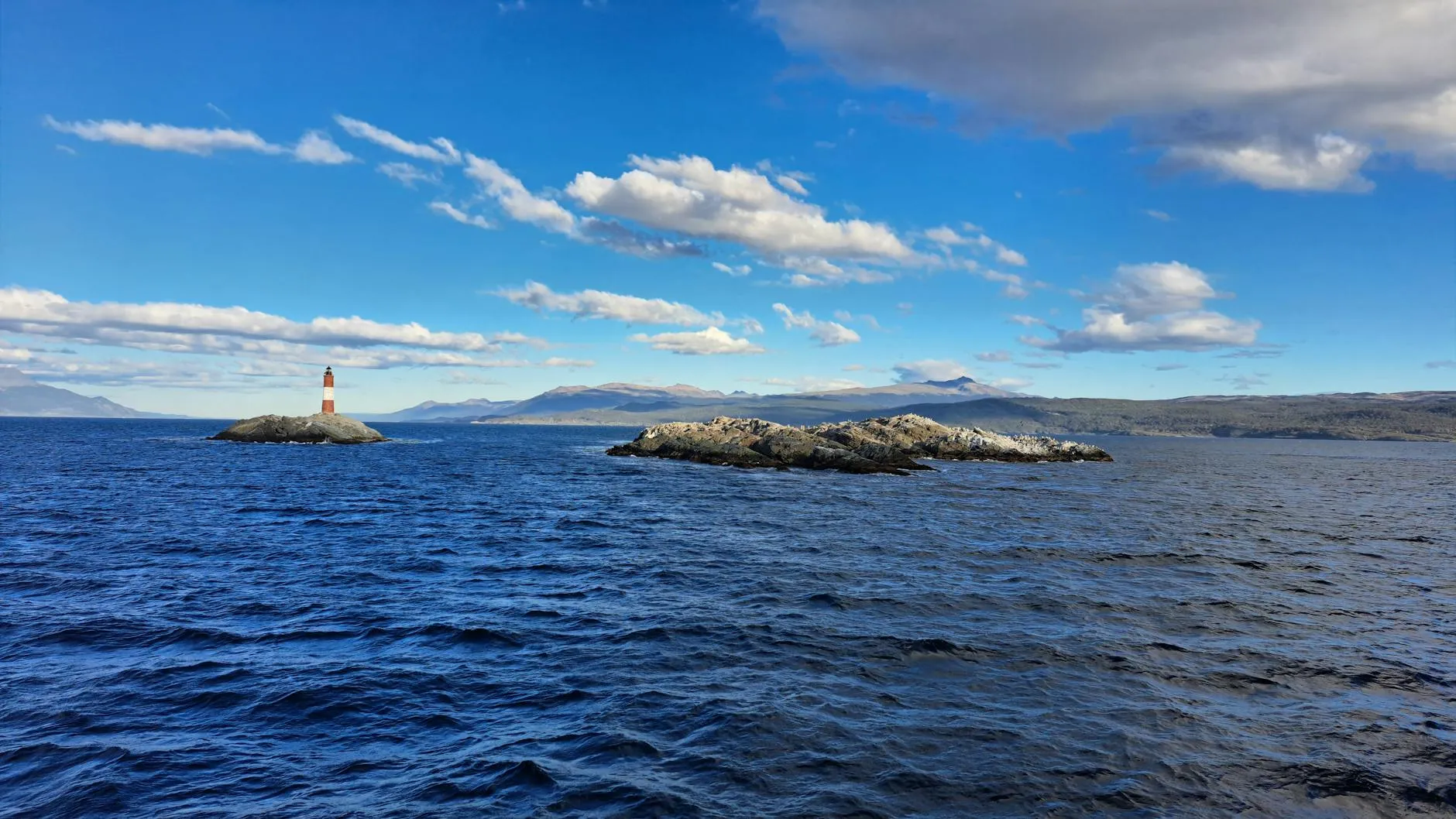
- 5–8 hours: a short Beagle Channel catamaran tour (2.5–4 hours) to the Les Éclaireurs lighthouse — the red-and-white tower built in 1919 — is feasible but tight, with no margin for error, and only if the boat schedule aligns with your window. Treat this as a same-day-arrival plan, not a connection plan.
- Full day or overnight: the national park, the End of the World Train, Estancia Harberton and Cerro Castor open up.
🏔️ Tierra del Fuego National Park
The entrance is about 12 km west on Ruta 3, roughly 20–30 minutes by road. Hourly summer buses run from town at approximately ARS 2,500–3,500 round trip in 2026. Entry for non-resident foreigners was around ARS 40,000 in early 2026, adjusted upward with inflation by the Administración de Parques Nacionales — cash only in pesos at the gate; verify the current rate before you go. Half to full day; not a layover option.
🚂 End of the World Train (Tren del Fin del Mundo)
The station is about 8 km from town; the narrow-gauge line runs into the park, stopping at the Macarena waterfall. Adult-foreigner fares in the January–June 2026 window were approximately ARS 65,000 tourist class and ARS 185,000 premium; the ride is roughly an hour out and 45 minutes back. Combine with the national park, not with a tight layover.
⛵ Beagle Channel Sailings
Boats leave from the town pier for the Les Éclaireurs lighthouse, sea-lion and cormorant colonies on the islets, and longer runs to Isla Martillo’s penguin colony or Estancia Harberton. The standard lighthouse-and-wildlife loop runs 2.5–4 hours; longer runs are a half to full day. Bring a windproof layer — the channel is cold and exposed even in January.
Isla Martillo penguin colony: Magellanic penguins (and a small number of gentoos) breed on the island roughly October to April; outside that window there are no penguins, so check the season before booking. Tours leave from the tourist pier and run about 5 hours total. Some operators land you on the island for a guided walk among the colony; others view only from the boat. Confirm which when you book — the prices and the experience differ materially.
Estancia Harberton: Tierra del Fuego’s oldest farm, founded in 1886 by missionary Thomas Bridges, about 83 km east of Ushuaia along Ruta 3 and a gravel spur — roughly 1 hour 15 minutes by road. It holds the Acatushún marine-mammal museum and is the usual land-side jumping-off point for the Isla Martillo tours. Half to full day; combine both in one run east.
🏛️ Museums in Town
Maritime & Prison Museum (Museo Marítimo y del Presidio), on Yaganes: the actual former prison that built early Ushuaia. One ticket covers the maritime, Antarctic and old-prison halls plus an art gallery; adult admission was around ARS 44,000 in 2026, under-12s free. Open daily, broadly late morning to 20:00 — hours shift seasonally, so verify. Two to three hours, walkable from the centre, weather-proof, and the strongest option when the weather is genuinely bad.
End of the World Museum (Museo del Fin del Mundo): city history and natural history. Open Monday–Friday 10:00–19:00, Saturday 13:00–19:00, closed Sundays and holidays. An hour or so; pair it with the prison museum on a low-cloud day.
⛷️ Further Afield
Glaciar Martial sits only about 7 km from downtown — the closest nature option to the airport. The old chairlift has been out of service for years; the glacier viewpoint is reached on foot, roughly two hours up and back.
Cerro Castor, 26 km / about 35 minutes east, holds the title of the world’s southernmost ski resort, with Argentina’s longest ski season running roughly June to October. Winter day-trip only; you need a car or an organised transfer.
🔧 Practical Notes
WiFi: Free in the terminal.
SIM cards: Argentina’s three carriers are Claro, Movistar and Personal. For Patagonia, Claro has the most reliable coverage in remote areas; Movistar is a solid second on the main tourist routes. Movistar’s prepaid plans run approximately ARS 4,800 for 3 GB and ARS 6,100 for 5 GB on a 30-day basis (roughly USD 5–7), and the physical SIM is often near-free at a kiosk when you top up on the spot. An eSIM from Holafly, Airalo or a similar provider — bought before you fly — is the lowest-friction option if your phone supports it.
Safety: Ushuaia is a small, low-crime town by Argentine standards. Violent crime against tourists is rare. Standard bag-watching applies during the cruise-season crush at the pier and in busy restaurants along Avenida San Martín.
Tipping: Around 10% in restaurants where service is not already included. Check the bill for cubierto — a per-person cover charge that is not a tip and is not discretionary. Round up for taxis.
Tap water: Safe to drink; it comes off the surrounding mountains and is fine straight from the tap.
📱 SIM in Patagonia — Claro Covers More
Claro has the best coverage on remote routes (national park, Harberton, Lago Escondido, Lago Fagnano). Movistar is cheaper — 3 GB / 5 GB at roughly ARS 4,800 / 6,100 (≈ USD 5–7) — and adequate for town and the main tourist circuit. An eSIM bought before departure avoids the kiosk registration process entirely.
🌍 Planning the trip? Read our Argentina travel guide — best time to go, where to stay, and how to get around.
❓ Frequently Asked Questions
📊 At a Glance — USH 2026
| Feature | Detail |
|---|---|
| IATA / ICAO | USH / SAWH |
| Airport name | Ushuaia – Malvinas Argentinas International |
| Position | Southernmost international airport in the world |
| Distance to centre | 4 km south; 10–15 min |
| Terminal | Single; ~9,700 m²; two floors; architect Carlos Ott |
| Opened | 1995 |
| Runway | 07/25, concrete, 2,804 m |
| Passengers | ~512,000 (2021); higher post-recovery |
| Currency | Argentine peso (ARS) |
| FX rate (May 2026) | ≈ ARS 1,410–1,460 / USD; blue/MEP/official within ~2–3% |
| Best payment method | Foreign card — MEP rate ≈ street rate since April 2025 |
| Visa (US/UK/EU/CA/AU) | Visa-free, 90 days; reciprocity fee suspended |
| Lounge | W Lounge — Priority Pass / pay-per-use; opens 06:30; ~40 seats |
| Rideshare | None — taxis and remises only |
| Taxi to centre | ≈ ARS 7,000–12,000 (mid-2026, indicative) |
| Main carriers | Aerolíneas Argentinas, Flybondi, JetSMART, LATAM, LADE |
| 2026 seasonal additions | GOL (from 7 Jul) and LATAM Brazil (from 1 Jul) to São Paulo–Guarulhos |
| TDF National Park entry | ≈ ARS 40,000 non-resident (early 2026; cash only in pesos; verify) |
| End of the World Train | ≈ ARS 65,000 tourist / ARS 185,000 premium (Jan–Jun 2026) |
| Tap water | Safe to drink |
| Tipping | ~10% in restaurants; cubierto cover charge ≠ tip; round up taxis |
| 2026 watch item | Port-labour dispute affecting 2026–27 Antarctic cruise season |