Munich — The Complete City Guide 2026
The most liveable city in Germany is also the most misunderstood by visitors. Munich is not a theme park of lederhosen and beer steins — it is a place of serious art collections, ruthless punctuality, and a beer garden culture that operates on unwritten rules older than some countries.
Verified April 2026
✍️ 20-Year Travel EditorLast verified: April 2026. Every price, opening hour, and booking link in this guide has been checked against official sources. Verify at the listed URLs before visiting — Munich changes less than most cities, but it changes without telling you.
Why Munich? An Editor’s Note
I have been visiting Munich for fifteen years, and the thing I keep returning for is not the Oktoberfest or the BMW Museum or even the extraordinary Pinakotheken. It is the Isar. On a warm Friday evening in June, half of Munich is sitting on the gravel banks of the Isar river between Reichenbachbrücke and Flaucher, drinking beer from bottles they brought from home, grilling on disposable barbecues, watching kayakers run the weir. Nobody is performing. Nobody is curating an experience. It is a city that is genuinely, quietly happy — and it shows.
Munich is the richest city in Germany by GDP per capita. It is the safest major city in Germany by crime statistics. It has more Michelin-starred restaurants than any German city except Berlin. It has three of the world’s finest art galleries within a ten-minute walk of each other, and on Sundays they charge one euro. The Alps are visible from the city on clear days and reachable by regional train in ninety minutes. The beer gardens are not tourist attractions — they are municipal infrastructure, with seating for thousands and unwritten social rules that Bavarians take as seriously as their train timetables.
This guide is for people who want to understand Munich as a place, not just visit it as a destination. The difference matters here more than in most cities.
Extending the trip? See our Berlin city guide (4 hours by ICE), Vienna city guide (4 hours by Railjet), Prague city guide (5 hours by train or 1 hour flight), and Milan city guide (6–7 hours by train via Brenner) for the same treatment.
Table of Contents
- Top Attractions in Munich
- Beer Gardens — Munich’s Real Living Rooms
- Munich’s Best Neighbourhoods
- Where to Stay in Munich — By Budget
- Where to Eat in Munich
- Getting Around Munich
- Best Time to Visit Munich
- Month-by-Month Weather
- Daily Budget Breakdown
- Sample Itineraries
- Day Trips from Munich
- Safety & Practical Information
- Frequently Asked Questions
Top Attractions in Munich
1. Marienplatz & the Neues Rathaus
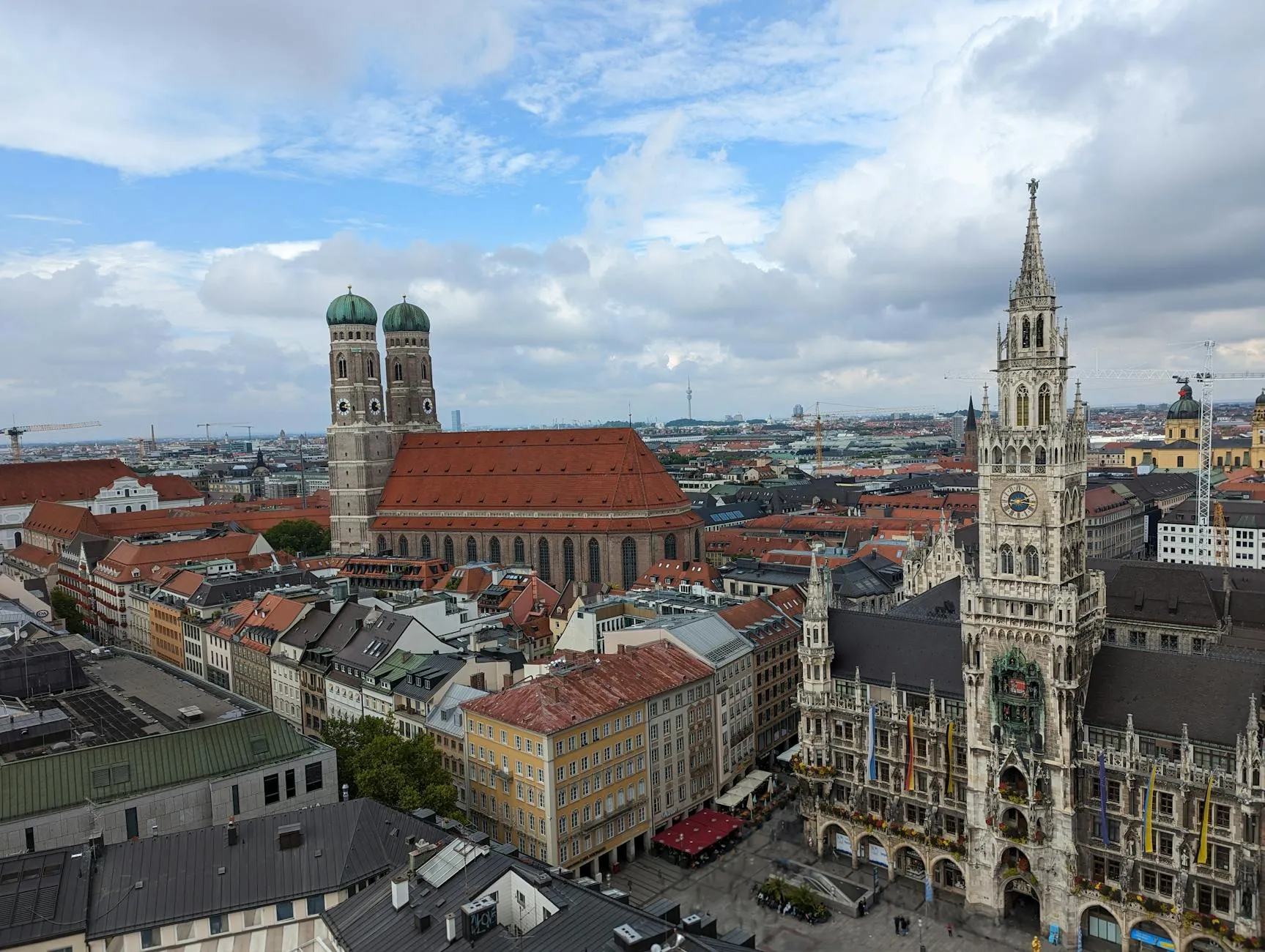
Munich’s central square has been the heart of the city since 1158. The Neues Rathaus (New Town Hall) dominates the north side — a neo-Gothic fantasy of turrets, gargoyles, and carved figures that looks medieval but was actually built between 1867 and 1909. The facade alone is worth ten minutes of study: 400 metres of ornamental stonework, from dragons to Bavarian dukes, designed to make Munich look as important as the city felt it was.
The Glockenspiel at 11:00 and 12:00 daily (plus 17:00 March–October) draws crowds to the square. Thirty-two life-sized figures re-enact two stories: the 1568 wedding of Duke Wilhelm V and the Schäfflertanz (coopers’ dance) that celebrated the end of the plague in 1517. The actual Schäfflertanz is performed live in Munich’s streets only every seven years — it last ran January–February 2026, so the next live performance will be 2033. The Glockenspiel is the only way to see it for the next seven years.
Tower: Lift to the 85-metre observation platform for a panoramic view across the city to the Alps on clear days. €7 per person. Tickets at the Tourist Information office on Marienplatz or online. Hours: Mon–Fri 10:00–20:00, Sat–Sun 10:00–19:00 (seasonal variations). Access: Lift to observation deck — wheelchair accessible.
Editor’s tip: Ignore the Glockenspiel crowd and go directly up the tower during the performance. Everyone is in the square looking up; the observation deck is nearly empty. The view of the Frauenkirche’s twin onion domes against the Alps is the single best photograph in Munich.
2. The Residenz — Europe’s Largest Urban Palace
The seat of Bavarian power for over four centuries, expanded by successive rulers from 1508 to 1918. The result is not a single building but a complex of ten courtyards and 130 rooms containing one of the finest collections of European decorative art in existence. The Antiquarium — a 66-metre barrel-vaulted Renaissance hall completed in 1571 — is the largest Renaissance interior north of the Alps. Most visitors photograph it and move on. Sit on one of the benches instead. The ceiling frescoes depicting Bavarian towns were painted when Shakespeare was alive, and the room functions as a kind of visual census of 16th-century Bavaria.
The Treasury (Schatzkammer) is separately ticketed and separately worth it. The collection includes the Bavarian Crown Jewels, a 590-carat emerald centrepiece, and a St. George statuette from 1599 encrusted with 2,291 diamonds, 209 pearls, and 406 rubies. The craftsmanship is hallucinogenic in its precision.
Price: Residenz Museum €10 | Treasury €10 | Cuvilliés Theatre €5 | Combination ticket (all three) €20. Under 18 free. Audio guides included. Hours: Daily 9:00–18:00 (summer), 10:00–17:00 (winter). Closed Jan 1, Shrove Tuesday, Dec 24/25/31. Access: Partially wheelchair accessible — lift covers most of the Museum. Treasury has steps; check residenz-muenchen.de for current accessibility. Book: residenz-muenchen.de
Editor’s tip: Buy the €20 combination ticket. The Cuvilliés Theatre alone — a Rococo jewel box where Mozart premiered Idomeneo in 1781 — is worth the €5 upgrade, and the Treasury is genuinely world-class. Start early; the Antiquarium is best in morning light.
3. The Pinakotheken — Three World-Class Galleries for €1
Munich’s museum quarter in Maxvorstadt contains three of the world’s great art galleries within a five-minute walk of each other. On Sundays, they all charge €1. This is the single highest-value cultural experience in Germany, and most visitors outside Bavaria have never heard of it.
The Alte Pinakothek holds 700 years of European painting: Dürer’s Self-Portrait (1500) — one of the first self-portraits in Western art — Rubens in a quantity and quality that rivals Madrid’s Prado, Raphael, Botticelli, and a Rembrandt self-portrait that stops conversations. The building was designed by Leo von Klenze in 1836 and was one of the world’s first purpose-built public art museums.
The Pinakothek der Moderne covers 20th and 21st century art, architecture, and design under one roof. The Beckmann collection is exceptional. The design wing includes everything from Bauhaus chairs to a Ferrari Testarossa. Thursday evenings until 20:00 are the quietest visiting time.
The Neue Pinakothek (19th century — Monet, Van Gogh, Klimt) is currently closed for renovation until 2029. Key works are displayed in the Alte Pinakothek’s East Wing and the Sammlung Schack.
Price: Alte Pinakothek €9 | Pinakothek der Moderne €10 | Museum Brandhorst €7 | Sammlung Schack €4. All museums €1 on Sundays. Combined day ticket €12 (excludes special exhibitions). Under 18 free. Hours: Daily 10:00–18:00; Alte Pinakothek Tue/Wed until 20:00; Pinakothek der Moderne Thu until 20:00. Closed Mondays. Access: All three are wheelchair accessible. Website: pinakothek.de
Editor’s tip: Come on a Sunday at 10:00. Pay €1 at the Alte Pinakothek, spend two hours with the Dürers and Rubens, walk three minutes to the Pinakothek der Moderne for €1, spend an hour with the Beckmanns and the design wing. You will have visited two of Europe’s great museums for the price of a bread roll. There is nothing comparable in London, Paris, or New York.
4. Englischer Garten — The People’s Park
One of the largest urban parks in the world — larger than Central Park, larger than Hyde Park — stretching 5.5 kilometres from the city centre to the northern suburbs. Created in 1789 by Benjamin Thompson (an American-born scientist who became a Bavarian count), the park was radical for its time: a public garden open to all classes in a society that separated them rigidly.
The Eisbachwelle at the park’s southern entrance is Munich’s most unexpected attraction. A standing wave on the Eisbach stream, roughly one metre high, has been surfed illegally by locals since the 1970s. The city legalised it in 2010. Surfers queue in strict order, drop in one at a time, ride for 30–60 seconds, peel off, and rejoin the queue. It operates year-round, in any weather, including snow. Watching is free and endlessly compelling. The skill level is professional. The water temperature in winter is roughly 5°C.
The Monopteros — a small Greek temple on a hill — offers the best view across the park to the city skyline. The Japanese Tea House hosts formal tea ceremonies on the second weekend of each month (check japanischesteehaus.de). The park’s southern meadows are designated clothing-optional areas — this is normal in Munich and has been since the 1960s.
Price: Free. Open 24 hours. Beer gardens inside the park: Chinesischer Turm (7,000 seats), Seehaus (2,500 seats, lakeside), Hirschau, Aumeister. Getting there: U3/U6 to Universität or Münchner Freiheit; tram 18 to Tivolistraße (for Eisbachwelle).
Editor’s tip: The Eisbachwelle is at the southern entrance near the Haus der Kunst museum. Go on a Saturday afternoon in summer — the queue is ten deep and the surfing is competition-grade. In winter, go at dawn: one surfer alone in the mist, steam rising from 5°C water. It is the best free spectacle in the city.
5. Deutsches Museum — The World’s Largest Science Museum
Founded in 1903 by Oskar von Miller, this is the world’s largest museum of science and technology. The collection spans 28,000 objects across 73 departments, from a full-size mining tunnel to original Wright Brothers aircraft components to the desk at which Otto Hahn split the atom in 1938. The museum occupies an entire island in the Isar river and has been undergoing a phased €400 million renovation since 2015.
Phase 1 reopened in July 2022 with 20 permanent exhibitions across 20,000 square metres. These include Aviation (full aircraft suspended from the ceiling, including a Junkers F13), Astronautics (with Spacelab components), Robotics and AI, Musical Instruments (playable demonstrations), and the Kids’ Kingdom (ages 3–8, outstanding). Phase 2 — an additional 25,000 square metres in the Collection Building — is expected in 2028.
Price: €16 | Reduced €9 | Family ticket €33 | Under 6 free. Hours: Daily 9:00–17:00 (last admission 16:30). Open 347 days a year. Entry: Currently via Corneliusbrücke entrance during renovation — not the main courtyard. Access: Wheelchair accessible on all floors. Website: deutsches-museum.de
Editor’s tip: The Flight Simulator (extra charge, ~€5) is genuinely good. The model railway runs demonstrations at set times — check the daily schedule at the entrance. Allow a minimum of three hours; serious visitors need five. The café on the top floor has Isar views.
6. Nymphenburg Palace & Gardens
The summer residence of the Wittelsbach dynasty, set in 200 hectares of formal gardens and parkland that were open to the public from 1792 — three years after the French Revolution, when most European royals were building higher walls, not removing them. The palace facade stretches 700 metres, making it one of the widest in Europe.
The interior highlight is the Gallery of Beauties: 36 portraits of women from all social classes, commissioned by King Ludwig I between 1827 and 1850. The collection was scandalous at the time — a shoemaker’s daughter displayed alongside princesses — and is fascinating today as a document of 19th-century ideas about beauty and class.
The Marstallmuseum contains the coronation coaches and ceremonial sleighs of the Bavarian kings, including the golden carriages used by Ludwig II (the builder of Neuschwanstein). The gardens are free, open daily from dawn to dusk, and are among the finest formal gardens in Germany.
Price: Palace €10 | Marstallmuseum + Porcelain Museum €8 | Park Palaces €6 | Summer combination ticket (all) €20 | Winter combination €16. Under 18 free. Hours: Summer daily 9:00–18:00 | Winter daily 10:00–16:00. Time-slot tickets recommended. Getting there: Tram 17 to Schloss Nymphenburg (from Hauptbahnhof, 20 min). Book: schloss-nymphenburg.de
Editor’s tip: The gardens are free and better than most paid attractions. The Amalienburg — a Rococo hunting lodge in the south garden — is the most beautiful single room in Munich and most visitors miss it entirely because they turn back after the palace.
7. Viktualienmarkt
Munich’s daily food market has operated on this site since 1807, and it functions as the city’s outdoor kitchen. This is not a farmers’ market in the modern sense — it is a permanent institution with 140 stalls, professional vendors, and prices that reflect quality rather than convenience. Do not come here to buy cheap groceries. Come here to eat.
A Leberkässemmel (meatloaf in a bread roll, ~€3–4) from one of the butcher stalls is the best fast meal in central Munich. The Münchner Suppenküche serves soups in quantities that could feed a household and has a devoted local following. Café Nymphenburg Sekt does cake and sparkling wine with the seriousness the combination deserves.
The beer garden in the centre rotates beers from all six Munich breweries — Augustiner, Hacker-Pschorr, Hofbräu, Löwenbräu, Paulaner, Spaten — changing every six weeks. It is the only beer garden in Munich that serves all six.
Hours: Mon–Sat 8:00–20:00 (some stalls close earlier; some closed Mondays). Beer garden open ~9:00–22:00 weather permitting. Getting there: 2 minutes walk south of Marienplatz. Free to browse.
Editor’s tip: The Weisswurst breakfast. Buy two Weisswurst (white sausages, ~€3.50 each), a pretzel, and sweet mustard from any stall. Peel the skin, dip in mustard, eat with the pretzel. Do this before noon — Weisswurst after midday is a violation of Bavarian custom that locals take more seriously than you expect.
8. St. Peter’s Church (Alter Peter) — The Best View in Munich
Munich’s oldest parish church, founded before the city itself — the first mention dates to 1158, the same year Munich was established. The interior is Baroque, restored after near-total destruction in 1945. But you are here for the tower.
The tower climb is 300 steps with no lift. The staircase narrows as you ascend and the final section is single-file. At 56 metres, the viewing platform offers a 360-degree panorama: Marienplatz directly below, the Frauenkirche’s twin domes at eye level, the Residenz, the Englischer Garten stretching north, and — on clear days — the entire Alpine chain from the Zugspitze to the Berchtesgadener Alps.
Price: Tower: €5 adults | €3 students & seniors | €2 children 6–18 | Under 6 free. Church entry free. Hours: Apr–Oct 9:00–19:00 | Nov–Mar 9:00–17:00. Access: Tower is NOT accessible — 300 steps, narrow staircase, no lift.
Editor’s tip: Go at opening time on a clear morning. The Alps are most visible before noon when the haze builds. This €5 view is better than most paid observation decks in Europe. Check the Marienplatz webcam (marienplatz.de) the evening before — if the Frauenkirche domes are sharp, the Alps will be visible at dawn.
9. Dachau Concentration Camp Memorial
Twelve kilometres northwest of Munich. Opened in March 1933, six weeks after Hitler became Chancellor — the first concentration camp, the model for all that followed. Over 200,000 people were imprisoned here. More than 41,500 died. The camp was liberated by American forces on 29 April 1945.
The memorial preserves the gatehouse with the inscription “Arbeit macht frei,” the roll-call square, two reconstructed barracks, the crematorium, and the gas chamber (built but, according to current historical evidence, not used for systematic mass killings at this specific camp — the exhibition explains this distinction carefully). The museum exhibition is one of the most thorough and honest historical displays in Germany. Allow at least three hours.
This is not a tourist attraction. It is a memorial. Behave accordingly. Photography is permitted but selfies at the gatehouse are not appropriate.
Price: Free. Audio guides €4.50. Guided tours €13–18. English tours daily at 11:00 and 13:00. Hours: Daily 9:00–17:00. Closed Dec 24 only. Getting there: S2 from Hauptbahnhof to Dachau station (~25 min), then Bus 726 to KZ-Gedenkstätte stop. Total ~40 min. MVV Zone M–1 day ticket covers both. Website: kz-gedenkstaette-dachau.de
Editor’s tip: The audio guide is essential — the exhibition panels are extensive but the audio adds survivor testimony and historical context that transforms the visit. If possible, take one of the guided tours — the guides are historians, not tour operators, and their depth of knowledge is extraordinary.
10. BMW Welt & Museum
Even if you have zero interest in cars, BMW Welt is worth visiting for the architecture alone. The building — a cantilevering double-cone of glass and steel designed by Coop Himmelb(l)au, opened in 2007 — is one of the most striking pieces of contemporary architecture in Germany. Entry to Welt is free.
The BMW Museum next door traces the company from its origins building aircraft engines in 1916 through the motorcycle era, the Isetta bubble car, the 2002 that created the sports saloon category, to current electric vehicles. The exhibition design is excellent — cars are displayed as objects rather than products.
Price: BMW Welt: free. BMW Museum: €17 | Family ticket (2+3): €38 | Under 10 free. Card/mobile payment only — no cash. Hours: Tue–Sun 10:00–18:00 (last entry 17:30). Closed Mondays. Getting there: U3 to Olympiazentrum. Website: bmw-welt.com
Editor’s tip: Visit Welt (free) even if you skip the Museum. The ground-floor showroom has current and concept vehicles, a Junior Campus for children, and a café with good views. The pick-up area where new owners collect their cars — watching someone see their car for the first time — is unexpectedly entertaining.
11. Asamkirche — The Most Beautiful Room in Munich
A late Baroque/Rococo church on Sendlinger Straße, built between 1733 and 1746 by the Asam brothers — not as a commission, but as their private chapel. They owned the adjoining house and built the church with their own money, to their own design, answering to no patron. The result is architecture as pure artistic expression: every surface gilded, painted, or sculpted, in a space barely 8 metres wide and 28 metres long.
The church is deliberately dark. The only natural light enters through carefully placed windows that illuminate specific features at specific times of day. The effect is theatrical and intentional — this is architecture designed to overwhelm the senses, and it succeeds.
Price: Free. Hours: Daily 9:00–18:00; Fridays from 13:00. Closed during services. Getting there: U1/U2/U3/U6 to Sendlinger Tor, 2 min walk. Access: Ground floor accessible; no steps at entrance.
Editor’s tip: Visit between 14:00 and 16:00 when the light hits the altar. Sit in a pew for five minutes rather than standing in the entrance. The scale reveals itself when you stop moving.
12. Hofbräuhaus — The Tourist Trap You Should Visit Anyway
Founded in 1589 by Duke Wilhelm V to brew beer for the Bavarian court. The current building dates to 1897. Mozart drank here. Lenin was a regular in 1901–1902 (his reserved seat is marked). The NSDAP held early rallies in the upstairs Festsaal. The building was 60% destroyed in 1945 and rebuilt to the original plans.
Yes, it is touristy. Yes, the oompah band plays to a room of people from forty countries. Yes, a Maß of Hofbräu Original costs ~€11–12. But the beer is brewed 300 metres away and arrives in the glass fresher than any other Hofbräu you will drink. The Schweinshaxe (€20–25) is the size of a human head and cooked properly. The experience is unique, absurd, and — at 10:00 on a Tuesday morning when it’s half-full of locals reading newspapers — genuinely good.
Price: Free to enter. Maß Hofbräu Original ~€11–12. Schweinshaxe ~€20–25. Hours: Daily 9:00–23:30. No reservations needed for the ground floor. Getting there: Platzl 9, 3 min walk from Marienplatz. Website: hofbraeuhaus.de
Editor’s tip: Go at 10:00 on a weekday morning for Weisswurst breakfast. The locals are there, the tourists are not, the band hasn’t started, and the beer is exceptional at that hour. The ground floor (Schwemme) is the authentic experience; the upper floors are for groups.
Lenbachhaus
The Blue Rider collection — the world’s most important holding of works by Kandinsky, Franz Marc, Gabriele Münter, and the rest of the Expressionist group that dominated Munich before World War I. Housed in a 19th-century villa beside Königsplatz with a sleek 2013 Foster + Partners extension. The collection alone justifies a half-day. €10 adult, €1 on Sundays. lenbachhaus.de
NS-Dokumentationszentrum
Munich’s Nazi documentation centre — built on the site of the former Brown House, the Nazi Party’s headquarters. A sober, rigorous, important museum opened in 2015 that traces the rise of National Socialism from its Munich origins through the post-war denazification. Free admission. Essential counterpart to a Dachau visit. nsdoku.de
Beer Gardens — Munich’s Real Living Rooms
Munich’s beer garden culture is not a tourist attraction — it is a legal institution. A 1812 Bavarian decree permitted breweries to serve beer directly to the public in their gardens, and specified that patrons could bring their own food. This right still exists and is actively exercised. In Munich’s major beer gardens, you will see families arrive with tablecloths, cutting boards, cold meats, salads, and Obatzda (Bavarian cheese spread) while buying only the beer. This is normal and expected. Do not let anyone convince you otherwise.
The unwritten rules: sit where there is space (communal tables are not optional — they are the point). If you bring food, clean up after yourself. The deposit on the Maß glass is ~€2 — return it when leaving. Do not order cocktails.
Augustiner-Keller
The beer garden that locals consider the best in Munich. Arnulfstraße 52, five minutes’ walk from Hauptbahnhof. 5,000 seats beneath ancient chestnut trees. The beer is Augustiner Edelstoff, served from wooden barrels (Holzfässer) — when a new barrel is tapped, a bell rings across the garden. Augustiner is Munich’s oldest brewery (1328) and the only major Munich brewery still in private hands. The beer from wood is measurably different from the bottled version — softer, rounder, with a warmth that metal kegs kill.
Maß price: ~€11–12. Hours: ~11:30 to midnight (weather dependent). Self-service area (bring your own food) plus serviced restaurant section.
Editor’s tip: This is the one. If you visit one beer garden in Munich, this is it. Arrive around 17:00 on a summer weekday, buy a Maß from the self-service counter, find a seat under the chestnuts, and stay until the light fades. This is Munich at its most honest.
Chinesischer Turm (Chinese Tower)
7,000 seats around the wooden pagoda in the Englischer Garten. The most photographed beer garden in Munich. Hofbräu beer. Live brass band on the pagoda platform on summer evenings. A playground for children. The atmosphere is more festive than Augustiner-Keller — families, tourists, students, pensioners all mixed. Maß ~€11–12.
Hirschgarten
The world’s largest beer garden: 8,000 seats. Augustiner from wooden barrels. Adjacent deer enclosure (Hirschgarten means “deer garden” — fallow deer have been here since 1780). Less central (Neuhausen/Nymphenburg area) and more local as a result. Combine with Nymphenburg Palace (15 min walk). Maß ~€11–12.
Seehaus
2,500 seats on the lake in the Englischer Garten. Paulaner beer. The setting is the selling point — water, ducks, paddle boats, and sunset views. Slightly more expensive and more upscale than the others. Best on a warm evening. Maß ~€12–13.
Hofbräukeller
Am Wiener Platz in Haidhausen. 1,400 seats. Hofbräu beer. Less famous than the Hofbräuhaus and better for it — the crowd is local, the atmosphere is relaxed, and the kids’ play area is excellent. The serviced section takes lunch reservations. Maß ~€11.
The Big Six Breweries
Munich’s beer culture is built on six breweries, all subject to the 1516 Reinheitsgebot (Purity Law), and each operates its own beer halls and beer gardens across the city. Understanding the six is the key to ordering without looking lost.
- Augustiner: The oldest (founded 1328), family-owned, and the locals’ favourite by a wide margin. The Edelstoff is the standard lager every Münchner orders.
- Paulaner: Founded 1634 by Paulist monks. Famous for Salvator, the original doppelbock, still brewed for Lent.
- Hofbräu: The state brewery (founded 1589 by the Duke of Bavaria) — tourist-heavy at the Hofbräuhaus, but the beer itself is excellent.
- Löwenbräu: Founded 1383. Widely available and a reliable everyday lager.
- Spaten: Founded 1397. Invented modern Helles in 1894; owned by AB InBev but still Munich-brewed.
- Hacker-Pschorr: Founded 1417. The Münchner Gold and the Dunkles are Munich classics.
Two More Beer Halls Worth Knowing
Augustiner Bräustuben: The less-touristed Augustiner beer hall, attached to the brewery itself on Landsberger Straße. Locals in proper Tracht, no souvenir mugs, and Edelstoff straight from the wooden barrel. A 15-minute walk west of the centre.
Weisses Bräuhaus: In the Altstadt near Marienplatz. The traditional home of Schneider Weisse (wheat beer). Order the original Weizen and the Weißwurst at breakfast — that’s the correct way to use this room.
Munich’s Best Neighbourhoods
Schwabing — The Bohemian Quarter
North of the Englischer Garten. Kandinsky, Thomas Mann, and Rilke all lived here during its early-20th-century golden age. Today it is Munich’s most pleasant residential area: tree-lined streets, independent cafés, galleries, and a relaxed energy that the city centre lacks. Leopoldstraße is the main boulevard; Münchner Freiheit square is the social hub. Evening walks here are excellent.
Maxvorstadt — The Museum Quarter
All three Pinakotheken, Museum Brandhorst, Lenbachhaus, and the Glyptothek within a ten-minute walk. Also the university district (LMU) — youthful energy, affordable lunch spots on Türkenstraße and Schellingstraße, and independent bookshops. This is where Munich’s intellectual life happens, and it spills onto the streets.
Glockenbachviertel — Where Munich Stays Up Late
Munich’s most vibrant neighbourhood. The LGBTQ+ heart of the city, centred on Gärtnerplatz and Hans-Sachs-Straße. The food scene is exceptional — the Vietnamese restaurants on Fraunhoferstraße (SEN, Chi Thu, An Nam) rival anything in Berlin. Bars, clubs, vinyl record shops, independent boutiques. If Munich has a neighbourhood that feels like it belongs to a different, looser city, this is it.
Haidhausen — The French Quarter
East of the Isar. Wiener Platz market square. Hofbräukeller beer garden. Quality without pretension — good restaurants, quiet streets, waterside walks along the Isar. The Gasteig cultural centre is being rebuilt but the neighbourhood’s character doesn’t depend on a single institution. Best for visitors who prefer local atmosphere to tourist infrastructure.
Where to Stay in Munich — By Budget
Budget: €25–50 per night per person
Hostel dorms run €25–50/night depending on season. Best areas: near Hauptbahnhof (convenient, not beautiful) or Schwabing (quieter, U-Bahn connected). Avoid booking during Oktoberfest — hostel prices double or triple. February and November are the cheapest months.
Mid-range: €100–180 per night (double room)
Maxvorstadt gives you the museums on foot. Haidhausen is quieter with better restaurants. Anywhere on the U-Bahn means the city centre is 10–15 minutes away. Munich’s hotel stock is high-quality — a 3-star here is a 4-star in most other German cities.
Splurge: €250–500+ per night
Hotel Bayerischer Hof (since 1841), The Charles, Mandarin Oriental, Vier Jahreszeiten. All within walking distance of Marienplatz. The Bayerischer Hof’s rooftop terrace has the best view of the Frauenkirche in Munich.
Where Not to Stay
Anything described as “near the Messe” or “near the airport” is a 40-minute train ride from everything in this guide. The airport is 35 km northeast. Hotels near it are for business travellers with early flights, not visitors.
Munich accommodation tax (Übernachtungssteuer): Munich introduced a 5% accommodation tax on the net room rate in January 2025. It’s applied per night at hotels and most short-stay accommodation, usually added to the final bill. Business travellers can sometimes claim exemption with proof; tourists cannot. Budget roughly €5–15 extra per night on mid-range and luxury stays.
Where to Eat in Munich
Munich’s food scene is deeper than the Bavarian clichés suggest. Yes, the Schweinshaxe and Weisswurst are excellent and you should eat them. But the city also has one of the best Vietnamese food streets in Germany, a serious Middle Eastern scene, and a new-Bavarian movement that is reinventing traditional recipes with modern technique.
Budget Eats (€5–15)
Viktualienmarkt stalls: Leberkässemmel (€3–4), soups at Münchner Suppenküche, pretzels from any bakery stall. The best value lunch in central Munich.
Weisswurst breakfast: Any traditional brewery restaurant before noon. Two Weisswurst + pretzel + sweet mustard: ~€8–10. Schneider Brauhaus (Tal 7) and Augustiner Stammhaus (Neuhauser Straße) are reliable.
Döner on Fraunhoferstraße: Munich’s Turkish food is excellent. €5–8 for a meal.
Mid-Range (€15–35)
Wirtshaus in der Au (Lilienstraße 51, Au): Famous for Knödel (dumplings) — the signature dish is a plate of three giant dumplings with different fillings. Devoted local following. Book ahead for dinner. Mains €15–25.
Schneider Brauhaus (Tal 7): The home of Schneider Weisse wheat beer. Traditional Bavarian food done with care. The Schweinshaxe is benchmark-quality. Mains €17–33.
SEN Restaurant (Fraunhoferstraße 6): Vietnamese with 4.7-star reviews and a loyal following. The pho is exceptional. Glockenbachviertel’s food scene at its best. Mains €12–20.
Seafood & Special Occasion
Dallmayr (Dienerstraße 14–15): Munich’s legendary delicatessen, operating since 1700. The restaurant upstairs is a special-occasion destination. Lunch is more accessible than dinner. Budget €40–80.
Traditional Bavarian Dishes to Know
Weißwurst: The white veal sausage eaten exclusively before noon — traditional Munich wisdom says the sausage should never hear the church bells ring midday. Served with sweet mustard (süßer Senf), a Brezn, and a Weißbier. Peel the skin off; don’t eat it. The canonical breakfast.
Obatzda: The beer garden cheese dip — aged Camembert mashed with butter, paprika, caraway, and onion. Scooped onto a Brezn and eaten with a cold Helles. The single most Bavarian thing you can eat.
Brezn (Laugenbrezel): The Bavarian pretzel. Larger, chewier, and saltier than the American version. Eaten as a snack, a beer accompaniment, or a Weißwurst vehicle. A plain Brezn should cost €1.50–3 at a bakery; €6 at a beer garden is overpaying.
Schweinshaxe: Roast pork knuckle — crackling skin, tender meat, served with dumplings and red cabbage. Best at Haxnbauer in the Altstadt or any traditional Wirtshaus. €18–28.
Leberkäse: Literally “liver cheese” — contains neither. A meatloaf-style beef-and-pork block, sliced and served in a Semmel (bread roll) with sweet mustard. The Bavarian snack, €3–5 from any butcher.
Munich Michelin — The Starred Restaurants
Munich has one of Germany’s strongest Michelin scenes — two three-star restaurants, four two-stars, and a deep bench of one-stars serving traditional Bavarian ingredients through modern technique.
Three Stars
JAN (Königsplatz): Chef Jan Hartwig — formerly of Atelier at the Bayerischer Hof — opened his own restaurant and was immediately awarded three Michelin stars. Ingredient-driven cuisine that is German at heart with Asian and French influences. Tasting menus €250+. Book 6–8 weeks ahead. jan-munich.de
Tohru in der Schreiberei (Altstadt): Chef Tohru Nakamura’s German-Japanese fine dining in Munich’s historic centre. Three stars. Precision, restraint, and a unique cultural fusion that reflects Nakamura’s Munich-born, dual-heritage identity. Tasting menus €250+. tohru.de
Two Stars
Atelier (Bayerischer Hof): The legendary hotel restaurant retains two stars through successive chef changes. Kevin Romes took over the kitchen in April 2026, following Anton Gschwendtner. Refined European cuisine in Axel Vervoordt’s artist-studio interior. Tasting menus €200+. bayerischerhof.de
Alois – Dallmayr Fine Dining (Dienerstraße): Chef Rosina Ostler — Munich’s only female two-star chef — leads the kitchen above Munich’s legendary delicatessen. Two stars. Seasonal, product-driven European fine dining. Tasting menus €180+.
Komu (Altstadt): Chef Christoph Kunz earned two stars from a standing start. Contemporary European with Asian accents. Tasting menus €180+.
One Star & Notable
EssZimmer (BMW Welt), Showroom, Mun, Gabelspiel, Mural, and others round out Munich’s one-star roster. The full Michelin Guide Germany is the authoritative source — check guide.michelin.com for the current list.
Spatenhaus an der Oper: Not starred but essential — classic Bavarian across from the Staatsoper. A fixture for pre- and post-opera dinners. €25–45 mains.
Note on Tantris: The legendary two-star institution in Schwabing — Munich’s fine-dining pioneer since the 1970s — continues under refreshed kitchen leadership in its original 70s Bavarian modernist interior. Tasting menus €180–240.
Getting Around Munich
From Munich Airport
Munich Airport is 35 km northeast of the city. Two S-Bahn lines connect it to the centre:
S1 (via western Munich): ~47 minutes to Hauptbahnhof. S8 (via eastern Munich): ~42 minutes to Hauptbahnhof. Trains alternate, giving a departure every ~10 minutes.
Single ticket (Zone M–5): ~€13.60. Airport-City Day Ticket: €16.30 (single) / €30.50 (group up to 5). The day ticket is almost always better value than a single — it covers all Munich transport for the rest of the day.
Lufthansa Express Bus: €13 one-way (€12 online) / €20 return. Every 20 min. Stops at Hauptbahnhof and Schwabing-Nord. Faster than the S-Bahn in peak hours.
MVV Day Tickets
Single Day Ticket Zone M (Innenraum): €10.10. Valid until 6:00 next day. Covers U-Bahn, S-Bahn, tram, and bus within Munich city. Buy at any ticket machine — validate before first journey.
Deutschlandticket: €63/month (from January 2026). Valid on ALL local and regional transport nationwide. Not valid on ICE/IC long-distance trains. Monthly subscription. If staying 3+ days and doing day trips, this is the best value in German transport.
Children 6–14: Travel FREE with a parent’s day ticket (own children unlimited; others’ children max 3). New from January 2026.
Bayern Ticket (for day trips)
€34 for one person + €10 each additional (up to 5 = €74 max). Valid on all regional trains, S-Bahn, and buses across Bavaria — including to Salzburg. Weekdays from 9:00; weekends/holidays from 6:00. Buy at bahn.de or ticket machines. This is how you reach Neuschwanstein, Salzburg, and the Alps cheaply.
Key U-Bahn Lines for Tourists
U3/U6: Marienplatz – Odeonsplatz – Universität (museum quarter) – Münchner Freiheit (Schwabing). U4/U5: Odeonsplatz – Karlsplatz/Stachus. U1/U2: Hauptbahnhof – Sendlinger Tor (Asamkirche).
On Foot
Munich’s centre is compact. Hauptbahnhof to Marienplatz: 12 min walk. Marienplatz to Englischer Garten: 15 min. The entire old town (Altstadt) fits inside a 30-minute walking circuit. Use the U-Bahn only for reaching the edges.
Best Time to Visit Munich
May–June is the sweet spot: beer gardens open, parks in full colour, daylight until 21:00, moderate crowds, pre-Oktoberfest hotel prices. June is the optimum month.
July–August: Peak summer. Hot (30°C+ common). Beer gardens are packed. Hotel prices rise but not as sharply as September.
Late September–early October (Oktoberfest): 6 million visitors over 16 days. Hotel prices 2–3x normal. Book accommodation 6–12 months ahead. Worth experiencing once; not worth experiencing every year. Dates for 2026: September 19 – October 4.
November–February: Quiet, cheap, cold (−5°C to 5°C). Museums are uncrowded. Christmas markets (Christkindlmarkt on Marienplatz, Tollwood at Theresienwiese) run late November through December 24 and are genuinely atmospheric. January–February are the cheapest months.
March–April: Shoulder season. Starkbierzeit (strong beer season) in March — a Bavarian tradition of drinking high-alcohol Bock beers during Lent, centred on the Paulaner am Nockherberg pub. Less famous than Oktoberfest, more authentic, cheaper, and more Bavarian.
Month-by-Month Weather
Munich’s climate is continental — cold winters, warm summers, and a genuine shoulder season in spring and autumn. The table below is built on Deutscher Wetterdienst (DWD) climate normals for the 519-metre city-centre station. The ⭐ marks the three months most travellers should prioritise.
| Month | High / Low | Rain days | Key events & notes |
|---|---|---|---|
| January | 3 / −4 °C | 10 | Quiet, cheap, cold. Museums uncrowded. Post-Christmas calm. Best hotel prices of the year. |
| February | 5 / −3 °C | 9 | Fasching (Carnival) celebrations. Still cold. Second-cheapest month. |
| March ⭐ | 10 / 0 °C | 10 | Starkbierzeit — strong-beer season at Paulaner am Nockherberg. More authentic than Oktoberfest, cheaper, and more Bavarian. Spring arriving. |
| April | 14 / 3 °C | 11 | Frühlingsfest (Spring Festival) at Theresienwiese — a smaller, local version of Oktoberfest. Cherry blossoms in Nymphenburg. Shoulder-season prices. |
| May ⭐ | 19 / 8 °C | 12 | Excellent. Beer gardens open fully. Parks in colour. Daylight until 21:00. Pre-summer prices. |
| June ⭐ | 22 / 11 °C | 13 | Best month. Long evenings (sunset 21:15). Beer gardens at peak. Isar river swimming begins. Tollwood Festival (Olympiapark). |
| July | 24 / 13 °C | 12 | Peak summer. 30 °C+ possible. Beer gardens packed. Hotel prices rise. Tollwood continues. |
| August | 24 / 13 °C | 11 | Peak summer continues. Some locals on holiday. Open-air cinema season. |
| September | 19 / 9 °C | 8 | Oktoberfest 19 Sep – 4 Oct 2026. Hotel prices 2–3× normal. Book 6–12 months ahead. City transforms. |
| October | 14 / 5 °C | 8 | Oktoberfest first week. Then autumn calm returns. Foliage in Englischer Garten. Auer Dult market. |
| November | 7 / 1 °C | 9 | Grey, quiet, cheap. Christmas market setup begins late month. Good museum weather. |
| December | 3 / −2 °C | 10 | Christkindlmarkt on Marienplatz (to 24 Dec). Tollwood Winter (Theresienwiese). Snow possible. Magical but cold. |
Source: Deutscher Wetterdienst (DWD) climate normals for Munich (519 m elevation).
Daily Budget Breakdown
Munich is the most expensive city in Germany by most measures, and the tiers below reflect that. The catch — and the reason the guide keeps returning to it — is that Munich’s best experiences are nearly free. A budget traveller with the €1-Sunday Pinakothek plan eats as well culturally as a luxury traveller at any other European capital.
| Category | Budget | Mid-Range | Luxury |
|---|---|---|---|
| Accommodation | €30 (hostel dorm) | €140 (3-star hotel) | €350+ (Bayerischer Hof / Mandarin Oriental) |
| Meals & Drinks | €20 (Viktualienmarkt + beer-garden self-service) | €60 (restaurants + craft beer) | €200+ (Michelin tasting menu) |
| Transport | €10 (MVV day ticket Zone M) | €15 (day ticket + occasional Bolt) | €60+ (taxi / private) |
| Activities | €2 (€1 Pinakothek Sunday × 2) | €25 (museum + tower + church) | €80+ (Residenz combo + Deutsches Museum + guided tour) |
| Daily Total | €62 | €240 | €690+ |
Budget traveller (€60–80/day): Munich’s secret is that its best experiences are nearly free. The Pinakotheken charge €1 on Sundays. The Englischer Garten, Eisbachwelle, Asamkirche, BMW Welt, NS-Dokumentationszentrum, Viktualienmarkt browsing, and the Isar riverbanks are all free. A Leberkässemmel costs €4. A Maß at Augustiner-Keller costs €11. You can have a world-class day for the price of a London lunch.
Mid-range (€200–280/day): A comfortable 3-star hotel in Maxvorstadt or Haidhausen, the Residenz combination ticket, a proper Schweinshaxe dinner at Schneider Brauhaus, and a beer-garden evening. Munich’s mid-range is genuinely excellent — the hotel stock quality is higher than most German cities.
Luxury (€500+/day): The Bayerischer Hof or Mandarin Oriental, a tasting menu at JAN or Tohru in der Schreiberei, a private Alpine day trip, an Oktoberfest tent reservation. Munich’s luxury tier is world-class without the pretension of Paris or London.
Sample Itineraries
Three planned days cover Munich in real walking-order. Timings are sensible blocks, not minute-by-minute — a rain burst or a long lunch will move things around. Every day ends in a beer garden because, in Munich, that is what a correct day ends with.
Day 1 — Old Town, History & Beer
- 09:00 — Marienplatz. Go up the Rathaus tower (€7) during the 11:00 Glockenspiel — the observation deck is empty while the crowd watches from below.
- 10:00 — Residenz (€20 combination ticket). Antiquarium in morning light, Treasury, Cuvilliés Theatre. Allow 2.5 hours.
- 12:30 — Viktualienmarkt. Weißwurst breakfast (yes, before noon) or a Leberkässemmel (€4). Browse the stalls.
- 14:00 — Asamkirche (free). Five minutes of silence in Munich’s most beautiful interior.
- 14:30 — Walk Sendlinger Straße to Marienplatz. St. Peter’s Church tower (€5, 300 steps) for the best panorama — Alps visible on clear mornings.
- 16:00 — NS-Dokumentationszentrum (free). Essential context for understanding Munich’s 20th century. 90 minutes.
- 17:30 — Augustiner-Keller beer garden. A Maß from the wooden barrel (€11). Bring your own Obatzda and Brezn from the Viktualienmarkt, or buy at the self-service counter. Stay until the light fades. This is Munich.
Day 2 — Museums, Park & Neighbourhood
- 10:00 — Alte Pinakothek (€9, or €1 on Sunday). Dürer, Rubens, Rembrandt. 2 hours.
- 12:00 — Walk to Pinakothek der Moderne (€10 / €1 Sunday). Beckmann, design wing, architecture. 1.5 hours.
- 13:30 — Lunch on Türkenstraße or Schellingstraße (Maxvorstadt student area, €8–15).
- 14:30 — Englischer Garten. Eisbachwelle surfers at the southern entrance. Walk north to Monopteros viewpoint. In summer: continue to Seehaus beer garden for a lakeside Maß.
- 17:00 — Glockenbachviertel. Walk Hans-Sachs-Straße and Gärtnerplatz. Coffee or early drinks.
- 19:00 — Dinner at SEN Vietnamese (Fraunhoferstraße, €12–20) or Wirtshaus in der Au for Knödel (€15–25).
- 21:00 — Cocktails at Zephyr, or a nightcap at Schumann’s legendary bar.
Day 3 — Palace, Science & Farewell
- 09:00 — Tram 17 to Nymphenburg Palace (€20 combo). Palace rooms, Gallery of Beauties, Amalienburg hunting lodge (don’t miss this). Gardens are free.
- 12:00 — Walk 15 minutes to Hirschgarten — the world’s largest beer garden, 8,000 seats, Augustiner from wood. Lunch here.
- 14:00 — Deutsches Museum (€16). Aviation hall, mining tunnel, Kids’ Kingdom if travelling with children. 2.5–3 hours.
- 17:00 — Walk along the Isar from the museum toward Flaucher. If warm: join the locals on the gravel banks with a beer.
- 19:30 — Farewell dinner: Hofbräuhaus for the full tourist experience done right (go early, ground floor), or Schneider Brauhaus for Schweinshaxe + Weizen in a more local setting.
Day 4–5 Add-Ons
Day 4: Dachau Memorial (morning, free, allow 3+ hours including travel). Afternoon: Lenbachhaus Blue Rider collection (€10 / €1 Sunday). Evening: Haidhausen — Hofbräukeller beer garden on Wiener Platz.
Day 5: Day trip — Neuschwanstein (Bayern Ticket €34, book castle entry 8 weeks ahead), Salzburg (Bayern Ticket covers return, bring passport), or Tegernsee (1 hour by train, hiking + monastery beer garden).
Day Trips from Munich
1. Neuschwanstein Castle — 2 Hours by Train
Ludwig II’s fairy-tale castle, built 1869–1886, the inspiration for Disney’s Sleeping Beauty Castle. Perched on a cliff above the Pöllat gorge with the Alps behind it and Alpsee lake below. 1.4 million visitors per year make it Germany’s most visited castle.
You MUST book in advance. Tickets are released 8 weeks ahead and summer slots fill within days. Guided tour only (35 min), fixed entry time. Arrive 10–15 min early.
Price: €15–20 + €2.50 online booking fee. Under 18 free. Getting there with Bayern Ticket (€34): Regional train Munich Hbf → Füssen (~2 hours), then Bus 73/78 to Hohenschwangau, then 30-min uphill walk (or horse carriage/shuttle). Book at: hohenschwangau.de
Editor’s tip: Book the earliest morning slot — coach parties arrive from 11:00 onwards. The Marienbrücke (bridge over the gorge behind the castle) has the iconic view but is very crowded by midday. Walk the 15 minutes to the Pöllat waterfall path instead — fewer people, better photographs.
2. Salzburg, Austria — 1.5 Hours by Train
Mozart’s birthplace, a UNESCO World Heritage old town, the Hohensalzburg Fortress, and the locations from The Sound of Music. The Bayern Ticket covers the entire return journey: €34 for one person, €44 for two, €74 for five. Weekdays valid from 9:00; weekends from 6:00.
You can see the old town, the Fortress, Mozart’s Birthplace, and the Mirabell Gardens in a full day. Bring your passport — you are crossing into Austria.
3. Zugspitze — Germany’s Highest Peak (2,962m)
Germany’s highest mountain, on the Austrian border. Accessible by rack railway (75 min from Garmisch-Partenkirchen) or cable car. On clear days the panorama covers four countries. The DB+Zugspitze combo ticket (~€72–88) includes Munich round-trip train + mountain transport. Bayern Ticket covers the train to Garmisch but NOT the mountain railway.
4. Starnberger See — 30 Minutes by S-Bahn
Munich’s closest lake. S6 from central Munich to Starnberg in 30 minutes, covered by the MVV day ticket. Swimming, boat rental, lakeside walks. Views of the Alps on clear days. King Ludwig II drowned here in 1886 under circumstances that remain unexplained — a memorial cross marks the spot in the lake.
5. Tegernsee — 1 Hour by Train
A smaller, more beautiful Alpine lake surrounded by mountains. BOB train from Hauptbahnhof to Tegernsee station (~1 hour). Excellent hiking (Tegernseer Höhenweg, Neureuth for panoramic views). Lakeside beer gardens serving Tegernseer beer — brewed at the monastery on the lakeshore since 1675. Bayern Ticket covers it.
Garmisch-Partenkirchen
Germany’s premier alpine resort, 90 minutes south of Munich by regional train. Two joined-but-distinct towns (Garmisch and Partenkirchen) at the foot of the Zugspitze — Germany’s highest peak at 2,962m. In summer: hiking the Partnachklamm gorge (€6), riding the cable car up the Zugspitze (€69 return), or cycling the valley. In winter: world-class skiing and the Olympic ski jump. Return train €25–35 with the right ticket, or included on the Deutschlandticket (€63/month).
Mittenwald
A smaller alpine village 30 minutes beyond Garmisch, famous for violin making — Mittenwald has produced violins since the 17th century and still does. The painted façades (Lüftlmalerei) are extraordinary, and the village sits at the foot of the Karwendel range. A good half-day extension from a Garmisch trip. Train direct from Munich (2 hours).
Safety & Practical Information
Munich is one of the safest major cities in Europe. Violent crime is rare. Pickpocketing exists at Marienplatz and on crowded S-Bahn trains but at lower rates than most European capitals. The U-Bahn is safe at all hours. The area around Hauptbahnhof is Munich’s roughest district — which, by European standards, means it is mildly gritty rather than dangerous.
Tap water is safe and excellent — Munich’s water comes from Alpine springs south of the city and is among the best-quality tap water in Europe. Restaurants are legally required to serve it free if you ask for “Leitungswasser.”
Shops are closed on Sundays — see the Cultural Practicalities section below for details.
German Cultural Practicalities
Sunday closures (Ladenschluss): Almost all shops in Germany — supermarkets, department stores, pharmacies, most bakeries — are closed on Sundays by law. The only exceptions are petrol stations, train-station shops (Hauptbahnhof), and bakeries that open for a few morning hours. Buy Saturday supplies before 20:00. This is not a tourist inconvenience; it is a Sunday-rest tradition locals defend strongly.
Quiet hours (Ruhezeit): Residential quiet hours run nightly from 22:00 to 06:00, plus 13:00–15:00 in many buildings, and ALL day Sunday and public holidays. No lawn-mowing, no loud music, no vacuuming. If you’re staying in a Munich Airbnb, keep the noise down — neighbours will genuinely complain to management.
Water ordering — “mit Gas / ohne Gas”: Restaurants don’t serve free tap water. Ordering water means carbonated (mit Kohlensäure / “with gas”) or still (ohne Kohlensäure / “without gas”). Asking for “a glass of water” in English will get you mineral water on the bill — this is normal and not a scam.
Tipping: Round up or add 5–10% at sit-down restaurants, rounded to a whole number. You don’t leave it on the table — you tell the server the total as they process payment (e.g. “Vierzig” for a €37 bill).
Visa & ETIAS (Entry Requirements)
Germany is a full Schengen member, so the standard Schengen 90/180-day rule applies: most non-EU visitors (UK, US, Canada, Australia, New Zealand, most of Latin America, and most of Asia) can enter visa-free for up to 90 days in any rolling 180-day period.
ETIAS — the European Travel Information and Authorisation System — is the forthcoming pre-travel authorisation for visa-exempt visitors to the Schengen area. As of April 2026, ETIAS is targeted for has no confirmed launch date with a grace period for travellers who arrive without one during early rollout. Until ETIAS is officially live, no pre-travel authorisation is required for standard tourist stays. EU/EEA/Swiss citizens retain unrestricted freedom of movement.
Not to be confused with: the UK’s ETA (Electronic Travel Authorisation), which applies to entry into the United Kingdom and is unrelated to Germany or the Schengen zone.
Shopping in Munich
Retail Zones
Maximilianstraße: Luxury shopping. Gucci, Louis Vuitton, etc. Beautiful architecture even if you’re just window shopping.
Kaufingerstraße/Neuhauser Straße: Pedestrian zone from Hauptbahnhof to Marienplatz. Chain stores, H&M, Zara.
Sendlinger Straße: Mix of chains and independent shops.
Schellingstraße/Maxvorstadt: Indie shops, vintage, student area.
What to Buy
Tracht (Traditional Dress): Dirndls and Lederhosen. Angermaier and Lodenfrey are serious outfitters. €200-500+ for quality pieces. Don’t buy cheap Halloween-costume versions.
Beer Steins: Traditional at Augustiner shops. Avoid tourist trap versions.
Porcelain: Nymphenburg produces some of Europe’s finest porcelain. The factory shop has seconds.
Bread: Rischart and Hofpfisterei bakeries. Not practical souvenirs, but essential eating.
Markets
Viktualienmarkt: Daily food market (except Sunday). Specialty foods, flowers, beer garden. Essential Munich experience.
Auer Dult: Traditional market/fair three times yearly (April, July, October). Antiques, kitchenware, food, rides.
Christkindlmarkt: Christmas market at Marienplatz. Late November through December. Crowded but magical.
Nightlife Beyond Beer
Munich’s nightlife is less intense than Berlin’s but more varied than its reputation suggests.
Cocktail Bars
Schumann’s: Legendary bar. Charles Schumann is the godfather of German bar culture. Classic cocktails, no frills.
Zephyr: Award-winning cocktails in Glockenbachviertel.
Heart: In the Mandarin Oriental. Sophisticated hotel bar.
Clubs
P1: Celebrity club, dress code, exclusive. The Munich stereotype.
Harry Klein: Techno, better music than P1, respected on the club circuit.
Rote Sonne: Electronic music, more underground feel.
Neighborhoods
Glockenbachviertel: LGBTQ+ center, excellent bars, restaurants, more alternative vibe.
Schwabing: Student area, cheaper drinks, more relaxed.
Munich with Kids
Munich is excellent for families — safe, clean, with museums that actually engage children rather than just tolerate them.
Top Family Attractions
Deutsches Museum: Interactive exhibits across every science domain. Kids can generate electricity, fly flight simulators, and explore mining tunnels. The ship section and planetarium are highlights. Full day easily.
Tierpark Hellabrunn: The city zoo, beautifully designed along geographic zones. Animals have generous enclosures. Playgrounds integrated throughout. €18 adults, €8 children 4-14.
Sea Life Munich: Aquarium at Olympiapark. Shark tunnel, touch pools, and well-paced for younger children. €19-22 depending on booking.
Spielzeugmuseum (Toy Museum): In the old town hall tower. Four floors of antique toys, dolls, and model trains. Charming. €5 adults, €1 children.
Parks & Playgrounds
English Garden: Endless space to run, playgrounds, duck feeding at the Chinese Tower.
Olympiapark: The 1972 Olympic grounds now host an adventure playground, rope climbing park, and summer swimming. The Olympic Tower observation deck has city views.
Westpark: Less crowded than the English Garden, with excellent playgrounds and Asian-themed gardens.
Rainy Day Options
Bavaria Filmstadt: Movie studio tours including 4D cinema and stunt shows. Think Universal Studios lite. Outside the center but worth the trip for film-loving families.
LEGOLAND Germany: In Günzburg, about 1.5 hours west. Full-day theme park. Worth it if kids are LEGO-obsessed.
Romantic Munich
Date Night Restaurants
Brenner: Mediterranean in a converted warehouse space. Buzzy atmosphere, excellent pasta.
Pageou: Ali Güngörmüş’s sophisticated cooking. Persian influences, modern technique. Perfect for a special occasion.
Matsuhisa: Nobu’s Munich outpost in the Mandarin Oriental. Elegant Japanese, indulgent omakase.
Sunset Spots
Monopteros (English Garden): Hilltop temple, city views, bring wine (allowed in parks).
Olympic Tower: 190m observation deck. Book the rotating restaurant for dinner with a view.
Nymphenburg Palace: The Baroque palace grounds at golden hour. Walk the formal gardens.
Romantic Hotels
Mandarin Oriental: The city’s most romantic luxury hotel. Rooftop pool, impeccable service.
Cortiina: Boutique design hotel, excellent location, intimate feel.
Bayerischer Hof: Grand hotel tradition with multiple restaurants and a rooftop spa.
Sports & Outdoor
Football
FC Bayern Munich: The dominant force in German football. Allianz Arena is a modern cathedral (red LED exterior for Bayern home games). Tickets are extremely difficult — join the membership or use the secondary market carefully. Stadium tours available daily (€15).
TSV 1860 München: The “other” Munich club, currently in lower divisions but with devoted fans. Matches at Grünwalder Stadion offer more authentic atmosphere.
Surfing
The Eisbach wave in the English Garden is a standing wave where surfers ride year-round. Watching is free and surreal. Only for experienced surfers — the concrete surroundings are unforgiving.
Cycling
Munich is excellent for cycling. The Isar river trail runs 12km through the city with minimal traffic. Bike rental from €15/day at various shops. The English Garden and Olympiapark have dedicated cycling paths.
Swimming
Isar River: Clean enough for swimming in designated areas. Flaucher is the popular spot.
Müller’sches Volksbad: Art Nouveau public swimming pool from 1901. Beautiful architecture, worth swimming just to experience the space. €6.50.
Winter Sports
Within an hour of Munich: skiing at Garmisch-Partenkirchen (1.5 hours), sledding at various Bavarian hills, ice skating at Olympiapark and temporary rinks throughout the city. Day trips are easy with Bayern-Ticket.
Oktoberfest 2026 — Complete Planning
The world’s largest folk festival runs September 19 – October 4, 2026. Six million visitors, seven million liters of beer.
Understanding the Tents
14 major beer tents, each run by a different brewery with distinct personalities:
Augustiner: The locals’ tent. No reservations inside — arrive early (before noon). Best beer.
Hofbräu: Most international, rowdiest atmosphere. Standing room available.
Schottenhamel: Where the festival officially opens. Most traditional.
Hacker-Festzelt: “Heaven of Bavaria” decorated ceiling. More refined.
Reservations
Tent reservations for prime evening times (6pm onwards) book 6-12 months in advance through brewery websites. Tables seat 8-10; you can’t reserve individual seats. Deposit and minimum food/drink spend required.
Without Reservations
Arrive early: Tents open at 10am weekdays, 9am weekends. By noon, popular tents are full. Augustiner and Hacker are best bets for walk-ins.
Oide Wiesn: The “old” Oktoberfest area has a €4 entry fee but smaller crowds, better atmosphere, and traditional folk music rather than brass bands playing pop songs.
Practical Tips
- Beer is sold only by the Maß (liter). €14-16 in 2026. Cash only in most tents.
- Tracht (traditional dress) is not required but enhances the experience. Rent if you don’t want to buy.
- Pace yourself. One liter of Oktoberfestbier is stronger than regular beer.
- Accommodation prices triple. Book months ahead or stay outside the city.
- The first weekend and last weekend are most crowded. Weekday afternoons are calmer.
Frequently Asked Questions
What is the best day in Munich for under €12?
Sunday. Alte Pinakothek — Dürer, Rubens, Rembrandt (€1). Walk to Pinakothek der Moderne — Beckmann, Bauhaus, design wing (€1). Leberkässemmel at Viktualienmarkt (€4). Walk through Englischer Garten — watch the Eisbachwelle surfers (free). Monopteros viewpoint (free). Asamkirche (free). Maß of Augustiner Edelstoff from the wooden barrel at Augustiner-Keller (€6). Total: €12. Two of Europe’s great museums, the best free surf show on the continent, Munich’s most beautiful church interior, and the city’s finest beer — for less than a London sandwich. There is no comparable day in any European capital at any price.
What should I do on a rainy day in Munich?
Munich gets 100+ rainy days per year. Plan for it.
The full experience (~€73): Residenz + Treasury morning (€20 combination ticket, 2.5 hours — the Antiquarium is spectacular in any weather). Lunch at Schneider Brauhaus for Schweinshaxe + Weizen (€25). Deutsches Museum afternoon (€16, 2.5+ hours — the aviation hall and mining tunnel are entirely indoors). Evening at Hofbräuhaus for a Maß and the atmosphere (€12). Three of Europe’s great indoor experiences plus two proper Bavarian meals.
The budget version (~€10): NS-Dokumentationszentrum (free, essential, 2 hours). Walk through the Residenz courtyards (free exterior access). Lunch at a Viktualienmarkt stall under the covered sections (€4). BMW Welt (free, stunning architecture, 1.5 hours). Maß at any Wirtshaus (€6). A Nazi documentation centre, a world-class car showroom, and a proper beer — entirely dry.
Is Munich expensive?
Yes — the most expensive city in Germany for visitors. A Maß of beer in a beer garden costs €11–13. A mid-range dinner for two with wine: €60–90. A central hotel: €120–200/night mid-range. However, Munich’s best experiences are remarkably cheap: €1 Pinakotheken on Sundays, free Englischer Garten, free BMW Welt, free Viktualienmarkt browsing, free Asamkirche. A visitor who plans well can have a world-class cultural day for under €20.
How many days do I need?
Three days for the city essentials: Day 1 for Marienplatz, Residenz, Viktualienmarkt, and a beer garden. Day 2 for the Pinakotheken (Sunday if possible), Englischer Garten, and Glockenbachviertel. Day 3 for Nymphenburg, Deutsches Museum, or a day trip. Four days adds Dachau and a second day trip. Five days makes Munich feel like home.
Do I need to speak German?
No. English is widely spoken in hotels, restaurants, museums, and transport. However, starting with “Grüß Gott” (the Bavarian greeting, pronounced “groos got”) rather than “Hello” will noticeably change the warmth of the interaction. Bavarians take regional identity seriously.
Is it worth visiting during Oktoberfest?
Once, yes. It is the world’s largest folk festival and genuinely unlike anything else. But hotel prices triple, crowds are extreme, and the city’s character is temporarily overwhelmed. If you want Munich rather than Oktoberfest, visit in May, June, or September before the festival starts. If you want Oktoberfest, book accommodation 6–12 months ahead and go on a weekday morning.
Can I visit Neuschwanstein as a day trip?
Yes, but book in advance — summer tickets sell out weeks ahead. The Bayern Ticket (€34) covers the full return train journey. Allow 5–6 hours total including travel. See the Day Trips section for details.
This guide was written with the belief that the best travel writing helps you understand a place, not just navigate it. Munich rewards that approach — it is a city that reveals itself slowly, and only to people who stop performing the role of tourist. Drink the beer. Walk along the Isar. Sit in the Alte Pinakothek on a Sunday morning for one euro. Munich will do the rest.
All prices verified April 2026. Verify at listed URLs before visiting.
Cheapest Flights to Munich
We track flight deals to Munich from 1 city worldwide. Here are the best recent fares:
Flight Deals from Munich
Looking for cheap flights departing Munich? Here are deals to 9 destinations:
- Munich to Istanbul, Turkey from €119
- Munich to Tbilisi, Georgia from €184
- Munich to New York, USA from €371
- Munich to Kuala Lumpur, Malaysia from €473
- Munich to Hanoi, Vietnam from €482
- Munich to Male, Maldives from €491
- Munich to Phuket City, Thailand from €515
- Munich to Addis Ababa, Ethiopia from €537
- Munich to Entebbe, Uganda from €552
Prices are based on recent deals and may no longer be available. Browse all flight deals