Cam Ranh International Airport (CXR) — Airport Guide 2026
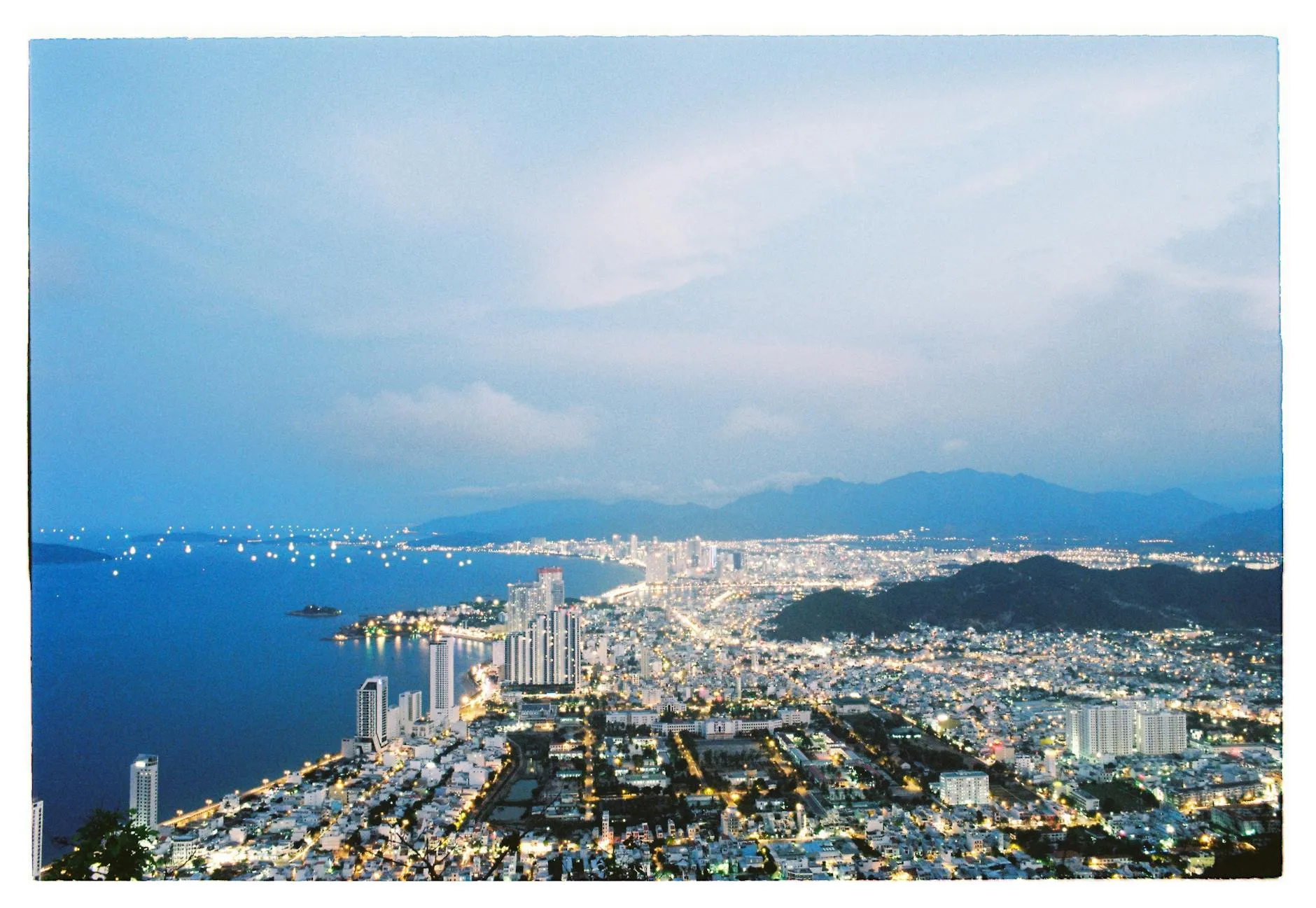
When you book a flight to Nha Trang, the airport you land at is ~35 km south of the city, on a narrow peninsula beside Cam Ranh Bay — and that gap is the central fact of this airport, the one that determines your transfer cost, your layover math, and whether the guy in the arrivals hall is worth talking to.
Quick Reference
Cam Ranh International Airport (CXR / VVCR)
Nha Trang and Khánh Hòa province, southern central Vietnam
Cam Ranh peninsula, ~35 km south of central Nha Trang
T1 (domestic), T2 (international, opened June 2018)
Vietnamese dong (VND); ~26,300 VND/USD 1; ~30,650 VND/EUR 1 (late May 2026 — verify)
E-visa up to 90 days (USD 25 single / USD 50 multiple); 45-day exemption for eligible nationalities
Route 18 (Dat Moi), ~65,000 VND, 60–75 min
Grab / Be / Gojek, ~200,000–300,000 VND, app-fixed price
~400,000–600,000 VND, ~45 min — official rank only
Sun Coast Lounge + SH Premium Lounge; Priority Pass / DragonPass / Dreamfolks
Vietjet (~88 weekly departures), Vietnam Airlines second
Thai VietJet daily Bangkok Suvarnabhumi–Cam Ranh from 29 January 2026
~4.4 million (~70% of pre-pandemic level)
🏢 Terminals & Who Flies Here
CXR has two terminals. T1 handles domestic routes — Hanoi, Ho Chi Minh City, Da Nang and the like. T2, opened June 2018, is the international terminal and the one this guide is written for. They share the same airport campus but are not a single airside zone, so a domestic-to-international connection means clearing immigration, reclaiming bags, and checking in again from scratch. A 60-minute “connection” here is not a connection; build real time if you need to do it.
Vietjet is the dominant operator at around 88 scheduled weekly departures, with Vietnam Airlines second. The international network is predominantly East Asia and Southeast Asia: Korean Air, Air Seoul, Air Busan, Jeju Air, Jin Air, Eastar Jet and T’way run a dense Korean-beach-market cluster; China Southern and Sichuan Airlines cover the mainland China feed; Scoot, AirAsia and Thai AirAsia run Singapore and Thailand legs; Air Astana holds the Kazakhstan link; Air Cambodia opened Phnom Penh service in January 2026.
That pattern tells you what CXR is: a leisure and short-haul-charter airport for the Korean, Chinese and Southeast Asian beach market. There are no direct long-haul services to Europe or North America. Travellers from those regions connect through Seoul, Singapore, Bangkok or Ho Chi Minh City.
✈️ 2026 change that actually matters
Thai VietJet launched daily Bangkok Suvarnabhumi–Cam Ranh on 29 January 2026, operating 737 MAX 8 aircraft. Bangkok is one of the realistic layover hubs for European and Australian travellers heading to Nha Trang, so this same-day routing now exists where it didn’t before.
🛂 Border & Visa
Vietnam runs its own entry system — no regional bloc arrangement, no third-country pre-travel authorisation to chase down. The question is simple: is your nationality exempt, and if not, do you have the e-visa?
📋 The e-visa
Vietnam’s electronic visa is issued at evisa.gov.vn — the official government portal. It covers stays up to 90 days, in single-entry (USD 25) or multiple-entry (USD 50) form. Processing is quoted at around three to five working days. Apply early; do not apply the night before departure. The e-visa is accepted at Cam Ranh and a long list of other air, sea and land ports.
Third-party sites resell the same approval at a markup and provide nothing the government site doesn’t. Use the official portal.
⚠️ Caution: third-party e-visa sites
A crowd of commercial sites mimic the government portal’s look and charge inflated fees for the same approval you can get yourself at evisa.gov.vn. There is no service they offer that justifies the premium. Use the official site and save the extra USD 20–50.
🌍 Visa exemption
A set of nationalities enter Vietnam visa-free for 45 days, including Germany, France, Italy, Spain, the United Kingdom, Russia, Japan, South Korea, Denmark, Sweden, Norway and Finland.
Under a tourism-stimulus arrangement running from 15 August 2025 to 14 August 2028, twelve additional European nationalities receive the same 45-day visa-free entry: Belgium, Bulgaria, Croatia, the Czech Republic, Hungary, Luxembourg, the Netherlands, Poland, Romania, Slovakia, Slovenia and Switzerland. That second list has an end date — confirm it is still in effect for your travel dates rather than treating it as permanent. Several Southeast Asian neighbours have separate 30-day exemptions. US and Canadian passport holders are not on any exemption list and need the e-visa.
🚫 Warning: the Phu Quoc trap
Vietnam grants a 30-day visa-free stay to all nationalities flying directly to Phu Quoc island and staying there. That exemption does not cover Cam Ranh. If you enter Vietnam through CXR, you need either an exemption that covers your nationality or an e-visa. Assuming the Phu Quoc rule applies at Nha Trang is how travellers get turned back at the desk.
Immigration at T2 is standard: passport, visa or exemption documentation, arrival formalities. Carry a printout or screenshot of your e-visa approval — officers want to see it, and airport wi-fi is not something to stake a boarding decision on.
🚌 Getting to Nha Trang
The 35 km is the number to keep in mind. Here is what that distance actually costs, in time and money.
🚍 Bus (cheapest)
Bus route 18, run by Dat Moi, connects the airport with central Nha Trang for roughly 65,000 VND one way — a little over USD 2.50. The ride takes 60–75 minutes with stops and departs in step with flight arrivals through the day. If you are travelling light and not in a hurry, this is the honest, cheap option. Confirm the current fare and stop location with the operator on arrival; pricing here drifts.
📱 Ride-hailing (best value for most travellers)
Grab, Be and Gojek all operate at CXR. The fare is fixed and shown in-app before you confirm — typically 200,000–300,000 VND (roughly USD 8–13) to central Nha Trang. The main virtue is that the price is agreed before you move, which on this route removes the single most tedious part of arriving here. The pickup point is signposted; if a driver asks you to meet them off-app or quotes a different number than the screen showed, decline.
📱 Ride-hailing removes the negotiation
Grab, Be and Gojek all work at CXR and show you a fixed fare before you accept — 200,000–300,000 VND to central Nha Trang. For most travellers this is the right call: app-fixed price, door-to-door, cheaper than the taxi rank, no standing around at the kerb.
🚕 Taxi (pricier, still legitimate)
Metered and fixed-rate airport taxis complete the run in about 45 minutes for somewhere around 400,000–600,000 VND depending on operator and exact destination. Use the official airport taxi rank and a marked, named-company car.
⚠️ Warning: the arrivals-hall driver
The recurring overcharge at CXR is the unmarked driver who approaches you in the arrivals hall and quotes a round-dollar number. The metered taxi rank outside exists precisely so you don’t need to deal with this. Walk past, use the rank or your app.
There is no rail link between the airport and Nha Trang, and none in operation or imminent. Nha Trang’s mainline railway station serves north–south Vietnam trains but is not connected to the airport by rail.
🛋️ Lounges
CXR’s T2 international terminal has lounge access, but calibrate expectations to “comfortable contract lounge” rather than flagship. There is no airline-run marquee lounge open to general paid entry in the way large hubs have.
Airside in T2’s international departures area, the Sun Coast Lounge sits opposite Gates 1–3 and the SH Premium Lounge is on the second floor near Gates 4–5. Both accept Priority Pass, DragonPass and Dreamfolks memberships. Walk-up entry is also sold: the Sun Coast has been quoted at around USD 34, the SH Premium around USD 33 — verify current pricing on arrival.
🛋️ Lounge access at CXR: bring Priority Pass or DragonPass
Both T2 lounges accept Priority Pass, DragonPass and Dreamfolks. LoungeKey is not listed among the accepted networks, so a LoungeKey-only card is not a reliable bet here. Walk-up is available at roughly USD 33–34 per lounge.
T1 (domestic) has further pay-per-use lounges accepting the same three networks, relevant only if your CXR time is on a domestic leg. The Vietnam Airlines premium lounge, where present, is for the airline’s own premium and elite passengers.
Honest read: the lounges are fine for a quiet hour and a charge. They are not a reason to arrive two hours early, and on a tight beach schedule the better move is usually to stay in Nha Trang longer and come to the airport closer to departure.
🍜 Food, SIM Cards & Duty-Free
T2’s airside food runs to Vietnamese standards — phở, bánh mì — alongside a coffee chain or two and convenience counters. The prices carry the standard airport premium over what the same bowl costs in the city. It is fuel, not a meal worth planning around. Landside, near check-in, cheaper and more local options exist if you have time before security.
📶 Buy a SIM at the airport, have them install it
Viettel, Vinaphone and Mobifone all have official operator counters at the airport. Tourist data SIMs are inexpensive — a few hundred thousand dong for a generous package. Get one from an official carrier counter (not an unbranded kiosk), and have the staff install and test it before you leave. Working mobile data the moment you land is what makes ride-hailing usable for the transfer out.
Duty-free at T2 covers the standard spirits, tobacco, fragrance and confectionery range. Nothing here is worth budgeting shopping time for; Vietnamese coffee and local goods are better and cheaper at the city markets.
⏱️ Layover Feasibility
This is where the 35 km becomes arithmetic. The airport-to-city run is about 45 minutes each way in light traffic. Add a minimum 90-minute return buffer — you want to be back through security with time to spare — and the logistics of a city visit alone cost roughly three to three and a half hours before you have spent one minute at the beach or in a restaurant.
Work through the brackets:
Under 5 hours: Stay airside. Once immigration on both ends, the transfer, and the security buffer are deducted, there is no usable time in the city. Use the lounge, eat, charge your devices.
5–7 hours: A city run is technically possible but tight, and a beach swim is not realistic once changing, sand and return travel are accounted for. You might manage a meal in town and a look at the seafront, but you are racing the clock the entire time. A significant portion of travellers decide the stress is not worth the thin slice of time available.
7 hours or more: Nha Trang’s main beach along Trần Phú is genuinely reachable. A swim, a meal, and back is manageable. The Po Nagar Cham towers north of the river are the other realistic sight on a half-day. Anything further — Vinpearl on Hòn Tre island, the bay islands, the mud baths — eats more time than a transit layover can support.
⏱️ Layover math for CXR
45 min each way + 90 min return buffer = ~3.5 hours of logistics before you see anything. Under 5 hours: stay airside. 7+ hours: the beach on Trần Phú and the Po Nagar towers are realistic. 5–7 hours: possible but tight, no beach swim.
The blunt version: CXR is not a terminal where you stroll into town on a three-hour connection. Missing an international departure to chase a beach swim is a bad trade.
🔧 Practical Notes
💵 Currency
The Vietnamese dong (VND) is the only currency that functions on the ground. As of late May 2026: ~26,300 VND to USD 1 and ~30,650 VND to EUR 1 — check before you travel. The numbers are large; 65,000 VND is about USD 2.50, and 500,000 VND is roughly USD 19.
ATMs at the airport and across Nha Trang give a better rate than airport exchange counters. Withdraw a working amount of cash on arrival. Cards are accepted at hotels and larger restaurants; the bus, street-food stalls and small vendors are cash only.
📡 Connectivity
Airport wi-fi exists and is the usual patchy free tier. A local data SIM — bought at an official operator counter in arrivals — is reliable, cheap and ensures your ride-hailing apps and e-visa screenshot work from the moment you land.
🏗️ The expansion proposal
Vietnam’s aviation authority floated a large multi-stage CXR expansion in May 2026 — a rebuilt domestic terminal, enlarged international terminal, replacement runway. This is a proposal on paper. Nothing about it will be visible at the gate in 2026. The concrete 2026 development is the new daily Bangkok link.
❓ FAQ
📊 At a glance — CXR 2026
| Item | Detail |
|---|---|
| Airport name | Cam Ranh International Airport (CXR / VVCR) |
| City served | Nha Trang, Khánh Hòa province, Vietnam |
| Distance to city | ~35 km south of central Nha Trang |
| Terminals | T1 domestic; T2 international (opened June 2018) |
| Largest carrier | Vietjet (~88 weekly departures); Vietnam Airlines second |
| Long-haul to EU / North America | None direct — connect via Seoul, Singapore, Bangkok or HCMC |
| Currency | Vietnamese dong (VND) |
| Exchange rate (late May 2026) | ~26,300 VND/USD 1; ~30,650 VND/EUR 1 (verify) |
| E-visa | Up to 90 days; USD 25 single / USD 50 multiple; evisa.gov.vn |
| Visa exemption | 45 days for expanded EU list and others; not US or Canada |
| Phu Quoc rule at CXR | Does not apply — exemption or e-visa required |
| Bus to city | Route 18 (Dat Moi), ~65,000 VND, 60–75 min |
| Ride-hailing to city | Grab / Be / Gojek, ~200,000–300,000 VND, app-fixed price |
| Airport taxi to city | ~400,000–600,000 VND, ~45 min — official rank only |
| Lounges (T2) | Sun Coast + SH Premium; Priority Pass / DragonPass / Dreamfolks |
| Walk-up lounge price | ~USD 33–34; LoungeKey not accepted |
| Layover threshold | 7+ hours for the beach; under 5 hours stay airside |
| 2026 change | Thai VietJet daily Bangkok–Cam Ranh from 29 January 2026 |
| 2024 passengers | ~4.4 million (~70% of pre-pandemic) |
🌍 Planning the trip? Read our Vietnam travel guide — best time to go, where to stay, and how to get around.