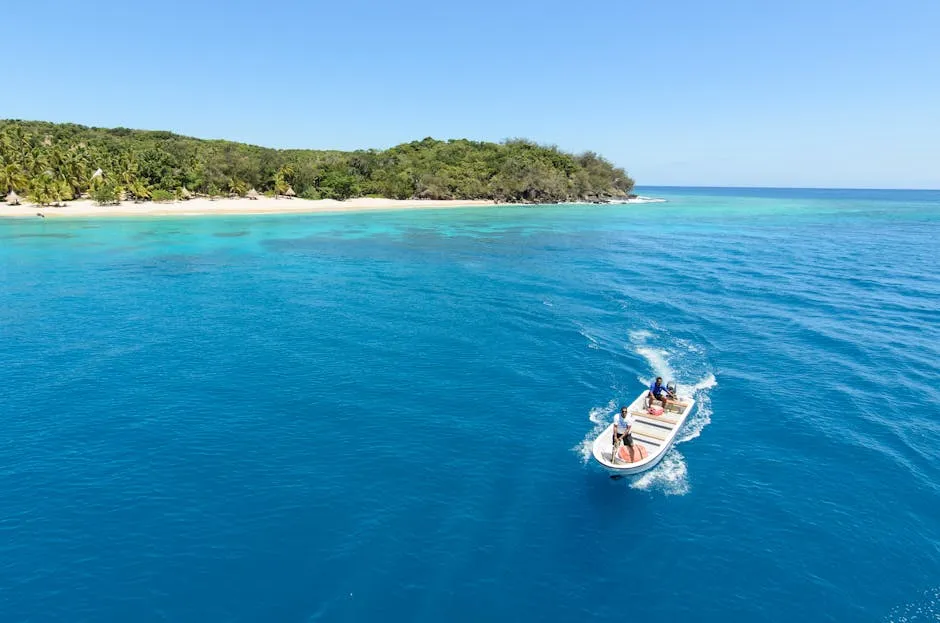
Fiji — The Complete Island Guide 2026
333 islands across the South Pacific; three Fijis on the same archipelago. The Mainland Viti Levu of Nadi and Suva, the resort tier of the Mamanucas and Yasawas, and the Outer Fiji of Vanua Levu and Taveuni — plus the 2022 democratic transition, the 2014 Vunidogoloa climate relocation, and the kava ritual that holds it together.
Why Fiji? An Editor’s Note
Walk down Beach Street in Levuka, the abandoned colonial capital on Ovalau Island, and find the small concrete obelisk in the grass behind the Sacred Heart Church. The Latin inscription is weather-worn; the English translation on the brass plate at the base reads, more or less, that on this site, on 10 October 1874, Tui Viti Ratu Seru Epenisa Cakobau and twelve other paramount Fijian chiefs signed the Deed of Cession that placed the Fiji Islands under British sovereignty. The British colonial capital remained at Levuka for eight years; the administration moved to Suva, on the bigger and better-watered island of Viti Levu, in 1882. The town has been quietly losing population for one hundred and forty-four years. It is now home to about three thousand people, a fish-canning factory, the original wooden-veranda main street (UNESCO inscribed it as a World Heritage Site in 2013), the Royal Hotel (operating continuously since 1860, the oldest in the South Pacific by several measures), and the question of whether anyone is going to remember any of this in another century.
Levuka is the right place to start a Fiji guide because everything that has happened to Fiji since flows from the Deed of Cession of 1874. The British indentured-labour scheme that began five years later, in 1879, brought sixty thousand Indians to work the sugar estates of Viti Levu’s western and northern coast across the next thirty-seven years. The 1970 independence settlement gave Fiji a constitution that tried — imperfectly, contentiously — to balance the political weight of indigenous Fijians (iTaukei) and the Indo-Fijian descendants of those indentured labourers. Four coups in three decades flowed from that unsettlement: Rabuka’s two in 1987, George Speight’s in 2000, Bainimarama’s in 2006. The 2022 general election was the first in the country’s modern history in which a coup-leader (Sitiveni Rabuka, the 1987 leader, now running as a civilian) peacefully defeated another coup-leader (Frank Bainimarama, who had ruled since 2006) at the ballot box, with the loser conceding and the winner taking office. By post-colonial Pacific standards this is a small miracle, and the visitor in May 2026 is visiting a country in the middle of testing whether the miracle is durable. Bainimarama was convicted of perverting the course of justice in 2024, served six months in prison, and is barred from the 2026 general election (scheduled between 24 June 2026 and 6 February 2027) by the eight-year ineligibility clause of the 2013 constitution. FijiFirst, his party, was formally dissolved by the High Court in October 2024. The political ground that fell out from under the 2006 coup is still settling.
A second working backdrop: climate displacement. On 17 January 2014, the village of Vunidogoloa on Vanua Levu’s Natewa Bay became the first community on the planet to be formally relocated by its own government on climate grounds. The original village, on the shore of the bay, had been losing ground to sea-level rise and storm surge since the mid-2000s; crops were being killed by saltwater intrusion; houses were flooding at high tide. The Fijian government and the community itself moved the village two kilometres inland and uphill to a site that the residents named Kenani (“Promised Land”). The original village is still there as a set of foundation slabs and broken concrete partly under the high-tide line, a quiet visitable archaeology of where Fiji is going. Several other villages have since followed; the official government list of climate-vulnerable relocation candidates ran to forty-five communities as of 2024.
These two backdrops — the political settlement that the 2022 election began testing, and the climate-relocation work that the 2014 Vunidogoloa move started — are why you cannot write a serious Fiji guide that is only about beaches and water villas. The beaches and water villas are real, deserve the photographs, and constitute the country’s working economic model (tourism is the second-largest sector after sugar, with somewhere around forty per cent of GDP if you count direct and indirect contributions). But the country those beaches sit on is more complicated, more dated, and more interesting than the brochures imply.
The right way to read Fiji is as three Fijis sharing one archipelago of 333 islands and 110 inhabited ones across roughly 18,000 square kilometres of South Pacific Ocean. The first is Mainland Fiji — the big island of Viti Levu (where seventy per cent of the population lives), with Nadi as the western gateway-town, Suva as the working southeast capital, Sigatoka on the Coral Coast, Lautoka as the sugar-and-Indo-Fijian centre. This is the country that visitors who only do a resort week never see. The second is Resort Fiji — the private-island resort chain of the Mamanuca group (immediately west of Nadi, the day-trip-accessible cluster) and the Yasawa group (the longer-distance northern archipelago made world-famous by The Blue Lagoon in 1980), plus the Denarau strip just outside Nadi (the all-inclusive five-star concentration). The third is Outer Fiji — Vanua Levu (the country’s second-biggest island, with Savusavu and Labasa), Taveuni (the “Garden Island,” with the 180th meridian running through it), Kadavu (the off-the-grid diving anchor), and the far-flung Lau group. Most visitors stay on Mainland or Resort Fiji; the Outer Fiji segment is where the country becomes itself.
A small note on language and naming: Fijian (the indigenous language, also called iTaukei) has the consonant cluster mb spelled as b, nd spelled as d, ng spelled as g, and th spelled as c. So Nadi is pronounced “Nandi,” Beqa is “Mbenga,” Cakobau is “Thakombau,” and yaqona is “yangona.” This is helpful when reading place-names aloud or when trying to find your village on a map. Fiji Hindi (the Indo-Fijian working language, descended from the Bhojpuri-Awadhi vernacular of the labour-recruitment districts of the 1879–1916 scheme) is the second working language. English is the official administrative language and is universally spoken in tourism.
Come with all three Fijis in mind, accept that the country is in a more interesting historical moment than its postcard reputation, eat the lovo at least once, drink the kava once if a host offers it, and try not to spend the entire week behind a resort security gate. The reward for any effort beyond the airport-to-Denarau-shuttle is steep.
Getting There — Nadi, Suva and the Domestic Network
Fiji has two international airports — Nadi International (NAN) on Viti Levu’s west coast (the working tourism gateway, handling about ninety-seven per cent of all foreign visitor arrivals) and Nausori International (SUV) outside the capital Suva (the secondary, with regional services from Auckland, Sydney and the Pacific). Almost every visitor uses Nadi.
Nadi (NAN) is the country’s flagship airport — currently mid-expansion under a FJ$2.3 billion / twenty-five-year redevelopment programme announced in 2024. The terminal has seven gates being expanded to eleven; smart gates, self-check-in kiosks and automated bag drops have been rolled out across 2025. The airport is small by Asian-hub standards, large by Pacific standards, and the immigration process is straightforward.
The direct routes that matter for European, North American and Australasian visitors:
- Fiji Airways — the national carrier, daily Sydney/Melbourne/Brisbane/Auckland/Los Angeles, plus the new Gold Coast (OOL) service launching 11 June 2026.
- Qantas, Air New Zealand, Virgin Australia — the Trans-Tasman codeshare network.
- Korean Air, Hawaiian, American Airlines — North Pacific connections via Honolulu and Seoul.
- No direct flights from Europe; almost all European visitors connect through Singapore, Hong Kong, Auckland, or Los Angeles.
From Nadi airport into the country
Nadi airport sits about nine kilometres north of Nadi town, twenty kilometres south of Denarau resort strip, and a forty-five-minute drive from the Coral Coast resorts.
- Local buses are the cheapest serious option. The Vodafone Arena / Nadi Town bus runs every fifteen to twenty minutes from the airport stop on Queens Road; FJ$1 (≈€0.40) for the fifteen-minute ride into Nadi town, then connecting buses on to Lautoka, Sigatoka, Suva. The Sunbeam and Pacific Transport long-distance buses run from Nadi town to Suva for FJ$15–25 (€6–10), four hours.
- Taxis to Denarau cost roughly FJ$25–35 (€10–14); to Nadi town FJ$15; to the Coral Coast resorts (Sigatoka, Korotogo) FJ$80–120. Use the Fiji Taxi app for transparent pricing; flag-down works too but agree the fare before getting in.
- Resort transfers are typically included in luxury and most upper-mid bookings; otherwise expect FJ$80–250 round-trip from Nadi to the Coral Coast or Denarau-pier transfers.
- Domestic flights — Fiji Link (the Fiji Airways regional subsidiary) and Northern Air run propeller-aircraft services to Savusavu, Taveuni, Kadavu, Labasa, Lakeba, Rotuma, and a handful of grass-airstrip outer-island destinations. Forty to seventy minutes of flight; FJ$200–500 (€78–195) one-way depending on route.
Boats to the Mamanucas and Yasawas
For the resort archipelagos, the working transport is the boat. South Sea Cruises and Awesome Adventures Fiji run the Yasawa Flyer catamaran daily from Port Denarau through the Mamanuca and Yasawa chains, calling at the named resorts and backpacker islands. FJ$210 (€82) Port Denarau to Octopus Resort one-way, ranging up to FJ$370 (€144) to the far north of the Yasawas (Nacula, Nanuya). The boat takes four to five hours end-to-end; intermediate stops are quick (10-minute boat-to-tender transfers). The Bula Combo / Bula Pass is the working budget framework: an unlimited-travel pass for the Yasawa Flyer over a set number of days, FJ$420–650.
Editor’s tip: Book your international flight to land in the morning, not the evening. Nadi’s east-bound onward connections (Yasawa Flyer to the islands, resort transfers to the Coral Coast) leave from Denarau pier around 09:00 and 12:30 each day; a 22:00 arrival in Nadi means a night in a Denarau hotel before you can move on. Most major Australia/NZ flights are red-eye departures landing 04:30–09:30 — these are the right connections.
Pro Tip: The Nadi-Suva road is one of the country’s underrated experiences — three hundred kilometres along the south coast of Viti Levu, through the Coral Coast (Sigatoka, Korotogo, Pacific Harbour), past the Pacific Harbour shark-dive base, into Suva via Navua. By Sunbeam bus it is FJ$25 and four hours; by self-drive rental car it is the same time at a different pace. Take it once in either direction; the contrast between the Indo-Fijian sugar-and-cane countryside around Nadi and the wetter, more iTaukei southeast is one of the country’s working sightlines.
Top 12 Attractions in Fiji
A first-time Fiji visitor’s attractions list should mix one or two land-based experiences with the right number of sea-based ones for your transfer budget. The list below favours the things that cannot be done elsewhere in the South Pacific.
1. Levuka (UNESCO World Heritage)
The 1881 colonial capital, on Ovalau Island, two hours east of Suva by inter-island ferry + 1-hour bus, or 25 minutes by Fiji Link from Suva. The UNESCO inscription (2013) covers the Levuka Historical Port Town — the wooden-veranda Beach Street, the Sacred Heart Church, the Royal Hotel (operating continuously since 1860), the Cession Stone marker, the small Levuka Town Council Hall and the working Pafco Fish Factory that has been the town’s economic anchor since 1964. The town is small (about three thousand people), entirely walkable, and is the right place to spend two days for a serious-history Fiji trip.
- Access: Inter-island ferry from Suva to Buresala, then 45-minute bus to Levuka, total ~5 hours and FJ$30; or Fiji Link from Suva to Bureta Airfield, 25 minutes, FJ$200 each way.
- Entry: Free for the town walkable circuit. The Levuka Historical & Cultural Society runs walking tours from the Royal Hotel for FJ$30; the Levuka Community Centre Museum is FJ$5.
Editor’s tip: Stay one night at the Royal Hotel — the rooms are basic, the bar is the country’s most interesting drinking room (kava in the corner, expat residents, the original wooden interior), and the breakfast is included. About FJ$95 per person.
2. Sigatoka Sand Dunes National Park
Fiji’s first national park (1989), on the south coast of Viti Levu at the mouth of the Sigatoka River. The dunes are 20–60 metres high across about 650 hectares of coastal sand-and-pine forest and are archaeologically significant: digs since the 1970s have uncovered Lapita-period pottery and human remains dating back roughly 2,600 years, making the site one of the most-studied prehistoric burial sites in the Pacific. The dunes are on the UNESCO World Heritage Tentative List (submitted 1999, not yet inscribed). The visitor centre has the archaeological interpretive exhibit; the walking tracks (a short Mahogany Loop, a longer 90-minute Coastal Track) take you across the dune field to the sea.
- Hours: 08:00–17:00 daily.
- Entry: FJ$15 adults (€5.85), FJ$5 children.
- Access: On Queens Road between Sigatoka town and the airport. Sunbeam bus from Nadi (FJ$5, 1 hour). Self-drive 70 km west on Queens Road.
3. Garden of the Sleeping Giant
The orchid-and-lily garden in the foothills of the Sabeto Range, 20 minutes north of Nadi airport. Started in the 1970s as the private orchid collection of the American actor Raymond Burr (Perry Mason, Ironside); the garden was bequeathed to Fiji on his death in 1993 and now holds approximately 2,000 orchids of about 100 species plus landscaped lawns, waterlily ponds, and a forest walking circuit. The “Sleeping Giant” is the named ridge profile of the Sabeto Range behind the garden.
- Hours: 09:00–17:00 daily.
- Entry: FJ$35 (€13.60) adults.
- Access: Bolt or taxi from Nadi airport (FJ$20–30 each way); often combined with the Sabeto Mud Pool in a half-day excursion.
Pro Tip: Combine with the Sabeto Hot Springs and Mud Pool (FJ$20 entry) on the same morning — they are 1 km apart in the same valley. The mud pool experience is genuinely Fijian, slightly silly, and the long shower in the natural thermal spring at the end is the better half of the visit.
4. The Lovo Earth-Oven Dinner
Not a single location but a category. The lovo is the traditional Fijian earth-oven feast — pork, chicken, fish, taro, cassava, sweet potato and palusami (taro leaves baked with coconut cream) wrapped in banana leaves, buried in a stone-lined pit over hot coals, and cooked for two to four hours. Most resort properties run a lovo night once or twice a week; most local-village cultural tours include one. The right thing to attend at least once during a Fiji visit.
- Where: Almost any resort (FJ$60–120 per head for the buffet plus meke dance); Robinson Crusoe Island day-trip lovo (FJ$240 including ferry); village cultural visits through tour operators (FJ$80–150 including kava ceremony, lovo and meke).
5. The Coral Coast — Pacific Harbour Shark Dive
The Coral Coast runs from Sigatoka east to Pacific Harbour, an 80-kilometre stretch of south-Viti Levu coast with reef-protected lagoons, the country’s best-known surf breaks (Cloudbreak, Restaurants — both off Tavarua Island), and the country’s most famous dive operation. The Beqa Lagoon Shark Dive, run by Beqa Adventure Divers out of Pacific Harbour, is the working iconic Fiji big-fish experience: bait-attracted dives with up to eight shark species including bull sharks (the standard sighting), tiger sharks (frequent at peak), silvertips, grey reefs, white-tips, black-tips, lemons and nurse sharks — at a single site, with seasoned divemasters and bait-handler safety protocols.
- Where: Pacific Harbour, two hours by bus or Sunbeam coach from Nadi.
- Cost: FJ$595 (€232) for the two-dive day trip including all gear, two boats, dive insurance, lunch.
- Season: Year-round; sharks are most reliable November–April.
Editor’s tip: The shark dive is the genuine deal — Beqa Adventure Divers have been running it since 2003 with no fatal incidents and have the country’s most rigorous safety reputation. Other operators offer “shark snorkels” and “swim with sharks” at lower prices; these are working operations but lack the same depth of expertise.
6. Tavoro Falls and Bouma National Heritage Park (Taveuni)
The signature land excursion on Taveuni, the “Garden Island.” The Tavoro Falls are a triple-cascade waterfall system in Bouma National Heritage Park — Lower Tavoro (the easy 10-minute walk from the visitor centre, the postcard fall with the swimming pool at the bottom), Middle Tavoro (a 30-minute scramble up), and Upper Tavoro (a 90-minute hike, less crowded, smaller plunge pool). Taveuni itself is reached by Fiji Link (40 minutes from Suva or 80 minutes from Nadi) plus a short transfer.
- Hours: 09:00–16:00 daily.
- Entry: FJ$30 (€11.70) for park entry.
- Access: Bouma village, north-east Taveuni, an hour’s drive from Matei (Taveuni’s main resort area).
7. The 180th Meridian / International Date Line, Taveuni
Taveuni is one of only two places in the world (the other is the abandoned-village site on the now-uninhabited Kiribati atoll of Caroline Island) where the original 180th meridian — the geographic centre of the International Date Line — crosses inhabited land. The line crosses Taveuni north-to-south at a marked spot on the west coast, where a small concrete pillar and an interpretive board stake the position. The actual International Date Line jogs eastward to keep Fiji on a single calendar day, but the geographic meridian remains. A working tourist-photo spot.
- Access: Waiyevo, the main road on Taveuni’s west coast, 10-minute drive from Matei.
- Entry: Free.
8. The Suva Municipal Market and Suva City Walk
The capital is undersold to most visitors. The Suva Municipal Market (Rodwell Road, in the city centre) is the largest produce-and-fish market in the South Pacific — three-storey, indoor-and-outdoor, working daily from 06:00. The surrounding city walk through Old Suva covers the Government Buildings (a 1939 art-deco-classical complex), the President’s House (former Governor-General’s Residence), the Fiji Museum in Thurston Gardens (the country’s national museum, with the country’s best collection of pre-colonial artefacts and the famously preserved cannibal forks used in the country’s nineteenth-century cannibalism practices, which are real, documented and not glossed-over in the museum’s exhibits), and the Sacred Heart Cathedral on Pratt Street.
- Fiji Museum hours: 09:30–16:30 Mon–Sat, closed Sunday.
- Entry: FJ$10 (€3.90) adult.
- Access: Suva is a four-hour bus ride or three-hour drive from Nadi. Worth a one-night stay rather than a day trip.
Pro Tip: The Fiji Museum’s cannibal-fork exhibit is a serious treatment of a real historical practice — not the touristic-curiosity framing that some Pacific museums attempt. Read the panel on Reverend Thomas Baker (the Methodist missionary killed and eaten in 1867 at Nubutautau in the Viti Levu highlands; the village formally apologised to Baker’s descendants in a ceremony in 2003) for the dated and specific version of the story.
9. Cloudbreak and Restaurants — Tavarua Island Surf
The most famous waves in Fiji are at Cloudbreak (a left-breaking reef pass at the south-west edge of the Mamanucas) and Restaurants (the right-hand wave at the same complex). Both are world-tour-quality breaks; both were “private waves” associated with the Tavarua Island Resort until 2010, when the Fijian government opened all reefs to public access under the Surfing Decree of that year. Surf charters from Nadi run day trips ($150–250 per person from a Mamanuca surf-camp like Tavarua’s competitor Namotu, or by a Fiji-mainland-based charter). The wave is for advanced surfers; the reef is unforgiving.
10. The Beqa Firewalkers
The Sawau people of Beqa Island are the traditional firewalkers of Fiji — performing the vilavilairevo (literally “jumping into the oven”) ceremony, walking barefoot across stones heated to red-hot in a fire pit, without observable burning. The practice is the traditional ritual of the Sawau and is now performed regularly for visiting groups at several Coral Coast resorts (Pearl Resort, Outrigger Coral Coast among others) and as part of village-cultural-visit programmes. The traditional account holds that the practice was given to a Sawau chief by a vu (spirit-being) in exchange for releasing the spirit from a trap; the demonstrable physics of the practice (the heat-conduction properties of the stones, the speed of the walk) are an ongoing subject of academic interest.
- Where: Pearl Resort (Coral Coast), Outrigger Coral Coast, and the village of Dakuibeqa on Beqa Island (visitable on a half-day tour from Pacific Harbour).
- Cost: Resort performances are typically free for guests; village-visit tours FJ$120–180 per person.
11. The Yasawa Islands Sandbank Excursions
The Yasawa group (the long northern chain of volcanic islands made famous by the 1980 film The Blue Lagoon, shot at the now-Turtle-Island-Resort lagoon between Nanuya Lailai and Matacawalevu) is the country’s resort-and-budget mix at its best. Most Yasawa accommodation — from the backpacker-priced Octopus Resort and Coralview Island Resort in the south to the upper-mid Yasawa Island Resort in the far north — runs daily sandbank picnic and lagoon snorkel excursions, included in package rates or FJ$60–120 as add-ons.
12. Vunidogoloa Old Village Site
A working climate-relocation site rather than a marketed attraction, on Vanua Levu’s Natewa Bay, two hours’ drive east of Savusavu. The original Vunidogoloa village (relocated in January 2014 to Kenani, two kilometres inland) is now a partial-archaeology site — the concrete house foundations and the village church floor still visible at low tide. Several of the relocated families will host visitors for a small donation, walk you across the original site, and explain the dated and concrete reasons for the move. This is one of the more sobering and dignified visits a traveller can make in Fiji.
- Access: Self-drive from Savusavu or by guided tour; arrange via the Cakaudrove provincial council or the Pacific Climate Action Network. Allow a full day from Savusavu and confirm visit protocol with the village before arrival; this is a working community relocation site, not a tourist set-piece.
The Islands — Where Each Fiji Lives
The Fijian archipelago is administratively divided into fourteen provinces across four divisions, but the working geography for a visitor is simpler. Six clusters, in rough order of visitor importance:
Viti Levu (Main Island)
The largest island (10,400 km²), holding about seventy per cent of the population. The west coast is the dry-Fiji, Indo-Fijian, sugar-cane belt — Nadi (airport, the working entry-town), Lautoka (the country’s second city, sugar-mill capital), Denarau (the resort-strip peninsula 20 km from Nadi). The south coast is the Coral Coast — Sigatoka, Korotogo, Pacific Harbour, the reef-protected resort beaches. The southeast corner holds Suva (capital, government, the working country). The interior is mountainous, dense forest, lightly inhabited.
Mamanuca Islands
Twenty islands, mostly small and palm-fringed, in a tight cluster immediately west of Nadi. The day-trip-accessible resort archipelago: Beachcomber Island, Treasure Island, South Sea Island (the backpacker-and-family group); Castaway Island Resort, Tokoriki, Likuliku Lagoon, Six Senses Fiji (the mid-to-upper resorts); Tavarua and Namotu (the surf islands).
Yasawa Islands
A long volcanic chain of twenty islands north of the Mamanucas, 50 to 90 kilometres from Nadi by boat. Steeper, more remote, more dramatic landscape (the Blue Lagoon shoot, the famous limestone-cave Sawa-i-Lau). Resort prices range from backpacker (Coralview, Octopus, Long Beach) to mid-tier (Mantaray Island, Barefoot Manta) to higher (Yasawa Island Resort). The Yasawa Flyer catamaran is the working transport.
Vanua Levu (Second Island)
The country’s second-largest island (5,580 km²), north-east of Viti Levu, much less developed. Savusavu on the south coast (the “Hidden Paradise” town, with the working hot springs in the main street and Jean-Michel Cousteau Resort offshore) is the visitor anchor; Labasa on the north coast (sugar-mill, Indo-Fijian, the most overlooked secondary city in the country) is the working alternative.
Taveuni (Third Island)
The “Garden Island,” a long volcanic outcrop east of Vanua Levu, the country’s third-largest land mass. Bouma National Heritage Park (Tavoro Falls), the 180th meridian marker, and the country’s most rainforest-dense interior. Resort base Matei in the north, Taveuni Resort in the middle.
Outer Islands — Kadavu, Lau, Rotuma
The genuinely remote Fiji. Kadavu (the diving anchor, 100 km south of Viti Levu, with the Great Astrolabe Reef — one of the largest barrier reefs in the world — and resident manta cleaning stations); the Lau group (the eastern chain, formerly the seat of the traditional aristocracy, almost no tourism infrastructure); Rotuma (the Polynesian-cultural outlier 600 km north, with its own language and a strict-permit visitor regime). All require domestic flight or boat charter.
Where to Stay — by Budget
Rates below are per person per night, double occupancy, shoulder season (May, October–November). Peak (June–September dry season + Christmas/Easter holidays) adds 20–40%; deep low season (February–March cyclone-peak) deducts 25–40%.
Backpacker / Local-island guesthouse — FJ$60–180 per person per night (€23–70)
The Yasawa Flyer catamaran route is the country’s working budget archipelago. Octopus Resort (Waya Island, Yasawas, dorm beds from FJ$95, beachfront private bures from FJ$280), Coralview Island Resort (Tavewa Island, dorms from FJ$75), Mantaray Island Resort (Nanuya Balavu, dorm-and-bure with the manta-snorkel programme). For Mainland Viti Levu, Smugglers Cove Beach Resort in Wailoaloa Beach (Nadi) is the working backpacker anchor — dorms from FJ$60, doubles from FJ$200.
The Mainland-Suva budget anchor is Five Princes Hotel (Tamavua, Suva) at around FJ$200 a night for a double.
Mid-range — FJ$280–650 per night (€110–250) for a double
The mid-tier resorts and the better Nadi/Denarau hotels. Castaway Island Resort (Mamanucas, family beachfront), Outrigger Beach Resort (Coral Coast, the long-running Fijian-family-friendly anchor), Sheraton Denarau Villas (the lower tier of the Denarau strip), Hideaway Resort (Coral Coast, Wakaya-quiet), Tokoriki Island Resort (adults-only Mamanucas; the most-awarded boutique resort in the country, 36 villas).
Upper-mid — FJ$700–1,800 per night (€270–700)
The flagship mid-luxury private islands. Likuliku Lagoon Resort (Malolo, Mamanucas — the property that introduced overwater bungalows to Fiji, ten of them, adults-only); Vomo Island Resort (Vomo, north Mamanucas — large private-island, family-friendly luxury, added new family villas 2025); Six Senses Fiji (Malolo, Mamanucas — wellness-and-sustainability-led, beachfront); InterContinental Fiji Resort (Natadola Beach, Viti Levu — surf, golf, the country’s most-awarded mainland luxury); Jean-Michel Cousteau Resort (Savusavu — the diving-and-marine-biology anchor); Royal Davui Island (Beqa Lagoon, near Pacific Harbour).
Top-tier — FJ$2,500–FJ$10,000+ per night (€975–€3,900+)
The genuine private-island floor. Vatuvara Private Islands (Lau group, four villas, the country’s most isolated luxury), Wakaya Club (Wakaya — Bill Gates and other names you’d recognise have stayed here, multi-thousand-dollar private-island villas), Turtle Island Resort (Yasawas — the Blue Lagoon shoot location, all-inclusive private-island), Laucala Island Resort (Laucala — Red-Bull-owner Dietrich Mateschitz’s private island, twenty-five villas, $7,500+/night).
Where not to stay
The Denarau strip itself is a working all-inclusive ghetto — large international-chain hotels (Sheraton, Westin, Hilton, Sofitel, Wyndham) sharing a single artificial-island peninsula with a fenced perimeter and a shuttle bus to Port Denarau pier. It is fine for a one-night-pre-resort-transfer or a three-night-quick-stay if you do not have time for a real island, but it is not a Fijian experience in any meaningful sense. Almost all resort guests come and go through Denarau pier on the boat to the Mamanucas; very few stay there for the duration of their trip.
Where to Eat — Kokoda, Lovo, and the Indo-Fijian Curry House
Fiji’s working cuisine has three distinct layers — traditional iTaukei Fijian (coastal-coconut-and-root-vegetable cooking, expressed at its peak in the lovo earth-oven feast), Indo-Fijian (Bhojpuri-Awadhi-derived curry cooking, simplified and South-Pacific-localised after a century and a half of separation from India), and the resort-international (everything-everywhere modern-Pacific-Asian-Mediterranean fusion). All three are worth eating, ideally on different days.
Traditional iTaukei — what to seek out
- Kokoda — the national dish. Raw white fish (typically walu / Spanish mackerel) marinated in lime juice, then mixed with coconut milk, tomato, onion, capsicum, chilli. Served chilled, often in a half-coconut. The right starter at any Fijian-cuisine restaurant.
- Lovo — the earth-oven feast (see Top Attractions #4). Pork, chicken, fish, taro, cassava, sweet potato, palusami — all banana-leaf-wrapped and slow-baked in a stone-lined pit.
- Palusami — taro leaves baked with coconut cream, often with corned beef or tinned fish in the middle. The pan-Pacific equivalent of a Southeast-Asian wrapped-leaf dish.
- Rourou — boiled taro leaves with coconut cream (the lighter, vegetable-only cousin to palusami).
- Kai — freshwater mussels, a Sigatoka-river specialty.
Where to eat Fijian on the mainland
- Nadina Authentic Fijian Restaurant, Port Denarau — the working sit-down Fijian-cuisine restaurant in the Nadi area. Lovo set menus, kokoda, palusami, kava on request. FJ$70–110 per head.
- Tu’s Place, Nadi town — the long-running family-run Fijian-and-Indian restaurant, much more local than touristic. FJ$25–50 per head.
- Beach Bar & Grill at Denarau — Fijian-fusion menu, mid-range mains with strong local-ingredient sourcing.
Indo-Fijian — the underrated half of the cuisine
The Indo-Fijian curry-house scene is genuinely strong and is the working everyday food for about a third of the country. The benchmark dishes are roti and curry (any of the standard Indian curries, served with house-made roti rather than rice), prawn curry (the Indo-Fijian coastal speciality), kadhi (the chickpea-flour-and-yogurt-based curry, eaten with steamed rice), and lolo buns (the Fijian-Indo-Fijian sweet bread baked with coconut). The right places to look:
- Saffron Tandoori Restaurant, Nadi — the long-established mid-range curry house.
- Maya Dhaba, Suva — the working Indian restaurant in the capital.
- Curry House, Nadi town — the cheaper working curry-and-roti shop the locals use.
Resort-international
The big resort dining rooms run reliable but unsurprising international menus. The standout is InterContinental Fiji’s Toba Lo Restaurant at Natadola Beach — five-time winner of the Fiji’s Best Restaurant category at the World Travel Awards — and Sheraton Denarau’s Tatavu restaurant, World Culinary Awards winner 2024. Both are reservation-only, FJ$130–250 per head with wine.
Michelin, plainly stated
There is no Michelin guide for Fiji or the wider South Pacific as of May 2026. The Michelin Guide has only just expanded to the Philippines (2026 launch); Fiji and the rest of the Pacific are not covered. No Fijian restaurant appears on the World’s 50 Best Restaurants Asia list (the geographic remit of which does not include the South Pacific anyway). Local awards are run primarily through the Fiji Tourism Awards and the World Travel Awards Oceania category.
Editor’s tip: Eat one lovo per trip, one kokoda per trip, one Indo-Fijian curry per trip. The three together cover what a non-Fijian visitor needs to leave understanding about the country’s food. The resort buffet you can get anywhere in the global beach-holiday economy; the lovo-and-kokoda is what only Fiji does.
Drinking — Kava, Fiji Bitter and the Resort Bar
Yaqona / Kava — the working ritual
The drinking ritual that matters most in Fiji is non-alcoholic. Yaqona (the iTaukei name; kava is the broader Polynesian/Fijian usage) is the root of the Piper methysticum plant, pulverised into a powder, mixed with cold water, strained through cloth, and drunk in coconut-half-bowls (bilo) as part of a formal community gathering. The drink is mildly sedative and numbs the tongue and lips on contact; the effect is somewhere between a strong herbal tea and a beer. Yaqona ceremonies are the country’s working social glue — the village chief receives visitors with a kava ceremony; a working community meeting opens with a kava ceremony; many rural-island guesthouses host evening kava sessions for guests. The protocol matters: clap once before accepting a bilo, drain it in a single draught if it is a small bilo (a “low tide”), clap three times after. The right thing to do at least once on a trip.
Kava is sold at every Fiji-Saturday market in bundles or as ground powder for FJ$10–25; foreign visitors can buy and take home small quantities (declare in your home country’s customs — kava is restricted in some jurisdictions).
Beer — Fiji Bitter and Vonu
The country’s brewed-beer scene is duopoly: Carlton Fiji Bitter (the established working beer, 4.6% ABV lager, the country’s mainstream pour) and Vonu (the post-2000 brand, lower-priced, the working budget option). Both are made by Paradise Beverages (the country’s brewing company, founded 1958, now owned by Coca-Cola Amatil’s South Pacific arm). FJ$5–8 for a standard 330 ml bottle in a bar, FJ$3 at a corner shop. Drink at the local Hard Rock Cafe Fiji (Denarau), the working Suva pubs (Traps Bar, Hourglass) or the dozens of Coral Coast resort bars.
Spirits and wine
The country produces no wine and no major spirits. Imports are heavily taxed; a glass of mid-range house wine at a resort is typically FJ$15–25, a bottle FJ$70–140. Spirits run similar. Cocktails at upper-tier resorts are FJ$25–45.
The dry-village rule
Many traditional iTaukei villages (especially in the Yasawas, Vanua Levu interior, and Lau) operate as dry communities — alcohol is either prohibited or strongly discouraged by the village chief. The resort beaches and the Coral Coast hotels are unaffected. If you stay at a village-run guesthouse or homestay, accept the working norm; the host family will explain. Bringing alcohol into a dry village without invitation is genuinely insulting.
Pro Tip: The kava ceremony is the better evening experience than the resort cocktail bar. If your local-island guesthouse offers one, attend. The ritual is real, the company is real, the conversation that comes from kava-after-dinner is the country’s working version of the post-dinner Mediterranean digestivo.
Getting Around the Country
Inter-island
- Yasawa Flyer catamaran (South Sea Cruises / Awesome Adventures Fiji) — daily morning departures from Port Denarau through the Mamanuca and Yasawa chains. FJ$210–370 per leg; Bula Pass unlimited-travel packages FJ$420–650.
- Fiji Link / Northern Air — domestic propeller-aircraft network. FJ$200–500 per flight one-way.
- Inter-island ferries — government and private operators, longer routes to Vanua Levu, Taveuni, Kadavu, Lau. Slower, cheaper, more weather-dependent.
On Viti Levu (mainland)
- Sunbeam / Pacific Transport long-distance buses — Nadi to Suva, four hours, FJ$15–25 (€6–10). Comfortable, reliable, the right way to see the south-coast Coral Coast.
- Local buses — Town-and-village circuits, FJ$1–3 per ride, fixed routes, no AC, the working Fijian experience.
- Bolt and Uber — both operate in Nadi and Suva. Most central-Nadi trips FJ$8–18; Nadi-Denarau FJ$25–40.
- Self-drive — small-car rental from FJ$80–140 per day; the Coral Coast loop is straightforward on Queens Road. Drive on the left (UK side). The road is a single-carriageway each way; expect speeds of 60–80 km/h.
Within Denarau / Nadi airport
The Bula Bus is the working Denarau shuttle — FJ$10 one-way ticket between Denarau hotels and the airport. Frequency every 30–60 minutes; the right answer if you have an airport-to-Denarau transfer to make without a resort pickup.
Driving
Fiji drives on the left. The road network on Viti Levu is reasonable (paved Queens Road / Kings Road encircles the island, about 500 km), on Vanua Levu and Taveuni is partial (some unpaved sections, some narrow river crossings), and on the outer islands is minimal.
Editor’s tip: Rent a car for one day for the Coral Coast loop (Nadi → Sigatoka → Pacific Harbour → and back); use the Sunbeam coach for the longer Nadi-Suva leg. Self-driving the south coast is the right way to absorb the geography; self-driving the Nadi–Suva trunk in heavy rain is needlessly tiring.
When to Visit
Fiji’s seasons are simple: dry from May to October (winter in the southern hemisphere — drier, cooler, lower humidity, the right time for a beach holiday) and wet from November to April (summer — humid, occasional rain, cyclone risk peak January to March). The temperatures are tropical year-round (18–32 °C); only the rainfall changes.
- May–October (dry season) — peak. Daytime 24–28 °C, low humidity, eight to nine hours of daily sunshine. Crowds and prices are highest June–September. Recommend June and September as the two best months — peak weather with slightly lower prices than the European-summer peak.
- November–December (early wet) — the right shoulder window. Warm humid days, occasional afternoon thunderstorms, lower prices.
- January–March (cyclone peak) — wet, hot, humid, with genuine cyclone risk. Several severe tropical cyclones have hit the country in recent years (Cyclone Winston 2016 is the working historical reference — Category 5, the strongest South Pacific landfall on record). Hotel rates are at their lowest; flexible booking and travel insurance are mandatory if you go in this window.
- April–May (late wet) — recovery, increasingly dry. The transition window, decent value.
The political-calendar layer for 2026: the general election is scheduled between 24 June 2026 and 6 February 2027. The exact date will be announced ahead of polling. Campaign weeks (the four weeks leading up to polling) will be visibly political — flags, posters, large rallies in Suva and Nadi, occasional Coral-Coast small-town events. No security concerns for visitors; the previous 2022 election was peaceful.
Month-by-Month Weather
| Month | Day high (°C) | Night low (°C) | Rain days | Cyclone risk | Notes |
|---|---|---|---|---|---|
| Jan | 31 | 23 | 18 | High | Peak cyclone risk; cheapest |
| Feb | 31 | 23 | 18 | High | Cyclone risk; cheap |
| Mar | 31 | 23 | 17 | High | Cyclone tail; cheaper |
| Apr | 30 | 22 | 14 | Falling | Transition window |
| May | 28 | 21 | 9 | Low | Dry season begins |
| Jun | 27 | 19 | 6 | None | Excellent — peak weather, slightly lower prices |
| Jul | 26 | 19 | 6 | None | Peak weather + winter-holiday prices |
| Aug | 26 | 19 | 5 | None | Driest month |
| Sep | 27 | 19 | 6 | None | Excellent — best month for visit |
| Oct | 28 | 21 | 8 | None | Peak ends; good value |
| Nov | 29 | 22 | 11 | Rising | Shoulder — warm and reasonably dry |
| Dec | 30 | 23 | 14 | Rising | Christmas surcharge offsets rain |
Daily Budget Breakdown
Figures are per person per day, in Fijian dollars and euro/USD equivalents at FJ$2.57 = €1 / FJ$2.20 = $1 (verified 17 May 2026).
| Budget level | Per day | What you get |
|---|---|---|
| Backpacker | FJ$120–250 / €47–97 / $55–115 | Dorm or shared bure (FJ$80), three island-café meals (FJ$80), one snorkel/sandbank excursion (FJ$60), local bus (FJ$3) |
| Local-island comfortable | FJ$350–650 / €135–250 / $160–295 | Mid-tier guesthouse or budget resort (FJ$250), three meals incl. lovo (FJ$180), Yasawa-flyer pass amortised (FJ$70), excursions (FJ$80) |
| Resort mid-range | FJ$650–1,400 / €250–545 / $295–635 | Mid-tier private-island resort, half-board, transfers included, two excursions a week |
| Resort high-end | FJ$1,800–3,500 / €700–1,360 / $820–1,590 | Likuliku / Tokoriki / Six Senses / Vomo, full-board, all excursions, premium drinks |
| Top-tier | FJ$5,000+ / €1,950+ / $2,270+ | Wakaya / Vatuvara / Laucala private-island, full-board, charter access |
The honest Fiji budget answer: the most cost-efficient sweet spot is the local-island-plus-mid-tier-resort mix — three nights at a Yasawa backpacker resort ($300 total) plus three nights at Tokoriki or Castaway ($1,800 total) plus two transit nights at Nadi/Denarau ($250 total) is materially better than seven nights at any single tier.
Sample Itineraries
5 days — the essential first visit
- Day 1 (Arrival). Land Nadi, transfer to Denarau or directly to a Mamanuca resort. Sunset at Wailoaloa Beach if a Nadi night; first beach evening at the resort if it’s a fast-transfer.
- Day 2 (Resort or Mamanuca). Mamanuca beach day, snorkel, sandbank picnic, lovo dinner.
- Day 3 (Garden of the Sleeping Giant + Sabeto). Half-day combo from Nadi area: orchid garden, mud pool, hot spring. Afternoon at the beach.
- Day 4 (Sigatoka Sand Dunes + Coral Coast). Day trip by bus or driver to Sigatoka Sand Dunes; lunch at Outrigger Coral Coast; afternoon Pacific Harbour shark dive (if certified) or beach-and-village visit.
- Day 5 (Departure). Slow morning, Denarau Marina, fly out.
7 days — adds the Yasawas
Days 1–5 as above; Day 6: Yasawa Flyer to Octopus Resort or a mid-Yasawa boutique. Day 7: Yasawa beach + lagoon snorkel + sunset, return via the afternoon Flyer or stay one more night and fly out the next morning.
10 days — adds Vanua Levu or Taveuni
Days 1–7 as above; Day 8: Fiji Link to Savusavu (Vanua Levu) — Jean-Michel Cousteau Resort or a town-based base. Day 9: Day trip to Vunidogoloa Old Village + Natewa Bay snorkel + Savusavu hot springs walk. Day 10: Return flight Suva-Nadi, transfer out.
For the alternative Taveuni itinerary at days 8–10: Tavoro Falls hike, 180th meridian marker, Lavena Coastal Walk, and the Wairiki Mission church.
Best Day Under FJ$80 — Coral Coast on the Local Bus
A genuinely cheap day, achievable from a Nadi or Denarau base, with the country’s working-class daily experience.
| Item | Cost | Notes |
|---|---|---|
| Filter coffee + roti at a Nadi-town shop | FJ$5 (€1.95) | Working morning |
| Local bus Nadi → Sigatoka | FJ$5 (€1.95) | 60 minutes, FJ$5 return; runs every 30 minutes |
| Sigatoka Sand Dunes entry | FJ$15 (€5.85) | Foreigner rate |
| Sand-dune walk (Coastal Track, 90 min) | FJ$0 | Included in entry |
| Lunch at the Sigatoka Market food court | FJ$8 (€3.10) | Indo-Fijian curry-and-roti + a coconut |
| Local bus return to Nadi | FJ$5 (€1.95) | |
| Sunset at Wailoaloa Beach | FJ$0 | Free |
| Beer + roti at Smugglers Cove | FJ$15 (€5.85) | Fiji Bitter + a working snack |
| Kokoda at Tu’s Place for dinner | FJ$22 (€8.60) | The working Fijian-Indian restaurant |
Running total: FJ$75 / €29.20 / $34.10 — under the FJ$80 target, comfortably.
For context, the fleet’s Best Day Under leaderboard reads roughly: Cairo $3.50 · Bogotá $6 · Kuala Lumpur €8.50 · Munich €12 · Bangalore €15 · Tbilisi €25 · Fiji €29 · Nicosia €32.60 · Sicily/Corsica €35–40 · Maldives $50. Fiji sits between the deep-cheap Asian band and the Mediterranean shoulder, a fair placement for a Pacific destination where the floor cost of the boat-and-transport network is real but the food-and-bus economy is generous.
Editor’s tip: If your trip is going to be entirely resort, do this day as a half-day driver-excursion (FJ$200 for a half-day taxi-tour to Sigatoka and back). The contrast between the FJ$5 local bus and the FJ$200 taxi is real, and most visitors who only do the taxi version leave the country having seen a single sliver of the actual place.
Hot Day, Cyclone Day & Off-Season Plans
Hot day (December–March, 30–32 °C)
The Fijian afternoon heat is manageable but humid. Lean indoors at the Fiji Museum (Suva, AC, the country’s best rainy-day reading-room), the Sheraton Denarau lobby (open to non-guests if you’re polite at the bar), the Garden of the Sleeping Giant orchid house (small, AC), or the resort spa. The right cooling system is the water: every reef-protected beach is the right answer at 33 °C.
Cyclone day (rare, January–March)
A serious South Pacific cyclone is a 6–24 hour event with hurricane-force winds, sometimes followed by 1–3 days of recovery before tourism returns to normal. Stay where your hotel tells you. All major resorts have cyclone plans (concrete-shelter buildings, food-and-water caches, generator backup, evacuation co-ordination). The country has had genuine cyclone disasters (Winston 2016, Yasa 2020); both were major-category events with concrete preparation that nevertheless caused widespread damage. The visitor lesson: travel insurance is mandatory in cyclone season; flexible bookings are essential.
Off-season (November–April)
The off-season Fiji is genuinely different. Hotel rates are 25–40% lower; the country is greener; the rainforest waterfalls (Tavoro especially) are at full volume; the diving visibility is still good in the dry-cyclone windows. Trade-off: rainfall is real, cyclone risk is real, and the Pacific Harbour shark dive is most active in this window (a non-trivial reason for an off-season visit if you are a diver).
Day Trips and Excursions
Mamanuca day cruise
The signature single-day Mamanuca experience. South Sea Cruises runs day cruises to South Sea Island or Tivua Island including lunch, snorkel, beach time, return by 16:30. FJ$170–220 per adult.
Coral Coast and Sigatoka
Self-drive or driver from Nadi (FJ$200 half-day, FJ$400 full-day): Sigatoka Sand Dunes + Sigatoka River boat or Naihehe Cave + lunch at Outrigger Coral Coast or Bedarra Beach.
Pacific Harbour shark dive
Run by Beqa Adventure Divers — FJ$595 for the two-dive trip, including all equipment and lunch. Pick-up from Pacific Harbour or by independent transport.
Suva and the Fiji Museum
A day trip from Nadi: four hours each way on the Sunbeam bus or a long self-drive. Day excursion is barely worth the travel time; recommend an overnight (the Holiday Inn Suva or the Five Princes Hotel are reliable mid-tier bases).
Levuka heritage trip
Two-day minimum, two-hour ferry from Suva (or 25-minute Fiji Link). Heritage walk, Royal Hotel night, Cession Stone, Pafco Fish Factory tour by appointment.
Robinson Crusoe Island
A tour-operator day cruise to a small Mamanuca-area island for a buffet-lovo-and-meke cultural-dance experience. Touristic by intention; FJ$240 per adult including transport and lunch.
Naihehe Cave
The Naihehe Cave is the country’s largest cave system, on the Sigatoka River. The cave was used as a refuge during the 19th-century tribal wars and contains both Cannibal Burial Chamber and Pregnancy Stone features. Half-day boat-and-cave tour from Sigatoka FJ$150–220.
Safety & Practical Information
Crime
Fiji is one of the safer destinations in the South Pacific by violent-crime metric. Tourists are rarely targeted. Petty crime exists in Suva, Nadi-town and at the Lautoka market — pickpocketing, bag-snatching, the standard taxi over-quotes. The resort islands and Coral Coast are functionally crime-free for visitors. Be sensible after dark in central Suva and Nadi.
Health
Tap water in Nadi, Denarau, the major Coral Coast resorts, Suva and Lautoka is officially drinkable and most visitors do drink it. On outer islands and at smaller villages, drink bottled water. Dengue fever is endemic and outbreaks happen — use repellent, especially in the wet season. Malaria is not present in Fiji. Standard travel vaccinations cover everything else.
Major hospitals: Lautoka Hospital (the country’s main referral hospital), CWM Hospital (Suva), Suva Private Hospital (private alternative). For anything serious, travel insurance with evacuation cover (typically to Australia or New Zealand) is the conservative choice.
Sun and reef
Fiji sits in the South Pacific tropics — UV index is 11+ for most of the year. Reef-safe sunscreen is increasingly enforced at resorts post-2024 coral-bleaching reports (the 2024 Pacific bleaching event was significant though not as documented as the Maldives or Great Barrier Reef events). Sunburn is the recurring medical issue.
Language
English is the official administrative language and is universally spoken in tourism contexts. Fijian (iTaukei) is the indigenous language; Fiji Hindi is the Indo-Fijian working language. A few iTaukei phrases to know: Bula (hello / cheers / general-purpose greeting), Vinaka (thank you), Yadra (good morning), Moce (goodbye, pronounced “mo-they”). The friendly response to bula is bula vinaka.
Money
The Fijian dollar (FJ$) is the only currency. Most resorts and major hotels accept Visa, Mastercard, AmEx; ATMs are common in Nadi, Suva, Lautoka, Sigatoka. Cash needed for local buses, small village shops, market stalls. Bring USD or Australian dollars for backup; both exchange easily.
Electrical and SIM
Type I socket (Australian-style three-pin), 240V/50Hz. A universal travel adapter is essential. Local SIMs from Vodafone Fiji and Digicel sell at the airport for FJ$10–30 with 10–20 GB data; passport required. Most EU/UK roaming plans do not include Fiji at a sensible price — buy a local SIM.
Modesty
Outside resort grounds, modest dress (covered shoulders, knees, particularly in village settings) is expected and respected. Topless and nude bathing are not permitted on any Fijian public beach. Inside resorts, beach swimwear is the norm.
Visa & Entry Requirements
Citizens of the European Union, United Kingdom, United States, Canada, Australia, New Zealand, Japan, and roughly 100 other jurisdictions receive a Visitor Permit valid for 4 months (120 days) on arrival. Free of charge; no application or e-visa required.
- Fee: Free.
- Validity: 4 months from date of entry.
- Passport: Valid for at least 6 months past the date of departure from Fiji, with at least one blank page.
- Onward travel: Confirmed onward or return ticket required (checked at airline boarding).
- Funds: Evidence of sufficient funds for the stay (rarely verified in practice, but technically required).
- Currency declaration: Cash over FJ$10,000 (or equivalent) must be declared on arrival and departure.
Extensions
Visitor Permits can be extended for an additional two months by application at the Immigration Department offices in Suva, Nadi or Lautoka before the original permit expires. Allow 2–3 working days; fee approximately FJ$78.
Hidden Fiji
Genuinely under-visited or under-marketed. The reason to make a second trip.
- Rotuma Island — the Polynesian-cultural outlier 600 km north of Vanua Levu, with its own language (Rotuman, unrelated to Fijian), its own visa-permit regime for visitors (foreign tourists need formal approval from the Rotuma Council before travel), and a small but real cultural-tourism programme. The most overlooked piece of the Fijian archipelago.
- The Naihehe Cave system — the country’s largest cave network, with the cannibal burial chamber and the working Sigatoka-River boat tour. Less touristic than the Sand Dunes, more interesting.
- The Sawa-i-Lau limestone caves — the dramatic limestone-cave system in the northern Yasawas, with a swimmable underwater entrance to the inner chamber. Featured in The Blue Lagoon (1980). FJ$60–80 entry, accessible from the northern Yasawa resort cluster.
- Levuka’s Royal Hotel — the 1860-and-still-running hotel on Ovalau, with the original wooden bar, the kava ceremony in the corner, the resident expat regulars. Two nights at the Royal Hotel + a Levuka walk is the country’s most overlooked culturally-rich weekend.
- The Suva Indo-Fijian curry-house scene — Maya Dhaba, Curry House, Shanti Mahal, and the dozen small roti shops in Cumming Street are the genuinely good Indian food in the country, and almost no foreign visitors get to them.
Romantic Fiji
The Fiji “honeymoon destination” framing is honest but the experience splits sharply.
- Likuliku Lagoon Resort overwater bungalow — the original Fiji overwater bungalow, adults-only, the postcard product done well. FJ$1,800–2,500 per night.
- A private Yasawa lagoon sandbank — a chartered boat from a Yasawa resort to a deserted-island sandbank for two, with a packed lunch and a beach umbrella. FJ$300–500 per couple.
- The Sigatoka River wedding cruise — for couples committing the romantic-act on Fiji rather than the romantic-after. Several operators run dual-purpose riverboat ceremonies and dinner cruises.
- A Coral Coast horse-ride at Natadola Beach — InterContinental and several independent operators run beach horseback excursions at sunrise or sunset. FJ$180–280 per person.
- A Levuka weekend at the Royal Hotel — the dignified low-key opposite of the overwater bungalow. FJ$200 per couple per night including breakfast, the working bar, and a sunset on the verandah looking over the harbour at the smallest UNESCO World Heritage town in the South Pacific.
Fiji with Kids
Fiji is unselfconsciously good for families. The trade-offs are real.
- Resort kids’ clubs — the Mamanuca and Coral Coast family resorts (Outrigger Coral Coast, Castaway Island, Sheraton Denarau, Westin Denarau) run reliable kids’-club programmes for 4–12s, included or low-cost extras.
- Sandbank picnics — the working family excursion, every resort offers some version.
- Bula spirit — Fijian children’s-program staff are famously good; the term “bula” is the equivalent of “welcome” / “hello” / “cheers” and is the working child-greeting throughout the resort scene.
- What does not work for kids — outer-island stays under the age of about 8 (the boat transfers are long, the medical infrastructure is thin, the dry-village no-alcohol rules also mean no fizzy drinks in some communities). Suva is a working city, not a kids’ destination.
Practical: pack reef-safe sunscreen, full UV-blocking rash vests for kids, mosquito repellent. Sunburn and dengue-mosquito-bite are the recurring medical issues for child visitors.
What’s New in 2026
- The political situation is in transition. Frank Bainimarama (former PM, 2006-coup leader) was convicted of perverting the course of justice in 2024 and served six months in prison; his party FijiFirst was dissolved by the High Court in October 2024. The 2026 general election is scheduled between 24 June 2026 and 6 February 2027 — the first election since the 2022 Rabuka–Bainimarama transition. As a visitor: no direct impact, campaign weeks are visibly political but peaceful.
- Nadi Airport (NAN) is in the middle of a FJ$2.3 billion / 25-year redevelopment programme announced in 2024. Smart gates, self-check-in kiosks, automated bag drops rolled out across 2025; the terminal expansion (from 7 to 11 gates) is in active construction in 2026.
- Fiji Airways’ new Gold Coast (OOL) ↔ Nadi service launches 11 June 2026, adding a fifth Australian-east-coast direct route.
- The 2024 Pacific coral bleaching affected several Fijian reefs; reef-safe sunscreen is increasingly required at most resorts.
- Climate-relocation programme continues. The Fijian government’s list of climate-vulnerable communities requiring future relocation runs to about 45 villages as of 2024. Vunidogoloa, the 2014-relocated original case, remains the working visitable site.
- Michelin status, plainly stated: No Michelin guide for Fiji or the South Pacific as of May 2026. No Fijian restaurant appears on the World’s 50 Best Restaurants Asia (geographically out of scope) or other major international restaurant lists. The strongest national recognition is the World Travel Awards Oceania category, which InterContinental Fiji’s Toba Lo restaurant and Sheraton Denarau’s Tatavu have both held in recent years.
Frequently Asked Questions
1. How many days do I need in Fiji?
Five days is the minimum given the long-haul flight and the inter-island transfer time. Seven days lets you mix a Mainland day with a Mamanuca resort stay. Ten days lets you add Vanua Levu, Taveuni, or a serious Yasawa-flyer week. Less than five days is feasible only if you stay at a Mamanuca resort and never leave it.
2. Is Fiji safe to visit in 2026?
Yes. Violent crime against tourists is rare. The 2022 democratic transition was peaceful and the 2026 election cycle is expected to be similar. Cyclone risk is real January–March; travel insurance and flexible bookings are mandatory in that window. Otherwise the country is one of the safer Pacific destinations.
3. Do I need a visa for Fiji?
No. Citizens of the EU, UK, US, Canada, Australia, New Zealand, Japan and 100+ other jurisdictions receive a free 4-month (120-day) Visitor Permit on arrival. No application, no fee, no e-visa. Passport must be valid 6 months past departure with at least one blank page; confirmed onward ticket required.
4. Does Fiji have any Michelin-star restaurants?
No. The Michelin Guide does not cover Fiji or the wider South Pacific as of May 2026. The Michelin Guide expanded to the Philippines for the first time in 2026 but has not yet reached Pacific Oceania. Fiji’s strongest culinary recognitions are the World Travel Awards Oceania category (InterContinental’s Toba Lo, Sheraton Denarau’s Tatavu) and the Fiji Tourism Awards.
5. How much does a Fiji trip cost?
The price range is wide. A backpacker week runs FJ$120–250 per person per day all-in (€47–97). A mid-range resort week runs FJ$650–1,400 per person per day (€250–545). A top-tier private-island week runs FJ$1,800–10,000+ per person per day. The most cost-efficient sweet spot is a mixed trip — three nights Yasawa backpacker + three nights Mamanuca mid-tier + two transit nights — at roughly FJ$3,500–5,000 per person for the week.
6. What is the best time to visit Fiji?
May to October (the dry season). June and September are the best months — peak weather, low humidity, slightly off the European-summer-school-holiday peak. January–March is cyclone-peak (cheaper rates, real risk). November-December and April-May are the working shoulder windows.
7. How do I get from Nadi airport to my resort?
The Mamanuca and Yasawa resorts use the Yasawa Flyer catamaran from Port Denarau (FJ$210–370 each way), with morning departures around 09:00 and 12:30. Coral Coast resorts run their own road transfers (FJ$80–250 round trip). Mainland Nadi/Denarau use Bolt/Uber (FJ$25–40), the Bula Bus shuttle (FJ$10), or local bus + walk (FJ$1–3). Outer-island resorts (Vanua Levu, Taveuni, Kadavu) use Fiji Link propeller-aircraft transfers.
8. Is Fiji expensive?
Mid-priced for the South Pacific. Cheaper than Tahiti, the Maldives, or the Bora Bora-tier. More expensive than Bali, Vietnam, Thailand. A backpacker can run €47/day; a comfortable mid-trip is €250/day; the resort high-end runs to €1,000+. The local-island guesthouse scene means budget travel is genuinely possible.
9. What is the Fijian-vs-Indo-Fijian situation?
Roughly 57% of the population is iTaukei (indigenous Fijian); roughly 38% is Indo-Fijian (descended from indentured labourers brought 1879-1916 to work the sugar estates). The political tension between the two communities drove four coups between 1987 and 2006 and remains the country’s defining political-historical fault line. The 2014 constitution moved away from race-based politics on paper; the 2022 election was the first peaceful democratic transition in the country’s modern history. As a visitor, you will experience both communities and both food cultures; the relationship is more nuanced and more functional than visiting journalists’ breathless coverage typically implies.
10. What’s the deal with kava?
Kava (also called yaqona) is the country’s traditional non-alcoholic ceremonial drink — a root-derived brew with mild sedative effects, drunk in community ceremonies and at evening social gatherings. Accepting a bilo (coconut-half-bowl) of kava when offered by a host is a working social courtesy; clap once before drinking, drain the bilo, clap three times after. The taste is earthy and the tongue numbs on contact; the effect after several bowls is mildly relaxing. Genuinely worth doing once.
11. Mamanucas or Yasawas?
Mamanucas are the closer, easier, more developed resort archipelago — 30-90 minutes by boat from Nadi, with the upper-tier private-island resorts (Likuliku, Tokoriki, Vomo, Six Senses Fiji). Yasawas are the longer-distance, more dramatic, more budget-friendly chain — 2-5 hours by Yasawa Flyer, with the backpacker resorts (Octopus, Coralview, Mantaray) and a smaller upper-tier (Yasawa Island Resort, Turtle Island). For a first visit, Mamanucas are easier; for a returning visitor or a backpacker budget, Yasawas are more rewarding.
12. What is the deal with the 2026 election?
The 2026 general election is scheduled between 24 June 2026 and 6 February 2027. Sitiveni Rabuka’s coalition government (People’s Alliance + NFP + SODELPA) will face the question of whether the 2022 democratic transition is durable. Frank Bainimarama, the former PM and coup leader, is barred from running by the 2024 conviction. FijiFirst, his party, was dissolved by the High Court in October 2024. The campaign weeks (the four weeks before polling) will be visibly political but historically peaceful.
13. Can I see sharks in Fiji?
Yes — the Beqa Adventure Divers shark dive at Pacific Harbour is the country’s signature big-fish experience, with up to eight species at a single bait-attracted site including bull, tiger, silvertip, grey reef, white-tip, black-tip, lemon and nurse sharks. FJ$595 for the two-dive day trip. Year-round; most reliable November–April.
14. Is Fiji going underwater like the Maldives?
Not at the same pace, but the climate-displacement question is real. The country’s land elevation is higher than the Maldives (Fiji has interior mountains; the Maldives is flat coral atolls), so the country’s headline climate risk is to specific coastal villages and reefs rather than to the entire landmass. Vunidogoloa (relocated 2014) was the world’s first formal community climate relocation; the official list of climate-vulnerable communities targeted for future relocation runs to roughly 45 villages as of 2024.
Explore More AiFly Guides
City guides: Tbilisi, GeorgiaYerevan, ArmeniaBangalore, IndiaAhmedabad, IndiaKolkata, IndiaChengdu, ChinaShenzhen, ChinaXi’an, ChinaChongqing, ChinaUlaanbaatar, MongoliaHalifax, CanadaWashington, D.C.San Salvador, El Salvador
Island guides: SeychellesCape VerdeMaldivesFijiCreteCyprusCorfuMykonosNaxosZakynthosRhodesSantoriniSicilySardiniaCorsicaMalta