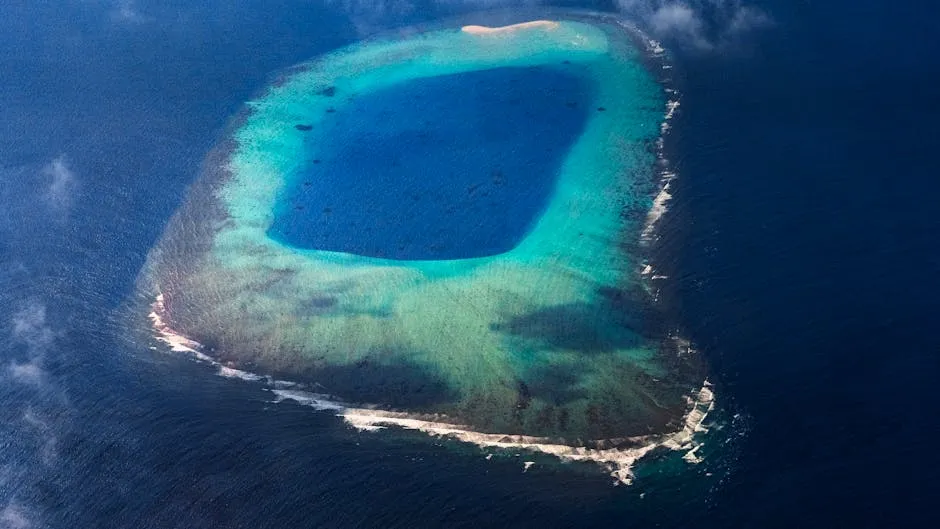
Maldives — The Complete Island Guide 2026
The country actively negotiating with the sea. Resort water villas at $1,200 a night and local-island guesthouses at $60, both on the same atolls, both depending on the same sandbar staying above water. The honest version of what’s real, what’s worth booking, and what the 2024 coral bleaching changed.
Why the Maldives? An Editor’s Note
On 17 October 2009, on a small military-training lagoon at Girifushi, President Mohamed Nasheed and thirteen members of his cabinet put on scuba gear, sat down at a table six metres below the surface, and signed a declaration asking the world’s governments to cut their carbon dioxide emissions in advance of the Copenhagen climate conference. The photographs went around the world. They are the iconic image of the climate-vulnerable small-island state, and they are exactly fifteen years old in 2026. Nasheed was forced from office by a 2012 putsch, jailed in 2015, exiled to the United Kingdom, returned and lost the 2023 election to the current president, Mohamed Muizzu, whose framing is the opposite of Nasheed’s: the Maldives is a sovereign developing nation, not a climate-poster-child to be pitied. The country still has an average ground elevation of one and a half metres. The sea has continued to do what the sea does. The political question of who gets to speak for the Maldives’ future has not been settled. This is the layer beneath every other layer in this guide, and it is worth saying first.
A visitor who comes to the Maldives in 2026 is choosing, often without knowing it, between three different versions of the country. The first is Resort Maldives: the model that began in 1972 when an Italian travel agent opened the first private-island guesthouse on Kurumba and that now operates roughly one hundred and seventy private-island resorts at price points between five hundred and fifteen thousand US dollars a night. This is the Conrad Rangali under-water restaurant, Soneva Fushi castaway villa, Anantara Kihavah champagne cellar model that the global travel industry has been selling since the 1990s. It is real, it is well-executed, and at no point in a seven-night stay are you required to interact with the country it is operating in. The water villas are stacked above water that was reef ten years ago. The staff are mostly Sri Lankan, Bangladeshi, Filipino and Nepali. The wine list is European. The cuisine is “modern Asian-Mediterranean.” This is the country’s working economic model and accounts for roughly a third of national GDP.
The second is Local-Island Maldives, which did not exist as a category before 2009. Until that year, the Maldivian government’s tourism policy banned foreign visitors from staying on any of the country’s two hundred and three inhabited local islands; the resort-and-local separation was the explicit design principle of Maldivian tourism since the 1970s, justified domestically as a defence of Islamic social norms and pragmatically as a way of keeping tourism dollars on the resort balance sheet. The 2009 reform under Nasheed reversed this. Foreign tourists may now stay on any inhabited island, in licensed guesthouses, at prices that begin at fifty US dollars a night. There are now roughly nine hundred and eleven of them across more than a hundred inhabited islands. Maafushi (the most-developed guesthouse island, party-and-social, ninety minutes by speedboat from Malé), Thulusdhoo (the surf island, “Cokes” and “Chickens” breaks), Dhigurah (the whale-shark island in Ari Atoll), and Fulidhoo (the manta island in Vaavu) are the working anchors. The local-island Maldives operates by different rules: no alcohol on the islands themselves (the country is dry outside resort and live-aboard licences), modest dress on public beaches, a separate “bikini beach” carved out at most guesthouse islands to keep tourist swimwear away from the family beach, and a working ferry network instead of seaplane transfers. It is a fundamentally different product, at roughly one-tenth the price, and it now accounts for an increasing share of total bed-nights.
The third is Climate Maldives — the country actively negotiating with the sea. Walk to the seaward edge of Hulhumalé, the artificial island built across the lagoon from Malé over the past twenty-five years, and look at the sea wall. Hulhumalé is the country’s literal answer to its climate problem: a 188-hectare, 1.8-to-2.0-metre-high reclaimed-land platform now home to about eighty-eight thousand people in Phase 1 (target completion 2026), with a 244-hectare Phase 2 underway and targeted for 2035 at one hundred and forty-five thousand residents. The architects designed it to remain above water until at least 2100. Beyond Hulhumalé, the country is engaged in a slower, less photogenic project: sea walls, beach renourishment, coral-restoration nurseries, the relocation of populations from the most exposed outer-atoll islands. The 2024 coral-bleaching event — the warmest sea-surface-temperature event the country has recorded since the catastrophic 1998 bleaching — killed an estimated fifteen to thirty per cent of inner-atoll coral cover in a single Indian Ocean summer. The reefs that the snorkellers come for are not the same reefs they were five years ago.
These three Maldives — the resort, the local island, the climate frontier — exist on the same atolls, often within a two-kilometre line of sight of each other. The visitor who books two nights at a twelve-hundred-dollar water villa and never sets foot on a local island is genuinely missing eighty per cent of the country. The visitor who books two weeks on Maafushi and never sees a coral reef from a live-aboard is missing the part the industry sells. Both are real. Both depend on the same sandbar staying above water. Read this guide in that frame, and the trade-offs make sense.
A working 2026 note on the economic backdrop: the country is in the worst debt crisis of its independent history. Roughly one and a half billion US dollars are due in 2025–26, including a five-hundred-million-dollar Islamic bond. Credit ratings are at junk level. The official Maldivian rufiyaa peg of MVR 15.42 to the dollar held through 2025, but black-market exchange premiums hit twenty-eight per cent at the height of the dollar shortage. For a visitor this matters only in narrow ways — your hotel bill is in USD and unaffected, but local-island guesthouses, ferries and kadafu (corner-shop) prices have moved with the rufiyaa rather than the official rate. Bring USD cash; trade it at a bank, not at a money-changer on the street.
Getting There — Velana, Seaplanes and Speedboats
The Maldives has one international airport — Velana International (MLE) — on the artificial island of Hulhulé, three kilometres north-east of Malé, connected to the capital by a Chinese-financed bridge (the Sinamale Bridge, opened 2018). Velana is the largest and busiest airport in the country and the working pinch-point for almost every visit: 99% of foreign visitors fly in here, transfer to a resort or a local-island ferry within hours, and fly out again. The new Terminal 2 opened on 26 July 2025, an expansion that roughly doubles international capacity and finally separates arrivals from departures at peak hours. The arrival hall now contains the world’s largest seaplane terminal — a separate single-storey building on the lagoon side, where Trans Maldivian Airways and Manta Air Twin Otters depart for resort transfers.
The direct routes that matter for European and North American visitors:
- Emirates (multi-daily ex Dubai), Qatar Airways (multi-daily ex Doha), Etihad (daily ex Abu Dhabi) — the Gulf-hub connections most European travellers use.
- Singapore Airlines (daily) and Cathay Pacific (daily ex Hong Kong) — the East-Asia hub options.
- Turkish Airlines (daily ex Istanbul) — the working European-via-Istanbul option, often the cheapest from continental Europe.
- Lufthansa, British Airways, KLM, Air France run seasonal direct flights — most reliable in the November–March peak season.
- IndiGo and SpiceJet ex India multiple daily — affected by the 2024 #BoycottMaldives campaign (Indian arrivals fell roughly 42 per cent in 2024 before partially recovering through 2025).
After Velana — the transfer is half the journey
The Maldives is not a place you arrive in. It is a place you arrive at the front door of. Almost every visitor needs a second transfer — by seaplane, speedboat, or domestic flight + speedboat — to reach the actual resort or guesthouse island. This is unique among major holiday destinations and has practical consequences for arrival timing.
Seaplane transfers (Trans Maldivian Airways, Manta Air) operate only in daylight: 06:00 to 15:30 approximately. If your international flight lands after 14:00 and your resort is seaplane-only, you will overnight at Hulhulé or Malé and transfer the next morning. Most luxury resorts include the seaplane in the package; expect $400–800 per person round-trip if booking separately. Manta Air is the newer operator with the cleaner aircraft; TMA has the larger network. The flight itself is part of the experience — twenty to fifty minutes low over the atolls in a Twin Otter on floats, with a pilot in shorts and Crocs.
Speedboat transfers are the 24-hour alternative used by resorts within roughly 100 km of Velana — typically North Malé Atoll, South Malé Atoll, and parts of Ari and Vaavu. $80–250 per person round-trip, 30–120 minutes each way. Speedboats run regardless of daylight, which means late-arriving guests can transfer at 22:00 if the resort is speedboat-accessible.
Domestic flights + speedboat — for the further atolls (Baa, Raa, Lhaviyani, Gaafu, Addu in the far south). Maldivian Airlines and Manta Air run a regional propeller-aircraft network from Velana to domestic airports at Dharavandhoo, Ifuru, Dhaalu, Kooddoo, Gan and others; from the domestic airport, a 10–30 minute speedboat to the final island. The domestic flight is normally $250–450 per person round-trip and is sold as part of the resort package.
Public ferries (MTCC Ferry Network) — the cheap option, but slow. The state-run MTCC operates scheduled ferries from Malé to most inhabited local islands at MVR 22–50 ($1.50–3.50) per person each way; the Malé–Maafushi ferry is the working backpacker route. Ferries do not run on Fridays, run 1–4 times a week to most islands, and take 90 minutes to 5 hours depending on the route. This is the right transport for a local-island stay; not realistic for a one-week resort trip.
Editor’s tip: Book your international flight to land before 12:00 if your resort is seaplane-only. The cascading effect of a missed seaplane connection — overnight in Malé, missed first night at the resort, no refund — is the single most common Maldives trip-killer. The major Gulf hubs (Dubai, Doha, Abu Dhabi) all have early-morning Malé departures that land 10:00–11:30 local; these are the right connections.
Pro Tip: The IMUGA online declaration is mandatory. Complete it at imuga.immigration.gov.mv within 96 hours of arrival — not earlier, not later. The form takes ten minutes, asks for passport details, arrival flight number, accommodation, and a health declaration. You will be asked for the IMUGA confirmation at check-in for your inbound flight; airlines have started refusing boarding to passengers without it.
Top 12 Attractions in the Maldives
The Maldives “attractions” list is unusual because most of it is in the sea rather than on land. Land-based attractions concentrate in Malé and Hulhumalé; the bigger experiences — manta cleaning stations, whale-shark transects, the thila dives — are positional events keyed to atoll and season. A first visit should mix one or two land-based attractions in Malé with the right number of sea-based experiences for your transfer-budget tolerance.
1. The Manta Ray Cleaning Station at Hanifaru Bay (Baa Atoll)
The most spectacular animal-aggregation event in the Maldives, and one of the most-documented in any tropical ocean. Between May and November, when the south-west monsoon current concentrates plankton in the funnel-shaped bay of Hanifaru in Baa Atoll, between fifty and two hundred reef manta rays (some sources say up to four hundred at peak) congregate at the cleaning station to feed and be picked clean by smaller fish. The bay was declared a UNESCO Biosphere Reserve in 2011 and the marine protected area is regulated: snorkellers only (no diving), maximum 80 visitors at a time, $25 (MVR 385) entry fee, mandatory guide. Most Baa Atoll resorts and Dhigurah / Dharavandhoo guesthouses run daily excursions in season for $80–150 per person.
- Access: Baa Atoll — requires either a Baa Atoll resort booking, or a Dharavandhoo guesthouse stay (the local-island option, with the airport on its doorstep).
- Season: May to November; peak August–October.
Editor’s tip: Hanifaru is one of the world’s busiest planned-encounter sites; the 80-visitor cap is enforced and the queueing system is real. If you have flexibility, go on a weekday morning rather than a Saturday. The mantas themselves are unfazed by snorkellers as long as the marine-park rules (no touching, no fins-on-coral, no flash) are observed.
2. The Whale-Shark Transect (South Ari Atoll)
The other megafauna anchor. South Ari Atoll holds one of the few year-round populations of juvenile whale sharks in the Indian Ocean — animals between four and seven metres long that feed along the inner reef edge between Maamigili and Dhigurah and have been monitored daily by the Maldives Whale Shark Research Programme since 2006. Guesthouses on Dhigurah run two-hour boat-and-snorkel excursions for $60–90 per person; resort-based excursions are $150–250 from the Ari Atoll properties.
- Season: Year-round, with August–November the peak sighting months.
- Access: Dhigurah local-island guesthouse base, or any South Ari Atoll resort.
3. The Old Friday Mosque (Hukuru Miskiy), Malé
The seventeenth-century coral-stone mosque on Medhuziyaaraiy Magu, in the heart of old Malé. Built between 1656 and 1658 under Sultan Ibrahim Iskandar I on the foundations of an older mosque from the 1100s, the building is a working jumu’ah (Friday prayer) mosque with a coral-stone interior decorated with intricate carved-and-painted Arabic calligraphy, lacquerwork, and a famous interlocking-coral-block construction technique that uses no mortar. The mosque is on the UNESCO World Heritage Tentative List (submitted 2013, not yet inscribed) and is the single most important pre-modern building in the Maldives.
- Hours: Closed during prayer times. Non-Muslim visitors are admitted between prayer windows on most days with permission from the Ministry of Islamic Affairs (a permit issued at their Malé office — bring passport, allow 1–2 hours).
- Entry: Free with permit. Modest dress strictly required (shoulders, knees, women’s hair covered). Shoes off at the door.
- Access: Walking distance from Malé waterfront — 5 minutes from the ferry terminal.
Pro Tip: The exterior is genuinely impressive even without entry — the coral-block walls, the wooden window frames, the cemetery of carved tombstones in the courtyard. Walk around the mosque at sunset; you do not need a permit for the outside.
4. The Malé Fish Market and Hulhumalé Beach
The working fish market on the northern Malé waterfront — daily morning landing of skipjack tuna, yellowfin tuna, reef fish and the occasional bigeye, sold from concrete trestles in front of the ferry terminal between 04:00 and 11:00. The market is loud, crowded, real, and is the part of Malé most short-stay visitors miss. Hulhumalé Beach is the artificial-island beach opposite — long sandy public beach, working bikini section (yes, in the Maldives capital), restaurants, ice cream, the right end-of-Malé afternoon. Both free.
5. The National Museum of the Maldives (Sultan Park, Malé)
The country’s national museum, in the former Sultan’s Palace grounds (the original palace itself was demolished in 1968 after the Republic was declared; the current museum building is a 2010 Chinese-funded structure on the same site). The permanent collection includes pre-Islamic Buddhist statues recovered from the country’s earliest periods — most of them famously smashed by an Islamist mob in 2012 during a brief political crisis and partially restored since. The museum tells the country’s history from the pre-Islamic Buddhist period through the 1153 Islamic conversion through the Sultanate to the modern Republic.
- Hours: Sunday–Thursday 10:00–16:00. Closed Friday/Saturday.
- Entry: MVR 100 (≈$6.50) adults, free under 12.
- Access: Walking distance from the Malé ferry terminal.
6. Ithaa Undersea Restaurant (Conrad Maldives Rangali Island)
The world’s first all-glass underwater restaurant — opened 2005, located five metres below the surface in the Conrad Maldives Rangali Island lagoon — is a working tourist anchor regardless of whether you stay at the resort. The acrylic-and-steel dome seats fourteen and serves lunch and dinner sittings; the experience is the room rather than the food, and the bookings sell out months ahead.
- Hours: Lunch and dinner; reservations only.
- Entry: Lunch from approximately $250 per person, dinner from approximately $400, both excluding tax and service. Open to outside guests on availability but the resort gives priority to its own.
Editor’s tip: The Ithaa lunch sitting at midday is the better one — natural light through the acrylic dome turns the reef into a working aquarium. The dinner sitting depends on resort floodlighting and the marine life is less active. The cost is high; the experience is genuinely singular.
7. The Undersea Restaurant at Anantara Kihavah (SEA)
The second-generation underwater restaurant — opened 2012, in Baa Atoll, more architecturally ambitious than Ithaa (a 24-seat acrylic tunnel rather than a dome) and with the country’s best-regarded wine cellar above it (the same building stacks SEA restaurant below water with SKY observatory and the CELLAR above). The Anantara Kihavah package routinely includes a SEA dinner; standalone bookings are about $350–500.
8. The Coral Restoration Site at Reefscapers Sites (various atolls)
The coral-restoration programmes run by Reefscapers and the resort-based marine-biology teams — Six Senses Laamu, Soneva Jani, Kuda Huraa, Anantara Kihavah — are not officially “attractions” but most participating resorts now run guest-attended coral planting sessions where visitors fix small coral fragments to metal frames that are then sunk in nursery sites. $50–150 per session including the framed coral, dive or snorkel, and certificate. After the 2024 bleaching event the resorts that run these programmes are taking them more seriously than they used to.
9. The Hulhumalé Sea Wall (Climate Walk)
Not a marketed attraction — a walking experience. The eastern sea wall of Hulhumalé Phase 1 (the artificial-island suburb opposite Malé) is a working flood-defence engineering project: a one-and-a-half-metre-high concrete-and-rock embankment, several kilometres long, with a pedestrian promenade behind it. Walking the wall at sunset is the most honest climate-impact experience the visitor can have in the Maldives without a research permit. It is twenty minutes from the airport by bus or fifteen from Malé by the Sinamale Bridge.
10. Surf Breaks — Cokes, Chickens and the South Atolls
The Maldives is one of the world’s quietly serious surf destinations — left and right reef-breaks across the central atolls, water at 28 °C, swells driven by Indian Ocean lows. Cokes and Chickens (Thulusdhoo, North Malé Atoll), Sultans and Pasta Point (Tari Village, North Malé), and the south-atoll breaks (Tiger Stripes, Beacons at Huvadhoo) are the names that come up. Surf season is February to November, with the best swells April–October. Surf-charter live-aboards from $1,200/week; Thulusdhoo guesthouses with surf packages from $90/night.
11. The Veligandu Sandbank (and other named sandbanks)
A sandbank picnic — boat to an empty white-sand bar in the middle of a reef, set up a small lunch, snorkel, swim, leave by dusk — is the iconic resort excursion and is also offered as a half-day trip from most guesthouse islands. The specific named sandbanks include Veligandu (Rasdhoo Atoll), Madivaru (Ari), Kondey (Vaavu), and the many unnamed ones each resort claims as “their” sandbank. $30–60 per person from a guesthouse island; included or upgraded from a resort.
12. The Maldives Victory Wreck Dive (North Malé Atoll)
The country’s signature wreck dive — the Maldives Victory, a 100-metre cargo ship that sank in February 1981 off the airport channel, now lying upright at 16–35 metres on a sandy bottom, encrusted with soft coral and patrolled by jacks, batfish, sometimes a large napoleon wrasse. Access by day-dive from Malé or a North Malé resort; standard wreck dive briefing applies. $80–120 per dive from a dive centre.
The Atolls — Where Each Maldives Lives
The Maldives is organised administratively as twenty-one geographic atoll groups stretching across roughly 870 kilometres of north-to-south Indian Ocean. Most visitors only encounter the central atolls; the further atolls are less developed, more expensive to reach, and often more interesting once you do. A short orientation, north to south.
North Malé Atoll and South Malé Atoll — the working centre
The two atolls that surround the capital. North Malé Atoll holds Hulhulé (airport), Malé (capital), Hulhumalé (suburb), and roughly thirty resort islands — the highest density of resorts in the country, all within seaplane or speedboat range. South Malé Atoll is smaller, with a similar concentration of mid-tier and upper-mid-tier resorts. This is the standard short-stay base — speedboat-accessible, less expensive transfers, easy combination with a Malé day. The trade-off: more development, more boat traffic, busier dive sites.
Ari Atoll — the whale-shark and big-fish atoll
Long thin atoll to the west, two hours by speedboat or 25 minutes by seaplane from Velana. South Ari is the year-round whale-shark range; North Ari has the manta-and-hammerhead range. Dhigurah is the local-island guesthouse anchor; Maamigili is the regional-airport island. Resorts range from mid-tier (Velassaru, Kuramathi) to upper-end (Velaa Private Island with its single Asia’s-50-Best-listed restaurant, Aragu).
Baa Atoll — UNESCO Biosphere, Hanifaru, the manta atoll
Forty-five minutes by seaplane north-west of Velana. UNESCO Biosphere Reserve since 2011. Hanifaru Bay (see above). Higher-end resorts (Soneva Fushi, Anantara Kihavah, Four Seasons Landaa Giraavaru, plus a working set of upper-mid options). The local-island guesthouse base is Dharavandhoo, the airport island, with the daily Hanifaru access boat.
Lhaviyani Atoll — the next-quietest atoll
North of North Malé. The diving anchor is Kuredu and the surf-and-dive site at Felivaru. Quieter than Baa, less famous than Ari, often the right choice for a second-visit traveller who wants the resort product without the busier atoll.
Laamu, Meemu, Faafu, Dhaalu — the central atolls
The middle of the country, less developed, generally requires a domestic flight from Velana plus speedboat. Six Senses Laamu is the flagship resort here — the southernmost surf resort in the country, with an in-house marine-biology centre. The local-island product in these atolls is genuinely thin.
Gaafu Atoll — the deep south
A long flight south (1 hour 15 minutes on the domestic-flight network). Two large atolls (Gaafu Alif and Gaafu Dhaalu) with the country’s best-regarded thila (submerged-pinnacle) dive sites. Resorts including Park Hyatt Hadahaa and Robinson Club Noonu.
Addu Atoll — the southernmost atoll
The far-south island group, just south of the equator, with the country’s second-largest airport at Gan (a former British RAF base, the airport built 1942) and the working second city of Hithadhoo. Geographically distinct — the only Maldivian atoll where you can drive from one end to the other on a road, courtesy of a series of British-built causeways from the 1950s. Equator Village is the working budget hotel.
Where to Stay — by Budget
Maldives accommodation breaks into four tiers, and the per-person-per-night ranges below assume double occupancy in shoulder season. Peak season (Christmas / New Year, Chinese New Year) adds 30–80%; deep low-season (May–August) deducts 25–40%.
Local-island guesthouse — $40–150 per person per night
The post-2009 segment. Family-run guesthouses on inhabited islands, two to twelve rooms, fan or AC, simple breakfasts, optional half-board, walking-distance bikini beach. Maafushi has the most density (hundreds of guesthouses, party scene), Thulusdhoo is the surf-and-quiet option, Dhigurah is the whale-shark base, Fulidhoo is the manta-and-quiet option, Ukulhas is the eco-anchor. The product is genuinely good at $80–120/night and includes the moral satisfaction that the money is largely staying with the host family rather than a Singaporean holding company.
- Examples: Arena Beach Hotel (Maafushi), Crown Beach Hotel (Maafushi), Salt Beach Hotel (Maafushi), Coconut Holidays (Thulusdhoo), Boutique Beach (Dhigurah). All $60–150/night including breakfast.
Budget resort — $250–450 per person per night
The lower tier of private-island resorts, often older properties or chain mid-market brands. Velassaru, Kandolhu, Adaaran Select Meedhupparu, Embudu Village, Olhuveli, Vilamendhoo. Half-board or all-inclusive packages standard. The product is honest and the snorkelling is real; the rooms and bars are dated compared to the upper tiers.
Upper-mid resort — $500–1,000 per person per night
The well-regarded middle of the resort range. Anantara Veli, Anantara Dhigu, Kuramathi, LUX South Ari Atoll, Hurawalhi, Constance Halaveli, Constance Moofushi, Dusit Thani, Atmosphere Kanifushi. Modern beach villas or entry-level water villas, multiple restaurants, full water-sports programme, in-house dive centre.
Top-tier resort — $1,200–8,000+ per person per night
The flagship private-island product. Soneva Fushi and Soneva Jani (the “no news, no shoes” pioneers; private chefs, observatories, multi-bedroom villa-houses), Cheval Blanc Randheli, Velaa Private Island, The St Regis Vommuli, Joali, One&Only Reethi Rah, Four Seasons Landaa Giraavaru, Anantara Kihavah Villas, Conrad Rangali Island, Six Senses Laamu. Water villas, butler service, multiple restaurants, the most ambitious culinary programmes in the country, multi-thousand-dollar excursion menus.
What to skip
Avoid Booking.com “Maldives” listings that turn out to be on Hulhumalé without specifying so — they market as “Maldives experience” but the snorkelling is municipal, the beach is artificial, and the whole experience is twenty minutes from the airport rather than a Maldivian atoll. Also avoid bottom-end “all-inclusive” deals on older resorts that look cheap on per-night line — once you factor in the seaplane/speedboat transfer (often $200–400 per person) and the alcohol upcharges, the total trip cost approaches mid-tier.
Where to Eat — Mas, Rihaakuru, the Resort Restaurant
Maldivian food is unfamiliar to most visitors and worth seeking out at least once during a trip, particularly on a local-island stay where it is the default rather than a resort speciality.
What Maldivian food actually is
- Mas — the all-purpose word for tuna, the country’s defining ingredient. Skipjack and yellowfin are everyday; trevally and bonito feature in specific dishes.
- Mas huni — the iconic breakfast: shredded smoked tuna mixed with grated coconut, finely chopped onion, lime juice and chilli, eaten with roshi (Maldivian flatbread) and hot black tea.
- Garudhiya — a clear tuna broth, the country’s national soup, served with rice, chilli, lime and onion as the working lunch.
- Rihaakuru — a dense brown thick fish-paste made by reducing tuna broth for hours; an acquired taste, intensely savoury, eaten in small amounts with rice as a condiment.
- Bis keemiya — fried pastry triangles filled with cabbage, onion and tuna; the country’s defining tea-time snack.
- Hedhikaa — the broader category of fried short-eats sold from a kadafu (corner shop): bajiya, gulha, kulhi boakibaa, the lot.
On a local island
- The working cafés on Maafushi, Thulusdhoo and other guesthouse islands serve a mix of Maldivian dishes, Indian-style curries (Sri Lankan and Indian influence is heavy), Western breakfast options and approximations of European mains. Expect $5–12 per main, $1.50–3 for a short-eat.
- The kadafu corner shops sell hedhikaa for MVR 5–15 each (40¢–$1) — the cheapest authentic Maldivian food experience in the country.
- Several guesthouses run traditional Maldivian dinners as an extra — a host-family meal of mas huni, garudhiya, rihaakuru and a fish curry, eaten in the family’s home for $15–25 per person. The right thing to book once per trip on a local island.
At a resort
The resort food product is fundamentally a different cuisine. Soneva Fushi has six restaurants from Japanese to Italian to Maldivian and runs guest-chef weeks throughout the year. Anantara Kihavah runs SEA (the underwater restaurant), SKY (the rooftop observatory wine cellar), CELLAR (the cellar tasting room) plus four other restaurants. Velaa Private Island holds Aragu, the only Maldivian restaurant on Asia’s 50 Best (the modern-European-with-Asian-twists tasting menu, chef Gaushan de Silva, around $250–400 per head for the tasting). Conrad Rangali has twelve restaurants including the Ithaa underwater room.
In Malé and Hulhumalé
The capital is the only place in the country with a non-resort restaurant scene at any scale.
- Symphony, Boduthakurufaanu Magu — the working upper-mid Maldivian seafood restaurant in central Malé. Grilled reef fish, garudhiya, the local-feast version. $20–40 per head.
- Sala Thai (Boduthakurufaanu Magu) and Sea House (the rooftop on the eastern waterfront) — the long-running mid-range options.
- Seagull Café (Chandhanee Magu) — the institutional Malé café-restaurant, ice cream, simple meals, working-day social anchor.
- The Sea Bar at Hulhumalé Phase 1 — the most reliable Hulhumalé end-of-day option after the climate-walk seawall stroll.
Michelin, plainly stated
The Maldives has no Michelin guide as of May 2026. The Michelin Guide has not extended to the Indian Ocean. Some Maldivian resort marketing copy references “Michelin-starred chefs” — this typically means a guest-chef visiting from a starred restaurant elsewhere (Anantara’s “Around the World” guest-chef programme is the working example), not a star awarded to the Maldivian property. Aragu at Velaa Private Island is the only Maldivian restaurant on the World’s 50 Best Restaurants Asia list, in the 51–100 band — the country’s strongest published international culinary recognition.
Editor’s tip: Eat one Maldivian meal per day on a local-island stay. The hedhikaa-and-tea morning is right, the mas huni breakfast is right, the host-family supra dinner is right at least once. The resort food is good but is not Maldivian food, and most visitors who only do the resort week leave without having eaten a single dish that could not have been served in Bali.
Drinking — Resort Bars and the Dry-Island Reality
The Maldives is a dry country in law and largely in practice. Alcohol is illegal for Maldivian citizens and is not sold on any inhabited island. Possession by tourists outside licensed premises is a customs offence — the airport’s arrivals customs check is strict on alcohol and pork, both confiscated at entry. There are no liquor stores. There are no bars on local islands. There are no off-license sales.
The two licensed-alcohol exceptions:
Resort bars
Every private-island resort holds a tourism licence that permits alcohol service. This is a working part of the resort segment and the wine programmes are some of the most ambitious in the Indian Ocean — Anantara Kihavah’s CELLAR holds a six-hundred-plus-label list; Velaa Private Island runs a wine vault that has earned multiple Wine Spectator awards; Soneva Fushi runs reserve-wine evenings with the in-house sommelier. Resort bars are open to all guests and prices range from $12–25 for a beer (Heineken, Tiger, Carlsberg are the working international labels) to $20–60 for a glass of mid-range wine.
Live-aboards and the airport hotel
The Hulhulé Island Hotel (the airport’s adjacent hotel) holds the country’s only on-airport-island alcohol licence — useful for an overnight if your seaplane has been cancelled and you want a beer. Live-aboard dive and surf boats that operate beyond Malé reef hold separate alcohol licences as floating tourist platforms. Both are limited to ticketed guests.
What this means for a local-island stay
Most visitors who stay on Maafushi, Thulusdhoo or other local islands quickly realise the trip is a dry-week experience. The work-arounds are real: the “booze cruise” day-trips (a chartered boat from the local island to a designated 12-mile-offshore live-aboard or anchored licence-holding vessel) run from Maafushi and other party islands for $30–60 per person; some local-island guesthouses arrange these. The other option is a half-day resort visit — most resorts will sell day passes ($150–400) that include lunch, beach access, and full bar service.
If you want a wine-and-cheese Maldives, book a resort. If you want a dry-week Maldives with snorkelling and Maldivian breakfasts, book a local island. Mixing the two within one trip is the better answer than picking either alone.
Pro Tip: Customs will confiscate any alcohol or pork product you bring in your luggage, including small quantities and gift-shop souvenirs. The dogs at Velana are real. If your duty-free wine purchase shows up, it gets bagged and tagged on arrival and returned on departure — minus a small storage fee. Just don’t bring it; the resort has wine, and the local island doesn’t allow it.
Getting Around the Country
The Maldives runs on boats. The internal transport system is one of the densest small-craft networks in the world.
Inside the resort or guesthouse island
You walk. Most resort islands are 500–1,500 metres long and 100–300 metres wide; most local islands are similar. Bicycles are sometimes available for hire at $5–10/day on the larger local islands.
Between islands
- Public ferry (MTCC) — the cheapest option. $1.50–4 per person, 90 minutes to 5 hours, 1–4 sailings per week per route, no Fridays. The Malé–Maafushi ferry is the working backpacker route ($1.50, 90 minutes, departs roughly 15:00 daily except Fridays, returns at 07:30).
- Speedboat shuttles — privately operated, $20–40 per person, 30–90 minutes, daily multiple sailings on the busiest routes (Malé–Maafushi, Malé–Hulhumalé). Use Trip.com or Maldivian.aero for booking; some operators are direct-booking only via WhatsApp.
- Domestic flights (Maldivian Airlines, Manta Air) — the working way to reach far atolls. 25–80 minutes flight time, $150–350 per leg.
- Seaplane transfers — resort-arranged; $200–500 per person each way, daylight only.
Within Malé and Hulhumalé
- Bus — the MPL bus runs Malé and Hulhumalé on a working route. MVR 5 (35¢) per ride.
- Taxi — cheap by tourism-zone standards. MVR 30 (≈$2) flat fare for a Malé taxi; airport taxi to Malé via the bridge is MVR 100–150 ($6.50–10). Use the Ekuveni or Avas apps; flag-down also works.
- Walking — Malé is 5.8 km² and entirely walkable end-to-end in 45 minutes.
Driving
There is no driving outside Malé / Hulhumalé / Hulhulé / the Sinamale Bridge (which connects all three) and Addu Atoll (which has the British-built causeway system). The four main central islands together permit a working road network of perhaps 20 km. Car hire is theoretically possible but unnecessary for a visitor.
Editor’s tip: The MTCC public ferry is the genuine Maldivian local experience and is worth doing at least once — for $1.50 you spend ninety minutes on the deck of a working inter-island ferry with locals, school children, fishermen and a stack of cargo. The schedule is real (not loose) and the boats are well-maintained. Buy the ticket at the Malé Villingili Ferry Terminal twenty minutes before sailing.
When to Visit
The Maldives has two seasons, defined by the monsoon direction.
- Iruvai monsoon (Northeast) — December to April. Dry, clear, calm seas, low humidity, eight to nine hours of sun per day. Peak tourism season. Hotel rates 30–80% above shoulder. Christmas–New Year and Chinese New Year are the absolute peak. Manta and whale-shark sightings continue.
- Hulhangu monsoon (Southwest) — May to November. Wet, with multi-day rain spells and bigger swells. The peak Hanifaru manta-aggregation season is here (May–November). Hotel rates fall 25–40%. Surf swells are best April–October. The trade-off: weather is genuinely less predictable, the seaplane flights occasionally cancel for low cloud, and you may lose half a day to a tropical squall.
The shoulder months
April and November are the right transition windows — generally dry-enough weather with shoulder-season pricing. May and October are second-best.
The wedding-month rule
For visitors planning honeymoons and special-occasion stays: late February through early March is the historical “best week” — confirmed dry, calm seas, post-Chinese-New-Year prices drop slightly. Mid-March onward is also reliable but the temperature begins climbing.
The political-calendar layer
The 2026 political calendar to note: the country has been in a worst-since-independence debt-restructuring negotiation through 2025 and into 2026. There are no visa or transit consequences for a tourist, but there have been occasional brief currency-control tightenings (cash withdrawal caps at ATMs, USD-cash purchase requirements at some local-island guesthouses); bring USD cash and verify card-payment expectations with your booking before travel.
Month-by-Month Weather
The Maldives is genuinely a year-round destination by temperature; the variable is rain. Figures below are working averages from the central atolls.
| Month | Day high (°C) | Night low (°C) | Rain days | Sea condition | Notes |
|---|---|---|---|---|---|
| Jan | 30 | 25 | 4 | Calm | Peak; book early |
| Feb | 31 | 25 | 3 | Calm | Driest month |
| Mar | 31 | 26 | 4 | Calm | Excellent visibility |
| Apr | 32 | 27 | 7 | Mostly calm | Transition; surf begins |
| May | 31 | 26 | 14 | Choppy | Monsoon onset; Hanifaru opens |
| Jun | 30 | 26 | 16 | Choppier | Off-peak rates; surf |
| Jul | 30 | 26 | 14 | Choppier | School-holiday upcharge offsets monsoon discount |
| Aug | 30 | 26 | 14 | Choppier | Peak Hanifaru |
| Sep | 30 | 25 | 14 | Choppy | Peak Hanifaru |
| Oct | 30 | 25 | 12 | Variable | Transition; whale sharks |
| Nov | 30 | 25 | 9 | Calming | Excellent shoulder |
| Dec | 30 | 25 | 6 | Calm | Peak begins; Christmas surcharge |
Daily Budget Breakdown
Figures below are per person per day, in US dollars (the working tourism currency). All-in includes accommodation share, food, transfers prorated, basic excursions.
| Budget level | Per day | What you get |
|---|---|---|
| Local-island backpacker | $50–90 | Maafushi/Thulusdhoo guesthouse ($60), breakfast included + lunch and dinner at island cafés ($20), one shared snorkel/sandbank excursion ($20) |
| Local-island comfortable | $120–200 | Upper-tier guesthouse with AC and beach ($110), two restaurant meals ($35), one half-day excursion ($40) |
| Budget resort | $300–500 | Older private-island resort, half-board, snorkelling included, transfers extra |
| Upper-mid resort | $700–1,200 | Modern beach villa, multiple restaurants, included transfers in package, two excursions a week |
| Top-tier resort | $1,500–6,000+ | Water villa or larger, butler service, all dining included, multiple excursions, the wine programme |
The honest Maldives budget answer: the most cost-efficient sweet spot is a mixed trip — three nights at a local-island guesthouse ($300 total) followed by three nights at an upper-mid resort ($3,500 total) is materially better than seven nights at a single tier, and the contrast between the two experiences is the trip-defining payoff.
Sample Itineraries
5 days — the essential first visit
- Day 1 (Malé and Hulhumalé). Arrive Velana, ferry to Malé, walk Old Friday Mosque + fish market + National Museum in the morning, lunch at Symphony, afternoon on Hulhumalé Beach + climate-wall walk, dinner at The Sea Bar in Hulhumalé.
- Day 2 (Local island arrival). Morning speedboat to Maafushi (90 min) or Thulusdhoo (depends on swell). Bikini beach afternoon, sunset snorkel, mas huni dinner at the guesthouse.
- Day 3 (Sandbank + snorkel day). Booked excursion: morning sandbank picnic, afternoon snorkel-channel drift dive, dinner in the village. ~$45.
- Day 4 (Resort arrival). Speedboat or seaplane to a North or South Malé Atoll mid-tier resort. Afternoon arrival, sunset cocktail at the resort, dinner.
- Day 5 (Resort day + departure). Lazy morning, snorkel, lunch, transfer to airport, evening departure.
7 days — adds the big animal anchor
Days 1–5 as above plus Days 6–7: Add the whale-shark anchor (south Ari) or the manta anchor (Baa, depending on season). Best done as either a guesthouse-on-the-airport-island stay (Dharavandhoo for Baa, Maamigili for South Ari) with daily excursions, or an Ari/Baa atoll resort.
10 days — the country in honest balance
Days 1–7 as above. Day 8: transfer to a different atoll (Baa if you did Ari, or vice versa). Day 9: the experience that the new atoll offers. Day 10: return transfer to Velana, departure. This is the trip Maldives veterans actually recommend.
Best Day Under $50 — Local Island and a Sandbank
The cheapest serious Maldives day, achievable from any of the major guesthouse islands. The price line is the price line; here are the working items.
| Item | Cost | Notes |
|---|---|---|
| Mas huni breakfast at the guesthouse | $0 | Included in standard half-board |
| Public ferry to a nearby uninhabited island | $3 | $1.50 each way |
| Half-day sandbank-and-snorkel excursion | $30 | Shared boat, mask + fins included |
| Lunch at the guesthouse / island café | $8 | Tuna curry + rice + lime |
| Hedhikaa snack from the kadafu | $1.50 | Two bajiya + a tea |
| Sunset at the local beach | $0 | Free |
| Dinner: grilled reef fish at an island restaurant | $12 | Mas + roshi + sambol |
Running total: $54.50 / €49 — slightly over the $50 target.
To genuinely fit under $50, swap the half-day excursion for a self-organised snorkel from the village reef (free), keep the rest, and the day comes in at $24.50 / €22 — well under, and still authentic.
For context, the fleet’s Best Day Under leaderboard reads roughly: Cairo $3.50 · Bogotá $6 · Kuala Lumpur €8.50 · Munich €12 · Bangalore €15 · Tbilisi €25 · Nicosia €32.60 · Sicily/Corsica €35–40 · Maldives (local island) $50. The Maldives is the most expensive entry on the Best Day Under leaderboard because the transport floor is genuinely higher — you cannot reach a usable snorkel reef on a $5 day. The reference is honest about that.
Editor’s tip: The “$50 Maldives day” requires you to be already on a local island. If you’re trying to do this from Malé, add $50–100 for the speedboat return, which busts the budget. The honest framing: this is a day-rate budget for a multi-day local-island stay, not a one-day-fly-in possibility.
Hot Afternoon, Storm-Day & Off-Season Plans
Hot afternoon (March–April, 31–33 °C)
The Maldives gets sticky-hot in the mid-afternoon March–April window. The right responses: get in the water (the sea is 28 °C and is the right cooling system); take a siesta in the AC room; or head for the resort spa. Avoid outdoor sandbank lunches at noon during these months — the sun is brutal, the white sand reflects, and the sandbank has no shade.
Storm day (May–November squalls)
A monsoon-season storm in the Maldives is a 90-minute tropical squall, often followed by clear weather. Stay indoors, lean on the resort’s library/games/spa programme, eat a long lunch. The seaplanes will not fly in heavy rain — if you have a storm-day-then-flight scheduled, expect delays.
Off-season (May–November)
The off-season Maldives is genuinely different. Hotel rates are 25–40% lower; the Hanifaru manta season is open; the surf is at its best. The trade-off: rainier weather, choppier seas, occasional seaplane cancellations, more multi-day grey spells. The right answer for a returning visitor or a budget-conscious first-timer; the wrong answer for a honeymooner with a single-week window who needs guaranteed weather.
Day Trips and Excursions
Manta Bay (Hanifaru, Baa Atoll)
See Top Attractions #1. $80–150 from Baa Atoll resorts or Dharavandhoo guesthouse, $25 marine-park entry, mandatory guide. May–November.
Whale-shark transect (South Ari Atoll)
See Top Attractions #2. $60–90 from Dhigurah, $150–250 from Ari Atoll resorts. Year-round, peak August–November.
Reef-channel drift snorkel
Standard guesthouse-island excursion. A boat takes you out to a tidal channel at slack water, drops you in, and picks you up on the other side as the current carries you through. Manta, eagle ray, reef shark, turtle, school fish. $25–50.
Live-aboard dive trip
The serious-diver answer to the Maldives. 5–7 night live-aboards out of Malé covering Central, Ari, Baa, North Malé. $1,800–3,500 per person for the week including dives. Operators: Carpe Diem, Emperor, and a substantial wider fleet — check operator safety record and recent reviews before booking.
Surf day or week (Thulusdhoo and other surf islands)
Thulusdhoo is the working surf base. Day surf-guides $50–80, boat-transfer to the breaks $30–60 per session. Surf-camp guesthouses run weekly packages from $90/night with surf included.
Resort day pass
Most North and South Malé Atoll resorts sell day passes from $150–400 per person including lunch and the bar. Useful from Maafushi or Hulhumalé for a one-day resort experience without the multi-night spend.
Submarine dive (Whale Submarine, Malé)
The Whale Submarine company operates a working tourist submarine out of Malé — 35-minute dive to ~40 metres, viewing-port windows on a recognised submarine. About $90 per adult, $45 child. Notable as the world’s largest passenger-submarine deep-dive operation; departure schedule depends on demand.
Safety & Practical Information
Crime
The Maldives is one of the safer destinations in South Asia by violent-crime metric — particularly on resort islands (closed populations, working tourist economy) and local islands outside Malé (small communities, low petty-crime baseline). Malé itself has the expected mid-density-city issues: pickpocketing in market areas, scooter-snatch bag thefts, occasional credit-card skimming reports. The standard response is the standard response.
Health
The Maldives operates a working medical infrastructure on the larger islands, with a referral hospital in Malé (the Indira Gandhi Memorial Hospital is the main public facility; ADK Hospital is the major private alternative) and resort-island clinics for routine matters. Decompression sickness is a real risk for divers — the country has chambers in Malé, Bandos and Kuredu. For anything serious, evacuation to Sri Lanka or India is the working pathway; travel insurance with diving cover is mandatory.
Sun and dehydration
The Maldives sits less than a degree off the equator. UV index routinely 11+. Day-one sunburn is the single most common visitor mistake. Reef-safe sunscreen (zinc-oxide-based, no oxybenzone) is required at most resorts since the 2024 coral-bleaching event; some resorts now confiscate non-reef-safe sunscreen at check-in. Drink more water than you think.
Modesty and the law
The Maldives is a Sunni Muslim country with a sharia-influenced legal framework. On resort islands the resort tourism licence overrides local social norms — bikini swimwear, alcohol service, mixed-gender beach use are all expected. On inhabited local islands, modesty is required: shoulders and knees covered in the village, swimwear only on the dedicated bikini beach (every guesthouse island has one). Public displays of affection should be moderate. Photography of locals should be with permission. Bringing in alcohol, pork, religious materials of other faiths, or anything resembling an idol is a customs offence.
Money and ATMs
- USD is the working tourism currency. Resort bills are in USD. Speedboat transfers are quoted in USD. Most large transactions go through in USD.
- MVR (the Maldivian rufiyaa, “roofiya” locally) is used in Malé shops, local-island guesthouses, ferries, taxis and the corner shops. Official peg MVR 15.42 = $1; in practice the rate moves between MVR 15 and MVR 19 depending on the dollar-shortage cycle.
- ATMs are concentrated in Malé and Hulhumalé. Bank of Maldives, State Bank of India, HSBC all operate ATMs. Larger local islands have a single ATM; smaller islands have none.
- Card payment works at resorts and at the larger Malé shops. Bring USD cash for local-island stays.
Internet and SIM
- Dhiraagu and Ooredoo are the two carriers. Both sell tourist SIMs at Velana arrivals for $15–30 with 20–50 GB data. Good 4G coverage in central atolls; spotty further out.
- Most resorts and guesthouses offer working WiFi.
Power
230V, EU/UK round/square pin sockets (UK Type G is the most common on resort islands; some local islands have EU two-pin). A universal adapter is the right answer.
Visa & Entry Requirements
The Maldives operates a visa-free 30-day tourist entry for all nationalities on arrival.
- Fee: Free. No charge, no payment counter, no e-visa portal.
- Validity: 30 days from arrival, extendable in-country at the Maldives Immigration office for a further 60 days for a fee (rare in practice).
- Passport: Officially valid for at least 1 month from arrival per the Maldives high-commission guidance, with a Machine Readable Zone; in practice many airlines and resorts apply a 6-month-validity rule. Use the 6-month rule to avoid airline-side issues.
- Onward travel: Confirmed return or onward ticket required (checked at airline boarding).
- Accommodation proof: Confirmed hotel/resort booking, or evidence of sufficient funds ($100 + $50/day) by cash or bank statement.
IMUGA — the mandatory pre-arrival declaration
Every traveller must complete an online IMUGA travel declaration within 96 hours before arrival. The form is at imuga.immigration.gov.mv, takes about ten minutes, asks for passport details, arrival flight, accommodation, health declaration. Airlines are increasingly refusing boarding to passengers without a completed IMUGA confirmation. Do it the day before your flight.
What you cannot bring
- Alcohol (any quantity)
- Pork and pork products
- Religious materials of other faiths (Bibles, Hindu deities, Buddhist iconography, etc.; personal use for non-Muslim visitors generally tolerated at the airport but the legal status is that the import is prohibited)
- Pornography of any kind
- Anything resembling an idol or a religious icon of a non-Islamic tradition
Customs at Velana enforce these rules. Alcohol confiscated at arrival is bonded and returned on departure (minus a storage fee).
Hidden Maldives
Genuinely under-visited or under-marketed. For a second-visit traveller, or a first-timer who wants to escape the resort-postcard set.
- The southern atolls — Gaafu Alif and Gaafu Dhaalu, deep south, 1h 15m by domestic flight from Velana. The country’s best thila (submerged-pinnacle) dive sites, the lowest visitor density of any developed atoll, and a measurably different Maldivian culture (the southern atolls speak distinct dialects, have historically been more independent of Malé, and are quietly the country’s surfing and free-diving heartland).
- Addu Atoll — the equator-crossing southern atoll with the British wartime airfield at Gan, the British-built road network, Equator Village (the working budget hotel), and a culture that feels genuinely different to North Malé. A 1h 15m flight; worth two nights if you have ten days in the country.
- The Whale Submarine in Malé — the working passenger submarine, somewhat dated, $90 a head, an honest oddity.
- Utheemu Ganduvaru (Utheemu Palace, Haa Alif Atoll, far north) — the wooden palace of the 16th-century national hero Sultan Mohamed Thakurufaanu, who liberated the country from the Portuguese in 1573 (the traditional account holds). One of the few remaining pre-modern wooden buildings in the country; UNESCO tentative list. Hard to reach (Hanimaadhoo airport + speedboat), genuinely worth the effort for the small-museum-of-Maldivian-history experience.
- The Bodu Beru drum circles — the traditional Maldivian drum-and-dance form, performed at most guesthouse-island cultural nights, weddings, and a small number of dedicated Malé-based cultural-tourism events. The drumming pattern is West-African-Indian-Ocean in origin; the dancing is collective. The right thing to attend once.
Romantic Maldives
The Maldives carries the global “honeymoon destination” reputation honestly, but the experience splits sharply between the resort-romantic and the local-romantic.
- The resort water villa at sunset — the iconic Maldives image. Sunset Banyan Tree water-villa cocktail; private decked plunge pool; the lagoon view. The product the global industry sells. Real, expensive, deserving the photographs.
- A SEA or Ithaa underwater dinner — the once-per-stay set piece. SEA at Anantara Kihavah is the better-regarded room; Ithaa at Conrad Rangali is the more famous. Both bookable a few months ahead.
- The Soneva Fushi private-island dinner — book a private chef table on a deserted-island sandbank for two. ~$1,200–2,500 per couple in the high tier.
- A sandbank picnic from a local-island base — the contrarian budget version. A shared-boat half-day sandbank lunch for $50–80, with the same white-sand-blue-water photographs at a tenth of the cost.
- The bioluminescent plankton walk — peak phenomenon June–September in some atolls (Vaadhoo Island, Mudhdhoo and others are the named places, but the actual bioluminescence appears wherever the right plankton blooms with the right tide). The night-time blue glow at the surf-line is a real thing; the photographs you’ve seen are real (within Instagram limits); the timing is genuinely unpredictable.
Maldives with Kids
The Maldives works for children better than most assume. The trade-offs are real.
- Resort kids’ clubs — most upper-mid and luxury resorts run free programmes for 4–12s. Soneva Fushi has the most ambitious (Den, Chef’s Table, Six Senses-style observation classes); Constance Halaveli and Kuramathi run reliable mid-tier versions. Mostly free for guests; some private excursions are extra.
- Lagoons and snorkelling — most resorts have shallow inner lagoons where the snorkelling is genuinely safe for under-tens. Mask-and-fin gear is included.
- Sea life encounters — the marine biology centres at the better resorts (Six Senses Laamu, Anantara Kihavah, Soneva Fushi) run children’s-programme coral planting, turtle releases, marine ID sessions. $20–50 per session, included in some packages.
- What doesn’t work for kids — guesthouse-island stays under the age of about 8. The dry-island reality, the modest-dress rules at the village, the limited kids’ menus, the lack of pools, and the heat all make this segment work less well for young families.
- Practical: Pack reef-safe sunscreen, kids’ rash vests, full UV-blocking hats. Sunburn is the recurring medical issue. Long-haul travel is real but the Gulf-hub connections (Dubai, Doha) generally make this manageable.
What’s New in 2026
- The political backdrop is unresolved. President Muizzu’s government is in the worst debt crisis in the country’s independent history; roughly $1 billion in repayments are due in 2026 alone, including a $500 million Islamic bond. Credit ratings remain at junk. As a visitor: no direct impact, but bring USD cash and verify card-payment expectations with your booking.
- The 2024 coral bleaching event is the working environmental backdrop. Sea-surface temperatures were the highest the country has recorded since 1998; estimates of inner-atoll coral cover loss range from 15% to 30%. The snorkelling is still good at many sites; the long-term arc is genuinely concerning. Reef-safe sunscreen is now actively enforced at many resorts.
- Velana Terminal 2 opened 26 July 2025 — the new international terminal roughly doubles capacity and introduces the world’s largest dedicated seaplane terminal. The arrivals process is materially smoother than before.
- Hulhumalé Phase 1 target completion 2026 (188 hectares, 88,000 residents). Phase 2 is targeted for 2035 (244 hectares, 145,000 residents).
- India relations reset. After the 2024 #BoycottMaldives campaign hit Indian arrivals -42%, the Muizzu government and India signed the Comprehensive Economic and Maritime Security Partnership in October 2024, with a $400M Indian currency swap. Indian arrivals are recovering; the tone between the two governments is materially warmer than 12 months ago.
- Michelin status, plainly stated: No Michelin guide for the Maldives as of May 2026. Aragu at Velaa Private Island is the country’s only entry on the World’s 50 Best Restaurants Asia list (51–100 band), held since the late 2010s.
- The MTCC ferry network has been quietly expanded over the past two years — check the latest timetable on the MTCC website before relying on a specific service for trip planning, as schedules are revised every few months.
Frequently Asked Questions
1. How many days do I need in the Maldives?
Five days is the realistic minimum given the long-haul flight and the transfer-time taxes. Seven days is comfortable. Ten days lets you split between a local island and a resort, which is the trip Maldives veterans actually recommend. Less than five days is not impossible but the transfer time eats too much of the trip.
2. Is the Maldives safe to visit in 2026?
Yes. Violent crime against tourists is rare. Petty crime is minor and concentrated in Malé. The country’s ongoing debt crisis affects locals more than visitors — bring USD cash, verify card payment with your booking, and the trip is unaffected. The bigger risks are sunburn, dehydration, decompression sickness for divers, and seaplane delays in monsoon weather.
3. Do I need a visa for the Maldives?
No. All nationalities receive a free 30-day tourist visa on arrival. You must complete the IMUGA online declaration within 96 hours before arrival (at imuga.immigration.gov.mv), bring a confirmed return ticket, confirmed accommodation, and either a hotel booking or evidence of $100 + $50/day in funds. Passport must be valid 6+ months for airline compliance (officially 1+ month).
4. Does the Maldives have any Michelin-star restaurants?
No. Michelin does not publish a guide for the Maldives or the wider Indian Ocean as of May 2026. The country’s strongest published international culinary recognition is Aragu at Velaa Private Island, which appears on the World’s 50 Best Restaurants Asia 51–100 list. Resort marketing copy that references “Michelin-starred chefs” usually means a visiting guest chef from a starred restaurant elsewhere, not a star awarded to the Maldivian property.
5. How much does a Maldives trip cost?
The price range is the country’s defining feature. A local-island guesthouse week runs $50–150 per person per day all-in ($600–1,500 for a week). A mid-tier resort week runs $700–1,200 per person per day ($5,000–8,500 for a week including transfers). A top-tier resort week runs $1,500–6,000+ per person per day ($10,000–40,000 for a week). The most cost-efficient sweet spot is a mixed trip — three nights local-island, three nights resort — at roughly $4,000–5,500 per person for the week.
6. What is the best time to visit the Maldives?
December to April for guaranteed dry, calm, hot weather and peak rates. April and November are the right shoulder windows. May to November is the off-season (monsoon: cheaper, rainier, choppy seas, but the best Hanifaru manta season and the best surf swells). Honeymooners and divers who need guaranteed conditions should book December–March.
7. How do I get from Velana airport to my resort?
By the resort’s pre-arranged seaplane, speedboat or domestic flight + speedboat. Seaplanes ($400–800 round trip) operate daylight-only (06:00–15:30); speedboats ($80–250) operate 24/7 for resorts within 100 km; domestic flights are required for the further atolls. Local-island visitors use the public MTCC ferry (Malé–Maafushi $1.50, 90 minutes, departs ~15:00 daily except Friday) or private speedboat shuttles ($20–40, daily).
8. Is the Maldives expensive?
The resort segment is among the most expensive holiday destinations in the world. The local-island segment is genuinely affordable — $50–150 per person per day. The difference is structural and intentional: the 2009 guesthouse reform created the budget tier; everything below the resort wall is now visitor-accessible.
9. What is the deal with the alcohol ban?
The Maldives is a Sunni Muslim country and alcohol is illegal for citizens and largely banned outside licensed premises. Resort islands hold tourism licences that permit alcohol service to guests. Local islands are dry — no alcohol sold, possession is a customs offence. Most local-island guesthouses arrange “booze cruise” day-trips to anchored licensed vessels offshore for $30–60 per person. If you want a wine-and-cocktail Maldives, book a resort.
10. What about coral bleaching and the climate situation?
The 2024 coral bleaching event killed an estimated 15–30% of inner-atoll coral cover — the worst since the 1998 catastrophe. The snorkelling is still good at many sites but the trend is concerning. Reef-safe sunscreen (zinc-oxide-based, no oxybenzone) is mandatory at most resorts. The wider sea-level rise question — the country averages 1.5 m elevation and 80% of islands are under 1 m — is the country’s defining long-term challenge. Hulhumalé, the artificial island opposite Malé, is the country’s literal climate-adaptation answer; you can walk the seawall.
11. Local island or resort?
The honest answer is both, in the same trip. Three nights local island + four nights resort is the model. Local islands give you the country (Maldivian breakfasts, local people, the dry-island reality, the $50/day budget tier); resorts give you the iconic product (water villas, snorkelling lagoon, alcohol, the marine-biology programme). Picking only one means missing half the experience.
12. Where do I see manta rays?
Hanifaru Bay in Baa Atoll, May to November — the world’s largest documented reef-manta aggregation, regulated marine park, 80-visitor cap, snorkel-only, $25 entry. Other manta sites: South Ari Atoll year-round (whale sharks plus mantas), Vaavu Atoll cleaning stations, Lhaviyani night dives. Most Baa Atoll resorts and Dharavandhoo guesthouses run daily Hanifaru excursions in season.
13. Can children come on a Maldives trip?
Yes. Resort kids’ clubs are excellent. Lagoons are safe and shallow. Resorts include reef-safe sunscreen, kids’ menus, family villa configurations. Avoid local-island guesthouse stays for under-eights — the dry-island, modest-dress rules and limited child-amenities make the segment work less well for young families.
14. Is the Maldives going underwater?
The country averages 1.5 m elevation and 80% of islands sit under 1 m above sea level. The IPCC projects sea-level rises of 0.5–0.9 m by 2100 under severe warming scenarios. The country is actively adapting (Hulhumalé Phase 1 raised to 1.8–2.0 m; sea walls, beach renourishment, coral restoration) and is engaged in a long political conversation about whether the framing is “doomed paradise” (Nasheed’s position) or “sovereign developing state” (Muizzu’s). Both framings have some truth. The visitor in 2026 is genuinely visiting one of the most climate-exposed places on the planet; that should inform the trip but not cancel it.
Explore More AiFly Guides
City guides: Tbilisi, GeorgiaYerevan, ArmeniaBangalore, IndiaAhmedabad, IndiaKolkata, IndiaChengdu, ChinaShenzhen, ChinaXi’an, ChinaChongqing, ChinaUlaanbaatar, MongoliaHalifax, CanadaWashington, D.C.San Salvador, El Salvador
Island guides: SeychellesCape VerdeMaldivesFijiCreteCyprusCorfuMykonosNaxosZakynthosRhodesSantoriniSicilySardiniaCorsicaMalta
Cheapest Flights to Maldives
We track flight deals to Maldives from 4 cities worldwide. Here are the best recent fares:
Prices are based on recent deals and may no longer be available. Browse all flight deals