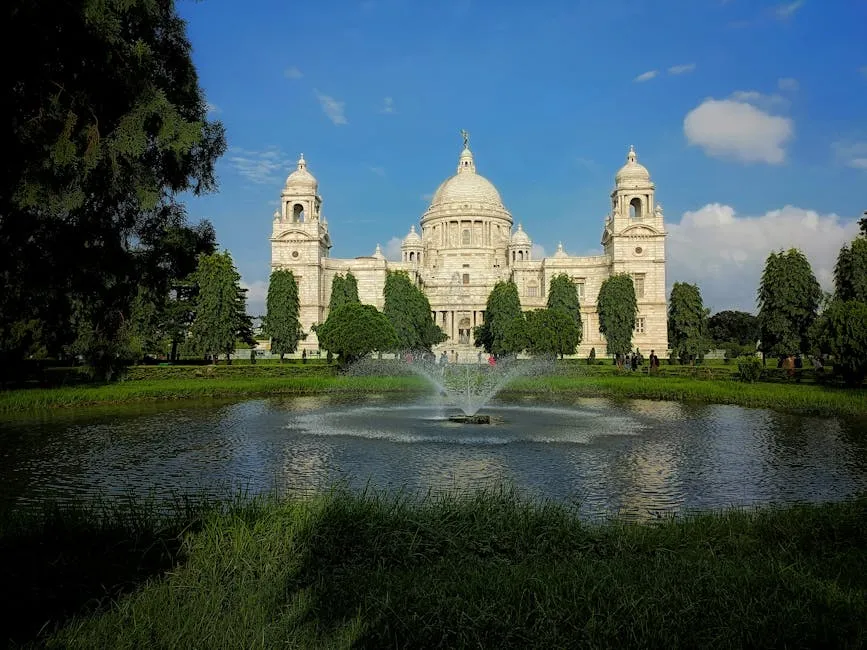
Kolkata — The Complete City Guide 2026
Former British capital of India (1772–1911), home of Mother Teresa’s Mother House (founded 1950), the Indian Coffee House College Street (1876 Albert Hall → 1942 coffee house → 1947 Indian Coffee House), the Howrah Bridge cantilever (Rabindra Setu, commissioned 1943), and Durga Puja (UNESCO Intangible Cultural Heritage since December 2021). Eden Gardens hosts the first semi-final of the 2026 ICC Men’s T20 World Cup on 4 March; Sundarbans tigers (~101 in the Indian Sundarbans) are 110 km south.
₹900–₹28,000/day budget
Tropical: 13 to 38°C; monsoon Jul-Aug
Indian rupee (₹) — €1 ≈ ₹95
e-Visa $25 (Jul–Mar) / $10 (Apr–Jun)
West Bengal — alcohol freely available
Editor’s Note — three Kolkatas behind one coffee house
Climb the wide stone staircase at 15 Bankim Chatterjee Street in the College Street neighbourhood. At the first-floor landing, push through the swinging wooden doors and you enter the long high-ceilinged hall of the Indian Coffee House — wooden tables, ceiling fans, white-uniformed waiters in faded peacock-blue turbans, the smell of coffee and cigarette smoke from before the smoking ban that they have not entirely abandoned. Order a coffee (~₹40; verify current pricing on arrival — the working register is consistently inexpensive). Look around at the tables: students from Presidency University across the road, retirees with newspapers, journalists, two professors arguing in Bengali, a young couple with a stack of secondhand books just purchased from the College Street book bazaar one staircase down.
The honest opening for Kolkata is the same coffee house. The building dates from April 1876 as Albert Hall — a colonial-era cultural venue. The Coffee Board of India converted it into a coffee house in 1942, during the Second World War. The post-independence Indian government renamed it the Indian Coffee House in 1947 — the year of Partition, the year the Indian Coffee Workers Cooperative took over from the colonial coffee chain. From that 1947 reopening forward, the first-floor hall has been the working gathering place of Bengali intellectual life. Satyajit Ray (1921–1992, the filmmaker), Amartya Sen (born 1933, the economist Nobel laureate), Mrinal Sen (1923–2018, the filmmaker), Aparna Sen (born 1945, the filmmaker), the Hungry Generation poets of the 1960s — all met here at these tables.
The Indian Coffee House is the honest opening because it carries three Kolkatas inside one room.
The first Kolkata is colonial. The East India Company moved its headquarters to a riverside trading post called Kalikata (one of three villages — Kalikata, Sutanuti, Gobindapur — purchased from local landowners) in 1690, when Job Charnock of the Company established the working factory there. The British formalised the settlement after 1772, when Warren Hastings moved the Bengal Presidency capital to Calcutta. The city was the capital of British India from 1772 until 1911, when King George V’s Delhi Durbar transferred the capital to Delhi. Across those 139 years Calcutta was the largest city in Asia for substantial periods, the working centre of the East India Company’s commercial empire, the administrative capital of the British Raj’s most productive province. The Victoria Memorial (commissioned 1906 by Lord Curzon, completed 1921), the Indian Museum (1814), the St Paul’s Cathedral (1847), Writers’ Building (1777), General Post Office (1868), High Court (1872) — the working stock of central Kolkata’s monumental architecture — are all of this period.
The second Kolkata is the Bengali Renaissance and the Revolution. From approximately 1820 through 1947, Bengal generated one of the most consequential intellectual flowerings of any modern colonial society. Raja Ram Mohan Roy (1772–1833) — religious reform, the Brahmo Samaj. Ishwar Chandra Vidyasagar (1820–1891) — Bengali script reform, women’s education advocacy. Bankim Chandra Chattopadhyay (1838–1894) — the Bengali novel; “Vande Mataram.” Swami Vivekananda (1863–1902) — Vedanta philosophy; 1893 Chicago World’s Parliament of Religions speech. Rabindranath Tagore (1861–1941) — poet, novelist, painter, composer, founder of Visva-Bharati University; 1913 Nobel Prize for Literature, the first non-European laureate. Subhas Chandra Bose (1897–1945) — the Indian National Army; Bengal nationalist anti-colonial militancy. The Communist Party of India founded in 1925 (the working conventional founding date and city is contested by historians, with both Tashkent 1920 and Kanpur 1925 cited as alternative origin points; the working Calcutta-centred party activity began in this period). The Naxalbari uprising of May 1967 in northern West Bengal spawned the Naxalite movement — Maoist insurgency that drew heavily from Calcutta university students through the late 1960s and 1970s. The Communist Party of India (Marxist)–led Left Front governed West Bengal from 1977 to 2011 — the longest continuously elected communist government anywhere in the world at 34 years. The All India Trinamool Congress under Mamata Banerjee displaced them in 2011 and continues to govern.
The third Kolkata is the city of the dead and the surviving. The 1943 Bengal Famine — caused, by the working historical consensus, principally by British wartime food-diversion policy combined with cyclone damage and inflationary speculation — killed approximately two to three million people across Bengal. Calcutta absorbed displaced rural starvation refugees through the war years. Direct Action Day on 16 August 1946 — the Muslim League’s call for action in support of partition — produced three days of inter-communal violence in Calcutta that killed an estimated 4,000 to 10,000 people, the working precursor to the broader Partition violence the following year. The 1947 Partition displaced millions across the new Indo-Pakistani border; Calcutta absorbed approximately two million Hindu refugees from East Pakistan (later Bangladesh) over the following decades, with major additional refugee flows during the 1971 Bangladesh Liberation War (when approximately ten million refugees fled to West Bengal). Mother Teresa (1910–1997) founded the Missionaries of Charity in Calcutta in 1950 specifically to serve the working poor — the lepers, the abandoned, the dying — of this post-Partition refugee city. Her Mother House at 54A AJC Bose Road is open free to visitors today (08:30–12:00 + 15:00–18:00, closed Thursdays); her tomb sits on the ground floor. The Calcutta-to-Kolkata renaming was made official on 1 January 2001 — the working postcolonial reclamation of the Bengali pronunciation Kolikata that had always been the local name. The city continues to absorb internal migration from rural Bengal and from across the Bangladesh border, and continues to operate the only tram network in India (since 1873, electrified 1902, second-oldest operating tram network in the world after Turin 1871) and the only licensed hand-pulled-rickshaw network anywhere in the world (declining; approximately 500 garages remaining from a peak of approximately 1,000; the working “last generation” of pullers).
These three Kolkatas coexist within the city’s roughly 15-million-person metropolitan area. The Indian Coffee House across the road from Presidency University is where the colonial building, the Renaissance university tradition, and the contemporary adda culture meet at a single table. An honest version of Kolkata takes the layering seriously — including the parts that are difficult, the parts the tourist infrastructure prefers to skip, and the parts (the hand-pulled rickshaw, the working poverty, the contested communal history) that visitors will encounter at street level whether they expect them or not.
The pages that follow take Kolkata layer by layer. Order a second coffee; you’ll need it.
Why Kolkata now
A 30-day Indian e-Tourist Visa runs US $25 (July–March) or US $10 (April–June discount tier) for most EU passports, UK, Canada, Australia, New Zealand, Japan, Korea, Singapore. US passport holders pay US $25 for the 30-day or US $160 for a 5-year multi-entry; UK passport holders pay US $484 for the 5-year (reciprocal pricing structure). Apply only at the official portal indianvisaonline.gov.in; submit at least 4 days before travel. The fee is non-refundable. Verify current pricing before booking.
Kolkata is one of India’s most-underrated tourist destinations from a Western perspective. The standard Golden Triangle itinerary (Delhi → Agra → Jaipur) skips eastern India entirely, and most Western travellers who do reach east go to Varanasi rather than Kolkata. From an Indian-domestic perspective, Kolkata is the working cultural anchor of eastern India — Bengali literature, Bengali cinema (the Ray-Sen tradition), Bengali music (Rabindra Sangeet, Baul folk), Bengali sweet-making, and the working Durga Puja festival that has been inscribed on the UNESCO Representative List of the Intangible Cultural Heritage of Humanity since December 2021. The city is materially cheaper than Mumbai or Bangalore (approximately 25–35% cheaper at equivalent tier) and offers a different India — colonial-monumental, intellectually traditional, culinarily distinctive — from the desert-state register of Rajasthan or the temple-town register of Tamil Nadu.
The 2026 specifics worth noting: the demolition of the old domestic terminal at CCU is scheduled for early 2026 as the working start of the airport’s expansion to a final 45-million-passenger annual capacity; the new U-shaped international terminal construction begins concurrently. The Kolkata Metro continues phased expansion. Durga Puja 2026 falls in late September into early October (verify exact 2026 dates against the lunar calendar). The Sundarbans tiger-reserve day-trip and overnight infrastructure is operational year-round but optimally visited November–February. No Indian city — including Kolkata — has an official Michelin Guide selection as of May 2026. The Michelin Guide does not publish for India.
Getting there
Netaji Subhas Chandra Bose International Airport (CCU)
CCU sits approximately 17 km north-east of central Kolkata in the Dum Dum area. The current integrated terminal (post-2013 reconstruction) handles approximately 26 million passengers annually and is scheduled for major expansion 2026 onwards. The old domestic terminal demolition begins early 2026, clearing the working footprint for a new U-shaped international terminal. Final design capacity: 45 million passengers annually (36 million domestic + 9 million international).
Long-haul connections from Europe: Direct flights operate on rotating seasonal schedules from select hub airports including Doha (Qatar Airways), Dubai (Emirates and flydubai), Abu Dhabi (Etihad), Sharjah (Air Arabia), Bangkok (Thai Airways), Singapore (Singapore Airlines and Scoot), Kuala Lumpur (AirAsia and Malaysia Airlines), Hong Kong (Cathay Pacific), and regional routes to Yangon, Kunming, Dhaka, and Kathmandu. The vast majority of European visitors arrive via Dubai, Doha or Singapore one-stop; confirm the airline’s current direct routing before paying.
Long-haul from North America: No direct flights as of May 2026; standard one-stop routings via Dubai, Doha, Singapore, or via Delhi (DEL) / Mumbai (BOM).
Airport to city: prepaid taxi. Counters in the arrivals hall offer prepaid airport-to-central-Kolkata taxis at ₹350–600 depending on destination zone, 30–60 minutes depending on traffic.
Uber and Ola: Both operate in Kolkata with full coverage. Pre-book at the gate or from inside the terminal; expect ₹250–500 to central Kolkata.
Metro: Kolkata Metro Line 6 (Orange Line / New Garia – Airport) connects the airport to the central city; verify the specific airport-terminal-to-Line-6 station walking transfer and current operational schedule before arrival.
Airport bus: Volvo AC airport bus service to Esplanade, Park Street, Howrah Station, Salt Lake. Approximately ₹50–100. Less frequent than autorickshaw alternatives but the working budget option.
Editor’s tip: Use the official prepaid taxi counter or pre-book Uber/Ola. Avoid drivers offering rides outside the official ranks — overcharging is the working scam.
Train
Howrah Station (HWH) is one of India’s largest railway stations (and historically among the busiest in the world by passenger throughput); Sealdah Station (SDAH) is the second major terminus. Both have direct connections to most major Indian cities:
- Delhi → Kolkata: approximately 17h by Rajdhani Express (¥3,500–6,000 / ~€37–63 second AC); 2h 15m by direct flight
- Mumbai → Kolkata: approximately 30h by direct express; 2h 30m by direct flight
- Bangalore → Kolkata: approximately 36h by train; 2h 30m by direct flight
- Chennai → Kolkata: approximately 27h by Coromandel Express; 2h by direct flight
- Guwahati → Kolkata: approximately 17h by overnight train; 1h by direct flight
- Varanasi → Kolkata: approximately 14h by overnight train
The Vande Bharat Express semi-high-speed services connect Kolkata to several major destinations including Howrah → Patna and Howrah → New Jalpaiguri (Darjeeling gateway); verify current Vande Bharat coverage from Kolkata against the IRCTC / 12306-equivalent Indian railway booking portal before assuming a specific route.
Bus
Long-distance buses connect Kolkata to neighbouring states; Volvo coaches via private operators serve Siliguri, Bhubaneswar, Ranchi, Patna, Guwahati. Generally less preferred than train for foreign visitors.
Road
Kolkata is connected by national highways to Mumbai (the historic NH 16 / Eastern Coast corridor) and to Delhi. Self-drive is not recommended for first-time foreign visitors; hire a car with driver (approximately ₹2,500–4,500 per day for an AC sedan).
12 attractions worth your time
1. Victoria Memorial
Address: Victoria Memorial Place, Maidan area
Hours: Tuesday–Sunday 10:00–17:00; closed Mondays and certain public holidays. Gardens approximately 06:00–18:00.
Cost: ₹500 foreign / ₹30 Indian for the museum interior; gardens ₹10
Allow: 2.5–3 hours
The 1906-commissioned-1921-completed white-marble Indo-Saracenic memorial to Queen Victoria, designed by Sir William Emerson, constructed in Makrana marble (the same source as the Taj Mahal). Lord Curzon (Viceroy of India 1899–1905) initiated the project after the queen’s 1901 death; the foundation stone was laid by King George V’s father in 1906. The building is set in a 64-acre garden in the Maidan, the working green lung of central Kolkata. The interior houses the Calcutta Gallery (a Kolkata-historical museum), portraits, royal-era memorabilia, and a substantial archive of the British Raj period.
Editor’s tip: The exterior is more interesting than the interior to most visitors. Visit at sunset for the working photograph of the dome lit by late sun and at night for the illuminated facade. The Calcutta Gallery (a relatively recent addition) is the working interior anchor for visitors interested in the city’s history.
Pro Tip: Combine with St Paul’s Cathedral (10-minute walk south) and the Indian Museum (15-minute walk north) for a full Maidan-area heritage half-day.
2. Indian Museum
Address: 27 Jawaharlal Nehru Road, Park Street area
Hours: Tuesday–Sunday 10:00–17:00; closed Mondays
Cost: ₹500 foreign / ₹50 Indian
Allow: 3–4 hours
The oldest and largest museum in India, founded in 1814 by the Asiatic Society of Bengal — and one of the oldest museums in the Asia-Pacific region. The collection covers archaeology (Indus Valley Harappan material, Buddhist art from Bharhut and Gandhara), anthropology, natural history (a substantial geological and zoological collection), and the Bharhut Stupa railing, one of the most important early-Buddhist sculptural assemblages anywhere. The building itself is a substantial late-classical structure of the colonial period.
Editor’s tip: The collection is genuinely encyclopedic and not curatorially up to current museum standards; visitors interested specifically in Indian archaeology should prioritise the Archaeology Gallery and the Bharhut Hall. The Natural History sections are dated and skippable. The exterior architecture is the secondary anchor.
3. Howrah Bridge (Rabindra Setu)
Address: Crosses the Hooghly River; western end at Howrah Station, eastern end at Burrabazar
Hours: 24/7 (pedestrian access permitted)
Cost: Free
Allow: 30–60 minutes (walk across) or 5–10 minutes (taxi crossing)
The cantilever bridge commissioned 1943 as the New Howrah Bridge (replacing an earlier pontoon bridge), renamed Rabindra Setu on 14 June 1965 in honour of Rabindranath Tagore. Still popularly called Howrah Bridge. Central span 1,500 feet (460 m), suspended span 564 feet (172 m). When built it was the third-longest cantilever bridge in the world (behind Quebec’s Pont de Québec at 549 m and Scotland’s Forth Bridge at 521 m). Today it carries approximately 100,000 vehicles and over 150,000 pedestrians daily — easily the busiest cantilever bridge in the world.
Editor’s tip: Walk across from the Burrabazar side eastwards toward Howrah Station at sunrise (06:00–07:00) — the bridge fills with commuter traffic, vendors, and the working morning pulse. Photography of the bridge is restricted under Indian government security regulations; do not photograph the bridge structurally from the bridge itself. Photography of the bridge from a distance (the riverbanks) is fine.
Pro Tip: Combine with the Mullick Ghat flower market at the eastern (Burrabazar) bridge base for an early-morning Kolkata sensory experience that is genuinely unlike anywhere else.
4. Mother House (Mother Teresa’s House)
Address: 54A, Acharya Jagadish Chandra Bose Road, Lower Circular Road area
Hours: Daily 08:30–12:00 + 15:00–18:00; closed Thursdays
Cost: Free entry
Allow: 1–1.5 hours
The Missionaries of Charity headquarters, established by Mother Teresa (1910–1997) in 1950 to serve the poor of Calcutta. Mother Teresa was laid to rest on the ground floor of the main building on 13 September 1997 (a state funeral), and her tomb remains the working pilgrimage anchor. A small museum (opened 2005) adjacent to the tomb displays her personal belongings, letters, photographs, and the working artefacts of her ministry. The sisters’ community continues to operate from the house.
Editor’s tip: Visit early in the morning (08:30 opening) for a quiet, contemplative experience. Photography is permitted in the museum but not in the chapel. Dress modestly. The Mother House is in a working residential neighbourhood; the visit is meaningful but does not take an entire day.
5. St Paul’s Cathedral
Address: 1A Cathedral Road, near Victoria Memorial
Hours: Daily approximately 09:00–17:00 (verify current schedule)
Cost: Free entry
Allow: 30–45 minutes
The 1847-consecrated Anglican cathedral, built in Indo-Gothic style by Major William Nairn Forbes. The cathedral suffered earthquake damage in 1934 (the steeple was reconstructed in the manner of Bell Harry Tower at Canterbury Cathedral after the original Gothic-revival spire collapsed). The interior includes stained-glass windows traditionally attributed to Edward Burne-Jones (one of the founding Pre-Raphaelite artists); the attribution is the conventional cathedral account, though some sources qualify it.
Editor’s tip: The cathedral is most rewarding as a 30-minute pairing with the Victoria Memorial; the two sit at opposite ends of the same Maidan-area cluster.
6. Marble Palace
Address: 46 Muktaram Babu Street, North Kolkata
Hours: Tuesday–Sunday approximately 10:00–16:00; closed Mondays. Requires a permit obtained 24 hours in advance from the West Bengal Tourism Office (₹40 fee + ID required).
Cost: Permit fee approximately ₹40; site entry free
Allow: 1.5–2 hours
The 1835-built private mansion of Raja Rajendra Mullick — Bengali aristocrat, art collector, and zoological enthusiast — preserved as a working private museum and family residence (the Mullick family still lives in part of the building). The collection includes European oil paintings (attributed to various Renaissance masters — verify specific attributions before citing), Italian marble sculptures, Venetian glassware, Belgian mirrors, French Empire furniture, and an extensive Indian art collection. The grounds include a small aviary and former zoological garden. The mansion’s interior is materially photogenic and largely un-touched-up since the late nineteenth century.
Editor’s tip: The permit requirement deters most visitors; obtain the permit from the West Bengal Tourism office at Government Place (10 Government Place East) at least 24 hours ahead. No interior photography permitted. Children of the Mullick family staff serve as guides for the working tour.
7. Dakshineswar Kali Temple
Address: Dakshineswar, north Kolkata, on the eastern bank of the Hooghly
Hours: Daily approximately 06:00–12:30 + 15:00–20:30
Cost: Free entry
Allow: 2 hours
The 1855-completed Kali temple commissioned by Rani Rashmoni, a wealthy Bengali landowner-philanthropist. The temple is most famous as the working location where Sri Ramakrishna Paramahamsa (1836–1886) served as priest from 1856 until his death in 1886, and where he developed the syncretic Vedanta-Bhakti-Tantra-Christian-Muslim spiritual practice that became the basis of the Ramakrishna Mission. Swami Vivekananda (Ramakrishna’s principal disciple) developed his religious thought here. The temple complex includes the main Kali shrine, twelve subsidiary Shiva shrines arranged in a row along the riverbank, and Ramakrishna’s room (preserved as a museum).
Editor’s tip: Combine with Belur Math (the Ramakrishna Mission headquarters) directly across the Hooghly — accessible by ferry from Dakshineswar ghat in 15 minutes. The Ramakrishna-Vivekananda-Bengal Renaissance lineage anchors at Dakshineswar.
8. Belur Math (Ramakrishna Mission Headquarters)
Address: Belur, west bank of the Hooghly, across from Dakshineswar
Hours: Daily approximately 06:30–12:00 + 16:00–19:00
Cost: Free entry
Allow: 1.5–2 hours
The 1898-founded headquarters of the Ramakrishna Mission, founded by Swami Vivekananda after his return from the 1893 Chicago World’s Parliament of Religions. The complex includes the main temple of Sri Ramakrishna (completed 1938, designed by Swami Vijnanananda — a Ramakrishna direct disciple — in an architecturally syncretic style that incorporates Hindu, Buddhist, Christian, and Islamic elements deliberately), Vivekananda’s mausoleum (samadhi mandir), and a substantial monastic community.
Editor’s tip: Belur Math is the working spiritual anchor of the post-Renaissance Bengali religious tradition. The architectural style of the main temple is unusually deliberate in its syncretism. Combine with Dakshineswar via a 15-minute ferry crossing — the natural pair.
9. Eden Gardens (cricket stadium)
Address: B.B.D. Bagh, central Kolkata
Hours: Stadium tours on non-match days (verify schedule with Cricket Association of Bengal); match days only for public match access
Cost: Match tickets ₹500–10,000+; stadium tours approximately ₹300
Allow: Full day for a match; 2 hours for a tour
Established 1864 (one of the oldest cricket stadiums in the world, second only to Lord’s in working international stature) with a current seating capacity of approximately 68,000 (the second-largest in India after the Narendra Modi Stadium in Ahmedabad). Eden Gardens hosted the 1987 Cricket World Cup final (Australia vs England) and is the venue for the first semi-final of the 2026 ICC Men’s T20 World Cup on 4 March 2026 (South Africa vs New Zealand, 19:00 IST). The tournament final is scheduled for the Narendra Modi Stadium in Ahmedabad on 8 March 2026. The stadium sits on the eastern edge of the Maidan, adjacent to the Hooghly riverfront.
Editor’s tip: A match at Eden Gardens — especially an India match — is a sensory experience worth the ticket. Tickets sell out fast through official channels; avoid the parallel market.
10. Kalighat Kali Temple
Address: Kalighat, south Kolkata
Hours: Daily approximately 05:00–14:00 + 17:00–22:30
Cost: Free entry (donations expected; tour-guide and priest-fees vary)
Allow: 1.5 hours
The city’s namesake temple — Kolkata is named after Kalighat — and one of the 51 Shakti Peethas in the Hindu pilgrimage tradition (Shakti Peethas mark the locations where parts of the goddess Sati’s body fell after the cosmic dissolution of her self-immolation, by the traditional account; Kalighat is identified as the location where Sati’s right toe fell). The temple structure dates to 1809 in its present form, although the working pilgrimage site is materially older. The temple is small, dense, crowded with pilgrims, working daily worship; goats are still occasionally offered in animal sacrifice at the temple precinct’s lower courtyard (the working tradition continues, though it is increasingly discouraged).
Editor’s tip: The Kalighat experience is intense, working, religious; tourists are tolerated but not particularly accommodated. The official temple priests can be aggressive in soliciting donations and personal performance services; agree on fees in advance. The neighbouring Kalighat Pat painting community (the Kalighat paintings, late-19th-century proto-modernist Bengali popular art) is documented at the Calcutta Gallery / Indian Museum. Combine with Mother House (15 minutes away).
11. Park Street (working Kolkata’s bar-and-restaurant strip)
Address: Park Street, central Kolkata (between Camac Street and Lower Circular Road)
Hours: Most restaurants 12:00–23:00; bars approximately 12:00–24:30
Cost: Restaurants ₹500–2,500 per person; bars ₹250–800 per drink
Allow: A working evening
Park Street is the historic colonial entertainment district — the working bar-and-restaurant strip from the British period that survived into independence and remains the working centre of Kolkata’s social-dining culture. The defining institutions: Mocambo (founded 1956 by Shivji V. Kothari, India’s first nightclub, Continental/European cuisine, INTACH heritage status), Trincas (founded 1939 by a Swiss couple as a tea-room and bakery, taken over 1959 by Om Prakash Puri + Ellis Joshua, jazz-music institution, INTACH heritage status), Peter Cat (founded 1975 by Nitin Kothari, son of Mocambo founder Shivji V. Kothari; the chelo kebab anchor; ranked 17th on Taste Atlas’s “Most Legendary Restaurants in the World” list in 2024 — verify the current ranking as it shifts), Kwality (INTACH heritage status), and Oly Pub (the working Park Street dive-bar anchor since the mid-20th century; verify exact founding date via the bar’s own records).
Editor’s tip: A first Park Street visit should include one Mocambo or Trincas lunch (€10–20 with drinks for two) and an Oly Pub or Roxy bar working-evening drink. The neighbourhood is dense and walkable; budget two to three hours for the working experience.
12. Sundarbans National Park (UNESCO 1987) — day-trip or overnight
Distance: Approximately 110 km south of Kolkata
Cost: Boat permits + national park entries ₹300–800; full-day tour packages ₹3,500–6,000 per person; overnight packages ₹4,500–12,000
Allow: Minimum 1 full day; better as an overnight (2 days 1 night)
The 4,260-square-kilometre mangrove tiger reserve straddling the West Bengal-Bangladesh border (the Bangladesh portion is a separate UNESCO inscription). Inscribed by UNESCO in 1987 as a natural World Heritage Site. The reserve is the only place where Royal Bengal Tigers thrive in a tidal mangrove ecosystem — approximately 101 tigers per the most recent Indian Sundarbans census (2022 figures released late 2024: 80 in the core Tiger Reserve plus 21 in the adjoining South 24 Parganas Division), plus saltwater crocodiles, spotted deer, river dolphins, and 78+ documented mangrove species. (A separate Bangladesh Sundarbans population of approximately 125 is counted independently.) The tigers are working-shy and tiger-sightings are not the working point; the mangrove ecosystem itself, the river-and-tidal-flat geography, and the boat travel through the working creeks are the working anchors.
Editor’s tip: The day-trip from Kolkata (3 hours by road to Godkhali boat departure + boat ride through the channels) is feasible but exhausting; the overnight version (sleep in a Sajnekhali Tiger Reserve or Pakhiralay lodge) is materially better and allows a second day on the water at dawn — the working light for wildlife photography. Visit November–February for the working clear weather and best wildlife sightings.
Pro Tip: Use a reputable Sundarbans operator; package quality varies widely. The Sundarban Tiger Camp, Sundarban Jungle Camp, and the Sundarban Foundation lodges are the working established operators; verify current operator status and 2026 pricing through Trip.com, GetYourGuide, or West Bengal Tourism before booking.
Neighbourhoods at a glance
Central Kolkata — the Maidan / B.B.D. Bagh / Park Street axis
The Maidan (Bengali for “open field”) is the working green lung of central Kolkata — approximately 4 square kilometres of open ground with the Victoria Memorial, St Paul’s Cathedral, the Indian Museum, Eden Gardens, Fort William (the working military installation, not publicly accessible), and the Race Course at its perimeters. B.B.D. Bagh (Binoy-Badal-Dinesh Bagh, formerly Dalhousie Square) is the working colonial-monumental district — Writers’ Building, GPO, High Court. Park Street is the working entertainment-restaurant district. Esplanade is the central transit-and-shopping anchor.
North Kolkata — College Street / Burrabazar / the old city
The historic colonial-Bengali commercial heart. College Street with the Indian Coffee House and the kilometres-long book bazaar (the second-largest used-book market in the world by some metrics; the working anchor for Kolkata’s intellectual book culture). Presidency University and Sanskrit College and University. Marble Palace (10 minutes from College Street). Burrabazar (the working commercial wholesale district, with the most-photographed Hooghly riverfront flower-market at Mullick Ghat). Kumartuli (the clay-idol-makers’ neighbourhood — the working source of Durga Puja’s clay murtis).
South Kolkata — Ballygunge / Gariahat / Jadavpur
The middle-class residential and educational district. Ballygunge with the older affluent Bengali homes; Gariahat with the working shopping markets (saris, silver, working everyday commerce); Jadavpur University (the working contemporary intellectual centre). 6 Ballygunge Place is a working Bengali fine-dining anchor here.
Salt Lake (Bidhannagar) — the planned satellite
The 1960s-planned satellite city east of central Kolkata, with Sector V as the working IT-corporate hub. Hyatt Regency, Westin, and a number of newer business hotels are clustered here. Not a tourist destination but useful as a working business-traveller base.
Howrah — the western bank
The working twin city across the Hooghly. Howrah Station (one of India’s largest railway stations), Belur Math (10 km north up the Hooghly), the Howrah Bridge (Rabindra Setu) approach. Substantially industrial; the working travel-anchor is the railway station and the bridge crossing.
Dum Dum — the airport
The northern district where CCU airport sits. Approximately 17 km from central Kolkata. Working residential-commercial; not a tourist destination but a working transit point.
Where to stay by budget
The honest sorting: stay in central Kolkata for a first visit — Park Street area, Maidan area, or Sudder Street (the working backpacker district). Salt Lake makes sense only for business travel.
Budget (₹1,500–3,500 per night / €16–37)
- Sudder Street guest houses (the working backpacker enclave one block from Park Street) — Hotel Maria, Salvation Army Red Shield Guest House, Hotel Paragon, and a working cluster of 30–50 small guest houses with ₹600–1,500 dorm/single rates. Variable quality; book the higher-tier options.
- OYO and Treebo chain properties — clean, modern budget tier, ₹1,200–2,500 per night
- Tollygunge Club historic accommodations — historically members-only; visitor access varies and is best arranged through a member or via partner hotels
Mid-range (₹3,500–8,000 per night / €37–84)
- The Park Kolkata (boutique business luxury, Park Street area)
- Lalit Great Eastern Kolkata — a restored 19th-century colonial hotel (the Great Eastern Hotel traces its origins to the 1840s on the same site; verify exact founding date with the hotel’s own heritage page); the working Kolkata historical-restoration anchor
- Lemon Tree Premier Salt Lake and Lemon Tree Premier City Centre — modern business chain
- Pride Plaza Hotel Aerocity — newer mid-tier
- Sapphire Suites — Sudder Street area, mid-tier
High-end (₹8,000–18,000 per night / €84–189)
- The Oberoi Grand Kolkata — the “Grand Dame of Chowringhee,” a working colonial-era institutional hotel for over a century. The property’s legacy traces to the 1800s (originally a British colonel’s residence, then Mrs Annie Monk’s boarding house, then Mr Aratoon Stephen acquired it in 1914 and built it out as The Grand Hotel); Rai Bahadur Mohan Singh Oberoi acquired the property in 1938, beginning the working Oberoi era. Honoured with the Indian National Trust for Art and Cultural Heritage’s blue plaque on 10 May 2024. The closest to the working colonial-luxury register. Central location.
- ITC Royal Bengal, a Luxury Collection Hotel — 456 rooms + 82 service apartments, 7 dining outlets, 5,630 sqm banqueting, luxury spa. Newer; modern-luxury rather than historical-luxury.
- Taj Bengal — 3.2 km from business district, 4 km from Eden Gardens, 19.3 km from airport. The working established Taj property.
- Hyatt Regency Kolkata — Salt Lake, 234 rooms (70 Regency Club + 13 suites). 15-minute drive from airport.
- JW Marriott Hotel Kolkata — central, modern luxury
- The Westin Kolkata Rajarhat — Newtown, modern luxury near the IT corridor
Luxury (₹18,000+ per night / €189+)
- The Oberoi Grand Heritage suites — the highest tier of the working colonial-era Kolkata hotel
- ITC Royal Bengal presidential suites
- Taj Bengal heritage suites
No major new luxury hotel openings have been confirmed in Kolkata for calendar-year 2026 (against the IHG, Marriott, Hyatt, Accor opening calendars as of May 2026); verify against operator pages before booking.
Editor’s tip: The Oberoi Grand is the working colonial-luxury anchor and the right first-visit choice for visitors who want a heritage-Kolkata stay. ITC Royal Bengal is the working modern-luxury anchor. Sudder Street is the working backpacker anchor.
Where to eat — Bengali fish, Mughlai biryani, Park Street
Bengali home cooking (the working register)
Bengali cuisine is fish-and-rice-based, with mustard oil and posto (poppy seeds) and shorshe (mustard paste) as defining flavours, distinct from northern Indian and southern Indian registers. The working signature dishes:
- Shorshe ilish — hilsa fish in mustard sauce; the working signature fish dish of Bengal. Hilsa is in season July–September (monsoon-running spawning); ilish prices spike during the season.
- Kosha mangsho — slow-cooked Bengali mutton curry; the working Sunday-meal staple
- Macher jhol — light fish curry with vegetables
- Doi maach — fish in yoghurt-and-spice sauce
- Aloo posto — potato cooked in poppy-seed paste (Bengali working comfort food)
- Cholar dal — Bengal-gram dal cooked with coconut and raisins, slightly sweet
- Luchi — Bengali deep-fried flatbread (puffed, white-flour-based)
- Shukto — bittermelon-and-mixed-vegetable opening course
Named Bengali-cuisine restaurants
- 6 Ballygunge Place — the working anchor Bengali fine-dining institution; multiple branches; thali-and-à-la-carte; ₹500–1,500 per person
- Bhojohori Manna — chain Bengali home-cooking restaurant across the city; the working everyday Bengali tier; ₹300–700 per person
- Kewpie’s Kitchen — Bengali home-cooking institution founded by Rakhi Purnima Dasgupta; verify current operational status before visiting
- Saptapadi — Bengali home-style cooking; verify current branches via Zomato
- Sonar Tori — historic Bengali restaurant; verify current operational status before visiting
Mughlai and the Kolkata biryani
Kolkata’s Muslim community — substantially augmented by the deposed Nawab of Awadh, Wajid Ali Shah, who was exiled to the Metiabruz suburb of Calcutta in 1856 and brought his royal cooks with him — developed a distinctive Kolkata biryani featuring a boiled-and-fried potato (a working potato addition that does not appear in Lucknow or Hyderabad biryani). The defining institutions:
- Aminia — multiple branches across the city; the working anchor Kolkata biryani chain founded in 1929 by Abdul Rahim, originally on Zakaria Street opposite the Nakhoda Masjid. Now operates across West Bengal and internationally in Dubai. Approximately ₹250–500 per biryani.
- Arsalan Restaurant — Park Circus and other branches; the working mid-tier biryani anchor; ₹350–700.
- Shiraz Golden Restaurant — Park Circus; old-school Mughlai-Bengali Muslim; ₹300–600.
- Royal Indian Hotel — Chitpur Road (147 Rabindra Sarani); founded 1905 by Ahmed Hussain, who migrated to Kolkata from Lucknow. Credited with the introduction of Awadhi spices to Kolkata and the unique Kolkata-style biryani-with-potato innovation. ₹250–500.
Park Street institutions (the working colonial-era restaurant strip)
- Mocambo (1956) — Continental/European fine dining; the working old-Kolkata register. Chicken à la Kiev, fish meunière, beef stroganoff are the working signature dishes. ₹1,500–3,000 per person with drinks.
- Trincas (1939) — Continental cuisine + jazz music; the working night-out anchor. Devilled crab, chicken stroganoff, bhekti in paprika sauce. ₹1,200–2,500.
- Peter Cat (1975) — the working Chelo Kebab anchor; ₹600–1,500.
- Olypub (Oly Pub) — the working dive-bar anchor; cheap beer, working snacks.
- Kwality (Park Street) — Continental; INTACH heritage tag.
- Flury’s (Park Street) — the working Anglo-Bengali confectionery and tea-room founded in 1927 by Swiss partners Joseph Flury and Quinto Cinzio Trinca (the partnership Flury & Trinca was dissolved in 1939). Working Park Street breakfast anchor. Owned and managed by the Apeejay Surrendra Group since 1965.
Sweet shops (Bengali mishti)
Bengal’s mishti (sweet) tradition is distinctive — milk-based, often syrup-soaked, with regional variations. Defining categories:
- Rasgulla — the working signature Bengali sweet (cottage-cheese balls in sugar syrup). Nobin Chandra Das experimentally developed the modern rasgulla in 1868 at his Chitpur Road shop (after a first failed shop attempt in Jorashinko in 1866); his son K.C. Das (born 1869) opened the family’s first official shop, Krishna Chandra Das Confectioner, in 1930. K.C. Das Pvt Ltd was incorporated in 1946. Multiple branches operate today.
- Sandesh — milk-and-sugar-based fudge with regional variations.
- Mishti doi — sweetened yoghurt, slow-cooked, the working Bengali dessert.
- Rasmalai — cottage-cheese flat patties in saffron-cardamom thickened milk.
The working sweet-shop anchors: Balaram Mullick & Radharaman Mullick (with a working heritage of over 130 years; verify the specific founding-date claim on their company page), KC Das, Sen Mahasaya (Park Street and other branches), Hindusthan Sweets, Banchharam’s. Verify the current operational status and branch locations of named shops before visiting.
Street food
- Phuchka (the Bengali version of pani puri) — small fried-shell stuffed with potato/chickpea and dipped in tamarind water; ₹40–80 per plate
- Jhalmuri — puffed rice tossed with peanuts, spices, mustard oil; ₹30–60
- Kati roll — the working Kolkata-origin street wrap (paratha-and-meat-or-vegetable filling); the conventional account credits Nizam’s in central Kolkata as the inventor in the early-to-mid 20th century, though the specific historical attribution varies; ₹80–200
- Telebhaja — assorted fried snacks; ₹15–30 per piece
- Jhalmuri-and-chai at Maidan or Princep Ghat is the working sunset combination
Drinking — Park Street and the bar tradition
Unlike Gujarat (dry state since 1949) or Bihar, West Bengal permits alcohol consumption freely. Bars, restaurants, hotels, and licensed liquor shops operate normally. Foreign visitors require no special permit. Working hours: bars typically 12:00–24:30; liquor shops 12:00–22:30.
Park Street bars (the working historical anchor)
- Oly Pub — Park Street; the working dive-bar; cheap beer and whisky, working snacks; the working anchor of late-evening Park Street since the mid-20th century
- Trincas — Park Street; the working jazz bar with live music several nights weekly
- Peter Cat — Park Street; the working pre-dinner-drink anchor
- The Bridge / Westwind — the modern Park Street cocktail bars
- Roxy — the modern Park Street club anchor
Hotel bars (the working international register)
- The Oberoi Grand bar — the working colonial-luxury cocktail bar
- ITC Royal Bengal bar — modern luxury
- Hyatt Regency Salt Lake — business-traveller working bar
- The Park Kolkata — modern boutique cocktail bar
Coffee (the working alternative)
- Indian Coffee House at College Street — the working Bengali adda anchor; tea/coffee ₹15–60; snacks ₹40–150
- Coffee House branches across the city (Jadavpur, Esplanade) — variable
- Starbucks and Blue Tokai — the working modern international-coffee tier at Park Street, Salt Lake, central Kolkata
Getting around
Metro
The Kolkata Metro is the oldest metro system in India (opened 1984, predates Delhi Metro by 18 years). Currently operating Lines 1 (north–south), 2 (East–West), 3, 4, 6 (Orange / airport-bound), and additional working lines. Fares ₹5–25 by distance. The metro is the working fast cross-city transit answer, particularly for north–south journeys.
Uber and Ola
Both operate in Kolkata. Typically 70–90% of metered taxi. Pay by card or UPI; cash also accepted. English-language interface.
Yellow taxi (the working iconic Kolkata transit)
The Ambassador yellow taxi is the working iconic Kolkata image — though declining as Uber and Ola displace it. The remaining fleet operates on meter; working short-trip fares ₹50–200. The taxis are non-AC and frequently old; the working register is functional rather than comfortable.
Autorickshaw
The yellow-and-black autorickshaw operates across Kolkata; meter rates approximately ₹20 for the first 1 km + ₹13 per additional km. Working trip ₹50–250.
Trams (the working museum-transit)
The Kolkata Trams — operating since 1873 (second-oldest tram network in the world after Turin 1871), electrified 1902 (the first Asian city with electric tramway) — continue to operate two main street routes plus heritage joy-ride routes: Line 5 (Shyambazar–Esplanade) and Line 25 (Gariahat–Esplanade). Approximately 40–45 trams on 7–8 routes covering 40 km, with 10,000–12,000 daily passengers. The network peaked at 37 lines in the 1960s. Operated by the West Bengal Transport Corporation (WBTC). Fares ₹6–15.
The trams are a working transit-and-historical-anchor combination — slow, characteristic, and visible. Visit at sunrise/sunset for the working photograph of the tracks against the colonial-era streetscape. A ride from Shyambazar to Esplanade is the working tourist anchor for the trams.
Hand-pulled rickshaws (the working ethical question)
Kolkata is the only city in the world with licensed operational hand-pulled rickshaws (Bengali “tana rickshaw”). The Left Front government attempted a ban in 2006; the implementation has been slow. Approximately 500 garages remain from a peak of approximately 1,000. Working April 2026 news reports describe the rickshaw-pullers as the “last generation” of a working trade reaching its natural end.
The honest framing: the hand-pulled rickshaw is a working ethical problem. The pullers — often elderly, often migrants from rural Bihar and other northern states — earn approximately ₹200–400 per day (€2–4); the working economic alternative is increasingly thin. The practice has been widely characterised as exploitative; the Indian government has not abolished the working trade despite multiple announcements. Most foreign visitors who use a rickshaw for tourism purposes pay above the working rate as an acknowledged supplement; others decline on ethical grounds. The working choice is the visitor’s.
Buses
Government WBTC buses and private operator buses operate dense routes; the working fare ₹5–25. The working concern is overcrowding at peak times; AC buses are limited.
Walking
Central Kolkata is deeply walkable — the Maidan, Park Street, B.B.D. Bagh, the Hooghly riverfront, and the College Street book bazaar are all within working walking distance. Working walking distances 1–3 km per cluster. The summer humidity (May–September) makes long walks materially uncomfortable.
What does not work
- Self-drive car — Indian traffic and Kolkata congestion are not friendly to first-time visitors
- Bicycle — limited bike-rental infrastructure; not recommended for central streets
When to visit
Best months: November, December, January, February. Mild temperatures (13–28°C), dry, low humidity, comfortable walking. The working tourist season. Mid-October through early November also good but coincides with Durga Puja peak crowds.
Avoid (heat + humidity): April, May, early June. Daytime highs 35–38°C combined with rising humidity. The working summer is difficult for sustained outdoor walking.
Avoid (peak monsoon): July, August, early September. Heavy rainfall (~1,600 mm annual concentrated in monsoon), working flooding episodes, cyclone risk. Hilsa season for foodies but tourist-walking is difficult.
Cyclone risk: Cyclone risk peaks April–June (pre-monsoon) and October–November (post-monsoon). Cyclones like Amphan (May 2020) and Yaas (May 2021) caused major flooding in Kolkata. Monitor cyclone forecasts during these windows.
Shoulder seasons: March (warming but still pleasant until end-March), late September–early October (post-monsoon, working Durga Puja preparation). October is the working Durga Puja festival month; book hotels 60+ days ahead.
Festivals worth planning around
- Durga Puja (late September / October, exact dates vary by lunar calendar): the UNESCO Intangible Cultural Heritage of Humanity (inscribed December 2021) — the working largest festival in Bengal. Ten-day festival; key dates Mahalaya (eyes painted on the clay murtis), then Saptami through Dashami (the working main four-day cycle, with visiting between pandals as the working activity). Thousands of pandals across the city; book hotels 60+ days ahead. 2026 dates: Mahalaya 10 October; Shashthi 16 October through Vijaya Dashami 21 October 2026.
- Kali Puja and Diwali (October/November, lunar dates): the Kali-Bengal-Diwali festival; smaller than Durga Puja but visually substantial.
- Kolkata Book Fair / Boi Mela (late January – early February): the world’s largest non-trade book fair by visitor count (the working count exceeds 2 million visitors over 12 days). Free entry. The 49th International Kolkata Book Fair 2026 runs 22 January – 3 February 2026 at the Boimela Prangan, Central Park Mela Ground, Sector II, Salt Lake. Argentina is the theme country.
- Kolkata International Film Festival (KIFF) — November, exact dates vary year to year
- Bengali New Year (Poila Boishakh) — 14/15 April annually; the working Bengali cultural anchor
- 49th International Kolkata Book Fair (Boi Mela) 2026 — 22 January through 3 February 2026 at Boimela Prangan, Central Park Mela Ground, Sector II, Salt Lake. Free entry. Argentina theme country.
Month-by-month weather
| Month | Avg low | Avg high | Notes |
|---|---|---|---|
| January | 13°C | 26°C | Best — cool, dry, Book Fair |
| February | 16°C | 30°C | Best — pleasant, dry |
| March | 21°C | 33°C | Warming; still good early month |
| April | 25°C | 36°C | Hot, humid building; outdoor difficult |
| May | 26°C | 37°C | Furnace heat + humidity — avoid |
| June | 26°C | 35°C | Monsoon onset; humid; cyclone risk |
| July | 26°C | 32°C | Peak monsoon — heaviest rain |
| August | 26°C | 32°C | Monsoon continues |
| September | 26°C | 33°C | Drying; Durga Puja preparation |
| October | 23°C | 32°C | Durga Puja peak — book ahead |
| November | 18°C | 30°C | Best — clearing, festival aftermath |
| December | 14°C | 27°C | Best — cool, dry, low humidity |
Annual rainfall approximately 1,600 mm (concentrated June–September). The summer humidity is the working daily concern; the winter morning fog (a working dense river-valley fog) is the secondary working concern.
Daily budget breakdown
Backpacker — ₹900–2,000 per person per day (€9–21)
- Sudder Street guest-house single ₹500–900
- Three street-tier meals (chai + thali + biryani or kati roll) ₹250–500
- Metro/autorickshaw cross-city ₹100–250
- One paid attraction (Victoria Memorial ₹500 foreign, Indian Museum ₹500 foreign) ₹0–500
Mid-range — ₹3,800–8,000 per person per day (€40–84)
- Mid-tier hotel single room ₹2,500–4,500
- Three meals (restaurant breakfast + thali lunch + Park Street dinner) ₹800–1,800
- Metro + Uber + one tram ride ₹200–500
- Two to three paid attractions/day ₹300–1,500
- One luxury dinner (Mocambo, Trincas, 6 Ballygunge Place) ₹1,500–3,000 (occasional)
Luxury — ₹14,000–28,000 per person per day (€147–295)
- Top-tier hotel suite ₹12,000–25,000
- Three meals including one luxury dinner ₹2,500–5,000
- Private driver / guide ₹3,500–6,000 per day
- Multiple attractions + Sundarbans overnight day trip
The defining single-attraction-day-trip outlay: Sundarbans overnight (2 days 1 night, package tour) costs approximately ₹4,500–12,000 per person depending on operator tier. Day-trip alternative (full day from Kolkata) ₹3,500–6,000.
Sample itineraries
Two days — the working compressed visit
Day 1: Central Kolkata + Maidan
– 07:00 — Howrah Bridge walk from Burrabazar side at sunrise; Mullick Ghat flower market
– 09:30 — Indian Coffee House at College Street + College Street book bazaar
– 12:00 — Lunch at a Bengali home-cooking restaurant (6 Ballygunge Place or Bhojohori Manna)
– 14:00 — Victoria Memorial + Gardens
– 16:30 — Indian Museum
– 19:30 — Park Street dinner (Mocambo, Trincas, or Peter Cat) + bar (Oly Pub)
Day 2: South + North Kolkata
– 08:30 — Mother House
– 10:00 — Kalighat Temple
– 11:30 — Light lunch
– 13:00 — Dakshineswar Kali Temple
– 14:30 — Ferry to Belur Math (15 minutes across Hooghly)
– 16:30 — Return ferry; rest
– 19:00 — Manek Chowk-equivalent evening: street food at Princep Ghat (riverfront food stalls) or Maidan area
Three days — the right basic visit
Day 1: Central Kolkata + Maidan as Day 1 above
Day 2: South + North + Dakshineswar/Belur as Day 2 above
Day 3: Marble Palace (with 24-hour-advance permit) + Park Street + Eden Gardens (stadium tour or match)
Four to five days — including day trip
Add Sundarbans overnight (2 days 1 night) plus a final Kolkata day.
Six to seven days — Kolkata + Darjeeling
Add Darjeeling and Kalimpong as a 3–4 day mountain-and-tea excursion (overnight train to New Jalpaiguri or 1h flight to Bagdogra, then road to Darjeeling).
Ten days — full eastern India circuit
Add Bhubaneswar/Puri/Konark (Odisha temple circuit, 3 days) plus Sundarbans overnight, with Kolkata as the central base.
Best Day Under €12
Total: ₹1,135 (€11.95) — verified against May 2026 exchange rates.
- Indian Coffee House breakfast (coffee + toast + omelette): ₹130
- Walking College Street + book bazaar (free)
- Metro to Esplanade: ₹15
- Walk Maidan + St Paul’s Cathedral exterior + Victoria Memorial Gardens (₹10 entry to gardens; skip the ₹500 foreign-museum-fee)
- Lunch — Bengali thali at a Bhojohori Manna or 6 Ballygunge Place lite branch: ₹350
- Howrah Bridge walk + Mullick Ghat flower market (free)
- Tea-stall chai + jhalmuri afternoon snack: ₹40
- Tram from Esplanade to Shyambazar (working anchor experience): ₹10
- Mother House visit (free)
- Kati roll + phuchka dinner at a street stall: ₹150
- Late-evening Indian Coffee House return for second coffee + adda: ₹50
- Auto back to Sudder Street: ₹110
If you swap the Victoria Memorial museum (foreigner ₹500) into the day, the total exceeds €18 — walk it back to the gardens-only entry or save the museum interior for a separate visit. The Indian Museum (also ₹500 foreigner) similarly overshoots; do it on a separate day.
On the budget leaderboard: Cairo $3.50 · Bogotá $6 · Kuala Lumpur €8.50 · Munich €12 · Ahmedabad €11.79 · Kolkata €11.95 · San Salvador €13 · Bangalore €15 · Tbilisi/Chengdu/Shenzhen/Xi’an/Chongqing €20–25 · Fiji €29 · Washington €30 · Nicosia €32.60 · Sicily/Corsica €35–40 · Maldives $50.
Kolkata is one of the cheapest major Indian metropolitan cities — comparable to Ahmedabad, materially cheaper than Mumbai or Bangalore. The under-€12 working day is genuinely achievable; the foreign-tourist museum-entry surcharges (₹500 at both Victoria Memorial and Indian Museum) are the working budget breakers, and require a separate higher-budget day.
Hot, rainy, and off-season plans
The 37°C summer day (May–early June)
Skip outdoor attractions between 11:00 and 17:00. Working summer day:
– Early morning (06:30–10:30) — Howrah Bridge walk, Mother House, Indian Coffee House, College Street
– Midday (11:00–17:00) — Indian Museum (air-conditioned, multi-hour), Victoria Memorial interior, hotel pool/AC rest, ITC Royal Bengal lobby
– Evening (17:30 onwards) — Maidan walk, Park Street dinner, riverside walks
Peak monsoon (July–August)
Heavy rain, occasional flooding. Working indoor anchors: Indian Museum, Victoria Memorial interior, the Calcutta Gallery, Mother House, hotel restaurants. Cyclone monitoring is the working safety concern.
Cyclone season (April–June + October–November)
Major cyclones like Amphan (May 2020) and Yaas (May 2021) have flooded large parts of Kolkata. Check the India Meteorological Department (IMD) cyclone forecasts during these windows; some hotels carry working cyclone-emergency protocols.
Durga Puja peak (late Sept–Oct, lunar)
If you can secure hotel rooms 60+ days ahead, Durga Puja is the single best time to visit Kolkata for a culturally immersive experience. The working anchor is the pandal-hopping tradition (visiting different temporary structures across the city); the working hotels’ working concierges can arrange evening guided tours during the peak nights.
Book Fair (late January – early February)
The Kolkata International Book Fair (Boi Mela) — the working largest non-trade book fair in the world by visitor count. Free entry. The 49th International Kolkata Book Fair runs 22 January – 3 February 2026 at the Boimela Prangan, Central Park Mela Ground, Sector II, Bidhannagar (Salt Lake), daily 12:00–20:00. Free entry, no registration required. Argentina is the 2026 focal-theme country.
Day trips
Sundarbans National Park (UNESCO 1987)
See attraction #12 above. Day-trip-feasible from Kolkata but better as an overnight.
Belur Math + Dakshineswar (half-day)
Combine the Ramakrishna Mission HQ at Belur with the Dakshineswar Kali Temple across the Hooghly. Ferry between the two takes 15 minutes. The working morning anchor for the Bengali Renaissance / Ramakrishna-Vivekananda lineage.
Shantiniketan (Visva-Bharati University)
Distance: Approximately 160 km north of Kolkata
Travel: 2.5–3 hours by train (Howrah → Bolpur) or 3 hours by road
Allow: Full day from Kolkata; better as overnight
Rabindranath Tagore’s working anchor educational institution. Tagore founded Visva-Bharati at Shantiniketan in 1921, building on the open-air school his father had begun in 1863. The campus carries Tagore’s architectural-pedagogical vision: classes traditionally held outdoors under trees; the campus retains substantial open green space. Visit the Uttarayan Complex (Tagore’s home buildings), the Rabindra Bhavan museum, and the Kala Bhavana art school. Inscribed on UNESCO’s World Heritage List in September 2023 at the 45th World Heritage Committee meeting in Riyadh — a cultural-landscape inscription recognising Tagore’s working pedagogical-philosophical legacy.
Murshidabad
Distance: Approximately 200 km north
Travel: 4 hours by train (Howrah → Murshidabad) or 5 hours by road
Allow: Full day from Kolkata; better as overnight
The former Mughal-period capital of Bengal under the Nawabs of Bengal (1717–1765). Site of the 1757 Battle of Plassey that established British East India Company supremacy in Bengal. Working anchors: Hazarduari Palace (the 1837-completed nawab’s palace), Katra Mosque (1723), Khoshbagh and Jafarganj Cemeteries (Mughal nawabs’ tombs).
Darjeeling and Kalimpong
Distance: Approximately 600 km north
Travel: 12h overnight train to New Jalpaiguri + 3h road to Darjeeling; OR 1h flight to Bagdogra + 3h road
Allow: 3+ days minimum
The British colonial hill station and tea-growing region in the eastern Himalayas. Substantial separate destination rather than a day trip; consider a 3–4 day extension from Kolkata.
Bishnupur
Distance: Approximately 130 km west
Travel: 3 hours by train + road or 3 hours road
Allow: Full day or overnight
The 17th-century Malla-dynasty capital of Bishnupur, famous for terracotta temple architecture — the working terracotta-templing tradition is most concentrated here. UNESCO-tentative-listed.
Safety and practical concerns
Crime
Kolkata is generally safe for foreign visitors. Violent crime against tourists is rare; petty crime (pickpocketing at crowded markets like Burrabazar and the Howrah Bridge approaches) is the working concern. Indian traffic safety is the working hazard for any visitor.
Air quality
Kolkata’s winter air quality (November–February) is among the worst in India per recent IQAir reporting — PM2.5 readings frequently exceed 200 AQI on the worst days; check IQAir or the Central Pollution Control Board real-time index before booking. Visitors with respiratory sensitivities should consider the winter pre-Diwali shoulder (mid-October) or post-monsoon September window, or carry N95 masks.
Cyclones
The April–June and October–November cyclone windows carry working risk. Monitor IMD forecasts.
Heat and humidity (April–June)
Combined heat-and-humidity makes the working summer materially harder than dry-heat destinations like Ahmedabad. Drink plenty of water; rest indoors midday.
Food safety
Standard Indian food-safety precautions: bottled water only, avoid uncovered stalls with low turnover, build gradually into street food over the first 2–3 days. Bengali fish dishes are widely safe at established restaurants; uncovered fish at smaller stalls can carry risk.
Women travellers
Kolkata is generally considered safer for solo women travellers than several other Indian cities, with the working conservative cultural register (modest dress is the working norm but not as strictly enforced as in Gujarat or Rajasthan). Standard precautions apply: avoid walking alone after 22:00 in less-frequented neighbourhoods; use pre-booked Uber/Ola at night; carry a charged phone.
Religious sensitivities
Kali temples (Kalighat, Dakshineswar) carry working religious intensity; respect the working pilgrimage register (modest dress; remove shoes; small donations expected; agree to priest fees in advance). Mother House expects respectful behaviour (modest dress; no chapel photography). Belur Math expects similar respect.
Connectivity
India is fully connected with strong 4G/5G mobile data. Visitors can buy Indian tourist SIM (Jio, Airtel, Vi) at the airport with passport + visa registration. WhatsApp, Google Maps, Uber, Ola, all Western apps work normally — no firewall. Working data plans approximately ₹500–1,500 per month.
Cashless
India has the most-developed UPI/QR payment system in the world. Foreign credit cards accepted at international-tier hotels and restaurants; UPI/QR codes work at street stalls, autorickshaws, museums. Carry small denominations; ATM withdrawal limits apply.
Language
Bengali is the local language; Hindi and English widely understood in tourist-facing service. Bengali culture is intellectually English-friendly — the post-Partition Bengali professional class has consistently been English-bilingual. The working tourist conversation defaults to English; deeper neighbourhood interaction shifts to Hindi or Bengali.
Visa and entry
Indian e-Tourist Visa (the working answer for most visitors)
The Indian e-Tourist Visa (eTV) is available online at indianvisaonline.gov.in to citizens of approximately 170 countries including the EU, UK, US, Canada, Australia, New Zealand, Japan, Singapore, Malaysia. Three tiers:
- 30-day (single-entry): US $25 (July–March), US $10 (April–June discount tier)
- 1-year (multiple entries): approximately US $40 (verify current 2026 tier pricing at indianvisaonline.gov.in)
- 5-year (multiple entries): US $200 for most countries; US $160 for US citizens; US $484 for UK citizens (reciprocal pricing structure)
Apply only at indianvisaonline.gov.in — the sole official Indian government portal. Submit ≥4 days before travel. The fee is non-refundable.
Validity: 30-day eTV valid from first arrival; 1-year/5-year valid from grant date with 180-day maximum stay per calendar year.
Other entry pathways
- Conventional tourist visa (paper, via Indian Embassy/Consulate) for longer stays or non-eTV nationalities
- Tourist Visa on Arrival (TVoA) available for a small number of countries (Japan, South Korea, UAE) — verify your specific eligibility
Arrival formalities
Immigration at CCU is generally efficient. Carry the printed e-Visa approval (ETA). Customs declarations apply for cash over US $10,000 equivalent. Foreigners staying longer than 180 days must register with the local Foreigners Regional Registration Office (FRRO).
Hidden Kolkata
Kumartuli (the clay-idol-makers’ neighbourhood)
The working clay-murti-making neighbourhood in north Kolkata where the Durga Puja statues are crafted. Working artisans, clay courtyards, working processes visible to visitors. Visit August through October for the peak Durga preparation; visit any time of year for the working off-season operations.
Park Circus Maidan and the working Bengali Muslim neighbourhood
The historic Bengali Muslim commercial and residential cluster. Arsalan, Shiraz, Aminia biryani institutions are concentrated here. The neighbourhood has substantial working Mughlai food culture without the Park Street tourist density.
Tagore’s House (Jorasanko Thakurbari)
Address: 6/4 Dwarkanath Tagore Lane, North Kolkata
Hours: Tuesday–Sunday 10:30–17:00; closed Mondays
Cost: ₹50–100 (verify current fee at the entry desk)
Allow: 1.5–2 hours
The birthplace and residence of Rabindranath Tagore (1861–1941), the working family compound of the Tagore family (one of Bengal’s most consequential intellectual dynasties). Preserved as a museum showing Tagore’s working rooms, his family’s working dining hall, and the Tagore family’s working contribution to the Bengal Renaissance. Less visited than Sabarmati Ashram or other major sites; the working anchor for Tagore-interested visitors.
Park Street Cemetery (South Park Street Cemetery)
Address: Park Street
Hours: Daily approximately 09:00–17:00
Cost: Free entry
Allow: 45–60 minutes
The 1767-established colonial European cemetery — one of the oldest non-church-attached European cemeteries in Asia. Working anchors: numerous British colonial-era tombs, working monuments to the 18th- and 19th-century European population of Calcutta (East India Company personnel, missionaries, Anglo-Indian aristocrats). Working sense of the colonial-era city’s demographic register.
Princep Ghat
The 1843-completed riverside walk and Greek-style pavilion built in memory of James Prinsep (orientalist scholar). Working evening promenade along the Hooghly; working sunset photograph viewpoint with Howrah Bridge in the distance. Street food vendors cluster here.
The Tollygunge Club (visitor passes available)
A 1895-founded private members’ club in south Kolkata occupying a former indigo factory and zamindar estate. Working colonial-era club tradition with golf course, swimming pool, restaurants. Visitor passes for the club are sometimes arranged through major hotels (Oberoi Grand and other partner properties); verify current visitor-pass arrangements directly with your hotel concierge.
The Marble Palace’s free-zoo-and-mansion
Marble Palace (see attraction #6) includes one of the oldest working private zoos in Calcutta (1854-founded), with rare bird collections and the working family menagerie. Working permit required; one of the working hidden anchors of north Kolkata.
Romantic Kolkata
Less obvious as a “romantic destination” than Udaipur or Goa — the romantic register here is the working evening on Park Street, the riverside Hooghly walks, the Oberoi Grand rooftop, and the working colonial-era cocktail tradition.
- Princep Ghat at sunset (the working riverside evening anchor)
- Maidan + Victoria Memorial gardens at dusk (the working colonial-monumental sunset)
- Mocambo or Trincas dinner with Trincas jazz (the working Park Street romantic anchor)
- Oberoi Grand rooftop or pool-deck evening drinks (the working luxury-romantic anchor)
- Belur Math + Dakshineswar ferry crossing at sunset (the working spiritual-romantic anchor)
- The Indian Coffee House evening adda (the working intellectual-romantic anchor — for a different register of romantic)
With kids
Kolkata is a workable family destination with moderate caveats.
Working family attractions:
– Howrah Bridge walk at sunrise — the working sensory experience genuinely fascinates children of all ages
– Indian Museum — multi-room, air-conditioned, family-paced; the Bharhut Stupa hall is the working anchor for children 8+
– Victoria Memorial gardens — open space, working playground options
– Trams — children 5+ enjoy the working old-tram experience
– Mother House — quiet, contemplative; appropriate for children 8+ with brief visits
– Eden Gardens match day — sensory but mobbed; suitable for children 6+
– Sundarbans day trip or overnight — engaging for children 8+ with the working boat experience
– Kumartuli — fascinating for children of all ages, the working clay-idol-making process
Less family-friendly:
– Long heritage walks at 07:00 — challenging for under-8
– Summer heat + humidity (April–June) materially difficult for young children
– Kalighat Temple — religiously intense and crowded; not recommended for children under 8
What’s new in 2026
-
Old domestic terminal demolition at CCU — early 2026; clearing the working footprint for a new U-shaped international terminal. Final design capacity 45 million annual passengers.
-
Eden Gardens hosts 2026 ICC Men’s T20 World Cup matches — verify exact 2026 match schedule.
-
Durga Puja 2026 — Mahalaya falls on Saturday 10 October 2026; the main festival runs Shashthi 16 October through Vijaya Dashami 21 October 2026 per the Bengali lunar calendar. UNESCO Intangible Cultural Heritage of Humanity (inscribed December 2021).
-
Kolkata Metro expansion — Phase 6 (Orange Line / airport-direct extension) continuing through 2026; verify current operational status of specific extensions before assuming a direct line is open.
-
Michelin Guide India — Michelin does not publish a guide for India as of May 2026. No restaurant in Kolkata, Mumbai, Delhi, Bangalore, or any Indian city holds an official Michelin star. The Park Street institutions (Mocambo, Trincas, Peter Cat, Kwality) carry INTACH heritage tags, which is a different domestic working recognition.
-
Shantiniketan UNESCO World Heritage inscription — Rabindranath Tagore’s Visva-Bharati at Shantiniketan was inscribed at the 45th World Heritage Committee meeting in Riyadh, Saudi Arabia in September 2023 as a cultural-landscape inscription, recognising Tagore’s working pedagogical-architectural-philosophical legacy at the school he founded in 1901 and the university (Visva-Bharati) he established in 1921.
-
Sundarbans continuing tiger conservation — approximately 101 tigers across the Indian Sundarbans per the 2022 census released late 2024 (80 in the core Tiger Reserve + 21 in the adjoining South 24 Parganas Division); a new census is in progress with formal work commenced in November 2025.
-
Hand-pulled rickshaws — the “last generation” of pullers; approximately 500 garages remaining from a peak of approximately 1,000; the working trade reaching its natural end.
FAQ
How many days do I need in Kolkata?
Two days is the minimum: Day 1 covering central Kolkata (Howrah Bridge sunrise, College Street + Indian Coffee House, Victoria Memorial, Indian Museum, Park Street dinner) and Day 2 covering south Kolkata + north Kolkata (Mother House, Kalighat Temple, Dakshineswar, Belur Math). Three days lets you add Marble Palace (24h advance permit), Eden Gardens, and a full Park Street evening. Four to five days lets you add Sundarbans overnight, plus optionally Tagore’s House and the South Park Street Cemetery. Most Western itineraries skip Kolkata entirely; three to four days is the right anchor for a first visit, especially given the cultural depth (UNESCO Durga Puja, colonial monumental architecture, Bengali Renaissance lineage, Mother Teresa, working tram network).
Is Kolkata safe to visit in 2026?
Yes. Violent crime against foreign tourists is rare; petty crime (pickpocketing at Howrah Bridge approaches, Burrabazar markets) is the working concern. Indian traffic safety is the working hazard for any visitor — never assume right-of-way. Winter air quality (November-February PM2.5 inversions frequently exceeding 200 AQI) is the working seasonal concern; visitors with respiratory sensitivities should consider the late-October to mid-November shoulder. Cyclone risk peaks April-June and October-November (Cyclones Amphan May 2020 and Yaas May 2021 caused major flooding). Heat and humidity April-June. Solo women travellers report Kolkata as among India’s safer cities; the working conservative dress norm is less strictly enforced than in Gujarat or Rajasthan.
Do I need a visa for Kolkata in 2026?
Yes, almost all non-Indian visitors require an Indian e-Tourist Visa. Apply only at the official Indian government portal indianvisaonline.gov.in (not third-party sites that charge markups). Three tiers: 30-day single-entry at US $25 (July-March) or US $10 (April-June discount tier); 1-year multi-entry at US $40; 5-year multi-entry at US $200, US $160 for US citizens, US $484 for UK citizens (the UK-India reciprocal premium). The 30-day visa is sufficient for most tourist visits. Submit at least 4 days before travel; the fee is non-refundable. Validity: 30-day from first arrival; 1-year and 5-year from date of grant with 180-day maximum stay per calendar year. Visa-on-Arrival is available for a small number of nationalities (Japan, South Korea, UAE) — verify your specific country’s eligibility.
How much does a Kolkata trip cost?
A backpacker week runs ₹900-2,000 per person per day (€9-21). A mid-range week runs ₹3,800-8,000 per day (€40-84). A luxury week runs ₹14,000-28,000+ per day (€147-295+). The currency is the Indian rupee (₹) — May 2026 rate approximately €1 = ₹95 / $1 = ₹85. Kolkata is materially cheaper than Mumbai or Bangalore by approximately 25-35%. The defining single-day-trip outlay is Sundarbans overnight (₹4,500-12,000 per person depending on operator tier). The major foreign-tourist budget breakers are the ₹500 foreign-citizen entry fees at the Victoria Memorial museum interior and the Indian Museum — these single-attraction surcharges are 10-15× the Indian-citizen rate. The €12 working day is genuinely achievable if you stick to gardens-only entries.
What is the best time to visit Kolkata?
November to February. Mild temperatures (13-28°C), dry weather, low humidity, comfortable walking. The Kolkata International Book Fair (late January through early February — the largest non-trade book fair in the world by visitor count) is the cultural anchor of the season. Avoid April-June (hot-humid, 37°C peaks combined with rising humidity) and July-August (peak monsoon, ~1,600 mm annual rainfall concentrated here, cyclone risk continues from spring). Durga Puja (late September into early October — UNESCO Intangible Cultural Heritage of Humanity since December 2021) is the working largest festival and the best time to visit culturally, but requires booking hotels 60+ days ahead. The October shoulder before Durga Puja peak is humid but workable.
How do I get from CCU airport to the city?
Multiple working options. Prepaid taxi from the rank: ₹350-600 to central Kolkata, 30-60 minutes. Uber and Ola (Indian ride-share, fully available in English): typically 70-90% of metered taxi rates, ₹250-500. Autorickshaw from the prepaid rank: ₹200-400. Kolkata Metro Line 6 (Orange Line / New Garia-Airport): operational as of 2025; verify 2026 operational status of the airport-direct extension. Airport bus (Volvo AC) to Esplanade, Park Street, Howrah Station: ₹50-100, less frequent. Avoid informal taxi drivers outside the terminal — use the prepaid counter or pre-book Uber/Ola from inside the gate. The new U-shaped international terminal construction begins in 2026; expect possible disruption during peak demolition phase.
Does Kolkata have any Michelin-starred restaurants?
No. The Michelin Guide does not publish a guide for India as of May 2026 — no restaurant in any Indian city (Kolkata, Mumbai, Delhi, Bangalore, Chennai, Hyderabad, Ahmedabad) holds an official Michelin star. The working fine-dining anchors in Kolkata operate at high standards without official designation. Three Park Street institutions — Mocambo (1956), Trincas (1939), and Kwality — hold the Indian National Trust for Art and Cultural Heritage (INTACH) heritage status, which is a domestic Indian recognition rather than a Michelin equivalent. Peter Cat (1975) was ranked 17th on the Taste Atlas 2024 “Most Legendary Restaurants in the World” list. The other established fine-dining anchors are 6 Ballygunge Place (Bengali), Bhojohori Manna (Bengali), and the hotel restaurants at the Oberoi Grand, ITC Royal Bengal, Taj Bengal, and Hyatt Regency.
What is the Durga Puja and when is it in 2026?
Durga Puja is the working largest Bengali festival, a ten-day worship of the Hindu mother-goddess Durga celebrated primarily in Kolkata and West Bengal. It was inscribed on the UNESCO Representative List of the Intangible Cultural Heritage of Humanity in December 2021 (the 16th UNESCO session). The festival typically falls in late September or early October by the Bengali lunar calendar. Working dates open with Mahalaya (when artisans paint eyes on the unfired-clay Durga images, bringing the goddess to life) and conclude on Dashami with the immersion of the images in the Hooghly. Thousands of pandals (temporary structures) are built across Kolkata for the festival; the working visitor activity is pandal-hopping between neighbourhoods. Book hotels 60+ days ahead for the peak days; 2026 specific dates ⟨verify against the Bengali lunar calendar⟩. The Durga Puja experience is the single most-immersive Bengali cultural experience available; it is also the single most-crowded Kolkata visit.
What is Bengali food like?
Fish-and-rice-based, distinct from northern Indian and southern Indian registers. Defining flavours: mustard oil, posto (poppy seeds), shorshe (mustard paste), and a sweetness that runs through both savoury and dessert. Signature dishes: shorshe ilish (hilsa in mustard sauce, working signature, in season July-September), kosha mangsho (slow-cooked mutton), macher jhol (light fish curry), aloo posto (potato in poppy-seed paste), cholar dal, luchi (deep-fried flatbread), shukto (bittermelon-and-vegetable opening course). The Kolkata biryani is distinctive — the boiled-and-fried potato addition is unique to Kolkata, traced to the exiled Awadhi nawab Wajid Ali Shah who came to Metiabruz suburb in 1856. Bengali sweets (mishti) form their own register: rasgulla (cottage-cheese balls in syrup, KC Das since 1866 claims the modern rasgulla origination), sandesh, mishti doi, rasmalai. Park Street institutions (Mocambo, Trincas, Peter Cat) operate the working European-Continental tradition.
Can I visit the Sundarbans from Kolkata?
Yes. The Sundarbans National Park (UNESCO World Heritage 1987) is approximately 110 km south of Kolkata. Day-trip feasible (3 hours road to Godkhali + boat through the mangrove channels), but materially better as an overnight (2 days 1 night). The park is the only place in the world where Royal Bengal Tigers thrive in a tidal mangrove ecosystem, with approximately 96 tigers (latest tiger census figures vary; verify 2026 numbers). 78 documented mangrove species. Tigers are working-shy; sightings are not the working point of the trip. The boat travel through the mangrove channels, the working tidal-flat ecosystem, and the working sunrise river light are the actual anchors. Visit November-February for the working best weather and wildlife. Package tours from Kolkata: ₹3,500-6,000 day trip; ₹4,500-12,000 overnight, varying by operator tier.
What about Mother Teresa?
Mother Teresa (born Anjezë Gonxhe Bojaxhiu in 1910, died in Calcutta on 5 September 1997) founded the Missionaries of Charity in Calcutta in 1950 to serve the poor of the working post-Partition refugee city. The Mother House at 54A AJC Bose Road remains the working headquarters of the Missionaries of Charity. Mother Teresa was laid to rest on the ground floor of the main building on 13 September 1997 (a state funeral); her tomb is the working pilgrimage anchor. A small museum (opened 2005) adjacent to the tomb displays her personal belongings, letters, photographs. Visiting hours daily 08:30-12:00 + 15:00-18:00, closed Thursdays. Free entry. Photography permitted in the museum but not in the chapel. She was canonised by Pope Francis on 4 September 2016. The working sisters’ community continues to operate from the house.
Are the Kolkata trams really still running?
Yes, but barely. The Kolkata Trams have been operating since 1873 (the second-oldest tram network in the world after Turin 1871). Calcutta became the first Asian city with an electric tramway in 1902. The network peaked at 37 lines in the 1960s. Currently 2 main street routes operate — Line 5 (Shyambazar-Esplanade) and Line 25 (Gariahat-Esplanade) — plus heritage joy-ride routes. Approximately 40-45 trams on 7-8 working routes, 40 km total, 10,000-12,000 daily passengers. Operated by the West Bengal Transport Corporation (WBTC) after the historic Calcutta Tramways Company merged. The trams are the only working tram system in India. Working fares ₹6-15. The system has declined sharply through the 2000s-2010s with several ban-attempts and route closures. The Shyambazar-Esplanade ride is the working tourist anchor; the working photograph is the trams against the colonial-era streetscape.
What about the hand-pulled rickshaws — should I take one?
The honest framing: this is your ethical choice. Kolkata is the only city in the world with licensed operational hand-pulled rickshaws (“tana rickshaw” in Bengali). The Left Front government attempted a ban in 2006; implementation has been slow. Approximately 500 garages remain (peak ~1,000); the working pullers describe themselves as the “last generation.” Pullers — often elderly, often migrants from rural Bihar — earn approximately ₹200-400 per day (€2-4). The working economic alternative for individual pullers is increasingly thin. The practice has been widely characterised as exploitative. Some foreign visitors decline to use rickshaws on ethical grounds; others use them and pay above the working rate as an acknowledged supplement to the puller’s income. Both positions are defensible. Whichever you choose, do not photograph the rickshaw-puller without explicit permission, and pay generously if you use the working service.
How does Kolkata combine with other Indian cities?
By plane or train. Delhi → Kolkata: ~17h Rajdhani Express (~₹3,500-6,000 second AC) or 2h 15m direct flight. Mumbai → Kolkata: ~30h direct express or 2h 30m direct flight. Chennai → Kolkata: ~27h Coromandel Express or 2h direct flight. Varanasi → Kolkata: ~14h overnight train. Guwahati → Kolkata: ~17h train or 1h flight. The natural pairings: Kolkata + Darjeeling/Kalimpong (3-4 day mountain extension via overnight train to New Jalpaiguri or 1h flight to Bagdogra), Kolkata + Bhubaneswar/Puri/Konark (Odisha temple circuit, 3 days), or Kolkata + Bangladesh (Dhaka via direct flight). Kolkata is the natural anchor for eastern India tourism — under-visited by Western tourists relative to its cultural depth.
Explore More AiFly Guides
City guides: Tbilisi, Georgia · Yerevan, Armenia · Bangalore, India · Ahmedabad, India · Kolkata, India · Chengdu, China · Shenzhen, China · Xi’an, China · Chongqing, China · Ulaanbaatar, Mongolia · Halifax, Canada · Washington, D.C. · San Salvador, El Salvador
Island guides: Seychelles · Cape Verde · Maldives · Fiji · Crete · Cyprus · Corfu · Mykonos · Naxos · Zakynthos · Rhodes · Santorini · Sicily · Sardinia · Corsica · Malta
🌍 See the bigger picture: our India travel guide covers regions, when to go, and getting around.
Cheapest Flights to Kolkata
We track flight deals to Kolkata from 2 cities worldwide. Here are the best recent fares:
Prices are based on recent deals and may no longer be available. Browse all flight deals