Bangalore — The Complete City Guide 2026
A South Indian Silicon Plateau in its third year of water-table breakdown, where the institutional dosa houses still run on the original 1924 menus and the Yellow Line metro finally reaches Electronic City. The honest version of what’s worth the visit, what to skip, and what the locals actually eat.
Why Bangalore? An Editor’s Note
In March 2024, in Whitefield — the eastern edge of the city where Microsoft, SAP, Accenture and most of the visiting IT consultants sleep — middle-class apartment blocks ran out of water. Not in the slum-rebuke sense in which Indian cities run out of water for the poor every year. In the literal-tap-runs-dry sense, on the tenth floor of a glass building with a Microsoft sign on the roof. Water tankers were charging ₹2,000 (€18) per 6,000-litre delivery by the end of the month, up from ₹600 in January, and the queues outside borewell depots were six tankers deep at 04:00. The Bangalore Water Supply and Sewerage Board, asked publicly when the situation might improve, said: when the monsoon comes. That summer about seven thousand of the city’s fourteen thousand seven hundred and eighty-one registered borewells went dry. New borewells are now being sunk to 1,500 feet; a decade ago, 500 feet was considered deep. The crisis was the front page of the Deccan Herald every day for ten weeks and then it rained, and the front page moved on. The borewells did not refill.
This is the working version of Bangalore in 2026, and it deserves saying first because every other line in this guide depends on it. The 14–34 °C climate that built the city as a colonial sanatorium between 1809 and 1947, the “Pensioner’s Paradise” identity that the post-Independence Indian middle class inherited, the air-conditioner-free apartment buildings of Indiranagar and Jayanagar, and the 1991-onwards IT boom that nominated Bangalore the global Silicon Plateau — all of these depended on a free climate dividend and a free water table. Both are running out. The city is roughly thirteen million people on infrastructure built for six. The 2,600 million litres of water a day it needs come up about five hundred million short. The Cauvery river — already piped 100 kilometres uphill from a state-line negotiation that took the Supreme Court forty-six years to settle — gives 1,460. The rest is borewells and tankers. Whitefield in March 2024 is what happens when the rest stops giving.
To understand the city, read it as three Bangalores stacked on a high plateau at the meeting point of three river systems. The first is Kempegowda’s Bengaluru Pete, the 1537 fortified market town founded by the Vijayanagara-era chieftain whose name the airport now carries — Avenue Road, Chickpet, City Market, KR Market, the bullock-cart-scaled lanes of the old town that still close at six and still trade by community. This is the Kannada-speaking Bengaluru, the city the British found when they took it from Tipu Sultan in 1799, and the city most short-stay visitors never enter.
The second is the British Cantonment, established 1809 after the British East India Company decided Srirangapatnam was malarial — a separate town three kilometres to the north-east, with its own parade ground (Cubbon Park), its own hill-station bungalows (Bangalore Palace, the Residency), its own commercial street (Mahatma Gandhi Road, originally South Parade), its own clubs, golf courses and Anglican churches. The two cities — Pete and Cantonment — were administered separately until 1949 and used different languages, different time-keeping, and in some cases different currencies. They were formally merged but the cultural seam runs straight down the middle of the modern map, roughly along Kempegowda Road. Stand at Majestic and look east: that’s the Cantonment. Look west: that’s the Pete.
The third is Tech-Belt Bangalore, built between 1985 (Texas Instruments opening the first foreign tech office in Indiranagar) and 2026 (Microsoft, Apple, Google, Amazon, Walmart, every Fortune-500 you can name) on the southern and eastern edges of the existing city — Electronic City in the far south, then Whitefield in the east, then the Outer Ring Road belt between them lined with twenty-storey IT parks and the eight-lane road that connects them. This is the city the global investor and the working software engineer know; it is roughly twenty kilometres from the older two Bangalores, and most days, in rush-hour traffic, two hours away. Sarjapur Road and Outer Ring Road between Marathahalli and Silk Board are the working national-stereotype of Indian traffic — one set of brake lights from horizon to horizon, four hundred metres an hour. Namma Metro’s Yellow Line to Electronic City finally opened in 2025 and the Blue Line to the airport is targeted for late 2026 onwards, but the bulk of the IT-belt commute is still a Bolt or an Uber on a flooded road in October or a four-degree-fan-only auto-rickshaw in April.
Three Bangalores. One climate dividend ending. The visitor in May 2026 is looking at a city that is half pre-British market town, half British hill-station relic, half global tech capital, and entirely out of water for a third of the year. This is not a bad time to come — Bangalore food, weather and friendliness are still meaningfully better than most of urban India — but it is a different city to visit than the Lonely Planet of 2015 will tell you about. Plan around the infrastructure rather than ignoring it; eat unselfconsciously well; and book your hotel by metro-line proximity, not by neighbourhood marketing.
Getting There — BLR Airport & Train Stations
Bangalore has one international airport — Kempegowda International (BLR) — thirty-five to forty kilometres north of the city centre, near Devanahalli. It is the third-busiest airport in India (after Delhi and Mumbai), modern by Indian standards (the new Terminal 2 opened in 2023 with a bamboo-and-garden interior that has won architecture awards), and easily clearable: large international wing, working immigration, working ATMs, working SIM-card kiosks. Most major European carriers — Lufthansa, Air France, KLM, British Airways, Virgin Atlantic — fly direct; Emirates, Qatar, Etihad and Singapore Airlines run multi-daily connections; AirAsia and IndiGo run a long roster of South-East Asia and Gulf routes.
Vayu Vajra airport buses (operated by BMTC, the city transport corporation) are the cheapest serious option. Twelve numbered routes (KIA-1 to KIA-12) leave from the terminal pickup zone every twenty to forty minutes, going to roughly every major neighbourhood — Majestic, MG Road, Whitefield, Electronic City, Indiranagar, Jayanagar. Fares are ₹120–270 (€1.10–2.40) one-way depending on distance, payable in cash or card; the buses are air-conditioned Volvos with luggage racks; journeys take 60–110 minutes depending on traffic. The first bus leaves the airport at 03:00 and the last around 23:30. This is the right choice if you have time and a low budget; the bus is also one of the most reliable airport runs in India in monsoon, because it does not get diverted by flooding on the inner ring road.
Taxis and ride-hails are the default working choice. Uber, Ola and Rapido all serve the airport; you’ll get a ride within five minutes of opening the app at the dedicated pickup zone on the lower level. Expect ₹900–1,800 (€8–16) to most central destinations, ₹1,200–1,800 to Whitefield, ₹1,500–2,200 to Electronic City. Premium “Uber XL” and “Ola Prime SUV” are roughly forty per cent more. The fixed-fare BIAL Meru taxi counter inside the terminal sells flat-fare cabs at a 10–20% premium to the app price — useful if your phone is dead, otherwise pay-by-app.
Avoid the touts who approach you in the arrivals hall. They will quote you €30–50 for a journey that costs €12 on Uber. Walk past them to the pre-paid taxi desk or open the app.
A direct Metro link to the airport is under construction (the Blue Line, Phase 2B) and is targeted for completion in 2027 — that is, not in operation for a visitor in 2026. The intermediate Phase 2A (Central Silk Board to KR Pura) is expected to open in December 2026.
The two main railway stations are KSR Bengaluru City Junction (SBC) in Majestic — the historical hub for trains from Mumbai, Delhi, Chennai and the south Indian network — and Yesvantpur (YPR) to the north-west, busier for newer routes. Sir M. Visvesvaraya Terminal (SMVT) in Baiyappanahalli has taken over part of the eastern-route long-distance traffic since 2022. From any of these stations a Bolt to MG Road runs ₹150–300.
Pro Tip: Vayu Vajra by day, ride-hail by night. The morning buses are reliable and traffic-tolerant; after 22:00 the Vayu Vajra frequency drops to every 90 minutes and an Uber XL split four ways becomes cheaper than waiting. The exception: a one-tanker storm in monsoon when surge pricing on Uber hits 2.5×. The bus runs anyway, on the same dedicated ramp from the airport, with a queue.
Top 12 Attractions in Bangalore
A first-time Bangalore visitor should not approach this list as a checklist. The city’s real attractions are diffuse — the morning at MTR over a rava idli, the slow circuit of Cubbon Park at 07:00, the unhurried buy-a-sari afternoon on Commercial Street — and the named monuments below are anchors rather than destinations. Three days is the minimum to do this list comfortably; five days lets you also do Mysore and Halebidu/Belur as day trips.
1. Lalbagh Botanical Garden
Lalbagh is the city’s first attraction in every meaningful sense — historically (laid out by Hyder Ali in the 1760s as a Mughal-style pleasure garden, expanded by Tipu Sultan, formally re-planted by the British), spatially (240 acres in the geographic centre of the historic city), and socially (the working public park where Bangalore residents take morning walks, Sunday-afternoon dates, and the once-a-month Flower Show that fills the central glasshouse). The collection includes specimens from across India, a 3,000-million-year-old peninsular-gneiss rock outcrop (“Lalbagh Rock”), the Glass House modelled on London’s Crystal Palace, a working bonsai garden, and one of the better silk-cotton-tree groves in southern India.
- Hours: 06:00–19:00 daily.
- Entry: Free 06:00–09:00 (for morning walkers) and 18:00–19:00; ₹50 (€0.45) at other times. Free for children and disabled visitors at all hours.
- Access: Lalbagh Metro Station (Green Line) is the back gate; Lalbagh Main Gate is a 10-minute walk from MG Road.
Editor’s tip: Go at sunrise or just before the gates close. The Glass House is most worth it during the Flower Show (twice a year, around 26 January / Republic Day and 15 August / Independence Day), when the central hall is built out into a themed flower-sculpture pavilion that takes two months to construct.
2. Cubbon Park
The 1864 cantonment-side equivalent of Lalbagh — 300 acres of trees, lawns, and minor monuments wrapped around the colonial-administrative heart of the city. Walking circuit takes 90 minutes; the highlights are the Sir Mark Cubbon equestrian statue (1866), the High Court of Karnataka (the candy-pink 1864 Attara Kacheri, currently in working use as the High Court), the Government Museum (one of India’s oldest, with the famous Halmidi inscription — the earliest dated stone inscription in the Kannada language, sixth century AD), the State Library in the brick Seshadri Iyer Memorial Hall, and the bandstand still used for Saturday-morning band concerts. The park also includes the working Bangalore Aquarium and a small toy train for children.
- Hours: Open 24 hours; gates locked for vehicle traffic on Sundays and 2nd Saturdays for the “Cubbon Sunday” pedestrian/cycling day.
- Entry: Free.
- Access: Cubbon Park Metro (Purple Line) drops you directly at the south-east corner.
Pro Tip: Sunday morning is the day to visit. The park is closed to motor traffic from 05:00 to 09:00 and is taken over by joggers, cycling clubs, dog-walkers, Bharatanatyam practitioners, and the working “Cubbon Reads” community library — a strangely magnetic phenomenon where several hundred people sit on the grass with books on the second-and-fourth Sundays of the month.
3. Vidhana Soudha
The 1956 seat of the Karnataka Legislature — a four-storey granite pile in Mysore neo-Dravidian style, designed by Kengal Hanumanthaiah, built by sentenced prison labour, with a footprint of 60,000 square metres and a Sanskrit inscription on the central pediment reading “Government work is god’s work” (a 1950s political claim that has held up about as well as you would expect). The building dominates the cantonment-government quarter and is most photogenic at night, when the façade is floodlit and the central dome is visible from a kilometre away.
- Hours: Public guided tours run on Sundays and on the second and fourth Saturdays of the month, 08:00–17:00. Tours in Kannada and English. The building is otherwise closed to the public.
- Entry: ₹50 (€0.45) per adult, free under 15. Each tour day caps at 300 visitors, split into 30-person groups.
- Access: Vidhana Soudha Metro Station (Purple Line) is across the road; or walk from Cubbon Park.
Editor’s tip: The guided tour is a 2025-2026 development — Vidhana Soudha was previously a strict no-public-entry building, and the opening to ticketed Sunday tours is one of the genuine new things in Bangalore visiting. Book in advance via the Karnataka government tourism site; on-day walkup tickets exist but sell out before noon.
4. Bangalore Palace
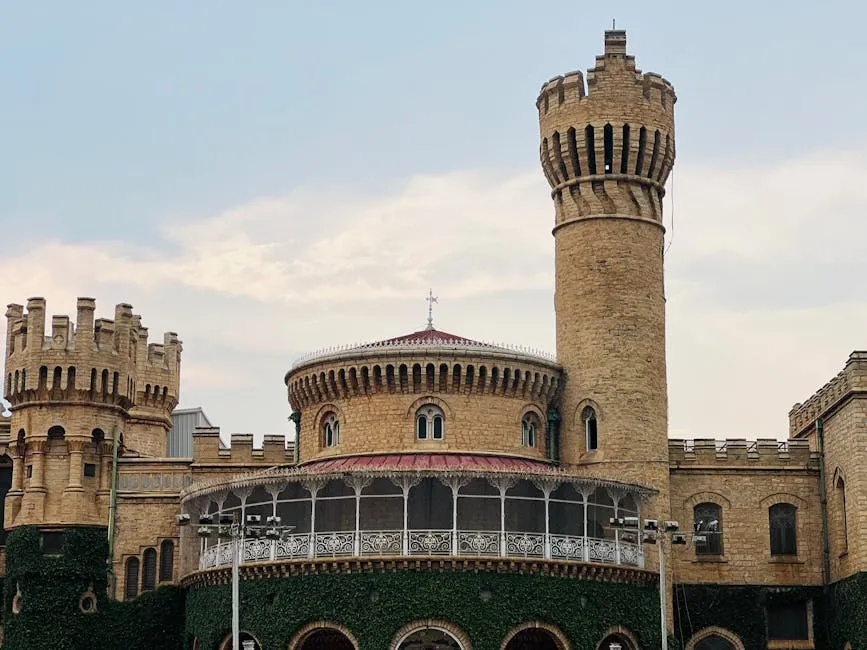
A 1878 Wodeyar dynasty residence, designed loosely on Windsor Castle by John W. Coleman, on 454 acres of central-city land. The interior is heavy Victorian — wood-panelled rooms, ornate balustrades, period furniture in occasional working condition — and the audio guide (included in the ticket) is the unexpectedly good part of the visit. Outside, the palace grounds are now substantially developed for concerts and weddings; a non-trivial fraction of Bangalore’s large outdoor music events happen on the lawns.
- Hours: 10:00–17:30 daily.
- Entry: ₹230 (€2.10) Indian / ₹460 (€4.15) foreigner. Audio guide in Hindi, English, Kannada, French, German, Italian included.
- Access: Bolt to “Bangalore Palace” or a 15-minute walk from Kanteerava Studios Metro (Green Line).
5. Tipu Sultan’s Summer Palace
Smaller, older and more honest than Bangalore Palace. The 1791 wood-and-teak palace of Tipu Sultan — the Tiger of Mysore, the eighteenth-century ruler whose two wars against the British East India Company shaped the South Indian map — is a single floor of pillared verandahs, painted ceilings, and a small museum showing Tipu’s correspondence, weapons, and the documents of the 1799 fall of Srirangapatnam. The setting (a quiet walled compound in the heart of the old Pete) is the part to come for.
- Hours: 08:30–17:30 daily.
- Entry: ₹15 (€0.14) Indian / ₹200 (€1.80) foreigner. Photography fee ₹25.
- Access: Krishna Rajendra Market (KR Market) Metro Station (Green Line), 5-minute walk.
Pro Tip: Combine with the Bangalore Fort (₹15 / ₹200) and KR Market in the same morning — all three are within a 600-metre walking radius and together give you the working-Pete experience that Bangalore Palace by itself does not.
6. Bull Temple (Dodda Basavana Gudi)
The 16th-century stone temple in Basavanagudi housing a 4.6-metre monolithic Nandi (the bull who is Shiva’s mount), carved from a single block of granite. The temple is functionally working — daily pujas, Saturday-evening abhishekam (anointing) ceremonies, the annual Kadalekai Parishe groundnut fair in November–December — and is one of the few major southern-Indian temples that allows foreigners inside the sanctum without prior arrangement. Dress modestly, remove shoes, do not photograph the deity.
- Hours: 06:00–13:00, 16:00–21:00 daily.
- Entry: Free; donation expected. ₹100 (€0.90) photography permit at the gate if you want to shoot the exterior.
- Access: National College Metro (Green Line), 10-minute walk. Combine with Vidyarthi Bhavan for breakfast (see Where to Eat).
7. ISKCON Temple Bangalore
The 1997 hilltop temple complex in Rajajinagar — the international headquarters of the International Society for Krishna Consciousness Bangalore branch, which split acrimoniously from the Mumbai/Delhi parent ISKCON in 2001 over property and theological disputes. The building is large, modern, glass-and-marble, and unapologetically theatrical — escalator approach, themed dioramas, gift shop, vegetarian food court producing what is widely held to be the city’s best prasadam meal. Worth visiting on a long Sunday morning when local families are out in force; less interesting mid-week.
- Hours: 04:15–13:00, 16:15–20:30 weekdays; longer on weekends and festival days.
- Entry: Free.
- Access: Mahalakshmi Metro (Green Line), 10-minute walk uphill.
8. Commercial Street and the Cantonment Bazaars
Not a single attraction but a working district that earns the entry. Commercial Street (in the cantonment, off MG Road) is the British-period shopping street the colonial wives once used; it now operates as a five-block pedestrianised bargaining-stretch for textiles, cheap fashion, gold jewellery, leather, Indian sweets, and street food. Russell Market (the 1927 covered market a block over) handles fish, meat, flowers and produce. Shivajinagar (just north) is the city’s wholesale-electronics and printer-cartridge quarter. The whole zone is at its best in the early evening, when the lights come on and the working-day crowds replace the morning shoppers.
Editor’s tip: The cantonment bazaar district is where most first-time visitors get their first honest dose of working Bangalore. Use it accordingly — buy a kurta, eat a bhel puri at a street stall, drink a jaljeera lemonade. Do not buy gold or anything claiming to be silk on the street.
9. Bangalore Fort (Remnant)
What is left of Kempegowda’s 1537 mud fort, rebuilt in stone by Hyder Ali in 1761, partially demolished by the British after their 1791 conquest — basically a single Delhi Gate, fragments of the south wall, and a small Ganesha temple where the inner keep used to be. Free, open all hours, takes fifteen minutes, and is the bookend to the Tipu Sultan Palace visit.
- Hours: 24/7.
- Entry: Free.
- Access: KR Market Metro, 5-minute walk to either Tipu Sultan’s Palace or the fort fragments.
10. National Gallery of Modern Art (NGMA)
The Bangalore branch of the Indian national modern-art collection, opened 2009 in the heritage Manikyavelu Mansion on Palace Road. The permanent collection includes works by Raja Ravi Varma, Amrita Sher-Gil, Nandalal Bose, Jamini Roy, M.F. Husain, and most of the Indian twentieth-century masters; the temporary exhibitions are well-curated, often political, sometimes controversial. The building itself (a colonial bungalow on a large landscaped plot) is half the visit.
- Hours: 11:00–18:30, closed Mondays and national holidays.
- Entry: ₹20 (€0.18) Indian / ₹500 (€4.50) foreigner. Camera fee ₹150 still / ₹300 video.
- Access: Bangalore Palace is 600 m away; walk between them.
11. UB City Mall and Vittal Mallya Road
The mixed-use luxury complex on the central-cantonment skyline — built 2008 by Vijay Mallya (the disgraced UB Group chairman, currently fugitive from Indian banking-fraud charges and resident in the UK), now operating under different ownership. The mall itself is generic global-luxury (Louis Vuitton, Burberry, Rolex, etc.) but the rooftop bars and the high-end restaurants — Toscano, Skyye, Sanchez — make it Bangalore’s most reliable upscale-evening sightline. The wider Vittal Mallya Road between UB City and Cubbon Park is the city’s working luxury-restaurant strip.
- Hours: 10:00–23:00, individual outlets vary.
- Entry: Free.
- Access: Cubbon Park Metro (Purple Line), 10-minute walk.
Editor’s tip: If the budget runs to it, a sundowner at Skyye (the open-air rooftop, 16th floor) is the most justified expensive drink in the city — clear north-east view down to the airport flight path, with the sun setting behind the cantonment behind you. The drinks are €10–15 a pop, the small plates ₹600–1,200, and the dress code is enforced (no shorts, no flip-flops, no athleisure).
12. The Bangalore Aquarium and Government Museum
The two oldest visitable institutions of the cantonment, both inside Cubbon Park. The Government Museum (1865, the second-oldest in India) holds the Halmidi inscription — the earliest stone inscription in any Dravidian language, 450 AD — and a working coin and pottery collection from the South Indian dynasties. The Bangalore Aquarium (the second-oldest aquarium in India, 1983) is small and modest and is included on this list because it is what generations of Bangalore children remember as their first day out, and the building itself is one of the architectural curiosities of the park.
- Hours: Museum 10:00–17:00, closed Mondays. Aquarium 10:00–18:00 Tue–Sun.
- Entry: Museum ₹10 Indian / ₹100 foreigner. Aquarium ₹10.
- Access: Cubbon Park Metro.
Bangalore’s Neighbourhoods
Bangalore is a sprawl — 741 square kilometres of municipal limit, 13 million people across a metropolitan area that takes two hours to cross by car. A visitor who tries to “see Bangalore” by hopping neighbourhoods will spend most of their trip in traffic. The right strategy is: pick one or two neighbourhoods to base in, and treat the rest as day excursions on the metro. The list below is in clockwise order around the Cubbon Park axis.
Cantonment Core — MG Road, Brigade Road, Vittal Mallya Road
The classical visitor’s Bangalore. Walking distance to Cubbon Park, Vidhana Soudha, Bangalore Palace, UB City, the National Gallery and Commercial Street; well-served by both Purple and Green metro lines (MG Road, Cubbon Park, Trinity); restaurant-dense; safe at all hours; the most cosmopolitan crowd in the city. The downside: it is expensive by Indian standards, both for hotels and for food, and the area is genuinely loud at weekends.
Indiranagar — The Working Cosmopolitan
Three kilometres east of MG Road, bounded by 100ft Road, CMH Road, and 12th Main. Indiranagar is the post-2000 yuppie quarter — global-Indian restaurants, microbreweries, third-wave coffee, independent boutiques, the city’s densest concentration of bars, the working “expat” zone for the IT-belt. Toit, Glen’s Bakehouse, Truffles and most of the city’s well-known fusion places are here. Metro: Indiranagar Station (Purple Line). Hotel base: good. The downside: the area has been raucous since about 2018 and the 12th Main bar strip is loud on weekend nights.
Basavanagudi — The Old Bangalore
South of the city centre, west of Lalbagh, between Bull Temple Road and Gandhi Bazaar. This is the Kannada-speaking heart of the older city — single-family bungalows with red roof tiles, working temples, the original branch of Vidyarthi Bhavan, the iconic Bull Temple, and the morning kadalekai groundnut sellers of Bugle Rock. Quieter, more local, less tourist-friendly than the cantonment but the more rewarding base for a returning visitor.
Malleshwaram and Sankey Tank
North-west of the city centre. The brother-quarter to Basavanagudi (founded at the same time, after the 1898 plague), with the same red-roofed bungalow style and the same Brahmin-traditional cultural identity. Sankey Tank — the artificial lake that anchors the neighbourhood — is the morning-walk equivalent of Cubbon Park for the residents here. Closer to Malleshwaram Metro (Green Line). Quietly recommended for a second-visit traveller who has seen the cantonment side and wants the older-Bangalore version.
Jayanagar and JP Nagar
South-of-Lalbagh residential districts laid out 1948–60 in the comfortable Indian-middle-class manner: wide tree-lined avenues, four-storey apartment buildings, working community markets (Jayanagar 4th Block is the most beloved one in the city), excellent restaurants away from the cantonment-tourist tax. Less interesting for a first-time visitor but a useful base if your trip is going to include children or older parents — the neighbourhood is genuinely pleasant for walking and the food is twenty per cent cheaper than the equivalent in Indiranagar.
Koramangala
South-central — the post-2000 startup neighbourhood between Forum Mall and Sarjapur Road. The working centre of the city’s pre-Whitefield IT scene, with a heavy concentration of co-working spaces, third-wave cafés, mid-range restaurants and chain hotels. Less photogenic than the older neighbourhoods, more useful as a base for a working visit (conferences at Forum, meetings at the startup scenes). Bolt-accessible to most of the city; metro is a 1.5 km walk to the new Yellow Line (Jayadeva Hospital station, on the southern side).
Whitefield and Outer Ring Road — The IT Belt
Twenty kilometres east, the global-headquarters-of-Microsoft side of the city. Hotel base is genuinely good (the ITC Gardenia, Hyatt Regency, Marriott Whitefield, JW Marriott Whitefield all sit here at fifteen-to-thirty per cent below their Mumbai/Delhi equivalents) and the area is well-served by Purple Line metro and Yellow Line metro (which finally connects Whitefield to Electronic City via the eastern arc as of late 2025). The downside: it is twenty kilometres from anything historic; if your trip is heritage-focused, do not base here.
Where to Stay — by Budget
Rates below are for shoulder season (October–December for cool-and-dry; April–May for hot-and-dry); peak (December–February) runs 25–40 per cent higher, and the truly cheapest months are June–August during the monsoon. All rates double-occupancy.
Budget — ₹1,200–3,500 per person per night (€11–32)
Hostels are well-developed in central Bangalore. The Zostel Bangalore (Indiranagar), Conrad Hostel Bangalore (Indiranagar), and The Hosteller (multiple locations, MG Road and Indiranagar) all run dorm beds at ₹650–1,200 (€6–11) and private doubles at ₹2,000–3,500 (€18–32). Cleanliness and security are reliably acceptable in this band, and the central locations are walking-distance to metro and food.
For private rooms in the same price range, the Treebo and OYO branded budget chains run renovated mid-tier guesthouses at ₹1,800–3,500 per night. Booking through the operator’s own app rather than through Booking.com gets you a 10–15 per cent saving.
Mid-range — ₹4,500–9,500 per night (€41–86) for a double
Lemon Tree Premier, Vivanta by Taj, and the ibis central-Bangalore branches all sit in this band. The most central reliable mid-range hotel is Lemon Tree Hotel Ulsoor Lake (a 15-minute walk to MG Road, with a working lakeside view) at roughly ₹6,500 a night with breakfast.
In Indiranagar, the ibis Bengaluru Hosur Road and Fairfield by Marriott Whitefield are the safe choices in the ₹5,500–8,500 band. In Whitefield, the mid-range tower stock is plentiful and discounted in monsoon.
Splurge — ₹14,000+ per night (€125+) for a double
The Taj West End (Race Course Road) is the city’s signature heritage hotel — a 1887 colonial bungalow expanded into a 117-room property, with the 20-acre garden setting that gives it the only meaningful old-Cantonment-hotel experience in the city. Rates ₹22,000–45,000 (€198–405) depending on room type and season.
ITC Windsor (Golf Course Road) is the older Cantonment competitor, set in a 1980 expansion of a colonial-era property. The lobby and the wood-panelled lounge are a non-trivial piece of the experience. ₹16,000–28,000.
The Leela Palace Bengaluru (Old Airport Road) is the more recently-built (2001) member of the luxury set — a 357-room palace-style hotel with the city’s best-regarded fine-dining suite (the in-house Citrus, Le Cirque, Jamavar). ₹18,000–35,000.
JW Marriott Bengaluru (Vittal Mallya Road) anchors the UB City complex and is the right choice if you want central-Cantonment plus rooftop pool plus access-to-Vittal-Mallya-Road dining. ₹19,000–32,000.
Where not to stay
Avoid Booking.com “central” hotels that turn out to be in Madiwala, BTM Layout, or the southern fringe of Koramangala — they look cheap on the price-per-night line but the airport-or-attractions traffic-time tax wipes out the saving. Indiranagar, MG Road, Cubbon Park area, and Whitefield are the four reliable bases.
Where to Eat — Dosa, Filter Coffee, Coastal
South Indian food is the centre of the Bangalore experience and the single biggest reason a returning visitor comes back. The defining structures are:
- The dosa — fermented rice-and-lentil crêpe, served plain (sada), with potato filling (masala), with onion and chilli (onion masala), with butter (benne), or in the famous Bangalore-specific Mysore masala with red-chutney spread inside.
- The thali — a meal-on-one-plate of rice, two vegetable curries, sambar, rasam, curd, papad, pickle, and a sweet, eaten with the right hand.
- Filter kaapi — the South Indian filter-decoction coffee, served in a stainless-steel davara-and-tumbler set, distinctly stronger and more chicory-tinged than an espresso.
- Coastal Karnataka and Mangalorean fish — the under-promoted regional cuisine that Bangalore restaurants do as well as anywhere.
A short, opinionated list. Reservations are generally not required at the institutional eateries (the queues are the experience); the upmarket places take reservations through Zomato or Dineout.
The Institutional Tiffin Houses — ₹100–250 per head (€0.90–2.30)
- Mavalli Tiffin Rooms (MTR), Lalbagh Road — founded 1924, the most famous breakfast in southern India. Order the rava idli (their 1940s invention, when wartime rice shortages forced them to substitute semolina), the filter coffee, and the chandrahara dessert. Queue at 07:30; the first wave clears by 09:00.
- Vidyarthi Bhavan, Gandhi Bazaar, Basavanagudi — founded 1943, the city’s defining masala-dosa shop. Twelve-table single-room, white-shirted waiters carrying eight plates at once, the dosa folded into a half-moon and pressed flat under butter. Queue forms by 07:30. Cash only.
- CTR (Central Tiffin Room), Margosa Road, Malleshwaram — the benne masala dosa (butter masala dosa) in its most-respected form. The benne dosa is heavier, crisper and butter-soaked compared to the standard masala — it is the Bangalore-vs-Chennai dosa-style argument made visible.
- Brahmin’s Coffee Bar, Shankarapuram — the morning vada-sambar anchor. Ten-table standing operation, opens 06:45, sells out by 11:00.
Mid-Range Restaurants — ₹400–900 per head (€3.60–8)
- Karavalli, Vivanta by Taj, Residency Road — Mangalorean and West-coast-Indian coastal cooking in a heritage-bungalow setting. The fiery crab milagu fry, the meen pollichathu (banana-leaf-wrapped fish), and the appam-and-stew are the dishes to order.
- Mavalli Tiffin Rooms (MTR) Dinner, Lalbagh Road — the same institution, evening menu, mid-range thali at ₹550 (€5).
- Empire, multiple locations — the city’s defining late-night kebab-and-biryani chain. Open until 03:00, working class to mid-range, the chicken biryani is the order.
- Truffles, Indiranagar (and other branches) — the Bangalore-defining American-burger institution. Queue forms at 19:00 on weekends.
Higher-end — ₹1,500–4,500 per head (€13–40)
- Farmlore, Uttarahalli — the most-talked-about restaurant in the city in 2026. A 37-acre working farm on the south-western outskirts, a ten-course farm-to-table tasting menu, the chef-collective drawing on regional Karnataka ingredients. Featured on the World’s 50 Best Asia 51-100 list 2026. Book three weeks ahead; ₹4,500–6,500 (€40–58) per head. The drive out is an hour from the centre — set aside the whole evening.
- Zarqash, The Ritz-Carlton — refined Indian and Middle-Eastern fine dining under chef Rohit Ghai (who holds a Michelin star for his London work; not for Bangalore — India has no Michelin guide). ₹2,500–4,000 per head.
- Toit, Indiranagar — the city’s defining microbrewery, opened 2010 in a converted warehouse with mid-Atlantic gastropub food and house-brewed lagers. ₹1,000–1,800 per head with two pints.
Coastal Karnataka — the cuisine to focus on
Mangalorean and West-coast cooking is the regional specialty that Bangalore restaurants do better than almost anywhere else. Karavalli is the fine-dining benchmark; Coastal Goa Restaurant (Indiranagar), Pallavi (Jayanagar), and the small Mangaluru Pearl chain do the same cuisine at half the price. Order: meen kolambu (fish curry), neer dosa (rice-flour pancakes), kori rotti (chicken curry on crisp rice wafer), kane fry (lady fish), pundi (steamed rice dumplings).
Vegetarian Bangalore
Bangalore is one of the most vegetarian-friendly cities in the world. Bull Temple Road and the surrounding Basavanagudi neighbourhood operate almost entirely as a vegetarian zone; most older Bangalore restaurants (MTR, Vidyarthi Bhavan, CTR, Brahmin’s) are vegetarian by tradition. A non-vegetarian visitor will not lack for meat but should expect that, in most homes and many neighbourhoods, “food” defaults to vegetarian.
Editor’s tip: The one Bangalore food rule is: order what is local rather than what is “Indian.” Don’t order butter chicken at MTR or biryani at Vidyarthi Bhavan — order the dosa they are famous for. Skip the Punjabi-North-Indian menus at South-Indian restaurants and vice versa. The reward for ordering locally is steep, and the penalty for ordering by national stereotype is a tepid, overspiced version of the dish you could have had better in Delhi or Lucknow.
Drinking — Toit, Pubs, Filter Kaapi
Bangalore has been the “pub capital of India” since the early 1990s (Karnataka liquor licensing was historically the most permissive in the country) and the post-2010 craft-brewery wave has consolidated the title. The scene has three layers.
Microbreweries and the post-2010 Bangalore wave
- Toit, Indiranagar — opened 2010, the originator. Eight house beers on tap (the Tintin wheat beer, the Basmati Blonde, the Toit Red, the Colonial Toit), wood-fired-oven food. The benchmark. Queue from 19:00 on weekends; the wait is real (60–90 minutes is common). Pints ₹250–350 (€2.30–3.20).
- Arbor Brewing Company, Magrath Road — the Michigan-derived second wave, opened 2013. Less queue, similar quality.
- Windmills Craftworks, Whitefield — the most physically impressive of the breweries, with a 200-seat live jazz bar, a working theatre, and a wine cellar.
- Brewsky, Whitefield — the IT-belt working-week answer; large, multi-level, popular with the office crowd.
The old “pub-capital” anchors
- Pecos, Brigade Road — opened 1989, the working students-and-classic-rock pub that the city was famous for in the 1990s. Two storeys, sticky floors, Pink Floyd at high volume, ₹120 pints (€1.10). The benchmark for the older Bangalore drinking scene.
- NASA, Church Street — the spaceship-themed bar that opened in 1990, recently refurbished but still working its original niche.
- Koshy’s, St Mark’s Road — not a bar in the modern sense but the working all-day café-and-grill that has been the literary-and-political meeting point of the city since 1940. Beer and chicken-cutlet for ₹450 (€4) total. Indispensable.
Filter Kaapi — the morning drinking ritual
Most South Indian drinking is coffee, not alcohol. The filter-decoction coffee — chicory-blended, brewed in a two-chamber stainless-steel filter, mixed with hot milk and sugar to taste, decanted between a stainless-steel tumbler and davara (saucer) to cool to drinking temperature — is the morning ritual the city is built around. Brahmin’s Coffee Bar, Airlines Hotel, and MTR are the institutional anchors; almost any working darshini (standing-only quick-meal cafeteria) will serve a ₹25 (€0.22) filter coffee that beats most European espresso.
Pro Tip: The Indiranagar microbrewery strip is best on a Wednesday or Thursday — the food is the same, the beer is the same, the wait is two-minute rather than forty-five-minute. Weekend Toit on Friday and Saturday nights is genuinely an hour-plus queue.
Getting Around the City
Bangalore runs on Namma Metro, app-based taxis (Uber, Ola, Rapido), auto-rickshaws, and the bus network. The right combination depends on the time of day and the destination.
Namma Metro
The two-line system from 2011 has expanded substantially. The Purple Line runs east–west from Whitefield to Challaghatta, covering Indiranagar, MG Road, Cubbon Park, Majestic; the Green Line runs north–south, covering Yelachenahalli, Jayanagar, Lalbagh, Majestic, Malleshwaram and onward. The Yellow Line to Electronic City opened in 2025 and finally made the southern IT belt metro-accessible (one of the most-cited 2026 improvements). The Pink Line elevated section is targeted to open in mid-2026, with the underground section to follow late 2026. The Blue Line to the airport is expected in 2027.
Fares are distance-based, ₹10–80 (€0.09–0.72) per journey. Buy a Metro Smart Card for ₹50 deposit (refundable) plus a top-up of your choice — the contactless tap lets you skip the ticket queue, which can be twenty minutes deep at Majestic in evening rush. Trains run from 05:00 to 23:00.
App-based Ride-hails
Uber and Ola dominate the city’s taxi and auto-rickshaw market. The Ola Auto option for auto-rickshaws is roughly half the price of Uber Cab for short trips; the Uber Auto equivalent is comparable. Expect ₹100–300 (€0.90–2.70) for a 5–7 km trip in normal traffic, ₹400–800 for a 15 km trip. Surge pricing in monsoon and weekend evenings is real and reaches 2.5×.
Rapido (motorcycle taxis) is the working answer for traffic. A pillion ride costs roughly half the auto-rickshaw equivalent and bypasses most stuck-traffic situations by lane-splitting. Useful if you have a helmet (the driver provides one) and a high tolerance for Indian traffic behaviour; not recommended in heavy monsoon rain.
Auto-rickshaws (Street Hail)
The yellow-and-black three-wheelers are the city’s traditional working transport and are still the most common short-trip option. Use the meter, not a quoted fare — Karnataka law requires the meter to be used, and most drivers will comply if you insist. Meter rate is ₹30 (€0.27) for the first 1.9 km, then ₹15 per km. Night surcharge (after 22:00) is 50%. If a driver refuses the meter, walk away; the next one will use it.
BMTC Buses
The city bus network is comprehensive, cheap (₹5–25 per ride), and slow. Most visitors will not use it except for the Vayu Vajra airport buses. The Volvo air-conditioned buses are reliable; the older non-AC buses are a real experience but not recommended in summer heat or monsoon.
Walking
Bangalore is not a walking city in the European sense — pavements are absent or in poor repair, road-crossings are dangerous, and the heat-and-rain pattern is not friendly to long walks. The exceptions: Cubbon Park (genuinely walkable), Lalbagh Garden (genuinely walkable), the MG Road / Brigade Road / Commercial Street / Church Street pedestrian quarter (mostly walkable), the Basavanagudi / Gandhi Bazaar historic core (mostly walkable on the back streets), and the Indiranagar 100ft Road / 12th Main restaurant strip. Outside these zones, take a Bolt.
Editor’s tip: The Bolt-vs-Auto-vs-Metro decision usually goes Metro on the named routes (MG Road, Whitefield, Electronic City), Auto for everything within 4 km, and Bolt for the longer cross-city runs (8+ km) where the Metro doesn’t go. A useful rule: if you are in central Bangalore and the destination is more than 15 km away, take the Metro to the nearest station first and Bolt for the last leg; do not Bolt the whole way and sit in two hours of Outer Ring Road traffic.
When to Visit
Bangalore has three working seasons: cool-and-dry (October–February), hot-and-dry (March–May), and monsoon (June–September). The right months are October, November, December, January and February.
- November–February — the city at its best. Daytime 24–28 °C, night 14–17 °C, dry, clear, low humidity. The flower show is in late January; the Karaga festival (March, the working Kannada urban-Hindu festival of the Tigala community, ten days of street processions and the iconic balanced-pot dance) follows. December–January is peak hotel rate.
- March–May — hot. Daytime 32–34 °C, dry until the very end of May. The pre-monsoon thunderstorms (April–May, locally called “mango showers“) are short and intense; bring an umbrella. Not unbearable — Bangalore’s elevation keeps it cooler than Chennai or Hyderabad in the same months — but the climate dividend is less generous than the brochures imply.
- June–September — monsoon. Daytime 24–28 °C, frequent heavy rain, occasional flooding, the worst of the year’s traffic. Hotel rates drop 25–40 per cent. The trade-off: the city is genuinely greener and cooler, but Outer Ring Road is impassable in heavy rain and your day trips to Mysore/Coorg become weather-dependent.
The political calendar layer for 2026: civic polls across the five Bengaluru municipal corporations are scheduled for May 2026 following the longest-running set of voter-list and reservation disputes in the city’s history. Election days are quieter than usual (banks and schools closed) but the campaign weeks (late April through early May) are loud, traffic-clogged, and visibly partisan. Plan around if you want.
Month-by-Month Weather
| Month | Day high (°C) | Night low (°C) | Rain days | Notes |
|---|---|---|---|---|
| Jan | 27 | 15 | 1 | Peak season — cool, dry, clear |
| Feb | 30 | 17 | 1 | Still dry; flower show late month |
| Mar | 33 | 19 | 2 | First mango showers; Karaga festival |
| Apr | 34 | 21 | 5 | Hottest; afternoon thunderstorms |
| May | 33 | 21 | 9 | Pre-monsoon heat-rain mix |
| Jun | 29 | 21 | 14 | Monsoon onset; cooler, very wet |
| Jul | 27 | 20 | 17 | Heavy rain, lush green |
| Aug | 27 | 20 | 15 | Heaviest rain month |
| Sep | 27 | 19 | 13 | Lit Fest season — Bangalore Lit Fest typically late month |
| Oct | 27 | 19 | 9 | Best month — post-monsoon, fresh |
| Nov | 26 | 17 | 4 | Second-best month; Kannada Rajyotsava 1 Nov |
| Dec | 26 | 15 | 1 | Cool, peak season; holiday surcharge |
Daily Budget Breakdown
Figures below are per person per day, in rupees and euro equivalent, at the ₹111 = €1 rate verified 22 May 2026. They cover accommodation (double occupancy, divided by two), three meals, transit, and modest attraction-ticketing.
| Budget level | Per day | What you get |
|---|---|---|
| Backpacker | ₹900–1,800 / €8–16 | Hostel dorm (₹800), tiffin breakfast + thali lunch + dinner (₹400 total), metro day (₹100), one paid attraction (₹50) |
| Mid-range | ₹3,500–7,500 / €31–67 | Mid-range hotel per-person (₹2,750), sit-down meals incl. one Karavalli-style dinner (₹1,800), Uber + Metro (₹400), two attractions (₹500) |
| Higher | ₹12,000–18,000 / €108–162 | Taj West End per-person (₹11,000), a Karavalli or Toit dinner (₹2,500), a Farmlore reservation, Uber XL everywhere |
| Splurge | ₹25,000+ / €225+ | Heritage suite, Farmlore tasting menu, a private-car day trip to Mysore, top-tier spa at the Leela |
Bangalore is materially cheaper than any European capital and meaningfully cheaper than the top-tier Indian cities (Mumbai, Delhi). A mid-range day at €31–67 corresponds roughly to a backpacker day in Prague or Lisbon.
Sample Itineraries
3 days — the essential first visit
- Day 1 (Cantonment). Breakfast at MTR Lalbagh Road → Lalbagh Garden walk → Bull Temple → Vidyarthi Bhavan (early lunch) → Tipu Sultan’s Summer Palace → Bangalore Fort → KR Market. Bolt back. Dinner at Karavalli on Residency Road.
- Day 2 (Cubbon arc). Cubbon Park sunrise walk → Government Museum → Vidhana Soudha (if Sunday or 2nd/4th Saturday) → National Gallery of Modern Art → Bangalore Palace → UB City Mall and a sunset at Skyye.
- Day 3 (Indiranagar + Whitefield). Slow morning, late breakfast at Glen’s Bakehouse → Indiranagar shopping → afternoon Toit microbrewery → metro to Whitefield for evening Windmills Craftworks or back to Pecos for the old-Bangalore pub round.
5 days — adds Mysore
Days 1–3 as above. Day 4: Mysore day trip — leave at 07:00 on the Vande Bharat Express or hire a driver via the Bangalore-Mysuru Expressway (opened 2023, 2-hour drive); see Mysore Palace, Chamundi Hill, Devaraja Market; return for late dinner. Day 5: A second slower Bangalore day — Sankey Tank morning walk in Malleshwaram, the Jayanagar market for shopping, a late lunch at Halli Mane, and a final dinner at Farmlore (book three weeks ahead).
7 days — adds Coorg or Halebidu/Belur
Days 1–5 as above. Day 6: Halebidu and Belur — the twelfth-century Hoysala-period temple cities, three hours’ drive west of Bangalore, the architectural standout of southern India. Full-day driver hire ₹4,500–6,500 (€41–58). Day 7: Recovery day in the city — second visit to Lalbagh in a different light, slow lunch on Vittal Mallya Road, a final dinner at Karavalli or back at MTR.
Best Day Under €15 — Cantonment to Pete on Foot and Metro
A genuinely cheap day, walked plus metro, with the city’s defining experiences. Cyprus’s Best Day was €32.60; Nicosia is upper-Mediterranean; Bangalore is the cheap-Asian band. The leaderboard slot is solid.
| Item | Cost | Notes |
|---|---|---|
| Filter coffee + 2 idli at a standing darshini | ₹60 (€0.55) | Any working darshini on St Mark’s Road or near MG Road metro |
| Cubbon Park morning walk | ₹0 | 06:00–09:00 |
| Metro day pass (smart card top-up) | ₹100 (€0.90) | Unlimited central-line travel |
| Lalbagh entry (after 09:00) | ₹50 (€0.45) | Free if you enter before 09:00 |
| Lunch: dosa + filter coffee at Vidyarthi Bhavan | ₹150 (€1.35) | Cash only; ₹2.50 per dosa, ₹40 per coffee |
| Tipu Sultan’s Palace + Bangalore Fort | ₹400 (€3.60) | ₹200 + ₹200, foreigner rate |
| Afternoon: walk Commercial Street, browse, buy a kurta | ₹0–500 | The bargain is on you |
| Coffee at Koshy’s, St Mark’s Road | ₹80 (€0.72) | Or a slice of cake for ₹140 |
| Dinner: thali at MTR | ₹550 (€5.00) | The full deluxe thali |
| Pint at Toit if you have energy | ₹300 (€2.70) | One pint, walk-in midweek |
Running total: ₹1,690 / €15.23 — just over target if you do the pint at Toit, comfortably under if you swap to Koshy’s filter coffee (₹40 = €0.36).
For context, the fleet’s Best Day Under leaderboard reads roughly: Cairo $3.50 · Bogotá $6 · Kuala Lumpur €8.50 · Munich €12 · Bangalore €15 · Tbilisi €25 · Nicosia €32.60 · Sicily/Corsica €35–40. Bangalore sits between the deep-cheap Asian band and the South-Caucasus low band — a fair placement for one of the cheapest major Indian cities to visit honestly.
Editor’s tip: Bangalore is one of the few cities where the cheap day is meaningfully better than the expensive day. The institutional tiffin houses (MTR, Vidyarthi Bhavan, CTR) at ₹150 a meal are food no Bangalore Taj equivalent will serve you, and a Cubbon Park morning at ₹0 is a better walk than most paid attractions in the city. Save the splurge for one Farmlore dinner; keep the rest of the trip cheap.
Hot Afternoon, Rainy Day & Off-Season Plans
Hot afternoon (April–May, 32–34 °C)
Bangalore’s heat is friendlier than Mumbai or Delhi’s because of the 920-metre elevation, but the 14:00–17:00 window is still a write-off. Move indoors. The National Gallery of Modern Art is air-conditioned and has three hours of legitimate content. The Government Museum is more basic but cooler. The Cubbon Park-side State Central Library in the brick Seshadri Iyer Memorial Hall is open to visitors as a reading room and has been the city’s most reliable cool-quiet retreat for decades. The UB City Mall is the modern version. Save Lalbagh and Cubbon for sunrise and after 17:00.
Rainy day (June–September)
Bangalore monsoon is short-burst tropical-shower rather than all-day grey, but a 50-minute downpour in October on Outer Ring Road will write off the day. Lean indoors. The NGMA, the Government Museum in Cubbon Park, the Visvesvaraya Industrial and Technological Museum (a working hands-on science museum on Kasturba Road), and the Indian Music Experience (the music museum in JP Nagar, opened 2019) together give a visitor more good rain-fallback content than they will need in any one weather window. The MTR, Vidyarthi Bhavan and Koshy’s are all the right lunches for a rainy afternoon. The Sunday Cubbon Reads operates rain or shine; people just sit on rain mats.
Off-season (June–September)
The off-season Bangalore is what the locals get and what most visitors miss. Hotel rates drop 25–40 per cent; the city is genuinely greener; the Cauvery-fed reservoirs refill (and the water-tanker rates fall); the food does not change. The trade-off: day-trip range to Coorg and Halebidu/Belur is weather-dependent, the Outer Ring Road traffic problem is at its worst, and the Whitefield-to-MG-Road commute can become a three-hour ordeal in heavy rain.
Day Trips
Mysore (Mysuru) — full day, ₹400–8,000 by train/driver
The cultural capital of Karnataka, 145 km south-west of Bangalore. The Bangalore–Mysuru Expressway opened in 2023 and cut the drive from 4 hours to 2 hours each way. The route is the attraction as much as the destination: Mysore Palace (the 1912 Indo-Saracenic palace of the Wodeyar maharajas, the second-most-visited monument in India), Chamundi Hill (the south-side temple-and-viewpoint), Devaraja Market (the working sandalwood-and-flower bazaar), and Brindavan Gardens at sunset (the illuminated KRS Dam pleasure gardens, 19 km north).
- By train: the Vande Bharat Express Bangalore–Mysuru runs twice daily each way, 2 hours, ₹400–1,200 (€3.60–10.80) depending on class. Book through IRCTC three days ahead.
- By driver: ₹4,500–6,500 (€41–58) round-trip including waiting time.
Coorg (Madikeri) — overnight, ₹6,500–14,000 by driver
The coffee-growing hill country 250 km south-west, an honest 5–6 hours’ drive from the city. Best visited as a one-night overnight rather than a long-day-trip. Spice plantations, coffee estate-stays, Abbey Falls, Raja’s Seat sunset, Talakaveri (the source of the Cauvery river), and Dubare Elephant Camp.
Halebidu and Belur — full day, ₹4,500–6,500 by driver
The twelfth-century Hoysala-period temple cities, 220 km west of Bangalore, 3 hours’ drive each way. The architecture — the carved soapstone friezes of the Chennakeshava and Hoysaleswara temples — is one of the highest achievements of southern Indian temple architecture and is the genuine art-history reason to visit the South. UNESCO World Heritage inscription 2023.
Nandi Hills — half day, ₹1,500–2,500 by driver
The 1,478-metre granite outcrop 60 km north of the city, traditionally the Bangalore weekend-sunrise destination. Best visited 04:00 start to catch sunrise from Tipu’s Drop (the cliff where Tipu Sultan reportedly executed prisoners — the traditional account holds). The drive up to the summit is a working tarmac road. Crowds are real on weekends — go on a weekday if you can.
Srirangapatna — half day, on the Mysore route
The fortress-island town that was Tipu Sultan’s capital, sacked by the British East India Company on 4 May 1799. Worth a stop on the Mysore drive — the Daria Daulat Bagh (Tipu’s wooden summer palace), the Jama Masjid, the Tipu’s Death Spot marker, and the Sangam river confluence. Roughly an hour’s stop on the Mysore drive.
Safety & Practical Information
Crime
Bangalore is one of the safer large Indian cities. Violent crime against tourists is rare. Petty crime — pickpocketing at Majestic and KR Market, the standard taxi over-quote at the airport, occasional ATM-skimming reports — exists at the level you would expect of any 13-million-person city. The two specific things to know:
- The “auto-rickshaw refuses meter” scam is real. Walk away; the next driver will use it. Or use Uber/Ola Auto where the fare is locked in the app.
- Currency-exchange short-changes at unauthorized money changers around MG Road and Brigade Road. Use ATMs (HDFC, ICICI, SBI, Kotak are the major networks) or the official Thomas Cook / Centrum exchanges at the airport for cash.
Water and Health
Do not drink tap water anywhere in Bangalore — this is the universal rule for India. Bottled water (Bisleri, Aquafina, Kinley) is ₹20 per litre and ubiquitous; most hotels and restaurants will refill your bottle from filtered sources. Food at established restaurants (anything in this guide) is safe; street food carries variable risk and is more sensitive than the equivalent in northern India because of the local stomach-bug profile.
Medical care at the private hospital chains (Manipal, Fortis, Apollo, Sakra) is excellent and affordable by EU standards (a GP appointment runs ₹1,500–3,500 / €13–32). Public hospital infrastructure outside the private network is below EU standard; for anything serious, travel insurance with evacuation cover is the conservative choice.
Language
Kannada is the working state language; English is widespread in the city’s tourist and business areas — almost universal in hotels, restaurants, and the metro system. Hindi is widely understood but not universally spoken (and politically sensitive in some Karnataka contexts; the Kannada-vs-Hindi-imposition argument is a live one). A foreign visitor speaking only English will have no significant communication problems.
Money
ATMs are everywhere; most accept Visa/Mastercard with low fees. Withdraw in rupees, not in foreign currency. UPI (the Indian instant-payment system — Google Pay, PhonePe, Paytm) dominates digital payments and most restaurants, autos and shops display QR codes; foreign visitors generally cannot use UPI without an Indian bank account, but most places that take UPI also take cards, and the major Indian banks issue domestic cards that work fine.
Electrical and SIM
Type C/D/M sockets (the round Indian three-pin), 230V/50Hz. A universal travel adapter is essential. Local SIMs from Airtel and Jio are sold at the airport for ₹500–1,500 (€4.50–13.50) with 30 GB data and unlimited domestic calls; passport + Indian-address-proof required (most hotels will provide the address letter). EU and UK roaming plans rarely include India at a sensible price — buy a local SIM unless your stay is under 4 days.
Visa & Entry Requirements
India operates an e-Tourist Visa (eTV) system that is mandatory for most foreign visitors. This is not a visa-on-arrival; you must apply online before travel.
- Eligible passports: Citizens of the EU, the UK, the US, Canada, Australia, New Zealand, Japan, South Africa and 180+ other jurisdictions are eligible for the e-Tourist Visa.
- Fees (2026): 30-day visa $25 (July–March) or $10 (April–June reduced rate); 1-year visa $40 for most nationalities, $160 for US citizens, $484 for UK citizens (reciprocity-based). 5-year visa also available.
- Where to apply: The official portal is indianvisaonline.gov.in/evisa. Do not use the lookalike sites that show up first on Google search — they charge a ₹2,000–5,000 service fee for the same application you can do yourself in twenty minutes.
- Processing time: 72 hours standard, longer in peak season. Apply at least one week before travel.
- Passport validity: At least 6 months from arrival date; at least 2 blank pages.
- On arrival: Print the e-Visa approval (the ETA) and present at immigration. Biometric data is captured at the airport. The visa is multiple-entry within its validity window; total stay in India per calendar year on the 1-year visa cannot exceed 180 days.
Important 2026 detail: the e-Visa fees were revised in late 2025 (the April–June reduced rate is an ongoing concession aimed at the South Indian shoulder season). Verify current fee on the official portal before applying — the structure changes occasionally.
Hidden Bangalore
Genuinely under-visited rather than secret. Things a second-visit traveller can stack into an itinerary, not the ones to chase on a first trip.
- Bugle Rock and the Big Banyan Tree — the granite outcrop in Basavanagudi where a city watchman blew a bugle every evening from the 16th-century fort era until the 1860s; the surrounding small park is the working morning-walk space for the older neighbourhood. The 400-year-old Big Banyan Tree (Dodda Alada Mara) at Kethohalli, 28 km south-west, is a separate excursion — a single banyan tree covering more than 3 acres, one of the oldest in India.
- The Russian Centre of Science and Culture at Race Course Road — the Soviet-era Indo-Russian cultural building, working Russian library, monthly film screenings of Soviet cinema, the kind of city-secret that genuinely surprises a visitor.
- Cubbon Reads — the 2nd and 4th Sunday community-library gathering on the lawns of Cubbon Park. No registration, no fee; show up at 11:00 with a book.
- The Avenue Road book row — the back streets of the Pete around Avenue Road and Chickpet are India’s third-largest used-book trading area (after Mumbai’s Flora Fountain and Delhi’s Daryaganj). Sunday mornings are the working flea-market day.
- Yakshagana performances — the traditional Karnataka coastal dance-drama. Performances happen sporadically at the Ravindra Kalakshetra theatre and at the Karnataka Chitrakala Parishath cultural centre; ticket prices ₹100–500. Check listings the week of your visit.
Romantic Bangalore
The city is unselfconsciously romantic in a quieter, less obvious way than the Mediterranean or south-east Asian equivalents. Bangalore romance defaults to garden-and-coffee rather than rose-and-sunset-villa.
- Lalbagh sunrise — the gardens at 06:30 with a thermos of filter coffee from a darshini. Free.
- Sankey Tank evening walk in Malleshwaram — the artificial lake with a 1.5 km circuit, lights coming on, working older-Bangalore couples.
- Dinner at Karavalli — the Mangalorean fine-dining bungalow on Residency Road, candlelit, the meen pollichathu and a bottle of Sula’s Dindori Reserve.
- Sundowner at Skyye in UB City — the 16th-floor open-air rooftop. Expensive drinks, the right sightline.
- A weekend in Coorg — the coffee-estate boutique hotels (Tamara Coorg, Vivanta Coorg) at €150–250 a night with a fire-warmed plantation veranda. Two hours’ drive south-west, twenty per cent of central Bangalore’s price.
Bangalore with Kids
Bangalore is genuinely good for children — the climate is mild, the food is mostly vegetarian and gentle, and the city has more child-targeted attractions than most Indian cities of its size.
- The Bangalore Aquarium in Cubbon Park — modest but loved.
- Bal Bhavan and the toy train in Cubbon Park — the working children’s-amusement complex.
- Visvesvaraya Industrial and Technological Museum on Kasturba Road — hands-on science museum, the equivalent of London’s Science Museum at one-tenth the scale.
- HAL Aerospace Museum (Hindustan Aeronautics Limited) — actual decommissioned Indian Air Force aircraft, walkable through, on the eastern fringe of the city near the old HAL airport.
- Wonderla Amusement Park on the Mysore Road — a full water-and-rides theme park, day-trip distance.
- Bannerghatta National Park and Zoo — the large open-jeep safari zone 22 km south of the city, with the working tiger, lion and leopard enclosures, plus a butterfly conservatory and a small zoo.
Practical: most Bangalore sit-down restaurants will accommodate children without comment; the thali style of multi-small-dish eating works well for picky eaters. Auto-rickshaws and metro both work fine with small children; Uber XL is the right call for longer journeys with toddlers.
What’s New in 2026
- The water crisis is the structural backdrop. Borewells running dry across the city in summer 2024; recovery dependent on monsoon performance and the Cauvery Stage V project. Twenty-six new sewage treatment plants are scheduled to come online by June 2026, raising the city’s treated-water capacity to 2,200 MLD.
- Namma Metro Yellow Line to Electronic City opened in 2025 and crossed the 1-million-daily-rides mark — the single biggest 2025–2026 improvement in city transport, and the reason a Whitefield or central-Bangalore visitor can now reach Electronic City reliably.
- Pink Line elevated section is expected to open mid-2026, with the underground section to follow late 2026. The full Phase 2 buildout targets 175 km of metro network by 2027.
- Vidhana Soudha public tours began June 2025 — the first time the Karnataka Legislative Assembly has been open to ticketed public visits.
- The Bangalore–Mysuru Expressway (opened March 2023) has settled into reliable two-hour operation between the two cities, making Mysore a comfortable day-trip rather than the 4-hour ordeal it used to be.
- BBMP civic polls scheduled for May 2026 across the five new municipal corporations of Greater Bengaluru; political-noise weeks in late April and early May.
- Michelin status, plainly stated: India has no Michelin guide as of May 2026. Some Bangalore marketing copy refers to “Michelin-star chefs” — this typically means a chef who holds a Michelin star for their work in another country (the UK most often), not a star for their Bangalore restaurant. Farmlore appears on the World’s 50 Best Restaurants Asia 51–100 list 2026 — the city’s strongest international recognition this year.
🌍 See the bigger picture: our India travel guide covers regions, when to go, and getting around.
Frequently Asked Questions
1. How many days do I need in Bangalore?
Three days is the minimum for a proper first visit (the Cantonment-Cubbon arc, the Pete and Tipu Sultan’s palace, Indiranagar food and drink). Five days adds Mysore. Seven days lets you also do Halebidu/Belur or Coorg and gives you space to repeat the bits you liked.
2. Is Bangalore safe to visit in 2026?
Yes. Bangalore is one of the safer large Indian cities. Violent crime against tourists is rare. The two everyday concerns are pickpocketing at crowded markets (KR Market, Majestic) and auto-rickshaw drivers refusing the meter — both manageable. The 2026 political-calendar wrinkle is the May 2026 civic-election campaign weeks, which are loud and traffic-clogged but not dangerous. Women travellers should observe standard urban-India common sense: avoid empty side streets after dark, prefer Uber to street-hail autos at night.
3. Do I need a visa for India?
Yes. The e-Tourist Visa is mandatory for almost all foreign visitors and must be applied for online before travel at indianvisaonline.gov.in/evisa. 30-day visa $25 (Jul–Mar) or $10 (Apr–Jun); 1-year visa $40 (most nationalities), $160 for US citizens, $484 for UK citizens. Apply at least one week before travel. Passport must be valid 6+ months with 2 blank pages.
4. Does Bangalore have any Michelin-star restaurants?
No. Michelin does not publish a guide for India as of May 2026, so no Indian restaurant holds a Michelin star within the published Michelin scope. Farmlore (Uttarahalli) appears on the World’s 50 Best Restaurants Asia 51–100 list 2026 and is the city’s strongest international culinary recognition. Marketing claims about “Michelin-star chefs” in Bangalore usually refer to chefs who hold Michelin stars in other countries (notably the UK), not for their Bangalore work.
5. How much does a trip to Bangalore cost?
Bangalore is one of the cheapest big-city visits in the world. A backpacker day runs €8–16. A mid-range day runs €31–67 (mid-range hotel, three sit-down meals, transit, attractions). A high-end day runs €108–162. A €15 day genuinely fits if you eat at the institutional tiffin houses and walk between attractions.
6. What is the best time to visit Bangalore?
November to February — cool, dry, clear, 26–28 °C days. December–January is the peak season with hotel surcharges. October is the post-monsoon shoulder; March–May is hot and dry with pre-monsoon mango showers; June–September is monsoon (cheaper hotels, heavier rain, worse traffic).
7. How do I get from Bangalore airport (BLR) to the city centre?
Vayu Vajra airport buses (KIA-1 to KIA-12) cost ₹120–270 (€1.10–2.40), take 60–110 minutes, run 03:00–23:30. Uber/Ola cost ₹900–1,800 (€8–16) and take 50–90 minutes depending on traffic. BIAL Meru fixed-fare cabs from the terminal counter run 10–20% above app prices. A direct Metro link to the airport is expected in 2027, not 2026.
8. Is Bangalore expensive?
No — it is cheaper than any major European or East Asian city and comparable to or cheaper than Mumbai or Delhi. Restaurant prices are roughly one-quarter of equivalent Western quality; accommodation is one-third. The €15 day is genuinely possible.
9. What is the famous Bangalore food scene?
Dosas (fermented rice-and-lentil crêpes — the Mysore masala, the benne masala, the rava are all city specialties); idlis and filter coffee at the institutional tiffin houses (MTR, Vidyarthi Bhavan, CTR, Brahmin’s); Mangalorean coastal cuisine at Karavalli and the smaller coastal restaurants; and the post-2010 microbrewery scene led by Toit in Indiranagar. Bangalore is famously vegetarian-friendly but the coastal-seafood scene is one of the strongest in India.
10. What’s the water situation in 2026?
Bangalore had a serious water crisis in summer 2024 — about 7,000 of the city’s 14,800 registered borewells went dry, water-tanker prices tripled. The 2025 and early 2026 situation is stable but the underlying groundwater depletion is unresolved. As a visitor: hotels and restaurants are unaffected (they get municipal Cauvery supply); do not drink tap water (always bottled); the day-to-day visit is normal. The structural crisis is the city’s working backdrop, not a tourist obstacle.
11. What is the best day trip from Bangalore?
Mysore for the palace and the cultural-capital experience (2 hours each way on the new expressway or the Vande Bharat train); Halebidu and Belur for the twelfth-century Hoysala temples (3 hours each way, full day); Coorg for the coffee country (5–6 hours, better as an overnight); Nandi Hills for sunrise (1 hour). Mysore is the answer if you can only do one.
12. Should I use Uber, Ola or auto-rickshaws?
Metro for the named lines (Whitefield, Indiranagar, MG Road, Lalbagh, Electronic City). Ola Auto / Uber Auto for short trips under 4 km. Uber Cab / Ola Cab for cross-city runs over 8 km. Street-hail autos work fine if the driver uses the meter — walk away if they refuse. Rapido motorcycle taxis bypass traffic but are not for everyone.
13. What’s the deal with Bangalore traffic?
It is the working national stereotype of Indian traffic. Outer Ring Road between Marathahalli and Silk Board, and Sarjapur Road, are the worst-affected stretches; central Cantonment (MG Road, Brigade Road, Cubbon Park) is much better. Plan trips that need to cross the city for off-peak hours (10:00–17:00, 22:00 onwards). Metro is the only reliable cross-city transport at rush hour.
14. Is Bangalore in the south?
Bangalore is in Karnataka, the south-central state of India. It is genuinely a southern Indian city — Kannada language, dosa-idli-sambar food culture, the temple-architecture tradition of Halebidu/Belur — but its post-1991 IT-sector identity has made it more cosmopolitan and English-speaking than any other South Indian capital. Chennai (Tamil Nadu) and Hyderabad (Telangana) are the immediate cultural peers; Mumbai and Delhi are a different country culturally.
Explore More AiFly Guides
City guides: Tbilisi, GeorgiaYerevan, ArmeniaBangalore, IndiaAhmedabad, IndiaKolkata, IndiaChengdu, ChinaShenzhen, ChinaXi’an, ChinaChongqing, ChinaUlaanbaatar, MongoliaHalifax, CanadaWashington, D.C.San Salvador, El Salvador
Island guides: SeychellesCape VerdeMaldivesFijiCreteCyprusCorfuMykonosNaxosZakynthosRhodesSantoriniSicilySardiniaCorsicaMalta
Cheapest Flights to Bangalore
We track flight deals to Bangalore from 6 cities worldwide. Here are the best recent fares:
Prices are based on recent deals and may no longer be available. Browse all flight deals